
Bhagavad Gita — Moksha Sannyasa Yoga, Shloka 49
Moksha Sannyasa Yoga
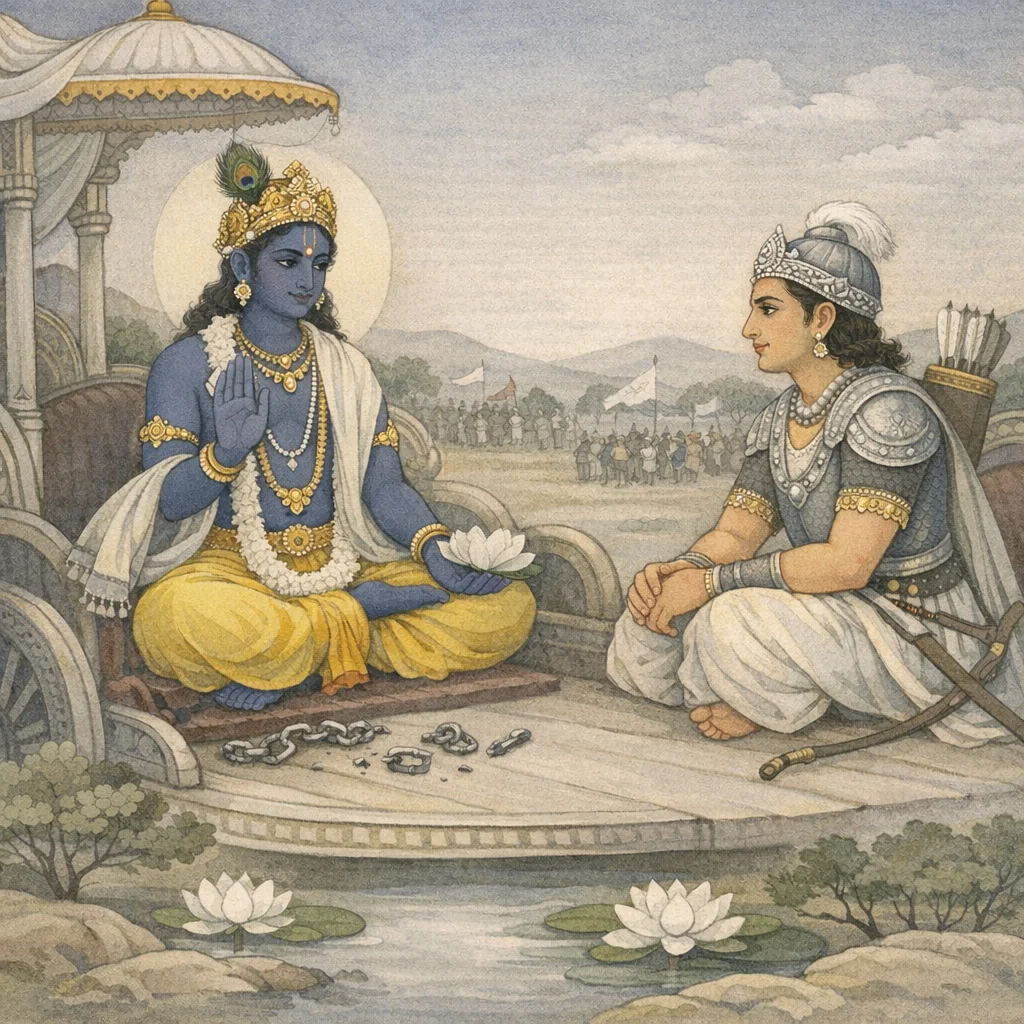
असक्तबुद्धिः सर्वत्र जितात्मा विगतस्पृहः । नैष्कर्म्यसिद्धिं परमां संन्यासेनाधिगच्छति ॥ १८.४९ ॥
asakta-buddhiḥ sarvatra jitātmā vigata-spṛhaḥ | naiṣkarmya-siddhiṁ paramāṁ saṁnyāsenādhigacchati || 18.49 ||

He whose intellect is unattached everywhere, who has conquered the self, and who is free from craving—by renunciation he attains the supreme perfection of actionlessness (naiṣkarmya-siddhi).
जो पुरुष सर्वत्र आसक्तिरहित बुद्धिवाला, जीते हुए मनवाला और स्पृहारहित है, वह संन्यास के द्वारा परम नैष्कर्म्यसिद्धि को प्राप्त होता है।
With understanding unattached everywhere, with self (mind) mastered, and free from craving, one attains the supreme perfection of ‘non-action’ (naiṣkarmya) through renunciation.
‘Saṁnyāsa’ here is often read not merely as social monasticism but as inner renunciation—giving up possessiveness and fruit-attachment. ‘Naiṣkarmya’ is interpreted by many Vedāntic commentators as freedom from binding karma (not literal inactivity). Some modern readings emphasize psychological non-reactivity and non-compulsion.
FAQs
It describes a mature mental profile: reduced attachment, regulated impulses, and diminished craving—conditions associated with less anxiety and more consistent ethical behavior.
‘Non-action’ indicates a state where actions no longer generate binding consequences due to absence of egoic appropriation; agency is reinterpreted within a liberation-oriented metaphysics.
Following the claim that duties should not be abandoned (18.48), this verse clarifies that renunciation is primarily of attachment and craving, not necessarily of activity.
Practice doing necessary tasks without compulsive validation-seeking: set intentions, act, and release fixation on outcomes.