
Bhagavad Gita — Moksha Sannyasa Yoga, Shloka 63
Moksha Sannyasa Yoga
इति ते ज्ञानमाख्यातं गुह्याद्गुह्यतरं मया । विमृश्यैतदशेषेण यथेच्छसि तथा कुरु ॥ १८.६३ ॥
iti te jñānam ākhyātaṁ guhyād guhyataraṁ mayā | vimṛśyaitad aśeṣeṇa yathecchasi tathā kuru || 18.63 ||

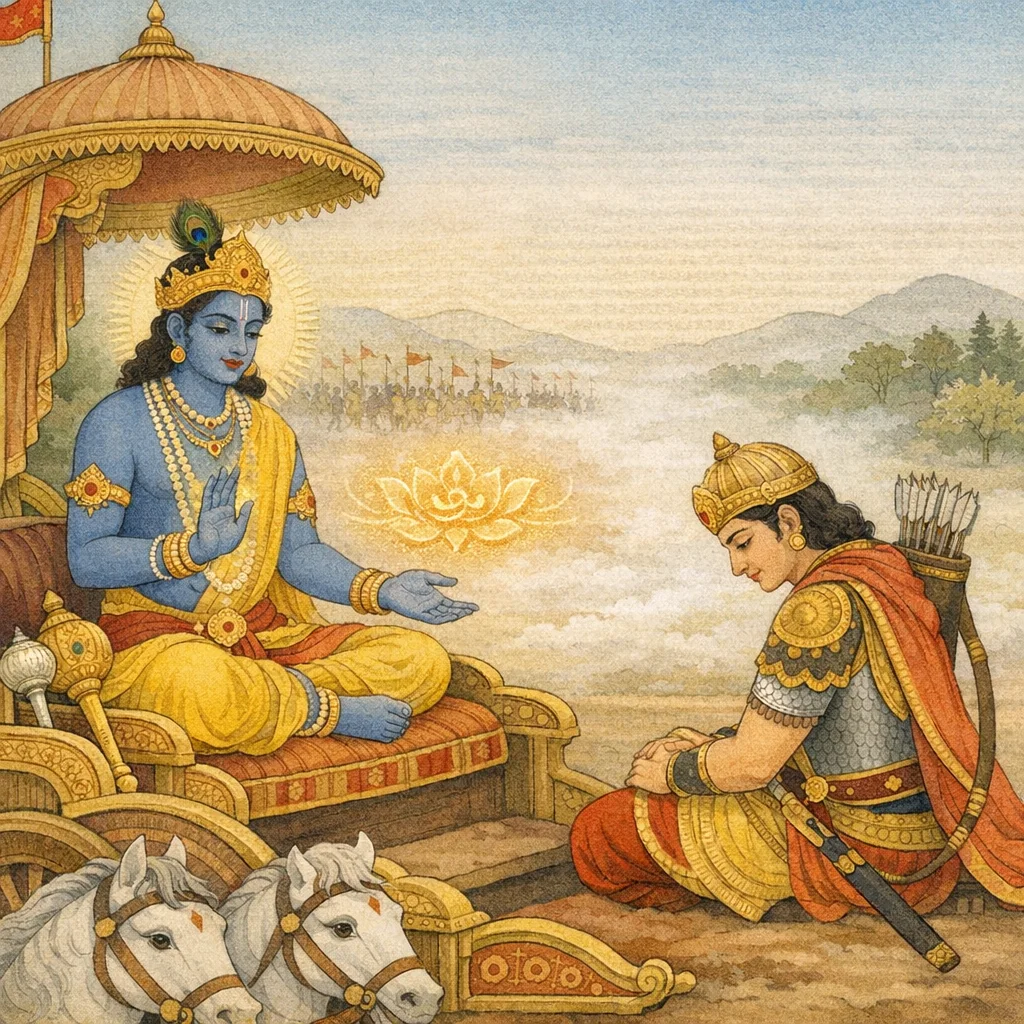
Thus I have declared to you the knowledge more secret than the most secret; reflect on it fully, and then do as you wish.
इस प्रकार मैंने तुमसे गुह्य से भी अधिक गुह्य ज्ञान कह दिया; इसे पूर्णतः विचार करके जैसे चाहो वैसे करो।
Thus I have declared to you knowledge more secret than what is secret; having reflected on this entirely, do as you wish.
This verse is often cited in discussions of agency: despite earlier statements about prakṛti’s compulsion, Krishna explicitly invites deliberation (vimṛśya) and choice (yathecchasi), suggesting a pedagogical balance between conditioned action and reflective autonomy.
FAQs
The instruction to reflect fully emphasizes metacognition: stepping back, integrating information, and choosing deliberately rather than reacting from fear or ego.
Even within a world structured by prakṛti and karma, the text grants a meaningful role to insight-driven decision-making as a vehicle for liberation-oriented action.
Krishna signals completion of the main teaching and returns agency to Arjuna, marking a transition from instruction to personal commitment.
It supports informed consent in ethical life: consider teachings critically, examine consequences, and then act in accordance with one’s considered judgment.