
Bhagavad Gita — Moksha Sannyasa Yoga, Shloka 68
Moksha Sannyasa Yoga
य इमं परमं गुह्यं मद्भक्तेष्वभिधास्यति । भक्तिं मयि परां कृत्वा मामेवैष्यत्यसंशयः ॥ १८.६८ ॥
ya imaṁ paramaṁ guhyaṁ mad-bhakteṣv abhidhāsyati | bhaktiṁ mayi parāṁ kṛtvā mām evaiṣyaty asaṁśayaḥ || 18.68 ||

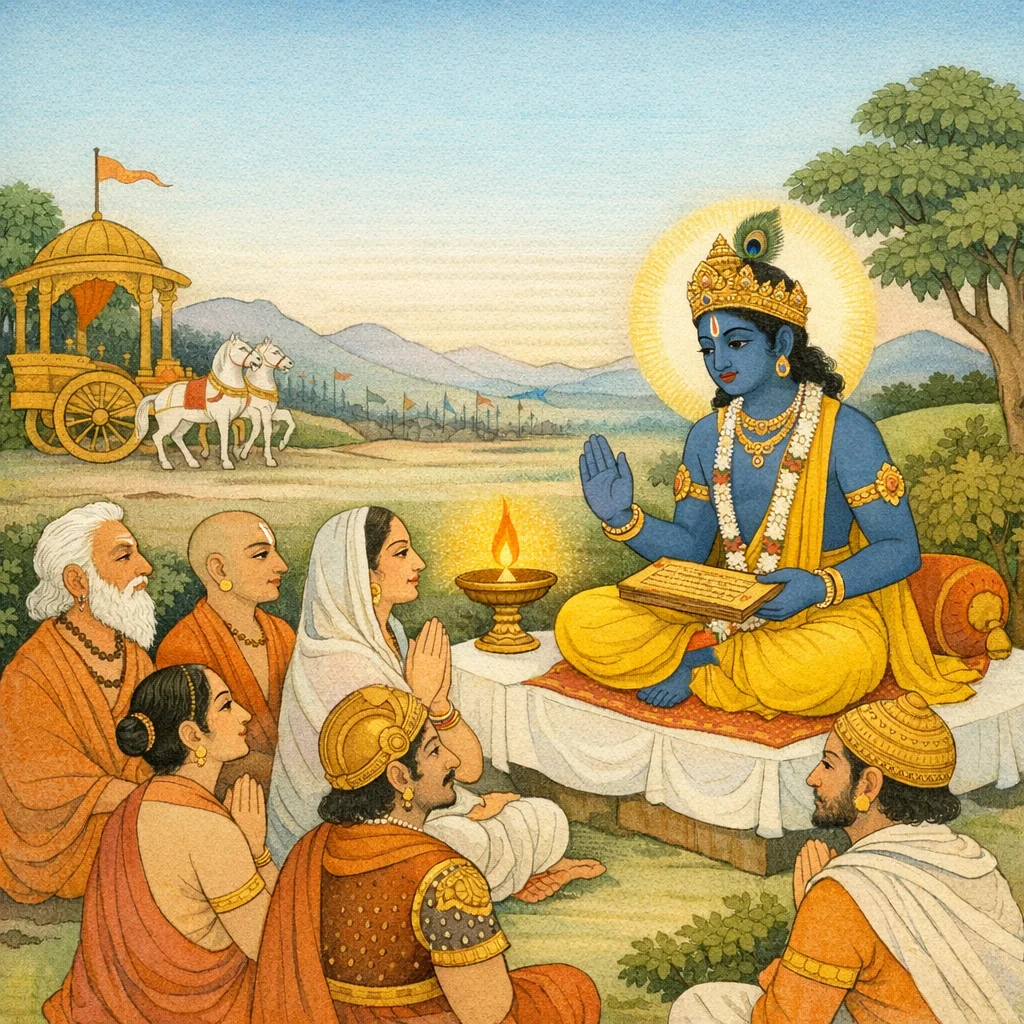
He who shall declare this supreme secret among My devotees, having performed supreme devotion to Me, shall come to Me alone—without doubt.
जो इस परम गुह्य (उपदेश) को मेरे भक्तों में कहेगा, वह मुझमें परम भक्ति करके निःसंदेह मुझे ही प्राप्त होगा।
Whoever will expound this supreme secret among my devotees—having established the highest devotion toward me—will come to me indeed, without doubt.
Most recensions read closely as here; interpretive difference lies mainly in whether ‘mad-bhakteṣu’ is taken as ‘to my devotees’ or ‘among my devotees’ (audience/context rather than a distinct doctrinal point).
FAQs
The verse frames teaching as an act that consolidates one’s own commitment: articulating a valued doctrine to a receptive audience can deepen conviction and stabilize motivation.
‘Coming to me’ expresses the text’s theistic soteriology: devotion and right orientation toward the divine culminate in union/attainment (interpreted variously as proximity, communion, or liberation depending on school).
Near the conclusion, Krishna turns from instruction to the ethics of dissemination, emphasizing that the teaching is to be shared responsibly with sympathetic hearers.
Share transformative ideas with care for audience readiness; teaching can be practiced as service and as a discipline that refines one’s own understanding.