
Bhagavad Gita — Moksha Sannyasa Yoga, Shloka 27
Moksha Sannyasa Yoga
रागी कर्मफलप्रेप्सुर्लुब्धो हिंसात्मकोऽशुचिः । हर्षशोकान्वितः कर्ता राजसः परिकीर्तितः ॥ १८.२७ ॥
rāgī karmaphalaprepsur lubdho hiṁsātmako 'śuciḥ | harṣaśokānvitah kartā rājasaḥ parikīrtitaḥ || 18.27 ||

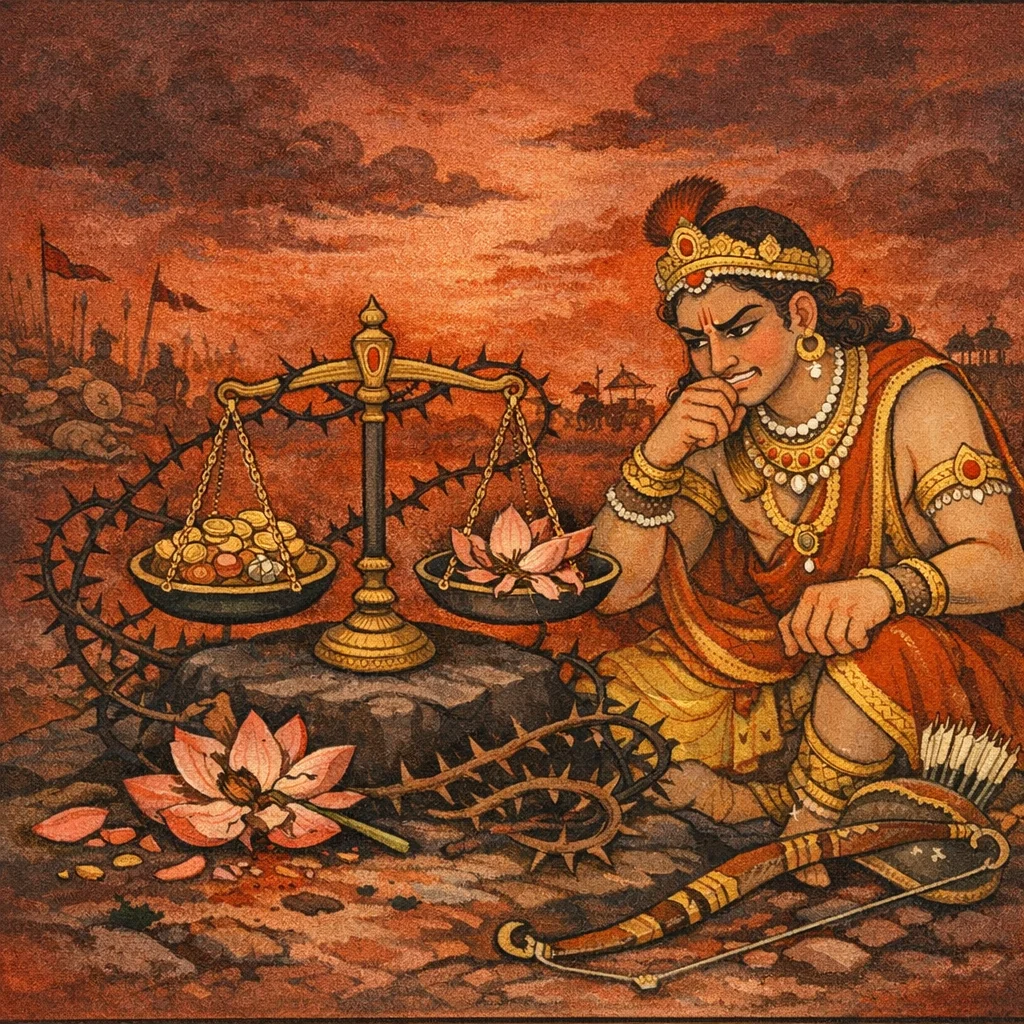
The doer who is passionate, who longs for the fruits of action, greedy, injurious by nature, impure, and swayed by joy and sorrow—is proclaimed to be rajasic.
जो कर्ता रागयुक्त है, कर्मफल की इच्छा करने वाला है, लोभी है, दूसरों को कष्ट पहुँचाने वाला, अशुद्ध (असंयमी) है तथा हर्ष-शोक से युक्त रहता है—वह राजस कहा गया है।
An agent who is passionate/attached, desirous of the fruit of action, greedy, disposed to causing harm, impure, and subject to elation and sorrow—such an agent is said to be rajasic.
Traditional translations often interpret ‘aśuci’ as inner impurity (lack of self-restraint) and ‘hiṁsātmaka’ as a tendency to harm (broadly construed). Academic renderings similarly avoid narrowing it to physical violence, reading it as ethically injurious disposition within social and psychological contexts.
FAQs
The rajasic agent is portrayed as driven by desire and reward, prone to greed and reactive emotional swings (elation and disappointment), which can destabilize judgment and relationships.
It exemplifies rajas as a binding force through craving and agitation, keeping agency oriented around personal gain and fluctuating affect rather than stable discernment.
This verse continues the guṇa-based taxonomy of the doer, contrasting the sattvic agent’s steadiness with rajasic volatility and fruit-orientation.
It can be used as a diagnostic for workplace or personal conduct: if decisions are consistently reward-driven and emotionally reactive, practices that cultivate restraint, reflection, and non-attachment may help rebalance behavior.