
Bhagavad Gita — Moksha Sannyasa Yoga, Shloka 43
Moksha Sannyasa Yoga
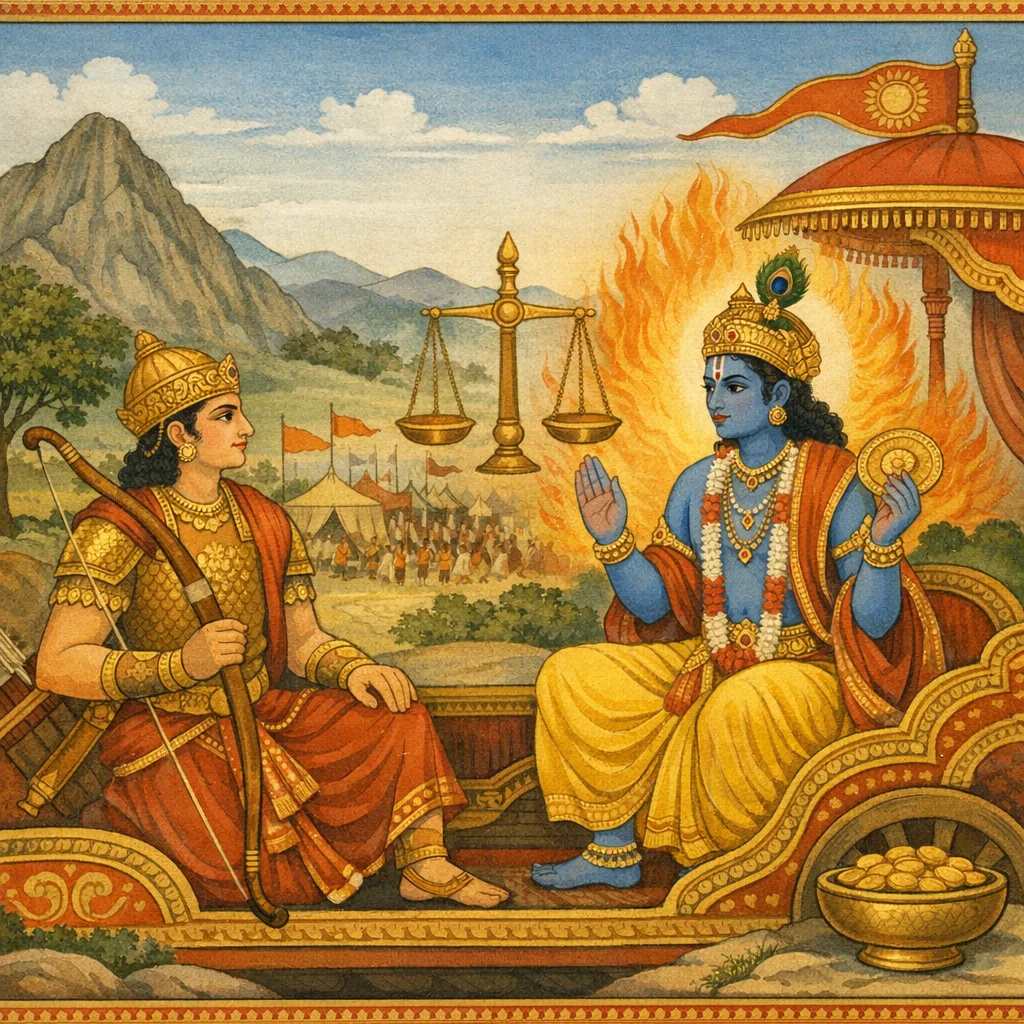
शौर्यं तेजो धृतिर्दाक्ष्यं युद्धे चाप्यपलायनम् । दानमीश्वरभावश्च क्षात्रं कर्म स्वभावजम् ॥ १८.४३ ॥
śauryaṃ tejo dhṛtir dākṣyaṃ yuddhe cāpy apalāyanam | dānam īśvara-bhāvaś ca kṣātraṃ karma svabhāvajam || 18.43 ||

Valor, splendor, steadfastness, skill, and not fleeing in battle; generosity and lordliness—these are the duties of a kṣatriya, born of his nature.
शौर्य, तेज, धृति, दक्षता, युद्ध में न भागना, दान और ईश्वरभाव—ये क्षत्रिय के स्वभाव से उत्पन्न कर्म हैं।
Valor, vigor, steadiness, skill, and also not withdrawing in disciplined conflict, generosity, and lordliness/leadership—these are the kṣatriya’s duties, born of nature.
‘Yuddhe apalāyanam’ can be read historically as steadfastness in battle, and more broadly as courage and non-evasion in demanding responsibilities. ‘Īśvara-bhāva’ is often interpreted as capacity for governance and protective leadership rather than metaphysical ‘being God.’
FAQs
It outlines a leadership psychology: courage, stamina, composure, competence, and the ability to face difficult situations without avoidance, balanced by generosity.
Even roles involving authority remain within prakṛti’s guṇas; the teaching elsewhere in the Gītā stresses acting without egoistic appropriation of power.
In the Gītā’s setting, Arjuna’s crisis concerns duty under pressure; this verse articulates traits expected of the protector-governor function in classical society.
It can be applied to civic and organizational leadership: perseverance, skill, accountability, and public-spiritedness, interpreting 'conflict' as principled engagement with challenges.