
Bhagavad Gita — Moksha Sannyasa Yoga, Shloka 28
Moksha Sannyasa Yoga
अयुक्तः प्राकृतः स्तब्धः शठो नैष्कृतिकोऽलसः । विषादी दीर्घसूत्री च कर्ता तामस उच्यते ॥ १८.२८ ॥
ayuktaḥ prākṛtaḥ stabdhaḥ śaṭho naiṣkṛtiko 'lasaḥ | viṣādī dīrghasūtrī ca kartā tāmasa ucyate || 18.28 ||

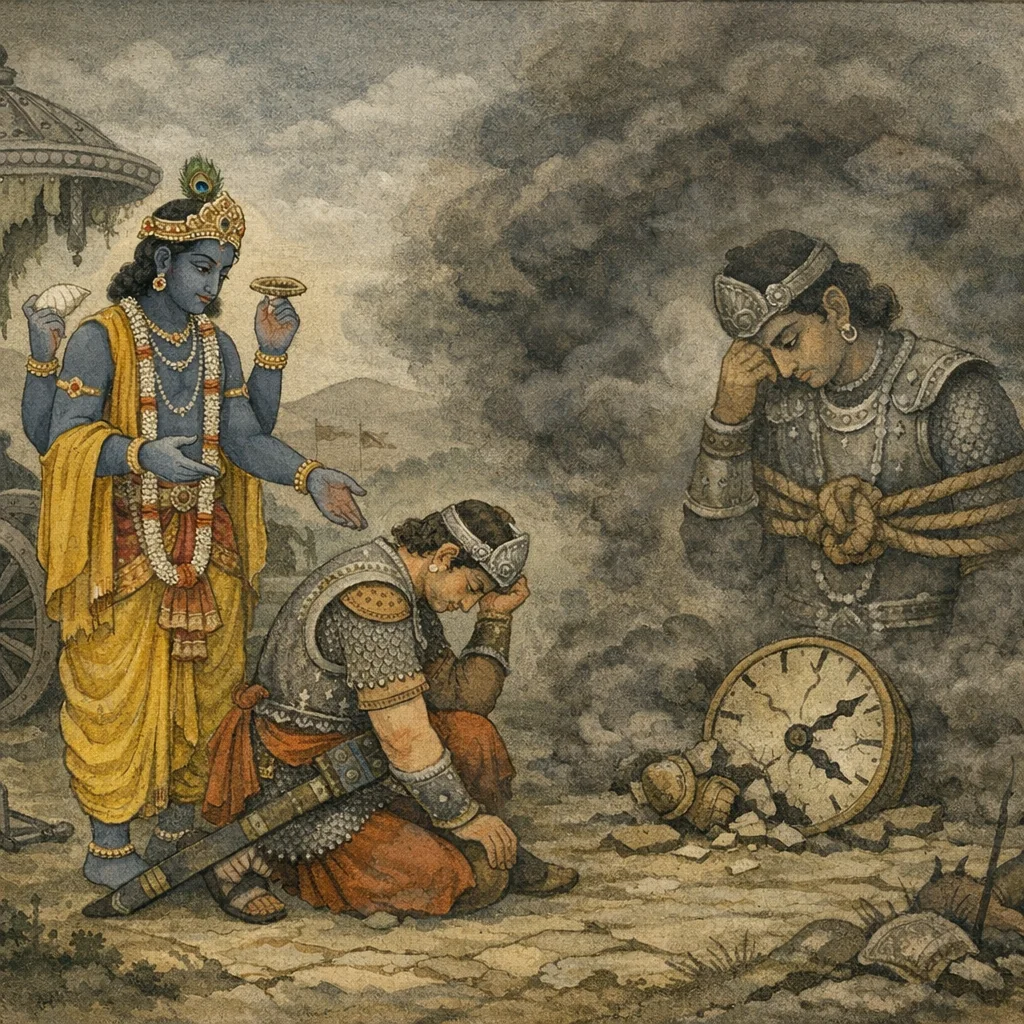
The doer who is undisciplined, coarse, stubborn, deceitful, malicious, lazy, despondent, and procrastinating—is said to be tamasic.
The doer who is undisciplined, vulgar (unrefined), obstinate, deceitful, malicious, lazy, despondent, and procrastinating is said to be tamasic.
A tamasic agent is described as unyoked (without self-control), crude/naturalistic, rigid, deceitful, harmful, indolent, prone to dejection, and one who delays (draws things out).
Key terms admit nuance: prākṛta can mean “uncultivated” or “guided by raw nature”; naiṣkṛtika is variously rendered “malicious,” “harm-doing,” or “unscrupulous.” The verse functions as an ethical-psychological typology of agency under tamas.
FAQs
The verse profiles tamas as a pattern of inertia and obscuration: low self-regulation (ayukta), rigidity (stabdha), avoidance (ālasa), low mood (viṣādī), and delay (dīrghasūtrī). It reads as an early taxonomy of counterproductive traits that impair effective and ethical action.
Within Sāṃkhya-influenced Gītā discourse, guṇas condition prakṛti and thus behavior. A “tamasic doer” indicates agency dominated by tamas, where clarity (sattva) is veiled and impulse or inertia shapes conduct.
This continues the chapter’s classification of action, agent, intellect, and perseverance by the three guṇas, offering criteria for self-assessment rather than describing external conflict.
It can be used as a reflective checklist: identify tendencies like procrastination or rigid defensiveness, then cultivate counter-habits (structure, accountability, clarity of purpose) aligned with more sattvic functioning.