
Bhagavad Gita — Moksha Sannyasa Yoga, Shloka 19
Moksha Sannyasa Yoga
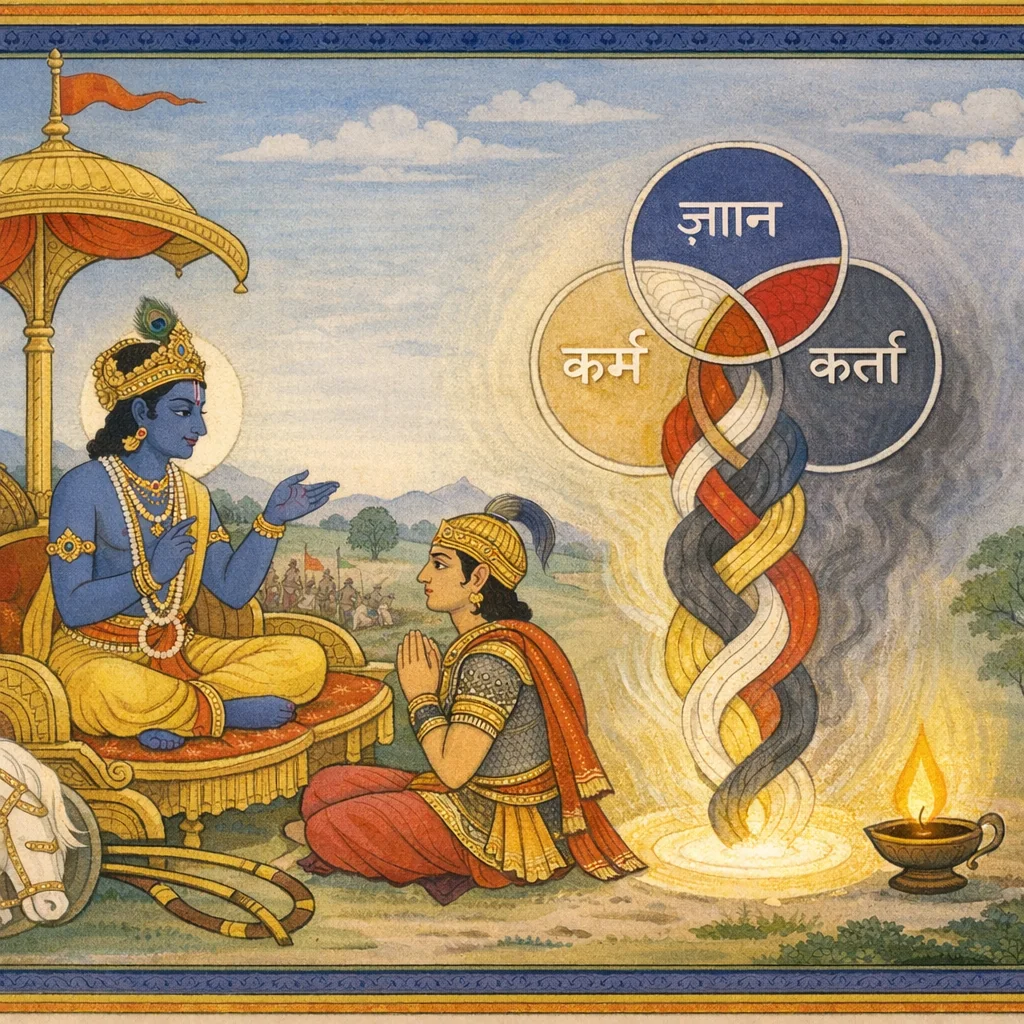
ज्ञानं कर्म च कर्ता च त्रिधैव गुणभेदतः । प्रोच्यते गुणसंख्याने यथावच्छृणु तान्यपि ॥ १८.१९ ॥
jñānaṁ karma ca kartā ca tridhaiva guṇabhedataḥ | procyate guṇasaṅkhyāne yathāvac chṛṇu tāny api || 18.19 ||

Knowledge, action, and the doer—these three are declared to be of three kinds, distinguished by the guṇas. As set forth in the analysis of the guṇas, hear them also rightly, as they truly are.
ज्ञान, कर्म और कर्ता—ये तीनों ही गुणों के भेद से तीन प्रकार के कहे जाते हैं; गुणों के विवेचन में जैसा (शास्त्र में) कहा गया है, उन्हें भी यथार्थ सुनो।
Knowledge, action, and agent are each described as threefold, by distinction of the guṇas; as stated in the enumeration of guṇas, hear them as they are.
Traditional translations sometimes paraphrase ‘guṇasaṅkhyāna’ as ‘the teaching that counts/explains the guṇas (e.g., Sāṅkhya-like analysis)’. Academic translations preserve the technical sense of ‘enumeration/classification’ without committing to a specific school beyond the Gītā’s own usage.
FAQs
The verse proposes that cognition, behavior, and the sense of self-as-agent vary with temperament (guṇas). It anticipates a nuanced psychology in which motives and clarity differ across sattva, rajas, and tamas.
By tying knowledge and agency to guṇas, the text treats embodied experience as conditioned by prakṛti-like qualities, while still allowing for a higher standpoint (later associated with renunciation and steadiness).
It introduces the next sequence (18.20 onward) where each category—knowledge, action, and agent—is defined under the three guṇas.
It supports self-assessment: one can examine whether one’s understanding, work-style, and self-image are driven by clarity, restlessness, or inertia, and adjust habits accordingly.