
Bhagavad Gita — Moksha Sannyasa Yoga, Shloka 78
Moksha Sannyasa Yoga
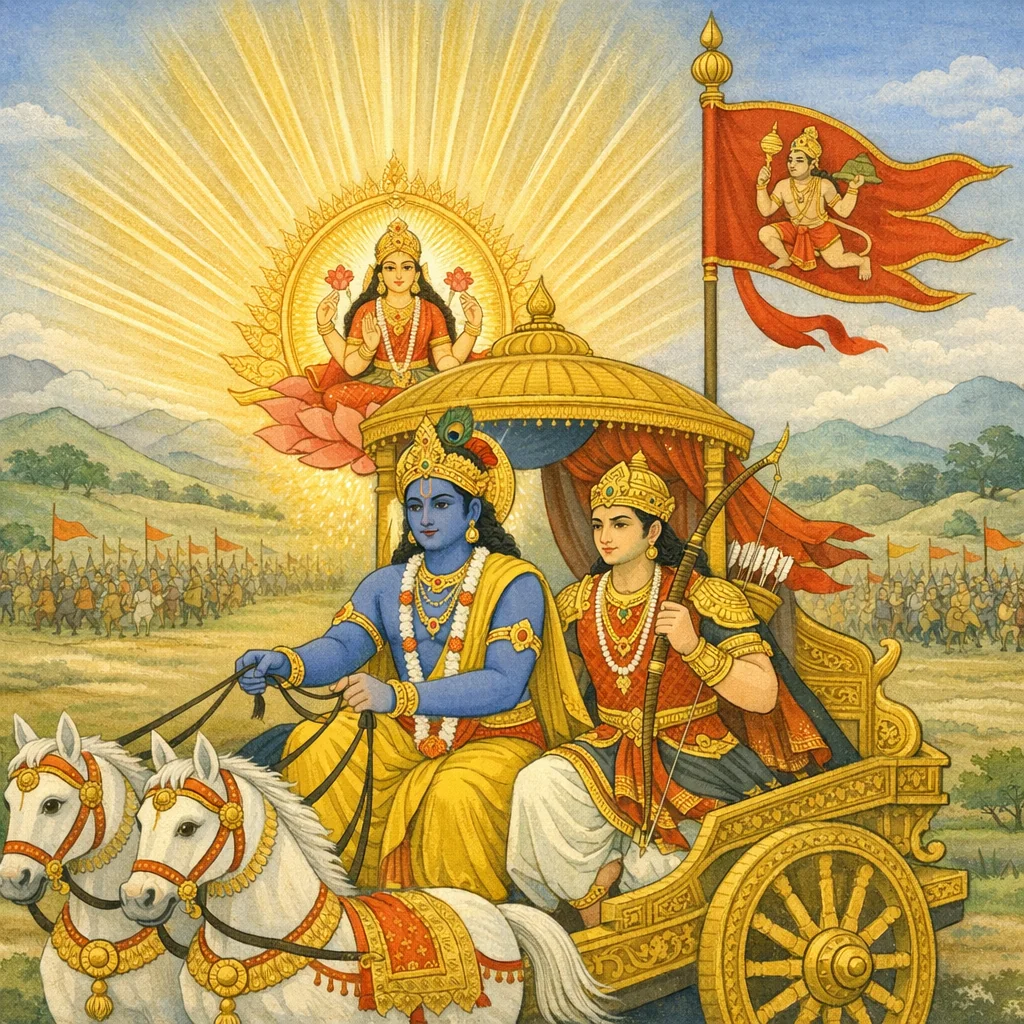
यत्र योगेश्वरः कृष्णो यत्र पार्थो धनुर्धरः । तत्र श्रीर्विजयो भूतिर्ध्रुवा नीतिर्मतिर्मम ॥ १८.७८ ॥
yatra yogeśvaraḥ kṛṣṇo yatra pārtho dhanur-dharaḥ | tatra śrīr vijayo bhūtir dhruvā nītir matir mama || 18.78 ||

Wherever there is Kṛṣṇa, the Lord of Yoga, and wherever there is Pārtha, the bow-wielding warrior, there surely are prosperity, victory, well-being, and steadfast righteousness—such is my conviction.
Wherever there is Śrī Kṛṣṇa, the Lord of Yoga, and wherever there is Pārtha (Arjuna), the wielder of the bow, there are surely prosperity, victory, well-being, and firm righteousness—such is my conviction.
Where Kṛṣṇa, master of yoga, is, and where Pārtha the bow-bearer is, there are prosperity (śrī), success/victory (vijaya), flourishing/welfare (bhūti), and steadfast right order (dhruvā nīti)—this is my understanding.
Most recensions read closely as transmitted here. Translation differences mainly concern (a) śrī as “prosperity/fortune/splendor,” (b) vijaya as “victory” or more generally “success,” (c) bhūti as “well-being/flourishing,” and (d) nīti as “ethical governance/right conduct.” The verse functions as Sañjaya’s concluding affirmation, so “matiḥ mama” is often rendered as “my conviction/assessment” rather than a doctrinal claim.
FAQs
The verse can be read as a statement about aligned cognition and action: when discerning guidance (symbolized by Kṛṣṇa as “master of yoga”) is present alongside focused human agency (Arjuna as the trained archer), outcomes such as confidence, stability, and constructive success tend to follow. It highlights the psychological value of integrating reflective clarity with disciplined effort.
Metaphysically, “yogeśvara” signals mastery over yoga as a means of harmonizing the self with a larger order (dharma). The pairing of Kṛṣṇa and Arjuna can also be interpreted as the conjunction of transcendent insight and embodied practice, from which “śrī, vijaya, bhūti, nīti” emerge as signs of an ordered life.
This is the closing verse of the Gītā as narrated by Sañjaya to Dhṛtarāṣṭra. After recounting the dialogue, Sañjaya summarizes his conclusion: the presence of Kṛṣṇa’s yogic wisdom together with Arjuna’s readiness to act implies the triumph of right order. References to “victory” belong to the epic’s historical narrative frame and can also be taken more broadly as success of ethical resolve.
In contemporary terms, it can be applied as a principle of ethical effectiveness: cultivate a guiding framework (values, clarity, reflective practice) and pair it with skillful execution. The verse suggests that sustainable prosperity and success are most reliable when grounded in steadfast ethical orientation (dhruvā nīti).