Adhyaya 8
धृतराष्ट्रस्य मूर्च्छा—व्यासोपदेशः (Dhṛtarāṣṭra’s Collapse and Vyāsa’s Counsel)
Upa-parva: Dhṛtarāṣṭra-śoka-śamana (Vyāsa-upadeśa) Upa-Parva
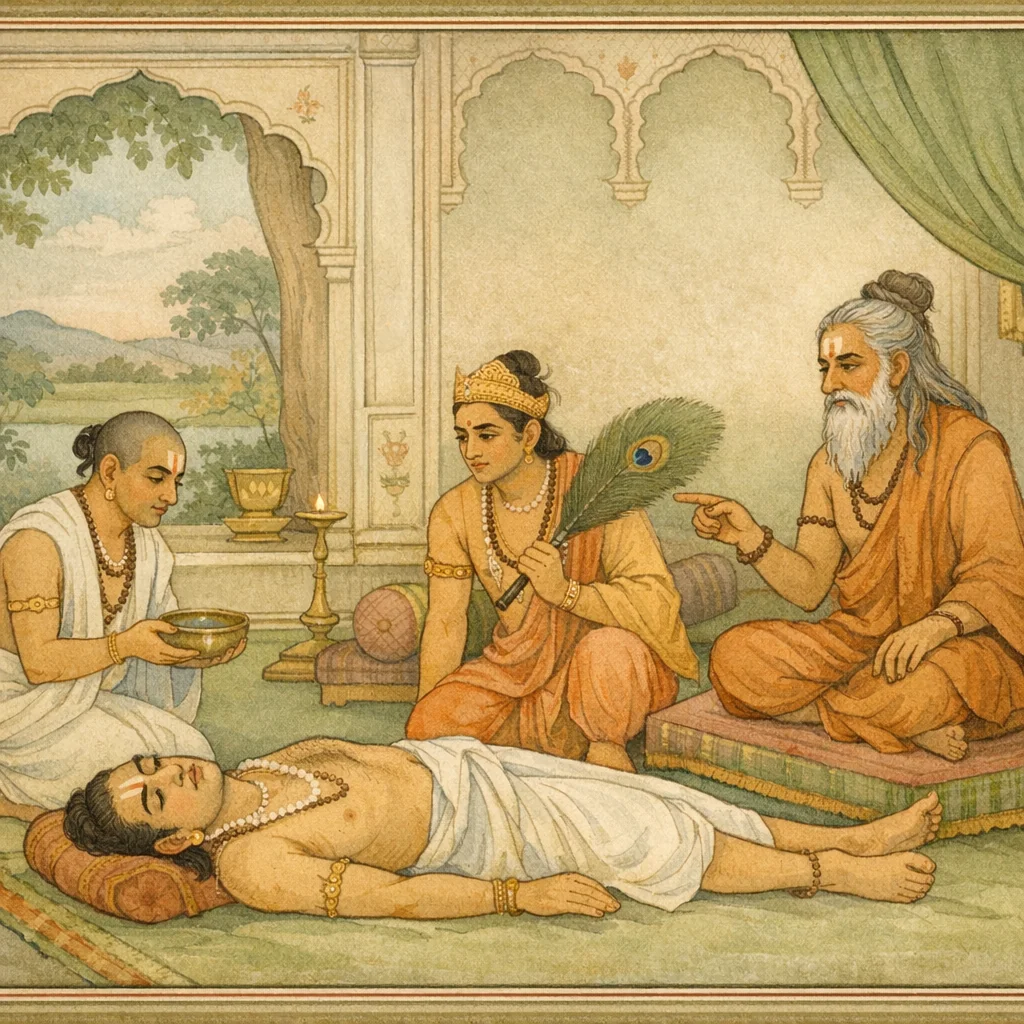
Vaiśaṃpāyana reports that Dhṛtarāṣṭra, overwhelmed by putra-śoka after hearing Vidura, falls unconscious. Courtiers and kin—including Vyāsa, Vidura, Sañjaya, and trusted attendants—attempt revival with cool water, touch, and fanning. Regaining consciousness, the king laments the nature of human attachment, describing grief as a corrosive force that burns the body and destroys discernment, making death appear preferable. Vyāsa responds with a didactic intervention: Dhṛtarāṣṭra already knows mortality’s impermanence, so mourning should not eclipse reason. Vyāsa frames the conflict’s origin as visible and time-conditioned, and narrates a prior divine assembly motif in which Earth petitions the gods and Viṣṇu identifies Duryodhana as an instrument for the reduction of worldly burden; allied figures (Śakuni, Karṇa, and others) are described as converging toward destruction. Vyāsa asserts the sons’ destruction as arising from the king’s own enabling faults (ātmaparādha) rather than Pandava culpability, and notes that such outcomes were earlier disclosed (including via Nārada in a Rājasūya context). He urges Dhṛtarāṣṭra to preserve life out of duty and compassion, and to extinguish grief with discernment. Dhṛtarāṣṭra accepts the counsel, resolves to endure, and Vyāsa departs.
Chapter Arc: कुरुक्षेत्र-विनाश के बाद धृतराष्ट्र शोक से मूर्छित होकर भूमि पर गिर पड़ते हैं; सभा में उपस्थित बान्धव, विदुर, संजय और द्वारस्थ जन शीतल जल व तालवृन्तों से उन्हें होश में लाने का यत्न करते हैं। → होश में आते ही धृतराष्ट्र का पुत्र-शोक दावानल की भाँति भड़क उठता है; तब कृष्णद्वैपायन व्यास उन्हें यह स्मरण कराते हैं कि यह संहार अवश्यम्भावी था और इसके मूल में दुर्योधन का कलि-स्वरूप, अमर्षशील स्वभाव तथा आत्मापराध निहित है। → व्यास का कठोर-करुण उपदेश—‘तुम्हारे पुत्र अपने ही अपराध से विनष्ट हुए; शोक का कारण नहीं’—धृतराष्ट्र के भीतर उठती ज्वाला पर प्रज्ञा-जल छिड़कता है, और संहार के दैवी-नियोजन (देवर्षि नारद आदि की उपस्थिति, पृथ्वी का भार-हरण) का व्यापक दृश्य उद्घाटित होता है। → धृतराष्ट्र को शोक-निवृत्ति और विवेक की ओर मोड़ा जाता है: पुत्र-शोक को अग्नि मानकर उसे बुद्धि-जल से शांत करने का आग्रह होता है; युद्ध को ‘भार-नाश’ हेतु घटित दैवी-कार्य के रूप में समझाया जाता है। → व्यास के संकेतों से आगे की दिशा बनती है—पृथ्वी-भार-हरण के निमित्त देव-योजना पूर्ण हो चुकी; अब शेष पात्रों को अपने-अपने लोक/स्थान की ओर लौटने और शोक के बीच आगे के कर्म (अंत्येष्टि, स्त्रियों का विलाप, उत्तरकृत्य) की ओर बढ़ना है।
Shlokas
Verse 1
(दाक्षिणात्य अधिक पाठका १ श्लोक मिलाकर कुल ३० “लोक हैं।) ऑपनआक्षाता बछ। अंक अष्टमो> ध्याय: व्यासजीका संहारको अवश्यम्भावी बताकर धृतराष्ट्रको समझाना वैशम्पायन उवाच विदुरस्य तु तद् वाक््यं निशम्य कुरुसत्तम: । पुत्रशोकाभिसंतप्त: पपात भुवि मूर्च्छित:,वैशम्पायनजी कहते हैं--राजन्! विदुरजीके ये वचन सुनकर कुरुश्रेष्ठ राजा धुृतराष्ट्र पुत्रशोकसे संतप्त एवं मूर्च्छित होकर पृथ्वीपर गिर पड़े
Vaiśampāyana said: O King, having heard those words of Vidura, Dhṛtarāṣṭra—the foremost of the Kurus—overwhelmed by grief for his sons, collapsed upon the ground, fainting. The scene underscores how unchecked attachment and the consequences of adharma culminate not only in political ruin but in personal devastation.
Verse 2
त॑ तथा पतितं भूमौ नि:संज्ञं प्रेक्ष्य बान्धवा: । कृष्णद्वैपायनश्रैव क्षत्ता च विदुरस्तथा
Vaiśampāyana said: Seeing him fallen thus upon the ground, unconscious, his kinsmen looked on—along with Kṛṣṇa Dvaipāyana (Vyāsa) and Vidura, the royal chamberlain. The scene underscores the human cost of the war: even the wise and the close kin are compelled to witness the collapse of life and certainty in the wake of violence.
Verse 3
संजय: सुहृदश्चान्ये द्वा:स्था ये चास्य सम्मता: । जलेन सुखशीतेन तालवृन्तैश्वन भारत
Vaiśampāyana said: Sañjaya, along with other well-wishers and the trusted doorkeepers at his gate, attended him—refreshing and soothing him with pleasantly cool water and with palm-leaf fans, O Bhārata. The scene underscores the duty of attendants and friends to offer care and comfort amid the grief and exhaustion that follow the devastation of war.
Verse 4
पस्पृशुश्च करैगात्रं वीजमानाश्न यत्नतः । अन्वासन् सुचिरं काल धृतराष्ट्र तथागतम्
Vaiśampāyana said: The women carefully touched his limbs with their hands and diligently fanned him. Thus they attended upon Dhṛtarāṣṭra, who had arrived there, for a long time—an image of devoted service offered to an aged, grief-stricken king in the aftermath of war.
Verse 5
उन्हें इस प्रकार अचेत होकर भूमिपर गिरा देख सभी भाई-बन्धु, व्यासजी, विदुर, संजय, सुहृदगण तथा जो विश्वसनीय द्वारपाल थे, वे सभी शीतल जलके छींटे देकर ताड़के पंखोंसे हवा करने और उनके शरीरपर हाथ फेरने लगे। उस बेहोशीकी अवस्थामें वे बड़े यत्नके साथ धृतराष्ट्रको होशमें लानेके लिये देरतक आवश्यक उपचार करते रहे || २-- ४।। अथ दीर्घस्य कालस्य लब्धसंज्ञों महीपति: । विललाप चिरं काल पुत्राधिभिरभिप्लुत:,तदनन्तर दीर्घकालके पश्चात् राजा धृतराष्ट्रको चेत हुआ और वे पुत्रोंकी चिन्तामें डूबकर बड़ी देरतक विलाप करते रहे
After a long time, the king regained consciousness. Overwhelmed by the anguish of his sons, he lamented for a long while—his mind submerged in grief and remembrance, unable to steady itself after the catastrophe that had befallen his lineage.
Verse 6
धिगस्तु खलु मानुष्यं मानुषेषु परिग्रहे । यतो मूलानि दुःखानि सम्भवन्ति मुहुर्मुहु:,वे बोले--“इस मनुष्यजन्मको धिक्कार है! इसमें भी विवाह आदि करके परिवार बढ़ाना तो और भी बुरा है; क्योंकि उसीके कारण बारंबार नाना प्रकारके दु:ख प्राप्त होते हैं
Vaiśampāyana said: “Fie upon human life—indeed, even more upon the human impulse to ‘acquire’ and bind oneself through worldly attachments among people. For from that very grasping arise the roots of sorrow, again and again.”
Verse 7
इस प्रकार श्रीमह्या भारत स्त्रीपर्वके अन्तर्गत जलप्रदानिकपर्वमें धृतराष्ट्रके शोकका निवारणविषयक सातवाँ अध्याय पूरा हुआ,पुत्रनाशे<र्थनाशे च ज्ञातिसम्बन्धिनामथ । प्राप्पते सुमहद् दुःखं विषाग्निप्रतिमं विभो 'प्रभो! पुत्र, धन, कुटुम्ब और सम्बन्धियोंका नाश होनेपर तो विष पीने और आगमें चलनेके समान बड़ा भारी दुःख भोगना पड़ता है
Vidura said: “O mighty one, when one loses sons, wealth, and one’s own family and kin-relations, a vast sorrow arises—like drinking poison or walking into fire.”
Verse 8
येन दह्ान्ति गात्राणि येन प्रज्ञा विनश्यति । येनाभिभूत: पुरुषो मरणं बहु मन्यते,इति श्रीमहाभारते स्त्रीपर्वणि जलप्रदानिकपर्वणि धृतराष्ट्रविशोककरणे अष्टमोडथ्याय: इस प्रकार श्रीमह्ाभारत स्त्रीपर्वके अन्तर्गत जलप्रदानिकपर्वमें धृतराष््रके शीकका निवारणविषयक आठवाँ अध्याय पूरा हुआ
Vaiśampāyana said: “That by which the limbs are scorched, that by which discernment is destroyed—overpowered by that, a man comes to regard death itself as a great (and preferable) thing.”
Verse 9
“उस दुःखसे सारा शरीर जलने लगता है, बुद्धि नष्ट हो जाती है और उस असहा शोकसे पीड़ित हुआ पुरुष जीनेकी अपेक्षा मर जाना अधिक अच्छा समझता है ।। तदिदं व्यसन प्राप्त मया भाग्यविपर्ययात् । तस्यान्तं नाधिगच्छामि ऋते प्राणविमोक्षणात्,“आज भाग्यके फेरसे वही यह स्वजनोंके विनाशका महान् दुःख मुझे प्राप्त हुआ है। अब प्राण त्याग देनेके सिवा और किसी उपायद्वारा मैं इस दुःखसे पार नहीं पा सकता
Vaiśaṃpāyana said: 'By a cruel reversal of fortune, this calamity—the great sorrow born of the destruction of one’s own kin—has now fallen upon me. I can see no end to this grief by any means, except by relinquishing life itself.'
Verse 10
तथैवाहं करिष्यामि अद्यैव द्विजसत्तम । इत्युक्त्वा तु महात्मानं पितरं ब्रह्मुवित्तमम्,'द्विजश्रेष्ठ] इसलिये आज ही मैं अपने प्राणोंका परित्याग कर दूँगा।” अपने ब्रह्मवेत्ता पिता महात्मा व्यासजीसे ऐसा कहकर राजा धृतराष्ट्र अत्यन्त शोकमें डूब गये और सुध-बुध खो बैठे। राजन! पुत्रोंका ही चिन्तन करते हुए वे बूढ़े नरेश वहाँ मौन होकर बैठे रह गये
“So indeed I shall do it—today itself, O best of Brahmins.” Having spoken thus to his great-souled father, the foremost knower of Brahman, Dhṛtarāṣṭra was overwhelmed by grief and lost all composure. Absorbed only in thoughts of his sons, the aged king sat there in silence, stunned by sorrow.
Verse 11
धृतराष्ट्रो3भवन्मूढ: स शोक॑ परमं गतः । अभूच्च तूष्णी राजासौ ध्यायमानो महीपते,'द्विजश्रेष्ठ] इसलिये आज ही मैं अपने प्राणोंका परित्याग कर दूँगा।” अपने ब्रह्मवेत्ता पिता महात्मा व्यासजीसे ऐसा कहकर राजा धृतराष्ट्र अत्यन्त शोकमें डूब गये और सुध-बुध खो बैठे। राजन! पुत्रोंका ही चिन्तन करते हुए वे बूढ़े नरेश वहाँ मौन होकर बैठे रह गये
Vaiśampāyana said: Dhṛtarāṣṭra became utterly bewildered, having fallen into the deepest grief. O king, absorbed in brooding, that aged monarch then sat in silence—his mind fixed on his sons, overwhelmed by sorrow and moral collapse in the wake of their destruction.
Verse 12
तस्य तद् वचन श्रुत्वा कृष्णद्वैपायन: प्रभु: । पुत्रशोकाभिसंतप्त॑ पुत्र वचनमब्रवीत्,उनकी बात सुनकर शक्तिशाली महात्मा श्रीकृष्ण-द्वैपायन व्यास पुत्रशोकसे संतप्त हुए अपने बेटेसे इस प्रकार बोले--
Hearing those words, the mighty lord Kṛṣṇa-Dvaipāyana (Vyāsa), overwhelmed by grief for his son, addressed his son in reply—setting the next counsel within the moral weight of bereavement and duty.
Verse 13
व्यास उवाच धृतराष्ट्र महाबाहो यत् त्वां वक्ष्यामि तच्छूणु । श्रुतवानसि मेधावी धर्मार्थकुशल:ः प्रभो,व्यासजीने कहा--महाबाहु धृतराष्ट्र! मैं तुमसे जो कुछ कहता हूँ, उसे ध्यान देकर सुनो। प्रभो! तुम वेदशास्त्रोंके ज्ञानसे सम्पन्न, मेधावी तथा धर्म और अर्थके साधनमें कुशल हो
Vyāsa said: “O mighty-armed Dhṛtarāṣṭra, listen attentively to what I am about to tell you. O lord, you are learned in sacred knowledge, intelligent, and skilled in the means of dharma and artha.”
Verse 14
न ते<स्त्यविदितं किंचिद् वेदितव्यं परंतप । अनित्यतां हि मर्त्यानां विजानासि न संशय:,शत्रुसंतापी नरेश! जाननेयोग्य जो कोई भी तत्त्व है, वह तुमसे अज्ञात नहीं है। तुम मानव-जीवनकी अनित्यताको अच्छी तरह जानते हो, इसमें संशय नहीं है
Vyāsa said: “O scorcher of foes, there is nothing that ought to be known which is unknown to you. You understand well the impermanence of human life—of this there is no doubt.”
Verse 15
अश्रुवे जीवलोके च स्थाने वा शाश्वते सति । जीविते मरणान्ते च कस्माच्छोचसि भारत,भरतनन्दन! जब जीव-जगत् अनित्य है, सनातन परम पद नित्य है और इस जीवनका अन्त मृत्युमें ही है, तब तुम इसके लिये शोक क्यों करते हो?
Vyāsa said: “In this world of living beings, everything is perishable; only the eternal abode truly endures. And since life inevitably ends in death, why do you grieve over it, O Bhārata, delight of the Bharata line?”
Verse 16
प्रत्यक्ष तव राजेन्द्र वैरस्पास्य समुद्धव: । पुत्र ते कारणं कृत्वा कालयोगेन कारित:
Vyāsa said: “O king, the outbreak of this enmity has occurred before your very eyes. Taking your son as the immediate cause, it has been brought about by the conjunction of Time and destiny.”
Verse 17
राजेन्द्र! तुम्हारे पुत्रको निमित्त बनाकर कालकी प्रेरणासे इस वैरकी उत्पत्ति तो तुम्हारे सामने ही हुई थी ।। अवश्यं भवितव्ये च कुरूणां वैशसे नृप । कस्माच्छोचसि तान् शूरान् गतान् परमिकां गतिम्,नरेश्वरर जब कौरवोंका यह विनाश अवश्यम्भावी था, तब परम गतिको प्राप्त हुए शूरवीरोंके लिये तुम क्यों शोक कर रहे हो?
O lord of kings, with your son as the occasion, and urged on by Time, the rise of this enmity happened before your very eyes. And when the slaughter of the Kurus was inevitable, O king, why do you grieve for those heroes who have departed to the highest state?
Verse 18
जानता च महाबाहो विदुरेण महात्मना । यतितं सर्वयत्नेन शमं प्रति जनेश्वर,महाबाहु नरेश्वर! महात्मा विदुर इस भावी परिणामको जानते थे, इसीलिये इन्होंने सारी शक्ति लगाकर संधिके लिये प्रयत्न किया था
Vyāsa said: O mighty-armed one, O lord of men—Vidura, that great-souled man, foresaw what was to come. Therefore, with every effort at his command, he strove for reconciliation and peace. The verse underscores the ethical duty of the wise to avert catastrophe through counsel and conciliation, even when others are driven by pride and hostility.
Verse 19
न च दैवकृतो मार्ग: शक््यो भूतेन केनचित् | घटतापि चिरं काल॑ नियन्तुमिति मे मति:
And the course laid down by destiny cannot be altered by any living being. Even if one strives for a long time, to restrain or redirect it is not possible—such is my understanding.
Verse 20
मेरा तो ऐसा विश्वास है कि दीर्घ कालतक प्रयत्न करके भी कोई प्राणी दैवके विधानको रोक नहीं सकता ।। देवतानां हि यत् कार्य मया प्रत्यक्षत: श्रुतम् । तत् ते5हं सम्प्रवक्ष्यामि यथा स्थैर्य भवेत् तव,देवताओंका जो कार्य मैंने प्रत्यक्ष अपने कानोंसे सुना है, वह तुम्हें बता रहा हूँ, जिससे तुम्हारा मन स्थिर हो सके
Vyāsa said: “This is my firm conviction: even after striving for a very long time, no living being can obstruct what has been ordained by fate. I shall now tell you what I myself have directly heard concerning the work of the gods, so that your mind may become steady.”
Verse 21
पुराहं त्वरितो यात: सभामैन्द्रीं जितक्लम: । अपश्यं तत्र च तदा समवेतान् दिवौकस:,पूर्वकालकी बात है, एक बार मैं यहाँसे शीघ्रतापूर्वक इन्द्रकी सभामें गया। वहाँ जानेपर भी मुझे कोई थकावट नहीं हुई; क्योंकि मैं इन सबपर विजय पा चुका हूँ। वहाँ उस समय मैंने देखा कि इन्द्रकी सभामें सम्पूर्ण देवता एकत्र हुए हैं
Vyāsa said: “Long ago I once went swiftly to Indra’s celestial assembly, free from fatigue, having overcome weariness. There, at that time, I saw all the gods gathered together in Indra’s hall.”
Verse 22
नारदप्रमुखाश्नापि सर्वे देवर्षयो5नघ । तत्र चापि मया दृष्टा पृथिवी पृथिवीपते
Vyāsa said: “O sinless one, all the divine seers too—Nārada at their head—were there. And there, O lord of the earth, I also beheld the Earth herself.”
Verse 23
उपगम्य तदा धात्री देवानाह समागतान्
Then the Protectress (Dhātrī), approaching the assembled gods, addressed them—signaling a decisive moment where divine counsel is sought in response to the unfolding moral crisis after the war.
Verse 24
यत् कार्य मम युधष्माभिन्रह्मण: सदने तदा | प्रतिज्ञातं महाभागास्तच्छीघ्रं संविधीयताम्
Vyāsa said: “O noble ones, let that task which was then promised to me in the dwelling of the Brāhmaṇa—at Yudhiṣṭhira’s behest—be carried out without delay.”
Verse 25
उस समय विश्वधारिणी पृथ्वीने वहाँ एकत्र हुए देवताओंके पास जाकर कहा --“'महाभाग देवताओ! आपलोगोंने उस दिन ब्रह्माजीकी सभामें मेरे जिस कार्यको सिद्ध करनेकी प्रतिज्ञा की थी, उसे शीघ्र पूर्ण कीजिये' ।। तस्यास्तदू वचन श्रुत्वा विष्णुलोकनमस्कृत: । उवाच वाकयं प्रहसन् पृथिवीं देवसंसदि
At that time Earth, the sustainer of the world, approached the gods assembled there and said: “Fortunate deities! Quickly fulfill the task of mine that you promised to accomplish on that day in Brahmā’s assembly.” Hearing her words, the one revered even in Viṣṇu’s realm spoke with a smile to Earth in the council of the gods.
Verse 26
धृतराष्ट्रस्य पुत्राणां यस्तु ज्येष्ठ: शतस्य वै | दुर्योधन इति ख्यातः स ते कार्य करिष्यति
Among Dhṛtarāṣṭra’s sons, the one who is indeed the eldest of the hundred—known as Duryodhana—he will carry out your purpose. The statement points to the decisive agency of the eldest Kaurava, whose will and actions become the instrument through which intended plans—whether prudent or harmful—are executed, underscoring the ethical weight of leadership and choice.
Verse 27
तं च प्राप्पय महीपालं कृतकृत्या भविष्यसि । उसकी बात सुनकर विश्ववन्दित भगवान् विष्णुने देवसभामें पृथ्वीकी ओर देखकर हँसते हुए कहा--'शुभे! धृतराष्ट्रके सौ पुत्रोंमें जो सबसे बड़ा और दुर्योधननामसे विख्यात है, वही तेरा कार्य सिद्ध करेगा। उसे राजाके रूपमें पाकर तू कृतार्थ हो जायगी || २५-२६ ई | तस्यार्थे पृथिवीपाला: कुरुक्षेत्र समागता:
Having obtained that king, you will consider your purpose fulfilled. For his sake, the rulers of the earth assembled at Kurukṣetra—an ominous convergence in which personal ambition and destiny draw entire kingdoms into a single field of conflict, setting the stage for vast moral consequences.
Verse 28
ततस्ते भविता देवि भारस्य युधि नाशनम्
Then, O Goddess, there will come about in battle the destruction of that burden—an end to the oppressive weight borne by the earth through the annihilation of the forces that have made war inevitable. Vyāsa frames the coming slaughter not as mere victory, but as a grim, fated removal of an unbearable load, carrying an ethical tension between necessity and tragedy.
Verse 29
य एष ते सुतो राजन् लोकसंहारकारणात्
Vyāsa said: “O King, this son of yours—by reason of being a cause in the great destruction of peoples—…”
Verse 30
कलेरंश: समुत्पन्नो गान्धार्या जठरे नृप । अमर्षी चपलश्चापि क्रोधनो दुष्प्रसाधन:
Vyāsa said: O king, an embodiment of a portion of Kali has arisen in Gāndhārī’s womb—one who is intolerant, fickle, wrathful, and hard to restrain. The verse frames the coming character not merely as a political threat but as a moral force of disorder, warning that unchecked anger and impulsiveness become engines of adharma and collective ruin.
Verse 31
राजन! नरेश्वर! यह जो तुम्हारा पुत्र दुर्योधन था, वह सारे जगत्का संहार करनेके लिये कलिका मूर्तिमान् अंश ही गान्धारीके पेटसे पैदा हुआ था। वह अमर्षशील, क्रोधी, चंचल और कूटनीतिसे काम लेनेवाला था ।। दैवयोगात् समुत्पन्ना भ्रातरश्नास्य तादृशा: । शकुनिर्मातुलश्चैव कर्णश्ष परम: सखा
Vyāsa said: “O king, lord of men! This son of yours, Duryodhana, was born from Gāndhārī’s womb as a manifest portion of Kali, for the very purpose of bringing destruction upon the world. He was intolerant of affront, quick to anger, fickle, and one who achieved his ends through crooked policy. By the conjunction of fate, his brothers too arose with a similar disposition; and his maternal uncle Śakuni, along with Karṇa, became his closest ally.”
Verse 32
दैवयोगसे उसके भाई भी वैसे ही उत्पन्न हुए। मामा शकुनि और परम मित्र कर्ण भी उसी विचारके मिल गये ।। समुत्पन्ना विनाशार्थ पृथिव्यां सहिता नृपा: । यादृशो जायते राजा तादृशो5स्य जनो भवेत्,ये सब नरेश शत्रुओंका विनाश करनेके लिये ही एक साथ इस भूमण्डलपर उत्पन्न हुए थे। जैसा राजा होता है, वैसे ही उसके स्वजन और सेवक भी होते हैं
Vyāsa said: These kings were born together upon the earth for the very purpose of bringing about destruction. For as a king is, so too become his people—his kin and his servants—shaped in the same likeness. In this, the epic points to a moral causality: leadership does not remain private; it reproduces itself in the conduct and character of those who gather around it, and thus a ruler’s nature can become the seed of collective ruin.
Verse 33
अधर्मो धर्मतां याति स्वामी चेद् धार्मिको भवेत् | स्वामिनो गुणदोषाभ्यां भृत्या: स्युर्नात्र संशय:,यदि स्वामी धार्मिक हो तो अधर्मी सेवक भी धार्मिक बन जाते हैं। सेवक स्वामीके ही गुण-दोषोंसे युक्त होते हैं, इसमें संशय नहीं है
Vyāsa said: When the master becomes righteous, even unrighteousness turns toward righteousness. Servants inevitably take on the virtues and faults of their lord—of this there is no doubt. The verse underscores moral contagion in leadership: the ethical quality of those in authority shapes the conduct of those who depend on them.
Verse 34
दुष्ट राजानमासाद्य गतास्ते तनया नृप । एतमर्थ महाबाहो नारदो वेद तत्त्ववित्,महाबाहु नरेश्वर! दुष्ट राजाको पाकर तुम्हारे सभी पुत्र उसीके साथ नष्ट हो गये। इस बातको तत्त्ववेत्ता नारदजी जानते हैं
Vyāsa said: “O king, your sons, having come into the power and company of a wicked ruler, have met their ruin along with him. This truth is known to Nārada, the knower of reality. The verse underscores how association with unrighteous leadership corrupts judgment and leads even the mighty to destruction.”
Verse 35
आत्मापराधात् पुत्रास्ते विनष्टा: पृथिवीपते । मा तान् शोचस्व राजेन्द्र न हि शोके5स्ति कारणम्,पृथ्वीनाथ! आपके पुत्र अपने ही अपराधसे विनाशको प्राप्त हुए हैं। राजेन्द्र! उनके लिये शोक न करो; क्योंकि शोकके लिये कोई उपयुक्त कारण नहीं है
Vyāsa said: “O lord of the earth, your sons have perished because of their own wrongdoing. O best of kings, do not grieve for them, for there is no fitting cause for sorrow—when the ruin has arisen from one’s own fault.”
Verse 36
नहि ते पाण्डवा: स्वल्पमपराध्यन्ति भारत । पुत्रास्तव दुरात्मानो यैरियं घातिता मही,भारत! पाण्डवोंने तुम्हारा थोड़ा-सा भी अपराध नहीं किया है। तुम्हारे पुत्र ही दुष्ट थे, जिन्होंने इस भूमण्डलका नाश करा दिया
Vyāsa said: “O Bhārata, the Pāṇḍavas have not wronged you in the least. It was your own sons—evil-minded—by whose deeds this earth has been brought to ruin.”
Verse 37
नारदेन च भद्रं ते पूर्वमेव न संशय: । युधिष्टिरस्थ समितौ राजसूये निवेदितम्
O blessed one, there is no doubt: this was already conveyed earlier by Nārada—presented in the assembly to Yudhiṣṭhira at the time of the Rājasūya sacrifice. Vyāsa recalls that the matter now being discussed is not new, but had been formally reported before, underscoring the weight of prior counsel and the moral responsibility to heed it.
Verse 38
पाण्डवा: कौरवा: सर्वे समासाद्य परस्परम् । न भविष्यन्ति कौन्तेय यत् ते कृत्यं तदाचर
Vyāsa said: “O son of Kuntī, when all the Pāṇḍavas and the Kauravas have met one another face to face, they will not remain (alive/continue as before). Therefore, do that which is your duty—carry out the course of action that lies before you.”
Verse 39
राजन! तुम्हारा कल्याण हो। राजसूय यज्ञके समय देवर्षि नारदने राजा युधिष्ठिरकी सभामें नि:संदेह पहले ही यह बात बता दी थी कि कौरव और पाण्डव सभी आपसमें लड़कर नष्ट हो जायँगे; अतः कुन्तीनन्दन! तुम्हारे लिये जो आवश्यक कर्तव्य हो, उसे करो ।। नारदस्य वच: श्रुत्वा तदाशोचन्त पाण्डवा: । एवं ते सर्वमाख्यातं देवगुह्मां सनातनम्,प्रभो! नारदजीकी वह बात सुनकर उस समय पाण्डव बहुत चिन्तित हो गये थे। इस प्रकार मैंने तुमसे देवताओंका यह सारा सनातन रहस्य बताया है, जिससे किसी तरह तुम्हारे शोकका नाश हो। तुम अपने प्राणोंपर दया कर सको और देवताओंका विधान समझकर पाण्डुके पुत्रोंपर भी तुम्हारा स्नेह बना रहे
“O King, may welfare be yours. At the time of the Rājasūya sacrifice, the divine seer Nārada had already declared—without any doubt—in King Yudhiṣṭhira’s assembly that the Kauravas and the Pāṇḍavas would all fight among themselves and perish. Therefore, O son of Kuntī, do the duty that is necessary for you. Hearing Nārada’s words, the Pāṇḍavas were then filled with grief and anxiety. Thus, O lord, I have told you this entire ancient, divine secret so that your sorrow may be dispelled: have compassion for your own life, and, understanding the ordinance of the gods, let your affection for the sons of Pāṇḍu also remain.”
Verse 40
कथं ते शोकनाश: स्यात् प्राणेषु च दया प्रभो । स्नेहश्न पाण्डुपुत्रेषु ज्ञात्वा दैवकृतं विधिम्,प्रभो! नारदजीकी वह बात सुनकर उस समय पाण्डव बहुत चिन्तित हो गये थे। इस प्रकार मैंने तुमसे देवताओंका यह सारा सनातन रहस्य बताया है, जिससे किसी तरह तुम्हारे शोकका नाश हो। तुम अपने प्राणोंपर दया कर सको और देवताओंका विधान समझकर पाण्डुके पुत्रोंपर भी तुम्हारा स्नेह बना रहे
Vyāsa said: “O lord, how may your grief be brought to an end, and how may compassion arise in you toward your own life? And how may your affection remain toward the sons of Pāṇḍu, once you have understood the ordinance wrought by the divine?”
Verse 41
एष चार्थों महाबाहो पूर्वमेव मया श्रुतः । कथितो धर्मराजस्य राजसूये क्रतूत्तमे,महाबाहो! यह बात मैंने बहुत पहले ही सुन रखी थी और क्रतुश्रेष्ठ राजसूयमें धर्मराज युधिष्ठिरको बता भी दी थी
Vyāsa said: “O mighty-armed one, I had heard this very matter long ago, and I had also related it to Dharmarāja (Yudhiṣṭhira) during the supreme sacrifice—the Rājasūya.”
Verse 42
यतितं धर्मपुत्रेण मया गुहे निवेदिते । अविग्रहे कौरवाणां दैवं तु बलवत्तरम्
Vyāsa said: “Though Dharmaputra strove for peace, and though I too conveyed the proposal in secret, the Kauravas would not be reconciled—for in this matter destiny proved stronger.”
Verse 43
मेरे द्वारा उस गुप्त रहस्यके बता दिये जानेपर धर्मपुत्र युधिष्ठिरने बहुत प्रयत्न किया कि कौरवोंमें परस्पर कलह न हो; परंतु दैवका विधान बड़ा प्रबल होता है ।। अनतिक्रमणीयो हि विधी राजन् कथंचन । कृतान्तस्य तु भूतेन स्थावरेण चरेण च,राजन्! दैव अथवा कालके विधानको चराचर प्राणियोंमेंसे कोई भी किसी तरह लाँघ नहीं सकता
Vyāsa said: O King, the ordinance of fate is in no way transgressible. Neither the moving nor the unmoving beings can overstep the decree of Kṛtānta (Death)—that is, the dispensation of destiny or of Time. Thus, even though Dharmaputra Yudhiṣṭhira strove greatly to prevent discord among the Kauravas, the stronger law of providence prevailed.
Verse 44
भवान् धर्मपरो यत्र बुद्धिश्रेष्ठक्ष भारत । मुहाते प्राणिनां ज्ञात्वा गतिं चागतिमेव च,भरतनन्दन! तुम धर्मपरायण और बुद्धिमें श्रेष्ठ हो। तुम्हें प्राणियोंके आवागमनका रहस्य भी ज्ञात है, तो भी क्यों मोहके वशीभूत हो रहे हो?
Vyāsa said: You are devoted to dharma and foremost in discernment, O Bhārata. You understand the course and the return of living beings—their going and not-going—so why do you still fall under the spell of delusion? In this moment of grief, remember what you know: sorrow must not overturn ethical clarity, for one who sees the law of life and death should not be mastered by moha.
Verse 45
त्वां तु शोकेन संतप्तं मुहामान मुहुर्मुहुः । ज्ञात्वा युधिष्ठिरो राजा प्राणानपि परित्यजेत्
But if King Yudhiṣṭhira were to learn that you are scorched by grief and repeatedly sinking into delusion, he would abandon even his own life. The statement underscores how the king’s sense of responsibility and affection makes him unable to bear the ruin of his loved ones after the war’s devastation.
Verse 46
तुम्हें बारंबार शोकसे संतप्त और मोहित होते जानकर राजा युधिष्छिर अपने प्राणोंका भी परित्याग कर देंगे |। कृपालुर्नित्यशो वीरस्तिर्यग्योनिगतेष्वपि । स कथं त्वयि राजेन्द्र कृपां नैव करिष्यति,राजेन्द्र! वीर युधिष्ठिर पशु-पक्षी आदि योनिके प्राणियोंपर भी सदा दयाभाव बनाये रखते हैं; फिर तुमपर वे कैसे दया नहीं करेंगे?
Knowing that you are again and again scorched by grief and overcome by delusion, King Yudhiṣṭhira would even abandon his own life. Ever compassionate, that heroic man maintains kindness even toward creatures born in animal and bird wombs; how, then, O best of kings, would he not show compassion to you? The speech frames Yudhiṣṭhira’s dharma as steadfast mercy, warning that another’s uncontrolled sorrow can become an ethical burden that harms the righteous as well.
Verse 47
मम चैव नियोगेन विधेश्चाप्यनिवर्तनात् । पाण्डवानां च कारुण्यात् प्राणान् धारय भारत,अतः भारत! मेरी आज्ञा मानकर, विधाताका विधान टल नहीं सकता, ऐसा समझकर तथा पाण्डवोंपर करुणा करके तुम अपने प्राण धारण करो
“Therefore, O Bhārata, sustain your life—out of obedience to my command, knowing that the ordinance of the Creator cannot be overturned, and out of compassion for the Pāṇḍavas.”
Verse 48
एवं ते वर्तमानस्य लोके कीर्तिर्भविष्यति । धर्मार्थ: सुमहांस्तात तप्तं स्याच्च तपश्चिरात्,तात! ऐसा बर्ताव करनेसे संसारमें तुम्हारी कीर्ति बढ़ेगी, महान् धर्म और अर्थकी सिद्धि होगी तथा दीर्घ कालतक तपस्या करनेका तुम्हें फल प्राप्त होगा
If you conduct yourself in this way, your fame in the world will grow. You will gain a very great attainment of dharma and artha, and you will also receive the fruit of long-performed austerity.
Verse 49
पुत्रशोक॑ समुत्पन्नं हुताशं ज्वलितं यथा । प्रज्ञाम्भसा महा भाग निर्वापय सदा सदा,महाभाग! प्रज्वलित आगके समान जो तुम्हें यह पुत्रशोक प्राप्त हुआ है, इसे विचाररूपी जलके द्वारा सदाके लिये बुझा दो
Vyāsa said: “This grief for your son has arisen and blazes like a fire. O noble one, extinguish it—again and again—by the water of discernment, so that it is quenched for good.”
Verse 50
वैशग्पायन उवाच तच्छुत्वा तस्य वचन व्यासस्यामिततेजस: । मुहूर्त समनुध्यायन् धृतराष्ट्रो5भ्यभाषत,वैशम्पायनजी कहते हैं--राजन्! अमित तेजस्वी व्यासजीका यह वचन सुनकर राजा धृतराष्ट्र दो घड़ीतक कुछ सोच-विचार करते रहे; फिर इस प्रकार बोले---
Vaiśampāyana said: Hearing those words of the sage Vyāsa, whose splendor was immeasurable, King Dhṛtarāṣṭra reflected for a while. Then, after pondering, he spoke in reply.
Verse 51
महता शोकजालेन प्रणुन्नो$स्मि द्विजोत्तम । नात्मानमवबुध्यामि मुहामानो मुहुर्मुहु:,“विप्रवर! मुझे महान् शोकजालने सब ओरसे जकड़ रखा है। मैं अपने-आपको ही नहीं समझ पा रहा हूँ। मुझे बारंबार मूर्च्छा आ जाती है
Vaiśaṃpāyana said: “O best of Brahmins, I am overwhelmed and driven about by a vast net of grief. I can no longer clearly comprehend even myself; again and again I fall into bewilderment and faintness.”
Verse 52
इदं तु वचन श्रुत्वा तव देवनियोगजम् । धारयिष्याम्यहं प्राणान् घटिष्ये न तु शोचितुम्,“अब आपका यह वचन सुनकर कि सब कुछ देवताओंकी प्रेरणासे हुआ है, मैं अपने प्राण धारण करूँगा और यथाशक्ति इस बातके लिये भी प्रयत्न करूँगा कि मुझे शोक न हो'
Having heard these words of yours—that what has occurred was brought about under the dispensation of the gods—I will steady myself and continue to live. I will also strive, as far as I am able, to keep myself from falling into grief.
Verse 53
एतच्छुत्वा तु वचनं व्यास: सत्यवतीसुत: । धृतराष्ट्रस्य राजेन्द्र तत्रैवान्तरधीयत,राजेन्द्र! धृतराष्ट्रका यह वचन सुनकर सत्यवतीनन्दन व्यास वहीं अन्तर्धान हो गये
Hearing these words of Dhṛtarāṣṭra, Vyāsa—the son of Satyavatī—vanished then and there, O king. The moment underscores the sage’s sovereign spiritual power and signals that the counsel has been delivered; what remains is for the grieving ruler to act with restraint and dharma amid the aftermath of war.
Verse 226
कार्यार्थमुपसम्प्राप्ता देवतानां समीपत: । अनघ! वहाँ नारद आदि समस्त देवर्षि भी उपस्थित थे। पृथ्वीनाथ! मैंने वहीं इस पृथ्वीको भी देखा, जो किसी कार्यके लिये देवताओंके पास गयी थी
Vyāsa said: “For the sake of a certain task, she had come into the presence of the gods. O sinless one, there too were present Nārada and all the divine seers. O lord of the earth, I also beheld the Earth herself there—she had gone to the gods to seek the fulfillment of a purpose.”
Verse 273
अन्योन्यं घातयिष्यन्ति दृढै: शस्त्रै: प्रहारिण: । “उसके लिये सारे भूपाल कुरुक्षेत्रमें एकत्र होंगे और सुदृढ़ शस्त्रोंद्वारा परस्पर प्रहार करके एक-दूसरेका वध कर डालेंगे
Vyāsa declares that the warriors, striking hard with firm weapons, will turn upon one another and bring about each other’s death—an ominous foretelling of war’s self-consuming violence and the moral collapse that follows when hostility overrides restraint.
Verse 283
गच्छ शीघ्र स्वकं स्थानं लोकान् धारय शोभने । “देवि! इस प्रकार उस युद्धमें तेरे भारका नाश हो जायगा। शोभने! अब तू शीघ्र अपने स्थानपर जा और समस्त लोकोंको पूर्ववत् धारण कर”
Vyāsa said: “Go quickly to your own abode, O fair one, and uphold the worlds. In this way, in that war your burden will be lightened; therefore return at once to your proper station and sustain all beings as before.”
Frequently Asked Questions
Dhṛtarāṣṭra faces a crisis between despair-driven withdrawal (including impulses toward self-negation) and the duty to endure; the dilemma is whether grief can override discernment and responsibility after enabling destructive policy.
Vyāsa emphasizes anityatā and the limits imposed by daiva/kāla while insisting on ethical clarity: grief should be cooled by prajñā (discernment), and causality must include personal accountability rather than scapegoating others.
Yes. Vyāsa links the war’s outcome to an earlier divine-council rationale (Earth’s burden relief) and recalls prior disclosures (e.g., Nārada’s earlier statements), positioning the episode as part of a long-foreseen causal arc within the epic.