Adhyaya 35
Trita in the Well (Udapāna-kathā) — Balarāma’s Tīrtha Observances
Upa-parva: Trita-udapāna Tīrtha-kathā (Balarāma at the Well of Trita)
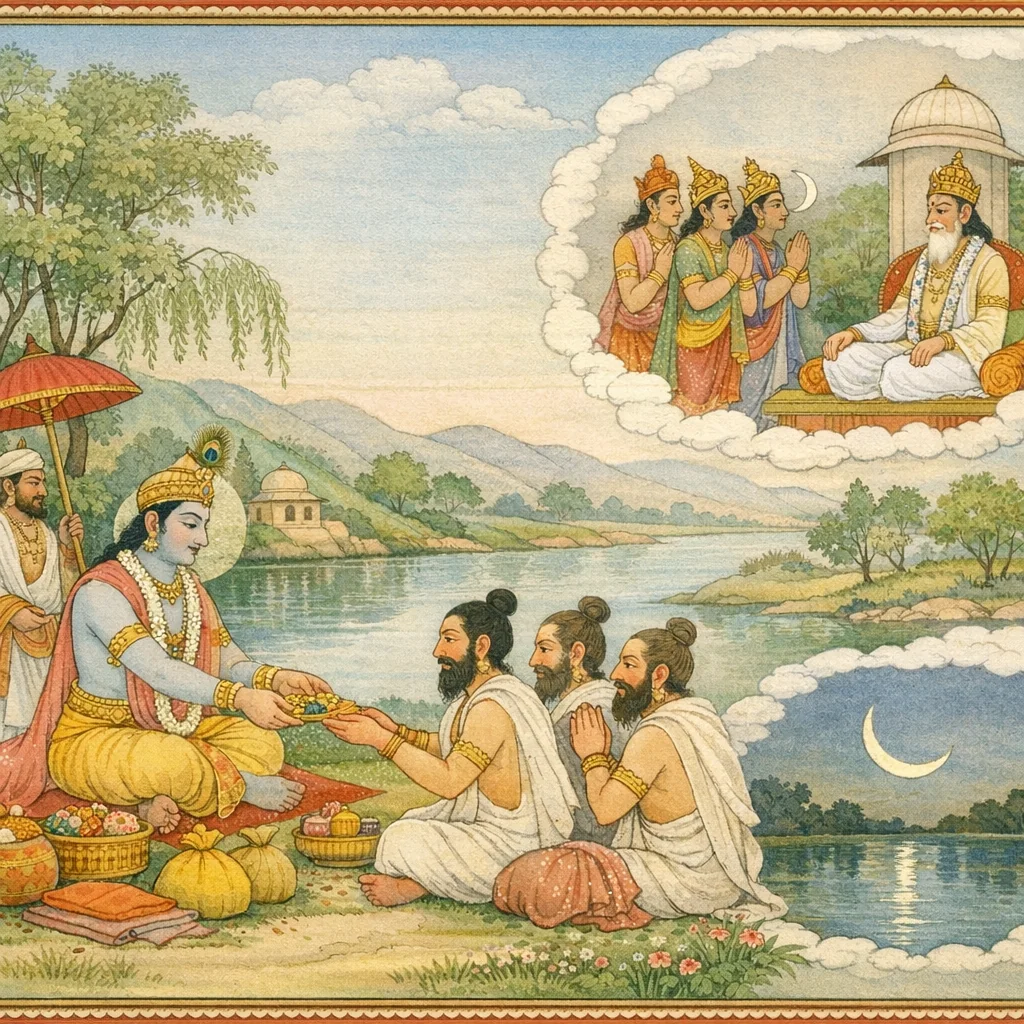
Vaiśaṃpāyana recounts that Balarāma visits the famed udapāna of the illustrious ṛṣi Trita, gives gifts, honors brāhmaṇas, and performs ablution. Janamejaya asks how the well became significant and how Trita was abandoned. The narrative backtracks to an earlier age: three ṛṣi-brothers—Ekatā, Dvitā, and Trita—excel in tapas and Vedic learning; Trita becomes preeminent. Seeking wealth for sacrifice, they conduct yajña and acquire many cattle; while traveling, Ekatā and Dvitā conspire to exclude Trita. A wolf appears at night; in fear Trita falls into a deep, terrifying well near the Sarasvatī. Hearing his cries, the brothers knowingly abandon him. Trapped, Trita resolves to drink soma and mentally constructs the ritual: he imagines waters and fires, fashions pressing-stones from gravel, performs soma-pressing, and offers shares to the devas with correct mantra. The ritual sound reaches heaven; Bṛhaspati leads the devas to Trita, who reproaches them for his peril yet distributes their portions properly. Pleased, the devas grant boons; Trita asks to be rescued and that those who bathe at the well attain soma-merit. Sarasvatī rises in waves and lifts him out. Trita then confronts his brothers, curses them for greed, and their offspring become marked by animal-like traits; the curse manifests immediately. The chapter returns to Balarāma, who again bathes, gives donations, praises the udapāna, and proceeds toward Vinaśana.
Chapter Arc: Janamejaya, eager to know what befell while the war-clouds gathered, asks how Baladeva—refusing to aid either Kauravas or Pandavas—set forth on a tīrtha-yātrā, and why Prabhāsa is praised as supreme among holy places. → Vaiśampāyana narrates Baladeva’s firm vow of neutrality and his departure as the war nears; the journey begins from Kurukṣetra with many vehicles and attendants, and the tale widens into the sanctity of Sarasvatī’s tīrthas and the special potency of Prabhāsa—hinting that even the gods once sought relief there. → The narrative crests in the Prabhāsa-episode: the Moon (Soma), struck by Dakṣa’s curse and seized by rājayakṣmā, wanes—causing herbs and beings to wither—until the gods, alarmed by cosmic decline, seek a remedy and plead for the curse’s reversal. → The chapter closes by laying out the full account of Soma’s curse and the greatness of Prabhāsa as a ‘tīrtha of tīrthas,’ where purification and restoration become possible; Baladeva’s pilgrimage is framed as moving through these power-laden sites with lavish gifts and rites. → How Dakṣa is finally appeased, what precise observance at Prabhāsa restores Soma, and how this sacred precedent will mirror Baladeva’s own later return to the war’s aftermath.
Shlokas
Verse 1
अपर बक। ] अति: पजञ्चत्रिशो<ड्ध्याय: बलदेवजीकी तीर्थयात्रा तथा प्रभास-क्षेत्रके प्रभावका वर्णनके प्रसंगमें चन्द्रमाके शापमोचनकी कथा जनमेजय उवाच पूर्वमेव यदा रामस्तस्मिन् युद्ध उपस्थिते । आमन्त्रय केशवं यातो वृष्णिभि: सहित: प्रभु:,जनमेजयने कहा--ब्रह्मन! जब महाभारतयुद्ध आरम्भ होनेका समय निकट आ गया, उस समय युद्ध प्रारम्भ होनेसे पहले ही भगवान् बलराम श्रीकृष्णकी सम्मति ले, अन्य वृष्णिवंशियोंके साथ तीर्थयात्राके लिये चले गये और जाते समय यह कह गये कि “केशव! मैंन तो धृतराष्ट्रपुत्र दुर्योधनकी सहायता करूँगा और न पाण्डवोंकी ही'
Janamejaya said: When the great war was already at hand, even before the fighting began, Lord Balarāma—after taking leave of Keśava (Kṛṣṇa)—set out, accompanied by the Vṛṣṇis. The verse frames Balarāma’s deliberate withdrawal from the impending conflict, highlighting the ethical tension between kinship, allegiance, and the choice to avoid participation in a fratricidal war.
Verse 2
साहाय्य॑ धार्तराष्ट्स्य न च कर्तास्मि केशव । न चैव पाण्डुपुत्राणां गमिष्यामि यथागतम्,जनमेजयने कहा--ब्रह्मन! जब महाभारतयुद्ध आरम्भ होनेका समय निकट आ गया, उस समय युद्ध प्रारम्भ होनेसे पहले ही भगवान् बलराम श्रीकृष्णकी सम्मति ले, अन्य वृष्णिवंशियोंके साथ तीर्थयात्राके लिये चले गये और जाते समय यह कह गये कि “केशव! मैंन तो धृतराष्ट्रपुत्र दुर्योधनकी सहायता करूँगा और न पाण्डवोंकी ही'
“Keśava, I will not become an ally of the son of Dhṛtarāṣṭra; nor will I go over to the sons of Pāṇḍu as things now stand.” In this moment, the speaker frames a deliberate stance of non-participation: refusing to lend strength to either side as the war approaches, emphasizing personal restraint and a chosen distance from the coming conflict.
Verse 3
एवमुक्त्वा तदा रामो यात: क्षत्रनिबर्हण: । तस्य चागमन भूयो ब्रह्मन् शंसितुमरहसि,विप्रवर! उन दिनों ऐसी बात कहकर जब क्षत्रियसंहारक बलरामजी चले गये, तब उनका पुनः आगमन कैसे हुआ, यह बतानेकी कृपा करें
Janamejaya said: “Having spoken thus, Balarāma—renowned as the chastiser of the Kṣatriyas—departed. O Brahman, best of the twice-born, you ought to recount to me how he later came again.”
Verse 4
आखाेणयाहि मे विस्तरश: कथ॑ं राम उपस्थित: । कथं च दृष्टवान् युद्ध कुशलो हासि सत्तम,साधुशिरोमणे! आप कथा कहनेमें कुशल हैं; अतः मुझे विस्तारपूर्वक बताइये कि बलरामजी कैसे वहाँ उपस्थित हुए और किस प्रकार उन्होंने युद्ध देखा?
Janamejaya said: “O best of men, O foremost among the virtuous—since you are skilled in recounting battles—tell me in full detail: how did Rama (Balarāma) come to be present there, and in what manner did he witness the war?”
Verse 5
वैशम्पायन उवाच उपप्लव्ये निविष्टेषु पाण्डवेषु महात्मसु । प्रेषितो धृतराष्ट्रस्य समीप॑ मधुसूदन:
Vaiśampāyana said: When the great-souled Pāṇḍavas had taken up residence at Upaplavya, Madhusūdana (Kṛṣṇa) was dispatched to the presence of Dhṛtarāṣṭra—an act of diplomacy meant to seek a righteous settlement and avert the ruin that follows obstinate injustice.
Verse 6
शमं प्रति महाबाहो हितार्थ सर्वदेहिनाम् वैशम्पायनजीने कहा--राजन्! जिन दिनों महामनस्वी पाण्डव उपप्लव्य नामक स्थानमें छावनी डालकर ठहरे हुए थे, उन्हीं दिनोंकी बात है। महाबाहो! पाण्डवोंने समस्त प्राणियोंके हितके लिये सन्धिके उद्देश्यसे भगवान् श्रीकृष्णको धृतराष्ट्रके पास भेजा || ५३ || स गत्वा हास्तिनपुरं धृतराष्ट्रं समेत्य च
Vaiśampāyana said: Having gone to Hāstinapura, he met with Dhṛtarāṣṭra as well—continuing the Pandavas’ peace-oriented effort undertaken for the welfare of all beings before the war’s final escalation.
Verse 7
न च तत् कृतवान् राजा यथा ख्यातं हि तत् पुरा,नरेश्वर! किंतु राजा धृतराष्ट्रने भगवानका कहना नहीं माना। यह सब बात पहले यथार्थरूपसे बतायी गयी है। महाबाहु पुरुषोत्तम भगवान् श्रीकृष्ण वहाँ संधि करानेमें सफलता न मिलनेपर पुनः उपप्लव्यमें ही लौट आये
Vaiśampāyana said: The king did not act in the manner that had earlier been reported as proper and true. O lord of men, King Dhṛtarāṣṭra did not accept the counsel of the Blessed One. All this has already been narrated exactly as it happened. When the mighty-armed, supreme Person, Lord Śrī Kṛṣṇa, failed to secure a reconciliation there, he returned again to Upaplavya. Ethically, the passage underscores how refusal to heed righteous counsel closes the door to peace and hastens the descent into war.
Verse 8
अनवाप्य शमं तत्र कृष्ण: पुरुषसत्तम: | आगच्छत महाबाहुरुपप्लव्यं जनाधिप,नरेश्वर! किंतु राजा धृतराष्ट्रने भगवानका कहना नहीं माना। यह सब बात पहले यथार्थरूपसे बतायी गयी है। महाबाहु पुरुषोत्तम भगवान् श्रीकृष्ण वहाँ संधि करानेमें सफलता न मिलनेपर पुनः उपप्लव्यमें ही लौट आये
Vaiśampāyana said: There, Kṛṣṇa—the best of men, mighty-armed—having failed to secure peace, returned to Upaplavya, O lord of the people, O king. The verse underscores the ethical gravity of attempted reconciliation: even when a righteous envoy strives for concord, peace cannot be achieved if those in power refuse wise counsel, and the path toward war becomes harder to avert.
Verse 9
ततः प्रत्यागतः कृष्णो धार्तराष्ट्रविसर्जित: । अक्रियायां नरव्यापत्र पाण्डवानिदमब्रवीत्,नरव्याप्र! कार्य न होनेपर धृतराष्ट्रसे विदा ले वहाँसे लौटे हुए श्रीकृष्णने पाण्डवोंसे इस प्रकार कहा--
Then Kṛṣṇa, having taken leave of Dhṛtarāṣṭra and returned when no effective action could be accomplished, addressed the Pāṇḍavas with these words, O tiger among men. The verse underscores the ethical frustration of counsel failing to produce righteous action, and the necessity of returning to one’s own side to speak plainly when mediation proves fruitless.
Verse 10
न कुर्वन्ति वचो महां कुरव: कालनोदिता: । निर्गच्छध्वं पाण्डवेया: पुष्पेण सहिता मया,“कौरव कालके अधीन हो रहे हैं, इसलिये वे मेरा कहना नहीं मानते हैं। पाण्डवो! अब तुमलोग मेरे साथ पुष्य नक्षत्रमें युद्धके लिये निकल पड़ो,
Vaiśampāyana said: “The great Kurus, driven onward by Time, do not heed my words. Therefore, O sons of Pāṇḍu, set out with me—together with Puṣya (the auspicious lunar mansion)—for the undertaking of war.”
Verse 11
इसके बाद जब सेनाका बँटवारा होने लगा, तब बलवानोंमें श्रेष्ठ महामना बलदेवजीने अपने भाई श्रीकृष्णसे कहा--
Then, when the division of the armies began, the high-minded Balarāma—foremost among the mighty—addressed his brother Śrī Kṛṣṇa. The moment signals a morally charged turning point: as forces are apportioned for war, kinship and duty intersect, and counsel between brothers frames the ethical weight of choosing sides.
Verse 12
तेषामपि महाबाहो साहाय्यं॑ मधुसूदन । क्रियतामिति तत् कृष्णो नास्य चक्रे वचस्तदा,“महाबाहु मधुसूदन! उन कौरवोंकी भी सहायता करना। परंतु श्रीकृष्णने उस समय उनकी यह बात नहीं मानी”
Vaiśampāyana said: “O mighty-armed Madhusūdana, extend your help even to those men (the Kauravas).” Yet at that time Kṛṣṇa did not accept his request. The passage underscores a moral boundary in counsel: assistance is not granted merely because it is asked for, but is weighed against righteousness and the larger ethical order governing the war.
Verse 13
ततो मन्युपरीतात्मा जगाम यदुनन्दन: । तीर्थयात्रां हलधर: सरस्वत्यां महायशा:,इससे मन-ही-मन कुपित और खिन्न होकर महायशस्वी यदुनन्दन हलधर सरस्वतीके तटपर तीर्थयात्राके लिये चल दिये
Then, his mind overwhelmed by anger and inward distress, the illustrious Yadu-descendant—Haladhara (Balarāma)—set out on a pilgrimage along the Sarasvatī. Choosing withdrawal over escalation, he turns from the heat of conflict toward sacred travel, implying an ethical preference for restraint and purification when passions surge.
Verse 14
मैत्रनक्षत्रयोगे सम सहित: सर्वयादवै: । आश्रयामास भोजस्तु दुर्योधनमरिंदम:,इसके बाद शत्रुओंका दमन करनेवाले कृतव्माने सम्पूर्ण यादवोंके साथ अनुराधानक्षत्रमें दुर्योधनका पक्ष ग्रहण किया
Vaiśampāyana said: Under the astrological conjunction of the Maitra (Anurādhā) lunar mansion, the Bhoja hero—renowned as a subduer of foes—together with all the Yādavas, chose to take refuge with Duryodhana, thereby aligning himself with the Kaurava cause. The verse underscores how political allegiance in war is often framed as a deliberate, time-marked decision, carrying moral weight because it determines whom one supports in an unrighteous conflict.
Verse 15
युयुधानेन सहितो वासुदेवस्तु पाण्डवान् | रौहिणेये गते शूरे पुष्पेण मधुसूदन:
Vaiśampāyana said: Accompanied by Yuyudhāna, Vāsudeva (Kṛṣṇa) approached the Pāṇḍavas. When the valiant Rauhiṇeya (Balarāma) had departed, Madhusūdana (Kṛṣṇa) came to them with a conciliatory, gentle intent—seeking to steady their resolve and guide them amid the moral strain of war.
Verse 16
गच्छन्नेव पथिस्थस्तु राम: प्रेष्यानुवाच ह,यात्रा करते हुए बलरामजीने स्वयं मार्गमें ही रहकर अपने सेवकोंसे कहा--“'तुमलोग शीघ्र ही द्वारका जाकर वहाँसे तीर्थयात्रामें काम आनेवाली सब सामग्री, समस्त आवश्यक उपकरण, अग्निहोत्रकी अग्नि तथा पुरोहितोंको ले आओ
Vaiśampāyana said: While still on the road, Balarāma addressed his attendants: “Go quickly to Dvārakā and bring from there all the supplies and necessary equipment required for the pilgrimage—along with the sacred fire for the agnihotra and the priests.” The moment underscores disciplined preparation and reverence for Vedic rites even amid the larger turmoil of the epic’s events.
Verse 17
सम्भारांस्तीर्थयात्रायां सर्वोपकरणानि च । आनयघध्वं द्वारकायामग्नीन् वै याजकांस्तथा,यात्रा करते हुए बलरामजीने स्वयं मार्गमें ही रहकर अपने सेवकोंसे कहा--“'तुमलोग शीघ्र ही द्वारका जाकर वहाँसे तीर्थयात्रामें काम आनेवाली सब सामग्री, समस्त आवश्यक उपकरण, अग्निहोत्रकी अग्नि तथा पुरोहितोंको ले आओ
Vaiśampāyana said: Remaining on the road, Balarāma instructed his attendants, “Go quickly to Dvārakā and bring back all the provisions and necessary implements for the pilgrimage—along with the sacred fires for the agnihotra and the officiating priests as well.” The verse underscores that even a holy journey is to be undertaken with due preparation and proper ritual order, not with haste or negligence.
Verse 18
सुवर्ण रजतं चैव धेनूर्वासांसि वाजिन: । कुण्जरांश्व रथांश्वैव खरोष्ट्र वाहनानि च
Vaiśampāyana said: “Gold and silver, cows, garments, horses; elephants and chariots; and also conveyances drawn by donkeys and camels.” The verse lists the kinds of wealth and transport being assembled or bestowed, highlighting how, amid the pressures of war, material resources—precious metals, livestock, clothing, and vehicles—become instruments of policy, reward, and obligation, and thus raise questions of rightful use and distribution (dharma) even in a martial setting.
Verse 19
प्रतिस्रोत: सरस्वत्या गच्छध्वं शीघ्रगामिन:
Vaiśampāyana said: “Go swiftly, moving against the current of the Sarasvatī.” The command underscores urgent resolve—pressing forward even when the way is difficult, as duty in a crisis often demands.
Verse 20
ऋच्विजश्नानय ध्वं वै शतशक्ष द्विजर्षभान् । शीघ्रगामी सेवको! तुम सरस्वतीके स्रोतकी ओर चलो और सैकड़ों श्रेष्ठ ब्राह्मणों तथा ऋत्विजोंको ले आओ' ।। एवं संदिश्य तु प्रेष्यानू बलदेवो महाबल:
Vaiśampāyana said: “Have the officiating priests bathe, and (also) bathe hundreds of bull-like Brahmins. You, swift-moving attendant—go at once toward the stream of the Sarasvatī and bring back hundreds of excellent Brahmins and ṛtviks.” Having thus instructed his messengers, the mighty Baladeva (set the arrangements in motion).
Verse 21
तीर्थयात्रां ययौ राजन् कुरूणां वैशसे तदा । सरस्वती प्रतिस्रोत: समन्तादभिजग्मिवान्
Vaiśampāyana said: O King, at that time he set out on a pilgrimage to sacred fords, in the aftermath of the Kurus’ slaughter, and he approached the Sarasvatī—moving against its current—coming to it from all sides. The verse frames a turn from battlefield devastation toward expiation and moral reckoning through tīrtha-journeying.
Verse 22
ऋषच्विग्भिश्न सुहृद्धिश्व॒ तथान्यैरद्धिजसत्तमै: । रथैर्गजैस्तथाश्रैश्ष प्रेष्यैज्ञु भरतर्षभ
Vaiśampāyana said: “O bull among the Bharatas, he was accompanied by seers and officiating priests, by well-wishing friends, and by other eminent men of noble birth—along with chariots, elephants, horses, and attendants.”
Verse 23
गोखरोष्ट प्रयुक्तैश्व यानैश्व बहुभिवत: । राजन्! महाबली बलदेवजीने सेवकोंको ऐसी आज्ञा देकर उस समय कुरुक्षेत्रमें ही तीर्थयात्रा आरम्भ कर दी। भरतश्रेष्ठ! वे सरस्वतीके स्रोतती ओर चलकर उसके दोनों तटोंपर गये। उनके साथ ऋत्विज, सुहृद, अन्यान्य श्रेष्ठ ब्राह्मण, रथ, हाथी, घोड़े और सेवक भी थे। बैल, गदहा और ऊँटोंसे जुते हुए बहुसंख्यक रथोंसे बलरामजी घिरे हुए थे || २०-- २२३ || श्रान्तानां क्लान्तवपुषां शिशूनां विपुलायुषाम्
Vaiśampāyana said: O King, the mighty Balarāma, surrounded by many vehicles drawn by oxen, donkeys, and camels, issued his orders to his attendants and, right there on the field of Kurukṣetra, began his pilgrimage. O best of the Bharatas, he proceeded toward the streams of the Sarasvatī and moved along both of her banks. With him went officiating priests, friends, and other eminent brāhmaṇas, as well as chariots, elephants, horses, and servants. Encircled by a great number of carts yoked to oxen, donkeys, and camels, Balarāma advanced—turning from the violence of war toward the discipline of sacred travel and restraint.
Verse 24
देशे देशे तु देयानि दानानि विविधानि च । अचयि चार्थिनां राजन् क्लृप्तानि बहुशस्तथा
Vaiśampāyana said: “O King, in various regions, many kinds of gifts were to be given; and for the sake of those who sought help, provisions were repeatedly arranged and accumulated in due order.”
Verse 25
राजन! उस समय उन्होंने देश-देशमें थके-माँदे रोगी, बालक और वृद्धोंका सत्कार करनेके लिये नाना प्रकारकी देनेयोग्य वस्तुएँ प्रचुर मात्रामें तैयार करा रखी थीं ।। तानि यानीह देशेषु प्रतीक्षन्ति सम भारत । बुभुक्षितानामर्थाय क्लृप्तमन्नं समन््तत:
Vaiśampāyana said: “O King, at that time they had arranged in abundance many kinds of gifts and supplies, prepared across various regions, in order to honor and care for the weary, the sick, children, and the aged. Those provisions were kept ready in these lands, O descendant of Bharata, and food had been set out on all sides for the sake of the hungry.”
Verse 26
भारत! विभिन्न देशोंमें लोग जिन वस्तुओंकी इच्छा रखते थे, उन्हें वे ही दी जाती थीं। भूखोंको भोजन करानेके लिये सर्वत्र अन्नका प्रबन्ध किया गया था ।। यो यो यत्र द्विजो भोज्यं भोक्तुं कामयते तदा । तस्य तस्य तु तत्रैवमुपजहुस्तदा नूप,नरेश्वरर जिस किसी देशमें जो-जो ब्राह्मण जब कभी भोजनकी इच्छा प्रकट करता, बलरामजीके सेवक उसे वहीं तत्काल खाने-पीनेकी वस्तुएँ अर्पित करते थे
O Bhārata, whatever goods people desired in the various regions were provided to them accordingly. Arrangements of food were made everywhere so that the hungry might be fed. Whenever and wherever a brāhmaṇa wished to eat, attendants promptly presented him with food and drink right there—thus, O king among men, hospitality was ensured without delay.
Verse 27
तत्र तत्र स्थिता राजन् रोहिणेयस्य शासनात् । भक्ष्यपेयस्य कुर्वन्ति राशींस्तत्र समन््ततः,राजन! रोहिणीकुमार बलरामजीकी आज्ञासे उनके सेवक विभिन्न तीर्थस्थानोंमें खाने- पीनेकी वस्तुओंके ढेर लगाये रखते थे
Vaiśampāyana said: “O King, stationed here and there in accordance with the command of Rohiṇeya (Balarāma), his attendants kept piling up heaps of food and drink all around at those places.”
Verse 28
वासांसि च महाहाणि पर्यड्कास्तरणानि च । पूजार्थ तत्र क्लृप्तानि विप्राणां सुखमिच्छताम्,सुख चाहनेवाले ब्राह्मणोंके सत्कारके लिये बहुमूल्य वस्त्र, पलंग और बिछौने तैयार रखे जाते थे
Vaiśampāyana said: There, for the purpose of honoring them, costly garments, bedsteads, and bedding were kept ready—arranged to ensure the comfort of the brāhmaṇas who desired ease. The passage highlights the social ethic of hospitality: reverence is shown not merely by words, but by providing dignified material support to worthy guests.
Verse 29
यत्र यः स्वपते विप्रो यो वा जागर्ति भारत । तत्र तत्र तु तस्यैव सर्व क्लृप्तमदृश्यत,भारत! जो ब्राह्मण जहाँ भी सोता या जागता था, वहाँ-वहाँ उसके लिये सारी आवश्यक वस्तुएँ सदा प्रस्तुत दिखायी देती थीं
Vaiśampāyana said: O Bhārata, wherever that brāhmaṇa lay down to sleep, or wherever he remained awake, in that very place all things needful for him were seen already arranged and ready—suggesting an unseen providence attending upon his conduct and worth.
Verse 30
यथासुखं जन: सर्वो याति तिष्ठति वै तदा । यातुकामस्य यानानि पानानि तृषितस्य च,भरतश्रेष्ठ! इस यात्रामें सब लोग सुखपूर्वक चलते और विश्राम करते थे। यात्रीकी इच्छा हो तो उसे सवारियाँ दी जाती थीं, प्यासेको पानी और भूखेको स्वादिष्ट अन्न दिये जाते थे। साथ ही वहाँ बलरामजीके सेवक वस्त्र और आभूषण भी भेंट करते थे
Vaiśampāyana said: At that time, everyone on the journey moved along and halted in comfort. Whoever wished to travel was provided with conveyances, and whoever was thirsty was given drink—an orderly hospitality that ensured no one’s need was neglected.
Verse 31
बुभुक्षितस्य चान्नानि स्वादूनि भरतर्षभ । उपजहुर्नरास्तत्र वस्त्राण्याभरणानि च,भरतश्रेष्ठ! इस यात्रामें सब लोग सुखपूर्वक चलते और विश्राम करते थे। यात्रीकी इच्छा हो तो उसे सवारियाँ दी जाती थीं, प्यासेको पानी और भूखेको स्वादिष्ट अन्न दिये जाते थे। साथ ही वहाँ बलरामजीके सेवक वस्त्र और आभूषण भी भेंट करते थे
Vaiśampāyana said: “O bull among the Bharatas, for the hungry they brought delicious foods; and there, people also presented garments and ornaments.” The scene underscores a culture of hospitality and service: travelers are cared for according to need—food for hunger, and respectful gifts—reflecting dharmic generosity even amid the larger tensions of the war narrative.
Verse 32
स पन्था: प्रब॒भौ राजन् सर्वस्यैव सुखावह: । स्वर्गोपमस्तदा वीर नराणां तत्र गच्छताम् | नित्यप्रमुदितोपेत: स्वादुभक्ष्य: शुभान्वित:,वीर नरेश! वहाँ यात्रा करनेवाले सब लोगोंको वह मार्ग स्वर्गके समान सुखदायक प्रतीत होता था। उस मार्गमें सदा आनन्द रहता, स्वादिष्ट भोजन मिलता और शुभकी ही प्राप्ति होती थी
Vaiśaṃpāyana said: “O King, that road then shone forth as a bringer of happiness to everyone. To the warriors and men who travelled there, it seemed like heaven itself—filled with constant gladness, offering sweet and pleasing food, and attended by auspicious outcomes.”
Verse 33
विपण्यापणपण्यानां नानाजनशतैर्व॑त: । नानाद्रुमलतोपेतो नानारत्नविभूषित:,उस पथपर खरीदने-बेचनेकी वस्तुओंका बाजार भी साथ-साथ चलता था, जिसमें नाना प्रकारके सैकड़ों मनुष्य भरे रहते थे। वह हाट भाँति-भाँतिके वृक्षों और लताओंसे सुशोभित तथा अनेकानेक रत्नोंसे विभूषित दिखायी देता था
Vaiśampāyana said: Along the road there moved, as it were, a continuous market of wares for sale—crowded with hundreds of people of many kinds. That bazaar-like procession appeared adorned with diverse trees and creepers, and embellished with many sorts of jewels, displaying the splendor and bustle that accompany royal movement even amid the grim setting of war.
Verse 34
इस प्रकार श्रीमह्या भारत शल्यपवके अन्तर्गत गदापवमें बलरामजीका आगमनविषयक चौंतीसवाँ अध्याय पूरा हुआ,ततो महात्मा नियमे स्थितात्मा पुण्येषु तीर्थेषु वसूनि राजन् | ददौ द्विजेभ्य: क्रतुदक्षिणा श्र यदुप्रवीरो हलभृत् प्रतीत: राजन! यदुकुलके प्रमुख वीर हलधारी महात्मा बलराम नियमपूर्वक रहकर प्रसन्नताके साथ पुण्यतीथोमें ब्राह्मगोंको धन और यज्ञकी दक्षिणाएँ देते थे
Sanjaya said: Then that great-souled Balarāma—steadfast in his vows and self-controlled—moved among the sacred pilgrimage-fords and, O King, gladly bestowed wealth upon the Brahmins, along with the sacrificial fees (dakṣiṇās). Thus the renowned plough-bearing hero, foremost of the Yadus, acted with serene satisfaction, upholding the ethical duty of generosity and ritual propriety even amid the wider turmoil of war.
Verse 35
दोग्ध्रीक्ष धेनूश्न सहस्नरशो वै सुवासस: काञ्चनबद्धशृद्धी: । हयांश्न नानाविधदेशजातान् यानानि दासांश्व शुभान द्विजेभ्य:,बलरामने श्रेष्ठ ब्राह्मणोंको सहस्रों दूध देनेवाली गौएँ दान कीं, जिन्हें सुन्दर वस्त्रोंसे सुसज्जित करके उनके सींगोंमें सोनेके पत्र जड़े गये थे। साथ ही उन्होंने अनेक देशोंमें उत्पन्न घोड़े, रथ और सुन्दर वेश-भूषावाले दास भी ब्राह्मणोंकी सेवामें अर्पित किये। इतना ही नहीं, बलरामने भाँति-भाँतिके रत्न, मोती, मणि, मूँगा, उत्तम सुवर्ण, विशुद्ध चाँदी तथा लोहे और ताँबेके बर्तन भी बाँटे थे इति श्रीमहाभारते शल्यपर्वणि गदापर्वणि बलदेवतीर्थयात्रायां प्रभासोत्पत्तिकथने पज्चत्रिंशोडध्याय:
Vaiśampāyana said: Balarāma, the foremost among the best, bestowed upon the brāhmaṇas thousands of milch-cows, adorned with fine garments and with their horns fitted with gold. He also presented horses bred in many different regions, along with vehicles (chariots and the like) and well-attired servants for their service. The passage highlights the ethic of dāna (generous giving) as a sacred duty—honouring learned brāhmaṇas and supporting ritual life through wealth offered without coercion or expectation of return.
Verse 36
रत्नानि मुक्तामणिविद्रुमं चा- प्यग्रयं सुवर्ण रजतं सुशुद्धम् अयस्मयं ताम्रमयं च भाण्डं ददौ द्विजातिप्रवरेषु राम:,बलरामने श्रेष्ठ ब्राह्मणोंको सहस्रों दूध देनेवाली गौएँ दान कीं, जिन्हें सुन्दर वस्त्रोंसे सुसज्जित करके उनके सींगोंमें सोनेके पत्र जड़े गये थे। साथ ही उन्होंने अनेक देशोंमें उत्पन्न घोड़े, रथ और सुन्दर वेश-भूषावाले दास भी ब्राह्मणोंकी सेवामें अर्पित किये। इतना ही नहीं, बलरामने भाँति-भाँतिके रत्न, मोती, मणि, मूँगा, उत्तम सुवर्ण, विशुद्ध चाँदी तथा लोहे और ताँबेके बर्तन भी बाँटे थे
Vaiśampāyana said: Rāma (Balarāma) bestowed upon the foremost of the twice-born (eminent brāhmaṇas) precious treasures—gems, pearls, and coral—along with excellent gold and perfectly pure silver. He also distributed vessels made of iron and copper. In ethical tenor, the verse highlights the ideal of dāna (generous giving) to worthy recipients, presenting Balarāma’s largesse as a dharmic act that honors learning and priestly virtue even amid the wider turmoil of the war narrative.
Verse 37
एवं स वित्त प्रददौ महात्मा सरस्वतीतीर्थवरेषु भूरि । ययौ क्रमेणाप्रतिमप्र भाव- सतत: कुरुक्षेत्रमुदारवृत्ति:
Thus that great-souled one bestowed abundant wealth at the most excellent sacred fords of the Sarasvatī. Then, proceeding step by step—of incomparable splendor and ever of noble conduct—he went on toward Kurukṣetra.
Verse 38
इस प्रकार उदार वृत्तिवाले अनुपम प्रभावशाली महात्मा बलरामने सरस्वतीके श्रेष्ठ तीर्थोमें बहुत धन दान किया और क्रमशः यात्रा करते हुए वे कुरक्षेत्रमें आये ।। जनमेजय उवाच सारस्वतानां तीर्थानां गुणोत्पत्तिं वदस्व मे । फलं च द्विपदां श्रेष्ठ कर्मनिर्वत्तिमेव च,जनमेजय बोले--ब्रह्मवेत्ताओंमें श्रेष्ठ और मनुष्योंमें उत्तम ब्राह्मगदेव! अब आप मुझे सरस्वती-तटवर्ती तीर्थोंके गुण, प्रभाव और उत्पत्तिकी कथा सुनाइये। भगवन्! क्रमश: उन तीर्थोके सेवनका फल और जिस कर्मसे वहाँ सिद्धि प्राप्त होती है, उसका अनुष्ठान भी बताइये, मेरे मनमें यह सब सुननेके लिये बड़ी उत्कण्ठा हो रही है
Janamejaya said: “Tell me of the sacred fords along the Sarasvatī—how their virtues arise and how they originated. And, O best among men, explain also the fruits gained from visiting them in due order, and the specific rites and disciplines by which spiritual success is attained there.”
Verse 39
यथाक्रमेण भगवंस्तीर्थानामनुपूर्वश: । ब्रह्मन ब्रह्मविदां श्रेष्ठ परं कौतूहलं हि मे,जनमेजय बोले--ब्रह्मवेत्ताओंमें श्रेष्ठ और मनुष्योंमें उत्तम ब्राह्मगदेव! अब आप मुझे सरस्वती-तटवर्ती तीर्थोंके गुण, प्रभाव और उत्पत्तिकी कथा सुनाइये। भगवन्! क्रमश: उन तीर्थोके सेवनका फल और जिस कर्मसे वहाँ सिद्धि प्राप्त होती है, उसका अनुष्ठान भी बताइये, मेरे मनमें यह सब सुननेके लिये बड़ी उत्कण्ठा हो रही है
Janamejaya said: “O venerable one, please recount, in due order and sequence, the sacred fords (tīrthas). O Brahman, best among the knowers of Brahman—my curiosity is profound. I long to hear, one by one, the merits, powers, and origins of the tīrthas along the Sarasvatī, and also the fruits of visiting them in proper order, together with the disciplines by which success is attained there.”
Verse 40
वैशम्पायन उवाच तीर्थानां च फलं राजन् गुणोत्पत्तिं च सर्वश: । मयोच्यमान वै पुण्यं शृणु राजेन्द्र कृत्सनश:,वैशम्पायनजीने कहा--राजेन्द्र! मैं तुम्हें तीर्थोके गुण, प्रभाव, उत्पत्ति तथा उनके सेवनका पुण्य-फल बता रहा हूँ। वह सब तुम ध्यानसे सुनो
Vaiśampāyana said: “O King, I shall describe in full the fruits of visiting sacred fords (tīrthas), their virtues, and their origins in every respect. O lord of kings, listen attentively to this complete account of the merit that arises from them.”
Verse 41
पूर्व महाराज यदुप्रवीर ऋषत्विक्सुह्ृद्विप्रगणैश्न सार्थम् पुण्यं प्रभासं समुपाजगाम यत्रोडुराड् यक्ष्मणा क्लिश्यमान:,महाराज! यदुकुलके प्रमुख वीर बलरामजी सबसे पहले ऋत्विजों, सुहृदों और ब्राह्मणोंके साथ पुण्यमय प्रभासक्षेत्रमें गये, जहाँ राजयक्ष्मासे कष्ट पाते हुए चन्द्रमाको शापसे छुटकारा मिला था। नरेन्द्र! वे वहीं पुन: अपना तेज प्राप्त करके सम्पूर्ण जगत्को प्रकाशित करते हैं। इस प्रकार चन्द्रमाको प्रभासित करनेके कारण ही वह प्रधान तीर्थ इस पृथ्वीपर प्रभास नामसे विख्यात हुआ
Vaiśampāyana said: “Formerly, O great king, the foremost hero of the Yadus went together with officiating priests, well-wishers, and companies of brāhmaṇas to the holy tīrtha called Prabhāsa—where the Moon, the lord of the stars, afflicted by consumption (yakṣmā), found relief and regained his radiance. Because that sacred place caused the Moon to shine forth again, it became renowned on earth by the name Prabhāsa (‘the place of splendor’).”
Verse 42
विमुक्तशाप: पुनराप्य तेज: सर्व जगद् भासयते नरेन्द्र । एवं तु तीर्थप्रवरं पृथिव्यां प्रभासनात् तस्य ततः प्रभास:,महाराज! यदुकुलके प्रमुख वीर बलरामजी सबसे पहले ऋत्विजों, सुहृदों और ब्राह्मणोंके साथ पुण्यमय प्रभासक्षेत्रमें गये, जहाँ राजयक्ष्मासे कष्ट पाते हुए चन्द्रमाको शापसे छुटकारा मिला था। नरेन्द्र! वे वहीं पुन: अपना तेज प्राप्त करके सम्पूर्ण जगत्को प्रकाशित करते हैं। इस प्रकार चन्द्रमाको प्रभासित करनेके कारण ही वह प्रधान तीर्थ इस पृथ्वीपर प्रभास नामसे विख्यात हुआ
Vaiśampāyana said: “Released from the curse, the Moon regained his radiance and once again illumined the entire world, O king. Thus, because that foremost sacred ford on earth caused him to shine forth, it thereafter became renowned by the name Prabhāsa.”
Verse 43
जनमेजय उवाच कथं तु भगवन् सोमो यक्ष्मणा समगृहा[त । कथं च तीर्थप्रवरे तरमिं श्षन्द्रोी न्यमज्जत,जनमेजयने पूछा--भगवन्! चन्द्रमा कैसे राजयक्ष्मासे ग्रस्त हो गये और उस उत्तम तीर्थमें किस प्रकार उन्होंने स्नान किया?
Janamejaya said: “O revered one, how did Soma (the Moon) come to be seized by consumption (rājayakṣmā)? And how, at that most excellent sacred ford, did the Moon immerse himself in the holy waters?”
Verse 44
कथमाप्लुत्य तस्मिंस्तु पुनराप्पायित: शशी । एतनमे सर्वमाचक्ष्व विस्तरेण महामुने,महामुने! उस तीर्थमें गोता लगाकर चन्द्रमा पुनः किस प्रकार हृष्ट-पुष्ट हुए? यह सब प्रसंग मुझे विस्तारपूर्वक बताइये
Janamejaya said: “O great sage, how did the Moon, after bathing in that sacred ford, become nourished and restored again? Please recount this entire episode to me in detail.”
Verse 45
वैशम्पायन उवाच दक्षस्य तनयास्तात प्रादुरासन् विशाम्पते । स सप्तविंशतिं कन्या दक्ष: सोमाय वै ददौ,वैशम्पायनजीने कहा--तात! प्रजानाथ! प्रजापति दक्षके बहुत-सी संतानें उत्पन्न हुई थीं। उनमेंसे अपनी सत्ताईस कन्याओंका विवाह उन्होंने चन्द्रमाके साथ कर दिया था
Verse 46
नक्षत्रयोगनिरता: संख्यानार्थ च ताभवन् | पत्न््यो वै तस्य राजेन्द्र सोमस्य शुभकर्मण:,राजेन्द्र! शुभ कर्म करनेवाले सोमकी वे पत्नियाँ समयकी गणनाके लिये नक्षत्रोंसे सम्बन्ध रखनेके कारण उसी नामसे विख्यात हुईं
Vaiśampāyana said: O king, those wives of Soma, the doer of auspicious deeds, being devoted to their association with the lunar mansions, became well-known by those very names, and they also served for the reckoning of time. The passage frames cosmic order as a basis for human order: time is made intelligible through a sacred, name-bearing structure.
Verse 47
तास्तु सर्वा विशालाक्ष्यो रूपेणाप्रतिमा भुवि | अत्यरिच्यत तासां तु रोहिणी रूपसम्पदा,वे सब-की-सब विशाल नेत्रोंसे सुशोभित होती थीं। इस भूतलपर उनके रूपकी समानता करनेवाली कोई स्त्री नहीं थी। उनमें भी रोहिणी अपने रूप-वैभवकी दृष्टिसे सबकी अपेक्षा बढ़ी-चढ़ी थी
Verse 48
ततस्तस्यां स भगवान् प्रीति चक्रे निशाकरः । सास्य हृद्या बभूवाथ तस्मात् तां बुभुजे सदा,इसलिये भगवान् चन्द्रमा उससे अधिक प्रेम करने लगे, वही उनकी हृदयवल्लभा हुई; अतः वे सदा उसीका उपभोग करते थे
Thereafter the divine Moon (Niśākara) conceived a special affection for her. She became dear to his heart; therefore he continually enjoyed her company—an episode that underscores how attachment and preference can arise even in celestial beings, setting the stage for later moral reflection on desire and partiality.
Verse 49
पुरा हि सोमो राजेन्द्र रोहिण्यामवसत् परम् | ततस्ता: कुपिता: सर्वा नक्षत्राख्या महात्मन:,राजेन्द्र! पूर्वकालमें चन्द्रमा सदा रोहिणीके ही समीप रहते थे; अतः नक्षत्रनामसे प्रसिद्ध हुईं महात्मा सोमकी वे सारी पत्नियाँ उनपर कुपित हो उठीं
Vaiśampāyana said: “In former times, O king, Soma (the Moon) dwelt exceedingly with Rohiṇī alone. Therefore all his other wives—those illustrious ones known as the Nakṣatras—became angry with that great-souled Soma, seeing his partiality.”
Verse 50
ता गत्वा पितरं प्राहु: प्रजापतिमतन्द्रिता: । सोमो वसति नास्मासु रोहिणीं भजते सदा,और आलस्य छोड़कर अपने पिताके पास जाकर बोलीं--'प्रभो! चन्द्रमा हमारे पास नहीं आते। वे सदा रोहिणीका ही सेवन करते हैं
Then those (daughters), without indolence, went to their father Prajāpati and spoke: “Lord, Soma does not dwell with us. He continually keeps company only with Rohiṇī.” The passage highlights a moral tension between partiality and fairness within family and social order, implying that favoritism—even by a revered figure—disturbs harmony and invites correction through rightful appeal to authority.
Verse 51
ता वयं सहिता: सर्वास्त्वित्सकाशे प्रजेश्वर । वत्स्यामो नियताहारास्तपश्चरणतत्परा:
Vaiśampāyana said: “All of us, united together, O lord of the people, will remain in your presence—restrained in our food and wholly devoted to the practice of austerity.”
Verse 52
“अत: प्रजेश्वर! हम सब बहिनें एक साथ नियमित आहार करके तपस्यामें संलग्न हो आपके ही पास रहेंगी! ।। श्रुत्वा तासां तु वचनं दक्ष: सोममथाब्रवीत् । सम॑ वर्तस्व भार्यासु मा त्वाधर्मो महान् स्पृशेत्,उनकी यह बात सुनकर प्रजापति दक्षने चन्द्रमासे कहा--'सोम! तुम अपनी सभी पत्नियोंके साथ समानतापूर्ण बर्ताव करो, जिससे तुम्हें महान् पाप न लगे”
“Therefore, O Lord of creatures! We sisters shall all remain together in your very presence, undertaking austerities with regulated food.” Hearing their words, Prajāpati Dakṣa then said to Soma (the Moon): “Soma, conduct yourself with equal regard toward all your wives, so that great unrighteousness may not touch you.”
Verse 53
तास्तु सर्वाब्रवीद् दक्षो गच्छध्वं शशिनो5न्तिकम् | सम॑ वत्स्यति सर्वासु चन्द्रमा मम शासनात्,फिर दक्षने उन सभी कन्याओंसे कहा--“अब तुमलोग चन्द्रमाके पास ही जाओ। वे मेरी आज्ञासे तुम सब लोगोंके प्रति समानभाव रखेंगे”
Vaiśampāyana said: Then Dakṣa addressed all of them, “Go now to the Moon’s presence. By my command, Candramā will dwell with equal regard toward each of you.” The passage underscores the ethical demand for impartiality in relationships and the corrective force of rightful authority when favoritism disrupts harmony.
Verse 54
विसृष्टास्तास्तथा जम्मु: शीतांशुभवनं तदा । तथापि सोमो भगवान् पुनरेव महीपते
Vaiśampāyana said: Thus released, they then went to the abode of the cool-rayed Moon. Yet even so, O king, the blessed Lord Soma returned again—suggesting that divine agency is not bound merely by a single departure or event, but re-engages according to a higher purpose within the unfolding of fate and duty.
Verse 55
ततस्ता: सहिता: सर्वा भूय: पितरमन्रुवन्,तब वे सब कन्याएँ पुन: एक साथ अपने पिताके पास जाकर बोलीं--'हम सब लोग आपकी सेवामें तत्पर रहकर आपके ही समीप रहेंगी। चन्द्रमा हमारे साथ नहीं रहते। उन्होंने आपकी बात नहीं मानी”
Vaiśaṃpāyana said: Then all those maidens, gathered together, again approached their father and spoke: “We shall remain near you, devoted to serving you. The Moon does not stay with us; he has not complied with your word.” In this, their loyalty to filial duty and truthful reporting stands against the Moon’s refusal to honor the father’s instruction.
Verse 56
तव शुश्रूषणे युक्ता वत्स्यामो हि तवान्तिके । सोमो वसति नास्मासु नाकरोद् वचनं तव,तब वे सब कन्याएँ पुन: एक साथ अपने पिताके पास जाकर बोलीं--'हम सब लोग आपकी सेवामें तत्पर रहकर आपके ही समीप रहेंगी। चन्द्रमा हमारे साथ नहीं रहते। उन्होंने आपकी बात नहीं मानी”
Vaiśampāyana said: “Committed to serving you, we shall indeed remain close by your side. Soma (the Moon) does not dwell with us; he did not comply with your command.”
Verse 57
तासां तदू् वचन श्रुत्वा दक्ष: सोममथाब्रवीत् । सम॑ वर्तस्व भार्यासु मा त्वां शप्स्ये विरोचन,उनकी बात सुनकर दक्षने पुन: सोमसे कहा--'प्रकाशमान चन्द्रदेव! तुम अपनी सभी पत्नियोंके साथ समान बर्ताव करो, नहीं तो तुम्हें शाप दे दूँगा"
Vaiśampāyana said: Hearing the words of those wives, Dakṣa again addressed Soma: “O radiant Moon-god, conduct yourself with equal regard toward all your wives; otherwise I shall curse you.” The passage underscores the ethical demand of impartiality and restraint in marital conduct, warning that favoritism invites moral and social disorder and may draw punitive consequences.
Verse 58
अनादृत्य तु तद् वाक्य दक्षस्य भगवान् शशी । रोहिण्या सार्थमवसत् ततस्ता: कुपिता: पुनः
But disregarding Dakṣa’s words, the divine Moon remained living together with Rohiṇī. Therefore, the others again became angry—showing how partiality and contempt for rightful counsel rekindle resentment and disorder.
Verse 59
गत्वा च पितर प्राहु: प्रणम्य शिरसा तदा । सोमो वसति नास्मासु तस्मान्न: शरणं भव
Having gone to their father, they then spoke, bowing their heads in reverence: “Soma no longer dwells within us; therefore, become our refuge.” The appeal frames a moral moment of dependence and humility—when inner strength and auspicious vitality are felt to be lost, one turns to rightful authority for protection and guidance.
Verse 60
दक्षके इतना कहनेपर भी भगवान् चन्द्रमा उनकी बातकी अवहेलना करके केवल रोहिणीके ही साथ रहने लगे। यह देख दूसरी स्त्रियाँ पुनः क्रोधसे जल उठीं और पिताके पास जा उनके चरणोंमें मस्तक नवाकर प्रणाम करनेके अनन्तर बोलीं--“भगवन्! सोम हमारे पास नहीं रहते। अतः आप हमें शरण दें ।। रोहिण्यामेव भगवान् सदा वसति चन्द्रमा: । न त्वद्वाद्ो गणयति नास्मासु स्नेहमिच्छति
Vaiśaṃpāyana said: Even after Dakṣa had spoken thus, the divine Moon disregarded his words and continued to dwell only with Rohiṇī. Seeing this, the other wives again burned with anger. They went to their father, bowed their heads at his feet, and after offering reverence said, “Lord, Soma does not stay with us; therefore grant us refuge. The blessed Moon always lives only with Rohiṇī; he does not heed even your command, and he does not wish to show affection toward us.”
Verse 61
तच्छुत्वा भगवान् क्रुद्धो यक्ष्माणं पृथिवीपते
Hearing that, the revered one—angered—addressed Yakṣmā, O lord of the earth. The line signals a moral turning-point: a response of righteous indignation is about to be voiced, implying that what was heard has crossed the bounds of acceptable conduct and demands correction or restraint.
Verse 62
ससर्ज रोषात् सोमाय स चोडुपतिमाविशत् । पृथ्वीनाथ! यह सुनकर भगवान् दक्ष कुपित हो उठे। उन्होंने चन्द्रमाके लिये रोषपूर्वक राजयक्ष्माकी सृष्टि की। वह चन्द्रमाके भीतर प्रविष्ट हो गया ।। ६१ $ ।। स यक्ष्मणाभिभूतात्माक्षीयताहरह: शशी
Vaiśampāyana said: Enraged, Dakṣa brought forth the affliction called Rājayakṣmā for Soma; and that disease entered the lord of the stars, the Moon. Overpowered by that wasting sickness, Śaśī (the Moon) diminished day by day. The episode underscores how unchecked offense and pride invite consequences, and how even the radiant are subject to decline when burdened by wrongdoing and curse-born retribution.
Verse 63
उक्तवान् वचन तथ्यं हितं चैव विशेषत: । भगवानने हस्तिनापुर जाकर धुृतराष्ट्रसे भेंट की और उनसे सबके लिये विशेष हितकारक एवं यथार्थ बातें कहीं,यत्नं चाप्यकरोदू राजन मोक्षार्थ तस्य यक्ष्मण: । यक्ष्मासे शरीर ग्रस्त हो जानेके कारण चन्द्रमा प्रतिदिन क्षीण होने लगे। राजन्! उस यक्ष्मासे छूटनेके लिये उन्होंने बड़ा यत्न किया ।। ६२ $ ।। इष्टवेष्टिभिमहाराज विविधाभिनिशाकर: न चामुच्यत शापाद् वै क्षयं चैवाभ्यगच्छत । महाराज! नाना प्रकारके यज्ञ-यागोंका अनुष्ठान करके भी चन्द्रमा उस शापसे मुक्त न हो सके और धीरे-धीरे क्षीण होते चले गये
Vaiśampāyana said: He spoke words that were true and beneficial, especially so. And, O king, he also strove earnestly to free him from that wasting disease. Seized in body by consumption, the Moon began to wane day by day. O king, to be released from that affliction he made great efforts. Yet, O great king, even after performing many kinds of sacrifices and rites, the Night-maker (the Moon) was not freed from the curse and continued to decline.
Verse 64
।। क्षीयमाणे तत: सोमे ओषध्यो न प्रजज्ञिरे
Vaiśampāyana said: When the Soma began to wane, the medicinal herbs no longer sprang forth. The passage evokes a moral-ecological warning: when the sustaining principle is diminished, the world’s supports—healing, nourishment, and renewal—also decline.
Verse 65
ओषधीनां क्षये जाते प्राणिनामपि संक्षय:
Vaiśampāyana said: When medicinal herbs are exhausted, living beings too fall into decline—life itself diminishes as its sustaining remedies disappear. The line underscores a moral ecology: when the supports of health and balance are destroyed, suffering spreads beyond the immediate loss and threatens the very continuity of life.
Verse 66
ततो देवा: समागम्य सोममूचुर्महीपते
Then the gods assembled and addressed Soma, O king—marking a decisive moment where divine counsel enters the narrative and frames the ensuing events within a moral and cosmic order.
Verse 67
किमिदं भवतो रूपमीदृशं न प्रकाशते । कारणं ब्रूहि नः सर्व येनेद॑ ते महद् भयम्
Vaiśampāyana said: “Why is your appearance, in this strange condition, not becoming clear to us? Tell us the full reason—by what cause has this great fear arisen in you?”
Verse 68
श्रुत्वा तु वचन त्वत्तो विधास्यामस्ततो वयम् | पृथ्वीनाथ! उस समय देवताओंने चन्द्रमासे मिलकर पूछा--“आपका रूप ऐसा कैसे हो गया? यह प्रकाशित क्यों नहीं होता है? हमलोगोंसे सारा कारण बताइये, जिससे आपको महान् भय प्राप्त हुआ। आपकी बात सुनकर हमलोग इस संकटके निवारणका कोई उपाय करेंगे” ।। ६६-६७ $ || एवमुक्त: प्रत्युवाच सर्वास्तान् शशलक्षण:
Hearing your words, we shall act accordingly. O Lord of the earth! At that time the gods, gathering together around the Moon, asked: “How has your form become like this? Why does your radiance not shine forth? Tell us the entire cause by which you have fallen into great fear. Once we have heard your account, we will devise some means to remove this distress.” Thus addressed, the Moon—marked with the hare—replied to them all.
Verse 69
देवास्तथा वच: श्रुत्वा गत्वा दक्षमथाब्रुवन्
Vaiśampāyana said: Hearing those words, the gods then went to Dakṣa and addressed him—signaling a shift from mere reception of counsel to responsible action and consultation with an authority figure, as the narrative moves toward an ethically consequential decision.
Verse 70
असौ हि चन्द्रमा: क्षीण: किज्चिच्छेषो हि लक्ष्यते,“चन्द्रमा क्षीण हो चुके हैं और उनका कुछ ही अंश शेष दिखायी देता है। देवेश्वर! उनके क्षयसे लता, वीरुतू, ओषधियाँ भाँति-भाँतिके बीज और सम्पूर्ण प्रजा भी क्षीण हो गयी है
Vaiśampāyana said: “Behold, the moon has waned; only a small remnant is visible. O Lord of the gods, because of this diminution, creepers, grasses, medicinal herbs, seeds of many kinds, and indeed all living beings have become enfeebled.”
Verse 71
क्षयाच्चैवास्य देवेश प्रजाश्नैव गता: क्षयम् वीरुदोषधयश्नैव बीजानि विविधानि च,“चन्द्रमा क्षीण हो चुके हैं और उनका कुछ ही अंश शेष दिखायी देता है। देवेश्वर! उनके क्षयसे लता, वीरुतू, ओषधियाँ भाँति-भाँतिके बीज और सम्पूर्ण प्रजा भी क्षीण हो गयी है
Vaiśampāyana said: “O Lord of the gods, as he wanes, the people too fall into decline. Creepers, grasses, medicinal herbs, and seeds of many kinds likewise waste away.” The verse underscores a cosmic-ethical linkage: when the sustaining order in nature diminishes, life-forms dependent on it—human and non-human—also wither, reflecting the Mahābhārata’s theme that disorder and exhaustion spread through the whole world-system.
Verse 72
तेषां क्षये क्षयो5स्माकं विनास्माभिर्जगच्च किम् | इति ज्ञात्वा लोकगुरो प्रसाद कर्तुमहसि,“उन सबके क्षीण होनेपर हमारा भी क्षय हो जायगा। फिर हमारे बिना संसार कैसे रह सकता है? लोकगुरो! ऐसा जानकर आपको बचन्द्रदेवपर अवश्य कृपा करनी चाहिये”
“If they are destroyed, we too will be destroyed; and what would the world be without us?” Knowing this, O Teacher of the worlds, you ought to show grace. The appeal frames mercy not as personal favoritism but as a protection of the wider order: the speaker argues that the ruin of one side will inevitably consume the other and destabilize the world that depends on them.
Verse 73
एवमुक्तस्ततो देवान् प्राह वाक््यं प्रजापति: । नैतच्छक्यं मम वचो व्यावर्तयितुमन्यथा
Thus addressed, Prajāpati then spoke these words to the gods: “It is not possible to turn my statement aside in any other way.” In the narrative’s ethical frame, the line underscores the irrevocability of a divinely grounded resolve—once a principled decree is uttered, it is not to be bent by preference or pressure.
Verse 74
हेतुना तु महाभागा निवर्तिष्यति केनचित् । उनके ऐसा कहनेपर प्रजापति दक्ष देवताओंसे इस प्रकार बोले--“महाभाग देवगण! मेरी बात पलटी नहीं जा सकती। किसी विशेष कारणसे वह स्वतः निवृत्त हो जायगी ।। ७३ न! सम॑ वर्ततु सर्वासु शशी भार्यासु नित्यश:,“यदि चन्द्रमा अपनी सभी पत्नियोंके प्रति सदा समान बर्ताव करें और सरस्वतीके श्रेष्ठ तीर्थमें गोता लगायें तो वे पुनः बढ़कर पुष्ट हो जायँगे। देवताओ! मेरी यह बात अवश्य सच होगी
Vaiśaṃpāyana said: “O fortunate ones, for some particular cause she will withdraw of her own accord.” The statement underscores a moral logic often seen in epic narrative: even when a decree cannot be reversed, a higher or subtler causality may bring about restraint and restoration without violating truth or authority.
Verse 75
सरस्वत्या वरे तीर्थे उन्मज्जन् शशलक्षण: । पुनर्वर्थिष्यते देवास्तद् वै सत्यं वचो मम,“यदि चन्द्रमा अपनी सभी पत्नियोंके प्रति सदा समान बर्ताव करें और सरस्वतीके श्रेष्ठ तीर्थमें गोता लगायें तो वे पुनः बढ़कर पुष्ट हो जायँगे। देवताओ! मेरी यह बात अवश्य सच होगी
Verse 76
मासार्ध च क्षयं सोमो नित्यमेव गमिष्यति । मासार्ध तु सदा वृद्धि सत्यमेतद् वचो मम,'सोम आधे मासतक प्रतिदिन क्षीण होंगे और आधे मासतक निरन्तर बढ़ते रहेंगे। मेरी यह बात अवश्य सत्य होगी
Vaiśampāyana said: “For half the month the Moon will steadily wane day by day, and for the other half it will continually wax. This statement of mine shall indeed prove true.”
Verse 77
समुद्र पश्चिमं गत्वा सरस्वत्यब्धिसड्रमम् । आराधयतु देवेशं तत: कान्तिमवाप्स्यति,'पश्चिमी समुद्रके तटपर जहाँ सरस्वती और समुद्रका संगम हुआ है, वहाँ जाकर चन्द्रमा देवेश्वर महादेवजीकी आराधना करें तो पुनः वे अपनी कान्ति प्राप्त कर लेंगे!
Vaiśampāyana said: “Let him go to the western ocean, to the confluence where the Sarasvatī meets the sea. If he worships the Lord of gods, Mahādeva, there, then he will regain his lost radiance.” The passage frames restoration not as mere fortune but as the fruit of pilgrimage, humility, and devotion to Śiva.
Verse 78
सरस्वतीं ततः सोम: स जगामर्षिशासनात् | प्रभासं प्रथमं तीर्थ सरस्वत्या जगाम ह,ऋषि (दक्ष प्रजापति)-के इस आदेशसे सोम सरस्वतीके प्रथम तीर्थ प्रभासक्षेत्रमें गये
Vaiśampāyana said: Then Soma, in obedience to the command of the seers, went to Sarasvatī. Indeed, he proceeded to Prabhāsa—the foremost sacred ford of the Sarasvatī—there to follow the ordained course of pilgrimage and purification.
Verse 79
अमावास्यां महातेजास्तत्रोन्मज्जन् महाद्युति: | लोकान् प्रभासयामास शीतांशुत्वमवाप च,महातेजस्वी महाकान्तिमान् चन्द्रमाने अमावास्याको उस तीर्थमें गोता लगाया। इससे उन्हें शीतल किरणें प्राप्त हुईं और वे सम्पूर्ण जगत्को प्रकाशित करने लगे
Vaiśampāyana said: On the new-moon night, that mighty, radiant one immersed himself there (at the sacred ford). By that act he attained the cool, moonlike quality of soothing rays, and began to illumine the worlds—his splendor and beauty becoming manifest again. The passage underscores the Mahābhārata’s recurrent ethic: sacred discipline and right observance can restore inner luminosity and benefit the wider world.
Verse 80
देवास्तु सर्वे राजेन्द्र प्रभासं प्राप्प पुष्कलम् । सोमेन सहिता भूत्वा दक्षस्य प्रमुखेडभवन्,राजेन्द्र! फिर सम्पूर्ण देवता सोमके साथ महान् प्रकाश प्राप्त करके पुनः दक्षप्रजापतिके सामने उपस्थित हुए
Vaiśampāyana said: “O king, all the gods, having reached the sacred Prabhāsa and obtained abundant radiance and auspicious merit there, then—accompanied by Soma—appeared again before Dakṣa. The episode underscores that even the gods seek purification and renewed order through holy places and rightful authority, returning to the cosmic administrator (Dakṣa) after restoration.”
Verse 81
ततः प्रजापति: सर्वा विससर्जाथ देवता: । सोम॑ च भगवान् प्रीतो भूयो वचनमबत्रवीत्,तब भगवान् प्रजापतिने समस्त देवताओंको विदा कर दिया और सोमसे पुनः प्रसन्नतापूर्वक कहा--
Then Prajāpati dismissed all the assembled gods. Pleased, the venerable Soma again addressed him with further words—continuing the counsel that follows in the narrative.
Verse 82
मावमंस्था: स्त्रिय: पुत्र मा च विप्रान् कदाचन । गच्छ युक्त: सदा भूत्वा कुरु वै शासनं मम,“बेटा! अपनी स्त्रियों तथा ब्राह्मणोंकी कभी अवहेलना न करना। जाओ, सदा सावधान रहकर मेरी आज्ञाका पालन करते रहो”
Vaiśaṃpāyana said: “My son, never treat women with contempt, and never at any time slight the brāhmaṇas. Go now; remain ever disciplined and vigilant, and carry out my command.”
Verse 83
स विसृष्टो महाराज जगामाथ स्वमालयम् । प्रजाश्न॒ मुदिता भूत्वा पुनस्तस्थुर्यथा पुरा,महाराज! ऐसा कहकर प्रजापतिने उन्हें विदा कर दिया। चन्द्रमा अपने स्थानको चले गये और सारी प्रजा पूर्ववत् प्रसन्न रहने लगी
Vaiśampāyana said: “Thus dismissed, O great king, he went to his own abode. And the people, becoming joyful once again, remained as they had been before.”
Verse 84
एवं ते सर्वमाख्यातं यथा शप्तो निशाकर: । प्रभासं च यथा तीर्थ तीर्थानां प्रवरं महत्,इस प्रकार चन्द्रमाको जैसे शाप प्राप्त हुआ था और महान् प्रभासतीर्थ जिस प्रकार सब तीर्थोमें श्रेष्ठ माना गया, वह सारा प्रसंग मैंने तुमसे कह सुनाया
Vaiśampāyana said: Thus I have told you everything—how the Moon came under a curse, and how Prabhāsa, that great sacred ford, came to be regarded as the foremost among all pilgrimage places.
Verse 85
अमावास्यां महाराज नित्यश: शशलक्षण: । स्नात्वा ह्॒ाप्यायते श्रीमान् प्रभासे तीर्थ उत्तमे
Vaiśampāyana said: “O great king, on every new-moon day the illustrious one marked with the hare-sign (the Moon) bathes at Prabhāsa, that most excellent sacred ford, and thereby becomes replenished and restored to fullness.”
Verse 86
महाराज! चन्द्रमा उत्तम प्रभासतीर्थमें प्रत्येक अमावास्याको स्नान करके कान्तिमान् एवं पुष्ट होते हैं ।। अतसश्चैतत् प्रजानन्ति प्रभासमिति भूमिप । प्रभां हि परमां लेभे तस्मिन्नुन्मज्ज्य चन्द्रमा:,भूमिपाल! इसीलिये सब लोग इसे प्रभासतीर्थके नामसे जानते हैं; क्योंकि उसमें गोता लगाकर चन्द्रमाने उत्कृष्ट प्रभा प्राप्त की थी
Vaiśampāyana said: “O great king, the Moon, by bathing at the excellent sacred ford of Prabhāsa on every new-moon day, becomes radiant and well-nourished. Therefore, O ruler of the earth, people know this place by the name ‘Prabhāsa’; for it was there—by immersing himself—that the Moon obtained supreme brilliance.”
Verse 87
ततस्तु चमसोद्धेदमच्युतस्त्वगमद् बली । चमसोद्धेद इत्येवं यं जना: कथयन्त्युत,तदनन्तर भगवान् बलराम चमसोद्धेद नामक तीर्थमें गये। उस तीर्थको सब लोग चमसोद्धेदके नामसे ही पुकारते हैं
Vaiśampāyana said: Thereafter the mighty one went to the sacred ford called Camasoddheda. Indeed, people commonly refer to that place by the very name “Camasoddheda.” The narration marks Balarāma’s onward pilgrimage, emphasizing how tīrthas are remembered and sanctified through name, tradition, and collective reverence.
Verse 88
तत्र दत्त्वा च दानानि विशिष्टानि हलायुध: । उषित्वा रजनीमेकां स्नात्वा च विधिवत्तदा,श्रीकृष्णके बड़े भाई हलधारी बलरामने वहाँ विधिपूर्वक स्नान करके उत्तम दान दे एक रात रहकर बड़ी उतावलीके साथ वहाँसे उदपानतीर्थको प्रस्थान किया, जो मंगलकारी आदि तीर्थ है। राजेन्द्र जममेजय! उदपान वह तीर्थ है, जहाँ उपस्थित होनेमात्रसे महान् फलकी प्राप्ति होती है। सिद्ध पुरुष वहाँ ओषधियों (वृक्षों और लताओं)-की स्निग्धता और भूमिकी आर्द्रता देखकर अदृश्य हुई सरस्वतीको भी जान लेते हैं
There, Halāyudha (Balarāma) bestowed distinguished gifts. Having stayed for a single night and then bathing according to proper rite, he set out from that place with eager haste toward Udapāna-tīrtha, an auspicious primeval sacred ford. O king Janamejaya, Udapāna is that tīrtha where merely arriving brings great spiritual reward; and the perfected sages, noticing the lushness of the healing plants and the moistness of the soil, discern even the (otherwise) unseen Sarasvatī.
Verse 89
उदपानमथागच्छत्त्वरावान् केशवाग्रज: । आद्य॑ स्वस्त्ययनं चैव यत्रावाप्प महत् फलम्,श्रीकृष्णके बड़े भाई हलधारी बलरामने वहाँ विधिपूर्वक स्नान करके उत्तम दान दे एक रात रहकर बड़ी उतावलीके साथ वहाँसे उदपानतीर्थको प्रस्थान किया, जो मंगलकारी आदि तीर्थ है। राजेन्द्र जममेजय! उदपान वह तीर्थ है, जहाँ उपस्थित होनेमात्रसे महान् फलकी प्राप्ति होती है। सिद्ध पुरुष वहाँ ओषधियों (वृक्षों और लताओं)-की स्निग्धता और भूमिकी आर्द्रता देखकर अदृश्य हुई सरस्वतीको भी जान लेते हैं
Vaiśampāyana said: Then Keśava’s elder brother, the swift-moving Balarāma, went to Udapāna—an ancient and auspicious sacred ford—where one attains great merit merely by arriving. There, having bathed according to proper rite and having given excellent gifts, he stayed for a night and, in eager haste, proceeded onward. O king Janamejaya, Udapāna is that tīrtha whose very presence bestows great spiritual fruit; accomplished sages recognize even the hidden Sarasvatī there by observing the lushness of medicinal plants and the moistness of the ground.
Verse 90
स्निग्धत्वादोषधीनां च भूमेश्नव जनमेजय । जानन्ति सिद्धा राजेन्द्र नष्टामपि सरस्वतीम्,श्रीकृष्णके बड़े भाई हलधारी बलरामने वहाँ विधिपूर्वक स्नान करके उत्तम दान दे एक रात रहकर बड़ी उतावलीके साथ वहाँसे उदपानतीर्थको प्रस्थान किया, जो मंगलकारी आदि तीर्थ है। राजेन्द्र जममेजय! उदपान वह तीर्थ है, जहाँ उपस्थित होनेमात्रसे महान् फलकी प्राप्ति होती है। सिद्ध पुरुष वहाँ ओषधियों (वृक्षों और लताओं)-की स्निग्धता और भूमिकी आर्द्रता देखकर अदृश्य हुई सरस्वतीको भी जान लेते हैं
Vaiśampāyana said: O Janamejaya, because of the lush, unctuous vitality of the herbs and plants and the moistness of the earth, the perfected sages—O king—can recognize even the Sarasvatī though she has become hidden from sight. The passage underscores that sacred presence is not always grasped by ordinary perception; purity, insight, and attentiveness to subtle signs reveal what is concealed, and holy places yield fruit even by mere arrival.
Verse 131
ततो विभज्यमानेषु बलेषु बलिनां वर: । प्रोवाच भ्रातरं कृष्णं राहिणेयो महामना:
Then, as the armies were being divided and assigned, the foremost among the mighty—Rāhiṇeya, the great-souled one—addressed his brother Kṛṣṇa. In the charged moral atmosphere of war, the verse marks a decisive moment of counsel and command: the redistribution of forces is not merely tactical, but a test of leadership, loyalty, and responsibility toward one’s own side.
Verse 153
पाण्डवेयान् पुरस्कृत्य ययावभिमुख: कुरून् | सात्यकिसहित भगवान् श्रीकृष्णने पाण्डवोंका पक्ष लिया। रोहिणीनन्दन शूरवीर बलरामजीके चले जानेपर मधुसूदन भगवान् श्रीकृष्णने पाण्डवोंको आगे करके पुष्यनक्षत्रमें कुरुक्षेत्रकी ओर प्रस्थान किया
Vaiśampāyana said: Placing the sons of Pāṇḍu at the forefront, Kṛṣṇa—accompanied by Sātyaki—set out facing the Kurus. After the heroic Balarāma, the delight of Rohiṇī, had departed, Madhusūdana Kṛṣṇa openly took the Pāṇḍavas’ side and, making them lead the way, began the march toward Kurukṣetra under the auspicious Puṣya constellation—an act that frames his ethical commitment to uphold a righteous cause amid the pressures of war.
Verse 186
क्षिप्रमानीयतां सर्व तीर्थहेतो: परिच्छदम् । 'सोना, चाँदी, दूध देनेवाली गायें, वस्त्र, घोड़े, हाथी, रथ, गदहा और ऊँट आदि वाहन एवं तीर्थोपयोगी सब सामान शीघ्र ले आओ
Vaiśaṃpāyana said: “Bring at once all the requisites meant for the sacred rite—everything needed for the pilgrimage and holy observance.” The command underscores the urgency of preparing proper offerings and materials so that the act of going to a tīrtha is not merely travel, but a disciplined, dharmic undertaking supported by fitting resources.
Verse 543
रोहिणीं निवसत्येव प्रीयमाणो मुहुर्मुहु: । पृथ्वीनाथ! पिताके विदा करनेपर वे पुनः चन्द्रमाके घरमें लौट गयीं, तथापि भगवान् सोम फिर रोहिणीके पास ही अधिकाधिक प्रेमपूर्वक रहने लगे
Vaiśampāyana said: Though the Moon had returned to his own abode after taking leave, he repeatedly and with ever-growing affection continued to dwell chiefly with Rohiṇī. The episode underscores how partiality born of attachment can disturb balance and invite moral tension, even when one outwardly follows proper formalities.
Verse 603
तस्मान्नस्त्राहि सर्वा वै यथा न: सोम आविशेत् । “भगवान् चन्द्रमा सदा रोहिणीके ही समीप रहते हैं। वे आपकी बातको कुछ गिनते ही नहीं हैं। हमलोगोंपर स्नेह रखना नहीं चाहते हैं, अतः आप हम सब लोगोंकी रक्षा करें, जिससे चन्द्रमा हमारे साथ भी सम्बन्ध रखें”
Vaishampayana said: “Therefore protect us all, so that Soma (the Moon) may enter into relationship with us as well.” The plea reflects a moral anxiety about partiality—how favor shown to one (Rohiṇī) can estrange others—and seeks a restoring protection that re-establishes equitable regard and connection.
Verse 643
निरास्वादरसा: सर्वा हतवीर्याश्च सर्वश: । चन्द्रमाके क्षीण होनेसे अन्न आदि ओषधियाँ उत्पन्न नहीं होती थीं। उन सबके स्वाद, रस और प्रभाव नष्ट हो गये
Vaiśampāyana said: All things became devoid of taste and sap; their potency was everywhere destroyed. With the waning of the moon, even grains and medicinal herbs failed to arise, and whatever did appear had lost its flavor, nourishment, and effective power—an ominous sign of a world’s vitality collapsing under the weight of calamity.
Verse 653
कृशाश्चासन् प्रजा: सर्वा: क्षीयमाणे निशाकरे । ओषधियोंके क्षीण होनेसे समस्त प्राणियोंका भी क्षय होने लगा। इस प्रकार चन्द्रमाके क्षयके साथ-साथ सारी प्रजा अत्यन्त दुर्बल हो गयी
Vaiśampāyana said: As the moon waned, all the people grew thin and weak. With the decline of the medicinal herbs, the living beings too began to waste away. Thus, in step with the moon’s diminution, the whole populace became exceedingly enfeebled—an image of how the weakening of a sustaining order brings suffering to all.
Verse 683
शापस्य लक्षणं चैव यक्ष्माणं च तथा55त्मन: । उनके इस प्रकार पूछनेपर चन्द्रमाने उन सबको उत्तर देते हुए अपनेको प्राप्त हुए शापके कारण राजयक्ष्माकी उत्पत्ति बतलायी
Vaiśaṃpāyana said: They asked about the marks of the curse and about the wasting disease (yakṣmā) as it affected him. In response, Candra explained to them how, due to the curse that had befallen him, the ailment known as rājayakṣmā came into being—showing how moral transgression and its consequences can manifest as suffering, and how inquiry into causes becomes a step toward understanding and remedy.
Verse 693
प्रसीद भगवन् सोमे शापो<यं विनिवर्त्यताम् । उनका वचन सुनकर देवता दक्षके पास जाकर बोले--'भगवन्! आप चन्द्रमापर प्रसन्न होइये और यह शाप हटा लीजिये
Vaiśampāyana said: “Be gracious, O venerable Soma. Let this curse be withdrawn.” Hearing these words, the gods approached Dakṣa and said, “O Lord, be pleased with the Moon and remove this curse.” The passage highlights the ethical force of appeasement and reconciliation: even divine conflict is resolved through humility, intercession, and the restoration of balance rather than through escalation.
Frequently Asked Questions
The dilemma centers on whether kinship duty and protection of a companion can be overridden by fear and greed; Ekatā and Dvitā choose self-interest, while Trita maintains dharmic resolve despite abandonment.
The chapter teaches that disciplined intention and correct knowledge can sustain dharmic action even under severe constraint, and that unethical choices—especially betrayal—generate immediate and enduring karmic effects.
Yes: Trita requests (and receives) a boon that anyone who performs ablution at this udapāna attains soma-associated merit (somapagatī), functioning as an explicit tīrtha-phala statement.