Adhyaya 8
उपसंहारः, वैष्णवपुराण-प्रशंसा, फलश्रुति, परम्परा-प्रवहः (पाठ-श्रवण-फलम्)
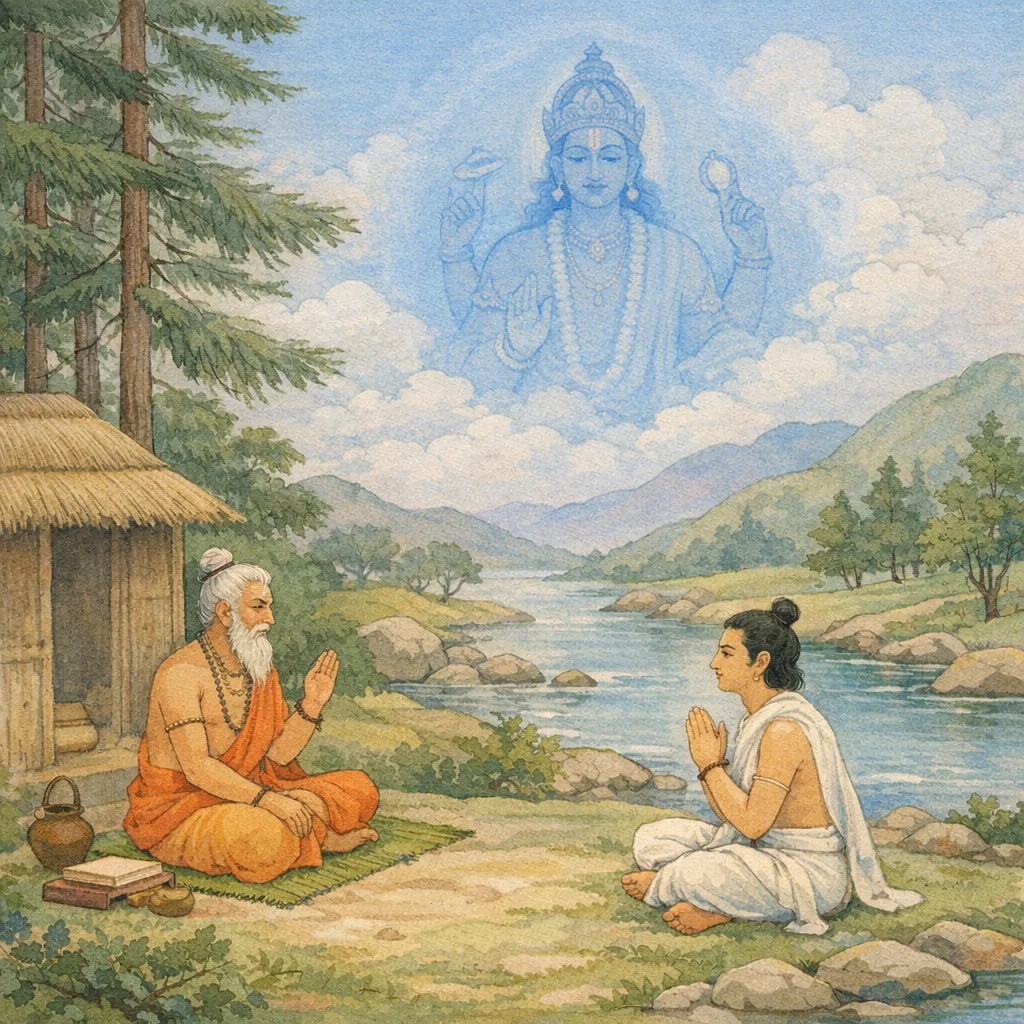
Parashara briefly concludes for Maitreya the teaching called the “third pratisanchara,” the liberating dissolution into the eternal Brahman, and declares that the Purana’s five marks—creation, re-creation, dynasties, manvantaras, and the deeds of royal lines—have been fully related. Maitreya, grateful, says all doubts are dispelled, the mind is purified, and he has understood varna-dharma, the ways of pravritti and nivritti, karma, and knowledge; nothing more need be asked. Parashara then praises the Vaishnava Purana as Veda-sanctioned and sin-destroying, teaching in the phalashruti that mere hearing yields fruits equal to great sacrifices, pilgrimages, and gifts; especially, name-kirtana bhakti burns sins like fire, bathing in the Yamuna at Mathura and observing Dvadashi vows bring equivalent merit, and hearing the Purana is equal to delivering one’s ancestors. Finally he recounts the flow of transmission from Brahma through Rbhu, Priyambhrata and others down to Naga, the recovery of memory through Pulastya-vara, and the charge that at the end of Kali Maitreya will instruct Cinika; in the closing hymns Hari is wholly praised as all-being yet formless, Lord of sacrifice, enjoyer as the deities of the ancestors, and giver of moksha—the supreme Brahman, cause of the universe.
Shlokas
Verse 1
इत्य् एष कथितः सम्यक् तृतीयः प्रतिसंचरः आत्यन्तिको विमुक्तिर् या लयो ब्रह्मणि शाश्वते
Thus the third pratisaṃcara has been rightly described—namely, the ultimate liberation: complete merging into the eternal Brahman.
Verse 2
सर्गश् च प्रतिसर्गश् च वंशो मन्वन्तराणि च वंशानुचरितं चैव भवतो गदितं मया
Creation and re-creation; the lines of descent; the successive Manvantaras; and the chronicles that follow those dynasties—all these, O revered one, have been declared by me to you.
Verse 3
पुराणं वैष्णवं त्व् एतत् सर्वकिल्बिषनाशनम् विशिष्टं सर्वशास्त्रेभ्यः पुरुषार्थोपपादकम्
This Vaishnava Purāṇa truly destroys every stain of sin. Distinguished above all scriptures, it establishes the path to the true aims of human life.
Verse 4
तुभ्यं यथावन् मैत्रेय प्रोक्तं शुश्रूषवे ऽव्ययम् यद् अन्यद् अपि वक्तव्यं तत् पृच्छाद्य वदामि ते
O Maitreya, to you who long to listen I have spoken the imperishable truth exactly as it should be. If anything still remains to be said, ask now; I shall tell it to you.
Verse 5
भगवन् कथितं सर्वं यत् पृष्टो ऽसि मया मुने श्रुतं चैतन् मया भक्त्या नान्यत् प्रष्टव्यम् अस्ति मे
O venerable sage, you have told in full all that I asked of you. I have heard it with devotion; for me, there is nothing else left to ask.
Verse 6
विच्छिन्नाः सर्वसंदेहा वैमल्यं मनसः कृतम् त्वत्प्रसादान् मया ज्ञाता उत्पत्तिस्थितिसंयमाः
All my doubts have been cut away; my mind has been made clear and stainless. By your grace I have understood the principles of origination, preservation, and restraint—creation, continuance, and dissolution within the cosmic order.
Verse 7
ज्ञातश् चतुर्विधो राशिः शक्तिश् च त्रिविधा गुरो विज्ञाता चापि कार्त्स्न्येन त्रिविधा भावभावना
O Guru, the aggregate has been understood as fourfold, and power (śakti) as threefold. Fully, I have also comprehended the threefold bhāva-bhāvanā, by which beings and states are conceived and brought to manifestation.
Verse 8
त्वत्प्रसादान् मया ज्ञातं ज्ञेयैर् अन्यैर् अलं द्विज यथैतद् अखिलं विष्णोर् जगन् न व्यतिरिच्यते
By your gracious favor, O twice-born sage, I have understood that there is no need of any other objects of knowledge; for this entire universe, in its totality, does not exist apart from Vishnu.
Verse 9
कृतार्थो ऽस्म्य् अपसंदेहस् त्वत्प्रसादान् महामुने वर्णधर्मादयो धर्मा विदिता यद् अशेषतः
Through your grace, O great sage, I am fulfilled and free from doubt—for the dharmas beginning with the duties of the social orders have been made known to me completely, without remainder.
Verse 10
प्रवृत्तं च निवृत्तं च ज्ञातं कर्म मयाखिलम् प्रसीद विप्रप्रवर नान्यत् प्रष्टव्यम् अस्ति मे
I have now understood in full the way of action and the way of withdrawal—every duty in its entirety. Be gracious, O best of Brahmins; I have nothing further to ask.
Verse 11
यद् अस्य कथनायासैर् योजितो ऽसि मया गुरो तत् क्षम्यतां विशेषो ऽस्ति न सतां पुत्रशिष्ययोः
O Guru, if I have pressed you into the strain of explaining all this with my repeated requests, may that be forgiven. For among the noble there is no sense of ‘difference’—not between father and son, nor between teacher and disciple.
Verse 12
एतत् ते यन् मयाख्यातं पुराणं वेदसंमितम् श्रुते ऽस्मिन् सर्वदोषोत्थः पापराशिः प्रणश्यति
This Purāṇa, which I have declared to you and which accords with the Veda—when it is heard, the entire heap of sins arising from every fault is destroyed.
Verse 13
सर्गश् च प्रतिसर्गश् च वंशो मन्वन्तराणि च वंशानुचरितं कृत्स्नं मयात्र तव कीर्तितम्
Creation and re-creation; the lines of descent; the successive Manvantaras; and the complete chronicles of the dynasties—of all these I have spoken here to you in full.
Verse 14
अत्र देवास् तथा दैत्या गन्धर्वोरगराक्षसाः यक्षा विद्याधराः सिद्धाः कथ्यन्ते ऽप्सरसस् तथा
Here are described, in due order, the diverse orders of beings—gods and Daityas; Gandharvas; serpentine races and Rākṣasas; Yakṣas; Vidyādharas; Siddhas; and likewise the Apsarases.
Verse 15
मुनयो भावितात्मानः कथ्यन्ते तपसान्विताः चातुर्वर्ण्यं तथा पुंसां विशिष्टचरिता नराः
They are called sages whose inner selves are refined—men endowed with austerity. Likewise, among human beings, the fourfold social order is taught, distinguished by the specific conduct and duties of each.
Verse 16
पुण्याः प्रदेशा मेदिन्याः पुण्या नद्यो ऽथ सागराः पर्वताश् च महापुण्याश् चरितानि च धीमताम्
Holy are the regions of the earth; holy are the rivers, and so too the oceans. Most holy are the mountains—and holy as well are the life-stories and noble deeds of the wise.
Verse 17
वर्णधर्मादयो धर्मा वेदशाखाश् च कृत्स्नशः येषां संश्रवणात् सद्यः सर्वपापैः प्रमुच्यते
All the ordinances of dharma—beginning with the duties of the social orders—and all the branches of the Veda in full: by hearing them recited, one is at once released from every sin.
Verse 18
उत्पत्तिस्थितिनाशानां हेतुर् यो जगतो ऽव्ययः स सर्वभूतः सर्वात्मा कथ्यते भगवान् हरिः
He who is the imperishable cause of the world’s arising, continuance, and dissolution—He is present as all beings and is the inner Self of all; He is spoken of as Bhagavān Hari.
Verse 20
यन् नामकीर्तनं भक्त्या विलायनम् अनुत्तमम् मैत्रेयाशेषपापानां धातूनाम् इव पावकः
O Maitreya, the chanting of His Name with devotion is the unsurpassed dissolver of all sins—just as fire melts and refines metals.
Verse 22
हिरण्यगर्भदेवेन्द्ररुद्रादित्याश्विवायुभिः पावकैर् वसुभिः साध्यैर् विश्वेदेवादिभिः सुरैः
Along with Hiraṇyagarbha, Devendra (Indra), Rudra, the Ādityas, the Aśvins, and Vāyu; with the Pāvakas, the Vasus, the Sādhyas, and the Viśvedevas—indeed with all these orders of the shining gods (He is praised).
Verse 23
यक्षरक्षोरगैः सिद्धैर् दैत्यगन्धर्वदानवैः अप्सरोभिस् तथा तारानक्षत्रैः सकलैर् ग्रहैः
Along with Yakṣas, Rākṣasas, and Nāgas; with the Siddhas; with Daityas, Gandharvas, and Dānavas; and with the Apsarases—together with all the stars, constellations, and the complete host of planets (the cosmic realm is filled).
Verse 24
सप्तर्षिभिस् तथा धिष्ण्यैर् धिष्ण्याधिपतिभिस् तथा ब्राह्मणाद्यैर् मनुष्यैश् च तथैव पशुभिर् मृगैः
Along with the Seven Great Seers, with the sacred cosmic stations and their presiding lords; likewise with human beings beginning with the brāhmaṇas, and also with cattle and the wild creatures of the forests—all are encompassed within this ordered domain.
Verse 25
सरीसृपैर् विहंगैश् च पलाशाद्यैर् महीरुहैः वनाद्रिसागरसरित्पातालैः सधरादिभिः
It is filled with creeping creatures and birds, with great trees such as the palāśa and others; with forests, mountains, oceans, and rivers; with the nether regions (Pātāla) and with the supporting earth and its various divisions.
Verse 26
शब्दादिभिश् च सहितं ब्रह्माण्डम् अखिलं द्विज मेरोर् इवाणुर् यस्यैतद् यन्मयं च द्विजोत्तम
O twice-born, this entire cosmic egg—together with sound and the rest of the subtle elements—is but an atom when set against Him, as Mount Meru is to a mere speck; and indeed, O best of Brahmins, this whole universe is of His very nature, made of Him and pervaded by Him.
Verse 27
स सर्वः सर्ववित् सर्वस्वरूपो रूपवर्जितः भगवान् कीर्तितो विष्णुर् अत्र पापप्रणाशनः
He is all—knower of all—whose very nature is the essence of everything, yet who is free from limiting form. Here that Blessed Lord is praised as Viṣṇu, the destroyer of sin.
Verse 28
यद् अश्वमेधावभृथे स्नातः प्राप्नोति वै फलम् सकलं तद् अवाप्नोति श्रुत्वैतन् मुनिसत्तम
Whatever complete reward is truly gained by one who bathes at the concluding ablution of the Aśvamedha sacrifice—O best of sages—one attains that entire merit simply by hearing this sacred teaching.
Verse 29
प्रयागे पुष्करे चैव कुरुक्षेत्रे तथार्बुदे कृतोपवासः प्राप्नोति तद् अस्य श्रवणान् नरः
Whatever merit is gained by fasting at Prayāga, Puṣkara, Kurukṣetra, and Arbuda, that very fruit a person attains simply by hearing this Purāṇa.
Verse 30
यद् अग्निहोत्रे सुहुते वर्षेणाप्नोति वै फलम् महापुण्यमयं विप्र तद् अस्य श्रवणात् सकृत्
O brāhmaṇa, the supremely meritorious fruit gained by performing the Agnihotra well for a full year is obtained likewise by hearing this sacred Purāṇic teaching even once.
Verse 31
यज् ज्येष्ठशुक्लद्वादश्यां स्नात्वा वै यमुनाजले मथुरायां हरिं दृष्ट्वा प्राप्नोति परमां गतिम्
Whoever, on the bright Dvādaśī of the month of Jyeṣṭha, bathes in the waters of the Yamunā and then beholds Hari in Mathurā, attains the supreme destination—the highest liberation in the Lord.
Verse 33
यमुनासलिले स्नातः पुरुषो मुनिसत्तम ज्येष्ठामूले ऽमले पक्षे द्वादश्याम् उपवासकृत्
O best of sages, a man who bathes in the waters of the Yamunā and, in the pure bright fortnight of Jyeṣṭha (when Mūla prevails), keeps a fast on Dvādaśī becomes attuned to dharma’s cleansing order and the Lord’s sanctifying grace.
Verse 34
समभ्यर्च्याच्युतं सम्यङ् मथुरायां समाहितः अश्वमेधस्य यज्ञस्य प्राप्नोत्य् अविकलं फलम्
Whoever, with a gathered mind, worships Achyuta rightly in Mathurā attains—without diminution—the complete fruit of the Aśvamedha sacrifice.
Verse 35
आलोक्यर्द्धिम् अथान्येषाम् उन्नीतानां स्ववंशजैः एतत् किलोचुर् अन्येषाम् पितरः सपितामहाः
Seeing the prosperity of others, raised up by their own descendants, the forefathers—together with the grandsires—of yet other men declared: “Truly, it is so.”
Verse 36
कच्चिद् अस्मत्कुले जातः कालिन्दीसलिलाप्लुतः अर्चयिष्यति गोविन्दं मथुरायाम् उपोषितः
Has one been born in our lineage who—bathed in the waters of the Kāliṇdī (Yamunā) and fasting in Mathurā—will worship Govinda?
Verse 37
ज्येष्ठामूले सिते पक्षे येनैवं वयम् अप्य् उत पराम् ऋद्धिम् अवाप्स्यामस् तारिताः स्वकुलोद्भवैः
In the bright fortnight, under the asterisms Jyeṣṭhā and Mūla, by this very observance even we, in time, shall attain the highest prosperity, carried across by those born in our own lineage.
Verse 38
ज्येष्ठामूले सिते पक्षे समभ्यर्च्य जनार्दनम् धन्यानां कुलजः पिण्डान् यमुनायां प्रदास्यति
In the bright fortnight at the time of Jyeṣṭhā and Mūla, having duly worshipped Janārdana, one born in a virtuous lineage should offer piṇḍa-oblations into the Yamunā.
Verse 39
तस्मिन् काले समभ्यर्च्य तत्र कृष्णं समाहितः दत्त्वा पिण्डं पितृभ्यश् च यमुनासलिलाप्लुतः
At that time, with his mind gathered into stillness, he duly worshipped Kṛṣṇa there; and having offered the piṇḍa-oblation to the ancestors, he bathed, immersed in the waters of the Yamunā.
Verse 40
यद् आप्नोति नरः पुण्यं तारयन् स्वपितामहान् श्रुत्वाध्यायं तद् आप्नोति पुराणस्यास्य भक्तिमान्
Whatever merit a man gains by ferrying even his own forefathers across the ocean of saṃsāra, that very merit is gained by the devoted listener simply by hearing a single chapter of this Purāṇa.
Verse 41
एतत् संसारभीरूणां परित्राणम् अनुत्तमम् दुःस्वप्ननाशनं नॄणां सर्वदुष्टनिबर्हणम्
This is the unsurpassed refuge for those who tremble at the wheel of saṃsāra; it destroys men’s evil dreams and drives away every form of wickedness.
Verse 42
इदम् आर्षं पुरा प्राह ऋभवे कमलोद्भवः ऋभुः प्रियव्रतायाह स च भागुरये ऽब्रवीत्
Long ago, the Lotus-born (Brahmā) imparted this primordial seers’ teaching to Ṛbhu. Ṛbhu taught it to Priyavrata, and Priyavrata in turn declared it to Bhāguri.
Verse 43
भागुरिः स्तम्भमित्राय दधीचाय स चोक्तवान् सारस्वताय तेनोक्तं भृगुः सारस्वताद् अपि
Bhāguri taught it to Stambhamitra; Stambhamitra in turn taught it to Dadhīca. By him it was taught to Sārasvata, and from Sārasvata again Bhṛgu received it.
Verse 44
भृगुणा पुरुकुत्साय नर्मदायै स चोक्तवान् नर्मदा धृतराष्ट्राय नागायापूरणाय च
Bhṛgu spoke this sacred account to King Purukutsa and also to the goddess-river Narmadā. Narmadā in turn conveyed it to Dhṛtarāṣṭra, to the Nāga, and likewise to Āpūraṇa.
Verse 45
ताभ्यां च नागराजाय प्रोक्तं वासुकये द्विज वासुकिः प्राह वत्साय वत्सश् चाश्वतराय वै
And by those two it was conveyed to the king of the Nāgas, O twice-born one—to Vāsuki. Vāsuki then taught it to Vatsa, and Vatsa indeed passed it on to Aśvatara.
Verse 46
कम्बलाय च तेनोक्तम् एलापत्राय तेन वै
He declared it to Kambala; and indeed, in the same way, to Elāpatra as well.
Verse 47
पातालं समनुप्राप्तस् ततो वेदशिरा मुनिः प्राप्तवान् एतद् अखिलं स वै प्रमतये ददौ
Then, having descended to Pātāla, the sage Vedashiras obtained it all in full, and indeed bestowed it upon Pramati.
Verse 48
दत्तं प्रमतिना चैव जातूकर्णाय धीमते जातूकर्णेन चैवोक्तम् अन्येषां पुण्यशालिनाम्
Pramati bestowed it upon the wise Jātūkarṇa; and Jātūkarṇa, in turn, declared it onward to other virtuous bearers of merit.
Verse 49
पुलस्त्यवरदानेन ममाप्य् एतत् स्मृतिं गतम् मयापि तुभ्यं मैत्रेय यथावत् कथितं त्व् इदम्
By the boon granted by Pulastya, this teaching returned into my own remembrance; thus, O Maitreya, I have related it to you exactly as it truly is.
Verse 50
त्वम् अप्य् एतच् छिनीकाय कलेर् अन्ते वदिष्यसि
You too shall proclaim this very message to Chinīkā at the close of the Kali age.
Verse 51
इत्य् एतत् परमं गुह्यं कलिकल्मषनाशनम् यः शृणोति नरः पापैः स सर्वैर् द्विज मुच्यते
Thus this supremely secret and profound teaching destroys the defilements born of the Kali age. O twice-born, whoever hears it is freed from all sins.
Verse 52
पितृयक्षमनुष्येभ्यः समस्तामरसंस्तुतिः कृता तेन भवेद् एतद् यः शृणोति दिने दिने
For the Pitṛs, the Yakṣas, and humankind, this becomes a complete hymn of praise, lauded even by all the immortals; and such is the fruit for the one who listens to it day after day.
Verse 53
कपिलादानजनितं पुण्यम् अत्यन्तदुर्लभम् श्रुत्वा त्व् अस्य दशाध्यायान् अवाप्नोति न संशयः
The merit born of gifting a tawny cow (kapilā-dāna) is exceedingly rare; yet by hearing these ten chapters one surely attains that very merit—of this there is no doubt.
Verse 54
यस् त्वैतत् सकलं शृणोति पुरुषः कृत्वा मनस्य् अच्युतं सर्वं सर्वमयं समस्तजगताम् आधारम् आत्माश्रयम् ज्ञानं ज्ञेयम् अनन्तम् आदिरहितं सर्वामराणां हितं स प्राप्नोति न संशयो ऽस्त्य् अविकलं यद् वाजिमेधे फलम्
But whoever listens to this entire teaching, fixing Acyuta within the mind—He who is all, who pervades all, the support of all worlds, self-established; who is both knowledge and the object of knowledge; infinite, beginningless, and the benefactor of all the immortals—without doubt attains in full the very fruit won by the Aśvamedha sacrifice.
Verse 55
यत्रादौ भगवांश् चराचरगुरुर् मध्ये तथान्ते च स ब्रह्मज्ञानमयो ऽच्युतो ऽखिलजगन्मध्यान्तसर्गप्रभुः तच् छृण्वन् पुरुषः पवित्रपरमं भक्त्या पठन् धारयन् प्राप्नोत्य् अस्ति न तत् समस्तभुवनेष्व् एकान्तसिद्धिर् हरिः
He in whom—at the beginning, in the middle, and at the end—abides the Bhagavān, the Guru of all that moves and does not move; that imperishable Acyuta, made of Brahma-knowledge itself, the Lord of creation in the beginning, middle, and end of the entire universe—whoever hears of Him, or with bhakti recites and holds this supremely purifying teaching in the heart, attains the highest consummation. In all the worlds there is nothing beyond that single-pointed perfection: Hari alone.
Verse 56
यस्मिन् न्यस्तमतिर् न याति नरकं स्वर्गो ऽपि यच् चिन्तने विघ्नो यत्र निवेशितात्ममनसो ब्राह्मो ऽपि लोको ऽल्पकः मुक्तिं चेतसि यः स्थितो ऽमलधियां पुंसां ददात्य् अव्ययः किं चित्रं यद् अघं प्रयाति विलयं तत्राच्युते कीर्तिते
He in whom the mind, once set, never falls into hell—whose remembrance makes even heaven seem a hindrance; for one whose self and mind are fixed in Him, even Brahmā’s world is trifling. Abiding in the heart, that imperishable Lord grants liberation to those of stainless understanding. What wonder, then, that sin is dissolved when Acyuta is praised?
Verse 57
यज्ञैर् यज्ञविदो यजन्ति सततं यज्ञेश्वरं कर्मिणो यं यं ब्रह्ममयं परापरपरं ध्यायन्ति च ज्ञानिनः यं संप्राप्य न जायते न म्रियते नो वर्धते हीयते नैवासन् न च सद् भवत्य् अति ततः किं वा हरेः श्रूयताम्
Ritualists skilled in sacrifice worship the Lord of sacrifice ceaselessly through yajña; the knowers meditate on Him as the very essence of Brahman, the Supreme beyond both higher and lower. Having attained Him, one is not born, does not die, neither increases nor diminishes; He is not merely ‘non-being’ nor merely ‘being’—He transcends even these. What more, then, is there to be heard of Hari?
Verse 58
कव्यं यः पितृरूपधृग् विधिहुतं हव्यं च भुङ्क्ते विभुर् देवत्वे भगवान् अनादिनिधनः स्वाहास्वधासंज्ञितः यस्मिन् ब्रह्मणि सर्वशक्तिनिलये मानानि नो मानिनां निष्ठायै प्रभवन्ति हन्ति कलुषं श्रोत्रं स यातो हरिः
He is the all-pervading Lord who, taking the very form of the Pitṛs, partakes of the kavya-offerings; and who, as the deity, receives the havya poured according to sacred rule—known in the rites as “svadhā” and “svāhā,” the Blessed One without beginning or end. In that Brahman, the refuge of every power, the proud find no footing for their self-importance; rather, steadfastness is born in those who seek true establishment. Hearing of Him destroys impurity: thus has Hari been declared.
Verse 59
नान्तो ऽस्ति यस्य न च यस्य समुद्भवो ऽस्ति वृद्धिर् न यस्य परिणामविवर्जितस्य नापक्षयं च समुपैत्य् अविकल्पवस्तु यस् तं नतो ऽस्मि पुरुषोत्तमम् ईशम् ईड्यम्
I bow to the Supreme Lord—Puruṣottama, the adorable Sovereign—who has no end and no origin; who neither grows nor undergoes change, being beyond all transformation; who never declines; who is the indivisible, non-dual Reality itself.
Verse 60
तस्यैव यो ऽनुगुणभुग् बहुधैक एव शुद्धो ऽप्य् अशुद्ध इव मूर्तिविभागभेदैः ज्ञानान्वितः सकलतत्त्वविभूतिकर्ता तस्मै नतो ऽस्मि पुरुषाय सदाव्ययाय
I bow to that eternal, undecaying Supreme Person—who, though truly One, appears as many through the distinctions of embodied forms; who, ever pure, seems impure only by the differences of manifestation; who is endowed with perfect knowledge and brings forth all principles and their powers that constitute the universe.
Verse 61
ज्ञानप्रवृत्तिनियमैक्यमयाय पुंसो भोगप्रदानपटवे त्रिगुणात्मकाय अव्याकृताय भवभावनकारणाय वन्दे स्वरूपभवनाय सदाजराय
I adore the ever-unaging Lord—who, for embodied beings, is the single unity of knowledge, activity, and the laws that govern them; who is supremely able to bestow the fruits of experience; who, as the essence of the three guṇas, yet remains the Unmanifest; the causal ground by which becoming is conceived and brought forth—whose own nature is His abode.
Verse 62
व्योमानिलाग्निजलभूरचनामयाय शब्दादिभोग्यविषयोपनयक्षमाय पुंसः समस्तकरणैर् उपकारकाय व्यक्ताय सूक्ष्मविमलाय सदा नतो ऽस्मि
I ever bow to Him who is the very fabric of ether, wind, fire, water, and earth; who can present to embodied beings the objects of enjoyment—sound and the rest; who, through all the organs, becomes the benefactor of the person; who is the manifest world and yet the subtle, stainless Reality.
Verse 63
इति विविधम् अजस्य यस्य रूपं प्रकृतिपरात्ममयं सनातनस्य प्रदिशतु भगवान् अशेषपुंसां हरिर् अपजन्मजरादिकां स सिद्धिम्
Thus manifold is the form of the Unborn, the Eternal One—whose being is at once Nature and the Supreme Self. May the Blessed Lord Hari bestow upon all beings the final attainment: perfection free from birth, old age, and all other worldly afflictions.
Frequently Asked Questions
It identifies the ‘third pratisaṃcara’ as ātyantika-vimukti—complete dissolution/merging into the eternal Brahman—framing liberation as the final re-absorption beyond cyclical creation and dissolution.
Sarga (primary creation), pratisarga (secondary creation/re-creation), vaṃśa (genealogies), manvantara (cosmic epochs ruled by Manus), and vaṃśānucarita (dynastic chronicles). Parāśara states he has taught all these.
Phalaśruti is the ‘statement of fruits’ attached to hearing/reciting a sacred text. Here it promises sin-destruction and merit comparable to major sacrifices (like Aśvamedha), tīrtha-fasts, and great gifts—through devoted listening, recitation, and internalization of Acyuta.
It legitimizes the teaching as āṛṣa (seer-origin) by tracing its custodianship from Brahmā through sages, kings, and nāga-lords to Parāśara, and projects its future transmission through Maitreya—linking authority, memory (smṛti), and liberating efficacy.