Adhyaya 18
विषप्रयोगः कृत्योत्पादनं च (प्रह्लादस्य अवध्यता, कृत्याविनाशः, पुरोहितानां रक्षणम्)
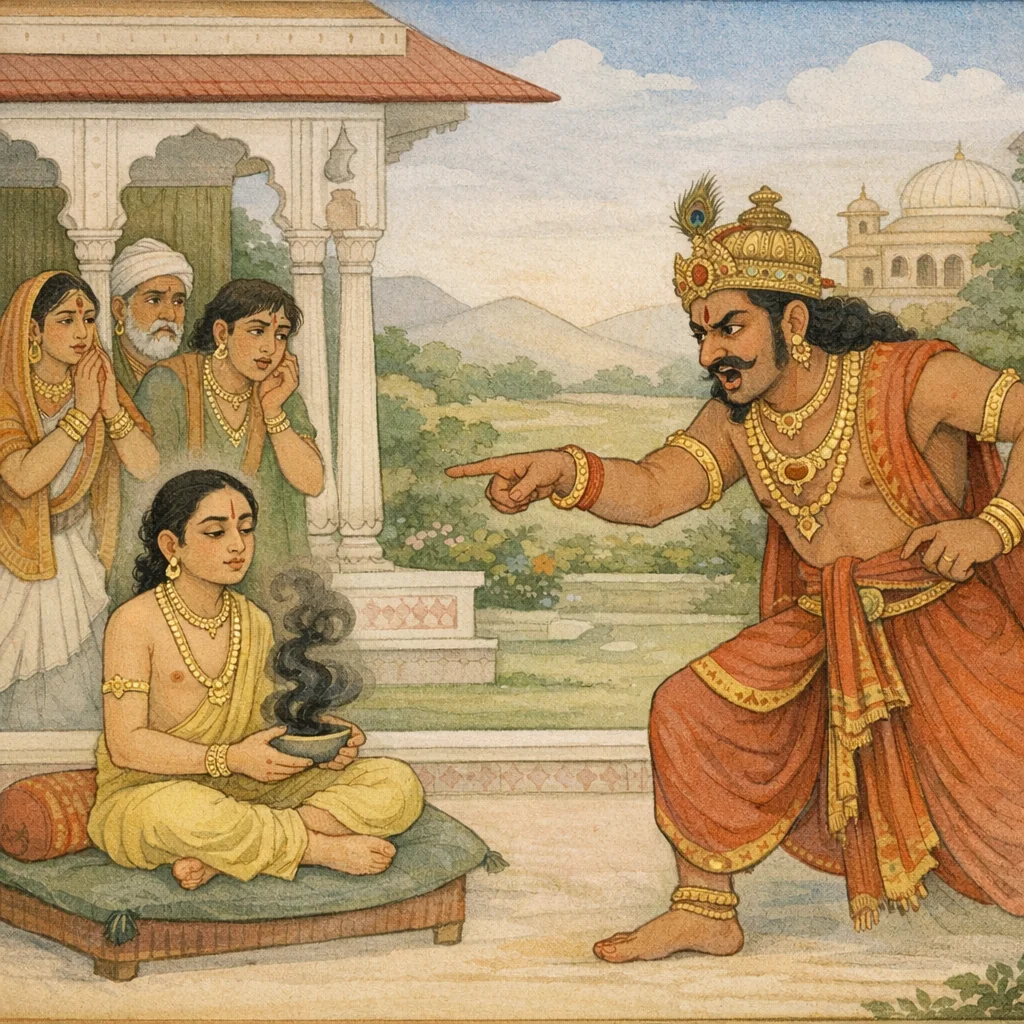
Parashara narrates how Hiranyakashipu ordered Prahlada's food poisoned with Halahala. Prahlada sanctified it by uttering Ananta's name and consumed it unharmed. The priests then created a fiery 'Krtya' demoness to kill him. However, her trident shattered against Prahlada's chest because Hari resides within him. The Krtya turned back and burned the priests, but Prahlada prayed to Janardana to revive them, saving his enemies.
Shlokas
Verse 1
तस्यैतां दानवाश् चेष्टां दृष्ट्वा दैत्यपतेर् भयात् आचचक्षुः स चोवाच सूदान् आहूय सत्वरः
Seeing this manoeuvre of his, the Dānavas—out of fear of the lord of the Daityas—reported it at once; and he, summoning the cooks in haste, issued his command.
Verse 2
हे सूदा मम पुत्रो ऽसाव् अन्येषाम् अपि दुर्मतिः कुमार्गदेशिको दुष्टो हन्यताम् अविलम्बितम्
“O Sūda, that one—though my own son—has become a corrupter of others as well: a man of perverse counsel, a teacher of the wrong path, wicked in conduct. Let him be put to death at once, without delay.”
Verse 3
हालाहलं विषं तस्य सर्वभक्ष्येषु दीयताम् अविज्ञातम् असौ पापो वध्यतां मा विचार्यताम्
“Let the deadly Hālāhala poison be mixed into all his food. That sinful wretch acts unseen and unrecognized—put him to death at once; let there be no deliberation.”
Verse 4
ते तथैव ततश् चक्रुः प्रह्लादाय महात्मने विषदानं यथाज्ञप्तं पित्रा तस्य महात्मनः
Then, exactly as they had been commanded, they carried out the giving of poison to the great-souled Prahlāda—just as his father had ordered, against that noble one.
Verse 5
हालाहलं विषं घोरम् अनन्तोच्चारणेन सः अभिमन्त्र्य सहान्नेन मैत्रेय बुभुजे तदा
That dreadful poison, Hālāhala—having been sanctified by the utterance of Ananta’s name—he then consumed, O Maitreya, taking it together with food.
Verse 6
अविकारं स तद् भुक्त्वा प्रह्लादः स्वस्थमानसः अनन्तख्यातिनिर्वीर्यं जरयाम् आस दुर्विषम्
Having consumed that terrible poison, Prahlada remained wholly unchanged. By the boundless power of his sacred repute, he caused that deadly venom to lose its strength.
Verse 7
ततः सूदा भयत्रस्ता जीर्णं दृष्ट्वा महाविषम् दैत्येश्वरम् उपागम्य प्रणिपत्येदम् अब्रुवन्
Then the Sūdas, shaken with fear, seeing that the mighty poison had been consumed, approached the lord of the Daityas; and, bowing down before him, they spoke these words.
Verse 8
दैत्यराज विषं दत्तम् अस्माभिर् अतिभीषणम् जीर्णं तच् च सहान्नेन प्रह्लादेन सुतेन ते
O king of the Daityas, we administered a most dreadful poison; yet your son Prahlada consumed and digested it—even along with his food—unharmed.
Verse 9
त्वर्यतां त्वर्यतां सद्यो हे हे दैत्यपुरोहिताः कृत्यां तस्य विनाशाय उत्पादयत मा चिरम्
“Hurry—hurry at once! O priests of the Daityas, come, come—without delay. Raise up a kṛtyā, a destructive rite-made being, for his ruin; do not take long!”
Verse 10
सकाशम् आगम्य ततः प्रह्लादस्य पुरोहिताः सामपूर्वम् अथोचुस् ते प्रह्लादं विनयान्वितम्
Then, approaching Prahlāda, his household preceptors addressed the humble, well-mannered Prahlāda first with conciliatory words—gentle and diplomatically spoken.
Verse 11
जातस् त्रैलोक्यविख्यात आयुष्मन् ब्रह्मणः कुले दैत्यराजस्य तनयो हिरण्यकशिपोर् भवान्
O long-lived one, renowned throughout the three worlds—you were born in Brahmā’s lineage, as the son of the Daitya king Hiraṇyakaśipu.
Verse 12
किं दैवैः किम् अनन्तेन किम् अन्येन तवाश्रयः पिता समस्तलोकानां त्वं तथैव भविष्यसि
What need have you of the gods? What need of Ananta, or of anything else? You have taken refuge in the Father of all worlds, and you too shall be established in that same supreme state.
Verse 13
तस्मात् परित्यजैनां त्वं विपक्षस्तवसंहिताम् वाच्यः पिता समस्तानां गुरूणां परमो गुरुः
Therefore, abandon this hostile stance you have gathered within yourself. Speak of Him who is the Father of all, the supreme Teacher, the Teacher of all teachers.
Verse 14
एवम् एतन् महाभागाः श्लाघ्यम् एतन् महाकुलम् मरीचेः सकले ऽप्य् अस्मिन् त्रैलोक्ये नान्यथा वदेत्
So indeed it is, O greatly fortunate ones: this noble and illustrious lineage of Marīci is truly worthy of praise. Throughout the entire threefold world, none would speak of it otherwise.
Verse 15
पिता च मम सर्वस्मिञ् जगत्य् उत्कृष्टचेष्टितः एतद् अप्य् अवगच्छामि सत्यम् अत्रापि नानृतम्
My father, in all this world, is foremost in conduct and accomplishment. This too I understand: here also it is truth—there is no falsehood in it.
Verse 16
गुरूणाम् अपि सर्वेषां पिता परमको गुरुः यद् उक्तं भ्रान्तिस् तत्रापि स्वल्पापि हि न विद्यते
Even among all teachers, the father is the highest Guru. In what he has spoken there is not even the slightest error—no trace of delusion is found there.
Verse 17
पिता गुरुर् न संदेहः पूजनीयः प्रयत्नतः तत्रापि नापराध्यामीत्य् एवं मनसि मे स्थितम्
A father is, without any doubt, a guru and must be honored with sincere effort. Even so, this resolve stands firm within my heart: “Even there I shall not commit wrongdoing.”
Verse 18
यत् त्व् एतत् किम् अनन्तेनेत्य् उक्तं युष्माभिर् ईदृशम् को ब्रवीति यथायुक्तं किं तु नैतद् वचो ऽर्थवत्
But this remark of yours—“What is this to Ananta?”—is not something a discerning person would say in a fitting way; indeed, such words are not truly meaningful.
Verse 19
इत्य् उक्त्वा सो ऽभवन् मौनी तेषां गौरवयन्त्रितः प्रहस्य च पुनः प्राह किम् अनन्तेन साध्व् इति
Having spoken thus, he fell silent, restrained by reverence for them. Then, with a smile, he spoke again: “Good sir, what need is there for endless elaboration?”
Verse 20
साधु भोः किम् अनन्तेन साधु भो गुरवो मम श्रूयतां यद् अनन्तेन यदि खेदं न यास्यथ
Well spoken—what need is there for endless elaboration? Well spoken, my revered teachers. If you will not grow weary, then please hear what I shall set forth at length.
Verse 21
धर्मार्थकाममोक्षाख्यः पुरुषार्थ उदाहृतः चतुष्टयम् इदं यस्मात् तस्मात् किं किम् इदं वृथा
The aims of human life are declared to be four—Dharma, Artha, Kāma, and Mokṣa. What could lie beyond these? Why then this vain wandering after other pursuits?
Verse 22
मरीचिमिश्रैर् दक्षेण तथैवान्यैर् अनन्ततः धर्मः प्राप्तस् तथैवान्यैर् अर्थः कामस् तथापरैः
Through Marīci and the sages of his line, through Dakṣa, and through countless others, Dharma was obtained and established; by other lineages Artha was secured, and by yet others Kāma was regulated—thus, in endless variety, the aims of life were set within the world’s unfolding.
Verse 23
तत्तत्त्ववेदिनो भूत्वा ज्ञानध्यानसमाधिभिः अवापुर् मुक्तिम् अपरे पुरुषा ध्वस्तबन्धनाः
Becoming knowers of Reality as it truly is, some—through knowledge, meditation, and the stillness of samādhi—attained liberation, their bonds utterly destroyed.
Verse 24
संपदैश्वर्यमाहात्म्यज्ञानसंततिकर्मणाम् विमुक्तेश् चैकतो लभ्यं मूलम् आराधनं हरेः
Prosperity, sovereign power, true greatness, liberating knowledge, worthy progeny, the fruits of righteous action—and even final release: all of these are obtained together from a single root, the worship of Hari.
Verse 25
यतो धर्मार्थकामाख्यं विमुक्तिश् च फलं द्विजाः तेनापि हि किम् इत्य् एवम् अनन्तेन किम् उच्यते
O twice-born ones, from whom arise the fruits called dharma, artha, and kāma—and even the final fruit, liberation—what could even that fruit be to Him? Thus, what can truly be said of the Infinite?
Verse 26
किं वात्र बहुनोक्तेन भवन्तो गुरवो मम वदन्तु साधु वासाधु विवेको ऽस्माकम् अल्पकः
What need is there for many words here? You are my revered teachers—please tell me plainly what is right and what is not right, for our discernment is but small.
Verse 27
दह्यमानस् त्वम् अस्माभिर् अग्निना बाल रक्षितः भूयो न वक्ष्यसीत्य् एवं नैवं ज्ञातो ऽस्य् अबुद्धिमान्
“Though you were being burned by the fire raised by us, you were protected, child. Thinking, ‘Now you will never speak again,’ that fool did not understand the truth of what had happened.”
Verse 28
यद्य् अस्मद्वचनान् मोहग्राहं न त्यक्ष्यते भवान् ततः कृत्यां विनाशाय तव सृक्ष्याम दुर्मते
If, despite our words, you do not abandon this delusive obsession, then—O evil-minded one—we shall unleash a kṛtyā to bring about your destruction.
Verse 29
कः केन रक्ष्यते जन्तुर् जन्तुः कः केन हन्यते हन्ति रक्षति चैवात्मा जगत् सर्वं चराचरम्
Who is protected by whom, and what creature is slain by whom? It is the Self alone that both destroys and safeguards; the Self pervades and governs the entire universe—everything moving and unmoving.
Verse 30
इत्य् उक्तास् तेन ते क्रुद्धा दैत्यराजपुरोहिताः कृत्याम् उत्पादयाम् आसुर् ज्वालामालोज्ज्वलाननाम्
Thus addressed by him, the priests of the Daitya king flared up in anger; and, in their wrath, they brought forth a kṛtyā—an engineered rite-born force—its face blazing with garlands of flame.
Verse 31
अतिभीमा समागम्य पादन्यासक्षतक्षितिः शूलेन सा सुसंक्रुद्धा तं जघानाथ वक्षसि
Then Atibhīmā rushed forward—so forceful that the very earth was scarred beneath her footfalls—and, inflamed with fierce wrath, she struck him on the chest with her trident.
Verse 32
तत् तस्य हृदयं प्राप्य शूलं बालस्य दीप्तिमत् जगाम खण्डितं भूमौ तत्रापि शतधाभवत्
That blazing spear, having struck the boy’s heart, fell shattered upon the ground—and even there it broke into a hundred pieces.
Verse 33
यत्रानपायी भगवान् हृद्य् आस्ते हरिर् ईश्वरः भङ्गो भवति वज्रस्य तत्र शूलस्य का कथा
Where the imperishable Lord Hari, the Supreme Ruler, abides within the heart and never departs—there even the thunderbolt is shattered; what then could a mere spear possibly accomplish?
Verse 34
अपापे तत्र पापैश् च पातिता दैत्ययाजकैः तान् एव सा जघानाशु कृत्या नाशं जगाम च
Though herself innocent, she was struck down there by the sinful rites of the Daitya-priests; yet she swiftly slew those very men—and the malign sorcery (kṛtyā) itself was destroyed.
Verse 35
कृत्यया दह्यमानांस् तान् विलोक्य स महामतिः त्राहि कृष्णेत्य् अनन्तेति वदन्न् अभ्यवपद्यत
Seeing them scorched by the kṛtyā, that great-souled one cried, “Save us, O Kṛṣṇa—O Ananta!” and at once surrendered, taking refuge in the Lord.
Verse 36
सर्वव्यापिञ् जगद्रूप जगत्स्रष्टर् जनार्दन त्राहि विप्रान् इमान् अस्माद् दुःसहान् मन्त्रपावकात्
O all-pervading Lord, whose form is the universe—Creator of the worlds, O Janārdana—save these brahmins; deliver us from this unbearable fire kindled by the power of mantra.
Verse 37
यथा सर्वेषु भूतेषु सर्वव्यापी जगद्गुरुः विष्णुर् एव तथा सर्वे जीवन्त्व् एते पुरोहिताः
Just as Viṣṇu alone—the all-pervading Guru of the universe—abides within all beings, so may all these priests live on, sustained and protected.
Verse 38
यथा सर्वगतं विष्णुं मन्यमानो ऽनपायिनम् चिन्तयाम्य् अरिपक्षे ऽपि जीवन्त्व् एते तथा द्विजाः
Knowing Viṣṇu to be all-pervading and never absent, I hold this thought even amid the enemy ranks: “So too, may these twice-born men live.”
Verse 39
ये हन्तुम् आगता दत्तं यैर् विषं यैर् हुताशनः यैर् दिग्गजैर् अहं क्षुण्णो दष्टः सर्पैश् च यैर् अहम्
Those who came to kill me—by whom poison was given, by whom fire was employed, by whom I was trampled by the elephants of the quarters, and by whom I was bitten by serpents—all of them…
Verse 40
तेष्व् अहं मित्रपक्षे च समः पापो ऽस्मि न क्वचित् यथा तेनाद्य सत्येन जीवन्त्व् असुरयाजकाः
Among them—even standing on the side of my friends—I remain impartial; I am in no way at fault. Therefore, by this truth spoken today, let those who offer sacrifices to the Asuras live.
Verse 41
इत्य् उक्तास् तेन ते सर्वे संस्पृष्टाश् च निरामयाः समुत्तस्थुर् द्विजा भूयस् तं चोचुः प्रश्रयान्वितम्
Thus addressed by him, all those twice-born sages—touched by his hand and freed from affliction—rose up again; and once more, with reverence and humility, they spoke to him.
Verse 42
दीर्घायुर् अप्रतिहतो बलवीर्यसमन्वितः पुत्रपौत्रधनैश्वर्यैर् युक्तो वत्स भवोत्तमः
May you be long-lived, unopposed and unhindered, endowed with strength and valor. Dear child, may you become most excellent—blessed with sons and grandsons, with wealth, and with sovereign prosperity.
Verse 43
इत्य् उक्त्वा तं ततो गत्वा यथावृत्तं पुरोहिताः दैत्यराजाय सकलम् आचचक्षुर् महामुने
Having spoken thus to him, the priests then departed; and, O great sage, they went and reported to the king of the Daityas the entire matter exactly as it had occurred.
Frequently Asked Questions
It depicts nāma as a direct conduit of Viṣṇu’s śakti: remembrance/utterance (smaraṇa–uccāraṇa) aligns the devotee with the all-pervading Lord, rendering even cosmic poison powerless.
The narrative encodes a dharmic reflex: violence aimed at the innocent devotee collapses upon its authors. Where Hari is ‘anapāyin’ in the heart, hostile force cannot land; it rebounds and consumes the adharma that generated it.
It states that prosperity, power, knowledge, progeny, karmic fruits, and even mokṣa arise from one ‘mūla’: ārādhana of Hari—making bhakti the integrating principle rather than a fifth goal.