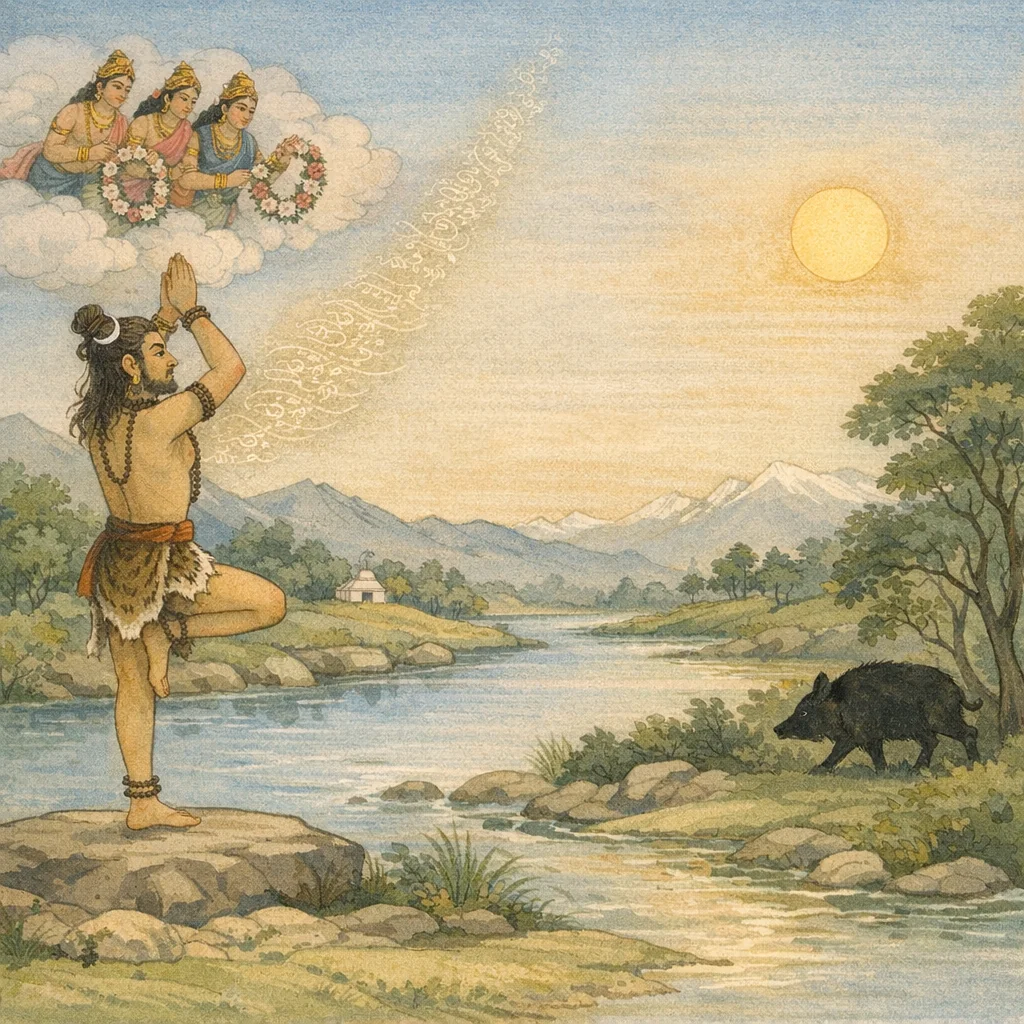
तपः–मन्त्रजप–ध्यानविधिः (Protocol of Tapas, Mantra-Japa, and Śiva-Dhyāna)
Spoken by Nandīśvara, this adhyāya sets out a strictly ordered sādhana: after snāna and preliminaries the practitioner performs nyāsa and enters Śiva-dhyāna “as taught by Vyāsa.” The austerity is defined by standing on one foot, fixing the gaze on the sun (sūrya-dṛṣṭi-niyama), and unbroken mantra-repetition. The text exalts Śambhu’s Pañcākṣara as the central japa-current, portraying tapas as a radiance that astonishes the devas. The devas approach Śiva with praise, affirming that such concentrated austerity for Śiva’s purpose makes any boon attainable. Śiva calmly reassures them, sends them back to their stations, and promises to accomplish their task. The narrative then turns toward impending conflict: meanwhile a daitya named Mūka arrives in boar form, signaling the shift from contemplative power (tapas/mantra) to its cosmic consequences through divine intervention against disruptive forces.
Shlokas
Verse 1
नन्दीश्वर उवाच । स्नानं स विधिवत्कृत्वा न्यासादि विधिवत्तथा । ध्यानं शिवस्य सद्भक्त्या व्यासोक्तं यत्तथाऽकरोत्
Nandīśvara said: Having performed the ritual bath in the prescribed manner, and having duly carried out the rites beginning with nyāsa, he then meditated on Lord Śiva with true devotion—exactly as Vyāsa had instructed—and acted accordingly.
Verse 2
एकपादतलेनैव तिष्ठन्मुनिवरो यथा । सूर्य्ये दृष्टिं निबध्यैकां मंत्रमावर्तयन्स्थितः
Like an eminent sage, he stood balanced on the sole of one foot; fixing his single-pointed gaze upon the sun, he remained steady, continuously repeating the mantra.
Verse 3
तपस्तेपेति संप्रीत्या संस्मरन्मनसा शिवम् । पंचाक्षरं मनुं शंभोर्जपन्सर्वो त्तमोत्तमम्
With heartfelt joy he undertook austerities, inwardly remembering Lord Śiva; and he kept chanting Śambhu’s five-syllabled mantra—supremely excellent above all that is excellent.
Verse 4
तपसस्तेज एवासीद्यथा देवा विसिस्मियुः । पुनश्चैव शिवं याताः प्रत्यूचुस्ते समाहिताः
Such was the radiant power born of that austerity that the gods were struck with wonder. Then, going again to Lord Śiva, those deities—composed and attentive—addressed Him in reply.
Verse 5
देवा ऊचुः । नरेणैकेन सर्वेश त्वदर्थे तप आहितम् । यदिच्छति नरस्सोयं किन्न यच्छति तत्प्रभो
The Devas said: “O Lord of all, a single man has undertaken austerity for Your sake. Whatever this man desires—O Master—why would You not grant him that?”
Verse 6
नन्दीश्वर उवाच । इत्युक्त्वा तु स्तुतिं चकुर्विविधान्ते तदा सुराः । तत्पादयोर्दृशः कृत्वा तत्र तस्थुः स्थिराधयः
Nandīśvara said: Having spoken thus, the gods then offered praises in many ways. Fixing their gaze upon His feet, they stood there with steady minds.
Verse 7
शिवस्तु तद्वचः श्रुत्वा महाप्रभुरुदारघीः । सुविहस्य प्रसन्नात्मा सुरान्वचनमब्रवीत्
Hearing those words, Lord Śiva—the great and sovereign Lord, noble in understanding—smiled gently. With a serene heart, He then spoke in reply to the gods.
Verse 8
शिव उवाच । स्वस्थानं गच्छत सुराः सर्वे सत्यन्न संशयः । सर्वथाहं करिष्यामि कार्यं वो नात्र संशय
Śiva said: “All of you gods, return to your own abodes—this is true, without any doubt. In every way I shall accomplish your task; of this too there is no doubt.”
Verse 9
नंदीश्वर उवाच । तच्छ्रुत्वा शंभुवचनन्निश्चयं परमं गताः । परावृत्य गताः सर्वे स्वस्वथानं ते हि निर्जराः
Nandīśvara said: Having heard Śambhu’s words, those deathless beings attained the highest resolve. Then, turning back, they all departed to their respective abodes—for they were indeed the immortals.
Verse 10
एतस्मिन्नंतरे दैत्यो मूकनामागतस्तदा । सौकरं रूपमास्थाय प्रेषितश्च दुरात्मना
Meanwhile, a demon named Mūka arrived there. Taking the form of a boar, he had been dispatched by that wicked one.
Verse 11
दुर्योधनेन विप्रेंद्र मायिना चार्जुनं तदा । यत्रार्जुनस्थितश्चासीत्तेन मार्गेण वै तदा
O best of Brahmins, at that time the delusive Duryodhana led Arjuna along that very route where Arjuna himself was staying.
Verse 12
शृङ्गाणि पर्वतस्यैव च्छिन्दन्वृक्षाननेकशः । शब्दं च विविधं कुर्व न्नतिवेगेन संयुतः
He cut away even the mountain’s peaks and felled many trees, raising many kinds of loud sounds; yet he was driven onward by a force that was not excessive.
Verse 13
अजुनोपि च तं दृष्ट्वा मूकनामासुरं तदा । स्मृत्वा शिवपदांभोजं विचारे तत्परोऽभवत्
Then Arjuna too, on seeing the asura named Mūka, remembered the lotus-feet of Lord Śiva; and, wholly intent upon that contemplation, he entered into clear deliberation and firm resolve.
Verse 14
अर्जुन उवाच । कोयं वा कुत आयाति क्रूरकर्मा च दृश्यते । ममानिष्टं ध्रुवं कर्तुं समागच्छत्यसंशयम्
Arjuna said: “Who is this, and from where has he come? He appears bent on cruel deeds. Without doubt, he is approaching with the resolve to do me harm.”
Verse 15
ममैवं मन आयाति शत्रुरेव न संशयः । मया विनिहताः पूर्वमनेके दैत्यदानवाः
Thus my mind concludes: he is indeed an enemy—there is no doubt. In the past, I have already slain many Daityas and Dānavas.
Verse 16
तदीयः कश्चिदायाति वैरं साधयितुम्पुनः । अथवा च सखा कश्चिद्दुर्योधनहितावहः
Perhaps some associate of his is coming again to prosecute that enmity; or else some friend—one who works for Duryodhana’s advantage—may be arriving.
Verse 17
यस्मिन्दृष्टे प्रसीदेत्स्वं मनः स हितकृद्ध्रुवम् । यस्मिन्दृष्टे तदेव स्यादाकुलं शत्रुरेव सः
He by whose very sight one’s own mind becomes calm and pleased is certainly a true well-wisher. But he at whose sight that same mind turns disturbed and agitated—he alone is to be known as an enemy.
Verse 18
आचारः कुलमाख्याति वपुराख्याति भोजनम् । वचनं श्रुतमाख्याति स्नेहमाख्याति लोचनम्
Conduct reveals one’s lineage; the body reveals one’s food and habits of living. Speech reveals what one has truly learned; and the eyes reveal the presence of affection and one’s inner disposition.
Verse 19
आकारेण तथा गत्या चेष्टया भाषितैरपि । नेत्रवक्त्रविकाराभ्यां ज्ञायतेऽन्तर्हितं मनः
By one’s form, manner of walking, gestures, and even speech—and by the changes in the eyes and the expressions of the face—the mind hidden within becomes known.
Verse 20
उज्ज्वलं सरसञ्चैव वक्रमारक्त कन्तथा । नेत्रं चतुर्विधं प्रोक्तं तस्य भावं पृथग्बुधाः
The eyes are declared to be of four kinds—bright, moist and gentle-clear, curved, and reddish-lovely. The wise discern the distinct inner import (bhāva) of each.
Verse 21
उज्ज्वलं मित्रसंयोगे सरसम्पुत्रदर्शने । वक्रं च कामिनीयोगे आरक्तं शत्रुदर्शने
A bright eye is an auspicious sign of reunion with friends; a moist and pleasing eye signifies the sight of one’s son. A crooked eye signifies union with a beloved woman; a reddish eye signifies the sighting of an enemy.
Verse 22
अस्मिन्मम तु सर्वाणि कलुषानीन्द्रियाणि च । अयं शत्रुर्भवेदेव मारणीयो न संशयः
“In this person, as though gathered together, are all my defilements and even the faults of my senses. He has truly become my enemy; he must be destroyed—of this there is no doubt.”
Verse 23
गुरोश्च वचनं मेद्य वर्तते दुःखदस्त्वया । हन्तव्यः सर्वथा राजन्नात्र कार्या विचारणा
“Even the command of the guru has, through you, been made a cause of sorrow. Therefore, O King, you must be slain without fail—there is no need for deliberation in this matter.”
Verse 24
एतदर्थं त्वायुधानि मम चैव न संशयः । विचार्य्येति च तत्रैव बाणं संस्थाय संस्थितः
“For this very purpose, your weapons—and mine as well—are surely meant; there is no doubt.” Having reflected thus, he remained right there, setting an arrow upon the bow and standing ready.
Verse 25
एतस्मिन्नन्तरे तत्र रक्षार्थं ह्यर्जुनस्य वै । तद्भक्तेश्च परीक्षार्थं शंकरो भक्तवत्सलः
Just then, in that very moment, Śaṅkara—ever tender to His devotees—appeared there to protect Arjuna, and also to test the devotion of that devotee.
Verse 26
विदग्धभिल्लरूपं हि गणैः सार्ध महाद्भुतम् । तस्य दैत्यस्य नाशार्थं द्रुतं कृत्वा समागतः
Assuming a wondrous form like a clever Bhilla (forest-hunter), and accompanied by His Gaṇas, He swiftly arrived with the sole intent of destroying that Daitya.
Verse 27
बद्धकच्छश्च वस्त्रीभिर्वद्धेशानध्वजस्तदा । शरीरे श्वेतरेखाश्च धनुर्बाणयुतः स्वयम्
Then he stood with his garment tucked up and fastened, bearing the banner of Īśāna; on his body were white streak-marks, and he himself was equipped with bow and arrows.
Verse 28
बाणानान्तूणकं पृष्ठे धृत्वा वै स जगाम ह । गणश्चैव तथा जातो भिल्लराजोऽभवच्छिवः
Placing the quiver of arrows upon his back, he departed. In that very manner a gaṇa was born, and Śiva manifested as the king of the Bhillas.
Verse 29
शब्दांश्च विविधान्कृत्वा निर्ययौ वाहिनीपतिः । सूकरस्य ससाराथ शब्दश्च प्रदिशो दश
Raising many kinds of loud cries, the commander of the army marched forth. Then the boar charged, and its roar spread through the ten directions.
Verse 31
अहो किन्नु भवेदेष शिवः शुभकरस्त्विह । मया चैव श्रुतम्पूर्वं कृष्णेन कथितम्पुनः
“Ah! Who indeed could this auspicious, beneficent Shiva be here? I have heard of him before as well—again and again, as it was spoken by Krishna.”
Verse 32
व्यासेन कथितं चैवं स्मृत्वा देवै स्तथा पुनः । शिवः शुभकरः प्रोक्तः शिवः सुखकरस्तथा
Thus, recalling what was spoken by Vyāsa, the gods again declared: “Śiva is the bestower of auspiciousness; Śiva, likewise, is the giver of true happiness.”
Verse 33
मुक्तिदश्च स्वयं प्रोक्तो मुक्तिदानान्न संशयः । तन्नामस्मरणात्पुंसां कल्याणं जायते धुवम्
He is indeed proclaimed by Himself as “the Giver of Liberation”; there is no doubt that He bestows mokṣa. From the remembrance of His Name, auspicious welfare surely arises for human beings.
Verse 34
भजतां सर्वभावेन दुःखं स्वप्नेऽपि नो भवेत् । यदा कदाचिज्जायेत तदा कर्मसमुद्भवम्
For those who worship (Śiva) with their whole being, sorrow does not arise even in a dream. If ever it does arise at some time, then know it to be born of past karma.
Verse 35
तदेतद्बह्वपि ज्ञेयं नूनमल्पं न संशयः । प्रारब्धस्याथ वा दोषो नूनं ज्ञेयो विशेषतः
Even though much is being taught here, what is truly grasped is surely only a little—of this there is no doubt. Or else, it must be understood that the particular obstacle lies in one’s prārabdha (already-begun karma), which specifically veils full comprehension.
Verse 36
अथ वा बहु चाल्पं हि भोग्यं निस्तीर्य शंकरः । कदाचिदिच्छया तस्य दूरीकुर्य्यान्न संशयः
Or else—after causing him to pass through the enjoyments to be undergone, whether many or few—Śaṅkara, at some time, by His own will, removes those bondages/afflictions from him; of this there is no doubt.
Verse 37
विषं चैवामृतं कुर्यादमृतं विषमेव वा । यदिच्छति करोत्येव समर्थः किन्निषिध्यते
He can turn poison into nectar, and nectar into poison as well. Whatever He wills, that alone He accomplishes; since He is all-powerful, who can restrain or forbid Him?
Verse 38
इत्थं विचार्य्यमाणेऽपि भक्तैरन्यैः पुरातनैः । भाविभिश्च सदा भक्तैरिहानीय मनः स्थिरम्
Thus, even as other ancient devotees reflect upon this—and as devotees yet to come will also reflect—one should draw the mind here and make it steady, ever established in devotion.
Verse 39
इति श्रीशिवमहापुराणे तृतीयायां शतरुद्रसंहितायां किरातावतारवर्णने मूकदैत्यवधोनामैकोनचत्वारिंशोऽध्यायः
Thus, in the Śrī Śiva Mahāpurāṇa, in the third Saṃhitā called the Śatarudra Saṃhitā, within the narration of the Kirāta incarnation, ends the thirty-ninth chapter entitled “The Slaying of the Demon Mūka.”
Verse 41
अंते च सुखदः प्रोक्तो दयालुत्वान्न संशयः । यथा चैव सुवर्णं च शोधि तं शुद्धतां व्रजेत्
And in the end, He is declared to be the giver of bliss—of this there is no doubt, for He is compassion itself. Just as gold, when refined, attains purity, so too the devotee, purified through His grace, reaches inner purity.
Verse 42
एवं चैवं मया पूर्वं श्रुतं मुनिमुखात्तथा । अतस्तद्भजनेनैव लप्स्येऽहं सुखमुत्तमम्
Thus, in this very manner, I had earlier heard it from the mouth of a sage. Therefore, by worshipping Śiva alone, I shall attain the highest bliss.
Verse 43
इत्येवन्तु विचारं स करोति यावदेव हि । तावच्च सूकरः प्राप्तो बाणसंमोचनावधिः
While he was still reflecting in this very way, at that very moment the boar came within the range for releasing the arrow.
Verse 44
शिवोपि पृष्ठतो लग्नो ह्यायातः शूकरस्य हि । तयोर्मध्ये तदा सोयं दृश्यते शृंगमद्भुतम्
Śiva too, clinging close behind the boar, came rushing on. Then, between the two of them, there appeared a wondrous horn—an astonishing sign of the Lord’s inscrutable power.
Verse 45
तस्य प्रोक्तं च माहात्म्यं शिवः शीघ्रतरं गतः । अर्जुनस्य च रक्षार्थं शंकरो भक्तव त्सलः
Hearing that glory proclaimed, Śiva went there with utmost swiftness. To protect Arjuna, Śaṅkara—the tender guardian of His devotees—hastened to act.
Verse 46
एतस्मिन्समये ताभ्यां कृतं बाणविमोचनम् । शिवबाणस्तु पुच्छे वै ह्यर्जुनस्य मुखे तथा
At that very moment, the two of them released their arrows. Śiva’s arrow struck the tail end, while Arjuna’s arrow struck the mouth.
Verse 47
शिवस्य पुच्छतो गत्वा मुखान्निस्सृत्य शीघ्रतः । भूमौ विलीनः संयातस्तस्य वै पुच्छतो गतः
Having gone to Śiva’s tail end and then swiftly emerging from His mouth, he merged into the earth and departed—indeed, he had moved along from that very tail end.
Verse 48
पपात पार्श्वतश्चैव बाणश्चैवार्जुनस्य च । सूकरस्तत्क्षणं दैत्यो मृतो भूमौ पपात ह
Arjuna’s arrow fell to the side as well. In that very instant the boar-form demon, struck down, died and collapsed upon the earth.
Verse 49
देवा हर्षं परम्प्रापुः पुष्पवृष्टिं च चक्रिरे । जयपूर्व स्तुतिकराः प्रणम्य च पुनःपुनः
The gods were filled with supreme joy. They showered flowers in reverence and, first crying “Victory!”, they offered hymns of praise—bowing down again and again.
Verse 51
अर्जुनस्तु विशेषेण सुखिना प्राह चेतसा । अहो दैत्यवरश्चायं रूपं तु परमाद्भुतम्
Then Arjuna, with a mind especially filled with joy, exclaimed: “Ah! This foremost of daityas—his form is truly supremely wondrous!”
Verse 52
कृत्वागतो मद्वधार्थैं शिवेनाहं सुरक्षितः । ईश्वरेण ममाद्यैव बुद्धिर्दत्ता न संशयः
“He has come, having undertaken the intent to kill me; yet I am protected by Śiva. Indeed, this very day the Lord (Īśvara) has granted me the right discernment—of this there is no doubt.”
Verse 53
विचार्य्येत्यर्जुनस्तत्र जगौ शिवशिवेति च । प्रणनाम शिवं भूयस्तुष्टाव च पुनः पुनः
Having reflected, Arjuna there uttered “Śiva, Śiva.” Again he bowed to Lord Śiva, and time after time he praised Him.
Verse 33930
वनेचरेण शब्देन व्याकुलश्चार्जुनस्तदा । पर्वताद्याश्च तैश्शब्दैस्ते सर्वे व्याकुलास्तदा
Then Arjuna was disturbed by the cry of a forest-dweller; and by those very sounds even the mountains and all the surroundings were thrown into agitation.
Verse 33940
जयते पुण्यपापाभ्यां शंकरस्सुखदः सदा । कदाचिच्च परीक्षार्थं दुःखं यच्छति वै शिवः
Victorious is Śaṅkara, ever the giver of true well-being, untouched by both merit and sin. Yet at times Śiva bestows sorrow, solely to test and ripen the soul.
Verse 33950
शिवस्तुष्टमना आसीदर्जुनः सुखमागतः । दैत्यस्य च तदा दृष्ट्वा क्रररूपं च तौ तदा
Śiva was inwardly pleased, and Arjuna attained ease and joy. Then, seeing the demon’s terrifying form, the two stood ready at that very moment.
Frequently Asked Questions
It presents the efficacy-argument of disciplined sādhana: a single ascetic’s tapas and Pañcākṣarī-japa generate such tejas that the devas appeal to Śiva, who then guarantees cosmic resolution; the narrative closes by introducing the daitya Mūka’s boar-form arrival as the next causal development.
Nyāsa and dhyāna indicate internalization—mantra is installed into the body-mind so attention becomes ritually structured; the sun-fixed gaze functions as a concentration device (ekāgratā) rather than solar worship per se, and tapas-tejas symbolizes the measurable ‘output’ of stabilized consciousness in Purāṇic idiom.
Śiva is highlighted as Śambhu/Mahāprabhu—the responsive sovereign who validates tapas and promises intervention; no distinct named Śakti-form is foregrounded in the provided verses, while the adversarial manifestation is the daitya Mūka adopting a saukara (boar) form.