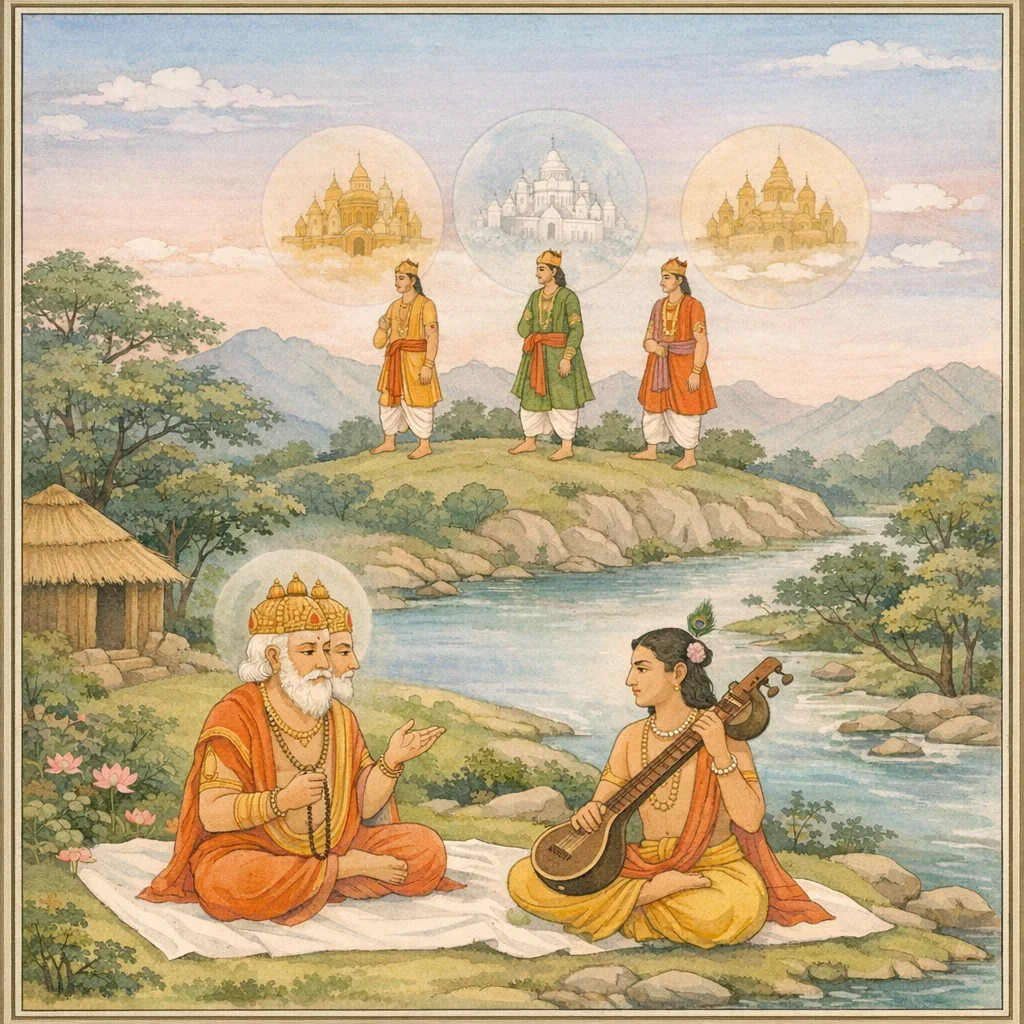
त्रिपुरवर्णनम् (Tripura-varṇanam) — “Description of Tripura”
Adhyāya 1 begins the Tripuravadha-upākhyāna with invocatory salutations (to Gaṇeśa; to Gaurī–Śaṅkara) and a request to transmit the sacred account. Nārada asks for the “supremely bliss-giving” story: how Śaṅkara, as Rudra, destroyed the roaming wicked and, especially, how with a single arrow he burned the three cities of the devas’ enemies at once. Brahmā replies by placing the narration within a purāṇic chain of transmission (Vyāsa → Sanatkumāra → Brahmā → Nārada), establishing authority and continuity of śruti-like remembrance. Sanatkumāra then gives the causal prelude: after Skanda slays Tārakāsura, three sons arise—Tārakākṣa (eldest), Vidyunmālī (middle), and Kamalākṣa (youngest). Though disciplined and mighty—self-controlled, restrained, truth-speaking, firm-minded, great heroes—they are essentially devadrohin, hostile to the gods. Thus the chapter sets the ethical tension of Tripura lore: formidable asuric tapas and orderliness misaligned with dharma, calling for Śiva’s eventual intervention.
Shlokas
Verse 1
इति श्रीशिवमहापुराणे द्वितीयायां रुद्रसंहितायां पञ्चमे युद्धखण्डे त्रिपुरवधोपाख्याने त्रिपुरवर्णनं नाम प्रथमोऽध्यायः
Thus, in the Śrī Śiva Mahāpurāṇa—within the Second section, the Rudra-saṃhitā—within the Fifth, the Yuddha-khaṇḍa, in the sub-narrative of the slaying of Tripura, begins the First Chapter entitled “Description of Tripura.”
Verse 2
इदानीं ब्रूहि सुप्रीत्या चरितं वरमुत्तमम् । शंकरो हि यथा रुद्रो जघान विहरन्खलान्
Now, with great affection, tell us that most excellent and sublime account—how Śaṅkara, indeed as Rudra, while roaming in sportive freedom, struck down the wicked.
Verse 3
कथं ददाह भगवान्नगराणि सुरद्विषाम् । त्रीण्येकेन च बाणेन युगपत्केन वीर्यवान्
How did the Blessed Lord burn the cities of the enemies of the gods? And how did that mighty One, with a single arrow, destroy the three cities all at once?
Verse 4
एतत्सर्वं समाचक्ष्व चरितं शशिमौलिनः । देवर्षिसुखदं शश्वन्मायाविहरतः प्रभोः
Tell us all of this—the sacred deeds of the Lord who bears the moon upon His crest—deeds that ever delight the gods and seers, as the Supreme Master sports through His divine māyā.
Verse 5
ब्रह्मोवाच । एवमेतत्पुरा पृष्टो व्यासेन ऋषिसत्तमः । सनत्कुमारं प्रोवाच तदेव कथयाम्यहम्
Brahmā said: “So indeed it was. Formerly, when the foremost of sages was questioned by Vyāsa, he instructed Sanatkumāra; that very account I shall now narrate.”
Verse 6
सनत्कुमार उवाच । शृणु व्यास महाप्राज्ञ चरितं शशिमौलिनः । यथा ददाह त्रिपुरं बाणेनैकेन विश्व हृत्
Sanatkumāra said: Listen, O Vyāsa, greatly wise one, to the sacred deeds of the Moon-crested Lord—how the Stealer of the worlds’ hearts burned Tripura, the three cities, with a single arrow.
Verse 7
शिवात्मजेन स्कन्देन निहते तारकासुरे । तत्पुत्रास्तु त्रयो दैत्याः पर्यतप्यन्मुनीश्वर
O lord among sages, when Tārakāsura was slain by Skanda, the son of Śiva, his three sons—daitya princes—were seized by burning anguish and began to torment the world.
Verse 8
तारकाख्यस्तु तज्जेष्ठो विद्युन्माली च मध्यमः । कमलाक्षः कनीयांश्च सर्वे तुल्यबलास्सदा
Of them, the one named Tāraka was the eldest; Vidyunmālī was the middle; and Kamalākṣa was the youngest—yet all of them were always equal in strength.
Verse 9
जितेन्द्रियास्ससन्नद्धास्संयतास्सत्यवादिनः । दृढचित्ता महावीरा देवद्रोहिण एव च
They were masters of their senses, fully armed and disciplined, devoted to truth. Steadfast in resolve, they were mighty heroes—yet they were indeed hostile to the Devas.
Verse 10
ते तु मेरुगुहां गत्वा तपश्चक्रुर्महाद्भुतम् । त्रयस्सर्वान्सुभोगांश्च विहाय सुमनोहरान्
But those three, having gone to a cave on Mount Meru, performed an exceedingly wondrous austerity, renouncing all delightful and enticing enjoyments.
Verse 11
वसंते सर्वकामांश्च गीतवादित्रनिस्स्वनम् । विहाय सोत्सवं तेपुस्त्रयस्ते तारकात्मजाः
When spring arrived, those three sons of Tāraka renounced all pleasures and the festive sounds of song and instruments, and they undertook austere penance (tapas).
Verse 12
ग्रीष्मे सूर्यप्रभां जित्वा दिक्षु प्रज्वाल्य पावकम् । तन्मध्यसंस्थाः सिद्ध्यर्थं जुहुवुर्हव्यमादरात्
In the summer’s heat, outshining even the sun’s radiance, they kindled fire in all directions. Seated in the midst of that blazing circle, they reverently poured hāvya—sacred oblations—into the holy fire for the attainment of siddhi, spiritual accomplishment.
Verse 13
महाप्रतापपतितास्सर्वेप्यासन् सुमूर्छिताः । वर्षासु गतसंत्रासा वृष्टिं मूर्द्धन्यधारयन्
Struck down by that mighty, blazing prowess, all of them fell and lay utterly senseless. Like people caught in heavy rains, their fear subsided, and they bore the downpour upon their heads.
Verse 14
शरत्काले प्रसूतं तु भोजनं तु बुभुक्षिताः । रम्यं स्निग्धं स्थिरं हृद्यं फलं मूलमनुत्तमम्
In the autumn season, the hungry partook of food ripened then—pleasant, unctuous, sustaining, and heart-gladdening; and they also enjoyed excellent fruits and roots.
Verse 15
संयमात्क्षुत्तृषो जित्वा पानान्युच्चावचान्यपि । बुभुक्षितेभ्यो दत्त्वा तु बुभूवुरुपला इव
Through self-restraint they conquered hunger and thirst, and even the lure of various drinks. Giving those drinks to the hungry instead, they became like stones—unmoved and unshaken by craving.
Verse 16
संस्थितास्ते महात्मानो निराधाराश्चतुर्दिशम् । हेमंते गिरिमाश्रित्य धैर्येण परमेण तु
Those great souls stood firm in all directions, without any support; and in the winter season, taking refuge on the mountain, they endured with supreme steadfastness.
Verse 17
तुषारदेहसंछन्ना जलक्लिन्नेन वाससा । आसाद्य देहं क्षौमेण शिशिरे तोयमध्यगाः
Their bodies were sheathed in frost, and their garments were drenched with water. In that wintry cold, wrapped in linen cloth, they stood steadfast in the midst of the waters.
Verse 18
अनिर्विण्णास्ततस्सर्वे क्रमशोऽवर्द्धयंस्तपः । तेपुस्त्रयस्ते तत्पुत्रा विधिमुद्दिश्य सत्तमाः
Then all of them, undiscouraged, gradually intensified their austerity. Those three noble sons performed tapas with their minds fixed upon Brahmā (Vidhī), seeking his grace and ordinance.
Verse 19
तप उग्रं समास्थाय नियमे परमे स्थिता । तपसा कर्षयामासुर्देहान् स्वान् दानवोत्तमाः
Undertaking fierce austerity and abiding in the highest discipline, those foremost among the Dānavas tormented and emaciated their own bodies through tapas.
Verse 20
वर्षाणां शतकं चैव पदमेकं निधाय च । भूमौ स्थित्वा परं तत्र तेपुस्ते बलवत्तराः
Planting a single step in one place, they remained on the earth without moving; and there—steadfast and exceedingly powerful—they performed severe austerities for a full hundred years.
Verse 21
ते सहस्रं तु वर्षाणां वातभक्षास्सुदारुणाः । तपस्तेपुर्दुरात्मानः परं तापमुपागताः
For a full thousand years, those exceedingly fierce beings—living only on air—performed austerities (tapas). Yet, being of perverse intent, they fell into extreme torment, the burning consequence of their own harsh tapas.
Verse 22
वर्षाणां तु सहस्रं वै मस्तकेनास्थितास्तथा । वर्षाणां तु शतेनैव ऊर्द्ध्वबाहव आसिताः
Indeed, for a thousand years they remained standing upon their heads; and for a further hundred years they stayed with their arms lifted upward—enduring severe austerity in steadfast discipline.
Verse 23
एवं दुःखं परं प्राप्ता दुराग्रहपरा इमे । ईदृक्ते संस्थिता दैत्या दिवारात्रमतंद्रिता
Thus, having fallen into extreme suffering, these beings—driven by obstinate, misguided resolve—remained in that very state. Those Daityas persisted day and night without respite, unwavering in their deluded determination.
Verse 24
एवं तेषां गतः कालो महान् सुतपतां मुने । ब्रह्मात्मनां तारकाणां धर्मेणेति मतिर्मम
O sage, thus a long span of time passed for those lords of sons; and in my understanding, the Tārakas—whose very nature was bound up with Brahmā’s power—were sustained and guided by their own ordained dharma.
Verse 25
प्रादुरासीत्ततो ब्रह्मा सुरासुरगुरुर्महान् । संतुष्टस्तपसा तेषां वरं दातुं महायशाः
Then the great Brahmā—revered as the preceptor of both the devas and the asuras—manifested before them. Pleased with their austerities (tapas), that highly renowned one came to grant them a boon.
Verse 27
ब्रह्मोवाच । प्रसन्नोऽस्मि महादैत्या युष्माकं तपसा मुने । सर्वं दास्यामि युष्मभ्यं वरं ब्रूत यदीप्सितम्
Brahmā said: “O mighty Daityas—O sage—your austerity has pleased me. I shall grant you everything; speak the boon you desire.”
Verse 28
किमर्थं सुतपस्तप्तं कथयध्वं सुरद्विषां । सर्वेषां तपसो दाता सर्वकर्तास्मि सर्वदा
“For what purpose have you performed this excellent austerity? Tell me, O adversaries of the gods. I am ever the bestower of the fruits of all tapas, and at all times I am the universal doer who brings all acts to completion.”
Verse 29
सनत्कुमार उवाच । तस्य तद्वचनं श्रुत्वा शनैस्ते स्वात्मनो गतम् । ऊचुः प्रांजलयस्सर्वे प्रणिपत्य पितामहम्
Sanatkumāra said: Hearing his words, they gradually returned to their own composure. Then all of them, with folded hands, bowed down and addressed Pitāmaha (Brahmā).
Verse 30
दैत्या ऊचुः । यदि प्रसन्नो देवेश यदि देयो वरस्त्वया । अवध्यत्वं च सर्वेषां सर्वभूतेषु देहिनः
The Daityas said: “If you are pleased, O Lord of the gods, and if a boon is to be granted by you, then grant us inviolability—so that among all embodied beings in all orders of creatures, none may slay us.”
Verse 31
स्थिरान् कुरु जगन्नाथ पांतु नः परिपंथिनः । जरारोगादयस्सर्वे नास्मान्मृत्युरगात् क्वचित्
O Lord of the universe, make us steadfast; protect us from all adversaries. May old age, disease, and every affliction not befall us, and may death never come upon us at any time.
Verse 32
अजराश्चामरास्सर्वे भवाम इति नो मतम् । समृत्यवः करिष्यामस्सर्वानन्यांस्त्रिलोकके
“This is our firm resolve: we shall all become ageless and deathless. We shall make all others in the three worlds subject to death.”
Verse 33
लक्ष्म्या किं तद्विपुलया किं कार्यं हि पुरोत्तमैः । अन्यैश्च विपुलैर्भोगैस्स्थानैश्वर्येण वा पुनः
What use is immense wealth? What need is there for the highest worldly ranks? And again, what is gained by abundant enjoyments, exalted stations, or sovereignty—when the supreme aim is communion with Śiva beyond all possessions?
Verse 34
यत्रैव मृत्युना ग्रस्तो नियतं पंचभिर्दिनैः । व्यर्थं तस्याखिलं ब्रह्मन् निश्चितं न इतीव हि
O Brahman, for one seized by Death and destined to die within five days, all that he undertakes becomes futile—indeed, it is as though nothing is truly settled or secured for him.
Verse 35
सनत्कुमार उवाच । इति श्रुत्वा वचस्तेषां दैत्यानां च तपस्विनाम् । प्रत्युवाच शिवं स्मृत्वा स्वप्रभुं गिरिशं विधिः
Sanatkumāra said: Having thus heard the words of those Daityas and the ascetic sages, Vidhi (Brahmā) replied—first remembering Śiva, his own Lord, Girīśa, the Lord of the mountains.
Verse 36
ब्रह्मोवाच । नास्ति सर्वामरत्वं च निवर्तध्वमतोऽसुराः । अन्यं वरं वृणीध्वं वै यादृशो वो हि रोचते
Brahmā said: “There is no possibility of complete immortality for all. Therefore, O Asuras, desist. Choose some other boon—whatever truly pleases you.”
Verse 37
जातो जनिष्यते नूनं जंतुः कोप्यसुराः क्वचित् । अजरश्चामरो लोके न भविष्यति भूतले
Surely, whatever being is born will indeed be born again; in this world upon the earth, no creature—whether among the gods or the asuras—will ever become ageless and deathless.
Verse 38
ऋते तु खंडपरशोः कालकालाद्धरेस्तथा । तौ धर्माधर्मपरमावव्यक्तौ व्यक्तरूपिणौ
Except for Khaṇḍaparaśu and Hari—who is Kāla and yet beyond Kāla—the two supreme principles, Dharma and Adharma, remain unmanifest in their highest reality, though in the world they appear through manifest forms.
Verse 39
संपीडनाय जगतो यदि स क्रियते तपः । सफलं तद्गतं वेद्यं तस्मात्सुविहितं तपः
If tapas is undertaken to oppress the world, it should be understood as ‘fruitful’ only in that destructive intent; therefore true tapas must be rightly directed—performed in a well-ordained, dharmic manner aligned with Śiva’s order rather than cruelty.
Verse 40
तद्विचार्य स्वयं बुद्ध्या न शक्यं यत्सुरासुरैः । दुर्लभं वा सुदुस्साध्यं मृत्युं वंचयतानघाः
Reflecting with their own discernment, they realized that what cannot be accomplished by gods or demons—whether rare or exceedingly difficult—could be achieved by those blameless ones, for they were able to elude even Death.
Verse 41
तत्किंचिन्मरणे हेतुं वृणीध्वं सत्त्वमाश्रिताः । येन मृत्युर्नैव वृतो रक्षतस्तत्पृथक् पृथक्
“O you who are established in purity (sattva), choose for yourselves some specific cause of death, each in your own way, so that Death may not seize you while you are being protected—each one separately.”
Verse 42
सनत्कुमार उवाच । एतद्विधिवचः श्रुत्वा मुहूर्त्तं ध्यानमास्थिताः । प्रोचुस्ते चिंतयित्वाथ सर्वलोकपितामहम्
Sanatkumāra said: Having heard these words of injunction, they entered meditation for a moment. Then, reflecting, they addressed Pitāmaha (Brahmā), the grandsire of all the worlds.
Verse 43
दैत्या ऊचुः । भगवन्नास्ति नो वेश्म पराक्रमवतामपि । अधृष्याः शात्रवानां तु यन्न वत्स्यामहे सुखम्
The Daityas said: “O Lord, even though we are mighty, we have no secure abode. For our enemies are unassailable; therefore we cannot dwell in happiness.”
Verse 44
पुराणि त्रीणि नो देहि निर्मायात्यद्भुतानि हि । सर्वसंपत्समृद्धान्य प्रधृष्याणि दिवौकसाम्
“Grant us three wondrous cities, fashioned by your unrivalled power of manifestation—cities overflowing with every prosperity, impregnable and unconquerable even to the gods who dwell in heaven.”
Verse 45
वयं पुराणि त्रीण्येव समास्थाय महीमिमाम् । चरिष्यामो हि लोकेश त्वत्प्रसादाज्जगद्गुरो
O Lord of the worlds, O Guru of the universe—supported by the authority of these three Purāṇas, by your grace we shall indeed traverse this earth.
Verse 46
तारकाक्षस्ततः प्राह यदभेद्यं सुरैरपि । करोति विश्वकर्मा तन्मम हेममयं पुरम्
Then Tārakākṣa said: “That golden city of mine which even the gods cannot breach—Viśvakarmā shall build it.”
Verse 47
ययाचे कमलाक्षस्तु राजतं सुमहत्पुरम् । विद्युन्माली च संहृष्टो वज्रायसमयं महत्
Then Kamalākṣa asked for a vast city of silver; and Vidyunmālī, delighted at heart, requested a great city made of adamantine iron, vajra-like in hardness.
Verse 48
पुरेष्वेतेषु भो ब्रह्मन्नेकस्थानस्थितेषु च । मध्याह्नाभिजिते काले शीतांशौ पुष्प संस्थिते
O Brahmā, when these fortified cities had come to rest in a single alignment and in one place, at the auspicious midday moment called Abhijit, while the cool-rayed moon was set amid blossoms, (the destined event was to occur).
Verse 49
उपर्युपर्यदृष्टेषु व्योम्नि लीलाभ्रसंस्थिते । वर्षत्सु कालमेघेषु पुष्करावर्तनामसु
High above, in the sky where playful masses of clouds had gathered, the dark rain-clouds known as Puṣkarāvarta began to pour down. The sight appeared as an omen, foreshadowing the fierce turn of the coming battle.
Verse 50
तथा वर्षसहस्राते समेष्यामः परस्परम् । एकीभावं गमिष्यंति पुराण्येतानि नान्यथा
Likewise, when a thousand years have passed, we shall meet one another. Then these ancient Purāṇas will surely merge into a single unity—there is no other way.
Verse 51
सर्वदेवमयो देवस्सर्वेषां मे कुहेलया । असंभवे रथे तिष्ठन् सर्वोपस्करणान्विते
That Lord—who embodies all the gods—by my own illusory stratagem stood upon an inconceivable chariot, furnished with every implement of war.
Verse 52
असंभाव्यैककांडेन भिनत्तु नगराणि नः । निर्वैरः कृत्तिवासास्तु योस्माकमिति नित्यशः
“By a single, unimaginable stroke, let him shatter our cities. Yet Kṛttivāsā (Śiva), who is ever without enmity, is always ‘ours’—indeed, he belongs to us continually.”
Verse 53
वंद्यः पूज्योभिवाद्यश्च सोस्माकं निर्दहेत्कथम् । इति चेतसि संधाय तादृशो भुवि दुर्लभः
“He is worthy of reverence, worship, and salutations—how, then, could he burn us?” Thinking thus within their hearts, they reflected that such a one is indeed rare upon the earth.
Verse 54
सनत्कुमार उवाच । एतच्छ्रुत्वा वचस्तेषां ब्रह्मा लोकपितामहः । एवमस्तीति तान् प्राह सृष्टिकर्ता स्मरञ्शिवम्
Sanatkumāra said: Hearing their words, Brahmā—the grandsire of the worlds, the creator—remembered Lord Śiva and replied to them, “So be it; it is indeed as you have said.”
Verse 55
आज्ञां ददौ मयस्यापि कुत्र त्वं नगरत्रयम् । कांचनं राजतं चैव आयसं चेति भो मय
He also issued a command to Maya: “O Maya, where are you to fashion the three cities—one of gold, one of silver, and one of iron?”
Verse 56
इत्यादिश्य मयं ब्रह्मा प्रत्यक्षं प्राविशद्दिवम् । तेषां तारकपुत्राणां पश्यतां निजधाम हि
Thus having instructed them, Brahmā—formed of Māyā, the cosmic power of manifestation—then visibly entered the heavens, while the sons of Tāraka looked on and saw him go to his own celestial abode.
Verse 57
ततो मयश्च तपसा चक्रे धीरः पुराण्यथ । कांचनं तारकाक्षस्य कमलाक्षस्य राजतम्
Thereafter Māyā, steadfast and skilled, fashioned the fortified cities by the power of his tapas (austerity): one of gold for Tārakākṣa, and one of silver for Kamalākṣa.
Verse 58
विद्युन्माल्यायसं चैव त्रिविधं दुर्गमुत्तमम् । स्वर्गे व्योम्नि च भूमौ च क्रमाज्ज्ञेयानि तानि वै
That supreme, formidable stronghold is indeed of three kinds—Vidyunmālī, Mālī, and Ayasa. These are to be understood, in order, as situated in heaven, in the sky, and upon the earth.
Verse 59
दत्वा तेभ्यो सुरेभ्यश्च पुराणि त्रीणि वै मयः । प्रविवेश स्वयं तत्र हितकामपरायणः
Having bestowed upon those gods three fortified cities, Maya then entered there himself, wholly intent on their welfare.
Verse 60
एवं पुत्रत्रयं प्राप्य प्रविष्टास्तारकात्मजाः । बुभुजुस्सकलान्भोगान्महाबलपराक्रमाः
Thus, having obtained three sons, the sons of Tāraka became established in their dominion; mighty in strength and prowess, they indulged in every enjoyment and worldly power.
Verse 61
कल्पद्रुमैश्च संकीर्णं गजवाजिसमाकुलम् । नानाप्रासादसंकीर्णं मणिजालसमा वृतम्
It was filled with wish-fulfilling Kalpadruma trees and thronged with elephants and horses. Many palaces stood crowded together, and it was enclosed on every side as though by a net of jewels.
Verse 62
सूर्यमण्डलसंकाशैर्विमानैस्सर्वतोमुखैः । पद्मरागमयैश्चैव शोभितं चन्द्रसन्निभैः
On every side it was adorned with vimānas—celestial aerial chariots—radiant like the orb of the sun and facing in all directions; and it shone still more with ruby (padmarāga) structures, glowing with a moonlike splendor.
Verse 63
प्रासादैर्गोपुरैर्दिव्यैः कैलासशिखरोपमैः । दिव्यस्त्रीजनसंकीर्णैर्गंधर्वैस्सिद्धचारणैः
It was adorned with celestial mansions and splendid gateway-towers (gopuras), resembling the lofty peaks of Kailāsa, and it was thronged with divine women, as well as with Gandharvas, Siddhas, and Cāraṇas.
Verse 64
रुद्रालयैः प्रतिगृहमग्निहोत्रैः प्रतिष्ठितैः । द्विजोत्तमैश्शास्त्र ज्ञैश्शिवभक्तिरतैस्सदा
In every household, shrines of Rudra were established, and the agnihotra fires were duly maintained. The foremost among the twice-born, learned in the śāstras, were ever absorbed in devotion to Śiva.
Verse 65
वापीकूपतडागैश्च दीर्घिकाभिस्सुशोभितम् । उद्यानवनवृक्षैश्च स्वर्गच्युत गुणोत्तमैः
It was beautifully adorned with wells, stepwells, ponds, and long reservoirs, and also with gardens, groves, and trees of superb qualities, as though descended from heaven.
Verse 66
नदीनदसरिन्मुख्यपुष्करैः शोभितं सदा । सर्वकामफलाद्यैश्चानेकैर्वृक्षैर्मनोहरम्
It was ever adorned with excellent rivers, streams, and foremost lotus-lakes, and was enchanting with many trees that bestow all desired fruits and other blessings.
Verse 67
मत्तमातंगयूथैश्च तुरंगैश्च सुशोभनैः । रथैश्च विविधाकारैश्शिबिकाभिरलंकृतम्
It was splendidly adorned with herds of intoxicated elephants, with handsome horses, with chariots of many different designs, and with palanquins as well.
Verse 68
समयादिशिकैश्चैव क्रीडास्थानैः पृथक्पृथक् । वेदाध्ययनशालाभिर्विविधाभिः पृथक्पृथक्
And there were also separate quarters for instructors in proper conduct and discipline, separate grounds for recreation, and—distinct from these—many different halls set apart for the study and recitation of the Vedas.
Verse 69
अदृष्टं मनसा वाचा पापान्वितनरैस्सदा । महात्मभिश्शुभाचारैः पुण्यवद्भिः प्रवीक्ष्यते
That Reality which remains unseen to sinful people—whether by mind or by speech—comes to be truly perceived by great-souled ones, whose conduct is auspicious and who are endowed with merit.
Verse 70
पतिव्रताभिः सर्वत्र पावितं स्थलमुत्तमम् । पतिसेवनशीलाभिर्विमुखाभिः कुधर्मतः
Every place becomes supremely sanctified wherever there are devoted, chaste wives—women steady in the service of their husbands—who have turned away from wrongful conduct.
Verse 71
दैत्यशूरैर्महाभागैस्सदारैस्ससुतैर्द्विजैः । श्रौतस्मार्तार्थतत्त्वज्ञैस्स्वधर्मनिरतैर्युतम्
It was accompanied by heroic Daityas of great fortune—together with their wives and sons—and also by twice-born men who knew the true import of the Śrauta and Smārta ordinances, steadfastly devoted to their own prescribed duties.
Verse 72
व्यूढोरस्कैर्वृषस्कंधैस्सामयुद्धधरैस्सदा । प्रशांतैः कुपितैश्चैव कुब्जैर्वामनकैस्तथा
They were ever equipped for orderly combat—some with broad chests and bull-like shoulders; some calm and composed, others inflamed with wrath; some bent-backed, and others dwarf-like as well.
Verse 73
नीलोत्पलदलप्रख्यैर्नीलकुंचितमूर्द्धजैः । मयेन रक्षितैस्सर्वैश्शिक्षितैर्युद्धलालसैः
All of them—protected by Māyā—were well trained and eager for battle, with complexions like blue-lotus petals and with dark, curled hair.
Verse 74
वरसमररतैर्युतं समंतादजशिवपूजनया विशुद्धवीर्यैः । रविमरुतमहेन्द्रसंनिकाशैस्सुरमथनैस्सुदृढैस्सुसेवितं यत्
It was surrounded on every side by excellent warriors, ever intent on noble combat—men whose potency had been purified by worship of Śiva, the Unborn. They shone like the Sun, the Wind, and Mahendra (Indra), firm and unshakable, and were well attended by those who could crush even the hosts of the gods.
Verse 75
शास्त्रवेदपुराणेषु येये धर्माः प्रकीर्तिताः । शिवप्रियास्सदा देवास्ते धर्मास्तत्र सर्वतः
Whatever dharmas are proclaimed in the śāstras, the Vedas, and the Purāṇas—those dharmas are, in every way, upheld there as divine; for the gods are ever dear to Śiva, and those very dharmas are everywhere rooted in His favor.
Verse 76
एवं लब्धवरास्ते तु दैतेयास्तारकात्मजाः । शैवं मयमुपाश्रित्य निवसंति स्म तत्र ह
Thus, having obtained their boons, the Daitya sons of Tāraka took refuge in a stronghold fashioned by māyā in a Śaiva form, and indeed they dwelt there.
Verse 77
सर्वं त्रैलोक्यमुत्सार्य प्रविश्य नगराणि ते । कुर्वंति स्म महद्राज्यं शिवमार्गरतास्सदा
Driving out their foes throughout the entire three worlds, they entered the cities and established a great sovereignty—ever devoted to the path of Śiva.
Verse 78
ततो महान् गतः कालो वसतां पुण्यकर्मणाम् । यथासुखं यथाजोषं सद्राज्यं कुर्वतां मुने
Then a great span of time passed for those doers of merit who dwelt there; living in ease and as they wished, they continued to govern a good and well-ordered kingdom, O sage.
Frequently Asked Questions
The Tripuravadha narrative is opened: the background to Śiva’s burning of Tripura (the three asuric cities) with a single arrow, including the rise of Tārakāsura’s three sons who become the central antagonists.
Tripura commonly functions as an allegory for entrenched bondage/fortified ignorance (often mapped to triads such as three impurities or three states/structures), which cannot be dismantled by partial means and thus requires Śiva’s unitive, decisive act.
Śiva is invoked as Śaṅkara and Rudra, and described as Śaśimauli (“moon-crested”), emphasizing both beneficence and terrible sovereignty within the same divine identity.