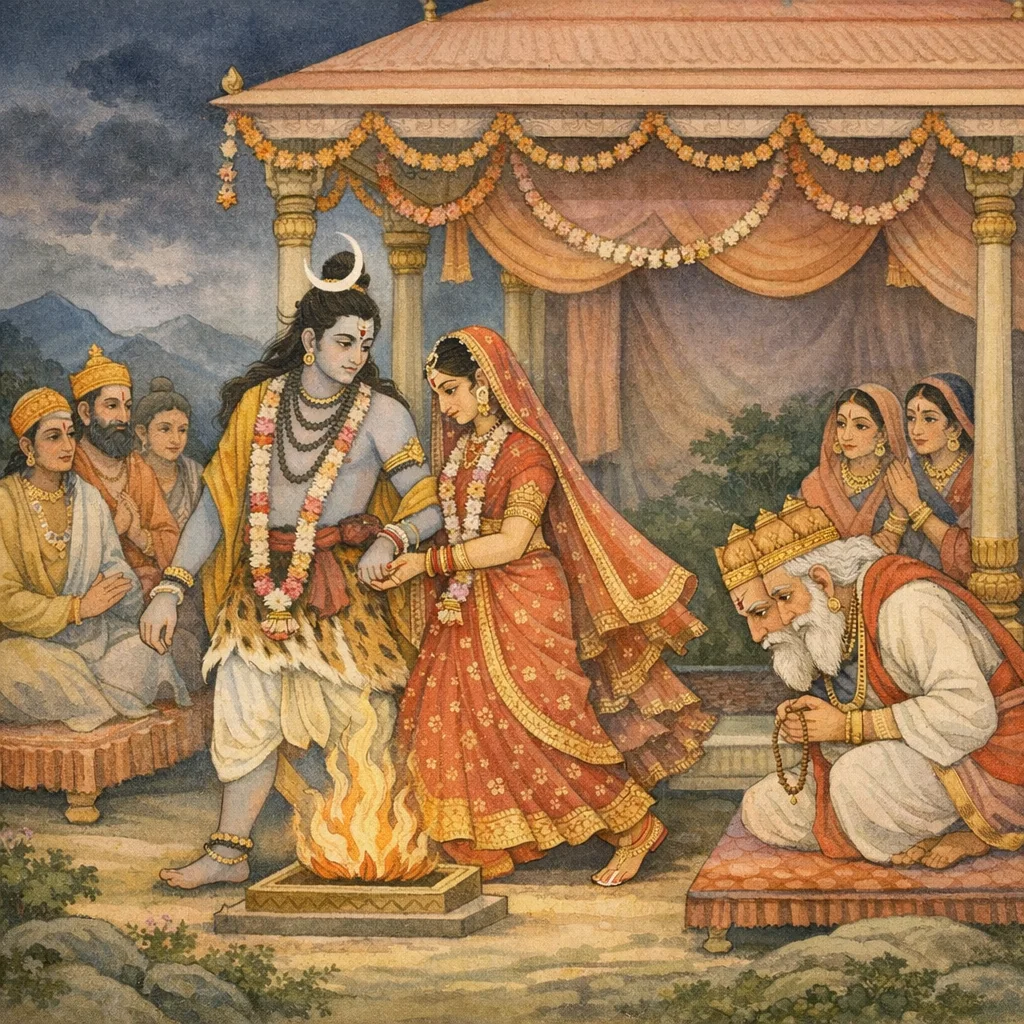
अध्याय ४९ — विवाहानुष्ठाने ब्रह्मणः काममोहः (Brahmā’s Enchantment by Desire during the Wedding Rites)
During the marriage rites of Śiva and Pārvatī, Brahmā recounts the prescribed ritual acts and a crisis that follows. At Brahmā’s direction the priests establish the sacred fire; Śiva performs homa with Ṛg–Yajus–Sāman mantras, and Maināka (named as Kālī’s brother) offers the customary lājāñjali. Śiva and Kālī/Pārvatī then circumambulate the fire according to rule and social convention (vahnipradakṣiṇā; lokācāra). At that moment an extraordinary disturbance arises: Brahmā, deluded by Śiva’s māyā, beholds a crescent-like, captivating beauty at the goddess’s toenail/foot and is overwhelmed by kāma. Gazing repeatedly, he loses composure and his semen falls to the ground; ashamed, he tries to conceal it by rubbing and covering it with his feet. When Mahādeva learns of this lapse, he burns with anger and seeks to punish Brahmā, spreading panic and fear among beings. The chapter thus moves from orderly Vedic wedding-rite to a theologically charged disruption, revealing the peril of desire, the reach of māyā, and Śiva’s role as cosmic disciplinarian within the sacramental setting of divine marriage.
Shlokas
Verse 1
ब्रह्मोवाच । अथो ममाज्ञया विप्रैस्संस्थाप्यानलमीश्वरः । होमं चकार तत्रैवमङ्के संस्थाप्य पार्वतीम्
Brahmā said: Then, by my command, the revered brāhmaṇas duly established the sacred fire. Thereupon the Lord performed the homa right there, having seated Pārvatī upon His lap.
Verse 2
ऋग्यजुस्साममन्त्रैश्चाहुतिं वह्नौ ददौ शिवः । लाजाञ्जलिं ददौ कालीभ्राता मैनाकसंज्ञकः
Reciting the mantras of the Ṛg, Yajus, and Sāma Vedas, Lord Śiva poured the oblations into the sacred fire. Then Maināka—known as Kālī’s brother—offered the lājāñjali, the ritual handful of parched grain for the wedding rite.
Verse 3
अथ काली शिवश्चोभौ चक्रतुर्विधिवन्मुदा । वह्निप्रदक्षिणां तात लोकाचारं विधाय च
Then Kālī and Śiva, both together, joyfully performed the rite in due accordance; and, dear one, having circumambulated the sacred fire, they also observed the customary ways of the world.
Verse 4
तत्राद्भुतमलञ्चक्रे चरितं गिरिजापतिः । तदेव शृणु देवर्षे तवस्नेहाद्ब्रवीम्यहम्
There, the Lord of Girijā (Śiva) performed a truly wondrous divine deed. Listen to that very account, O devarṣi; out of affection for you, I shall relate it.
Verse 5
तस्मिन्नवसरे चाहं शिवमायाविमोहितः । अपश्यञ्चरणे देव्या नखेन्दुञ्च मनोहरम्
At that very moment, I too—bewildered by Śiva’s māyā—beheld upon the Goddess’s foot the lovely, moon-like gleam of her toenail.
Verse 6
दर्शनात्तस्य च तदाऽभूवं देवमुने ह्यहम् । मदनेन समाविष्टोऽतीव क्षुभितमानसः
And at that time, O divine sage, upon seeing her I became completely overwhelmed—seized by Kāma (the power of desire), with my mind intensely agitated.
Verse 7
मुहुर्मुहुरपश्यं वै तदंगं स्मरमोहितः । ततस्तद्दर्शनात्सद्यो वीर्यं मे प्राच्युतद्भुवि
Again and again I gazed upon her limbs, my mind deluded by Kāma. Then, from that very sight, my virility at once fell down upon the earth.
Verse 8
रेतसा क्षरता तेन लज्जितोहं पितामहः । मुने व्यमर्द तच्छिन्नं चरणाभ्यां हि गोपयन्
“Because of that semen flowing forth, I—Brahmā, the Grandsire—was overcome with shame. O sage, concealing it, I crushed that fallen portion with my feet.”
Verse 9
तज्ज्ञात्वा च महादेवश्चुकोपातीव नारद । हन्तुमैच्छत्तदा शीघ्रं वां विधिं काममोहितम्
O Nārada, when Mahādeva came to know of this, he flared up with intense anger and at once wished to swiftly slay that Vidhi (Brahmā), who had been deluded by Kāma (desire).
Verse 10
हाहाकारो महानासीत्तत्र सर्वत्र नारद । जनाश्च कम्पिरे सर्व्वे भय मायाति विश्वभृत्
O Nārada, a great cry of lamentation arose everywhere there; all the people trembled as fear came upon the Sustainer of the universe.
Verse 11
ततस्तंन्तुष्टुवुश्शम्भुं विष्ण्वाद्या निर्जरा मुने । सकोपम्प्रज्वलन्तन्तन्तेजसा हन्तुमुद्यतम्
Then, O sage, the deathless gods beginning with Viṣṇu praised Śambhu. He, blazing with wrathful splendour, stood ready to strike and destroy.
Verse 12
देवा ऊचुः । देवदेव जगद्व्यापिन्परमेश सदाशिव । जगदीश जगन्नाथ सम्प्रसीद जगन्मय
The Devas said: O God of gods—O all-pervading Lord of the universe, Supreme Ruler, Sadāśiva; O Lord of the worlds, O Master of the universe—be gracious to us, O One who is Himself the very essence of the cosmos.
Verse 13
सर्वेषामपि भावानान्त्वमात्मा हेतुरीश्वरः । निर्विकारोऽव्ययो नित्यो निर्विकल्पोऽक्षरः परः
You are the very Self of all beings and states of existence; you are the sovereign Lord, the ultimate cause. You are changeless, imperishable, eternal, free from all conceptual distinctions, the undecaying Reality—supreme beyond all.
Verse 14
आद्यन्तावस्य यन्मध्यमिदमन्यदहम्बहिः । यतोऽव्ययः सनैतानि तत्सत्यम्ब्रह्म चिद्भवान्
That Reality in which the beginning and the end are contained, and which is the middle of all this; which is other than ‘this’ and other than ‘I’, and yet beyond all—He, the imperishable Being from whom these (categories of experience) arise, is the True, the Brahman, the very Consciousness—You indeed are That.
Verse 15
तवैव चरणाम्भोजम्मुक्तिकामा दृढव्रताः । विसृज्योभयतस्संगं मुनयस्समुपासते
Seeking liberation and firm in their vows, the sages worship only Your lotus-feet, having cast aside attachments to both sides—worldly enjoyment and even the pride of renunciation.
Verse 16
त्वम्ब्रह्म पूर्णममृतं विशोकं निर्गुणम्परम् । आनंदमात्रमव्यग्रमविकारमनात्मकम्
You are Brahman—perfect and complete, immortal and sorrowless; the supreme, attributeless Reality. You are pure bliss alone—undistracted, unchanging, and beyond all limited individuality.
Verse 17
विश्वस्य हेतुरुदयस्थितिसंयमनस्य हि । तदपेक्षतयात्मेशोऽनपेक्षस्सर्वदा विभुः
Indeed, He is the cause of the universe’s arising, continuance, and restraint (dissolution). Yet the Lord of the Self, the all-pervading Vibhū, remains forever independent—unconditioned and needing nothing, even though all things depend upon Him.
Verse 19
अज्ञानतस्त्वयि जनैर्विकल्पो विदितो यतः । तस्माद्भ्रमप्रतीकारो निरुपाधेर्न हि स्वतः
Because, through ignorance, people superimpose conceptual distinctions upon You, the remedy for delusion does not arise of itself from the attributeless Lord (nirupādhi). It must be undertaken by the deluded soul through right understanding and disciplined practice.
Verse 20
धन्या वयं महेशान तव दर्शनमात्रतः । दृढभक्तजनानन्दप्रदश्शम्भो दयां कुरु
O Maheśāna, we are truly blessed merely by receiving Your darśana. O Śambhu, giver of joy to steadfast devotees—show us Your compassion.
Verse 21
त्वमादिस्त्वमनादिश्च प्रकृतेस्त्वं परः पुमान् । विश्वेश्वरो जगन्नाथो निर्विकारः परात्परः
You are the beginning, and yet beginningless. Transcending Prakṛti, You are the Supreme Puruṣa—Lord of the universe, Master of all worlds, changeless, and higher than the highest.
Verse 22
योऽयं ब्रह्मास्तिऽ रजसा विश्वमूर्तिः पितामहः । त्वत्प्रसादात्प्रभो विष्णुस्सत्त्वेन पुरुषोत्तमः
O Lord, this Brahmā—who through rajas becomes the manifest form of the universe and is called Pitāmaha—exists by Your grace. Likewise, by Your favor, Viṣṇu, established in sattva, becomes Puruṣottama, the Supreme Person.
Verse 23
कालाग्निरुद्रस्तमसा परमात्मा गुणः परः । सदा शिवो महेशानस्सर्वव्यापी महेश्वरः
He is Kālāgnirudra, the fire of Time that consumes all; He is the Supreme Self, beyond the guṇas and higher than the highest. He is Sadāśiva, Maheśāna—the all-pervading Mahādeva, the Great Lord, Maheśvara.
Verse 24
व्यक्तं महच्च भूतादिस्तन्मात्राणीन्द्रियाणि च । त्वयैवाधिष्ठितान्येव विश्वमूर्ते महेश्वर
O Maheśvara, whose form is the whole universe—this manifest world, the Mahat (cosmic intellect), the primordial basis of the elements, the subtle essences (tanmātras), and the sense-faculties are all sustained and governed by You alone.
Verse 25
महादेव परेशान करुणाकर शंकर । प्रसीद देवदेवेश प्रसीद पुरुषोत्तम
O Mahādeva—Supreme Lord, compassionate Śaṅkara—be gracious. O Deva of devas, be pleased; O Puruṣottama, be pleased.
Verse 26
वासांसि सागरास्सप्त दिशश्चैव महाभुजाः । द्यौर्मूर्द्धा ते विभोर्नाभिः खं वायुर्नासिका ततः
Your garments are the seven oceans, and the directions themselves are Your mighty arms. O all-pervading Lord, the heaven is Your head; the sky is Your navel; and the wind is Your nose.
Verse 27
चक्षूंष्यग्नी रविस्सोमः केशा मेघास्तव प्रभो । नक्षत्रतारकाद्याश्च ग्रहाश्चैव विभूषणम्
O Lord, Your eyes are Fire, the Sun, and the Moon; Your hair is the mass of clouds. The constellations, stars, and the planets are indeed Your adornments.
Verse 28
कथं स्तोष्यामि देवेश त्वां विभो परमेश्वर । वाचामगोचरोऽसि त्वं मनसा चापि शंकर
O Lord of the gods, O all-pervading Supreme Lord—how can I praise You? O Śaṅkara, You are beyond the reach of speech, and beyond the mind as well.
Verse 29
पञ्चास्याय च रुद्राय पञ्चाशत्कोटिमूर्तये । त्र्यधिपाय वरिष्ठाय विद्यातत्त्वाय ते नमः
Salutations to You—Rudra of five faces, manifesting as fifty crores of forms; the supreme Lord of the three worlds, the Most Excellent, the very Principle of sacred Knowledge (vidyā-tattva).
Verse 30
अनिदेंश्याय नित्याय विद्युज्ज्वालाय रूपिणे । अग्निवर्णाय देवाय शंकराय नमोनमः
Salutations again and again to Śaṅkara—the divine Lord who is beyond indication, ever-eternal, whose very form is a lightning-flame, and whose radiance is like fire.
Verse 31
विद्युत्कोटिप्रतीकाशमष्टकोणं सुशोभनम् । रूपमास्थाय लोकेऽस्मिन्संस्थिताय नमो नमः
Salutations again and again to that Divine One who, assuming a supremely beautiful eight-angled form—radiant like the light of ten million flashes of lightning—abides and is established in this world.
Verse 32
ब्रह्मोवाच । इत्याकर्ण्य वचस्तेषां प्रसन्नः परमेश्वरः । ब्रह्मणो मे ददौ शीघ्रमभयं भक्तवत्सलः
Brahmā said: Having thus heard their words, the Supreme Lord became gracious; the Lord, ever affectionate to His devotees, quickly granted fearlessness to me, Brahmā.
Verse 33
अथ सर्वे सुरास्तत्र विष्ण्वाद्या मुनयस्तथा । अभवन्सुस्मितास्तात चक्रुश्च परमोत्सवम्
Then, there, all the gods—led by Viṣṇu—and the sages as well became gently smiling, dear one, and they celebrated a most exalted festival.
Verse 34
मम तद्रेतसा तात मर्दितेन मुहुर्मुहुः । अभवन्कणकास्तत्र भूरिशः परमोज्ज्वलाः
“O dear one, when that seed of mine was repeatedly crushed and ground again and again, there arose there in great abundance exceedingly radiant particles of gold.”
Verse 35
ऋषयो बहवो जाता वालखिल्यास्सहस्रशः । कणकैस्तैश्च वीर्यस्य प्रज्वलद्भिः स्वतेजसा
Then, by the potency of that virile energy, countless sages were born—thousands upon thousands of the Vālakhilyas—tiny in form yet blazing with their own innate radiance, like sparks of gold.
Verse 36
अथ ते ह्यृषयस्सर्वे उपतस्थुस्तदा मुने । ममान्तिकं परप्रीत्या तात तातेति चाब्रुवन्
Then all those sages, O seer, came and stood near me. With deep affection they addressed me, repeatedly saying, “Dear child, dear child.”
Verse 37
ईश्वरेच्छाप्रयुक्तेन प्रोक्तास्ते नारदेन हि । वालखिल्यास्तु ते तत्र कोपयुक्तेन चेतसा
Indeed, those words were spoken by Nārada, impelled by the will of Īśvara (Lord Śiva). But the Vālakhilya sages there, their minds seized by anger, reacted in wrath.
Verse 38
नारद उवाच । गच्छध्वं संगता यूयं पर्वतं गन्धमादनम् । न स्थातव्यम्भवद्भिश्च न हि वोऽत्र प्रयोजनम्
Nārada said: “All of you who have assembled here—go at once to Mount Gandhamādana. You should not remain here, for in this matter there is no purpose for you to serve by staying.”
Verse 39
तत्र तप्त्वा तपश्चाति भवितारो मुनीश्वराः । सूर्य्यशिष्याश्शिवस्यैवाज्ञया मे कथितन्त्विदम्
“Having performed austerities there, those great sages will indeed become accomplished. This account has been told to me by the disciples of Sūrya, by the very command of Śiva.”
Verse 40
ब्रह्मोवाच । इत्युक्तास्ते तदा सर्वे बालखिल्याश्च पर्वतम् । सत्वरम्प्रययुर्नत्वा शंकरं गन्धमादनम्
Brahmā said: Thus instructed, all of them—the Bālakhilya sages—then hurried to the mountain. Having bowed in reverence to Śaṅkara on Gandhamādana, they swiftly departed.
Verse 41
विष्ण्वादिभिस्तदाभूवं श्वासितोहं मुनीश्वर । निर्भयः परमेशानप्रेरितैस्तैर्महात्मभिः
O lord among sages, at that time I was revived and made to breathe again by Viṣṇu and the others—those great-souled ones who were impelled by Parameśāna (Śiva). Thus I became fearless.
Verse 42
अस्तवञ्चापि सर्वेशं शंकरम्भक्तवत्सलम् । सर्वकार्यकरं ज्ञात्वा दुष्टगर्वापहारकम्
Knowing Śaṅkara as the Lord of all—ever tender to His devotees, the accomplisher of every undertaking, and the remover of wicked pride—she too offered Him hymns of praise.
Verse 43
देवदेव महादेव करुणासागर प्रभो । त्वमेव कर्ता सर्वस्य भर्ता हर्त्ता च सर्वथा
O God of gods, O Mahādeva, ocean of compassion, O Lord—You alone are truly the doer of all; You alone sustain all, and You alone withdraw all, in every way.
Verse 44
त्वदिच्छया हि सकलं स्थितं हि सचराचरम् । तन्त्यां यथा बलीवर्दा मया ज्ञातं विशेषतः
Truly, by Your will alone everything—moving and unmoving—remains sustained. Just as oxen are held and guided by a tethering rope, so have I understood, in particular, that all this is governed by You.
Verse 45
इत्येवमुक्त्वा सोहं वै प्रणामं च कृताञ्जलिः । अन्येऽपि तुष्टुवुस्सर्वे विष्ण्वाद्यास्तं महेश्वरम्
Having spoken thus, I too bowed down with hands joined in reverence. Then all the others as well, beginning with Viṣṇu, praised that Mahādeva—Maheśvara, the Great Lord.
Verse 46
अथाकर्ण्य नुतिं शुद्धां मम दीनतया तदा । विष्ण्वादीनाञ्च सर्वेषां प्रसन्नोऽभून्महेश्वरः
Then, hearing that pure hymn of praise—offered by me in humble supplication, and also by all the gods beginning with Viṣṇu—Maheśvara (Śiva) became gracious and pleased.
Verse 47
ददौ सोतिवरं मह्यमभयं प्रीतमानसः । सर्वे सुखमतीवापुरत्यमोदमहं मुने
With his heart well pleased, he granted me the supreme boon—abhaya, fearlessness. Thereupon all attained great happiness; and I too, O sage, became exceedingly delighted.
Verse 49
इति श्रीशिवमहापुराणे द्वितीयायां रुद्रसंहितायां तृतीये पार्वतीखण्डे विधिमोहवर्णनं नाम नवचत्वारिंशोऽध्यायः
Thus, in the Śrī Śiva Mahāpurāṇa—within the Second division, the Rudra-saṃhitā, in its Third section, the Pārvatī-khaṇḍa—ends the forty-ninth chapter entitled “The Description of Brahmā’s Delusion.”
Frequently Asked Questions
During Śiva–Pārvatī’s wedding rites (homa and fire-circumambulation), Brahmā becomes deluded by desire upon seeing the goddess’s foot/toenail beauty; his semen falls, and Śiva becomes enraged upon learning of the transgression.
The episode dramatizes how kāma and māyā can overpower even creator-deities, while Śiva’s authority regulates and reorders cosmic energies (tejas/retas) within a sacramental context.
Ritual manifestations (Agni, mantra, homa, pradakṣiṇā) and psychological manifestations (kāma-moha, lajjā, krodha) are paired to show that inner states and outer rites jointly shape dharmic and cosmic outcomes.