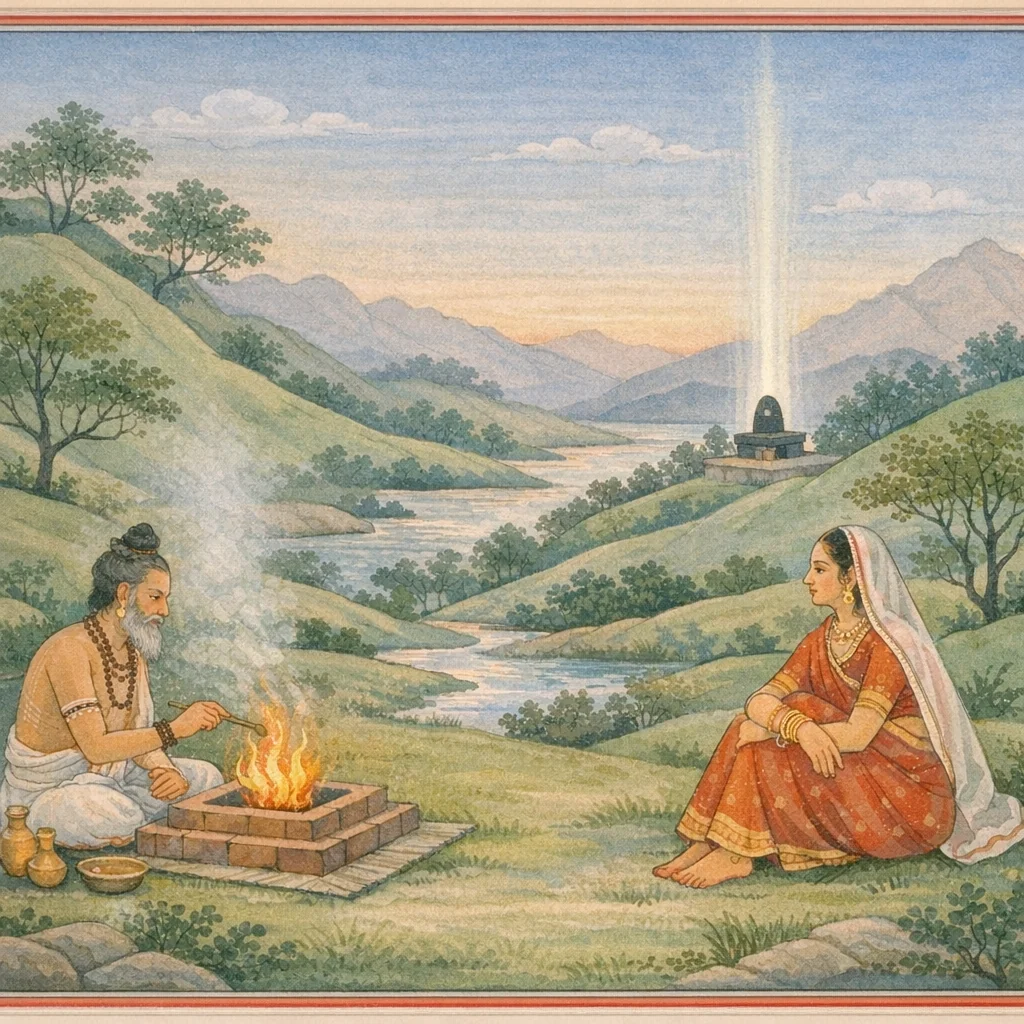
Ghuśmeśa-jyotirliṅga-māhātmya (The Greatness of the Ghuśmeśa Jyotirlinga)
This adhyāya begins as Sūta turns to the next jyotirliṅga, naming Ghuśmeśa as a Jyotirlinga and inviting the sages to hear its māhātmya. The setting is placed in the south at a radiant mountain called Girir-deva. Nearby lives Sudharmā, a brāhmaṇa of the Bhāradvāja lineage, portrayed as an exemplary householder: honoring devatās and guests, following the veda-mārga, serving the sacred fire (agni-sevā), performing tri-kāla sandhyā, and teaching śāstra. Though blessed with merit and prosperity, the couple remains childless. Sudharmā stays steady through knowledge of the ātman, refusing grief, while his wife Sudehā sorrows for lack of offspring. The chapter thus prepares the typical jyotirliṅga resolution, where worldly lack and spiritual composure become the doorway to Śiva’s grace through the holy site and the liṅga’s presence.
Shlokas
Verse 1
सूत उवाच । अतः परं च घुश्मेशं ज्योतिर्लिंगमुदाहृतम् । तस्यैव च सुमाहात्म्यं श्रूयतामृषिसत्तमः
Sūta said: “Next, the Jyotirliṅga known as Ghuśmeśa is proclaimed. O best of sages, now listen to the great and auspicious glory of that very Lord.”
Verse 2
दक्षिणस्यां दिशि श्रेष्ठो गिरिर्देवेति संज्ञकः । महाशोभान्वितो नित्यं राजतेऽद्भुत दर्शनः
In the southern direction stands an excellent mountain known by the name “Deva.” Ever adorned with great splendor, it shines perpetually, wondrous to behold.
Verse 3
तस्यैव निकटे कश्चिद्भारद्वाजकुलोद्भवः । सुधर्मा नाम विप्रश्च न्यवसद्ब्रह्मवित्तमः
Close by that very place there lived a Brahmin born in the lineage of Bharadvāja, named Sudharmā—an excellent knower of Brahman, firmly established in sacred wisdom.
Verse 4
तस्य प्रिया सुदेहा च शिवधर्मपरायणः । पतिसेवापरा नित्यं गृहकर्मविचक्षणा
His beloved wife, Sudekhā, was wholly devoted to the dharma of Śiva. Ever intent on serving her husband, she was skilled and discerning in the duties of the household.
Verse 5
सुधर्मा च द्विजश्रेष्ठो देवतातिथिपूजकः । वेदमार्गपरो नित्यमग्नि सेवापरायणः
And Sudharmā, the foremost among the twice-born, worshipped the deities and honored guests. Ever devoted to the Vedic path, he was constantly dedicated to the service of the sacred fire.
Verse 6
त्रिकालसंध्यया युक्तस्सूर्य्यरूपसमद्युतिः । शिष्याणां पाठकश्चैव वेदशास्त्रविचक्षणः
He was steadfast in the three daily Sandhyā devotions, radiant with a splendour comparable to the sun in form and brilliance. He also taught his disciples and was discerning in the Vedas and the sacred treatises.
Verse 7
धनवांश्च परो दाता सौजन्यगुणभाजनः । शिवकर्मरतो नित्यं शैवश्शैवजनप्रियः
He was prosperous and a foremost giver, a receptacle of the virtues of noble conduct. Ever engaged in the works of Śiva, he was truly a Śaiva—beloved among the devotees of Śiva.
Verse 8
आयुर्बहु व्यतीयाय तस्य धर्मं प्रकुर्वतः । पुत्रश्च नाभवत्तस्य ऋतुः स्यादफलः स्त्रियाः
Though he diligently performed his prescribed dharma, many years of his life passed away; yet no son was born to him, and the wife’s fertile season proved fruitless.
Verse 9
तेन दुःखं कृतं नैव वस्तुज्ञानपरेण हि । आत्मनस्तारकश्चात्मा ह्यात्मनः पावनश्च सः
For one devoted to the knowledge of Reality, no sorrow is truly produced. For the Self itself becomes one’s liberator, and that very Self is the purifier of the self.
Verse 10
इत्येवं मानसं धृत्वा दुःखं न कृतवान्स्तदा । सुदेहा च तदा दुःखं चकार पुत्रसम्भवम्
Having thus steadied his mind, he did not give way to sorrow at that time. But Sudehā then grieved, distressed by the matter of obtaining a son.
Verse 11
नित्यं च स्वामिनं सा वै प्रार्थयद्यत्नसाधने । पुत्रोत्पादनहेतोश्च सर्वविद्याविशारदम्
And she continually entreated her lord, who was skilled in every branch of knowledge, to undertake earnest effort—so that a son might be brought forth.
Verse 12
सोऽपि स्त्रियं तदा भर्त्स्य किं पुत्रश्च करिष्यति । का माता कः पिता पुत्रः को बंधुश्च प्रियश्च कः
He too will then scold the woman; and what will the son be able to do? Who is truly “mother,” who “father,” who “son”? Who indeed is “kinsman,” and who is “dear”?
Verse 13
सर्वं स्वार्थपरं देवि त्रिलोक्यां नात्र संशयः । जानीहि त्वं विशेषेण बुद्ध्या शोकं न वै कुरु
O Goddess, in the three worlds everyone is intent on their own advantage—of this there is no doubt. Know this clearly with discerning understanding, and do not give way to grief.
Verse 14
तस्माद्देवि त्वया दुःखं त्यजनीयं सुनिश्चितम् । नित्यं मह्यं त्वया नैव कथनीयं शुभव्रते
Therefore, O Devī, you must certainly abandon sorrow. And, O you of auspicious vows, you should never speak of it to me again—ever.
Verse 15
एवं तां सन्निवार्य्यैव भगवद्धर्मतत्परः । आसीत्परमसंतुष्टो द्वन्द्वदुःखं समत्यजत्
Thus, having firmly restrained her, he—devoted to the dharma of the Lord—became supremely content, and he cast off the sorrow born of the pairs of opposites.
Verse 16
कदाचिच्च सुदेहा वै गेहे च सहवासिनः । जगाम प्रियगोष्ठ्यर्थं विवादस्तत्र संगतः
Once, Sudehā, together with those dwelling in the same house, went out for a pleasant gathering; yet there a dispute arose.
Verse 17
तत्पत्नी स्त्रीस्वभावाच्च भर्त्सिता सा तया तदा । उक्ता चेति दुरुक्त्या वै सुदेहा विप्रकामिनी
Then that man’s wife, stirred by a woman’s nature (jealousy), harshly rebuked her at that time. With cutting words she spoke to Sudehā, who was enamored of the brāhmaṇa.
Verse 18
द्विजपत्न्युवाच अपुत्रिणि कथं गर्वं कुरुषे पुत्रिणी ह्यहम् । मद्धनं भोक्ष्यते पुत्रो धनं ते कश्च भोक्ष्यते
The Brahmin’s wife said: “O childless woman, how can you be proud? I am blessed with a son. My son will inherit and enjoy my wealth—who, indeed, will enjoy yours?”
Verse 19
नूनं हरिष्यते राजा त्वद्धनं नात्र संशयः । धिग्धिक्त्वां ते धनं धिक्च धिक्ते मानं हि वन्ध्यके
“Surely the king will seize your wealth—of this there is no doubt. Shame on you! Shame on your riches, and shame on that pride of yours, O barren woman!”
Verse 20
सूत उवाच । भर्त्सिता ताभिरिति सा गृहमागत्य दुःखिता । स्वामिने कथयामास तदुक्तं सर्वमादरात्
Sūta said: Thus rebuked by those women, she returned home distressed and, with due respect, reported to her husband everything that had been said.
Verse 21
ब्राह्मणोऽपि तदा दुःखं न चकार सुबुद्धिमान् । कथितं कथ्यतामेव यद्भावि तद्भवेत्प्रिये
Then that wise brāhmaṇa did not give way to grief. He said, “Speak freely what you have to say, O beloved; whatever is destined to occur will indeed occur.”
Verse 22
इत्येवं च तदा तेन ह्याश्वस्तापि पुनः पुनः । न तदा सात्यजद्दुःखं ह्याग्रहं कृतवत्यसौ
Thus, though he consoled her again and again, she did not then relinquish her sorrow; indeed, she remained steadfast in her insistence.
Verse 23
सुदेहोवाच । यथा तथा त्वया पुत्रस्समुत्पाद्यः प्रियोऽसि मे । त्यक्षामि ह्यन्यथाहं च देहं देहभृतां वर
Sudehā said: “By whatever means, you must indeed bring forth a son; you are dear to me. Otherwise, O best among embodied beings, I shall surely abandon this body.”
Verse 24
सूत उवाच । एवमुक्तं तया श्रुत्वा सुधर्मा ब्राह्मणोत्तमः । शिवं सस्मार मनसा तदाग्रहनिपीडितः
Sūta said: Hearing those words spoken by her, Sudharmā—the best of brāhmaṇas—oppressed by that insistence, inwardly remembered Lord Śiva in his mind.
Verse 25
अग्नेरग्रेऽक्षिपत्पुष्पद्वयं विप्रो ह्यतंद्रितः । मनसा दक्षिणं पुष्पं तन्मेने पुत्रकामदम्
In front of the sacred fire, the vigilant brāhmaṇa promptly cast two flowers. In his mind he regarded the right-hand flower as the giver of the boon of a son.
Verse 26
एवं कृत्वा पणं पत्नीमुवाच ब्राह्मणस्स च । अनयोर्ग्राह्यमेकं ते पुष्पं पुत्र फलाप्तये
Having thus made the agreement, that brāhmaṇa spoke to his wife: “From these two, take whichever single flower you choose, for the attainment of the fruit of a son.”
Verse 27
तया च मनसा धृत्वा पुत्रश्चैव भवेन्मम । तदा च स्वामिना यच्च धृतं पुष्पं समेतु माम्
Holding me within her mind, may I indeed become her son. And may that very flower which the Lord—her husband—then held in his hand come to me.
Verse 28
इत्युक्त्वा च तया तत्र नमस्कृत्य शिवं तदा । नत्वा चाग्निं पुनः प्रार्थ्य गृहीतं पुष्पमेककम्
Having spoken thus, she there bowed in reverence to Lord Śiva. Then, after bowing to the sacred fire and praying once more, she took up a single flower.
Verse 29
स्वामिना चिंतितं यच्च तद्गृहीतं तया न हि । सुदेहया विमोहेन शिवेच्छासंभवेन वै
Whatever her lord had intended, she did not accept it, for in Sudehā delusion had arisen—truly born of Śiva’s own will.
Verse 30
तद्दृष्ट्वा पुरुषश्चैव निश्वासं पर्यमोचयत् । स्मृत्वा शिवपदांभोजमुवाच निजकामिनीम्
Seeing that, the man at once heaved a deep sigh. Then, remembering the lotus-feet of Lord Śiva, he spoke to his beloved wife.
Verse 31
सुधर्मोवाच । निर्मितं चेश्वरेणैव कथं चैवान्यथा भवेत् । आशां त्यज प्रिये त्वं च परिचर्य्यां कुरु प्रभोः
Sudharma said: “Since it has been fashioned by the Lord Himself, how could it be otherwise? Abandon expectation, my beloved, and engage in devoted service to the Lord.”
Verse 32
इत्युक्त्वा तु स्वयं विप्र आशां परिविहाय च । धर्मकार्यरतस्सोऽभूच्छंकरध्यानतत्परः
Having spoken thus, that brāhmaṇa abandoned all worldly expectation, applied himself to the works of dharma, and became wholly intent on meditation upon Śaṅkara (Lord Śiva).
Verse 33
सा सुदेहाग्रहं नैव मुमोचात्मजकाम्यया । प्रत्युवाच पतिं प्रेम्णा सांजलिर्नतमस्तका
Longing for a son, she did not in the least relinquish her attachment to her beautiful body. Then, with loving devotion, hands joined in reverence and head bowed, she replied to her husband.
Verse 34
सुदेहोवाच । मयि पुत्रो न चास्त्वन्या पत्नीं कुरु मदाज्ञया । तस्यां नूनं सुतश्चैव भविष्यति न संशयः
Sudehā said: “Since no son has been born from me, marry another wife by my command. From her, surely a son will be born—of this there is no doubt.”
Verse 35
सूत उवाच । तदैव प्रथितो वै स ब्रह्मणश्शैवसत्तमः । उवाच स्वप्रियां तां च सुदेहां धर्म तत्परः
Sūta said: At that very time, Brahmā—renowned and foremost among Śiva’s devotees, ever devoted to dharma—spoke to his beloved Sudehā.
Verse 36
सुधर्मोवाच । त्वदीयं च मदीयं च सर्वं दुःखं गतं ध्रुवम् । तस्मात्त्वं धर्मविघ्नं च प्रियो मा कुरु सांप्रतम्
Sudharma said: “Surely, all sorrow—yours as well as mine—has now departed. Therefore, my dear one, do not at this moment become an obstacle to dharma.”
Verse 37
सूत उवाच । इत्येवं वारिता सा च स्वामातुः पुत्रिकां तदा । गृहमानीय भर्तारं वृणु त्वेनामिदं जगौ
Sūta said: Thus being restrained, she then brought that maiden—her own mother’s daughter—back home and said to her, “Choose a husband.”
Verse 38
सुधर्मोवाच । इदानीं वदसि त्वं च मत्प्रियेयं ततः पुनः । पुत्रसूश्च यदा स्याद्वै तदा स्पर्द्धां करिष्यसि
Sudharmā said: “Even now you speak of her as ‘my beloved’; but later, when a son is born, you will surely enter into rivalry and contention.”
Verse 39
नाहं स्पर्द्धां भगिन्या वै करिष्ये द्विजसत्तम । उपयच्छस्व पुत्रार्थमिमामाज्ञापयामि च
O best of Brahmins, I shall not engage in rivalry with my sister. Accept her for the sake of obtaining a son—this I also command.
Verse 40
इत्येवं प्रार्थितस्सोऽपि सुधर्मा प्रियया तया । घुश्मां तां समुपायंस्त विवाहविधिना द्विजः
Thus entreated in this way by his beloved, Sudharmā too—being a twice-born man—accepted Ghuśmā and married her according to the prescribed rites of marriage.
Verse 41
ततस्तां परिणीयाथ प्रार्थयामास तां द्विजः । त्वदीयेयं कनिष्ठा हि सदा पोष्यानघे प्रिये
Then, having duly married her, the brāhmaṇa respectfully addressed her: “Beloved, O sinless one—this younger sister of yours is entrusted to you; she should always be cared for and maintained.”
Verse 42
उक्तैव स च धर्मात्मा सुधर्मा शैवसत्तमः । यथायोग्यं चकाराशु धर्मसंग्रहमात्मनः
Thus instructed, Sudharmā—righteous in soul and foremost among the devotees of Śiva—promptly arranged for himself a fitting compendium of dharma, suited to his capacity and station.
Verse 43
सा चापि मातृपुत्रीं तां दासीवत्पर्यवर्त्तत । परित्यज्य विरोधं हि पुपोषाहर्निशं प्रिया
She too served that mother and daughter as though she were their maidservant; abandoning all opposition, the beloved one nurtured and cared for them day and night.
Verse 44
कनिष्ठा चैव या पत्नी स्वस्रनुज्ञामवाप्य च । पार्थिवान्सा चकाराशु श्रियमेकोत्तरं शतम्
Then the younger wife, having obtained her sister’s consent, quickly had a hundred and one earthen liṅgas made, for the sake of auspicious prosperity.
Verse 45
विधानपूर्वकं घुष्मा सोपचारसमन्वितम् । कृत्वा तान्प्राक्षिपत्तत्र तडागे निकटस्थिते
Ghuṣmā, having duly performed the prescribed rites with the proper offerings and attendant services, then cast those objects into the nearby pond.
Verse 46
एवं नित्यं सा चकार शिवपूजां स्वकामदाम् । विसृज्य पुनरावाह्य तत्सपर्य्याविधानतः
Thus, every day she performed the worship of Lord Śiva, the fulfiller of her righteous desires. Having respectfully concluded the rite, she invoked Him again and continued the service exactly according to the prescribed method of worship.
Verse 47
कुर्वन्त्या नित्यमेवं हि तस्याश्शंकरपूजनम् । लक्षसंख्याभवत्पूर्णा सर्वकामफलप्रदा
Indeed, by performing Śaṅkara’s worship in this manner every day, her count reached a complete lakh (one hundred thousand); and that worship became the bestower of the fruits of all desired aims.
Verse 48
कृपया शंकरस्यैव तस्याः पुत्रो व्यजायत । सुन्दरस्सुभगश्चैव कल्याणगुणभाजम्
By Śaṅkara’s very grace, a son was born to her—handsome, auspicious, and a true abode of virtuous and blessed qualities.
Verse 49
तं दृष्ट्वा परमप्रीतः स विप्रो धर्मवित्तमः । अनासक्तस्सुखं भेजे ज्ञानधर्मपरायणः
Seeing him, that brāhmaṇa—foremost among the knowers of dharma—became supremely delighted. Free from attachment, he peacefully enjoyed true well-being, steadfastly devoted to spiritual knowledge and righteous conduct.
Verse 50
सुदेहा तावदस्यास्तु स्पर्द्धामुग्रां चकार सा । प्रथमं शीतलं तस्या हृदयं ह्यसिवत्पुनः
Then Sudehā, filled with fierce rivalry, acted accordingly. At first her heart was cool and composed; but again it turned hard and cutting, as though it were a sword.
Verse 51
ततः परं च यज्जातं कुत्सितं कर्म दुःखदम् । सावधानेन मनसा श्रूयतां तन्मुनीश्वरा
Thereafter, whatever arose as a blameworthy deed that brings suffering—O lords among sages—listen to that now with a vigilant and attentive mind.
Frequently Asked Questions
The chapter initiates the Ghuśmeśa jyotirliṅga māhātmya by establishing the kṣetra (Girir-deva in the southern direction) and introducing an exemplary Vedic-orthodox, Śiva-aligned householder (Sudharmā) whose childlessness becomes the narrative problem that the jyotirliṅga’s grace will address.
The jyotirliṅga functions as the ‘locus of accessibility’ for transcendent Śiva: sacred geography (diśā + giri + kṣetra) encodes a theology where place, discipline (sandhyā/agni), and moral steadiness become conduits for anugraha. Sudharmā’s non-grief grounded in ātma-jñāna models inner purification, while the unresolved desire for progeny marks the boundary where ritual-site grace complements philosophical composure.
Śiva is highlighted specifically as Ghuśmeśa in the form of a jyotirliṅga (jyotirliṅgam udāhṛtam). No distinct named manifestation of Gaurī appears in the sampled opening verses; the feminine presence is represented narratively through Sudehā’s domestic and emotional role rather than a theophanic form.