ज्योतिर्लिङ्गमाहात्म्य-प्रस्तावना तथा सोमनाथ-प्रसङ्गः (Prologue to the Glory and Origin of the Jyotirliṅgas; Somnātha Episode Begins)
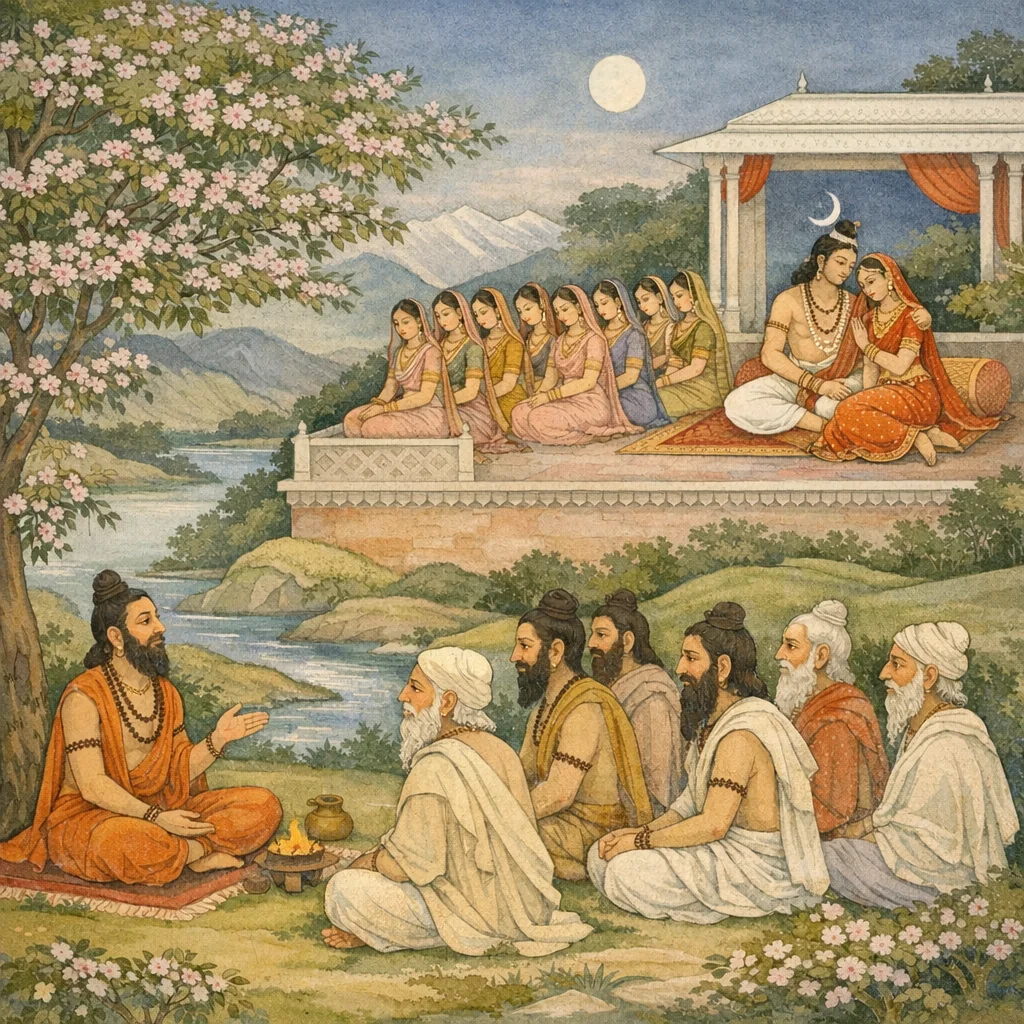
Adhyāya 14 is cast as an authorized, scholastic inquiry. The ṛṣis ask for a systematic account of the māhātmya (sacred greatness) and utpatti (origin and mode of manifestation) of the jyotirliṅgas, the “liṅgas of light.” Sūta replies that he will speak in concise form according to what he heard from a sadguru, establishing legitimacy through lineage while admitting the subject’s inexhaustibility. He then takes Somnātha as the first exemplar in the ordered series of jyotirliṅgas. The narrative begins with the Dakṣa–Candra marriage myth: Dakṣa gives his twenty-seven daughters (the Nakṣatras, starting with Aśvinī) to the Moon, Candra; prosperity and shared radiance follow. But Candra favors Rohiṇī, and the other wives, distressed, seek refuge with their father Dakṣa and report the injustice—setting in motion the causal chain that leads to Dakṣa’s curse, Candra’s affliction, and the salvific significance of the Somnātha liṅga.
Shlokas
Verse 1
ऋषय ऊचुः । ज्योतिषां चैव लिंगानां माहात्म्यं कथयाधुना । उत्पत्तिं च तथा तेषां ब्रूहि सर्वं यथाश्रुतम्
The sages said: “Now tell us the greatness of the luminous Jyotiḥ Liṅgas. Also explain their origin—tell us everything about them exactly as you have heard it in the sacred tradition.”
Verse 2
सूत उवाच । शृण्वन्तु विप्रा वक्ष्यामि तन्माहात्म्यं जनिं तथा । संक्षेपतो यथाबुद्धि सद्गुरोश्च मया श्रुतम्
Sūta said: “O brāhmaṇas, listen. I shall explain that glory and also its origin, briefly and according to my understanding—just as I have heard it from the true Sadguru, the genuine Guru.”
Verse 3
एतेषां चैव माहात्म्यं वक्तुं वर्षशतैरपि । शक्यते न मुनिश्रेष्ठास्तथापि कथयामि वः
O best of sages, the full greatness of these—Śiva’s holy manifestations and sacred places—cannot be told even in hundreds of years. Yet, for your sake, I shall still relate it.
Verse 4
सोमनाथश्च तेषां वै प्रथमः परिकीर्तितः । तन्माहात्म्यं शृणु मुने प्रथमं सावधानतः
Among those Jyotirliṅgas, Somanātha is indeed proclaimed as the first. Therefore, O sage, listen attentively first to the sacred greatness of Somanātha.
Verse 5
सप्तविंशन्मिताः कन्या दक्षेण च महात्मना । तेन चन्द्रमसे दत्ता अश्विन्याद्या मुनीश्वराः
O best of sages, the great-souled Dakṣa had twenty-seven daughters. He gave them in marriage to the Moon-god Candra, beginning with Aśvinī.
Verse 6
चन्द्रं च स्वामिनं प्राप्य शोभमाना विशेषतः । चन्द्रोऽपि चैव ताः प्राप्य शोभते स्म निरन्तरम्
Having attained Candra, the Moon, as their lord, they shone with exceptional splendor; and the Moon too, having attained them, continued to shine unceasingly.
Verse 7
हेम्ना चैव मणिर्भाति मणिना हेम चैव हि । एवं च समये तस्य यज्जातं श्रूयतामिति
Just as a jewel shines because of gold, and gold likewise shines because of the jewel, so—at that very time—listen to what occurred in that matter.
Verse 8
सर्वास्वपि च पत्नीषु रोहिणीनाम या स्मृता । यथैका सा प्रिया चासीत्तथान्या न कदाचन
Among all the wives, the one remembered as Rohiṇī alone was supremely beloved; as she alone was dear, no other ever was so.
Verse 9
अन्याश्च दुःखमापन्नाः पितरं शरणं ययुः । गत्वा तस्मै च यद्दुःखं तथा ताभिर्निवेदितम्
The other women, overcome with sorrow, went to their father for refuge; and upon approaching him, they reported truthfully the distress that had befallen them.
Verse 10
दक्षस्स च तथा श्रुत्वा दुःखं च प्राप्तावांस्तदा । समागत्य द्विजाश्चन्द्रं शान्त्यावोचद्वचस्तदा
Then Dakṣa, having heard it, was seized with sorrow. Thereupon the brahmin sages gathered and spoke soothing, conciliatory words to Candra (the Moon), seeking to restore peace.
Verse 11
दक्ष उवाच । विमले च कुले त्वं हि समुत्पन्नः कलानिधे । आश्रितेषु च सर्वेषु न्यूनाधिक्यं कथं तव
Dakṣa said: “O treasure-house of auspicious virtues, you have indeed been born in a pure and stainless lineage. Yet among all who have taken refuge in you, how can there be, on your part, any lesser or greater status?”
Verse 12
कृतं चेत्तकृतं तच्च न कर्तव्यं त्वया पुनः । वर्तनं विषमत्वेन नरकप्रदमीरितम्
If something has been done, do not treat it as though it were not done, and do not undertake it again. Such crooked conduct—marked by inconsistency and unfairness—is declared to lead to hellish consequences.
Verse 13
सूत उवाच । दक्षश्चैव च संप्रार्थ्य चन्द्रं जामातरं स्वयम् । जगाम मन्दिरं स्वं वै निश्चयं परमं गतः
Sūta said: Having personally entreated Candra—the Moon, his own son-in-law—Dakṣa then returned to his own residence, having arrived at a firm resolve.
Verse 14
चंद्रोऽपि वचनं तस्य न चकार विमोहितः । शिवमायाप्रभावेण यया संमोहितं जगत्
Even Candra (the Moon), deluded, did not carry out his command, for he was overpowered by the force of Śiva’s Māyā—by which the entire world is brought into bewilderment.
Verse 15
शुभं भावि यदा यस्य शुभं भवति तस्य वै । अशुभं च यदा भावि कथं तस्य शुभं भवेत्
When auspiciousness is destined for someone, auspicious results surely arise for him. But when inauspiciousness is destined, how can good fortune arise for him at all?
Verse 16
चन्द्रोऽपि बलवद्भाविवशान्मेने न तद्वचः । रोहिण्यां च समासक्तो नान्यां मेने कदाचन
But even Candra, overpowered by the force of destiny and his own strong inclination, did not heed that instruction. Deeply attached to Rohiṇī alone, he never regarded any of the other wives as equal at any time.
Verse 17
तच्छ्रुत्वा पुनरागत्य स्वयं दुःखसमन्वितः । प्रार्थयामास चन्द्रं स दक्षो दक्षस्सुनीतितः
Hearing that, Dakṣa returned again; overwhelmed with sorrow, that prudent Dakṣa then entreated Candra, the Moon.
Verse 18
दक्ष उवाच । श्रूयतां चन्द्र यत्पूर्वं प्रार्थितो बहुधा मया । न मानितं त्वया यस्मात्तस्मात्त्वं च क्षयी भव
Dakṣa said: “Hear me, O Candra. Formerly I entreated you many times, but you did not honor my request. Therefore you shall become one who wanes—subject to decline.”
Verse 19
सूत उवाच । इत्युक्ते तेन चन्द्रो वै क्षयी जातः क्षणादिह । हाहाकारो महानासीत्तदेन्दौ क्षीणतां गते
Sūta said: When he had spoken thus, the Moon at once began to waste away in that very moment. A great cry of distress arose when the lord of the night had fallen into emaciation.
Verse 20
देवर्षयस्तदा सर्वे किं कार्य्यं हा कथं भवेत् । इति दुःखं समापन्ना विह्वला ह्यभवन्मुने
Then all the divine seers, overwhelmed by sorrow, became distraught, saying, “Alas—what is to be done? How can this be?” O sage.
Verse 21
विज्ञापिताश्च चन्द्रेण सर्वे शक्रादयस्सुराः । ऋषयश्च वसिष्ठाद्या ब्रह्माणं शरणं ययु
Informed by Candra, all the gods beginning with Śakra (Indra), and the sages beginning with Vasiṣṭha, went to Brahmā for refuge.
Verse 22
गत्वापि तु तदा प्रोचुस्तद्वृत्तं निखिलं मुने । ब्रह्मणे ऋषयो देवा नत्वा नुत्वातिविह्वलाः
Having gone there, O sage, the gods and the seers told Brahmā the entire account of what had occurred; and, bowing down and offering hymns of praise, they stood overwhelmed with emotion.
Verse 23
ब्रह्मापि तद्वचः श्रुत्वा विस्मयं परमं ययौ । शिवमायां सुप्रशस्य श्रावयंस्तानुवाच ह
Hearing those words, Brahmā too was filled with the highest wonder. Praising the wondrous māyā of Śiva, he then addressed them, bidding them listen with full attention.
Verse 24
ब्रह्मोवाच । अहो कष्टं महज्जातं सर्वलोकस्य दुःखदम् । चन्द्रस्तु सर्वदा दुष्टो दक्षश्च शप्तवानमुम्
Brahmā said: “Alas! A great calamity has arisen, bringing sorrow to all the worlds. The Moon, Candra, has ever been improper in conduct, and Dakṣa has cursed him.”
Verse 25
सर्वं दुष्टेन चन्द्रेण कृतं कर्माप्यनेकशः । श्रूयतामृषयो देवाश्चन्द्रकृत्यं पुरातनम्
All this—many deeds and misdeeds—was done again and again by the wicked Moon, Candra. O sages and gods, hear now the ancient account of what was done by Candra.
Verse 26
बृहस्पतेर्गृहं गत्वा तारा दुष्टेन वै हृता । तस्य भार्या पुनश्चैव स दैत्यान्समुपस्थितः
The wicked Candra went to Bṛhaspati’s house and indeed carried off Tārā, Bṛhaspati’s wife. Thereafter he approached the Daityas, seeking their support.
Verse 28
तां च गर्भवतीं दृष्ट्वा न गृह्णामीति सोऽब्रवीत् । अस्माभिर्वारितो जीवः कृच्छ्राज्जग्राह तां तदा
Seeing that she was pregnant, he said, “I will not accept her.” Yet that embodied soul—though restrained by us—at that time took her with great difficulty.
Verse 29
यदि गर्भं जहातीह गृह्णामीत्यब्रवीत्पुनः । गर्भे मया पुनस्तत्र त्याजिते मुनिसत्तमाः
He said once more, “If she abandons the embryo here, I shall accept her again.” And when the embryo was again cast away there, O best of sages, (it was taken up again).
Verse 30
कस्यायं च पुनर्गर्भस्सोमस्येति च साऽब्रवीत् । पश्चात्तेन गृहीता सा मया च वारितेन वै
She said, “Whose child is this, conceived again—does it belong to Soma?” Thereafter she was taken by him, even though I had tried to restrain it.
Verse 31
एवंविधानि चन्द्रस्य दुश्चारित्राण्यनेकशः । वर्ण्यंते किं पुनस्तानि सोऽद्यापि कुरुते कथम्
Many kinds of the Moon’s misconduct are spoken of again and again. If that is so, how indeed could he still be doing those very deeds even today?
Verse 32
यज्जातं तत्सुसंजातं नान्यथा भवति ध्रुवम् । अतः परमुपायं वो वक्ष्यामि शृणुतादरात्
Whatever has arisen has indeed arisen as it must; it cannot become otherwise—this is certain. Therefore, I shall tell you the supreme means; listen with reverent attention.
Verse 33
प्रभासके शुभे क्षेत्रे व्रजेश्चन्द्रस्सदैवतैः । शिवमाराधयेत्तत्र मृत्युञ्जयविधानतः
In the auspicious holy field of Prabhāsa, King Candra (the Moon), together with the gods, went there and worshipped Lord Śiva according to the prescribed rite of Mṛtyuñjaya—He who conquers death.
Verse 34
निधायेशं पुरस्तत्र चन्द्रस्तपतु नित्यशः । प्रसन्नश्च शिवः पश्चादक्षयं तं करिष्यति
Having installed Īśa (Lord Śiva) there in front, let the Moon perform austerity constantly. Thereafter, when Śiva is pleased, He will make that (state or boon) imperishable.
Verse 35
सूत उवाच । इति श्रुत्वा वचस्तस्य ब्रह्मणस्ते सुरर्षयः । संनिवृत्याययुस्सर्वे यत्र दक्षविधू ततः
Sūta said: Having thus heard the words of Brahmā, those divine sages withdrew, and then all of them went to the place where Dakṣa’s sacrificial rite was being arranged.
Verse 36
गृहीत्वा ते ततश्चन्द्रं दक्षं चाश्वास्य निर्जराः । प्रभासे ऋषयश्चक्रुस्तत्र गत्वाखिलाश्च वै
Then the immortals took Chandra with them and, having consoled Dakṣa as well, all the sages went to Prabhāsa; reaching that holy place, they performed the prescribed rites there.
Verse 37
आवाह्य तीर्थवर्याणि सरस्वत्यादिकानि च । पार्थिवेन तदा पूजां मृत्युञ्जयविधानतः
Having invoked the most excellent sacred tīrthas—beginning with Sarasvatī and the rest—one should then perform worship with a Pārthiva (earthen) liṅga, in accordance with the Mṛtyuñjaya method of ritual.
Verse 38
ते देवाश्च तदा सर्वे ऋषयो निर्मलाशयाः । स्थाप्य चन्द्रं प्रभासे च स्वंस्वं धाम ययुर्मुदा
Then all those gods, together with the sages whose hearts were purified, having established the Moon in Prabhāsa, joyfully returned each to his own abode.
Verse 39
चन्द्रेण च तपस्तप्तं पण्मासं च निरंतरम् । मृत्युंजयेन मंत्रेण पूजितो वृषभध्वजः
Chandra too performed austerities continuously for six months, and worshipped Vṛṣabhadhvaja—Lord Śiva whose banner bears the bull—by the Mṛtyuñjaya mantra.
Verse 40
दशकोटिमितं मन्त्रं समावृत्य शशी च तम् । ध्यात्वा मृत्युञ्जयं मन्त्रं तस्थौ निश्चलमानसः
Having completed the mantra-repetition measured as ten crores, the Moon (Śaśī) then contemplated the Mṛtyuñjaya mantra and stood with an unwavering mind, absorbed in Lord Śiva, the conqueror of death.
Verse 41
तं दृष्ट्वा शंकरो देवः प्रसन्नोऽभूत्ततः प्रभुः । आविर्भूय विधुं प्राह स्वभक्तं भक्तवत्सलः
Seeing him, Lord Śaṅkara—the sovereign Deva—became pleased. Then that Lord, affectionate to His devotees, manifested Himself and spoke to Vidhu, His own devotee.
Verse 42
शंकर उवाच । वरं वृणीष्व भद्रं ते मनसा यत्समीप्सितम् । प्रसन्नोऽहं शशिन्सर्वं दास्ये वरमनुत्तमम्
Śaṅkara said: “Choose a boon—may auspiciousness be yours—whatever your mind truly desires. I am pleased with you, O Moon; I shall grant you the unsurpassed boon—everything.”
Verse 43
चंद्र उवाच । यदि प्रसन्नो देवेश किमसाध्यं भवेन्मम । तथापि मे शरीरस्य क्षयं वारय शंकर
Candra said: “O Lord of the gods, if you are pleased with me, what could possibly remain unattainable for me? Even so, O Śaṅkara, please stop the wasting away of my body.”
Verse 44
क्षंतव्यो मेऽपराधश्च कल्याणं कुरु सर्वदा । इत्युक्ते च तदा तेन शिवो वचनमब्रवीत्
“Please forgive my offense, and ever grant me auspiciousness.” When he had spoken thus, then Śiva replied with these words.
Verse 45
शिव उवाच । पक्षे च क्षीयतां चन्द्र कला ते च दिनेदिने । पुनश्च वर्द्धतां पक्षे सा कला च निरंतरम्
Śiva said: “In the dark fortnight, may your lunar digit wane day by day; and again, in the bright fortnight, may that same digit increase—thus continuously, without interruption.”
Verse 46
सूत उवाच । एवं सति तदा देवा हर्षनिर्भरमानसाः । ऋषयश्च तथा सर्वे समाजग्मुर्द्रुतं द्विजाः
Sūta said: When things had thus come to pass, the gods—whose minds were brimming with joy—along with all the sages and the twice-born, quickly assembled together.
Verse 47
आगत्य च तदा सर्वे चन्द्रायाशिषमब्रुवन् । शिवं नत्वा करौ बद्ध्वा प्रार्थयामासुरादरात्
Then all of them came forward and spoke blessings to Chandra. Bowing to Lord Śiva and joining their hands in reverence, they earnestly prayed with devotion.
Verse 48
देवाः ऊचुः । देवदेव महादेव परमेश नमोऽस्तु ते । उमया सहितश्शंभो स्वामिन्नत्र स्थिरो भव
The Devas said: “O God of gods, O Mahādeva, O Supreme Lord—salutations to You. O Śambhu, together with Umā, O Master, be firmly established here.”
Verse 49
सूत उवाच । ततश्चन्द्रेण सद्भक्त्या संस्तुतश्शंकरः पुरा । निराकारश्च साकारः पुनश्चैवाभवत्प्रभुः
Sūta said: Long ago, when the Moon praised Śaṅkara with true devotion, the Lord—beyond all form—again became manifest in a gracious form.
Verse 50
प्रसन्नश्च स देवानां क्षेत्रमाहात्म्यहेतवे । चन्द्रस्य यशसे तत्र नाम्ना चन्द्रस्य शंकरः
Pleased with the gods, Śaṅkara (Lord Śiva), to proclaim the greatness of that holy place, established Himself there, bestowing glory upon Candra (the Moon), and thus became renowned as “Candraśekhara.”
Verse 51
सोमेश्वरश्च नामासीद्विख्यातो भुवन त्रये । क्षयकुष्ठादिरोगाणां नाशकः पूजनाद्द्विजाः
He was known as Someshvara, famed throughout the three worlds. O twice-born ones, by worshipping Him, consumption, leprosy, and other diseases are destroyed.
Verse 52
धन्योऽयं कृतकृत्योयं यन्नाम्ना शंकरस्स्वयम् । स्थितश्च जगतां नाथः पावयञ्जगतीतलम्
Blessed is this place, fulfilled in its purpose, for Śaṅkara Himself abides here by His very Name. The Lord of the worlds stands present, sanctifying the face of the earth.
Verse 53
तत्कुंडं तैश्च तत्रैव सर्वैर्देवैः प्रतिष्ठितम् । शिवेन ब्रह्मणा तत्र ह्यविभक्तं तु तत्पुनः
There itself, that sacred kunda was duly established by all those gods. And in that very place, Shiva and Brahma were again beheld as undivided—one in essence, without separation.
Verse 54
चन्द्रकुण्डं प्रसिद्धं च पृथिव्यां पापनाशनम् । तत्र स्नाति नरो यस्स सर्वैः पापैः प्रमुच्यते
On earth, the renowned Candrakuṇḍa is a destroyer of sins. Whoever bathes there is freed from all sins.
Verse 55
रोगास्सर्वे क्षयाद्याश्च ह्यसाध्या ये भवंति वै । ते सर्वे च क्षयं यान्ति षण्मासं स्नानमात्रतः
All diseases—consumption and the rest—even those deemed incurable: all of them are destroyed merely by bathing in that sacred place for six months.
Verse 56
प्रभासं च परिक्रम्य पृथिवीक्रमसंभवम् । फलं प्राप्नोति शुद्धात्मा मृतः स्वर्गे महीयते
Having circumambulated Prabhāsa—born of the sacred stride that encompassed the earth—the purified soul attains the promised fruit; and upon death, is honored in heaven.
Verse 57
सोमलिंगं नरो दृष्ट्वा सर्वपापात्प्रमुच्यते । लब्ध्वा फलं मनोभीष्टं मृतस्स्वर्गं समीहते
By merely beholding the Soma-liṅga, a person is released from all sins. Having obtained the heart’s desired fruit, upon death he attains the heavenly state, moving onward by Śiva’s grace toward auspicious liberation.
Verse 58
यद्यत्फलं समुद्दिश्य कुरुते तीर्थमुत्तमम् । तत्तत्फलमवाप्नोति सर्वथा नात्र संशयः
Whatever fruit a person intends while undertaking the supreme pilgrimage to the tīrtha, that very fruit he surely attains in every way; of this there is no doubt at all.
Verse 59
इति ते ऋषयो देवाः फलं दृष्ट्वा तथाविधम् । मुदा शिवं नमस्कृत्य गृहीत्वा चन्द्रमक्षयम्
Thus those sages and divine beings, seeing the fruit to be just so, joyfully bowed to Lord Śiva; and having received the imperishable Moon, they departed, their purpose fulfilled.
Verse 60
परिक्रम्य च तत्तीर्थं प्रशंसन्तश्च ते ययुः । चंद्रश्चापि स्वकीयं च कार्य्यं चक्रे पुरातनम्
Having circumambulated that sacred tīrtha and singing its praises, they departed. And the Moon-god too carried out his own ancient, destined task once again.
Verse 61
इति सर्वः समाख्यातः सोमेशस्य समुद्भवः । एवं सोमेश्वरं लिंगं समुत्पन्नं मुनीश्वराः
Thus the entire account of the manifestation of Someśa has been narrated. In this manner, O best of sages, the Liṅga known as Someśvara came into being.
Verse 62
यः शृणोति तदुत्पत्तिं श्रावयेद्वा परान्नरः । सर्वान्कामानवाप्नोति सर्वपापैः प्रमुच्यते
Whoever hears this account of its sacred manifestation—or causes others to hear it—attains all rightful desires and is freed from all sins.
Verse 257
समाश्रितस्तदा दैत्यान्युद्धं देवैश्चकार ह । मयाऽत्रिणा निषिद्धश्च तस्मै तारां ददौ शशी
Then, having taken refuge among the Daityas, he indeed waged war against the Devas. But he was restrained by me and by the sage Atri; therefore the Moon (Śaśī) gave Tārā to him.
Frequently Asked Questions
It initiates the Somnātha jyotirliṅga etiology by narratively anchoring it in the Dakṣa–Candra marriage cycle: Dakṣa’s 27 daughters marry Candra; Candra’s partiality toward Rohiṇī provokes the others’ complaint to Dakṣa, setting up the later curse-and-redemption sequence that legitimizes Somnātha’s sanctity.
The “jyoti” in jyotirliṅga functions as a semantic bridge between cosmic light (astral order: nakṣatras and the Moon) and transcendent Śaiva presence (liṅga as aniconic axis). The chapter encodes a principle: disturbances in ethical balance (dharma) reverberate through cosmology, and sacred sites emerge as corrective nodes where Śiva’s light re-stabilizes order.
The highlighted manifestation is Somnātha as the first jyotirliṅga—Śiva’s presence articulated through a liṅga of light rather than an anthropomorphic form. Śakti is not foregrounded in these sample verses; the narrative emphasis is on Śiva’s site-based manifestation and its causal prehistory.