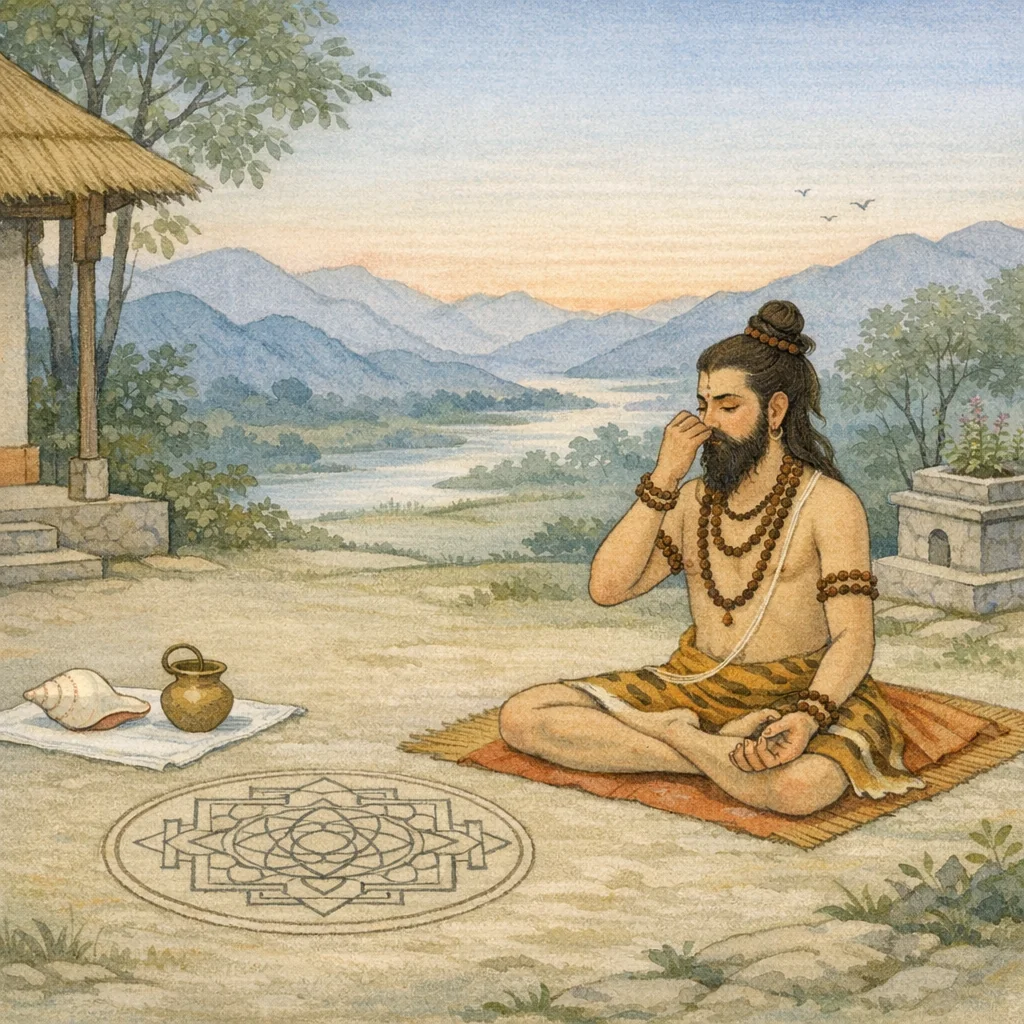
न्यासवर्णनम् (Nyāsa-varṇanam) — Description of Nyāsa in the Saṃnyāsa Procedure
This chapter, spoken as direct instruction (īśvara uvāca), lays out a technical nyāsa-and-pūjā sequence within the saṃnyāsa-paddhati. It describes purifying the ritual place and seat, spreading a tiger-skin (vaiyāghra-carma), and sprinkling pure water with the astra-mantra; then the ordered utterance of the praṇava (Om) with its ādhāra supports and śakti elements as a mantra-structure for inner placement. The practitioner stands facing north, performs prāṇāyāma before recitation, applies bhasma with mantras (agni-ādi), reveres the guru, and constructs a maṇḍala. Geometric forms (triangular/circular and quadrangular) are prescribed, and the conch (śaṅkha) is worshipped as a consecrated vessel; water is filled and perfumed with praṇava and worshipped repeatedly with gandha and puṣpa offerings. Ritual mudrās (dhenu-mudrā, śaṅkha-mudrā) are deployed, sprinkling with astra-mantra is repeated, and after preliminary purification and three prāṇāyāmas the ṛṣi/chandas/devatā viniyoga is stated. Mantra metadata is explicitly given for a Śrī-sauramantra (ṛṣi Devabhāga, chandas Gāyatrī, devatā Sūrya/Maheśvara), highlighting correct liturgical attribution and the authorization of mantra through nyāsa in a Śaiva renunciant context.
Shlokas
Verse 1
ईश्वर उवाच । दक्षिणे मंडलस्याथ वैयाघ्रं चर्मशोभनम् । आस्तीर्य्य शुद्धतोयेन प्रोक्षयेदस्त्रमंत्रतः
Īśvara (Lord Śiva) said: “Then, on the southern side of the ritual maṇḍala, one should spread a splendid tiger-skin, and sprinkle it with pure water while reciting the Astra-mantra.”
Verse 2
प्रणवं पूर्वमुद्धृत्य पश्चादाधार मुद्धरेत् । तत्पश्चाच्छक्तिकमलं चतुर्थ्यंतं नमोन्तकम्
First one should utter the Praṇava (Oṁ); then one should utter the Ādhāra, the supporting seed. After that, one should pronounce the Śakti-lotus power-seed, ending in the fourth case (dative), and concluding with the word “namaḥ” (salutation).
Verse 3
मनुमेवं समुच्चार्य स्थित्वा तस्मिन्नुदङ्मुखः । प्राणानायम्य विधिवत्प्र णवोच्चारपूर्वकम्
Having thus recited the mantra, he remained there facing north; then, in the prescribed manner, he regulated the breath—beginning with the utterance of Praṇava (Oṁ).
Verse 4
अग्निरित्यादिभिर्मंत्रैर्भस्म संधारयेत्ततः । शिरसि श्रीगुरुं नत्वा मण्डलं रचयेत्पुनः
Then, reciting the mantras beginning with “Agni,” one should apply and retain the sacred ash (bhasma). After bowing one’s head to the revered Guru, one should again prepare the ritual maṇḍala (sacred diagram) for worship.
Verse 5
त्रिकोणवृत्तं बाह्ये तु चतुरस्रात्मकं क्रमात् । अभ्यर्च्योमिति साधारं स्थाप्य शंखं समर्चयेत्
On the outside, one should arrange the ritual diagram in due order as a triangle and a circle, and further as a square. Having worshipped it with the mantra “Oṁ,” one should then place the conch upon its base and duly worship it.
Verse 6
आपूर्य शुद्धतोयेन प्रणवेन सुगंधिना । अभ्यर्च्य गंधपुष्पाद्यैः प्रणवेन च सप्तधा
Having filled (the worship-vessel or offering) with pure water made fragrant, while uttering the Praṇava (Oṁ), one should then worship Śiva—especially the Liṅga—with sandal paste, flowers, and other offerings, again reciting the Praṇava seven times.
Verse 7
अभिमंत्र्य ततस्तस्मिन्धेनुमुद्रां प्रदर्शयेत । शंखमुद्रां च तेनैव प्रोक्षयेदस्त्रमंत्रतः
Then, having sanctified it by mantra, one should display the Cow (Dhenu) Mudrā over that; and with the same hand one should also show the Conch (Śaṅkha) Mudrā and sprinkle it in accordance with the Astra-mantra, thus protecting and purifying the rite for Śiva’s worship.
Verse 8
आत्मानं गंधपुष्पादिपूजोपकरणानि च । प्राणायामत्रयं कृत्वा ऋष्यादिकमथाचरेत्
Having purified oneself and the implements of worship—sandal, flowers, and the rest—one should perform the threefold prāṇāyāma; then one should undertake the preliminary observances, beginning with the ṛṣi (invocation/nyāsa) and the related rites.
Verse 9
अस्य श्रीसौरमंत्रस्य देवभाग ऋषिस्ततः । छन्दो गायत्रमित्युक्तं देवस्सूर्यो महेश्वरः
For this auspicious Saura-mantra, Devabhāga is declared to be the seer (ṛṣi); the metre is said to be Gāyatrī; and the presiding deity is Sūrya—none other than Maheśvara (Śiva) Himself.
Verse 10
देवता स्यात्षडंगानि ह्रामित्यादीनि विन्यसेत् । ततस्संप्रोक्षयेत्पद्ममस्त्रेणाग्नेरगोचरम्
He should (mentally) establish the deity and perform the ṣaḍaṅga-nyāsa, using the mantra-syllables beginning with “hrām”. Thereafter, he should sprinkle and consecrate the lotus-seat with the Astra-mantra, rendering it protected—beyond the reach of fire.
Verse 11
तस्मिन्समर्चयेद्विद्वान् प्रभूतां विमलामपि । सारां चाथ समाराध्य पूर्वादिपरतः क्रमात्
There, the wise devotee should duly worship, offering even abundant and pure materials. Then, having reverently propitiated that sacred seat/installation with the very essence of worship, he should proceed in due order, beginning from the East and the other directions.
Verse 12
अथ कालाग्निरुद्रं च शक्तिमाधारसंज्ञिताम् । अनन्तं पृथिवीं चैव रत्नद्वीपं तथैव च
Then (he described) Kālāgnirudra, and the Śakti known as Ādhāra, the supporting power; also Ananta, the Earth itself, and likewise Ratnadvīpa, the Island of Jewels.
Verse 13
संकल्पवृक्षोद्यानं च गृहं मणिमयं ततः । रक्तपीठं च संपूज्य पादेषु प्रागुपक्रमात्
Then he envisioned the garden of wish-fulfilling trees and a mansion built of jewels. Having duly worshipped the red pedestal, he began the rite from the Lord’s feet, proceeding in the prescribed order.
Verse 14
धर्मं ज्ञानं च वैराग्यमैश्वर्यं च चतुष्टयम् । अधर्माद्यग्निकोणादिकोणेषु च समर्चयेत्
One should worship the fourfold excellence—dharma (right conduct), jñāna (true knowledge), vairāgya (dispassion), and aiśvarya (sovereign spiritual power)—placing them in the prescribed corners beginning with the fire-corner, together with their opposites such as adharma, according to the ritual array. Thus the sādhaka aligns outer worship with inner conquest of bonds, honoring Śiva as Pati, the giver of liberation.
Verse 15
मायाधश्छदनं पश्चाद्विद्योर्ध्वच्छदनं ततः । सत्त्वं रजस्तमश्चैव समभ्यर्च्य यथाक्रमम्
Then, in due order, one should worship the lower covering of Māyā; thereafter the higher covering of Vidyā; and then the three guṇas—sattva, rajas, and tamas—offering reverence to each in sequence.
Verse 16
पूर्वादिदिक्षु मध्ये च दीप्तां सूक्ष्मां जयामपि । भद्रां विभूति विमलाममोघां वैद्युतामपि
In the central spaces of the directions beginning with the East, one should contemplate the divine powers as Radiant, Subtle, and Victorious; as Auspicious; as all-pervading Vibhūti (glory); as Stainless Purity; as Unfailing Efficacy; and as Lightning-like Splendour.
Verse 17
सर्वतोमुखसंज्ञां च कन्दनालं तथैव च । सुषिरं च ततस्तं तु कंटकांस्तदनंतरम्
(These forms) are called “Sarvatomukha” (facing all directions) and also “Kandanāla”; then comes “Suṣira”; and thereafter, in due order, the “Kaṇṭaka” (thorned) type.
Verse 18
मूलच्छदनकिंजल्कप्रकाशसकलात्मनः । पंचग्रंथिकर्णिकां च दलानि तदनंतरम्
Then (he described) the root, the covering, the filaments, and the radiant inner essence that pervades all; and thereafter the central pericarp with its five knots, along with the petals surrounding it.
Verse 19
केशरान्ब्रह्मविष्णू च रुद्रमात्मानमेव च । अन्तरात्मानमपि च ज्ञानात्मपरमात्मनि
He recognizes (all) as contained in the Supreme Self—the Self of pure knowledge: Brahmā and Viṣṇu, Rudra, his own individual self, and even the Inner Self that abides within all.
Verse 20
सम्पूज्य पश्चात्सौराख्यं योगपीठं समर्चयेत् । पीठोपरि समाकल्प्य मूर्त्तिं मूलेन मूलवित्
After completing the worship, one should duly venerate the yogic pedestal called “Saurā.” Having arranged the Deity’s form upon that seat, the knower of the Root should worship with the root-mantra, thus establishing Saguna Śiva for contemplative union.
Verse 21
निरुद्धप्राण आसीनो मूलेनैव स्वमूलतः । शक्तिमुत्थाप्य तत्तेजः प्रभावात्पिंगलाध्वना
Seated with the life-breath restrained and firmly established at his own root (the mūlādhāra) by the root-mantra, he raised the inner Śakti; by the potency of that radiant energy, it ascended along the Piṅgalā nāḍī.
Verse 22
पुष्पांजलौ निर्गमय्य मण्डलस्थस्य भास्वतः । सिन्दूरारुणदेहस्य वामार्द्धदयितस्य च
Then, offering the handful of flowers, one should contemplate the radiant Lord abiding in the sacred circle—whose body gleams red like vermilion—and also His beloved who dwells in His left half, the Divine Śakti.
Verse 23
अक्षस्रक्पाशखट्वांगकपालांकुशपंकजम् । शंखं चक्रं दधानस्य चतुर्वक्त्रस्य लोचनैः
With their eyes they beheld the four-faced Lord, bearing a mālā (rosary), a pāśa (noose), a khaṭvāṅga staff, a kapāla (skull-bowl), an aṅkuśa (goad), a lotus, and also the conch and the discus—revealing a saguṇa form that bestows protection and liberation.
Verse 24
राजितस्य द्वादशभिस्तस्य हृत्पंकजोदरे । प्रणवं पूर्वमुद्धृत्य ह्रांह्रींसस्तदनन्तरम्
Within the heart-lotus of that radiant Lord, adorned with twelve (powers/manifestations), one should first draw forth the Praṇava “Oṁ”; thereafter, in due sequence, place the bīja-syllables “hrāṃ” and “hrīṃ”.
Verse 25
प्रकाशशक्तिसहितं मार्तण्डं च ततः परम् । आवाहयामि नम इत्यावाह्या वाहनाख्यया
Then, together with his radiant Śakti, I invoke Mārtaṇḍa (the Sun) thereafter; saying, “I invoke you—namah (obeisance),” he should be duly invoked by the rite known as Vāhana (bringing near).
Verse 26
मुद्रया स्थापनाद्याश्च मुद्रास्संदर्शयेत्ततः । विन्यस्यांगानि ह्रां ह्रीं ह्रूमंतेन मनुना ततः
Then, by means of mudrās (hand-gestures), he should display the mudrās beginning with sthāpanā (installation) and the rest. Thereafter, he should perform aṅga-nyāsa upon his limbs using the mantra “hrāṃ, hrīṃ, hrūṃ,” and then proceed further.
Verse 27
पंचोपचारान्संकल्प्य मूलेनाभ्यर्चयेत्त्रिधा । केशरेषु च पद्मस्य षडंगानि महेश्वरि
Having resolved in the mind the five offerings (pañcopacāra), one should worship Śiva three times with the root-mantra (mūla-mantra). And upon the filaments of the lotus, O Mahēśvarī, one should place the nyāsa of the six limbs (ṣaḍaṅga).
Verse 28
वह्नीशरक्षोवायूनां परितः क्रमतः सुधीः । द्वितीयावरणे पूज्याश्चतस्रो मूर्तयः क्रमात्
The wise worshipper should, in due order all around, worship in the second enclosing circuit (āvaraṇa) the four manifested forms—Agni, Īśa, Rakṣa, and Vāyu—sequentially.
Verse 29
पूर्वाद्युत्तरपर्यंतं दलमूलेषु पार्वति । आदित्यो भास्करो भानू रविश्चेत्यनुपूर्वशः
O Pārvatī, from the eastern side up to the northern side, at the bases of the petals, one should place (or contemplate) the Sun in due order by his names—Āditya, Bhāskara, Bhānu, and Ravi.
Verse 30
अर्को ब्रह्मा तथा रुद्रो विष्णुश्चेति पुनः प्रिये । ईशानादिषु संपूज्यास्तृतीयावरणे पुनः
“Again, O beloved, worship Arka (the Sun), Brahmā, Rudra, and Viṣṇu. They are to be duly honored in the stations beginning with Īśāna, in the third enclosing circuit (āvaraṇa), once more.”
Verse 31
सोमं कुजं बुधं जीवं कविं मंदं तम स्तमः । समंततो यजेदेतान्पूर्वादिदलमध्यतः
One should worship Soma (the Moon), Kuja (Mars), Budha (Mercury), Jīva (Jupiter), Kavi (Venus), Manda (Saturn), and also Tamaḥ and Stamaḥ, arranging their worship all around—placing them in the center of the petals, beginning from the eastern petal.
Verse 32
अथवा द्वादशादित्यान्द्वितीयावरणे यजेत । तृतीयावरणे चैव राशीर्द्वादश पूजयेत्
Or else, in the second enclosure (āvaraṇa) of worship, one should adore the Twelve Ādityas; and in the third enclosure, one should likewise honor the twelve zodiacal signs (rāśis).
Verse 33
सप्तसागरगंगाश्च बहिरस्य समंततः । ऋषीन्देवांश्च गंधर्वान्पन्नगानप्सरोगणान्
Outside it, on every side, were the Gaṅgās flowing to the seven oceans; and there too were hosts of Ṛṣis and Devas, Gandharvas, Nāgas, and companies of Apsarās.
Verse 34
ग्रामण्यश्च तथा यक्षान्यातुधानांस्तथा हयान् । सप्तच्छन्दोमयांश्चैव वालखिल्यांश्च पूजयेत्
He should also offer worship to the divine hosts—Grāmaṇyas (guardians of communities), the Yakṣas, the Yātudhānas, and the celestial horses; and likewise to those embodying the seven Vedic metres, as well as to the Vālakhilya sages—honouring them all as attendants within Lord Śiva’s sacred order.
Verse 35
एवं त्र्यावरणं देवं समभ्यर्च्य दिवाकरम् । विरच्य मंडलं पश्चाच्चतुरस्रं समाहितः
Thus, having duly worshipped the Sun-god (Divākara) as the deity of the three enclosures, he then—collected in mind—constructed a sacred maṇḍala, and thereafter laid out a four-sided (square) diagram.
Verse 36
स्थाप्य साधारकं ताम्रपात्रं प्रस्थोदविस्तृतम् । पूरयित्वा जलैः शुद्धैर्वासितैः कुसुमादिभिः
Setting in place a copper vessel upon a supporting base, of about one prastha in measure, one should fill it with pure water, fragranced with flowers and the like.
Verse 37
अभ्यर्च्य गंधपुष्पाद्यैर्जानुभ्यामवनीं गतः । अर्घ्यपात्रं समादाय भूमध्यान्तं समुद्धरेत्
Having worshipped (Śiva) with fragrance, flowers, and the like, he should kneel down and touch the earth; then, taking the arghya-vessel in hand, he should lift it up from the region near the middle of the worship-space, in the prescribed manner.
Verse 38
ततो ब्रूयादिमं मंत्रं सावित्रं सर्वसिद्धिदम् । शृणु तच्च महादेवि भक्तिमुक्तिप्रदं सदा
Then one should recite this Sāvitra mantra, the bestower of every siddhi. Hear it, O Mahādevī—for it always grants both bhakti (devotion) and mukti (liberation).
Verse 39
सिन्दूरवर्णाय सुमण्डलाय नमोऽस्तु वज्राभरणाय तुभ्यम् । पद्माभनेत्राय सुपंकजाय ब्रह्मेन्द्रनारायणकारणाय
Salutations to You—of vermilion radiance, encircled by a splendid halo; to You adorned with vajra-like, adamantine ornaments. Salutations to You whose eyes are like lotuses, who are supremely pure like the lotus, and who are the causal source even of Brahmā, Indra, and Nārāyaṇa.
Verse 40
सरक्तचूर्णं ससुवर्णतोयं स्रक्कुंकुमाढ्यं सकुशं सपुष्पम् । प्रदत्तमादाय सहेमपात्रं प्रशस्तमर्घ्यं भगवन्प्रसीद
Accept, O Blessed Lord, this excellent arghya-offering—mixed with sacred red powder and water infused with gold, enriched with garlands and fragrant kumkuma, together with kuśa grass and flowers—placed in a golden vessel. Be gracious to me.
Verse 41
एवमुक्त्वा ततो दत्त्वा तदर्थं सूर्यमूर्त्तये । नमस्कुर्यादिमं मंत्रं पठित्वा सुसमाहितः
Having spoken thus, and then offering that gift for that very purpose to the embodied form of the Sun (Sūrya), one should bow down—mind fully collected—after reciting this mantra.
Verse 42
नमश्शिवाय साम्बाय सगणायादिहेतवे । रुद्राय विष्णवे तुभ्यं ब्रह्मणे च त्रिमूर्तये
Salutations to You—Śiva, the Auspicious One—together with Ambā, attended by Your gaṇas, the primal cause of all. Salutations to You as Rudra, as Viṣṇu, and as Brahmā—You, the one Reality appearing as the Trimūrti.
Verse 43
एवमुक्त्वा नमस्कृत्य स्वासने समवस्थितः । ऋष्यादिकं पुनः कृत्वा करं संशोध्य वारिणा
Having spoken thus, he bowed in reverence and sat firmly upon his own seat. Then, performing again the preliminary rites beginning with the invocation of the seers, he purified his hands with water.
Verse 44
पुनश्च भस्म संधार्य पूर्वोक्तेनैव वर्त्मना । न्यासजातम्प्रकुर्वीत शिवभावविवृद्ध्धये
Again, having applied the sacred ash (bhasma) by the very method described earlier, one should perform the prescribed nyāsa, for the increase and deepening of Shiva-consciousness (śivabhāva).
Verse 45
पंचोपचारैस्संपूज्य शिरसा श्रीगुरुम्बुधः । प्रणवं श्रीचतुर्थ्यंतं नमोंतं प्रणमेत्ततः
Having duly worshipped the venerable Guru with the five offerings, the wise devotee should bow with the head. Thereafter, he should prostrate, uttering the Praṇava “Oṁ”, followed by the auspicious mantra ending in the fourth case (—ya), and concluding with “namo” (salutation).
Verse 46
पंचात्मकं बिन्दुयुतं पंचमस्वरसंयुतम् । तदेव बिन्दुसहितं पंचमस्वरवर्जितम्
That mantra which is fivefold in essence, joined with the bindu and united with the fifth vowel—indeed that very mantra again, with the bindu retained, is to be understood as without the fifth vowel.
Verse 47
पंचमस्वरसंयुक्तं मंत्रीशं च सबिन्दुकम् । उद्धृत्य बिन्दुसहितं संवर्तकमथोद्धरेत्
Joining the “lord of mantras” with the fifth vowel and with the bindu, one should first utter it; then, together with the bindu, one should next utter the syllable called Saṃvartaka.
Verse 48
एतैरेव क्रमाद्बीजैरुद्धृतैः प्रणमेद्बुधः । भुजयोरूरुयुग्मे च गुरुं गणपतिन्तथा
Using these very bīja seed-mantras, drawn forth in their proper order, the wise devotee should bow in reverence—touching the arms and the pair of thighs—saluting the Guru, and likewise Lord Gaṇapati.
Verse 49
दुर्गां च क्षेत्रपालं च बद्धांजलिपुटः स्थितः । ओमस्त्राय फडित्युक्त्वा करौ संशोध्य षट् क्रमात्
Standing with joined palms, he reverently salutes Durgā and the Kṣetrapāla, guardian of the sacred precinct. Uttering the mantra “Oṃ astrāya phaṭ,” he then ritually purifies his hands in the sixfold sequence, step by step.
Verse 50
अपसर्प्पन्त्विति प्रोच्य प्रणवं तदनंतरम् । अस्त्राय फडिति प्रोच्य पार्ष्णिघातत्रयेण तु
Uttering, “Depart, depart!”, one should next pronounce the Praṇava (Oṃ). Then, saying, “For the Astra—phaṭ!”, one should strike three times with the heel, driving away obstructing forces and securing the rite under Śiva’s mantric protection.
Verse 51
उद्धृत्य विघ्नान्भूयिष्ठान्कर तालत्रयेण तु । अन्तरिक्षगता न्दृष्ट्वा विलोक्य दिवि संस्थितान्
Then, with three claps of his hands, he dispelled the many obstacles. Seeing the obstructing forces moving through the mid‑sky, he looked up and beheld those stationed in the heavens.
Verse 52
निरुद्धप्राण आसीनो हंसमंत्रमनुस्मरन् । हृदिस्थं जीवचैतन्यं ब्रह्मनाड्या समान येत्
Seated with the vital breath restrained, repeatedly recollecting the Haṃsa-mantra, one should lead the living consciousness abiding in the heart into alignment with the Brahma-nāḍī, the central subtle channel.
Verse 53
द्वादशांतस्स्थविशदे सहस्रारमहाम्बुजे । चिच्चन्द्रमण्डलान्तस्थं चिद्रूपं परमेश्वरम्
In the pure realm of the dvādaśānta, within the great lotus of the Sahasrāra, one should contemplate Parameśvara—the Supreme Lord—abiding in the lunar orb of consciousness, whose very nature is pure Awareness (Cit).
Verse 54
शोषदाहप्लवान्कुर्याद्रेचकादि क्रमेण तु । सषोडशचतुष्षष्टिद्वात्रिंशद्गणनायुतैः
Then, following the proper sequence beginning with recaka (exhalation), one should perform the three inner operations—śoṣa (drying), dāha (heating/burning), and plāva (flooding/immersion)—in measured counts of sixteen, sixty-four, and thirty-two repetitions.
Verse 55
वाय्वग्निसलिलाद्यैस्तैस्स्तवेदाद्यैरनुक्रमात् । प्राणानायम्य मूलस्थां कुण्डलीं ब्रह्मरंध्रगाम्
Then, in due sequence, with those hymns and Vedic invocations beginning with the deities of wind, fire, water, and the rest, restraining and lengthening the vital breath, one should rouse the Kuṇḍalinī abiding at the root and lead her toward the Brahma-opening at the crown.
Verse 56
आनीय द्वादशांतस्थसहस्राराम्बुजोदरे । चिच्चन्द्रमण्डलोद्भूतपरमामृतधारया
Drawing it into the inner cavity of the thousand-petalled lotus situated at the end of the twelve (dvādaśānta), one should bathe the consciousness with the supreme stream of nectar that arises from the moon-orb of pure Awareness.
Verse 57
संसिक्तायां तनौ भूयश्शुद्धदेहस्सुभावनः । सोहमित्यवतीर्याथ स्वात्मानं हृदयाम्बुजे
When his body was again sprinkled and consecrated, he became purified in form and refined in disposition. Then, descending inward with the contemplation “So’ham” (“I am He”), he established his own Self in the lotus of the heart.
Verse 58
आत्मन्यावेश्य चात्मानममृतं सृतिधारया । प्राणप्रतिष्ठां विधिवत्कुर्यादत्र समाहितः
Having inwardly placed the self within the Self and, by the steady stream of amṛta—the nectar of consciousness—made it immortal, the practitioner, fully collected in mind, should perform here the rite of prāṇa-pratiṣṭhā according to the prescribed rule.
Verse 59
एकाग्रमानसो योगी विमृश्यात्तां च मातृकाम् । पुटितां प्रणवेनाथ न्यसेद्बाह्ये च मातृकाम्
With a one-pointed mind, the yogin should contemplate that Mātṛkā, the matrix of sacred letters. Then, enclosing it with the Pranava (Oṁ), he should also place that very Mātṛkā outwardly by performing the appropriate nyāsa.
Verse 60
पुनश्च संयतप्राणः कुर्याद्दृष्ट्यादिकं बुधः । शंकरं संस्मरंश्चित्ते संन्यसेच्च विमत्सरः
Again, having restrained the life-breath, the wise practitioner should perform the disciplines beginning with the steadiness of the gaze; remembering Śaṅkara within the mind, and free from envy, he should renounce all other supports and place himself wholly in Him.
Verse 61
प्रणवस्य ऋषिर्ब्रह्मा देवि गायत्रमीरितम् । छन्दोत्र देवताहं वै परमात्मा सदाशिवः
O Goddess, for the Pranava (Oṃ) the seer is Brahmā; its metre is declared to be Gāyatrī. And here, the presiding deity is verily I—Sadāśiva, the Supreme Self.
Verse 62
अकारो बीजमाख्यातमुकारः शक्तिरुच्यते । मकारः कीलकं प्रोक्तं मोक्षार्थे विनियुज्यते
The syllable ‘A’ is declared to be the seed (bīja); the syllable ‘U’ is said to be the power (śakti). The syllable ‘M’ is taught as the pin or seal (kīlaka). These are to be employed for the sake of liberation (mokṣa).
Verse 63
अंगुष्ठद्वयमारभ्य तलांतं परिमार्जयेत् । ओमित्युक्त्वाथ देवेशि करन्यासं समारभेत्
Beginning with the two thumbs, one should rub and purify the hands up to the ends of the palms. Then, having uttered “Oṁ,” O Devī, one should commence the kara-nyāsa, the ritual placing of the mantra upon the hands.
Verse 64
दक्षहस्तस्थितांगुष्ठं समारभ्य यथाक्रमम् । वामहस्तकनिष्ठांतं विन्यसेत्पूर्ववत्क्रमात्
Beginning with the thumb on the right hand and proceeding in due order, one should place the nyāsa of the mantra up to the little finger of the left hand, following the same sequence as previously taught.
Verse 65
अकारमप्युकारं च मकारं बिन्दुसंयुतम् । नमोन्तं प्रोच्य सर्वत्र हृदयादौ न्यसेदथ
Pronounce “a”, then “u”, then “ma” united with the bindu, thus forming “Oṁ”; and adding “namaḥ” at the end, one should then perform its nyāsa everywhere, beginning with the heart and the other limbs.
Verse 66
अकारं पूर्वमुद्धृत्य ब्रह्मात्मानमथाचरेत् । ङेंतं नमोंतं हृदये विनियुज्यात्तथा पुनः
First, one should draw forth the syllable “A” and practice contemplation of Brahman as one’s own Self. Then, in the heart, one should again place by nyāsa the subtle sounds “ṅeṃ” and “namoṃ” in their proper order.
Verse 67
उकारं विष्णुसहितं शिरोदेशे प्रविन्यसेत् । मकारं रुद्रसहितं शिखायान्तु प्रविन्यसेत्
One should place the syllable “u”, together with Viṣṇu, upon the region of the head. And one should place the syllable “ma”, together with Rudra, upon the śikhā, the crown-tuft.
Verse 68
एवमुक्त्वा मुनिर्मंत्री कवचं नेत्रमस्तके । विन्यसेद्देवदेवेशि सावधानेन चेतसा
Having spoken thus, the mantra-knowing sage should, with a vigilant mind, place the protective kavaca and the “Netra” (“Eye”) mantra upon the head—O Lord of the gods, supreme ruler among the divine.
Verse 69
अंगवक्त्रकलाभेदात्पंच ब्रह्माणि विन्यसेत् । शिरोवदनहृदगुह्यपादेष्वेतानि विन्यसेत्
Distinguishing the limbs and the five divine aspects, one should perform nyāsa of the five Brahmas. These are to be placed, by consecrating touch and mantra, upon the head, the face, the heart, the secret region, and the feet.
Verse 70
ईशान्यस्य कलाः पंच पंचस्वेतेषु च क्रमात् । ततश्चतुर्षु वक्त्रेषु पुरुषस्य कला अपि
Five divine potencies (kalās) belong to Īśāna, and in due order they are distributed as five each among these principles. Thereafter, in the four faces as well, the potencies of the Supreme Person (Puruṣa) are present.
Verse 71
चतस्रः प्रणिधातव्याः पूर्वादिक्रमयोगतः । हृत्कंठांसेषु नाभौ च कुक्षौ पृष्ठे च वक्षसि
In the proper sequence beginning from the east, four sacred placements are to be made—at the heart, the throat, and the shoulders; and also at the navel, the sides of the belly, the back, and the chest.
Verse 72
अघोरस्य कलाश्चाष्टौ पूजनीया यथाक्रमम् । पश्चात्त्रयोदशकलाः पायुमेढ्रोरुजानुषु
Next, the eight divine kalās of Aghora are to be worshipped in due order. Thereafter, the thirteen kalās are to be worshipped upon the anus, the genital organ, the thighs, and the knees, according to the prescribed placement in Śiva’s inner rite.
Verse 73
जंघास्फिक्कटिपार्श्वेषु वामदेवस्य भावयेत् । सद्यस्यापि कला चाष्टौ नेत्रेषु च यथाक्रमम्
One should contemplate Vāmadeva in the shanks, buttocks, waist, and the sides. Likewise, one should meditate on the eight kalās of Sadyojāta, placing them in the eyes in their proper order.
Verse 74
कीर्तितास्ताः कलाश्चैव पादयोरपि हस्तयोः । प्राणे शिरसि बाह्वोश्च कल्पयेत्कल्पवित्तमः
Thus, the wise adept—skilled in the prescribed contemplations—should also mentally install those very divine kalās in the feet and the hands, and likewise place them in the vital breath (prāṇa), in the head, and in the arms.
Verse 76
अष्टत्रिंशत्कलान्यासमेवं कृत्वा तु सर्वशः । पश्चात्प्रणवविद्धीमान्प्रणवन्यासमाचरेत् । बाहुद्वये कूर्परयोस्तथा च मणिबन्धयोः । पार्श्वतोदरजंघेषु पादयोः पृष्ठतस्तथा
Having thus performed the nyāsa of the thirty-eight kalās in every respect, the adept who knows the proper rule should thereafter perform the nyāsa of the Praṇava (Oṃ). He should place it on both arms, on the elbows, and also on the wrists; on the sides, the belly, the thighs, the feet, and likewise on the back.
Verse 77
इत्थं प्रणवविन्यासं कृत्वा न्यासविचक्षणः । हंसन्यासं प्रकुर्वीत परमात्मविबोधिनि
Thus, having performed the nyāsa (ritual placement) of the Praṇava (Oṃ), the adept skilled in nyāsa should then undertake Haṃsa-nyāsa—this practice that awakens direct realization of the Supreme Self, Paramātman.
Frequently Asked Questions
Rather than a mythic episode, the chapter presents a prescriptive theological-ritual argument: Shiva’s presence is made operative through correctly sequenced ritual technologies—purification with astra-mantra, praṇava-centered mantra-structure, and nyāsa—establishing that liberation-oriented renunciation still relies on precise liturgical grammar.
The ritual objects and gestures encode interiorization: the maṇḍala externalizes cosmic order for meditative entry; bhasma signifies impermanence and the reduction of individuality to ash; praṇava functions as the sonic body of Shiva; mudrās (dhenu/śaṅkha) act as seals that authorize and protect the rite; prokṣaṇa with astra-mantra marks the boundary between profane space and consecrated field.
The operative form is Īśvara/Maheśvara as the instructing and mantra-indwelling deity; the chapter’s emphasis is not on narrative iconography of a particular avatāra but on Shiva as mantra-devatā accessed through praṇava, viniyoga (ṛṣi/chandas/devatā), and nyāsa within a renunciant framework.