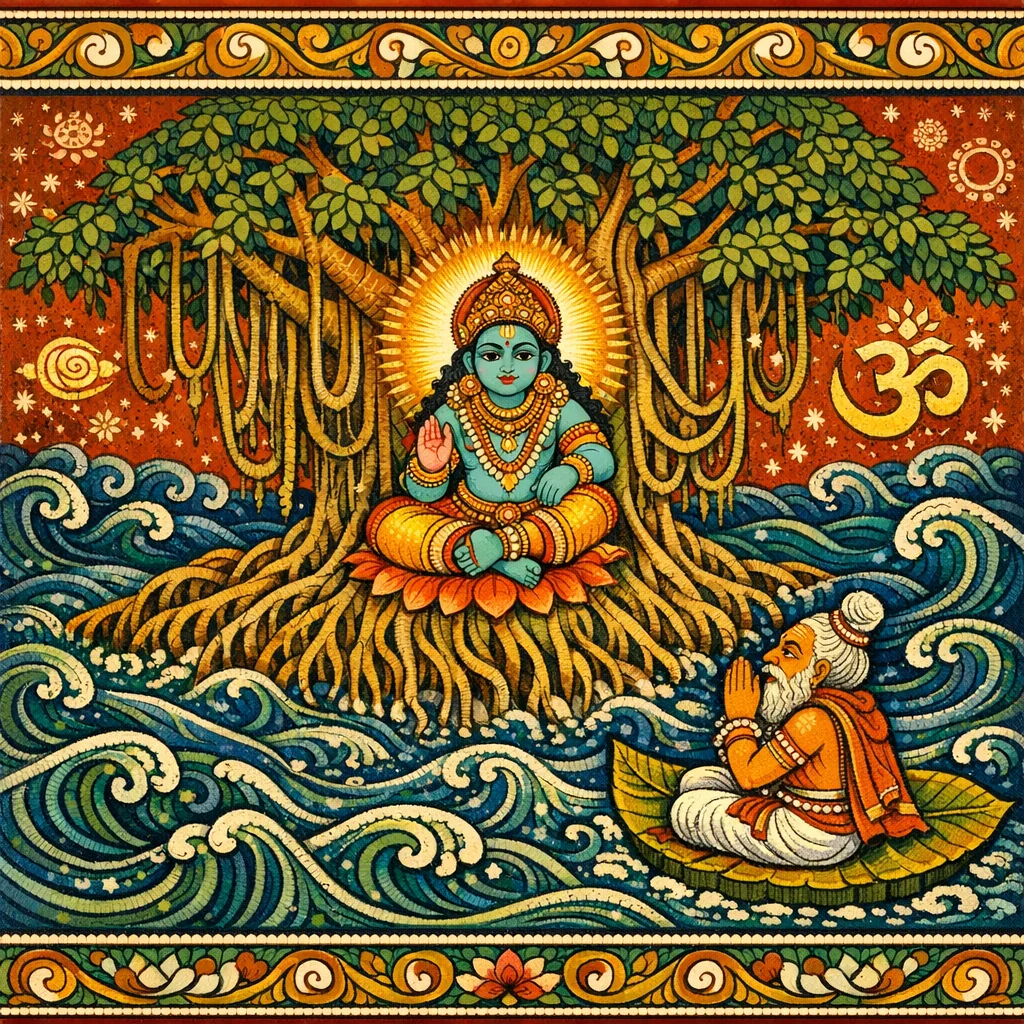
Adhyaya 167: Nārāyaṇa as Haṃsa in the Cosmic Ocean: Vedic Yajña-Puruṣa and Mārkaṇḍeya’s Vision within Pralaya
एकार्णव-हंसनारायण-मार्कण्डेयसंवादः
Speaker: Matsya, Sūta, Mārkaṇḍeya, Śrī Bhagavān (Nārāyaṇa / Madhusūdana / Hṛṣīkeśa)
Matsya describes pralaya: the world becomes Ekārṇava, a single cosmic ocean, and Nārāyaṇa, manifest as Haṃsa, reposes upon the waters. He points to the imperishable Brahman realized by a sattvic mind and links it to the Upaniṣadic “secret” doctrine. The teaching then turns to ritual cosmology: Puruṣa is Yajña, and from the Lord arise the sacrificial priests and an ordered set of sixteen officiants. Matsya next relates Mārkaṇḍeya’s wonder: swallowed by the Lord, the sage experiences a womb-like cosmos, wanders among tīrthas and hermitages, emerges to see only ocean and darkness, and later beholds a radiant child on a banyan branch. In dialogue, Mārkaṇḍeya protests being addressed by name; the Lord reveals Himself as his progenitor and as Nārāyaṇa. Proclaiming His all-pervasiveness (Time, gods, elements, Sāṃkhya-Yoga, Om), the Lord draws the sage back within, declaring that when sun and moon vanish He recreates the world again as Haṃsa.
Key Concepts
Shlokas in Adhyaya 167
Verse 1
*मत्स्य उवाच एवमेकार्णवीभूते शेते लोकेमहाद्युतिः प्रच्छाद्य सलिलेनोर्वीं हंसो नारायणस्तदा //
Matsya said: Thus, when the world had become a single ocean, the greatly radiant Lord Nārāyaṇa—manifest as the Haṃsa—reposed, having covered the earth with waters.
Verse 2
महतो रजसो मध्ये महार्णवसरःसु वै विरजस्कं महाबाहुम् अक्षयं ब्रह्म यद्विदुः //
In the midst of the vast expanse of rajas—within the great ocean-like waters—(the wise) know that imperishable Brahman: stainless (beyond passion), mighty-armed, and undecaying.
Verse 3
आत्मरूपप्रकाशेन तमसा संवृतः प्रभुः मनः सात्त्विकमाधाय यत्र तत्सत्यमासत //
Though the Lord is self-luminous in His own essential form, He is (as it were) veiled by darkness; and there, having established the mind in sattva (clarity), that Reality is truly realized.
Verse 4
याथातथ्यं परं ज्ञानं भूतं तद्ब्रह्मणा पुरा रहस्यारण्यकोद्दिष्टं यच्चौपनिषदं स्मृतम् //
That supreme knowledge—truth exactly as it is—was formerly known to Brahmā; it is the secret teaching indicated in the Āraṇyakas and remembered as the Upaniṣadic doctrine.
Verse 5
पुरुषो यज्ञ इत्येतद् यत्परं परिकीर्तितम् यश्चान्यः पुरुषाख्यः स्यात् स एष पुरुषोत्तमः //
That supreme principle which is proclaimed as “the Person is the Sacrifice (Yajña)”—and that other one who is known by the name ‘Puruṣa’—he indeed is the Puruṣottama, the Supreme Person.
Verse 6
ये च यज्ञकरा विप्रा ये चर्त्विज इति स्मृताः अस्मादेव पुरा भूता यज्ञेभ्यः श्रूयतां तथा //
And those Brahmins who perform sacrifices, and those who are remembered as ṛtvijas (sacrificial priests)—all of them, in former times, arose from this very (sacred source/teaching). So too, let it be heard as derived from the sacrifices themselves.
Verse 7
ब्रह्माणं प्रथमं वक्त्राद् उद्गातारं च सामगम् होतारमपि चाध्वर्युं बाहुभ्यामसृजत्प्रभुः //
The Lord first brought forth the Brahman-priest from His mouth; and He created the Udgātṛ, the chanter of Sāma, as well as the Hotṛ and the Adhvaryu from His two arms.
Verse 8
ब्रह्मणो ब्राह्मणाच्छंसि प्रस्तोतारं च सर्वशः तौ मित्रावरुणौ पृष्ठात् प्रतिप्रस्तारमेव च //
From the Brahman-priest (are appointed) the Brāhmaṇācchaṃsī and, in every respect, the Prastotṛ; and behind them are Mitra and Varuṇa, as well as the Pratiprastotṛ.
Verse 9
उदरात्प्रतिहर्तारं पोतारं चैव पार्थिव अच्छावाकमथोरुभ्यां नेष्टारं चैव पार्थिव //
From among those connected with the Udara (a designated group/line for this office), O king, one should appoint the Pratihartṛ and the Potṛ; likewise, from the two Urubhyas one should appoint the Acchāvāka and also the Neṣṭṛ, O king.
Verse 10
पाणिभ्यामथ चाग्नीध्रं सुब्रह्मण्यं च जानुतः ग्रावस्तुतं तु पादाभ्याम् उन्नेतारं च याजुषम् //
With the hands (one should assign) the Agnīdhra; with the knees, the Subrahmaṇya; with the feet, the Grāvastut; and (also) the Yājuṣa Unnetṛ.
Verse 11
एवमेवैष भगवान् षोडशैव जगत्पतिः प्रवक्तॄन्सर्वयज्ञानाम् ऋत्विजो ऽसृजदुत्तमान् //
Thus indeed, that Blessed Lord—the Lord of the world—created precisely sixteen excellent (functionaries): the reciters/instructors (pravaktṛs) and the officiating priests (ṛtviks) for all sacrifices.
Verse 12
तदेष वै वेदमयः पुरुषो यज्ञसंज्ञितः वेदाश्चैतन्मयाः सर्वे साङ्गोपनिषदक्रियाः //
Indeed, this Puruṣa is made of the Veda and is known as Yajña (the Sacrifice). And all the Vedas are of his very essence—together with their auxiliaries, the Upaniṣads, and the ritual procedures.
Verse 13
स्वपित्येकार्णवे चैव यदाश्चर्यमभूत्पुरा श्रूयतां तद्यथा विप्रा मार्कण्डेयकुतूहलम् //
And hear as well, O brahmins, what wondrous event once occurred in the single cosmic ocean (Ekārṇava) while (Nārāyaṇa) lay in yogic sleep—namely, the curious marvel experienced by Mārkaṇḍeya.
Verse 14
गीर्णो भगवतस्तस्य कुक्षावेव महामुनिः बहुवर्षसहस्रायुस् तस्यैव वरतेजसा //
Swallowed by that Blessed Lord, the great sage remained within His very belly, sustained for many thousands of years by the supreme radiance of that Lord alone.
Verse 15
अटंस्तीर्थप्रसङ्गेन पृथिवीं तीर्थगोचराम् आश्रमाणि च पुण्यानि देवतायतनानि च //
Roaming about on the pretext of visiting sacred fords, he traverses the earth—made accessible through tīrthas—also visiting holy hermitages and the sanctuaries (temples) of the gods.
Verse 16
देशान्राष्ट्राणि चित्राणि पुराणि विविधानि च जपहोमपरः शान्तस् तपो घोरं समास्थितः //
He has seen diverse lands and kingdoms, and many ancient traditions in their varied forms; devoted to mantra-recitation and sacrificial oblations, tranquil in mind, he has undertaken rigorous austerity.
Verse 17
मार्कण्डेयस्ततस्तस्य शनैर्वक्त्राद्विनिःसृतः स निष्क्रामन्न चात्मानं जानीते देवमायया //
Then Mārkaṇḍeya slowly emerged from his mouth. Yet, as he came out, by the power of divine illusion he did not recognize even his own self.
Verse 18
निष्क्रम्याप्यस्य वदनाद् एकार्णवमथो जगत् सर्वतस्तमसाच्छन्नं मार्कण्डेयो ऽन्ववैक्षत //
Even after emerging from His mouth, Mārkaṇḍeya beheld the world as a single ocean (ekārṇava), veiled on every side by darkness.
Verse 19
तस्योत्पन्नं भयं तीव्रं संशयश्चात्मजीविते देवदर्शनसंहृष्टो विस्मयं परमं गतः //
In him there arose an intense fear and also doubt about his own survival; yet, exhilarated by the sight of the deity, he was carried into the highest astonishment.
Verse 20
चिन्तयञ्जलमध्यस्थो मार्कण्डेयो विशङ्कितः किं नु स्यान्मम चिन्तेयं मोहः स्वप्नो ऽनुभूयते //
Markandeya, standing amid the waters, became anxious and reflective: “What could this be? I must consider it. Is this bewilderment—this experience—nothing but a dream?”
Verse 21
व्यक्तमन्यतमो भावस् तेषां संभावितो मम न हीदृशं जगत्क्लेशम् अयुक्तं सत्यमर्हति //
It is clearly some other motive that I suspect in them; for truth, when it is without proper reasoning, does not deserve to bring about such suffering in the world.
Verse 22
नष्टचन्द्रार्कपवने नष्टपर्वतभूतले कतमः स्यादयं लोक इति चिन्तामवस्थितः //
When the moon, the sun, and even the winds had vanished, and when the earth’s surface—its mountains and living beings—was ruined, he remained absorbed in anxious reflection: “What world is this now?”
Verse 23
ददर्श चापि पुरुषं स्वपन्तं पर्वतोपमम् सलिले ऽर्धमथो मग्नं जीमूतमिव सागरे //
He also beheld a man, asleep and mountain-like in form—half-submerged in the water—like a mass of clouds resting upon the sea.
Verse 24
ज्वलन्तमिव तेजोभिर् गोयुक्तमिव भास्करम् शर्वर्यां जाग्रतमिव भासन्तं स्वेन तेजसा //
Shining with his own radiance—like a blazing fire with its flames, like the sun yoked to its steeds, and like one who remains awake through the night—he appeared resplendent.
Verse 25
देवं द्रष्टुमिहायातः को भवानिति विस्मयात् तथैव स मुनिः कुक्षिं पुनरेव प्रवेशितः //
Having come here to behold the Deity, the sage—astonished—asked, “Who are you?” And just so, that muni entered again into (the Lord’s) belly.
Verse 26
सम्प्रविष्टः पुनः कुक्षिं मार्कण्डेयो ऽतिविस्मयः तथैव तु पुनर्भूयो विजानन्स्वप्नदर्शनम् //
Markandeya, filled with utter amazement, again entered the womb; and once more he recognized that what he had seen was like a dream-vision.
Verse 27
स तथैव यथापूर्वं यो धरामटते पुरा पुण्यतीर्थजलोपेतां विविधान्याश्रमाणि च //
Likewise, as in former times, whoever in earlier days wandered over the earth—(frequenting) sacred places endowed with holy waters, and also the many kinds of hermitages—(obtained the due religious merit).
Verse 28
क्रतुभिर्यजमानाश्च समाप्तवरदक्षिणान् अपश्यद्देवकुक्षिस्थान् याजकाञ्छतशो द्विजान् //
He beheld hundreds of twice-born priests—ritual officiants—who had been worshipping through sacrifices, whose excellent sacrificial fees had been duly completed, now dwelling within the womb-like abode of the gods.
Verse 29
सद्वृत्तमास्थिताः सर्वे वर्णा ब्राह्मणपूर्वकाः चत्वारश्चाश्रमाः सम्यग् यथोद्दिष्टा मया तव //
All the social orders—beginning with the Brāhmaṇas—are established in right conduct; and the four stages of life, too, have been correctly set forth for you by me, just as prescribed.
Verse 30
एवं वर्षशतं साग्रं मार्कण्डेयस्य धीमतः चरतः पृथिवीं सर्वां न कुक्ष्यन्तः समीक्षितः //
Thus, for a full hundred years and more, the wise Markandeya wandered over the entire earth; yet his belly was never seen to be filling (as with ordinary eating).
Verse 31
ततः कदाचिदथ वै पुनर्वक्त्राद्विनिःसृतः सुप्तं न्यग्रोधशाखायां बालमेकं निरैक्षत //
Then, at a certain time, he again emerged from the mouth and beheld a single child, asleep upon a branch of a banyan tree.
Verse 32
तथैवैकार्णवजले नीहारेणावृताम्बरे अव्यग्रः क्रीडते लोके सर्वभूतविवर्जिते //
So too, when all is a single ocean of waters and the sky is veiled in mist, he remains untroubled, sporting in that world which is devoid of all beings.
Verse 33
स मुनिर्विस्मयाविष्टः कौतूहलसमन्वितः बालमादित्यसंकाशं नाशक्नोदभिवीक्षितुम् //
That sage, overwhelmed with amazement and filled with curiosity, could not bear to look directly at the child, who shone with the splendor of the sun.
Verse 34
स चिन्तयंस्तथैकान्ते स्थित्वा सलिलसंनिधौ पूर्वदृष्टमिदं मेने शङ्कितो देवमायया //
Thus, pondering in solitude and standing near the water, he took this to be something he had foreseen before—yet, unsettled, he suspected it to be the divine illusion (māyā) of the Lord.
Verse 35
अगाधसलिले तस्मिन् मार्कण्डेयः सविस्मयः प्लवंस्तथार्तिम् अगमद् भयात्संत्रस्तलोचनः //
In that unfathomably deep expanse of water, Mārkaṇḍeya—astonished—kept floating about, and then, out of fear, he fell into distress, his eyes trembling with terror.
Verse 36
स तस्मै भगवानाह स्वागतं बालयोगवान् बभाषे मेघतुल्येन स्वरेण पुरुषोत्तमः //
To him the Blessed Lord said, “Welcome.” That Supreme Person then spoke in a voice deep as thunderclouds, addressing the youthful practitioner of yoga.
Verse 37
मा भैर्वत्स न भेतव्यम् इहैवायाहि मे ऽन्तिकम् मार्कण्डेयो मुनिस्त्वाह बालं तं श्रमपीडितः //
“Do not fear, dear child; you must not be afraid. Come here, right now—come near me.” Thus spoke the sage Mārkaṇḍeya to that boy, who was worn down by exhaustion.
Verse 38
*मार्कण्डेय उवाच को मां नाम्ना कीर्तयति तपः परिभवन्मम दिव्यं वर्षसहस्राख्यं धर्षयन्निव मे वयः //
Mārkaṇḍeya said: “Who is it that calls me aloud by name—almost as if slighting my ascetic power—disturbing my divine span of a thousand years, as though assailing my very age?”
Verse 39
न ह्येष वः समाचारो देवेष्वपि ममोचितः मां ब्रह्मापि हि देवेशो दीर्घायुरिति भाषते //
Indeed, this kind of conduct is not proper for you—nor is it fitting even among the gods, and much less toward me. For even Brahmā, the Lord of the gods, speaks of me as ‘long-lived.’
Verse 40
कस्तमो घोरमासाद्य मामद्य त्यक्तजीवितः मार्कण्डेयेति मामुक्त्वा मृत्युमीक्षितुमर्हति //
Who is that terrible one who has approached me today, having cast away his very life—who, calling out “Markandeya!”, dares to look upon Death?
Verse 41
*सूत उवाच एवमाभाष्य तं क्रोधान् मार्कण्डेयो महामुनिः तथैव भगवान्भूयो बभाषे मधुसूदनः //
Sūta said: Having thus addressed him in anger, the great sage Mārkaṇḍeya fell silent; then the Blessed Lord Madhusūdana again spoke in reply.
Verse 42
*श्रीभगवान् उवाच अहं ते जनको वत्स हृषीकेशः पिता गुरुः आयुष्प्रदाता पौराणः किं मां त्वं नोपसर्पसि //
The Blessed Lord said: “O dear child, I am your begetter—Hṛṣīkeśa—your father and your teacher, the giver of life and the Ancient One. Why do you not come near Me?”
Verse 43
मां पुत्रकामः प्रथमं पिता ते ऽङ्गिरसो मुनिः पूर्वमाराधयामास तपस्तीव्रं समाश्रितः //
Formerly, desiring a son, your father—the sage Aṅgiras—first propitiated me, having undertaken severe austerities.
Verse 44
ततस्त्वां घोरतपसा प्रावृणोदमितौजसम् उक्तवानहमात्मस्थं महर्षिम् अमितौजसम् //
Then, by fierce austerity, I encompassed you—one of immeasurable splendor; and I addressed that great seer, steadfast within the Self, endowed with boundless might.
Verse 45
कः समुत्सहते चान्यो यो न भूतात्मकात्मजः द्रष्टुमेकार्णवगतं क्रीडन्तं योगवर्त्मना //
Who else could even dare to behold Him—unless he is born of the very essence of the elements—when He sports within the single, all-encompassing cosmic ocean, moving along the path of Yoga?
Verse 46
ततः प्रहृष्टवदनो विस्मयोत्फुल्ललोचनः मूर्ध्नि बद्धाञ्जलिपुटो मार्कण्डेयो महातपाः //
Then the great ascetic Mārkaṇḍeya—his face radiant with joy and his eyes widened in wonder—raised his joined palms to his head in reverent salutation.
Verse 47
नामगोत्रे ततः प्रोच्य दीर्घायुर्लोकपूजितः तस्मै भगवते भक्त्या नमस्कारमथाकरोत् //
Then, having proclaimed his name and lineage, the long-lived and world-honoured one bowed down in devotion to that Blessed Lord.
Verse 48
*मार्कण्डेय उवाच इच्छेयं तत्त्वतो मायाम् इमां ज्ञातुं तवानघ यदेकार्णवमध्यस्थः शेषे त्वं बालरूपवान् //
Mārkaṇḍeya said: O sinless one, I wish to know, in its true reality, this māyā of yours—by which, in the midst of the single cosmic ocean, you abide upon Śeṣa in the form of a child.
Verse 49
किंसंज्ञश्चैव भगवांल् लोके विज्ञायसे प्रभो तर्कये त्वां महात्मानं को ह्यन्यः स्थातुमर्हति //
O Lord, by what name are You known in this world? I reason that You are the Supreme Great Soul—who else could possibly be worthy to stand in Your place?
Verse 50
*श्रीभगवानुवाच अहं नारायणो ब्रह्मन् सर्वभूतविनाशनः अहं सहस्रशीर्षाख्यो यः पदैरभिसंज्ञितः //
The Blessed Lord said: “O Brahman, I am Nārāyaṇa, the One who brings about the dissolution of all beings. I am He who is called ‘the Thousand-Headed One’, renowned in the sacred verses (padas).”
Verse 51
आदित्यवर्णः पुरुषो मखे ब्रह्ममयो मखः अहमग्निर्हव्यवाहो यादसां पतिरव्ययः //
In the sacrifice, the Puruṣa is radiant like the Sun; the sacrifice itself is pervaded by Brahman. I am Agni, the bearer of oblations, and I am the imperishable lord of the waters.
Verse 52
अहमिन्द्रपदे शक्रो वर्षाणां परिवत्सरः अहं योगी युगाख्यस्य युगान्तावर्त एव च //
In the station of Indra, I am Śakra; among the years, I am the cycle called Parivatsara. I am the Yogi of the age named Yuga, and I am also the great whirl at the end of the Yuga (the yuga-ending vortex of dissolution).
Verse 53
अहं सर्वाणि सत्त्वानि दैवतान्यखिलानि तु भुजंगानामहं शेषस् तार्क्ष्यो वै सर्वपक्षिणाम् //
I am the life within all beings, and I am indeed all the gods in their entirety. Among serpents I am Śeṣa, and among all birds I am Tārkṣya (Garuḍa).
Verse 54
कृतान्तः सर्वभूतानां विश्वेषां कालसंज्ञितः अहं धर्मस्तपश्चाहं सर्वाश्रमनिवासिनाम् //
I am Kṛtānta—the final end—for all beings; for the whole universe I am known as Time. I am Dharma, and I am also Tapas (austerity) for those who dwell in every āśrama (stage of life).
Verse 55
अहं चैव सरिद्दिव्या क्षीरोदश्च महार्णवः यत्तत्सत्यं च परमम् अहमेकः प्रजापतिः //
I alone am that divine river; I am the Ocean of Milk and the great cosmic sea. Whatever is the Supreme and the Real—of that too I am the one source, the single Lord of progeny (Prajāpati).
Verse 56
अहं सांख्यमहं योगो ऽप्यहं तत्परमं पदम् अहमिज्या क्रिया चाहम् अहं विद्याधिपः स्मृतः //
I am Sāṃkhya; I am Yoga; and I am that supreme state (the highest goal). I am worship and sacred action as well; I am remembered as the Lord of knowledge.
Verse 57
अहं ज्योतिरहं वायुर् अहं भूमिरहं नभः अहमापः समुद्राश्च नक्षत्राणि दिशो दश //
I am the light; I am the wind. I am the earth and I am the sky. I am the waters and the oceans, the stars, and the ten directions.
Verse 58
अहं वर्षमहं सोमः पर्जन्यो ऽहमहं रविः क्षीरोदसागरे चाहं समुद्रे वडवामुखः //
I am the rain; I am Soma. I am the rain-cloud, and I am the Sun. In the Ocean of Milk I am present, and within the sea I am the Mare-faced Fire (Vaḍavāmukha).
Verse 59
वह्निः संवर्तको भूत्वा पिबंस्तोयमयं हविः अहं पुराणः परमं तथैवाहं परायणम् //
Becoming the Saṃvarta fire (the conflagration of dissolution), I drink in the watery oblation; I am the Primordial One, the Supreme—indeed, I alone am the final refuge.
Verse 60
अहं भूतस्य भव्यस्य वर्तमानस्य संभवः यत्किंचित्पश्यसे विप्र यच्छृणोषि च किंचन //
I am the origin of the past, the future, and the present. O Brahmin, whatever little you see, and whatever little you hear—(all of it arises from Me).
Verse 61
यल्लोके चानुभवसि तत्सर्वं मामनुस्मर विश्वं सृष्टं मया पूर्वं सृज्यं चाद्यापि पश्य माम् //
Whatever you experience in this world—remember it all as Me. This entire universe was created by Me before, and it is being created even now; behold Me (as its ever-present cause).
Verse 62
युगे युगे च स्रक्ष्यामि मार्कण्डेयाखिलं जगत् तदेतदखिलं सर्वं मार्कण्डेयावधारय //
In every age (yuga), O Mārkaṇḍeya, I shall bring forth and preserve the whole world. Therefore, grasp this well—this entire account in its fullness, O Mārkaṇḍeya.
Verse 63
शुश्रूषुर्मम धर्मांश्च कुक्षौ चर सुखं मम मम ब्रह्मा शरीरस्थो देवैश्च ऋषिभिः सह //
“Eager to serve me and to uphold my ordinances, dwell happily within my womb. Within my very body resides Brahmā, together with the gods and the seers.”
Verse 64
व्यक्तमव्यक्तयोगं माम् अवगच्छासुरद्विषम् अहमेकाक्षरो मन्त्रस् त्र्यक्षरश्चैव तारकः //
Know Me—the foe of the Asuras—as the One who is the union of the manifest and the unmanifest. I am the one-syllable mantra, and I am also the three-syllabled Tāraka (saving) mantra.
Verse 65
परस्त्रिवर्गाद् ओंकारस् त्रिवर्गार्थनिदर्शनः एवमादिपुराणेशो वदन्नेव महामतिः //
The syllable Oṃ, transcending the three aims of life, is the revealer of the true meaning of the trivarga (dharma, artha, and kāma). Thus spoke the Lord of the primeval Purāṇa, the great-minded one, as he continued his discourse.
Verse 66
वक्त्रमाहृतवानाशु मार्कण्डेयं महामुनिम् ततो भगवतः कुक्षिं प्रविष्टो मुनिसत्तमः //
Swiftly drawing the great sage Mārkaṇḍeya into his mouth, the Blessed Lord (Bhagavān) then received him; and that best of sages entered into the Lord’s belly.
Verse 67
स तस्मिन्सुखमेकान्ते शुश्रूषुर्हंसमव्ययम् यो ऽहमेव विविधतनुं परिश्रितो महार्णवे व्यपगतचन्द्रभास्करे शनैश्चरन्प्रभुरपि हंससंज्ञितो ऽसृजज्जगद्विहरति कालपर्यये //
Dwelling there happily in solitude, he attended upon the imperishable Hamsa. For I myself—assuming manifold forms—abide in the great ocean; when the moon and sun have vanished, I, the Lord, moving slowly, bearing the name “Hamsa,” create the world again and sport through the revolutions of time.
Frequently Asked Questions
The chapter teaches that during pralaya (Ekārṇava) the Supreme Nārāyaṇa—manifest as Haṃsa—remains the imperishable Brahman, realizable through a sattvic, steady mind. It further instructs that Puruṣa is identical with Yajña: Veda, ritual action, and the ordered priesthood are expressions of the same cosmic Person. The Mārkaṇḍeya narrative reinforces that the Lord’s māyā can appear dream-like, yet the Supreme alone is the source of creation, dissolution, and re-creation in every yuga.
This adhyāya is primarily Sṛṣṭi/Pralaya theology (creation-dissolution), Vedic ritual science (yajña and the sixteen ṛtviks), and yogic-metaphysical doctrine (Brahman, Sāṃkhya-Yoga, Om/Tāraka). It also touches Dharma indirectly through the mention of varṇa-āśrama right conduct and through Mārkaṇḍeya’s tapas, japa, homa, and tīrtha-wandering. It does not present Vāstu-śāstra measurements or architectural prescriptions in this chapter.
Haṃsa functions as a theological epithet for the Supreme who moves in yogic stillness during pralaya and initiates re-creation when sun and moon vanish. The chapter explicitly states that the Lord, bearing the name “Haṃsa,” slowly moves in the great ocean and creates the world again through cycles of time.
It means sacrifice is not merely a ritual act but the cosmic Person’s own form: the Puruṣa is ‘Veda-made’ and known as Yajña, while the Vedas (with auxiliaries, Upaniṣads, and ritual procedures) are described as of His essence. Thus, ritual order mirrors metaphysical reality, and the sacrificial system is portrayed as an emanation of the Supreme.
The chapter describes the Lord bringing forth the primary Vedic priestly roles—Brahman, Udgātṛ (Sāma chanter), Hotṛ, and Adhvaryu—followed by associated assistants, culminating in sixteen excellent officiants for sacrifices. The significance is that the complete yajña-structure is grounded in divine origin, presenting ritual specialization as part of cosmic order rather than mere human convention.