Adhyaya 43: Lineage of Yayāti through Yadu and the Deeds of Kārtavīrya Arjuna (Haihaya Emperor)
ययातिवंशे यदुवंशवर्णनं कार्तवीर्यार्जुनचरितं च
Speaker: Sūta, Ṛṣis (sages), King Śatānīka (in narrative frame)
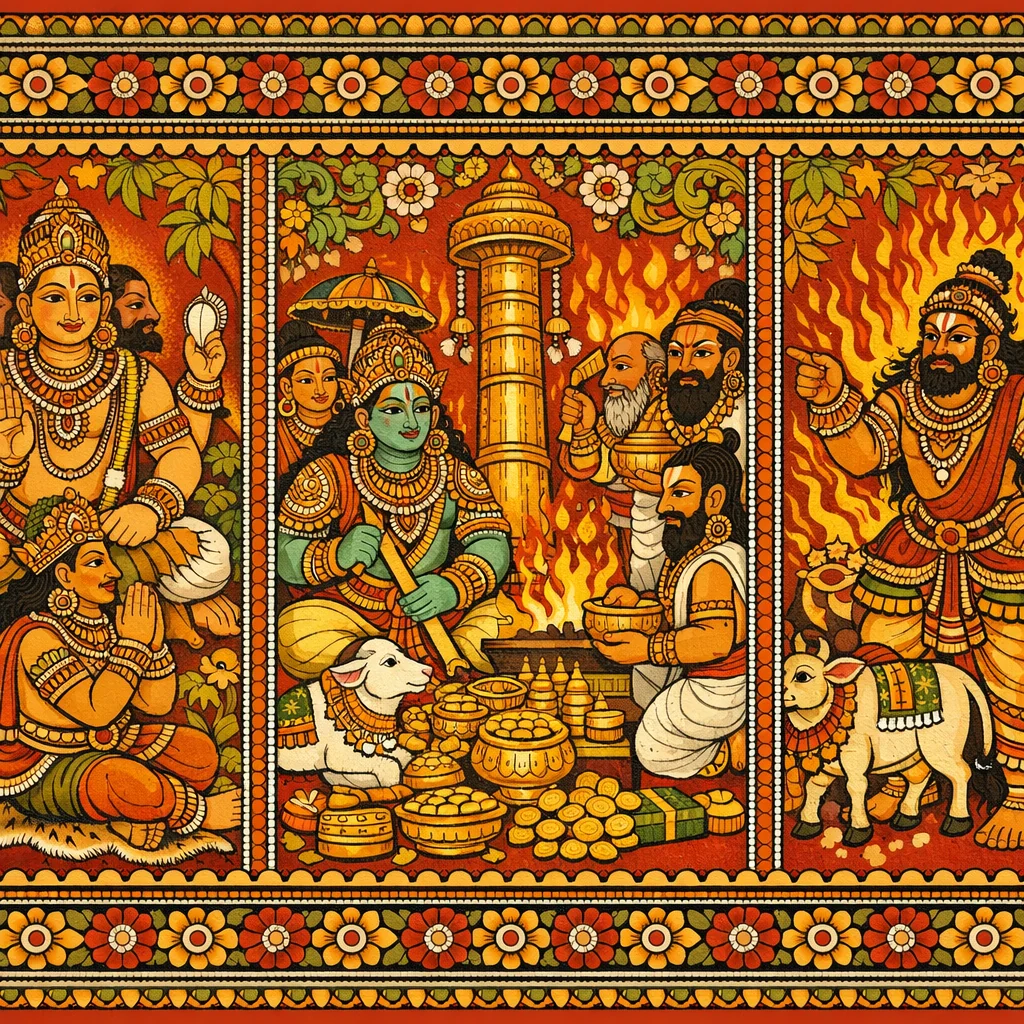
Sūta relates: Śatānīka, pleased by what he heard from Śaunaka, offers due honor and gifts; Śaunaka accepts, gives the wealth away to brāhmaṇas, and vanishes. The sages then ask Sūta to recount in detail Yayāti’s lineage through Yadu. Sūta names Yadu’s sons and traces the succession to the Haihaya branch, culminating in Kārtavīrya Arjuna. The chapter expands into praise of Arjuna—his boons from Datta (Dattātreya), dharmic rule, great sacrifices, and superhuman feats (ocean/Narmadā episodes, capture of Rāvaṇa). It concludes with Bhārgava’s curse and Arjuna’s destined death, mentions his many sons and Haihaya clans, and ends with a phalaśruti on the merit of reciting his name and birth.
Key Concepts
Shlokas in Adhyaya 43
Verse 1
*सूत उवाच इत्येतच्छौनकाद्राजा शतानीको निशम्य तु विस्मितः परया प्रीत्या पूर्णचन्द्र इवाबभौ //
Sūta said: Having heard this from Śaunaka, King Śatānīka—astonished and filled with supreme delight—shone like the full moon.
Verse 2
पूजयामास नृपतिर् विधिवच्चाथ शौनकम् रत्नैर्गोभिः सुवर्णैश्च वासोभिर्विविधैस्तथा //
Then the king duly honoured Śaunaka according to proper rite—offering him jewels, cows, gold, and garments of many kinds as well.
Verse 3
प्रतिगृह्य ततः सर्वं यद्राज्ञा प्रहितं धनम् दत्त्वा च ब्राह्मणेभ्यश्च शौनको ऽन्तरधीयत //
Then, having accepted all the wealth that the king had sent, Śaunaka distributed it to the brāhmaṇas—and thereafter disappeared from view.
Verse 4
*ऋषय ऊचुः ययातेर्वंशमिच्छामः श्रोतुं विस्तरतो वद यदुप्रभृतिभिः पुत्रैर् यदा लोके प्रतिष्ठितम् //
The sages said: “We wish to hear, in full detail, the lineage of Yayāti. Tell us at length how it became established in the world through his sons, beginning with Yadu.”
Verse 5
*सूत उवाच यदोर्वंशं प्रवक्ष्यामि ज्येष्ठस्योत्तमतेजसः विस्तरेणानुपूर्व्या च गदतो मे निबोधत //
Sūta said: I shall now describe the lineage of Yadu—the eldest, endowed with supreme splendor—fully and in due sequence. Listen attentively as I relate it.
Verse 6
यदोः पुत्रा बभूवुर्हि पञ्च देवसुतोपमाः महारथा महेष्वासा नामतस्तान्निबोधत //
Indeed Yadu had five sons, like the sons of the gods—great chariot-warriors and mighty bowmen. Now learn their names.
Verse 7
सहस्रजिर् अथो ज्येष्ठः क्रोष्टुर्नीलो ऽन्तिको लघुः सहस्रजेस्तु दायादः शतजिर्नाम पार्थिवः //
Then Sahasrajit was the eldest; after him came Kroṣṭu, Nīla, Antika, and Laghu. From Sahasrajit’s line was born a successor named Śatajit, a king upon the earth.
Verse 8
शतजेरपि दायादास् त्रयः परमकीर्तयः हैहयश्च हयश्चैव तथा वेणुहयश्च यः //
From Śatajit too arose three heirs of supreme renown—Haihaya, Haya, and also Veṇuhaya.
Verse 9
हैहयस्य तु दायादो धर्मनेत्रः प्रतिश्रुतः धर्मनेत्रस्य कुन्तिस्तु संहतस्तस्य चात्मजः //
From Haihaya, it is declared, there was an heir named Dharmanetra. From Dharmanetra came Kunti, and Saṃhata was his son.
Verse 10
संहतस्य तु दायादो महिष्मान्नाम पार्थिवः आसीन्महिष्मतः पुत्रो रुद्रश्रेण्यः प्रतापवान् //
From Saṃhata there arose an heir, a king named Mahiṣmān; and Mahiṣmān’s son was the valorous and mighty Rudraśreṇya.
Verse 11
वाराणस्याम् अभूद्राजा कथितं पूर्वमेव तु रुद्रश्रेण्यस्य पुत्रो ऽभूद् दुर्दमो नाम पार्थिवः //
In Vārāṇasī there was a king—already spoken of earlier. He was the son of Rudraśreṇya, a ruler named Durdama.
Verse 12
दुर्दमस्य सुतो धीमान् कनको नाम वीर्यवान् कनकस्य तु दायादाश् चत्वारो लोकविश्रुताः //
Durdama had a wise son named Kanaka, a man of great valor. And Kanaka, in turn, had four heirs renowned throughout the world.
Verse 13
कृतवीर्यः कृताग्निश्च कृतवर्मा तथैव च कृतौजाश्च चतुर्थो ऽभूत् कृतवीर्यात्ततो ऽर्जुनः //
The four sons were Kṛtavīrya, Kṛtāgni, likewise Kṛtavarmā, and as the fourth, Kṛtaujā. From Kṛtavīrya thereafter was born Arjuna (Kārtavīrya Arjuna).
Verse 14
जातः करसहस्रेण सप्तद्वीपेश्वरो नृपः वर्षायुतं तपस्तेपे दुश्चरं पृथिवीपतिः //
Born with a thousand hands, that king became the sovereign lord of the seven continents; the ruler of the earth performed severe, difficult austerities for ten thousand years.
Verse 15
दत्तमाराधयामास कार्तवीर्यो ऽत्रिसम्भवम् तस्मै दत्ता वरास्तेन चत्वारः पुरुषोत्तम //
Kārtavīrya (Arjuna) worshipped Datta, the descendant of Atri. Pleased, Datta granted him four boons, O best of men.
Verse 16
पूर्वं बाहुसहस्रं तु स वव्रे राजसत्तमः अधर्मं चरमाणस्य सद्भिश्चापि निवारणम् //
Formerly, that best of kings undertook this vow: that one who acts in unrighteousness (adharma) should be restrained—even by the good and virtuous.
Verse 17
युद्धेन पृथिवीं जित्वा धर्मेणैवानुपालनम् संग्रामे वर्तमानस्य वधश्चैवाधिकाद्भवेत् //
Having conquered the earth through war, one must thereafter protect and govern it by Dharma alone; for one engaged in battle, killing (the enemy) becomes a matter of greater necessity.
Verse 18
तेनेयं पृथिवी सर्वा सप्तद्वीपा सपर्वता सप्तोदधिपरिक्षिप्ता क्षात्त्रेण विधिना जिता //
By him, this entire earth—together with its seven continents and their mountains, encircled by the seven oceans—was conquered in accordance with the lawful code of kṣatriya rule.
Verse 19
जज्ञे बाहुसहस्रं वै इच्छतस्तस्य धीमतः रथो ध्वजश्च संजज्ञ इत्येवमनुशुश्रुम //
Indeed, for that wise one—merely by his wish—a thousand arms were born; and a chariot and a banner also came into being. Thus have we heard.
Verse 20
दश यज्ञसहस्राणि राज्ञां द्वीपेषु वै तदा निरर्गलानि वृत्तानि श्रूयन्ते तस्य धीमतः //
In those island-lands, it is heard that ten thousand royal sacrifices (yajñas) were then carried out without obstruction—such were the renowned deeds of that wise ruler.
Verse 21
सर्वे यज्ञा महाराज्ञस् तस्यासन् भूरिदक्षिणाः सर्वे काञ्चनयूपास्ते सर्वाः काञ्चनवेदिकाः //
All the sacrifices (yajñas) of that great king were accompanied by abundant dakṣiṇā—sacrificial gifts; all the sacrificial posts were of gold, and all the altars (vedikās) were likewise made of gold.
Verse 22
सर्वे देवैः समं प्राप्तैर् विमानस्थैरलंकृताः गन्धर्वैरप्सरोभिश्च नित्यमेवोपशोभिताः //
All are adorned by the gods who arrive together, seated in vimānas—celestial aerial cars; and they are ever beautified by Gandharvas and Apsarases.
Verse 23
तस्य यज्ञे जगौ गाथां गन्धर्वो नारदस्तथा कार्तवीर्यस्य राजर्षेर् महिमानं निरीक्ष्य सः //
At his sacrifice, the Gandharva Nārada sang a laudatory gāthā, having beheld the greatness of the royal seer (rājarṣi) Kārtavīrya.
Verse 24
न नूनं कार्तवीर्यस्य गतिं यास्यन्ति क्षत्रियाः यज्ञैर्दानैस्तपोभिश्च विक्रमेण श्रुतेन च //
Surely, no Kshatriyas will ever attain the exalted destiny of Kārtavīrya—whether by sacrifices, by gifts, by austerities, or even by valor and learned sacred knowledge (śruti).
Verse 25
स हि सप्तसु द्वीपेषु खड्गी चक्री शरासनी रथी द्वीपान्यनुचरन् योगी पश्यति तस्करान् //
For he—armed with sword, discus (cakra), and bow, and riding in a chariot—moves about through the seven continents (dvīpas); like a vigilant yogin, he surveys the lands and detects the thieves.
Verse 26
पञ्चाशीतिसहस्राणि वर्षाणां स नराधिपः स सर्वरत्नसम्पूर्णश् चक्रवर्ती बभूव ह //
For eighty-five thousand years that lord of men reigned; endowed with every precious treasure, he indeed became a universal emperor (cakravartin).
Verse 27
स एव पशुपालो ऽभूत् क्षेत्रपालः स एव हि स एव वृष्ट्या पर्जन्यो योगित्वादर्जुनो ऽभवत् //
He himself became the herdsman; indeed, he himself became the guardian of the fields. Through rainfall he became Parjanya (the rain-giver), and by the power of his yogic attainment he became Arjuna.
Verse 28
यो ऽसौ बाहुसहस्रेण ज्याघातकठिनत्वचा भाति रश्मिसहस्रेण शारदेनेव भास्करः //
He—resplendent with a thousand arms, his skin hardened by the repeated impact of the bowstring—shines with a thousand rays, like the sun in the clear autumn season.
Verse 29
एष नागं मनुष्येषु माहिष्मत्यां महाद्युतिः कर्कोटकसुतं जित्वा पुर्यां तत्र न्यवेशयत् //
This greatly radiant king among men, having conquered the Nāga—Karkoṭaka’s son—at Māhiṣmatī, settled there in that city and established his rule.
Verse 30
एष वेगं समुद्रस्य प्रावृट्काले भजेत वै क्रीडन्नेव सुखोद्भिन्नः प्रतिस्रोतो महीपतिः //
In the season of the rains (the monsoon), the ocean indeed takes on this surge: as though playing, it swells up in delight, and, O king, its currents run back against their usual course.
Verse 31
ललता क्रीडता तेन प्रतिस्रग्दाममालिनी ऊर्मिभ्रुकुटिसंत्रासाच् चकिताभ्येति नर्मदा //
As he sported with her, Narmadā—adorned with garlands and wreaths—came forward in startled haste, frightened by the frowning, wave-like ripples upon her brow.
Verse 32
एको बाहुसहस्रेण वगाहे स महार्णवम् करोत्युद्वृत्तवेगां तु नर्मदां प्रावृडुद्धताम् //
With a single arm he can plunge into the great ocean; yet he makes the Narmadā—swollen and raging in the monsoon—surge with an even more tumultuous force.
Verse 33
तस्य बाहुसहस्रेण क्षोभ्यमाणे महोदधौ भवन्त्यतीव निश्चेष्टाः पातालस्था महासुराः //
When the great ocean was being violently churned and agitated by his thousand arms, the mighty Asuras dwelling in Pātāla became utterly motionless and powerless.
Verse 34
चूर्णीकृतमहावीचिलीनमीनमहातिमिम् मारुताविद्धफेनौघम् आवर्ताक्षिप्तदुःसहम् //
The ocean became unbearable—its great waves crushing and churning, swarming with fishes and monstrous timi-whales; its masses of foam whipped up by fierce winds, and its violent whirlpools hurling everything about.
Verse 35
करोत्यालोडयन्नेव दोःसहस्रेण सागरम् मन्दरक्षोभचकिता ह्य् अमृतोत्पादशङ्किताः //
With his thousand arms he churned the ocean indeed; and those beings, alarmed by the shaking of Mount Mandara, suspected that nectar (amṛta) was about to arise.
Verse 36
तदा निश्चलमूर्धानो भवन्ति च महोरगाः सायाह्ने कदलीखण्डा निर्वातस्तिमिता इव //
At that time even the great serpents become motionless, their heads unmoving; and in the late afternoon the clumps of banana plants stand as if stilled in windless air.
Verse 37
एवं बद्ध्वा धनुर्ज्यायाम् उत्सिक्तं पञ्चभिः शरैः लङ्कायां मोहयित्वा तु सबलं रावणं बलात् //
Thus, having strung his bow and loosed five arrows, he forcibly bewildered Ravana along with his army in Lanka.
Verse 38
निर्जित्य बद्ध्वा चानीय माहिष्मत्यां बबन्ध च ततो गत्वा पुलस्त्यस्तु ह्य् अर्जुनं संप्रसादयन् //
Having conquered him, he bound him, brought him to Māhiṣmatī, and imprisoned him there. Thereafter Pulastya went and sought to appease Arjuna (Kārtavīrya).
Verse 39
मुमोच रक्षः पौलस्त्यं पुलस्त्येनेह सान्त्वितम् तस्य बाहुसहस्रेण बभूव ज्यातलस्वनः //
Here, Pulastya consoled the Paulastya rākṣasa and released him. With his thousand arms, there arose the resounding twang of the bowstring as he drew the bow.
Verse 40
युगान्ताभ्रसहस्रस्य आस्फोटस्त्वशनेरिव अहो बत विधेर्वीर्यं भार्गवो ऽयं यदाछिनत् //
Like the thunderclap of a lightning-bolt amid thousands of end-of-age clouds—astonishing indeed is the power of destiny, that this Bhārgava (Paraśurāma) cut it down.
Verse 41
तद्वै सहस्रं बाहूनां हेमतालवनं यथा यत्रापवस्तु संक्रुद्धो ह्य् अर्जुनं शप्तवान्प्रभुः //
Indeed, his thousand arms were like a grove of golden palm-trees; and there, enraged at the offence done to him, the mighty lord pronounced a curse upon Arjuna.
Verse 42
यस्माद्वनं प्रदग्धं वै विश्रुतं मम हैहय तस्मात्ते दुष्करं कर्म कृतमन्यो हरिष्यति //
Since my forest has indeed been burned down—and by that deed you, O Haihaya, have become notorious—therefore the hard-won act you performed will have its fruit and glory seized by another.
Verse 43
छित्त्वा बाहुसहस्रं ते प्रथमं तरसा बली तपस्वी ब्राह्मणश्च त्वां स वधिष्यति भार्गव //
First, with irresistible force, that mighty ascetic brāhmaṇa—Bhārgava—will cut off your thousand arms; then he will slay you.
Verse 44
*सूत उवाच तस्य रामस्तदा त्व् आसीन् मृत्युः शापेन धीमतः वरश्चैव तु राजर्षेः स्वयमेव वृतः पुरा //
Sūta said: For him, Rāma then indeed became Death, by the curse of that wise one; and the boon of the royal seer had, in former times, been chosen by himself alone.
Verse 45
तस्य पुत्रशतं त्व् आसीत् पञ्च तत्र महारथाः कृतास्त्रा बलिनः शूरा धर्मात्मानो महाबलाः //
He had a hundred sons; among them, five became great chariot-warriors—fully trained in weapons, strong and heroic, righteous in nature, and of mighty prowess.
Verse 46
शूरसेनश्च शूरश्च धृष्टः क्रोष्टुस्तथैव च जयध्वजश्च वैकर्ता अवन्तिश्च विशांपते //
O lord of the people, the descendants or royal figures are named Śūrasena, Śūra, Dhṛṣṭa, and likewise Kroṣṭu; also Jayadhvaja, Vaikartā, and Avanti.
Verse 47
जयध्वजस्य पुत्रस्तु तालजङ्घो महाबलः तस्य पुत्रशतान्येव तालजङ्घा इति श्रुताः //
Jayadhvaja’s son was the mighty Tālajaṅgha. It is heard that he had hundreds of sons, who became known collectively as the Tālajaṅghas.
Verse 48
तेषां पञ्च कुलाः ख्याता हैहयानां महात्मनाम् वीतिहोत्राश्च शार्यातो भोजाश्चावन्तयस्तथा //
Among those illustrious Haihayas, five great clans are renowned: the Vītihotras, the Śāryātas, the Bhojas, and likewise the Avantis.
Verse 49
कुण्डिकेराश्च विक्रान्तास् तालजङ्घास् तथैव च वीतिहोत्रसुतश्चापि आनर्तो नाम वीर्यवान् दुर्जेयस्तस्य पुत्रस्तु बभूव मित्रकर्शनः //
There were also the Kuṇḍikeras—valiant men—and likewise the Tāla-jaṅghas. Vītihotra’s son was the mighty hero named Ānarta; his son was Durjeya, a subduer of foes.
Verse 50
सद्भावेन महाराज प्रजा धर्मेण पालयन् कार्तवीर्यार्जुनो नाम राजा बाहुसहस्रवान् //
O great king, with a noble disposition and ruling his subjects in accordance with dharma, there was a king named Kārtavīrya Arjuna—renowned as the one of a thousand arms.
Verse 51
येन सागरपर्यन्ता धनुषा निर्जिता मही यस्तस्य कीर्तयेन्नाम कल्यमुत्थाय मानवः //
He by whose bow the earth, bounded by the ocean, was brought under conquest—any person who rises at dawn and auspiciously proclaims that hero’s name attains well-being.
Verse 52
न तस्य वित्तनाशः स्यान् नष्टं च लभते पुनः कार्तवीर्यस्य यो जन्म कथयेदिह धीमतः यथावत्स्विष्टपूतात्मा स्वर्गलोके महीयते //
For him there will be no loss of wealth, and what has been lost he obtains again. Whoever, with understanding, properly recounts here the birth of the wise Kārtavīrya—his soul purified as though by well-performed sacrifices—becomes honored in the heavenly world.
Frequently Asked Questions
The chapter teaches that royal power is legitimate when grounded in dharma: conquest may occur by kṣatriya code, but rulership must be sustained through righteous protection, yajña, and generosity. Even a cakravartin like Kārtavīrya Arjuna—empowered by tapas and Dattātreya’s boons—remains subject to moral consequence and destiny, shown by Bhārgava (Paraśurāma) cursing and destroying him after offense.
This adhyaya is primarily Genealogy (Yayāti → Yadu → Haihaya line) and Rajadharma (idealized kingship, conquest followed by dharmic governance), with strong yajña/dāna themes. It does not teach Vastu Shastra measurements; instead it uses sacrificial imagery (golden yūpas/altars) and phalaśruti to frame sacred remembrance.
Yes. Kārtavīrya Arjuna worships Datta, the descendant of Atri (Dattātreya), who grants boons. This anchors Arjuna’s extraordinary sovereignty in a devotional-tapas framework, showing that political authority in Purāṇic thought is ideally sanctioned by spiritual attainment and divine favor.
The text states that one who rises at dawn and auspiciously proclaims Kārtavīrya’s name attains well-being; there will be no loss of wealth, and lost wealth is regained. Properly recounting his birth purifies the narrator like well-performed sacrifices and brings honor in heaven.