Adhyaya 350
Āścarya-kathana: Brāhmaṇa–Nāga Dialogue on Sūrya (Vivasvat) and the ‘Second Sun’ Phenomenon
Upa-parva: Mokṣa-dharma (Liberation-Discourse) — Wonders associated with Sūrya and cosmological inquiry
The chapter opens with a brāhmaṇa requesting an account of any extraordinary sight connected to the one-wheeled chariot of Vivasvat (Sūrya). The nāga responds by first listing marvels embedded in regular cosmic order: perfected sages dwelling amid the sun’s thousand rays; the emergence and expansion of great wind associated with solar rays; the rain-bearing mechanism linked to a ‘dark/white foot’ (poetic-cosmological imagery) that releases water in the rainy season; and the cyclical ‘taking back’ of water over months through the sun’s pure rays. The discourse then shifts from generalized marvels to a singular event described as the ‘wonder among wonders’: at midday, when the sun heats the worlds, a radiant form resembling another sun appears from all directions, illuminates everything with its own brilliance, and advances toward the sun as if splitting the sky. It is depicted like a sacrificial fire-offering in luminous form, a second bhāskara of indeterminate appearance. As it approaches, Vivasvat extends a hand; the approaching radiance reciprocates with its right hand in a gesture of acknowledgment. It then pierces the firmament, enters the solar orb, and the two lights become one, instantly assuming ‘sun-ness.’ Observers are left with doubt about which is the sun and who the chariot-borne figure is; they question Ravi regarding the identity of the other sun-like being that traversed the heavens and merged into the solar sphere. The chapter’s thematic center is disciplined astonishment: it stages perception, merger, and doubt as prompts for higher explanation rather than sensationalism.
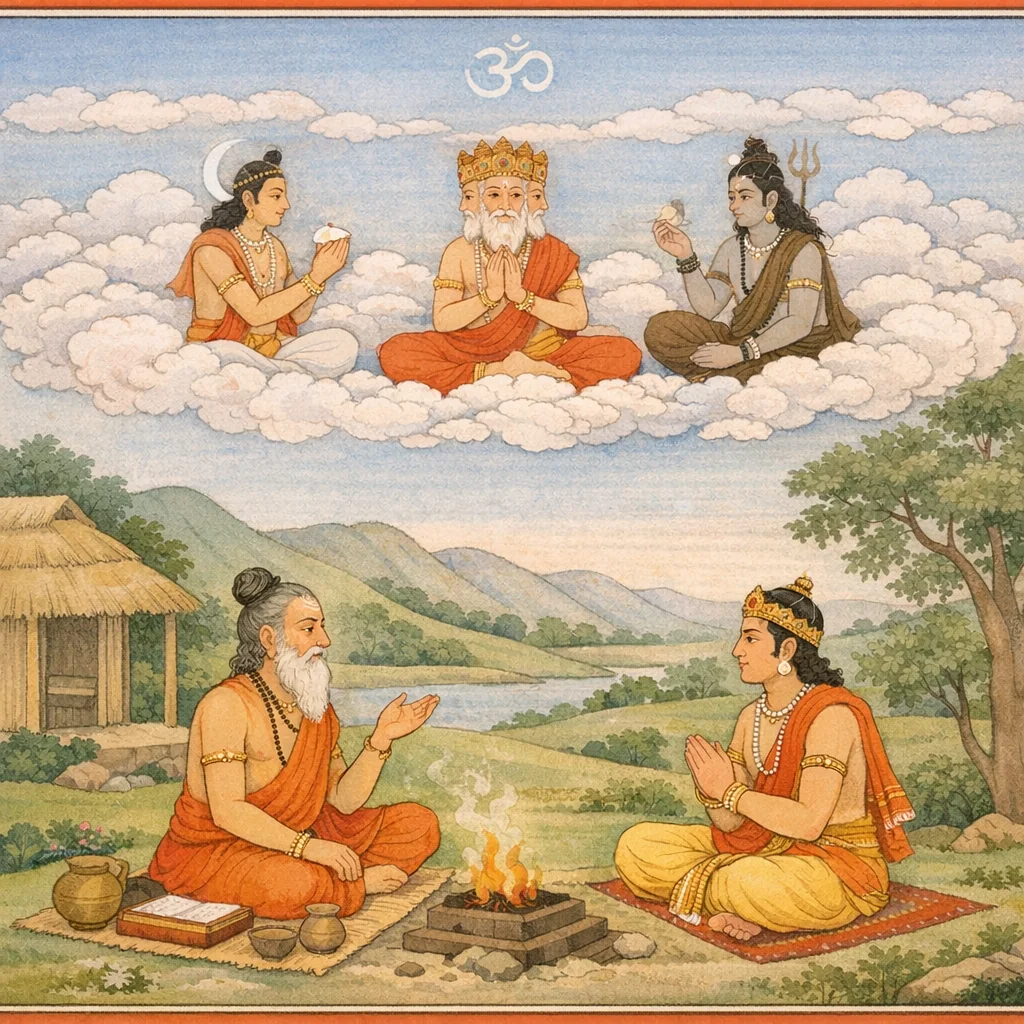
Chapter Arc: जनमेजय का विस्मय: जो भगवान् अनन्य-भक्ति से प्रसन्न होकर स्वयं पूजन ग्रहण करते हैं, उनकी कृपा और उस आनंद का रहस्य क्या है? → वैशम्पायन सूक्ष्म तत्त्व-क्रम खोलते हैं—जिनकी वासनाएँ दग्ध हो चुकीं, जो पुण्य-पाप से परे हो गए, उनकी ‘परम्परागत गति’ क्या है; और साथ ही ‘सात्वत/नारायणात्मको धर्म’ की प्राचीनता, वेद-साम्य और युग-युग में उसके प्रवाह का संकेत देते हैं। → नारायण-स्वरूप धर्म का दिव्य वंश-क्रम और उसका परम-गन्तव्य उद्घाटित होता है—यह धर्म सत्ययुग से चला, ब्रह्मा ने (द्वितीय जन्म/नेत्रोत्पत्ति के प्रसंग में) सोम से इसे सुना, रुद्र को प्रदान हुआ, इक्ष्वाकु के उपदेश से जगत में फैला, और कल्पान्त में पुनः नारायण में ही लीन हो जाएगा; साथ ही ‘अ-उ-म्’ त्र्यक्षर-युक्त, अत्यन्त सूक्ष्म सत्त्व-सम्बद्ध मार्ग का संकेत मिलता है। → अध्याय यह स्थिर करता है कि भक्ति-पूजा का ग्रहण केवल कर्मकाण्ड नहीं, बल्कि सत्त्व-शुद्धि, वासना-दाह और नारायण-धर्म की परम्परा से जुड़ा हुआ तत्त्व-मार्ग है; प्रवृत्ति-निवृत्ति के क्रम में जीव की गति का ढाँचा स्पष्ट होता है। → जनमेजय का प्रश्न आगे टिकता है—‘वैकारिक पुरुष’ (रज-तम से आच्छादित मन वाला) क्रमशः प्रवृत्ति-पथ से उठकर पुरुषोत्तम को कैसे प्राप्त करे?—इसका विस्तृत अनुभव-आधारित वर्णन अगले भाग में अपेक्षित है।
Shlokas
Verse 1
जनमेजयने कहा--ब्रह्मन! भगवान् अनन्यभावसे भजन करनेवाले सभी भक्तोंको प्रसन्न करते और उनकी विधिवत् की हुई पूजाको स्वयं ग्रहण करते हैं; यह कितने आनन्दकी बात है
Janamejaya said: “O Brahmin! How joyful it is that the Blessed Lord delights all devotees who worship Him with undivided devotion, and that He Himself accepts their duly performed worship.”
Verse 2
ये तु दग्धेन्धना लोके पुण्यपापविवर्जिता: । तेषां त्वयाभिनिर्दिष्टा पारम्पर्यागता गति:
Janamejaya said: “But those who, in that world, are like fuel already burnt—free from both merit and sin—of them you have described the destiny that comes down through tradition.”
Verse 3
संसारमें जिन लोगोंकी वासनाएँ दग्ध हो गयी हैं और जो पुण्य-पापसे रहित हो गये हैं, उन्हें परम्परासे जो गति प्राप्त होती है, उसका भी आपने वर्णन किया है ।। चतुर्थ्या चैव ते गत्यां गच्छन्ति पुरुषोत्तमम् । एकान्तिनस्तु पुरुषा गच्छन्ति परमं पदम्,जो भगवानके अनन्य भक्त हैं, वे साधुपुरुष अनिरुद्ध, प्रद्युम्म और संकर्षणकी अपेक्षा न रखकर वासुदेवसंज्ञक चौथी गतिमें पहुँचकर भगवान् पुरुषोत्तम एवं उनके परमपदको प्राप्त कर लेते हैं
Janamejaya said: “You have described even that destination which is attained in due succession by those in the world whose latent cravings have been burned away and who have become free from both merit and sin. By that fourth course they go to the Supreme Person. But those who are one-pointed in devotion—single-minded men of virtue—reach the highest state: without depending on Aniruddha, Pradyumna, or Saṅkarṣaṇa, they attain the ‘fourth’ destination known as Vāsudeva and thereby reach the Lord, the Puruṣottama, and His supreme abode.”
Verse 4
नूनमेकान्तधर्मो<यं श्रेष्ठो नारायणप्रिय: । अगत्वा गतयस्तिस््रो यद् गच्छत्यव्ययं हरिम्,निश्चय ही यह अनन्यभावसे भगवान्का भजनरूप धर्म श्रेष्ठ एवं श्रीनारायणको परम प्रिय है; क्योंकि इसका आश्रय लेनेवाले भक्तजन उक्त तीन गतियोंको प्राप्त न होकर सीधे चौथी गतिमें पहुँचकर अविनाशी श्रीहरिको प्राप्त कर लेते हैं
Janamejaya said: “Surely this path of single-minded devotion is the highest and most beloved of Nārāyaṇa. For one who takes refuge in it does not pass through the three ordinary destinations; instead, he goes straight to the imperishable Hari—attaining the supreme, fourth goal.”
Verse 5
सहोपनिषदान वेदान् ये विप्रा: सम्यगास्थिता: । पठन्ति विधिमास्थाय ये चापि यतिधर्मिण:
Janamejaya said: “Those brāhmaṇas who are firmly established in right conduct recite the Vedas together with the Upaniṣads, following the prescribed rule; and likewise those who live by the discipline of renunciation (yati-dharma)…”
Verse 6
केनैष धर्म: कथितो देवेन ऋषिणापि वा,भगवन! इस भक्तिरूप धर्मका किस देवता अथवा ऋषिने उपदेश किया है? अनन्य भक्तोंकी जीवनचर्या क्या है? और वह कबसे प्रचलित हुई? मेरे इस संशयका निवारण कीजिये। इस विषयको सुननेके लिये मेरे मनमें बड़ी उत्कण्ठा हो रही है
Janamejaya said: “Revered sir, by whom was this dharma taught—by a god or by a sage? Who first instructed this dharma whose very form is devotion? What is the way of life of those who are devoted with undivided loyalty, and from what time has this tradition been in practice? Please remove my doubt; my mind is intensely eager to hear about this matter.”
Verse 7
एकान्तिनां च का चर्या कदा चोत्पादिता विभो | एतन्मे संशयं छिन्धि परं॑ कौतूहलं हि मे,भगवन! इस भक्तिरूप धर्मका किस देवता अथवा ऋषिने उपदेश किया है? अनन्य भक्तोंकी जीवनचर्या क्या है? और वह कबसे प्रचलित हुई? मेरे इस संशयका निवारण कीजिये। इस विषयको सुननेके लिये मेरे मनमें बड़ी उत्कण्ठा हो रही है
Janamejaya said: “O mighty one, what is the disciplined way of life of those who are single-minded in devotion? And from what time did this path arise and become established? Cut through this doubt of mine, for my curiosity about it is profound, O Blessed Lord.”
Verse 8
वैशम्पायन उवाच समुपोढेष्वनीकेषु कुरुपाण्डवरयोर्मुथे । अर्जुने विमनस्के च गीता भगवता स्वयम्,वैशम्पायनजीने कहा--राजन्! जिस समय कौरव और पाण्डवोंकी सेनाएँ युद्धके लिये आमने-सामने डटी हुई थीं और अर्जुन युद्धसे अनमने हो रहे थे, उस समय स्वयं भगवानने उन्हें गीतामें इस धर्मका उपदेश दिया
Vaiśampāyana said: When the battle-formations of the Kurus and the Pāṇḍavas had drawn up face to face for combat, and Arjuna’s mind sank into hesitation about fighting, the Blessed Lord Himself instructed him in this dharma through the teaching known as the Gītā.
Verse 9
अगतिकश्न गतिश्चैव पूर्व ते कथिता मया । गहनो ह्ोष धर्मों वै दुर्विज्ञेयोडकृतात्मभि:,मैंने पहले तुमसे गति और अगतिका स्वरूप भी बताया था। यह धर्म गहन तथा अजितात्मा पुरुषोंके लिये दुर्गम है
Vaiśampāyana said: “Earlier I have already explained to you both ‘non-refuge’ (agati) and ‘refuge/attainment’ (gati). Indeed, this Dharma is profound—hard to penetrate and difficult to understand for those who have not mastered themselves.”
Verse 10
सम्मित: सामवेदेन पुरैवादियुगे कृत: । धार्यते स्वयमीशेन राजन् नारायणेन च,राजन! यह धर्म सामवेदके समान है। प्राचीनकालके सत्ययुगसे ही यह प्रचलित हुआ है। स्वयं जगदीश्वर भगवान् नारायण ही इस धर्मको धारण करते हैं
Vaiśampāyana said: “O King, this dharma is in full accord with the Sāmaveda. It was established long ago, in the primordial age. Indeed, the Lord Himself—Nārāyaṇa—upholds and bears this dharma.”
Verse 11
एतदर्थ महाराज पृष्ट: पार्थेन नारद: । ऋषिमध्ये महाभाग: शृण्वतो: कृष्णभीष्मयो:,महाराज! कुन्तीपुत्र युधिष्ठिरने ऋषियोंके बीचमें महाभाग नारदजीसे यही विषय पूछा था। उस समय श्रीकृष्ण और भीष्म भी इस विषयको सुन रहे थे
Vaiśampāyana said: “O King, on this very matter the illustrious Nārada was questioned by Pārtha in the midst of the sages, while Kṛṣṇa and Bhīṣma were listening.”
Verse 12
गुरुणा च मयाप्येष कथितो नृपसत्तम । यथा तत् कथित तत्र नारदेन तथा शृणु,नृपश्रेष्ठ! मेरे गुरु व्यासजीने और मैंने भी यह विषय कहा था; परंतु वहाँ नारदजीने उस विषयका जैसा वर्णन किया था, उसे बताता हूँ, सुनो
Vaiśampāyana said: “O best of kings, this very matter was related by my teacher (Vyāsa) and also by me. Now, O foremost of rulers, listen as I recount it exactly as Nārada described it on that occasion.”
Verse 13
यदासीन्मानसं जन्म नारायणमुखोद्गतम् | ब्रह्मण: पृथिवीपाल तदा नारायण: स्वयम्,भूपाल! सृष्टिके आदिमें जब भगवान् नारायणके मुखसे ब्रह्माजीका मानसिक जन्म हुआ था, उस समय साक्षात् नारायणने उन्हें इस धर्मका उपदेश किया था। भरतनन्दन! नारायणने उस धर्मसे देवताओं और पितरोंका पूजनादि कर्म किया था। फिर फेनप ऋषियोंने उस धर्मको ग्रहण किया
Vaiśaṃpāyana said: “O king, when Brahmā’s mind-born creation first arose, emerging from Nārāyaṇa’s own mouth, at that primordial moment Nārāyaṇa himself instructed him in this Dharma. By that very Dharma Nārāyaṇa performed the rites of worship for the gods and the ancestors; thereafter the sages known as the Phenapas accepted and upheld that Dharma.”
Verse 14
तेन धर्मेण कृतवान् दैवं पित्र्यं च भारत । फेनपा ऋषयश्जैव तं धर्म प्रतिपेदिरे,भूपाल! सृष्टिके आदिमें जब भगवान् नारायणके मुखसे ब्रह्माजीका मानसिक जन्म हुआ था, उस समय साक्षात् नारायणने उन्हें इस धर्मका उपदेश किया था। भरतनन्दन! नारायणने उस धर्मसे देवताओं और पितरोंका पूजनादि कर्म किया था। फिर फेनप ऋषियोंने उस धर्मको ग्रहण किया
Vaiśaṃpāyana said: “O Bhārata, by that very dharma Nārāyaṇa performed the rites of worship and offerings due to the gods and to the ancestors. And the sages called the Phenapās likewise adopted and upheld that dharma. Thus this teaching is presented as an ancient, authoritative rule of right conduct—practiced first by the divine and then received by the seers.”
Verse 15
वैखानसा: फेनपेभ्यो धर्म त॑ प्रतिपेदिरे । वैखानसे भ्य: सोमस्तु ततः सोडच्तर्दथे पुन:,फेनपोंसे वैखानसोंने उस धर्मको उपलब्ध किया। उनसे सोमने उसे ग्रहण किया। तदनन्तर वह धर्म फिर लुप्त हो गया
Vaiśampāyana said: “The Vaikhānasa sages received that dharma from the Phenapas. Soma, in turn, took it from the Vaikhānasas; thereafter, that dharma once again disappeared.”
Verse 16
यदासीच्चाक्षुषं जन्म द्वितीयं ब्रह्मणो नृूप । तदा पितामहेनैव सोमाद् धर्म: परिश्रुत:
Vaiśampāyana said: “O king, when the Creator Brahmā entered his second birth known as the Cākṣuṣa (Manvantara), then Dharma was heard and received—handed down by the Grandsire himself—from Soma.”
Verse 17
नारायणात्मको राजन् रुद्राय प्रददौ च तम् नरेश्वर! जब ब्रह्माजीका नेत्रजनित द्वितीय जन्म हुआ, तब उन्होंने सोमसे उस नारायण-स्वरूप धर्मको सुना था। राजन! ब्रह्माजीने रुद्रको इसका उपदेश दिया ।। १६३६ || ततो योगस्थितो रुद्र: पुरा कृतयुगे नूप,नरेश्वर! तत्पश्चात् योगनिष्ठ रुद्रने पूर्वकालके कृतयुगमें सम्पूर्ण बालखिल्य ऋषियोंको इस धर्मसे अवगत कराया; तदनन्तर भगवान् विष्णुकी मायासे वह धर्म फिर लुप्त हो गया
Vaiśampāyana said: “O king, that Dharma which is of the very nature of Nārāyaṇa was imparted to Rudra. Then Rudra, established in yoga, in ancient times—during the Kṛta age—made all the Bālakhilya sages acquainted with this teaching. Thereafter, by the māyā of Lord Viṣṇu, that Dharma again became hidden from the world.”
Verse 18
बालखिल्यानृषीन् सर्वान् धर्ममेतदपाठयत् | अन्तर्दधे ततो भूयस्तस्य देवस्य मायया,नरेश्वर! तत्पश्चात् योगनिष्ठ रुद्रने पूर्वकालके कृतयुगमें सम्पूर्ण बालखिल्य ऋषियोंको इस धर्मसे अवगत कराया; तदनन्तर भगवान् विष्णुकी मायासे वह धर्म फिर लुप्त हो गया
Rudra taught this Dharma to all the Bālakhilya sages. Then, by the māyā of that deity (Viṣṇu), that Dharma once more became hidden.
Verse 19
तृतीयं ब्रद्मणो जन्म यदासीद् वाचिकं महत् । तत्रैष धर्म: सम्भूत: स्वयं नारायणान्नूप,राजन्! जब भगवान्की वाणीसे ब्रह्माजीका तीसरा महत्त्वपूर्ण जन्म हुआ, तब फिर साक्षात् नारायणसे ही यह धर्म प्रकट हुआ
Vaiśampāyana said: “When Brahmā experienced his third, great ‘birth’—the one arising through divine speech—then, O king, this very Dharma manifested there, issuing directly from Nārāyaṇa Himself.”
Verse 20
सुपर्णो नाम तमृषि: प्राप्तवान् पुरुषोत्तमात् । तपसा वै सुतप्तेन दमेन नियमेन च,सुपर्ण नामक ऋषिने इन्द्रियसंयम और मनोनिग्रह-पूर्वक भलीभाँति तपस्या करके भगवान् पुरुषोत्तमसे इस धर्मको प्राप्त किया
Vaiśampāyana said: “The sage named Suparṇa obtained that Dharma from the Supreme Person (Puruṣottama), having performed well-austered tapas, together with self-restraint (dama) and disciplined observances (niyama).”
Verse 21
त्रिःपरिक्रान्तवानेतत् सुपर्णो धर्ममुत्तमम् । यस्मात् तस्माद् व्रतं होतत् त्रिसौपर्णमिहोच्यते,सुपर्णने प्रतिदिन इस उत्तम धर्मकी तीन आवृत्ति की थी, इसलिये इस व्रत या धर्मको यहाँ 'त्रिसौपर्ण” कहते हैं
Vaiśaṃpāyana said: “Suparṇa (Garuḍa) performed this supreme dharma by repeating it three times. Therefore, this observance is here called the ‘Trisauparṇa’ vow—named for Suparṇa’s threefold recitation and practice of the rite.”
Verse 22
ऋग्वेदपाठपठितं व्रतमेतद्धि दुश्चरम् । सुपर्णाच्चाप्यधिगतो धर्म एब सनातन:
Vaiśampāyana said: “This observance, grounded in the recitation and study of the Ṛgveda, is indeed difficult to practice. This eternal dharma, moreover, was also learned from Suparṇa (Garuḍa).”
Verse 23
वायो: सकाशात् प्राप्तश्ष ऋषिभिर्विघसाशिभि:,वायुसे विघसाशी ऋषियोंने इस धर्मका उपदेश ग्रहण किया। उनसे महोदधिको इस उत्तम धर्मकी प्राप्ति हुई। तत्पश्चात् यह धर्म फिर लुप्त होकर भगवान् नारायणमें विलीन हो गया
Vaiśampāyana said: This dharma was obtained in the presence of Vāyu by sages who lived on vighasa—the remnants of offerings and food. Those vighasāśin sages received this teaching of dharma; from them the great ocean (Mahodadhi) came to possess this excellent dharma. Thereafter, this dharma again disappeared, merging back into the Lord Nārāyaṇa—suggesting that sacred law is periodically revealed to the worthy and then withdrawn into its divine source.
Verse 24
ततो महोददघिश्नैव प्राप्तवान् धर्ममुत्तमम् । अन्तर्दधे ततो भूयो नारायणसमाहित:ः,वायुसे विघसाशी ऋषियोंने इस धर्मका उपदेश ग्रहण किया। उनसे महोदधिको इस उत्तम धर्मकी प्राप्ति हुई। तत्पश्चात् यह धर्म फिर लुप्त होकर भगवान् नारायणमें विलीन हो गया
Then Mahodadhi too attained that supreme teaching of dharma. Thereafter, that dharma once again disappeared, being reabsorbed into Nārāyaṇa, who was absorbed in his own divine state.
Verse 25
यदा भूय: श्रवणजा सृष्टिरासीन्महात्मन: । ब्रह्मण: पुरुषव्यात्र तत्र कीर्तयत: शूणु,पुरुषसिंह! जब पुनः भगवानके कानोंसे महात्मा ब्रह्माजीकी चौथी बार उत्पत्ति हुई, तब जिस प्रकार इस धर्मका प्रादुर्भाव हुआ था, वह बताता हूँ, सुनो
Vaiśampāyana said: O tiger among men, O lion-like hero, listen. When once again there arose the creation born from hearing—when the great Brahmā came forth for the fourth time—then, as that sacred order (dharma) manifested on that occasion, I shall recount it to you.
Verse 26
जगत्स्रष्टमना देवो हरिनारायण: स्वयम् | चिन्तयामास पुरुष॑ जगत्सर्गकरं प्रभुम्,साक्षात् भगवान् नारायण हरिने जगत्की सृष्टि करनेकी इच्छासे एक ऐसे पुरुषका चिन्तन किया, जो संसारकी सृष्टि करनेमें पूर्णतः समर्थ हो
Vaiśampāyana said: The god Hari-Nārāyaṇa Himself, intent upon creating the world, contemplated a supreme Person—an all-capable Lord who could directly bring about the emanation of the cosmos. The passage frames creation not as accident but as a deliberate, sovereign act grounded in divine will and competence.
Verse 27
अथ चिन्तयतस्तस्य कर्णाभ्यां पुरुष: स्मृत: । प्रजासर्गकरो ब्रह्मा तमुवाच जगत्पति:
As he sat absorbed in thought, a Person—remembered as if arising at his very ears—appeared. It was Brahmā, the creator who brings forth beings; and the Lord of the world addressed him.
Verse 28
श्रेयस्तव विधास्यामि बल॑ तेजश्च सुव्रत,“उत्तम व्रतका पालन करनेवाले पुत्र! मैं तुम्हारा कल्याण करूँगा और तुम्हारे भीतर तेज एवं बलकी वृद्धि करता रहूँगा। तुम मुझसे इस सात्वत नामक धर्मको ग्रहण करो और उसके द्वारा विधिपूर्वक सत्ययुगकी सृष्टि करके उसकी स्थापना करो”
Vaiśampāyana said: “I shall secure your highest good, O steadfast in vows. My son, who keeps the noblest disciplines, I will bring about your welfare and continually increase the strength and radiance within you. Receive from me this dharma called Sātvata; by it, create the Satya-yuga in due and proper manner and establish it firmly.”
Verse 29
धर्म च मत्तो गृह्नीष्व सात्वतं नाम नामत: । तेन सृष्टं कृतयुगं स्थापयस्व यथाविधि,“उत्तम व्रतका पालन करनेवाले पुत्र! मैं तुम्हारा कल्याण करूँगा और तुम्हारे भीतर तेज एवं बलकी वृद्धि करता रहूँगा। तुम मुझसे इस सात्वत नामक धर्मको ग्रहण करो और उसके द्वारा विधिपूर्वक सत्ययुगकी सृष्टि करके उसकी स्थापना करो”
Vaiśampāyana said: “Receive from me this Dharma known by the name ‘Sātvata’. By it, bring forth the Kṛta (Satya) Yuga as ordained, and establish it in due form.”
Verse 30
ततो ब्रह्मा नमश्षक्रे देवाय हरिमेधसे । धर्म चाग्यं स जग्राह सरहस्यं ससंग्रहम्
Then Brahmā offered reverent salutations to Śakra (Indra), the god of keen and far-reaching intelligence. From him he received the sacred teaching of Dharma in its complete form—together with its inner rationale and its systematic compendium—so that righteousness might be understood not merely as rule, but as a coherent, principled way of life.
Verse 31
उपदिश्य ततो धर्म ब्रह्मणेडमिततेजसे
Vaiśampāyana said: Having then instructed him in dharma, he addressed this teaching to the brāhmaṇa of immeasurable splendor.
Verse 32
जगाम तमस: पार यत्राव्यक्तं व्यवस्थितम्,यह आदेश देकर वे अज्ञानान्धकारसे परे विराजमान अपने परम अव्यक्त धामको चले गये। तदनन्तर वरदायक देवता लोकपितामह ब्रह्माने सम्पूर्ण चराचर लोकोंकी सृष्टि की
Vaiśampāyana said: Having given that injunction, he departed beyond the darkness of ignorance to his supreme, unmanifest abode. Thereafter, Brahmā—the boon-bestowing deity, the grandsire of the worlds—brought forth the creation of all realms, both moving and unmoving.
Verse 33
ततो<थ वरदो देवो ब्रह्मा लोकपितामह: । असृजत् स ततो लोकान् कृत्स्नान् स्थावरजजड्भमान्,यह आदेश देकर वे अज्ञानान्धकारसे परे विराजमान अपने परम अव्यक्त धामको चले गये। तदनन्तर वरदायक देवता लोकपितामह ब्रह्माने सम्पूर्ण चराचर लोकोंकी सृष्टि की
Then the boon-giving deity Brahmā, the grandsire and progenitor of the worlds, set about creation. From him arose the complete range of worlds and beings—both the immobile and the mobile—thus establishing the ordered field in which living creatures act, reap results, and pursue dharma.
Verse 34
ततः प्रावर्तत तदा आदौ कृतयुगं शुभम् । ततो हि सात्वतो धर्मो व्याप्प लोकानवस्थित:,फिर तो सृष्टिके आरम्भमें कल्याणकारी कृतयुगकी प्रवृत्ति हुई और तबसे सात्वतधर्म सारे संसारमें व्याप्त हो गया
Then, at the very beginning of creation, the auspicious Kṛta Yuga came into operation. From that time onward, the Sātvata dharma—steadfast, pure, and life-sustaining—spread throughout the worlds and became established among beings.
Verse 35
तेनैवाद्येन धर्मेण ब्रह्मा लोकविसर्गकृत् । पूजयामास देवेशं हरिं नारायणं प्रभुम्,लोकस॒ष्टा ब्रह्माने उसी आदिदधर्मके द्वारा देवेश्वर भगवान् नारायण हरिकी आराधना की
Vaiśampāyana said: By that very primeval dharma, Brahmā—the creator who sets the worlds in motion—worshipped the Lord of the gods, Hari, Nārāyaṇa, the supreme Master.
Verse 36
धर्मप्रतिष्ठाहेतोश्व मनुं स्वारोचिषं ततः । अध्यापयामास तदा लोकानां हितकाम्यया,फिर इस धर्मकी प्रतिष्ठाके लिये समस्त लोकोंके हितकी कामनासे उन्होंने स्वारोचिषमनुको उस समय इस धर्मका उपदेश किया
Vaiśampāyana said: And then, for the very purpose of firmly establishing dharma, he instructed Svarociṣa Manu at that time—out of a wish for the welfare of all the worlds.
Verse 37
ततः स्वरोचिष: पुत्र स्वयं शड्खपदं नृप । अध्यापयत् पुराव्यग्र: सर्वलोकपतिर्वि भु:,नरेश्वर! उन दिनों स्वारोचिष मनु ही सम्पूर्ण लोकोंके अधिपति एवं प्रभु थे। उन्होंने शान्तभावसे पहले अपने पुत्र शंखपदको स्वयं इस धर्मका ज्ञान प्रदान किया
Then, O king, the son of Svarociṣ (Manu)—the mighty lord and sovereign of all the worlds in those ancient times—personally instructed his own son Śaṅkhapada, calmly imparting to him the knowledge of this dharma.
Verse 38
तत:ः शड्खपदश्चापि पुत्रमात्मजमौरसम् । दिशां पाल॑ सुवर्णाभमध्यापयत भारत । सोडचन्तर्दथे ततो भूय: प्राप्ते त्रेतायुगे पुन:,भारत! फिर शंखपदने भी अपने औरस पुत्र दिक्पाल सुवर्णाभको इस धर्मका अध्ययन कराया। इसके बाद त्रेतायुग प्राप्त होनेपर वह धर्म फिर लुप्त हो गया
Vaiśampāyana said: Then Śaṅkhapada too instructed his own legitimate son, Suvarṇābha—who became a guardian of the quarters—in the study of that Dharma, O Bhārata. After this, he disappeared; and when the Tretā age arrived again, that very Dharma once more fell into obscurity.
Verse 39
नासिक्ये जन्मनि पुरा ब्रह्मण: पार्थिवोत्तम | धर्ममेतं स्वयं देवो हरिनारायण: प्रभु:
Vaiśampāyana said: “O best of kings, in a former birth at Nāsikya, this very dharma was taught directly by the Lord Himself—Hari Nārāyaṇa, the sovereign master.”
Verse 40
सनत्कुमारो भगवांस्तत: प्राधीतवान् नूप,नरेश्वर! तत्पश्चात् भगवान् सनत्कुमारने उनसे उस सात्वत-धर्मका उपदेश ग्रहण किया। कुरुश्रेष्ठ! सनत्कुमारसे वीरण प्रजापतिने कृतयुगके आदिमें इस धर्मका उपदेश ग्रहण किया
Vaiśampāyana said: “Then the blessed Sanatkumāra duly learned it, O king, lord among men. Thereafter, that venerable Sanatkumāra received from them the instruction in the Sātvata-dharma. O best of the Kurus, in the beginning of the Kṛta age the heroic Prajāpati received from Sanatkumāra the teaching of this dharma.”
Verse 41
सनत्कुमारादपि च वीरणो वै प्रजापति: । कृतादौ कुरुशार्दूल धर्ममेतदधीतवान्,नरेश्वर! तत्पश्चात् भगवान् सनत्कुमारने उनसे उस सात्वत-धर्मका उपदेश ग्रहण किया। कुरुश्रेष्ठ! सनत्कुमारसे वीरण प्रजापतिने कृतयुगके आदिमें इस धर्मका उपदेश ग्रहण किया
Vaiśampāyana said: Even from Sanatkumāra, the Prajāpati named Vīraṇa learned this very Dharma at the beginning of the Kṛta age, O tiger among the Kurus, O king. Thereafter, the blessed Sanatkumāra imparted that teaching of Sātvata-Dharma. O best of the Kurus, from Sanatkumāra the Prajāpati Vīraṇa received this instruction in Dharma in the earliest time of the Kṛta-yuga.
Verse 42
वीरणकश्चाप्यधीत्यैनं रैभ्याय मुनये ददौ । रैभ्य: पुत्राय शुद्धाय सुव्रताय सुमेधसे,वीरणने इसका अध्ययन करके रैभ्यमुनिको उपदेश दिया। रैभ्यने उत्तम व्रतका पालन करनेवाले श्रेष्ठ बुद्धिसे युक्त धर्मात्मा एवं शुद्ध आचार-विचारवाले अपने पुत्र दिक्पाल कुक्षिको इसका उपदेश दिया। तदनन्तर नारायणके मुखसे निकला हुआ यह सात्वत धर्म फिर लुप्त हो गया
Vaiśampāyana said: Vīraṇaka too, having studied this teaching, transmitted it to the sage Raibhya. Raibhya then imparted it to his son—pure in conduct, steadfast in vows, and endowed with excellent understanding. Thus this Sātvata dharma, said to have issued from Nārāyaṇa’s own mouth, was handed down through worthy recipients, though in time it again became obscured.
Verse 43
कुक्षिनाम्ने स प्रददौ दिशां पालाय धर्मिणे | ततोअप्यन्तर्दधे भूयो नारायणमुखोद्भव:,वीरणने इसका अध्ययन करके रैभ्यमुनिको उपदेश दिया। रैभ्यने उत्तम व्रतका पालन करनेवाले श्रेष्ठ बुद्धिसे युक्त धर्मात्मा एवं शुद्ध आचार-विचारवाले अपने पुत्र दिक्पाल कुक्षिको इसका उपदेश दिया। तदनन्तर नारायणके मुखसे निकला हुआ यह सात्वत धर्म फिर लुप्त हो गया
Vaiśampāyana said: He transmitted this teaching to the righteous guardian of the quarters named Kukṣi. After that, this Sātvata dharma—born from Nārāyaṇa’s own mouth—once again disappeared from circulation.
Verse 44
अण्डजे जन्मनि पुनर्ब्रद्मणे हरियोनये । एष धर्म: समुद््भूतो नारायणमुखात् पुन:,इसके बाद जब ब्रह्माजीका अण्डसे छठा जन्म हुआ, तब भगवानसे उत्पन्न हुए ब्रह्माजीके लिये पुनः भगवान् नारायणके मुखसे यह धर्म प्रकट हुआ
Vaiśampāyana said: When Brahmā again took birth from the cosmic egg—Brahmā whose source is Hari—this very dharma once more arose, being revealed anew from the mouth of Nārāyaṇa.
Verse 45
गृहीतो ब्रह्मणा राजन प्रयुक्तश्न यथाविधि । अध्यापिताश्च मुनयो नाम्ना बर्हिषदो नूप,राजन! ब्रह्माजीने इस धर्मको ग्रहण किया और वे विधिपूर्वक उसे अपने उपयोगमें लाये। नरेश्वर! फिर उन्होंने बर्हिषद् नामवाले मुनियोंको इसका अध्ययन कराया
Vaiśampāyana said: “O King, Brahmā accepted this dharma and employed it in accordance with proper rule. Then, O ruler of men, he caused the sages known as the Barhiṣads to study and master it.”
Verse 46
बहिंषद्धयश्न सम्प्राप्त: सामवेदान्तगं द्विजम् । ज्येष्ठ नामाभिविख्यातं॑ ज्येष्ठसामव्रतो हरि:,बर्हिषद् नामक ऋषियोंसे इस धर्मका उपदेश ज्येष्ठ नामसे प्रसिद्ध एक ब्राह्मणको मिला, जो सामवेदके पारंगत विद्वान थे। ज्ये'्ठतामकी उपासनाका उन्होंने व्रत ले रखा था। इसलिये वे ज्येष्ठसामव्रती हरि कहलाते थे
Vaiśampāyana said: This teaching on dharma, originating from the sage Barhiṣad Dhayaśna, reached a twice-born Brahmin renowned by the name Jyeṣṭha. He was a master of the concluding wisdom of the Sāmaveda, and because he had undertaken the observance connected with the Jyeṣṭha-sāman, he was known as Hari, the Jyeṣṭha-sāma-vratin.
Verse 47
ज्येष्ठाच्चाप्यनुसंक्रान्तोी राजानमविकम्पनम् । अन्तर्दथे ततो राजन्नेष धर्म: प्रभो हरे:,राजन! ज्येष्ठसे राजा अविकम्पनको इस धर्मका उपदेश प्राप्त हुआ। प्रभो! तदनन्तर यह भागवत-धर्म फिर लुप्त हो गया
Vaiśampāyana said: “From the eldest as well, this teaching was transmitted to King Avikampana. Then, O King, this dharma—belonging to the Lord Hari—disappeared from view, falling into obscurity.”
Verse 48
यदिदं सप्तमं जन्म पद्मजं ब्रह्मणो नूप । तत्रैष धर्म: कथित: स्वयं नारायणेन ह,नरेश्वर! यह जो ब्रह्माजीका भगवान्के नाभिकमलसे सातवाँ जन्म हुआ है, इसमें स्वयं नारायणने ही कल्पके आरम्भमें जगद्धाता शुद्धस्वरूप ब्रह्माको इस धर्मका उपदेश दिया; फिर ब्रह्माजीने सबसे पहले प्रजापति दक्षको इस धर्मकी शिक्षा दी
Vaiśampāyana said: “O king, in that seventh birth of Brahmā, the lotus-born, this very Dharma was taught—indeed, by Nārāyaṇa Himself. At the beginning of the aeon, the Lord instructed the pure-souled Brahmā, the creator of the worlds, in this Dharma; and thereafter Brahmā first imparted this teaching of Dharma to the Prajāpati Dakṣa.”
Verse 49
पितामहाय शुद्धाय युगादौ लोकधारिणे । पितामहश्न दक्षाय धर्ममेतं पुरा ददौ,नरेश्वर! यह जो ब्रह्माजीका भगवान्के नाभिकमलसे सातवाँ जन्म हुआ है, इसमें स्वयं नारायणने ही कल्पके आरम्भमें जगद्धाता शुद्धस्वरूप ब्रह्माको इस धर्मका उपदेश दिया; फिर ब्रह्माजीने सबसे पहले प्रजापति दक्षको इस धर्मकी शिक्षा दी
Vaiśampāyana said: At the beginning of the age, Nārāyaṇa taught this dharma to the pure Pitāmaha (Brahmā), the sustainer of the worlds. Thereafter, in ancient times, Pitāmaha (Brahmā) imparted this very dharma to Dakṣa, O king—thus establishing a lineage of sacred instruction from the cosmic source to the progenitors.
Verse 50
ततो ज्येषछ्े तु दौहित्रे प्रादाद् दक्षो नृपोत्तम । आदित्ये सवितुर्ज्येछ्ले विवस्वाउ्जगृहे तत:,नृपश्रेष्ठ! इसके बाद दक्षने अपने ज्येष्ठ दौहित्र-अदितिके सवितासे भी बड़े पुत्रको इस धर्मका उपदेश दिया। उन्हींसे विवस्वान् (सूर्य) ने इस धर्मका उपदेश ग्रहण किया
Then, O best of kings, Dakṣa imparted this teaching of dharma to his eldest grandson—Āditya, the eldest son of Savitṛ. From him, thereafter, Vivasvān (the Sun) received and learned this doctrine.
Verse 51
त्रेतायुगादौ च ततो विवस्वान् मनवे ददौ । मनुश्न लोकभूत्यर्थ सुतायेक्ष्वाकवे ददौ,फिर त्रेतायुगके आरम्भमें सूर्यने मनुको और मनुने सम्पूर्ण जगत्के कल्याणके लिये अपने पुत्र इक्ष्वाकुको इसका उपदेश दिया
Vaiśampāyana said: “Then, at the beginning of the Tretā-yuga, Vivasvān (the Sun) imparted this teaching to Manu; and Manu, for the welfare of the whole world, taught it to his son Ikṣvāku.”
Verse 52
इक्ष्वाकुणा च कथितो व्याप्य लोकानवस्थित: । गमिष्यति क्षयान्ते च पुनर्नारायणं नूप
Vaiśampāyana said: “He was also spoken of by Ikṣvāku; pervading the worlds, he remains established. And at the end of the dissolution he will depart again to Nārāyaṇa, O king.”
Verse 53
इक्ष्वाकुके उपदेशसे इस सात्वत धर्मका सम्पूर्ण जगतमें प्रचार और प्रसार हो गया। नरेश्वर! कल्पान्तमें यह धर्म फिर भगवान् नारायणको ही प्राप्त हो जायगा ।। यतीनां चापि यो धर्म: स ते पूर्व नृपोत्तम | कथितो हरिगीतासु समासविधिकल्पित:,नृपश्रेष्ठट यतियोंका जो धर्म है, वह मैंने पहले ही तुम्हें हरिगीतामें संक्षेप शैलीसे बता दिया है
Vaiśampāyana said: “Through Ikṣvāku’s instruction, this Sātvata dharma came to be widely proclaimed and spread throughout the whole world. O king, at the end of the cosmic age this dharma will return again to Bhagavān Nārāyaṇa alone. And as for the discipline of renunciants, O best of kings, I have already explained it to you earlier in the ‘Songs of Hari’, set forth in a concise method.”
Verse 54
नारदेन सुसम्प्राप्त: सरहस्य: ससंग्रह: । एष धर्मो जगन्नाथात् साक्षान्नारायणान्नूप,महाराज! नारदजीने रहस्य और संग्रहसहित इस धर्मको साक्षात् जगदीश्वर नारायणसे भलीभाँति प्राप्त किया था
Vaiśampāyana said: “This teaching on dharma—complete with its inner secret and its concise compendium—was duly obtained by Nārada directly from Nārāyaṇa, the Lord of the universe. O king.”
Verse 55
एवमेष महान् धर्म आद्यो राजन् सनातन: । दुरविज्ञियो दुष्करश्न सात्वतैर्धार्यते सदा,राजन्! इस प्रकार यह आदि एवं महान् धर्म सनातनकालसे चला आ रहा है। यह दूसरोंके लिये दुर्ज्ेय और दुष्कर है। भगवानके भक्त सदा ही इस धर्मको धारण करते हैं
Vaiśampāyana said: “Thus, O king, this is the primordial and great Dharma, eternal in its continuity. It is hard for others to discern and difficult to practice; yet the devotees of the Lord (the Sātvatas) always uphold it.”
Verse 56
तेभ्यो विशिष्टां जानामि गतिमेकान्तिनां नृणाम् जो ब्राह्मण उपनिषदोंसहित सम्पूर्ण वेदोंका भलीभाँति आश्रय ले उनका विधिपूर्वक स्वाध्याय करते हैं तथा जो संन्यासधर्मका पालन करनेवाले हैं, इन सबसे उत्तम गति उन्हींको प्राप्त होती है, जो भगवानके अनन्य भक्त होते हैं,धर्मज्ञानेन चैतेन सुप्रयुक्तेन कर्मणा । अहिंसाधर्मयुक्तेन प्रीयते हरिरी श्वर: इस धर्मको जाननेसे और अहिंसाभावसे युक्त इस सात्वतधर्मको क्रियारूपसे आचरणमें लानेसे जगदीश्वर श्रीहरि प्रसन्न होते हैं
Janamejaya asks about the highest destiny of those who are steadfast in the one-pointed path. The teaching given is that the Lord—Hari, the Supreme Ruler—is pleased when a person truly understands this dharma and puts it into practice through well-directed action that is grounded in the vow of non-violence. Such lived dharma, joined to inner knowledge and ethical restraint, is presented as the sure means to the best end and the highest good.
Verse 57
एकव्यूहविभागो वा क्वचिद् द्विव्यूहसंज्ञित: । त्रिव्यूहश्चापि संख्यातश्षतुर्व्यूहश्च दृश्यते
Vaiśampāyana said: “In some contexts the arrangement is described as a single formation; elsewhere it is designated as a twofold formation. It is also enumerated as threefold, and in other places a fourfold formation is seen.”
Verse 58
भगवानके भक्तोंद्वारा कभी केवल एक व्यूह--भगवान् वासुदेवकी, कभी दो व्यूह-- वासुदेव और संकर्षणकी, कभी प्रद्युम्मसहित तीन व्यूहोंकी और कभी अनिरुद्धसहित चार व्यूहोंकी उपासना देखी जाती है ।। हरिरेव हि क्षेत्रज्ञो निर्ममो निष्कलस्तथा । जीवश्व सर्वभूतेषु पजच भूतगुणातिग:,भगवान् श्रीहरि ही क्षेत्रज्ञ हैं, ममतारहित और निष्कल हैं। ये ही सम्पूर्ण भूतोंमें पाज्चभौतिक गुणोंसे अतीत जीवात्मारूपसे विराजमान हैं
Vaiśampāyana said: Among the devotees of the Blessed Lord, one may be seen worshipping a single manifestation—Vāsudeva alone; another worships two—Vāsudeva together with Saṅkarṣaṇa; another worships three—adding Pradyumna; and yet another worships four—adding Aniruddha. For Hari alone is the Knower of the Field (the inner witness), free from possessiveness and without parts. He abides as the living Self within all beings, transcending the qualities born of the five elements.
Verse 59
मनश्ष प्रथितं राजन पज्चेन्द्रियसमीरणम । एष लोकविधिर्धीमानेष लोकविसर्गकृत्,राजन! पाँचों इन्द्रियोंका प्रेरक जो विख्यात मन है, वह भी श्रीहरि ही हैं। ये बुद्धिमान् श्रीहरि ही सम्पूर्ण जगतके प्रेरक और स्रष्टा हैं
Vaiśampāyana said: “O King, the well-known Mind—impeller of the five senses—is none other than Śrī Hari. It is He alone, the all-wise, who governs the order of the world and brings forth the creation of beings.”
Verse 60
अकर्ता चैव कर्ता च कार्य कारणमेव च । यथेच्छति तथा राजन् क्रीडते पुरुषो5व्यय:,नरेश्वर! ये अविनाशी पुरुष नारायण ही अकर्ता, कर्ता, कार्य तथा कारण हैं। ये जैसा चाहते हैं, वैसे ही क्रीड़ा करते हैं
Vaiśampāyana said: “O king, that imperishable Person is at once the non-agent and the agent; He is both the effect and the cause. As He wills, so He plays—acting freely, without being bound—revealing that all agency and all outcomes ultimately rest in Him.”
Verse 61
एष एकान्तथर्मस्ते कीर्तितो नृपसत्तम । मया गुरुप्रसादेन दुर्विज्ञेयोडकृतात्मभि:,नृपश्रेष्ठ! यह मैंने तुमसे गुरुकृपासे ज्ञात हुए अनन्य भक्तिरूप धर्मका वर्णन किया है। जिनका अन्तःकरण पवित्र नहीं है, ऐसे लोगोंके लिये इस धर्मका ज्ञान होना बहुत ही कठिन है
O best of kings, by my teacher’s grace I have declared to you this dharma of single-minded, exclusive devotion—hard indeed to discern for those whose inner self is not purified.
Verse 62
एकान्तिनो हि पुरुषा दुर्लभा बहवो नृप । यद्येकान्तिभिराकीर्ण जगत् स्यात् कुरुनन्दन,नरेश्वर! भगवानके अनन्य भक्त दुर्लभ हैं, क्योंकि ऐसे पुरुष बहुत नहीं हुआ करते। कुरुनन्दन! यदि सम्पूर्ण भूतोंके हितमें तत्पर रहनेवाले, आत्मज्ञानी, अहिंसक एवं अनन्य भक्तोंसे जगत् भर जाय तो यहाँ सर्वत्र सत्ययुग ही छा जाय और कहीं भी सकाम कर्मोंका अनुष्ठान न हो
Vaiśampāyana said: “O king, men of single-minded devotion are indeed hard to find; they are not many. O joy of the Kurus, if the world were filled with such one-pointed souls, then the whole earth would be pervaded by the spirit of the Kṛta (Satya) Yuga—there would be no place for desire-driven rites, for all would be intent on the welfare of beings, grounded in self-knowledge, non-violence, and exclusive devotion.”
Verse 63
अहिंसकैरात्मविद्धि: सर्वभूतहिते रतै: । भवेत् कृतयुगप्राप्तिराशी:कर्मविवर्जिता,नरेश्वर! भगवानके अनन्य भक्त दुर्लभ हैं, क्योंकि ऐसे पुरुष बहुत नहीं हुआ करते। कुरुनन्दन! यदि सम्पूर्ण भूतोंके हितमें तत्पर रहनेवाले, आत्मज्ञानी, अहिंसक एवं अनन्य भक्तोंसे जगत् भर जाय तो यहाँ सर्वत्र सत्ययुग ही छा जाय और कहीं भी सकाम कर्मोंका अनुष्ठान न हो
O king, if the world were filled with non-violent people—self-knowers devoted to the welfare of all beings—then the coming of the Kṛta (Satya) Yuga would be realized here, and the pursuit of desire-driven, reward-seeking rites would fall away. Such single-minded devotees of the Lord are rare, for men of that kind are not many.
Verse 64
एवं स भगवान् व्यासो गुरुर्मम विशाम्पते । कथयामास धर्मज्ञो धर्मराज्ञे द्विजोत्तम:
Thus did the blessed Vyāsa—my revered teacher, O lord of the people—being a knower of dharma and the foremost among the twice-born, recount these matters to Dharmarāja (Yudhiṣṭhira).
Verse 65
तस्याप्यकथयत् पूर्व नारद: सुमहातपा:,राजन! उनसे भी प्राचीनकालमें महातपस्वी नारदजीने इसका प्रतिपादन किया था। नारायणकी आराधनामें लगे हुए अनन्य भक्त चन्द्रमाके समान गौरवर्णवाले उन्हीं परब्रह्मस्वरूप भगवान् अच्युतको प्राप्त होते हैं
Vaiśampāyana said: “O King, even earlier than that, the great ascetic Nārada had already taught this doctrine. Those exclusive devotees who remain absorbed in the worship of Nārāyaṇa—radiant and pure like the moon—attain that infallible Lord Acyuta, who is of the very nature of the Supreme Brahman.”
Verse 66
देवं परमकं ब्रद्दा श्वेतं चन्द्रा भभच्युतम् । यत्र चैकान्तिनो यान्ति नारायणपरायणा:,राजन! उनसे भी प्राचीनकालमें महातपस्वी नारदजीने इसका प्रतिपादन किया था। नारायणकी आराधनामें लगे हुए अनन्य भक्त चन्द्रमाके समान गौरवर्णवाले उन्हीं परब्रह्मस्वरूप भगवान् अच्युतको प्राप्त होते हैं
Vaiśampāyana said: Those single-minded devotees who are wholly devoted to Nārāyaṇa attain that supreme, stainless Lord Acyuta—radiant and white like the moon—who is the highest Brahman. The passage underscores that unwavering devotion and exclusive refuge in the Divine leads beyond worldly aims to the ultimate, transcendent goal.
Verse 67
जनमेजय उवाच एवं बहुविध॑ धर्म प्रतिबुद्धैर्निषिवितम् । न कुर्वन्ति कथं विप्रा अन्ये नानाव्रते स्थिता:,जनमेजयने पूछा--मुने! इस प्रकार ज्ञानी पुरुषोंद्वारा सेवित जो यह अनेक सदगुणोंसे सम्पन्न धर्म है, इसे नाना प्रकारके व्रतोंमें लगे हुए दूसरे ब्राह्मण क्यों आचरणमें नहीं लाते हैं?
Janamejaya said: “This dharma, rich in many forms and virtues, is practiced by the awakened and discerning. Why, then, do other brāhmaṇas—though engaged in various vows and observances—fail to live by it?”
Verse 68
वैशम्पायन उवाच तिस््र: प्रकृतयो राजन् देहबन्धेषु निर्मिता: । सात्त्विकी राजसी चैव तामसी चैव भारत,वैशम्पायनजीने कहा--भरतनन्दन! शरीरके बन्धनमें बँधे हुए जो जीव हैं, उनके लिये ईश्वरने तीन प्रकारकी प्रकृतियाँ बनायी हैं--सातक्चिकी, राजसी और तामसी
Vaiśampāyana said: O King, for embodied beings bound within the fetters of the body, the Lord has fashioned three dispositions (prakṛtis): the sāttvika, the rājasika, and the tāmasika, O scion of Bharata. The teaching frames moral psychology—how one’s inner constitution shapes conduct, responsibility, and the path toward clarity or bondage.
Verse 69
देहबन्धेषु पुरुष: श्रेष्ठ: कुरुकुलोदह । सात््विक: पुरुषव्याप्र भवेन्मोक्षाय निश्चित:,पुरुषसिंह! कुरुकुलधुरंधर वीर! इन तीन प्रकृतियोंवाले जीवोंमें जो सात्त्विकी प्रकृतिसे युक्त सात््विक पुरुष है, वही श्रेष्ठ है; क्योंकि वही मोक्षका निश्चित अधिकारी है
O lion among men, foremost of the Kuru line! Among beings possessed of these three dispositions, the person endowed with the sāttvika nature is the best; for he alone is assuredly fit for mokṣa—liberation.
Verse 70
अत्रापि स विजानाति पुरुष ब्रह्म॒वित्तमम् । नारायणपरो मोक्षस्ततो वै सात्त्विक: स्मृत:,यहाँ भी वह इस बातको अच्छी तरह जानता है कि परमपुरुष नारायण सर्वोत्तम वेदवेत्ता हैं और मोक्षके परम आश्रय भगवान् नारायण ही हैं, इसीलिये वह मनुष्य सात्त्विक माना गया है
Here too he knows well that the Supreme Person, Nārāyaṇa, is the foremost knower of the Vedas, and that the highest refuge of mokṣa is the Lord Nārāyaṇa alone. Therefore that person is remembered as sāttvika.
Verse 71
मनीषितं च प्राप्रोति चिन्तयन् पुरुषोत्तमम् | एकान्तभक्ति: सततं नारायणपरायण:,भगवान् नारायणके आश्रित उनका अनन्य भक्त अपने मनके अभीष्ट भगवान् पुरुषोत्तमका निरन्तर चिन्तन करता हुआ उनको प्राप्त कर लेता है
Vaiśampāyana said: One who is exclusively devoted, ever steadfast, and who takes Nārāyaṇa as the sole refuge—by continually contemplating Puruṣottama, the Supreme Person—attains Him and fulfills the heart’s intended goal.
Verse 72
मनीषिणो हि ये केचिद् यतयो मोक्षधर्मिण: । तेषां विच्छिन्नतृष्णानां योगक्षेमवहो हरि:,मोक्षधर्ममें तत्यर रहनेवाले जो कोई भी मनीषी यति हैं तथा जिनकी तृष्णाका सर्वथा नाश हो गया है, उनके योग-क्षेमका भार स्वयं भगवान् नारायण वहन करते हैं
Vaiśampāyana said: Among wise ascetics devoted to the discipline of liberation, whose craving has been wholly cut off, it is Hari (Nārāyaṇa) Himself who bears their yoga-kṣema—providing what is needed and safeguarding what has been gained.
Verse 73
जायमानं हि पुरुष यं पश्येन्मधुसूदन: । साच्चिकस्तु स विज्ञेयो भवेन्मोक्षे च निश्चित:,जन्म-मरणके चकक््करमें पड़े हुए जिस पुरुषको भगवान् मधुसूदन अपनी कृपा-दृष्टिसे देख लेते हैं, उसे सात्विक जानना चाहिये। वह मोक्षका सुनिश्चित अधिकारी हो जाता है
Vaiśampāyana said: The person whom Madhusūdana (the Lord) beholds with His grace even as he is born into the round of birth and death should be known as sāttvika in nature; such a one becomes a certain candidate for liberation.
Verse 74
सांख्ययोगेन तुल्यो हि धर्म एकान्तसेवित: । नारायणात्मके मोक्षे ततो यान्ति परां गतिम्,एकान्त भक्तोंद्वारा सेवित धर्म सांख्य और योगके तुल्य है। उसके सेवनसे मनुष्य नारायणस्वरूप मोक्षमें ही परम गतिको प्राप्त होते हैं
Vaiśampāyana said: The dharma practiced with single-minded dedication is equal in worth to Sāṅkhya and to Yoga. By following that devoted path, people attain the highest goal—liberation whose very essence is Nārāyaṇa.
Verse 75
नारायणेन दृष्टस्तु प्रतिबुद्धों भवेत् पुमान् एवमात्मेच्छया राजन् प्रतिबुद्धो न जायते,राजन! जिसपर भगवान् नारायणकी कृपादृष्टि हो जाती है, वह पुरुष ही ज्ञानवान् होता है। इस तरह अपनी इच्छामात्रसे कोई ज्ञानी नहीं होता
Vaiśampāyana said: Only the man upon whom Nārāyaṇa casts His gracious glance becomes truly awakened in knowledge. Thus, O King, awakening does not arise merely from one’s own wish.
Verse 76
राजसी तामसी चैव व्यामिश्रे प्रकृती स्मृते । तदात्मकं हि पुरुषं जायमानं विशाम्पते
Vaiśampāyana said: The natures are remembered as three—rajas, tamas, and their mixture. And a person, O lord of the people, is born bearing the stamp of that very nature, shaped by it in disposition and conduct.
Verse 77
पश्यत्येनं जायमान ब्रह्मा लोकपितामह:
Vaiśampāyana said: Brahmā, the grandsire and progenitor of the worlds, beholds him as he is being born—marking the event as one witnessed and sanctioned by the highest cosmic authority.
Verse 78
काम देवा ऋषयश्च सत्त्वस्था नृपसत्तम
Vaiśampāyana said: “Desire—along with the gods and the seers—abides in the mode of goodness, O best of kings.”
Verse 79
हीना: सत्त्वेन शुद्धेन ततो वैकारिका: स्मृता: । नृपश्रेष्ठ॒ देवता और ऋषि कामनायुक्त सत्त्वगुणमें स्थित होते हैं। उनमें भी शुद्ध सत्त्गगुणकी कमी होती है, इसलिये वे वैकारिक माने जाते हैं || ७८ $ ।। जनमेजय उवाच कथं वैकारिको गच्छेत् पुरुष: पुरुषोत्तमम्
Those beings are said to be ‘vaikārika’ because they are deficient in perfectly pure sattva. Janamejaya then asks: “How can a person of the vaikārika type attain the Supreme Person (Puruṣottama)?”
Verse 80
वैशम्पायन उवाच सुसुक्ष्मं सत्त्वसंयुक्तं संयुक्त त्रिभिरक्षरै:
Vaiśampāyana said: “(It is) exceedingly subtle, endowed with sattva (purity and clarity), and expressed through three syllables.”
Verse 81
एवमेक॑ सांख्ययोगं वेदारण्यकमेव च,इस प्रकार आत्मा और अनात्माका विवेक करानेवाला सांख्य, चित्तवृत्तियोंके निरोधका उपदेश देनेवाला योग, जीव और ब्रह्मके अभेदका बोध करानेवाला वेदोंका आरण्यकभाग (उपनिषद्) तथा भक्तिमार्गका प्रतिपादन करनेवाला पाउचरात्र आगम--ये सब शास्त्र एक लक्ष्यके साधक होनेके कारण एक बताये जाते हैं। ये सब एक-दूसरेके अंग हैं। सारे कर्मोंको भगवान् नारायणके चरणारविन्दोंमें समर्पित कर देना यह एकान्त भक्तोंका धर्म है
Vaiśampāyana said: Thus, Sāṅkhya—which teaches discernment between the Self and the non-Self—Yoga—which instructs the restraint of the mind’s modifications—the Āraṇyaka portion of the Vedas (the Upaniṣads), which reveals the non-difference of the individual soul and Brahman—and the Pañcarātra tradition, which sets forth the path of devotion: all these are spoken of as one, because they serve a single aim. They are mutually supportive, each forming a limb of the others. For those devoted exclusively, the true dharma is to offer every action into the lotus-feet of Lord Nārāyaṇa.
Verse 82
परस्पराड्जान्येतानि पाउचरात्रं च कथ्यते । एष एकान्तिनां धर्मो नारायणपरात्मक:,इस प्रकार आत्मा और अनात्माका विवेक करानेवाला सांख्य, चित्तवृत्तियोंके निरोधका उपदेश देनेवाला योग, जीव और ब्रह्मके अभेदका बोध करानेवाला वेदोंका आरण्यकभाग (उपनिषद्) तथा भक्तिमार्गका प्रतिपादन करनेवाला पाउचरात्र आगम--ये सब शास्त्र एक लक्ष्यके साधक होनेके कारण एक बताये जाते हैं। ये सब एक-दूसरेके अंग हैं। सारे कर्मोंको भगवान् नारायणके चरणारविन्दोंमें समर्पित कर देना यह एकान्त भक्तोंका धर्म है
Vaiśampāyana said: These teachings are to be understood as mutually connected; and the Pāñcarātra too is taught in this same spirit. This is the dharma of the single-minded devotees: it is wholly oriented to Nārāyaṇa—offering all one’s acts and aims to Him alone.
Verse 83
यथा समुद्रात् प्रसूता जलौघा- स्तमेव राजन् पुनराविशन्ति । इमे तथा ज्ञानमहाजलौघा नारायणं वै पुनराविशन्ति,राजन! जैसे सारे जल-प्रवाह समुद्रसे ही प्रसारको प्राप्त होते हैं और फिर उस समुद्रमें ही आकर मिल जाते हैं, उसी प्रकार ज्ञानरूपी जलके महान् प्रवाह नारायणसे ही प्रकट होकर फिर उन्हींमें लीन हो जाते हैं
Vaiśampāyana said: Just as the many torrents of water arise from the ocean and, O king, enter that very ocean again, so too these mighty streams of knowledge arise from Nārāyaṇa and, O king, return and merge into Him alone.
Verse 84
एष ते कथितो धर्म: सात्वत: कुरुनन्दन । कुरुष्वैनं यथान्यायं यदि शक्तोडसि भारत,भरतभूषण! कुरुनन्दन! यह तुम्हें सात्वत-धर्मका परिचय दिया गया है। यदि तुमसे हो सके तो यथोचितरूपसे इस धर्मका पालन करो
Vaiśampāyana said: “O delight of the Kurus, the Sātvata dharma has now been explained to you. If you are able, O Bhārata, then practice this dharma in the manner that is just and proper.”
Verse 85
एवं हि स महाभागो नारदो गुरवे मम । श्वेतानां यतिनां चाह एकान्तगतिमव्ययाम्,इस प्रकार महाभाग नारदजीने मेरे गुरु व्यासजीसे श्वेतवस्त्रधारी गृहस्थों और काषायवस्त्रधारी संन्यासियोंकी अविनश्वर एकान्त गतिका वर्णन किया है
Thus did the illustrious Nārada describe to my teacher Vyāsa the imperishable, solitary highest course—spoken with reference to both the white-clad householders and the ascetics—showing that the ultimate refuge lies in unwavering inner withdrawal and steadfastness in the path.
Verse 86
व्यासश्वाकथयत् प्रीत्या धर्मपुत्राय धीमते । स एवायं मया तुभ्यमाख्यात: प्रसृतो गुरो:,व्यासजीने भी बुद्धिमान धर्मपुत्र युधिष्ठिरको प्रेमपूर्वक इस धर्मका उपदेश दिया। गुरुके मुखसे प्रकट हुए उसी धर्मका मैंने यहाँ तुम्हारे लिये वर्णन किया है
Vaiśampāyana said: With affectionate goodwill, Vyāsa expounded this teaching of dharma to the wise son of Dharma, Yudhiṣṭhira. That very dharma—spoken forth from the guru’s own mouth—I have now related here for you.
Verse 87
इत्थं हि दुश्चरो धर्म एष पार्थिवसत्तम | यथैव त्वं तथैवान्ये भवन्तीह विमोहिता:,नृपश्रेष्ठ इस तरह यह धर्म दुष्कर है। तुम्हारी तरह दूसरे लोग भी इसके विषयमें मोहित हो जाते हैं
“Indeed, O best of kings, this dharma is difficult to practice. Just as you are, so too do other people here become deluded about it.”
Verse 88
कृष्ण एव हि लोकानां भावनो मोहनस्तथा । संहारकारकश्नैव कारणं च विशांपते,प्रजानाथ! भगवान् श्रीकृष्ण ही सम्पूर्ण लोकोंके पालक, मोहक, संहारक तथा कारण हैं (अतः तुम उन्हींका भक्तिभावसे भजन करो।)
Vaiśaṃpāyana said: “Indeed, Śrī Kṛṣṇa alone is the sustainer of all worlds, the one who enchants and draws beings into His power, the agent of dissolution, and the ultimate cause behind all that exists, O lord of the people. Therefore, one should turn to Him with devoted reverence.”
Verse 226
वायुना द्विपदां श्रेष्ठ कथितो जगदायुषा । यह दुष्कर धर्म ऋग्वेदके पाठमें स्पष्टरूपसे पढ़ा गया है। नरश्रेष्ठ! सुपर्णसे उस सनातन धर्मको इस जगत्के प्राणस्वरूप वायुने प्राप्त किया
Vaiśampāyana said: “O best of bipeds (man), this teaching was conveyed by Vāyu—the very life-breath of the world. That difficult-to-practise, eternal Dharma is explicitly recited in the Ṛgvedic tradition. O best of men, Vāyu, who functions as the vital force of the universe, received that timeless Dharma from Suparṇa (Garuḍa).”
Verse 276
सृज प्रजा: पुत्र सर्वा मुखत: पादतस्तथा । कहा जाता है, चिन्तन करते समय भगवानके दोनों कानोंसे एक पुरुषका प्रादुर्भाव हुआ। वही प्रजाकी सृष्टि करनेवाला ब्रह्मा हुआ। जगदीश्वर नारायणने ब्रह्मासे कहा--'बेटा! तुम अपने मुखसे लेकर पैरतकके अंगोंसे समस्त प्रजाकी सृष्टि करो
Vaiśaṃpāyana said: “Create all beings, my son, from your mouth and likewise from your feet.” In the surrounding narration, Nārāyaṇa, the Lord of the universe, brings forth Brahmā and instructs him to generate the whole range of creatures from the various limbs—signaling an ordered, purposeful creation in which each class of life has its appointed origin and function.
Verse 303
आरण्यकेन सहितं नारायणमुखोद्भवम् । तदनन्तर ब्रह्माने भगवान् श्रीहरिको नमस्कार किया और उन्हीं नारायणदेवके मुखसे प्रकट आरण्यक, रहस्य तथा संग्रहसहित उस श्रेष्ठ धर्मका उपदेश ग्रहण किया
Vaiśampāyana said: “Together with the Āraṇyaka portion, and originating from the mouth of Nārāyaṇa, that teaching was received thereafter. Then the blessed Śrī Hari bowed in reverence to Brahmā and accepted from the very mouth of Lord Nārāyaṇa the excellent instruction on dharma—complete with the Āraṇyaka, the esoteric ‘secret’ teachings, and the compendium.”
Verse 313
त्वं कर्ता युगधर्माणां निराशी: कर्मसंज्ञितम् । अमिततेजस्वी ब्रह्माको इस धर्मका उपदेश देकर उस समय भगवानने उनसे कहा --/तुम निष्कामभावसे सारे कर्म करते हुए युगधर्मोके प्रवर्तक बनो”
Vaiśampāyana said: “You are to be the establisher of the dharmas appropriate to the ages. Perform what is called ‘action’ without expectation of reward. Having instructed him in this dharma, the Blessed Lord said at that time: ‘Act in a spirit of desirelessness, carrying out all duties, and become the one who sets in motion the righteous order for the age.’”
Verse 348
इति श्रीमहाभारते शान्तिपर्वणि मोक्षधर्मपर्वणि नारायणीये ऐकान्तिकभावेडष्टचत्वारिंशदधिकत्रिशततमो< ध्याय:,इस प्रकार श्रीमहाभारत शान्तिपर्वके अन्तर्गत मोक्षधर्मपर्चमें नारययणकी महिमा एवं उनके प्रति ऐकान्तिकभावविषयक तीन सौ अड़तालीसवाँ अध्याय पूरा हुआ
Thus, in the Śrī Mahābhārata, within the Śānti Parva, in the Mokṣa-dharma section, in the Nārāyaṇīya portion, the three-hundred-and-forty-eighth chapter—concerning single-minded devotion (exclusive, unwavering dedication) to Nārāyaṇa—comes to an end.
Verse 393
तज्जगादारविन्दाक्षो ब्रह्मण: पश्यतस्तदा । नृपश्रेष्ठ! फिर पूर्वकालमें ब्रह्माजीने नासिकाके द्वारा जब पाँचवाँ जन्म ग्रहण किया, तब स्वयं कमलनयन भगवान् नारायण हरिने ब्रह्माजीके सामने इस धर्मका उपदेश दिया
Vaiśampāyana said: Then the lotus-eyed Lord spoke, while Brahmā was watching. O best of kings, in an earlier age, when Brahmā took a fifth birth through the nostril, the lotus-eyed Bhagavān Nārāyaṇa—Hari Himself—taught this dharma directly in Brahmā’s presence.
Verse 643
ऋषीणां संनिधौ राजन् शृण्वतो: कृष्णभीष्मयो: । प्रजानाथ! इस प्रकार मेरे धर्मज्ञ गुरु द्विजश्रेष्ठ भगवान् व्यासने श्रीकृष्ण और भीष्मके सुनते हुए ऋषि-मुनियोंके समीप धर्मराजको इस धर्मका उपदेश किया था
Vaiśampāyana said: “O King, in the presence of the sages, while Kṛṣṇa and Bhīṣma listened, my dharma-knowing teacher—the foremost of the twice-born, the venerable Vyāsa—thus instructed Dharmarāja in this teaching on righteousness. The counsel was delivered near the assembled seers, grounding royal duty in the witness of spiritual authority and the attentive hearing of the great.”
Verse 766
प्रवृत्तिलक्षणैर्युक्ते नावेक्षति हरि: स्वयम् । प्रजानाथ! राजसी और तामसी--ये दो प्रकृतियाँ दोषोंसे मिश्रित होती हैं। जो पुरुष राजस और तामस प्रकृतिसे युक्त होकर जन्म धारण करता है, वह प्रायः सकाम कर्ममें प्रवृत्तिके लक्षणोंसे युक्त होता है। अतः भगवान् श्रीहरि उसकी ओर नहीं देखते
Vaiśampāyana said: “O lord of creatures, when a person is marked by the signs of outward, desire-driven activity, Hari Himself does not turn His gaze toward him. The rajasic and tamasic dispositions are mixed with faults; one who is born under these natures generally inclines to actions performed for personal gain and is characterized by the marks of such worldly engagement. Therefore, the Blessed Śrī Hari does not look upon him with favor.”
Verse 773
रजसा तमसा चैव मानसं समभिप्लुतम् | ऐसा पुरुष जब जन्म लेता है, तब उसपर लोकपितामह ब्रह्माकी कृपादृष्टि होती है (और वे उसे प्रवृत्तिमार्गमें नियुक्त कर देते हैं)।| उसका मन रजोगुण और तमोगुणके प्रवाहमें डूबा रहता है
Vaiśampāyana said: “The mind is wholly inundated by rajas and tamas.” In ethical terms, this describes a person whose inner life is driven by passion, restlessness, and ignorance—so that discernment is obscured and conduct tends toward outward activity and impulse rather than clarity and restraint.
Verse 796
वद सर्व यथादृष्ट॑ प्रवृत्ति च यथाक्रमम् । जनमेजयने पूछा--मुने! वैकारिक पुरुष भगवान् पुरुषोत्तमको कैसे प्राप्त कर सकता है? यह सब आप अपने अनुभवके अनुसार बताइये और उसकी प्रवृत्तिका भी क्रमशः वर्णन कीजिये
Janamejaya said: “Tell me everything as you have seen it, and describe the course of practice in its proper sequence. O sage, how can a person subject to change and worldly modification attain the Blessed Supreme Person, the highest of beings? Please explain all this according to your own realization, and also set forth, step by step, the order of conduct by which it is achieved.”
Verse 803
पुरुष: पुरुष गच्छेन्निष्क्रियः पजचविंशक: । वैशम्पायनजीने कहा--जो अत्यन्त सूक्ष्म, सत्त्गगुणसे संयुक्त तथा अकार, उकार और मकार--इन तीन अक्षरोंसे युक्त प्रणवस्वरूप है, उस परम पुरुष परमात्माको पचीसवाँ तत्त्वरूप पुरुष (जीवात्मा) कर्तृत्वके अहंकारसे शून्य होनेपर प्राप्त करता है
Vaiśampāyana said: “The twenty-fifth principle—the individual self—when it becomes actionless, free from the ego of doership, attains the Supreme Person. That Supreme Self is described as exceedingly subtle, associated with sattva, and as the praṇava (Oṁ) constituted by the three sounds a, u, and m.”
Frequently Asked Questions
An epistemic dilemma: extraordinary perception produces saṃśaya (doubt) about identity and causality, raising the question of how one should interpret events that appear to violate ordinary classification while still belonging to a meaningful cosmic order.
That wonder is not opposed to order: cyclical natural processes can be framed as marvels, and exceptional events should lead to disciplined questioning rather than premature conclusions—linking observation to reflective inquiry.
No explicit phalaśruti is present in the provided verses; the chapter instead functions as an inquiry-setting passage whose significance lies in generating doubt, prompting questioning, and preparing the ground for interpretive resolution within the surrounding discourse.