Adhyaya 24
शल्यपर्व — चतुर्विंशोऽध्यायः | Śalya Parva, Chapter 24: Disruption of Kaurava Formations and the Elephant Encirclement
Upa-parva: Duryodhana–Dhṛṣṭadyumna Encounter and the Gaja-Āvaraṇa (Elephant Encirclement) Episode
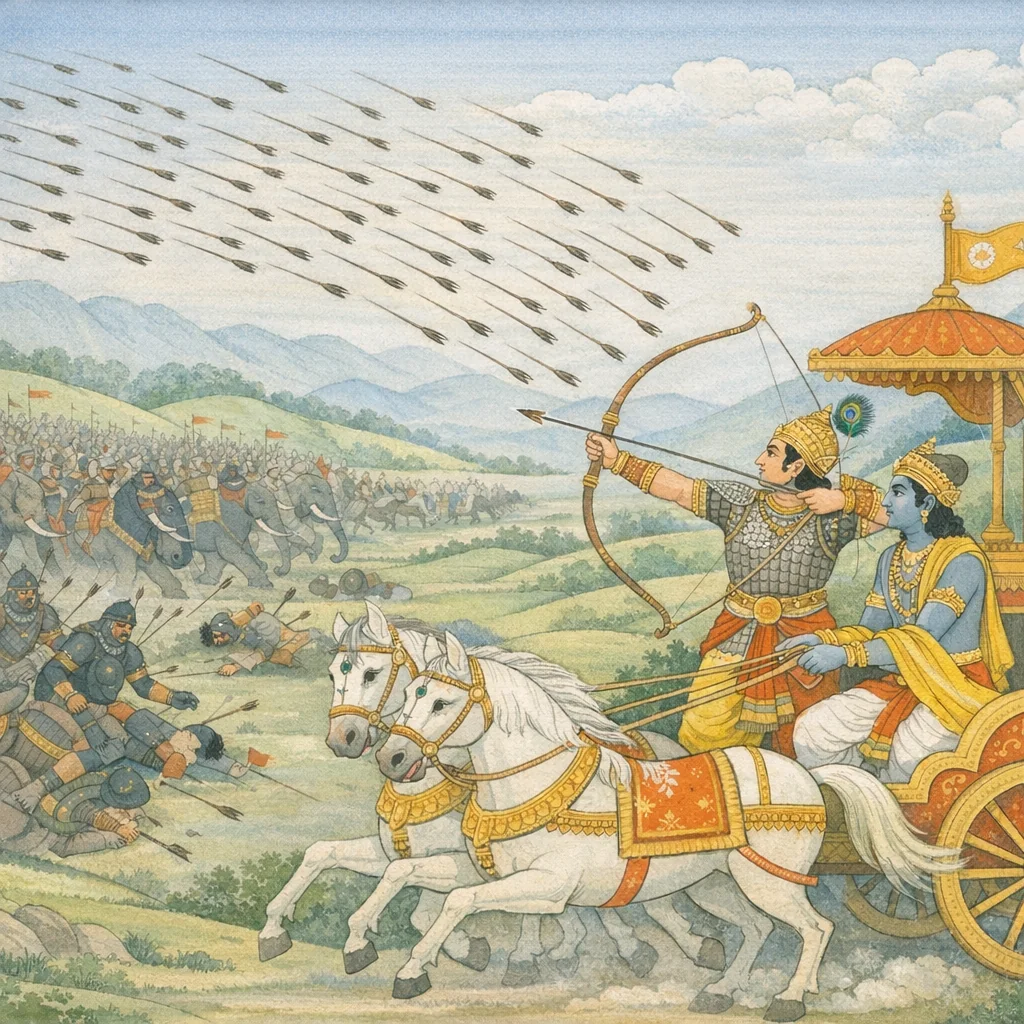
Saṃjaya reports that Arjuna (Dhanañjaya), with unwavering resolve (saṅkalpa) and the Gāṇḍīva, releases volleys likened to thunderbolts, driving sections of the Kaurava force into flight even as Duryodhana watches. The scene catalogs battlefield degradation—chariots losing yokes, axles, wheels, drivers, and archers running out of missiles—alongside human reactions: calling for sons, fathers, allies, and abandoning kin in panic. Some units pause to drink water, re-armor, and regroup, returning to the fight, while others re-enter under Duryodhana’s command with renewed aggression. Dhṛṣṭadyumna advances in anger; Duryodhana responds with concentrated arrow clusters, wounding Dhṛṣṭadyumna and killing his horses and charioteer, forcing Duryodhana to withdraw on horseback after his chariot is compromised. A mass elephant deployment then surrounds the five principal Pāṇḍava chariot-warriors, momentarily restricting mobility. Arjuna breaks the elephant screen with sharp nārācas, felling great elephants, while Bhīma dismounts with gadā to smash elephants at close range, causing widespread disorder. Yudhiṣṭhira and the Mādrī-sons also strike elephant-fighters with specialized arrows. Meanwhile, Aśvatthāmā, Kṛpa, and Kṛtavarmā search for the absent Duryodhana amid heavy losses, and the narrative closes on the Kaurava leadership’s anxiety and redeployment away from the Pāñcāla front toward Śakuni (Saubala).
Chapter Arc: मृदु-सा एक शब्द उठते ही संजय की दृष्टि युद्धभूमि पर टिक जाती है—जहाँ श्रीकृष्ण के सम्मुख अर्जुन, दुर्योधन के दुराग्रह को कुल-विनाश का बीज बताकर धिक्कारता है। → शकुनि शीघ्रता से वाहिनी के पास जाकर बार-बार ललकारता है—‘त्वरित होकर युद्ध करो’; पर क्षत्रिय-रथी उत्तर देते हैं कि रण के मध्य में टिके रहना ही धर्म है। इसी बीच अर्जुन कृष्ण से आग्रह करता है कि रथ को सैन्य-सागर में प्रविष्ट कराएँ—अठारह दिन के महायुद्ध की पराकाष्ठा में अब निर्णायक प्रहार चाहिए। → अर्जुन का बाण-वर्षा-रूप प्रकट होता है—नतपर्वण शरों का महान शब्द गूँजता है; शरौघ कवचों में अटकते नहीं, रथियों और वाहिनी पर बादल-सी धार बनकर टूटते हैं, और कौरव-पक्ष की रथी-सेना का संहार आरम्भ हो जाता है। → अर्जुन दुर्योधन की नीति-चेष्टा को विदुर-वचन की कसौटी पर रखकर ‘कुलक्षय-कर्ता’ ठहराता है और कृष्ण से कहता है कि कौरव-चमू की ओर बढ़ें—वह दुर्योधन और उसकी वाहिनी को शित-शरों से दबा देगा; युद्ध का प्रवाह पाण्डव-पक्ष के पक्ष में झुकता दिखता है। → अर्जुन की प्रतिज्ञा के बाद प्रश्न हवा में लटकता है—क्या यह बाण-वर्षा दुर्योधन तक सीधे पहुँचेगी, या कौरव-पक्ष कोई नया व्यूह/प्रतिरोध खड़ा करेगा?
Shlokas
Verse 1
अत-#--#क्रतज चतुर्विशो$ध्याय: श्रीकृष्णके सम्मुख अर्जुनद्वारा दुर्योधनके दुराग्रहकी निन्दा और रथियोंकी सेनाका संहार संजय उवाच तस्मिन् शब्दे मृदौ जाते पाण्डवैर्निहते बले । अश्लैः सप्तशतै: शिष्टैरुपावर्तत सौबल:,संजय कहते हैं--राजन्! जब पाण्डवयोद्धाओंने अधिकांश सेनाका संहार कर डाला और युद्धका कोलाहल कम हो गया, तब सुबलपुत्र शकुनि शेष बचे हुए सात सौ घुड़सवारोंके साथ कौरव-सेनाके समीप चला गया
Sañjaya said: O King, when the tumult of battle had subsided and the Pāṇḍavas had cut down the greater part of the army, Śakuni, the son of Subala, turned back and approached the Kaurava host with the seven hundred horsemen who still remained—an image of a collapsing cause clinging to its last, disciplined remnant amid the moral wreckage of obstinacy.
Verse 2
स यात्वा वाहिनी तूर्णमब्रवीत् त्वरयन् युधि । युद्धयध्वमिति संहृष्टा: पुनः पुनररिंदमा:
Sañjaya said: Having quickly gone to the army, he urged them on in the midst of battle and repeatedly proclaimed, “Fight!” Thus the foe-subduing warriors, stirred to exhilaration, were again and again incited to engage.
Verse 3
शकुनेस्तद् वच: श्रुत्वा तमूचुर्भरतर्षभ
Sañjaya said: Hearing Śakuni’s words, they addressed him—O bull among the Bharatas—replying to his counsel amid the war’s charged moral air.
Verse 4
असौ तिष्ठति कौरव्यो रणमध्ये महाबल: । यत्रैतत् सुमहच्छत्र॑ पूर्णचन्द्रसमप्रभम्
Sañjaya said: “There stands that mighty Kaurava in the very midst of the battle—where his exceedingly great royal parasol shines with the radiance of the full moon.”
Verse 5
यत्र ते सतनुत्राणा रथास्तिष्ठन्ति दंशिता: । भरतश्रेष्ठ शकुनिकी वह बात सुनकर जन क्षत्रियोंने उसे यह उत्तर दिया--'प्रभो! महाबली कुरुराज रणक्षेत्रके मध्यभागमें वहाँ खड़े हैं, जहाँ यह पूर्ण चन्द्रमाके समान कान्तिमान् विशाल छत्र तना हुआ है तथा जहाँ वे शरीर-रक्षक आवरणों एवं कवचोंसे सुसज्जित रथ खड़े हैं ।। यत्रैष तुमुलः शब्द: पर्जन्यनिनदोपम:
Sañjaya said: “O best of the Bharatas, there—where your well-protected, fully armed chariots stand—those Kshatriyas, having heard Śakuni’s words, replied: ‘Lord, the mighty king of the Kurus is stationed in the middle of the battlefield, beneath this vast parasol radiant as the full moon; and there too stand chariots fitted with protective coverings and armor. There a tumultuous roar is heard, like the thunder of rain-clouds.’”
Verse 6
एवमुक्तस्तु तैयोंथै: शकुनि: सौबलस्तदा,नरेश्वर! तब उन योद्धाओंके ऐसा कहनेपर सुबलपुत्र शकुनि वहीं गया, जहाँ आपका पुत्र दुर्योधन समरांगणमें विचित्र युद्ध करनेवाले वीरोंद्वारा सब ओरसे घिरा हुआ खड़ा था
Sañjaya said: Thus addressed by those warriors, Śakuni, the son of Subala, then went—O king—to the very place where your son Duryodhana stood on the battlefield, surrounded on all sides by heroic fighters skilled in varied and formidable modes of combat.
Verse 7
प्रययौ तत्र यत्रासौ पुत्रस्तव नराधिप । सर्वतः संवृतो वीरै: समरे चित्रयोधिभि:,नरेश्वर! तब उन योद्धाओंके ऐसा कहनेपर सुबलपुत्र शकुनि वहीं गया, जहाँ आपका पुत्र दुर्योधन समरांगणमें विचित्र युद्ध करनेवाले वीरोंद्वारा सब ओरसे घिरा हुआ खड़ा था
Sañjaya said: O king, Śakuni, the son of Subala, then went to the place where your son stood on the battlefield—surrounded on all sides by heroic warriors skilled in varied and striking modes of combat.
Verse 8
ततो दुर्योधन दृष्टवा रथानीके व्यवस्थितम् । स रथांस्तावकान् सर्वान् हर्षयन् शकुनिस्तत:,प्रजानाथ! तदनन्तर दुर्योधनको रथसेनामें खड़ा देख आपके सम्पूर्ण रथियोंका हर्ष बढ़ाता हुआ शकुनि अपनेको कृतार्थ-सा मानकर बड़े हर्षके साथ राजा दुर्योधनसे इस प्रकार बोला--
Then Duryodhana beheld the chariot-division drawn up in battle array. Thereupon Śakuni, gladdening and heartening all your chariot-warriors, deeming himself as one who had accomplished his task, spoke to King Duryodhana with great delight, as follows.
Verse 9
दुर्योधनमिदं वाक््यं हृष्टरूपो विशाम्पते । कृतकार्यमिवात्मानं मन्यमानोअब्रवीन्नपम्,प्रजानाथ! तदनन्तर दुर्योधनको रथसेनामें खड़ा देख आपके सम्पूर्ण रथियोंका हर्ष बढ़ाता हुआ शकुनि अपनेको कृतार्थ-सा मानकर बड़े हर्षके साथ राजा दुर्योधनसे इस प्रकार बोला--
Then Śakuni, his countenance bright with joy, addressed these words to Duryodhana, lord of men. Thinking of himself as one whose work was done, he spoke in overflowing delight.
Verse 10
जहि राजन् रथानीकममश्चा: सर्वे जिता मया | नात्यक्त्वा जीवितं संख्ये शक्यो जेतुं युधिषछ्ठिर:,“राजन! शत्रुकी रथसेनाका नाश कीजिये। समस्त घुड़सवारोंको मैंने जीत लिया है। राजा युधिष्छिर अपने प्राणोंका परित्याग किये बिना जीते नहीं जा सकते
“O King, strike down the enemy’s chariot-division. As for the horsemen, I have already subdued them all. Yudhiṣṭhira cannot be overcome in battle unless one is prepared to stake—and even relinquish—one’s very life.”
Verse 11
हते तस्मिन् रथानीके पाण्डवेनाभिपालिते | गजानेतान् हनिष्याम: पदातींश्वेतरांस्तथा,'पाण्डुपुत्र युधिष्ठिरके द्वारा सुरक्षित इस रथ-सेनाका संहार हो जानेपर हम इन हाथीसवारों, पैदलों और घुड़सवारोंका भी वध कर डालेंगे”
“When that chariot-division—kept under the protection of the Pāṇḍava—has been destroyed, we shall then also slay these elephant-warriors, and likewise the foot-soldiers and the remaining horsemen.”
Verse 12
श्रुत्वा तु वचनं तस्य तावका जयगृद्धिन: । जवेनाभ्यपतन् हृष्टा: पाण्डवानामनीकिनीम्,विजयाभिलाषी शकुनिकी यह बात सुनकर आपके सैनिक अत्यन्त प्रसन्न हो बड़े वेगसे पाण्डव-सेनापर टूट पड़े
Hearing his words, your warriors—hungry for victory—were filled with exhilaration and, with great speed, rushed to assault the Pāṇḍavas’ army.
Verse 13
सर्वे विवृततूणीरा: प्रगृहीतशरासना: । शरासनानि धुन्वाना: सिंहनादान् प्रणेदिरे,सबके तरकसोंके मुँह खुल गये, सबने हाथमें धनुष ले लिये और सभी धनुष हिलाते हुए जोर-जोरसे सिंहनाद करने लगे
Sanjaya said: All of them had their quivers thrown open and their bows gripped firmly in hand. Shaking their bows, they sent forth loud lion-roars.
Verse 14
ततो ज्यातलनिर्घोष: पुनरासीद् विशाम्पते । प्रादुरासीच्छराणां च सुमुक्तानां सुदारुण:,प्रजानाथ! तदनन्तर फिर प्रत्यंचाकी टंकार और अच्छी तरह छोड़े हुए बाणोंकी भयानक सनसनाहट प्रकट होने लगी
Sanjaya said: Then, O lord of the people, the twang of bowstrings arose once more; and there became manifest the dreadful whistling rush of arrows, well released.
Verse 15
तान् समीपगतान् दृष्टवा जवेनोद्यतकार्मुकान् । उवाच देवकीपुत्रं कुन्तीपुत्रो धनंजय:,उन सबको बड़े वेगसे धनुष उठाये पास आया देखकर कुन्तीकुमार अर्जुनने देवकीनन्दन भगवान् श्रीकृष्णसे इस प्रकार कहा--
Seeing those warriors draw near, their bows swiftly raised and ready, Kuntī’s son Dhanañjaya (Arjuna) addressed Devakī’s son, Kṛṣṇa.
Verse 16
चोदयाश्वानसम्भ्रान्त: प्रविशैतद् बलार्णवम् । अन्तमद्य गमिष्यामि शत्रूणां निशितै: शरै:,“जनार्दन! आप स्वस्थचित्त होकर इन घोड़ोंको हाँकिये और इस सैन्यसागरमें प्रवेश कीजिये। आज मैं तीखे बाणोंसे शत्रुओंका अन्त कर डालूँगा। परस्पर भिड़कर इस महान् संग्रामके आरम्भ हुए आज अठारह दिन हो गये
Sanjaya said: “O Janārdana, with a steady mind drive these horses and enter this ocean of armies. Today, with sharp arrows, I shall bring the enemies to their end.” The great war, begun by the armies’ mutual collision, had now reached its eighteenth day.
Verse 17
अष्टादश दिनान्यद्य युद्धस्यास्य जनार्दन | वर्तमानस्य महतः समासाद्य परस्परम्,“जनार्दन! आप स्वस्थचित्त होकर इन घोड़ोंको हाँकिये और इस सैन्यसागरमें प्रवेश कीजिये। आज मैं तीखे बाणोंसे शत्रुओंका अन्त कर डालूँगा। परस्पर भिड़कर इस महान् संग्रामके आरम्भ हुए आज अठारह दिन हो गये
Sanjaya said: “O Janārdana, today eighteen days have passed since this great war began—since the armies met one another in close engagement, and the vast conflict has continued without pause.”
Verse 18
अनन्तकल्पा ध्वजिनी भूत्वा होषां महात्मनाम् | क्षयमद्य गता युद्धे पश्य दैव॑ यथाविधम्,“इन महामनस्वी कौरवोंके पास अपार सेना थी; परंतु युद्धमें इस समयतक प्रायः नष्ट हो गयी। देखिये, प्रारब्धका कैसा खेल है?
Sañjaya said: “Though the high-souled Kauravas once possessed an army vast beyond measure, today in this war it has been brought to ruin. Behold how destiny—working in its appointed way—plays out.”
Verse 19
समुद्रकल्पं च बल धार्तराष्ट्रस्य माधव । अस्मानासाद्य संजातं गोष्पदोपममच्युत,“माधव! अच्युत! दुर्योधनकी समुद्र-जैसी अनन्त सेना हमलोगोंसे टक्कर लेकर आज गायकी खुरीके समान हो गयी है
Sañjaya said: “O Mādhava, O Acyuta! The Dhārtarāṣṭra host—once vast like the ocean—has, upon coming into collision with us, been reduced to something as small as a cow’s hoofprint.”
Verse 20
हते भीष्मे तु संदध्याच्छिवं स्थादिह माधव । न च तत् कृतवान् मूढो धार्तराष्ट्र: सुबालिश:,“माधव! यदि भीष्मके मारे जानेपर दुर्योधन सन्धि कर लेता तो यहाँ सबका कल्याण होता; परंतु उस अज्ञानी मूर्खने वैसा नहीं किया
Sañjaya said: “O Mādhava, had Dhṛtarāṣṭra’s son made peace after Bhīṣma was slain, it would have brought welfare here. But that deluded, utterly foolish man did not do so.”
Verse 21
उक्त भीष्मेण यद् वाक््यं हितं तथ्यं च माधव । तच्चापि नासौ कृतवान् वीतबुद्धिः सुयोधन:
Sañjaya said: “O Mādhava, the counsel spoken by Bhīṣma—beneficial and true—was not acted upon by that Suyodhana, whose judgment had been swept away.”
Verse 22
“मधुकुलभूषण! भीष्मजीने जो सच्ची और हितकर बात बतायी थी, उसे भी उस बुद्धिहीन दुर्योधनने नहीं माना ।। तस्मिंस्तु तुमुले भीष्मे प्रच्युते धरणीतले । न जाने कारणं कि तु येन युद्धमवर्तत,“तदनन्तर घमासान युद्ध आरम्भ हुआ और उसमें भीष्मजी पृथ्वीपर मार गिराये गये। फिर भी न जाने क्या कारण था, जिससे युद्ध चालू ही रह गया
Sañjaya said: “O ornament of the Madhu lineage! Even the truthful and beneficial counsel spoken by Bhīṣma was not accepted by that witless Duryodhana. And when, amid that terrible tumult, Bhīṣma had fallen upon the earth, I still cannot discern what cause it was by which the war nevertheless continued.”
Verse 23
इस प्रकार श्रीमह्याभारत शल्यपर्वमें संकुलयुद्धविषयक तेईसवाँ अध्याय पूरा हुआ,मूढांस्तु सर्वथा मन्ये धार्तराष्ट्रानू सुबालिशान् । पतिते शान्तनो: पुत्रे येडकार्षु: संयुगं पुन: “मैं धृतराष्ट्रके सभी पुत्रोंको सर्वथा मूर्ख और नादान समझता हूँ, जिन्होंने शान्तनुनन्दन भीष्मजीके धराशायी होनेपर भी पुनः युद्ध जारी रखा
Sanjaya said: “I deem the sons of Dhṛtarāṣṭra utterly deluded and foolish, for even after Śāntanu’s son (Bhīṣma) had fallen, they chose to resume the battle.” The statement bears a moral censure: to persist in violence after the fall of a revered elder and guardian of dharma is blindness to counsel, consequence, and righteous restraint.
Verse 24
अनन्तरं च निहते द्रोणे ब्रह्म॒विदां वरे राधेये च विकर्णे च नैवाशाम्यत वैशसम्,“तत्पश्चात् वेदवेत्ताओंमें श्रेष्ठ द्रोणाचार्य, राधापुत्र कर्ण और विकर्ण मारे गये तो भी यह मार-काट बंद नहीं हुई इति श्रीमहाभारते शल्यपर्वणि संकुलयुद्धे चतुर्विशो5ध्याय:
Sañjaya said: Even after Droṇa—foremost among knowers of sacred lore—had been slain, and after Rādheya (Karna) and Vikarṇa too had fallen, the slaughter did not subside. It shows how, once dharma collapses in war, killing can persist beyond any single hero’s death.
Verse 25
अल्पावशिटष्टे सैन्येडस्मिन् सूतपुत्रे च पातिते । सपुत्रे वै नरव्याप्रे नैवाशाम्यत वैशसम्,'पुत्रसहित नरश्रेष्ठ सूतपुत्रके मार गिराये जानेपर जब कौरव-सेना थोड़ी-सी ही बच रही थी तो भी यह युद्धकी आग नहीं बुझी
Sanjaya said: Even when only a small remnant of this army remained, and even after the charioteer’s son had been struck down—along with the tiger-like hero and his son—the slaughter did not subside. The war’s violence, once unleashed, refused to be quenched, showing how vengeance and grief can keep destruction burning even when the cause seems already decided.
Verse 26
श्रुतायुषि हते वीरे जलसन्धे च पौरवे । श्रुतायुधे च नृपती नैवाशाम्यत वैशसम्,'श्रुतायु, वीर जलसन्ध, पौरव तथा राजा श्रुतायुधके मारे जानेपर भी यह संहार बंद नहीं हुआ
Sañjaya said: Even after the valiant Śrutāyus was slain, and after Jalasaṃdha of the Paurava line, and the king Śrutāyudha too had fallen, the carnage did not subside. The momentum of violence, once unleashed on the battlefield, continued to consume lives beyond any single victory, revealing how war’s fury can outlast the fall of renowned warriors.
Verse 27
भूरिश्रवसि शल्ये च शाल्वे चैव जनार्दन । आव्न्त्येषु च वीरेषु नैवाशाम्यत वैशसम्
Sañjaya said: “O Janārdana, the carnage did not subside—whether among Bhūriśravas, among Śalya, among Śālva, or among the valiant warriors of Avanti. The slaughter continued unabated, as if no measure of suffering could quench the fury of war.”
Verse 28
“'जनार्दन! भूरिश्रवा, शल्य, शाल्व तथा अवन्ति देशके वीर मारे गये तो भी यह युद्धकी ज्वाला शान्त न हो सकी ।। जयद्रथे च निहते राक्षसे चाप्यलायुधे । बाह्विके सोमदत्ते च नैवाशाम्यत वैशसम्,“जयद्रथ, बाह्विक, सोमदत्त तथा राक्षस अलायुध--ये सभी परलोकवासी हो गये तो भी यह युद्धकी प्यास न बुझ सकी
Sanjaya said: “O Janardana! Though heroes such as Bhurishravas, Shalya, Shalva, and the warrior of the Avanti land have been slain, the blaze of this war has not been quenched. Even after Jayadratha was killed, and the rakshasa Alayudha too, and after Bahvika and Somadatta fell, the violence has not subsided.”
Verse 29
भगदत्ते हते शूरे काम्बोजे च सुदारुणे | दुःशासने च निहते नैवाशाम्यत वैशसम्,“भगदत्त, शूरवीर काम्बोजराज सुदक्षिण तथा अत्यन्त दारुण दुःशासनके मारे जानेपर भी कौरवोंकी युद्ध-पिपासा शान्त नहीं हुई
Sanjaya said: “Even after the valiant Bhagadatta was slain, and the Kamboja king—Sudakshina, fierce in battle—was also killed, and even after Duhshasana fell, the Kauravas’ frenzy for war did not subside.”
Verse 30
दृष्टवा विनिहतान् शूरान् पृथड्माण्डलिकान् नृपान् | बलिनश्च रणे कृष्ण नैवाशाम्यत वैशसम्,“श्रीकृष्ण! विभिन्न मण्डलोंके स्वामी शूरवीर बलवान् नरेशोंको रणभूमिमें मारा गया देखकर भी यह युद्धकी आग बुझ न सकी
Sanjaya said: “O Krishna, even after seeing the heroic and powerful kings—lords of many separate realms—slain on the battlefield, this dreadful violence did not subside; the blaze of war would not be quenched.”
Verse 31
अक्षौहिणीपतीन् दृष्टवा भीमसेननिपातितान् | मोहाद् वा यदि वा लोभान्नैवाशाम्यत वैशसम्,'भीमसेनके द्वारा धराशायी किये गये अक्षौहिणी-पतियोंको देखकर भी मोहवश अथवा लोभके कारण युद्ध बंद न हो सका
Sanjaya said: “Even after seeing the commanders of entire armies felled by Bhimasena, the slaughter did not subside—whether from delusion or from greed.”
Verse 32
को नु राजकुले जात: कौरवेयो विशेषत: । निरर्थक॑ महद् वैरं कुर्यादन्य: सुयोधनात्
Sanjaya said: “Who, born into a royal lineage—especially a Kaurava—would ever create a great and purposeless enmity, as Suyodhana (Duryodhana) has done?”
Verse 33
'राजाके कुलमें उत्पन्न होकर विशेषत: कुरुकुलकी संतान होकर दुर्योधनके सिवा दूसरा कौन ऐसा है, जो व्यर्थ ही (अपने बन्धुओंके साथ) महान् वैर बाँधे ।। गुणतो< भ्यधिकान ज्ञात्वा बलत: शौर्यतो5पि वा । अमूढ: को नु युद्धयेत जानन् प्राज्ञो हिताहितम्,“दूसरोंको गुणसे, बलसे अथवा शौर्यसे भी अपनी अपेक्षा महान् जानकर भी अपने हित और अहितको समझनेवाला मूढ़ताशून्य कौन ऐसा बुद्धिमान् पुरुष होगा? जो उनके साथ युद्ध करेगा
Sañjaya said: “Born in a royal line—and more particularly as a descendant of the Kuru house—who, other than Duryodhana, would ever forge a great enmity in sheer futility, even against his own kinsmen? Knowing the others to be superior in virtue, in strength, or even in valor, what clear-minded and wise man—one who understands what is beneficial and what is harmful—would choose to wage war against them?”
Verse 34
यन्न तस्य मनो हा[सीत् त्वयोक्तस्य हितं वच: । प्रशमे पाण्डवै: सार्थ सोडन्यस्य शृुणुयात् कथम्,“आपके द्वारा हितकारक वचन कहे जानेपर भी जिसका पाण्डवोंके साथ संधि करनेका मन नहीं हुआ, वह दूसरेकी बात कैसे सुन सकता है?
Sañjaya said: “Even after you spoke words meant for his welfare, his mind did not turn toward reconciliation with the Pāṇḍavas. How, then, could he be expected to listen to anyone else?”
Verse 35
येन शान्तनवो वीरो द्रोणो विदुर एव च । प्रत्याख्याता: शमस्यार्थे कि नु तस्याद्य भेषजम्,“जिसने संधिके विषयमें वीर शान्तनुनन्दन भीष्म, द्रोणाचार्य और विदुरजीकी भी बात माननेसे इनकार कर दी, उसके लिये अब कौन-सी दवा है?
Sañjaya said: “He who, when peace was sought, rejected even the counsel of the heroic son of Śāntanu (Bhīṣma), Droṇa, and Vidura—what remedy can there be for him now?”
Verse 36
मौख्याद् येन पिता वृद्ध: प्रत्याख्यातो जनार्दन । तथा माता हित॑ वाक््यं भाषमाणा हितैषिणी
Sañjaya said: “O Janārdana, through sheer folly he repudiated his aged father; and likewise he rejected the wholesome counsel spoken by his mother, who wished only his good.”
Verse 37
प्रत्याख्याता ह[सत्कृत्य स कस्मै रोचयेद् वच: । 'जनार्दन! जिसने मूर्खतावश अपने वृद्ध पिताकी भी बात नहीं मानी और हितकी बात बतानेवाली अपनी हितैषिणी माताका भी अपमान करके उसकी आज्ञा माननेसे इनकार कर दिया, उसे दूसरे किसीकी बात क्यों रुचेगी? ।। कुलान्तकरणो व्यक्त जात एष जनार्दन
Sañjaya said: “O Janārdana, if a man has already rejected counsel even when it was offered with due respect, to whom will he ever find anyone’s words agreeable? He who, out of folly, would not heed even the speech of his aged father, and who insulted his well-wishing mother that spoke for his good and refused to obey her command—why would he relish the advice of anyone else? Clearly, O Janārdana, this man has been born as a manifest destroyer of his own lineage.”
Verse 38
नैष दास्यति नो राज्यमिति मे मतिरच्युत,“अच्युत! मैं समझता हूँ, यह अब भी हमें अपना राज्य नहीं देगा। तात! महात्मा विदुरने मुझसे अनेक बार कहा है कि “मानद! दुर्योधन जीते-जी राज्यका भाग नहीं लौटायेगा
Sañjaya said: “O Acyuta, it is my settled conviction that he will not grant us our kingdom. Indeed, the noble Vidura has repeatedly told me that so long as Duryodhana lives, he will never restore even a share of the realm.”
Verse 39
उक्तो5हं बहुशस्तात विदुरेण महात्मना । न जीवन दास्यते भागं धार्तराष्ट्रस्तु मानद,“अच्युत! मैं समझता हूँ, यह अब भी हमें अपना राज्य नहीं देगा। तात! महात्मा विदुरने मुझसे अनेक बार कहा है कि “मानद! दुर्योधन जीते-जी राज्यका भाग नहीं लौटायेगा
Sañjaya said: “Dear sir, the great-souled Vidura has told me many times: ‘O bestower of honor, Dhritarashtra’s son will not, while he yet lives, give any share (of the kingdom).’”
Verse 40
यावत् प्राणा धरिष्यन्ति धार्तराष्ट्रस्य दुर्मते: । तावद् युष्मास्वपापेषु प्रचरिष्यति पापकम्,“दुर्बुद्धि दुर्योधनके प्राण जबतक शरीरमें स्थित रहेंगे, तबतक तुम निष्पाप बन्धुओंपर भी वह पापपूर्ण बर्ताव ही करता रहेगा
Sañjaya said: “So long as life-breath remains in that evil-minded son of Dhṛtarāṣṭra, he will continue to act sinfully—even toward you blameless brothers.”
Verse 41
न च युक्तोडन्यथा जेतुमृते युद्धेन माधव । इत्यब्रवीत् सदा मां हि विदुर: सत्यदर्शन:,“माधव! युद्धके सिवा और किसी उपायसे दुर्योधनको जीतना सम्भव नहीं है।' यह बात सत्यदर्शी विदुरजी सदासे ही मुझे कहते आ रहे हैं
Sañjaya said: “O Mādhava, it is not possible to conquer him by any other means—except through war.” Thus, Vidura, the seer of truth, has always been telling me this.
Verse 42
तत् सर्वमद्य जानामि व्यवसायं दुरात्मन: । यदुक्त वचन तेन विदुरेण महात्मना
Sañjaya said: “Now I understand fully the resolve and intent of that wicked-minded man. It has turned out exactly as the great-souled Vidura had spoken.”
Verse 43
“महात्मा विदुरने जो बात कही है, उसके अनुसार मैं उस दुरात्माके सम्पूर्ण निश्चयको आज जानता हूँ ।। यो हि श्रुत्वा वच: पथ्यं जामदग्न्याद् यथातथम् । अवामन्यत दुर्बुद्धिर्धुव॑ं नाशमुखे स्थित:,“जिस दुर्बुद्धिने यमदग्निनन्दन परशुरामजीके मुखसे यथार्थ एवं हितकारक वचन सुनकर भी उसकी अवहेलना कर दी, वह निश्चय ही विनाशके मुखमें स्थित है
“According to what the great-souled Vidura declared, today I know the whole resolve of that wicked man. For whoever, after hearing wholesome and beneficial counsel—truthfully spoken by Jāmadagnya (Paraśurāma)—still scorns it through perverse understanding, is surely standing at the very mouth of destruction.”
Verse 44
उक्त हि बहुश: सिद्धैर्जातमात्रे सुयोधने । एन॑ प्राप्य दुरात्मान॑ क्षयं क्षत्रं गमिष्यति,“दुर्योधनके जन्म लेते ही सिद्ध पुरुषोंने बारंबार कहा था कि “इस दुरात्माको पाकर क्षत्रियजातिका विनाश हो जायगा”
“Indeed, the perfected sages declared again and again at the very moment Suyodhana was born: ‘With the coming of this wicked man, the Kṣatriya order will go to destruction.’”
Verse 45
तदिदं वचन तेषां निरुक्तं वै जनार्दन । क्षयं याता हि राजानो दुर्योधनकृते भूशम्
“O Janārdana, this is indeed the saying they uttered: for because of Duryodhana the kings have gone to destruction, laid low upon the earth.”
Verse 46
“जनार्दन! उनकी वह बात यथार्थ हो गयी; क्योंकि दुर्योधनके कारण बहुत-से राजा नष्ट हो गये ।। सोउ्द्य सर्वान् रणे योधान् निहनिष्यामि माधव । क्षत्रियेषु हतेष्वाशु शून्ये च शिबिरे कृते
“O Janārdana, their words have proved true, for because of Duryodhana many kings have been destroyed. Therefore today, O Mādhava, I shall slay all the warriors in battle; and when the Kṣatriyas are swiftly cut down and the camp is made empty, the consequence of that wrongdoing will stand revealed.”
Verse 47
वधाय चात्मनो<स्माभि: संयुगं रोचयिष्यति । तदन्तं हि भवेद् वैरमनुमानेन माधव,“माधव! आज मैं रणभूमिमें शत्रुपक्षेके समस्त योद्धाओंको मार गिराऊँगा। इन क्षत्रियोंका शीघ्र ही संहार हो जानेपर जब सारा शिविर सूना हो जायगा, तब वह अपने वधके लिये हमलोगोंके साथ जूझना पसंद करेगा। माधव! मेरे अनुमानसे उसका वध होनेपर ही इस वैरका अन्त होगा
“He will choose to engage us in battle, seeking his own death. For, once the Kṣatriya warriors are swiftly destroyed and the entire camp lies deserted, he will prefer to fight with us for the sake of being slain. Mādhava, by my reckoning, only with his death will this enmity come to an end.”
Verse 48
एवं पश्यामि वार्ष्णेय चिन्तयन् प्रज्ञया स्वया । विदुरस्य च वाक्येन चेष्टया च दुरात्मन:,“वृष्णिनन्दन! मैं अपनी बुद्धिसे, विदुरजीके वाक्यसे और दुरात्मा दुर्योधनकी चेष्टासे भी सोच-विचारकर ऐसा ही होता देखता हूँ
Sañjaya said: “O descendant of the Vṛṣṇis, reflecting with my own discernment—and also in light of Vidura’s counsel and the conduct of that wicked-minded Duryodhana—I see that matters are unfolding exactly in this way.”
Verse 49
तस्माद् याहि चमूं वीर यावद्धन्मि शितै: शरै: । दुर्योधनं महाबाहो वाहिनी चास्य संयुगे,“अतः वीर! महाबाहो! आप कौरव-सेनाकी ओर चलिये, जिससे मैं पैने बाणोंद्वारा युद्धस्थलमें दुर्योधन और उसकी सेनाका संहार करूँ
Sañjaya said: “Therefore, O hero, advance toward the army—so that, while there is still time, I may strike down Duryodhana with keen arrows, and in the clash of battle destroy his host as well.”
Verse 50
क्षेममद्य करिष्यामि धर्मराजस्य माधव । हत्वैतद् दुर्बलं सैन्यं धार्तराष्ट्रस्य पश्यत:,“माधव! आज मैं दुर्योधनके देखते-देखते इस दुर्बल सेनाका नाश करके धर्मराजका कल्याण करूँगा”
Sañjaya said: “O Mādhava, today I shall secure the welfare of Dharmarāja: before Dhṛtarāṣṭra’s son can do anything but watch, I will destroy this weakened army of the Kauravas.”
Verse 51
संजय उवाच अभीषुहस्तो दाशार्हस्तथोक्त: सव्यसाचिना । तद् बलौघममित्राणामभीत: प्राविशद् बलात्,संजय कहते हैं--राजन्! सव्यसाची अर्जुनके ऐसा कहनेपर घोड़ोंकी बागडोर हाथमें लिये दशार्हकुल-नन्दन श्रीकृष्णने निर्भय हो शत्रुओंके उस सैन्य-सागरमें बलपूर्वक प्रवेश किया
Sañjaya said: “O King, when Savyasācī Arjuna had spoken thus, Śrī Kṛṣṇa—the pride of the Dāśārha line—holding the reins in his hand, fearlessly forced his way into that ocean of the enemy’s troops.”
Verse 52
कुन्तखड््गशरैघोरंं शक्तिकण्टकसंकुलम् । गदापरिघपन्थानं रथनागमहाद्रुमम्
Sañjaya said: “It was a dreadful scene—bristling with spears, swords, and showers of arrows; crowded with javelins like thorns; with maces and iron bars forming the very pathways; and with chariots and elephants standing like great trees.”
Verse 53
तत्र गच्छ द्रुतं राज॑स्ततो द्रक्ष्यसि कौरवम् । “राजन! जहाँ यह मेघोंकी गम्भीर गर्जनाके समान भयानक शब्द गूँज रहा है, वहीं शीघ्रतापूर्वक चले जाइये, वहाँ आप कुरुराजका दर्शन कर सकेंगे”,हयपत्तिलताकीर्ण गाहमानो महायशा: । व्यचरत्तत्र गोविन्दो रथेनातिपताकिना
Sañjaya said: “O King, go there quickly; there you will behold the Kuru ruler. In that very place where a dreadful roar—deep like thunderclouds—resounds, the illustrious Govinda moved about, pressing into the mass of horses, foot-soldiers, and chariots, riding in his chariot marked by a lofty banner.”
Verse 54
वह सेना एक वनके समान थी। वह वन कुन्त, खड्ग और बाणोंसे अत्यन्त भयंकर प्रतीत होता था, शक्तिरूपी काँटोंसे भरा हुआ था, गदा और परिघ उसमें जानेके मार्ग थे, रथ और हाथी उसमें रहनेवाले बड़े-बड़े वृक्ष थे, घोड़े और पैदलरूपी लताओंसे वह व्याप्त हो रहा था, महायशस्वी भगवान् श्रीकृष्ण ऊँची पताकावाले रथके द्वारा उस सैन्यवनमें प्रवेश करके सब ओर विचरने लगे ।। ते हया: पाण्डुरा राजन् वहन्तो<र्जुनमाहवे । दिक्षु सर्वास्वदृश्यन्त दाशाहेण प्रचोदिता:,राजन! श्रीकृष्णके द्वारा हाँके गये वे सफेद घोड़े युद्धस्थलमें अर्जुनको ढोते हुए सम्पूर्ण दिशाओंमें दिखायी पड़ते थे
Sañjaya said: O King, that host was like a forest—dreadful with spears, swords, and arrows; bristling with śakti-weapons as thorns; with maces and iron clubs for its paths; with chariots and elephants as its great trees; and with horses and footmen spreading through it like creeping vines. The illustrious Lord Śrī Kṛṣṇa, on a chariot crowned with a lofty banner, entered that forest of war and ranged about on every side. And the pale-white horses, driven on by Dāśārha (Śrī Kṛṣṇa), were seen in every direction on the battlefield as they bore Arjuna into the fight.
Verse 55
ततः प्रायाद् रथेनाजी सव्यसाची परंतप: । किरन् शरशतांस्तीक्ष्णान् वारिधारा घनो यथा
Sañjaya said: Then the ambidextrous Arjuna, scorcher of foes, advanced in his chariot into the battle, scattering hundreds of keen arrows—like a rain-cloud pouring down continuous sheets of water.
Verse 56
इषुभिश्छाद्यमानानां समरे सव्यसाचिना
Sañjaya said: “On the battlefield, they were being covered over—overwhelmed—by showers of arrows shot by the ambidextrous archer (Arjuna).”
Verse 57
इन्द्राशनिसमस्पर्शा गाण्डीवप्रेषिता: शरा:
Sañjaya said: The arrows released from the Gāṇḍīva—whose touch was like Indra’s thunderbolt—struck with irresistible force.
Verse 58
नरान् नागान् समाहत्य हयांश्वापि विशाम्पते । अपतन्त रणे बाणा: पतड़ा इव घोषिण:,प्रजानाथ! इन्द्रके वज़्की भाँति कठोर स्पर्शवाले बाण गाण्डीवसे प्रेरित हो मनुष्यों, घोड़ों और हाथियोंका भी संहार करके शब्द करनेवाले टिड्डीदलोंके समान रणभूमिमें गिर पड़ते थे
Sañjaya said: “O lord of the people, having struck down men and great elephants—and horses as well—the arrows fell upon the battlefield, loud and whirring like swarms of locusts. Driven from the Gāṇḍīva, they descended with a hard, thunderbolt-like force, revealing the relentless momentum of war, where skill and weaponry bring swift destruction.”
Verse 59
आसीत् सर्वमवच्छन्नं गाण्डीवप्रेषितै: शरैः । न प्राज्ञायन्त समरे दिशो वा प्रदिशोडपि वा,गाण्डीव धनुषसे छूटे हुए बाणोंद्वारा उस रणभूमिकी सारी वस्तुएँ आच्छादित हो गयी थीं। दिशाओं अथवा विदिशाओंका भी ज्ञान नहीं हो पाता था
Sañjaya said: “The entire battlefield was veiled by the arrows discharged from the Gāṇḍīva. In that clash, one could not even discern the directions or the intermediate quarters—such was the overwhelming storm of missiles that blotted out all bearings and order in war.”
Verse 60
सर्वमासीज्जगत् पूर्ण पार्थनामाड्कितै: शरै: । रुक्मपुड्खैस्तैलधौतै: कर्मारपरिमार्जिति:,अर्जुनके नामसे अंकित, तेलके धोये और कारीगरके साफ किये सुवर्णमय पंखवाले बाणोंद्वारा वहाँका सारा जगत् व्याप्त हो रथा था
Sañjaya said: “The whole field there seemed filled with arrows bearing Pārtha’s name—arrows with golden fletching, washed clean with oil and polished smooth by the smith—so thickly did Arjuna’s shafts spread through the battle.”
Verse 61
ते दहयमाना: पार्थेन पावकेनेव कुञ्जरा: । पार्थ न प्रजहुर्घोरा वध्यमाना: शितै: शरै:,दावानलके आगसे चलनेवाले हाथियोंके समान पार्थके पैने बाणोंकी मार खाकर दग्ध होते हुए वे घोर कौरवयोद्धा अर्जुनको छोड़कर हटते नहीं थे
Sañjaya said: “Though scorched by Pārtha’s shafts—like elephants caught in a forest-fire—those fierce Kaurava warriors, even while being struck down by sharp arrows, did not abandon Arjuna.”
Verse 62
शरचापधर: पार्थ: प्रज्वलन्निव भास्कर: । ददाह समरे योधान् कक्षमग्निरिव ज्वलन्,जैसे जलती हुई आग घास-फ़ूसके ढेरको जला देती है, उसी प्रकार सूर्यके समान प्रकाशित होनेवाले धनुष-बाणधारी अर्जुनने समरांगणमें आपके योद्धाओंको दग्ध कर दिया
Sañjaya said: “Arjuna, son of Pṛthā, bearing bow and arrows and blazing like the sun, scorched your warriors on the battlefield—just as a raging fire consumes a dry thicket.”
Verse 63
यथा वनान्ते वनपैर्विसृष्ट: कक्ष दहेत् कृष्णगति: सुघोष: । भूरिद्रुमं शुष्कलतावितानं भृशं समृद्धो ज्वलन: प्रतापी,जैसे वनचरोंद्वारा वनके भीतर लगायी हुई आग धीरे-धीरे बढ़कर प्रज्वलित एवं महान् तापसे युक्त हो घास-फ़ूसके ढेरको, बहुसंख्यक वृक्षोंको और सूखी हुई लतावल्लरियोंको भी जलाकर भस्म कर देती है, उसी प्रकार नाराचसमूहोंद्वारा ताप देनेवाले, बाणरूपी ज्वालाओंसे युक्त, वेगवान्, प्रचण्ड तेजस्वी और अमर्षमें भरे हुए अर्जुनने समरांगणमें आपके पुत्रकी सारी रथसेनाको शीघ्रतापूर्वक भस्म कर डाला
Sañjaya said: “Just as, deep within a forest, a fire kindled by forest-dwellers—moving with dark, irresistible speed and roaring loudly—swells into a fierce, blazing conflagration and burns to ashes thickets, masses of trees, and canopies of dried creepers, so too did Arjuna—his arrows like tongues of flame, swift, terrible in radiance, and driven by unyielding wrath—quickly consume in battle the entire chariot-host of your son.”
Verse 64
एवं स नाराचगणप्रतापी शरार्चिरुच्चावचतिग्मतेजा: । ददाह सर्वा तव पुत्रसेना- ममृष्यमाणस्तरसा तरस्वी,जैसे वनचरोंद्वारा वनके भीतर लगायी हुई आग धीरे-धीरे बढ़कर प्रज्वलित एवं महान् तापसे युक्त हो घास-फ़ूसके ढेरको, बहुसंख्यक वृक्षोंको और सूखी हुई लतावल्लरियोंको भी जलाकर भस्म कर देती है, उसी प्रकार नाराचसमूहोंद्वारा ताप देनेवाले, बाणरूपी ज्वालाओंसे युक्त, वेगवान्, प्रचण्ड तेजस्वी और अमर्षमें भरे हुए अर्जुनने समरांगणमें आपके पुत्रकी सारी रथसेनाको शीघ्रतापूर्वक भस्म कर डाला
Sañjaya said: Thus that mighty warrior, fierce with the power of volleys of nārāca-arrows—his energy sharp and blazing with the flame-like radiance of shafts—burned up all the army of your sons. Unable to endure (the affront and the pressure of battle), and driven by swift force, the powerful Arjuna rapidly consumed their chariot-forces on the battlefield, like a forest-fire kindled within the woods that spreads and, with great heat, reduces grass, trees, and dried creepers to ash.
Verse 65
तस्येषव: प्राणहरा: सुमुक्ता नासज्जन् वै वर्मसु रुक्मपुड्खा: । न चद्ठितीयं प्रमुमोच बाणं नरे हये वा परमद्दिपे वा,उनके अच्छी तरह छोड़े हुए सुवर्णमय पंखवाले प्राणान्तकारी बाण कवचोंपर नहीं अटवकते थे। उन्हें छेदकर भीतर घुस जाते थे। वे मनुष्य, घोड़े अथवा विशालकाय हाथीपर भी दूसरा बाण नहीं छोड़ते थे (एक ही बाणसे उसका काम तमाम कर देते थे)
Sañjaya said: His life-taking arrows, well released and fitted with golden fletching, did not lodge in the armours; they pierced through and entered within. And against a man, a horse, or even a mighty elephant, he did not loose a second shaft—one arrow was enough to finish the deed.
Verse 66
अनेकरूपाकृतिभिहिं बाणै- महारथानीकमनुप्रविश्य । स एवैकस्तव पुत्रस्य सेनां जघान दैत्यानिव वज्रपाणि:,जैसे वज्रधारी इन्द्र दैत्योंका संहार कर डालते हैं, उसी प्रकार एकमात्र अर्जुनने ही रथियोंकी विशाल सेनामें प्रवेश करके अनेक रूप-रंगवाले बाणोंद्वारा आपके पुत्रकी सेनाका विनाश कर दिया
Sañjaya said: Entering the great host of mighty chariot-warriors and striking with arrows of many forms and appearances, Arjuna alone destroyed your son’s army—just as Indra, wielder of the thunderbolt, slays the Daityas.
Verse 236
अपृच्छत् क्षत्रियांस्तत्र क्व नु राजा महाबल: । वह तुरंत कौरव-सेनामें पहुँचकर सबको युद्धके लिये शीघ्रता करनेकी प्रेरणा देता हुआ बोला--“शत्रुओंका दमन करनेवाले वीरो! तुम हर्ष और उत्साहके साथ युद्ध करो।” ऐसा कहकर उसने वहाँ बारंबार क्षत्रियोंसे पूछा--“महाबली राजा दुर्योधन कहाँ है?”
Sañjaya said: There he repeatedly questioned the assembled warriors: “Where indeed is the mighty king?” Having quickly reached the Kaurava host, he urged all to hasten to battle, declaring, “Heroes who subdue the foe, fight with joy and ardor!” And after saying this, he again and again asked the kṣatriyas there: “Where is King Duryodhana, so great in strength?”
Verse 376
तथास्य दृश्यते चेष्टा नीतिश्वैव विशाम्पते । 'जनार्दन! निश्चय ही यह अपने कुलका विनाश करनेवाला पैदा हुआ है। प्रजानाथ! इसकी नीति और चेष्टा ऐसी ही दिखायी देती है
Sañjaya said: “So too, O lord of the people, his conduct and his policy are seen to be of that very kind. ‘Janārdana, it is certain—this one has been born as a destroyer of his own lineage. O protector of subjects, his strategy and his actions appear exactly so.’”
Verse 556
प्रादुरासीन्महान् शब्द: शराणां नतपर्वणाम् | फिर तो जैसे बादल पानीकी धारा बरसाता है, उसी प्रकार शत्रुओंको संताप देनेवाले अर्जुन युद्धस्थलमें सैकड़ों पैने बाणोंकी वर्षा करते हुए रथके द्वारा आगे बढ़े। उस समय झुकी हुई गाँठवाले बाणोंका महान् शब्द प्रकट होने लगा
Then a great sound arose from the arrows with bent joints. Like a cloud pouring down sheets of rain, Arjuna—the tormentor of foes—advanced in his chariot, showering the battlefield with hundreds of keen shafts.
Verse 566
असज्जन्तस्तनुत्रेषु शरौघा: प्रापतन् भुवि । सव्यसाची अर्जुनद्वारा समरभूमिमें बाणोंसे आच्छादित होनेवाले सैनिकोंके कवचोंपर उनके बाण अटकते नहीं थे। वे चोट करके पृथ्वीपर गिर जाते थे
Sañjaya said: The volleys of arrows did not lodge in the warriors’ armour; after striking, they fell upon the earth. Thus, on the battlefield covered by Arjuna’s shafts, the missiles would not stick to the soldiers’ protective gear, but dropped down after impact.
Frequently Asked Questions
The chapter frames a leadership dilemma: whether to preserve authority through tactical withdrawal after logistical breakdown (loss of chariot support) or to risk symbolic persistence that may amplify troop panic and systemic collapse.
Resolve (saṅkalpa) becomes effective only when paired with functional support systems and disciplined action; conversely, fear spreads when coordination fails, showing how inner states and external structures mutually condition outcomes.
No explicit phalaśruti is stated in this passage; its meta-significance lies in illustrating how the epic links ethical causality and practical competence—morale, logistics, and leadership—within the broader trajectory toward war termination.