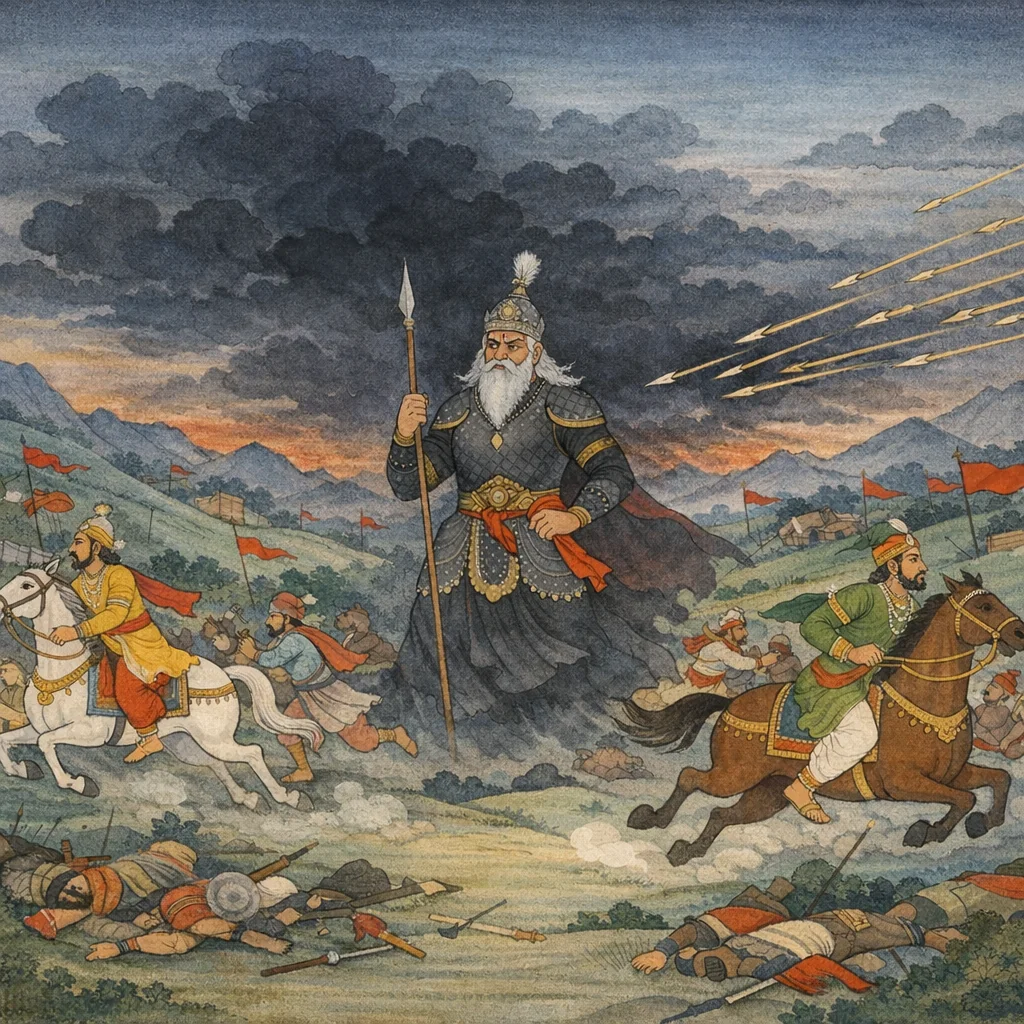
Adhyaya 63
Vāsudeva-Māhātmya: Duryodhana’s Inquiry and Bhīṣma’s Theological Account of Keśava
Upa-parva: Vāsudeva-Māhātmya (Praise of Vāsudeva) — Bhīṣma’s discourse to Duryodhana
The chapter opens with Duryodhana questioning Bhīṣma about Vāsudeva’s celebrated status, requesting clarification of his origin (āgama) and foundation (pratiṣṭhā). Bhīṣma answers by presenting Vāsudeva/Govinda as unsurpassed (beyond Puṇḍarīkākṣa none is seen), citing the tradition associated with Mārkaṇḍeya. The discourse then outlines a cosmogonic sequence: the supreme being arranges the elements (waters, wind, fire/tejas), creates earth and rests upon the waters in yogic absorption, and emits sacrificial-cosmological constituents (fire, wind), as well as Sarasvatī and the Vedas from mind. He is described as origin of worlds, gods, sages, and also of mortality as a cosmic condition. The chapter assigns him attributes of dharma, boons, and self-luminosity, and credits him with ordering time (past/present/future), directions, space, and rules. It narrates the slaying of the asura Madhu, grounding epithets such as Madhusūdana, and associates him with avatāra motifs (Varāha, Siṃha, Trivikrama). A sociological cosmogony follows with the emergence of the four varṇas. The closing verses function as practical instruction and phalaśruti: service to Keśava, recitation, and taking refuge in fear bring welfare; those who surrender do not fall into confusion, and Yudhiṣṭhira is cited as having embraced Krishna as Jagadīśvara and lord of yogas.
Chapter Arc: धृतराष्ट्र, अपने पुत्रों के भय और आशा के बीच झूलते हुए, संजय से पूछते हैं—उस भयंकर संग्राम में पितामह भीष्म ने पाण्डवों के विरुद्ध क्या किया। → संजय बताता है कि दिन का पूर्वाह्न बीतते-बीतते सूर्य पश्चिमाभिमुख होने लगा, पर रणभूमि की ज्वाला शांत न हुई। चारों ओर ‘ठहरो—मैं ठहरा हूँ’, ‘बींध डालो’, ‘लौटो’ जैसे युद्ध-घोष गूँजते हैं; रथों के यंत्र कटते हैं, ध्वज गिरते हैं, हाथी-बाणों से तपते हैं, और धनंजय के बाण-प्रहार से शत्रु-सेना की पंक्तियाँ टूटती-बिखरती हैं। → भीष्म, काल के समान मुख बाए खड़े दिखाई देते हैं; उन्हें देखकर युधिष्ठिर की ओर के अनेक राजा सिंह से भयभीत मृगों की भाँति भागने लगते हैं। इसी उग्र क्षण में भीष्म का गर्जन-सा संकल्प उभरता है—जो भी मुझे युद्ध में ललकारेगा, मैं द्रोण आदि सहित धार्तराष्ट्र-सेना के उन सबको ‘सानुबन्ध’ (समर्थकों सहित) नष्ट कर दूँगा। → दिन ढलते-ढलते भीषण संहार के बाद, धनंजय शत्रुओं को दबाकर, यश-कीर्ति प्राप्त कर, भाइयों और राजाओं के साथ रात्रि में शिविर लौटते हैं; रण का कोलाहल थमता है, पर भय और प्रतिज्ञाएँ शेष रहती हैं। → अर्जुन भीष्म के गौरव के कारण रण में ‘कर्तव्य’ को लेकर डगमगाता-सा दिखता है—यह संकेत देता है कि भीष्म-वध का प्रश्न अगले प्रसंगों में और तीखा होकर लौटेगा।
Shlokas
Verse 1
/ [दाक्षिणात्य अधिक पाठका हई “लोक मिलाकर कुछ ४६ ३ “लोक हैं] नसजआा न (0) आज अन+- एकोनषशष्टितमो< ध्याय: भीष्मका पराक्रम, श्रीकृष्णका भीष्मको मारनेके लिये उद्यत होना, अर्जुनकी प्रतिज्ञा और उनके द्वारा कौरव- सेनाकी पराजय, तृतीय दिवसके युद्धकी समाप्ति ध्ृतराष्र उवाच प्रतिज्ञाते ततस्तस्मिन् युद्धे भीष्मेण दारुणे । क्रोधितो मम पुत्रेण दु:खितेन विशेषत:,धृतराष्ट्रने पूछा--संजय! उस भयंकर युद्धमें जब भीष्मने मेरे विशेष दुःखी हुए पुत्रके क्रोध दिलानेपर प्रतिज्ञा कर ली, तब उन्होंने उस युद्धस्थलमें पाण्डवोंके प्रति क्या किया? तथा पांचाल योद्धाओंने पितामह भीष्मके प्रति क्या किया? इस प्रकार श्रीमहाभारत भीष्मपर्वके अन्तर्गत भीष्मवधपर्वमें तीसरे दिन येनाके विश्रामके लिये लौटनेसे सम्बन्ध रखनेवाला उनसठवाँ अध्याय पूरा हुआ ॥/ ५९ ॥ [दाक्षिणात्य अधिक पाठके १६ “लोक मिलाकर कुल १४० ६ “लोक हैं।] भी्न्म+ज (2) अमसना - सेई जन्तु, जिसके बदनमें काँटे होते हैं । षष्टितमो< ध्याय: चौथे दिन--दोनों सेनाओंका व्यूह-निर्माण तथा भीष्म और अर्जुनका द्वैरथ-युद्ध संजय उवाच व्युष्टां निशां भारत भारताना- मनीकिनीनां प्रमुखे महात्मा । ययौ सपत्नान् प्रति जातकोपो वृतः समग्रेण बलेन भीष्म:
Dhṛtarāṣṭra said: “Sañjaya, when, in that dreadful battle, Bhīṣma had made his vow—provoked to anger by my son, who was especially distressed—what did Bhīṣma then do on the battlefield toward the Pāṇḍavas?”
Verse 2
भीष्म: किमकरोत् तत्र पाण्डवेयेषु संयुगे । पितामहे वा पञ्चालास्तन्ममाचक्ष्व संजय,धृतराष्ट्रने पूछा--संजय! उस भयंकर युद्धमें जब भीष्मने मेरे विशेष दुःखी हुए पुत्रके क्रोध दिलानेपर प्रतिज्ञा कर ली, तब उन्होंने उस युद्धस्थलमें पाण्डवोंके प्रति क्या किया? तथा पांचाल योद्धाओंने पितामह भीष्मके प्रति क्या किया?
Dhṛtarāṣṭra said: “Sañjaya, tell me: in that battle, what did Bhīṣma do there against the sons of Pāṇḍu? And what did the Pañcālas do against Grandfather Bhīṣma?”
Verse 3
संजय उवाच गतपूर्वाह्नभूयिष्ठे तस्मिन्नहनि भारत । पश्चिमां दिशमास्थाय स्थिते चापि दिवाकरे,संजयने कहा--भारत! उस दिन जब पूर्वह्नकालका अधिक भाग व्यतीत हो गया, सूर्यदेव पश्चिम दिशामें जाकर स्थित हुए और विजयको प्राप्त हुए महामना पाण्डव खुशी मनाने लगे, उस समय सब धर्मोके विशेषज्ञ आपके ताऊ भीष्मजीने वेगशाली अअश्रोंद्वारा पाण्डवोंकी सेनापर आक्रमण किया। उनके साथ विशाल सेना चली और आपके पुत्र सब ओरसे उनकी रक्षा करने लगे
Sañjaya said: O Bhārata, when on that day the greater part of the forenoon had passed and the sun had turned toward the western quarter and stood there, the battle’s momentum entered its later phase. Then—when triumph and elation could rise in the Pāṇḍava host—Bhīṣma, your grandsire, the knower of dharma, pressed the attack with swift missiles, while your sons rallied on every side to protect him. The scene shows how, in war, confidence and despair turn with time, yet leaders bound to duty continue in their appointed roles despite shifting fortune.
Verse 4
जयं प्राप्तेषु हृष्टेु पाण्डवेषु महात्मसु । सर्वधर्मविशेषज्ञ: पिता देवव्रतस्तव,संजयने कहा--भारत! उस दिन जब पूर्वह्नकालका अधिक भाग व्यतीत हो गया, सूर्यदेव पश्चिम दिशामें जाकर स्थित हुए और विजयको प्राप्त हुए महामना पाण्डव खुशी मनाने लगे, उस समय सब धर्मोके विशेषज्ञ आपके ताऊ भीष्मजीने वेगशाली अअश्रोंद्वारा पाण्डवोंकी सेनापर आक्रमण किया। उनके साथ विशाल सेना चली और आपके पुत्र सब ओरसे उनकी रक्षा करने लगे
Sañjaya said: When the high-souled Pāṇḍavas had gained victory and were rejoicing, your father’s uncle Devavrata (Bhīṣma)—a master knower of the subtle distinctions of dharma—advanced against the Pāṇḍava host with swift, powerful missiles. A vast force moved with him, while your sons guarded him on every side. The scene highlights the tension between righteous discernment (dharma-jñāna) and the grim necessities of war, where even the most dharma-wise elder must act as a commander in battle.
Verse 5
अभ्ययाज्जवनैरश्वैः पाण्डवानामनीकिनीम् । महत्या सेनया गुप्तस्तव पुत्रैश्न सर्वश:,संजयने कहा--भारत! उस दिन जब पूर्वह्नकालका अधिक भाग व्यतीत हो गया, सूर्यदेव पश्चिम दिशामें जाकर स्थित हुए और विजयको प्राप्त हुए महामना पाण्डव खुशी मनाने लगे, उस समय सब धर्मोके विशेषज्ञ आपके ताऊ भीष्मजीने वेगशाली अअश्रोंद्वारा पाण्डवोंकी सेनापर आक्रमण किया। उनके साथ विशाल सेना चली और आपके पुत्र सब ओरसे उनकी रक्षा करने लगे
Sañjaya said: Then, protected on every side by your sons and supported by a vast host, Bhīṣma advanced swiftly with fast-moving horses and fell upon the Pāṇḍavas’ army. The verse shows how martial prowess is amplified by collective protection and coordinated force, even as the battle’s momentum turns on leadership and disciplined support.
Verse 6
प्रावर्तत ततो युद्ध तुमुलं लोमहर्षणम् । अस्माकं पाण्डवै: सार्थमनयात् तव भारत,भारत! तदनन्तर आपके अन्यायसे हमलोगोंका पाण्डवोंके साथ रोमांचकारी भयंकर संग्राम होने लगा
Sañjaya said: Then there began a tumultuous, hair-raising battle between our forces and the Pāṇḍavas—an encounter that, O Bhārata, arose as the consequence of your course of action. The war now moved from counsel and claim to direct, terrifying conflict, carrying the moral weight of responsibility for the injustice that had led to it.
Verse 7
धनुषां कूजतां तत्र तलानां चाभिहन्यताम् । महान् समभवच्छब्दो गिरीणामिव दीर्यताम्,उस समय वहाँ धनुषोंकी टंकार तथा हथेलियोंके आघातसे पर्वतोंके विदीर्ण होनेके समान बड़े जोरसे शब्द होता था
Sañjaya said: There, as the bows twanged and the palms struck in challenge and applause, a tremendous roar arose—like the cracking and splitting of mountains—signaling the fierce martial ardor that was swelling on the battlefield.
Verse 8
तिष्ठ स्थितो5स्मि विद्धोनं निवर्तस्व स्थिरो भव | स्थिरो5स्मि प्रहरस्वेति शब्दो5श्रूयत सर्वश:,उस समय “खड़े रहो, खड़ा हूँ, इसे बींध डालो, लौटो, स्थिर भावसे रहो, हाँ-हाँ स्थिरभावसे ही हूँ, तुम प्रहार करो” ऐसे शब्द सब ओर सुनायी पड़ते थे
Sanjaya said: On every side, in the thick of battle, warriors’ cries arose—“Hold your ground! I stand firm! Pierce him! Do not turn back! Be steady! Yes—I am steady—strike!” Thus the field resounded with commands and vows of resolve, revealing the fierce discipline and unwavering will demanded by righteous warfare.
Verse 9
काउ्चनेषु तनुत्रेषु किरीटेषु ध्वजेषु च । शिलानामिव शैलेषु पतितानामभूद् ध्वनि:,जब सोनेके कवचों, किरीटों और ध्वजोंपर योद्धाओं-के अस्त्र-शस्त्र टकराते, तब उनसे पर्वतोंपर गिरकर टकरानेवाली शिलाओंके समान भयानक शब्द होता था
Sañjaya said: As weapons struck against the warriors’ armor, their protective gear, their crowns, and their standards, a dreadful roar arose—like the crash of rocks colliding after falling upon mountains—signaling the fierce, impersonal momentum of battle where pride and protection alike are tested.
Verse 10
पतितान्युत्तमाज़ानि बाहवश्न विभूषिता: । व्यचेष्टन्त महीं प्राप्प शतशो5थ सहस्रश:,सैनिकोंके सैकड़ों-हजारों मस्तक तथा स्वर्ण-भूषित भुजाएँ कट-कटकर पृथ्वीपर गिरने और तड़पने लगीं
Sañjaya said: Hundreds and thousands of fallen heads and ornamented arms, severed in battle, struck the earth and still writhed there—an image of the war’s relentless violence and the terrible cost borne by warriors on both sides.
Verse 11
ह्वतोत्तमाज़ा: केचित् तु तथैवोद्यतकार्मुका: । प्रगृहीतायुधाश्चापि तस्थु: पुरुषसत्तमा:,कितने ही पुरुषशिरोमणि वीरोंके मस्तक तो कट गये, परंतु उनके धड़ पूर्ववत् धनुष- बाण एवं अन्य आयुध लिये खड़े ही रह गये
Sañjaya said: Some of those foremost warriors had their heads struck off; yet even so, with bows still raised and weapons still gripped, they remained standing—an awe-inspiring vision of the battlefield’s ferocity, where valor persists even as life departs.
Verse 12
प्रावर्तत महावेगा नदी रुधिरवाहिनी । मातड्ाड्रशिला रौद्रा मांसशोणितकर्दमा,रणक्षेत्रमें बड़े वेगसे रक्तकी नदी बह चली, जो देखनेमें बड़ी भयानक थी। हाथियोंके शरीर उसके भीतर शिलाखण्डोंके समान जान पड़ते थे। खून और मांस कीचड़के समान प्रतीत होते थे। बड़े-बड़े हाथी, घोड़े और मनुष्योंके शरीरोंसे ही वह नदी निकली थी और परलोकरूपी समुद्रकी ओर प्रवाहित हो रही थी। वह रक्त-मांसकी नदी गीधों और गीदड़ोंको आनन्द प्रदान करनेवाली थी
Sañjaya said: A river of blood began to flow with tremendous force. Terrifying to behold, it seemed strewn with boulder-like elephant bodies, and its mire was flesh and clotted blood. Born from the fallen bodies of elephants, horses, and men, it surged onward as though toward the ocean of the next world—an appalling image of war’s moral cost, where slaughter becomes a feast for scavengers rather than a field of honor.
Verse 13
वराश्चनरनागानां शरीरप्रभवा तदा | परलोकार्णवमुखी गृध्रगोमायुमोदिनी,रणक्षेत्रमें बड़े वेगसे रक्तकी नदी बह चली, जो देखनेमें बड़ी भयानक थी। हाथियोंके शरीर उसके भीतर शिलाखण्डोंके समान जान पड़ते थे। खून और मांस कीचड़के समान प्रतीत होते थे। बड़े-बड़े हाथी, घोड़े और मनुष्योंके शरीरोंसे ही वह नदी निकली थी और परलोकरूपी समुद्रकी ओर प्रवाहित हो रही थी। वह रक्त-मांसकी नदी गीधों और गीदड़ोंको आनन्द प्रदान करनेवाली थी
Sañjaya said: Then there surged a river born from the bodies of boars, men, and elephants, flowing toward the ocean of the next world. It delighted vultures and jackals. Upon the battlefield the river of blood ran with great force, dreadful to behold; the bodies of elephants within it seemed like boulders, and blood and flesh like mire. From the great bodies of elephants, horses, and men that river had arisen, and it streamed toward the sea of the hereafter, bringing joy only to carrion-feeders.
Verse 14
नदृष्ट न श्रुतं वापि युद्धमेतादृशं नृप । यथा तव सुतानां च पाण्डवानां च भारत,भारत! नरेश्वर! पाण्डवों और आपके पुत्रोंका उस दिन जैसा भयानक युद्ध हुआ, वैसा न कभी देखा गया है और न सुना ही गया है
Sañjaya said: O king, never before has such a battle been seen or even heard of—like the one that took place between your sons and the Pandavas, O Bharata.
Verse 15
नासीद् रथपथस्तत्र योधैर्युधि निपातितै: । गजैश्न पतितैर्नीलैर्गिरिशूज्ैरिवावृत:,वहाँ युद्धस्थलमें गिराये हुए योद्धाओं तथा पर्वतके श्याम शिखरोंके समान पड़े हुए हाथियोंसे अवरुद्ध हो जानेके कारण रथोंके आने-जानेके लिये रास्ता नहीं रह गया था
Sañjaya said: There was no longer any passage for chariots there, for the battlefield had become blocked—strewn with warriors fallen in combat and with dark, collapsed elephants that lay like the black peaks of mountains.
Verse 16
विकीर्णै: कवचैश्षित्रै: शिरस्त्राणैश्न मारिष । शुशुभे तद् रणस्थानं शरदीव नभस्तलम्,माननीय महाराज! इधर-उधर बिखरे हुए विचित्र कवचों तथा शिरस्त्राणों (लोहेके टोपों)-से वह रणभूमि शरद-ऋतुमें तारिकाओंसे विभूषित आकाशकी भाँति शोभा पाने लगी
Sañjaya said: O revered one, that battlefield, strewn in all directions with variegated coats of mail and helmets, shone like the autumn sky adorned with stars.
Verse 17
विनिर्भिन्ना: शरै: केचिदन्त्रापीडप्रकर्षिण: । अभीता: समरे शत्रूनभ्यधावन्त दर्पिता:,कुछ वीर बाणोंसे विदीर्ण होकर आँतोंमें उठनेवाली पीड़ासे अत्यन्त कष्ट पानेपर भी समरभूमिमें निर्भय तथा दर्पयुक्त भावसे शत्रुओंकी ओर दौड़ रहे थे
Sañjaya said: Though some were torn open by arrows and racked by agonizing pain that seemed to wrench at their entrails, they still rushed upon the enemy in the thick of battle—fearless, and driven by proud martial ardor.
Verse 18
तात भ्रात: सखे बन्धो वयस्यथ मम मातुल । मा मां परित्यजेत्यन्ये चुक़ुशु: पतिता रणे,कितने ही योद्धा रणभूमिमें गिरकर इस प्रकार आर्तभावसे स्वजनोंको पुकार रहे थे --तात! भ्रातः! सखे! बन्धो! मेरे मित्र! मेरे मामा! मुझे छोड़कर न जाओ”
Sañjaya said: “Father! Brother! Friend! Kinsman! Companion of my youth! O my maternal uncle! Do not abandon me!”—thus, as they fell upon the battlefield, many warriors cried out in anguish to their own people.
Verse 19
अथाभ्येहित्वमागच्छ कि भीतो$सि क्व यास्यसि । स्थितो5हं समरे मा भैरिति चान्ये विचुक्रुशु:,दूसरे सैनिक यों चिल्ला रहे थे--“अरे आओ, मेरे पास आओ, क्यों डरे हुए हो? कहाँ जाओगे? मैं संग्राममें डटा हुआ हूँ। तुम भय न करो”
Sañjaya said: Then others shouted, “Come here—do not run away! Why are you afraid? Where will you go? I am standing firm in the battle; do not fear.”
Verse 20
तत्र भीष्म: शान्तनवो नित्यं मण्डलकार्मुक: । मुमोच बाणान् दीप्ताग्रानहीनाशीविषानिव,वहाँ शान्तनुनन्दन भीष्म अपने धनुषको मण्डलाकार करके विषधर सर्पोंके समान भयंकर एवं प्रज्वलित बाणोंकी निरन्तर वर्षा कर रहे थे
Sañjaya said: There, Bhīṣma, the son of Śāntanu, ever wielding his bow in a circular sweep, kept releasing arrows with blazing tips—terrible like venomous serpents.
Verse 21
शरैरेकायनीकुर्वन् दिश: सर्वा यतव्रतः । जघान पाण्डवरथानादिश्य भरतर्षभ,भरतश्रेष्ठ! उत्तम व्रतका पालन करनेवाले भीष्म सम्पूर्ण दिशाओंको बाणोंसे व्याप्त करते हुए पाण्डव-पक्षीय रथियोंको अपना नाम सुना-सुनाकर मारने लगे
Sañjaya said: Bhīṣma, steadfast in his vowed discipline, filled every direction with his arrows, and—calling out his own name as a challenge and proclamation—began to strike down the chariot-warriors fighting for the Pāṇḍavas, O bull among the Bhāratas.
Verse 22
स उत्पन् वै रथोपस्थे दर्शयन् पाणिलाघवम् | अलातचक्रवद् राजंस्तत्र तत्र सम दृश्यते,राजन्! उस समय भीष्म अपने हाथकी फुर्ती दिखाते हुए रथकी बैठकपर नृत्य-सा कर रहे थे। घूमते हुए अलातचक्रकी भाँति वे यत्र-तत्र सर्वत्र दिखायी देने लगे
Sañjaya said: “Even as he rose upon the chariot-seat, Bhīṣma displayed the swift dexterity of his hands. O King, like a whirling firebrand forming a wheel of flame, he seemed to appear everywhere at once—here and there—through sheer speed and mastery in battle.”
Verse 23
तमेक॑ समरे शूरं पाण्डवा: सूंजयै: सह । अनेकशतसाहसं समपश्यन्त लाघवात्,युद्धमें शूरवीर भीष्म यद्यपि अकेले थे, तथापि सूंजयोंसहित पाण्डवोंको वे अपनी फुर्तीके कारण कई लाख व्यक्तियोंके समान दिखायी दिये
Sañjaya said: In the thick of battle, though Bhīṣma stood alone as a hero, the Pāṇḍavas—together with the Sṛñjayas—beheld him, by reason of his swift prowess, as if he were many hundreds of thousands.
Verse 24
मायाकृतात्मानमिव भीष्म तत्र सम मेनिरे । पूर्वस्यां दिशि त॑ दृष्टवा प्रतीच्यां ददृशुर्जना:
Sañjaya said: There, the people thought Bhīṣma to be as though a being fashioned by illusion. Having seen him in the eastern direction, they then beheld him again in the west—so wondrous and bewildering was his appearance and movement amid the tumult of war.
Verse 25
लोगोंको ऐसा मालूम हो रहा था कि रफणक्षेत्रमें भीष्मजीने मायासे अपनेको अनेक रूपोंमें प्रकट कर लिया है। जिन लोगोंने उन्हें पूर्वदिशामें देखा था, उन्हीं लोगोंको अखि फिरते ही वे पश्चिममें दिखायी दिये ।। उदीच्यां चैवमालोक्य दक्षिणस्यां पुनः प्रभो । एवं स समरे शूरो गाड़्जेय: प्रत्यदृश्यत,प्रभो! बहुतोंने उन्हें उत्तर दिशामें देखकर तत्काल ही दक्षिण दिशामें भी देखा। इस प्रकार समरभूमिमें वे शूरवीर गंगानन्दन भीष्म सब ओर दिखायी दे रहे थे
Sañjaya said: “O lord, having thus been seen in the northern quarter, he was again seen in the southern. In this way, in the thick of battle, the heroic Bhīṣma—the son of the Gaṅgā—appeared to be visible on every side.”
Verse 26
नचैवं पाण्डवेयानां कश्चिच्छकनोति वीक्षितुम् | विशिखानेव पश्यन्ति भीष्मचापच्युतान् बहून्ू,पाण्डवोंमेंसे कोई भी उन्हें देख नहीं पाता था। सब लोग भीष्मजीके धनुषसे छूटे हुए बहुसंख्यक बाणोंको ही देखते थे
Sañjaya said: None among the sons of Pāṇḍu was able to look upon him directly; all that could be seen were the countless arrows released from Bhīṣma’s bow, flashing forth like sharp darts.
Verse 27
कुर्वाणं समरे कर्म सूदयानं च वाहिनीम् | व्याक्रोशन्त रणे तत्र नरा बहुविधा बहु
Sañjaya said: As he carried out his deeds in the thick of battle and began to slaughter the opposing host, many kinds of men there on the battlefield cried out loudly in distress—again and again—overwhelmed by the violence of war.
Verse 28
शलभा इव राजान: पतन्ति विधिचोदिता:
Sañjaya said: Driven onward by the force of destiny, kings fall—like moths rushing into a flame—drawn helplessly toward ruin amid the war’s consuming blaze.
Verse 29
न हि मोघ: शर: कश्चिदासीद् भीष्मस्य संयुगे
Sañjaya said: In that battle, not a single arrow of Bhīṣma’s was ever wasted; each shot found its mark, underscoring his unmatched martial discipline and the grim inevitability of war’s consequences.
Verse 30
(प्रच्छादयन् शरान् भीष्मो निशितान् कड्कपत्रिण: ।) भिनत्त्येकेन बाणेन सुमुखेन पतत्त्रिणा
(Sañjaya said:) Covering the field with sharp arrows feathered like those of a heron, Bhīṣma splits them—each with a single arrow—shot from his well-made, swift-flying bow.
Verse 31
गजकण्टकसंनद्धं वज्ेणेव शिलोच्चयम् । भीष्म कंकपत्रसे युक्त बहुसंख्यक तीखे बाणोंको युद्धमें बिखेर रहे थे। वे एक ही पंखयुक्त सीधे बाणसे लोहेकी झूलसे युक्त हाथीको भी विदीर्ण कर डालते थे। जैसे इन्द्र महान् पर्वतको अपने वज्ञसे विदीर्ण कर देते हैं || ३० हू ।। दौ त्रीनपि गजारोहान् पिण्डितान् वर्मितानपि
Sañjaya said: Bhīṣma, as though hurling a storm of sharp arrows in battle, struck even an elephant armored with iron trappings and fitted with goads. With a single straight, feathered shaft he could split such a war-elephant—just as Indra cleaves a mighty mountain with his thunderbolt.
Verse 32
यो यो भीष्म॑ नरव्याप्रमभ्येति युधि कश्चन
Sañjaya said: “Whoever—any warrior at all—advances in battle to confront Bhīṣma, that mighty mover of men, …”
Verse 33
मुहूर्तदृष्टः स मया पतितो भुवि दृश्यते । जो कोई भी योद्धा नरश्रेष्ठ भीष्मके सम्मुख आ जाता, वह मुझे एक ही मुहूर्तमें खड़ा दिखायी देकर उसी क्षण धरतीपर लोटता दिखायी देता था | ३२ ह ।। एवं सा धर्मराजस्य वध्यमाना महाचमू:
Sañjaya said: “I saw him only for a brief moment—then he was seen fallen upon the earth. Whatever warrior came face to face with Bhīṣma appeared to me standing for but an instant, and in that very instant was seen brought down, rolling upon the ground.”
Verse 34
भीष्मेणातुलवीर्येण व्यशीर्यत सहस्रधा । इस प्रकार अतुल पराक्रमी भीष्मके द्वारा मारी जाती हुई धर्मराज युधिष्ठिरकी वह विशाल वाहिनी सहस्रों भागोंमें बिखर गयी ।। ३३ ह ।। प्राकम्पत महासेना शरवर्षेण तापिता
Sañjaya said: “Struck by Bhīṣma of incomparable might, that vast host was shattered into a thousand fragments. Scorched by his rain of arrows, the great army began to tremble.”
Verse 35
पश्यतो वासुदेवस्य पार्थस्याथ शिखण्डिन: । उनकी बाण-वर्षासे संतप्त हो पाण्डवोंकी वह महती सेना श्रीकृष्ण, अर्जुन और शिखण्डीके देखते-देखते काँपने लगी || ३४ इ ।। वर्तमाना5पि ते वीरा द्रवमाणान् महारथान्
Sañjaya said: “Even as Vāsudeva (Kṛṣṇa), Pārtha (Arjuna), and Śikhaṇḍin looked on, the mighty Pāṇḍava host—scorched by that shower of arrows—began to tremble; and those heroes, great chariot-warriors, were seen breaking and fleeing.”
Verse 36
महेन्द्रसमवीर्येण वध्यमाना महाचमू:
Sañjaya said: “The great host, being struck down by one whose prowess equaled that of Indra, was steadily being destroyed.”
Verse 37
आविद्धनरनागाश्चं पतितध्वजकूबरम्
Sañjaya said: “And there were men and elephants struck down, and the chariot lay with its banner and pole fallen.”
Verse 38
जघानात्र पिता पुत्र पुत्रश्न पितरं तथा
Sañjaya said: Here, in this battle, a father struck down his son, and likewise a son struck down his father—showing how the frenzy of war overturns natural bonds and drives men to acts that violate ordinary moral feeling.
Verse 39
विमुच्य कवचान्यन्ये पाण्डुपुत्रस्य सैनिका:
Sañjaya said: Some of the soldiers of the son of Pāṇḍu, casting off their armor (in the press of battle), did so as a sign of exhaustion and disarray amid the harsh demands of war.
Verse 40
तद् गोकुलमिवोदशभ्रान्तमुद्भ्रान्तरथयूथपम्,उवाच पार्थ बीभत्सुं निगृहा रथमुत्तमम् उस समय पाण्डुनन्दन युधिष्ठिरकी वह सेना व्याकुल होकर भटकती हुई गौओंके समूहकी भाँति आर्तस्वरसे हाहाकार करती हुई देखी गयी। कितने ही रथयूथपति भी किंकर्तव्यविमूढ़ होकर घूम रहे थे। अपनी सेनामें इस प्रकार भगदड़ मची हुई देख यदुकुलनन्दन भगवान् श्रीकृष्णने अपने उत्तम रथको खड़ा करके कुन्तीपुत्र अर्जुनसे कहा --
Sañjaya said: That army of the son of Pāṇḍu was seen in turmoil, wandering about like a herd of cattle, crying out in distress. Many leaders of chariot-squadrons too were roaming about, bewildered as to what should be done. Seeing such a rout within their own ranks, Bhagavān Śrī Kṛṣṇa, the delight of the Yadu line, reined in and halted his excellent chariot and spoke to Arjuna, son of Kuntī—Bībhatsu, the dauntless one.
Verse 41
ददृशे पाण्डुपुत्रस्य सैन्यमार्तस्वरं तदा । प्रभज्यमान सैन्यं तु दृष्टवा यादवनन्दन:
Sañjaya said: Then the army of the son of Pāṇḍu was seen raising cries of distress. And when the Yādava’s beloved (Kṛṣṇa) beheld that host being shattered, the scene signaled a grave turning in the battle—where fear and disorder begin to test resolve, discipline, and the warriors’ adherence to their chosen duty.
Verse 42
अयं स काल: सम्प्राप्त: पार्थ यस्तेडभिकाड्क्षित:
Sañjaya said: “O Pārtha, the very time you had long awaited has now arrived.”
Verse 43
प्रहरस्व नरव्याप्र न चेन्मोहाद विमुहा[से । 'पुरुषसिंह! जिसकी तुम दीर्घकालसे अभिलाषा करते थे, वही यह अवसर प्राप्त हुआ है। यदि तुम मोहसे किंकर्तव्यविमूढ़ नहीं हो गये हो तो पूरी शक्ति लगाकर युद्ध करो ।। ४२ -॥] यत् त्वया कथितं वीर पुरा राज्ञां समागमे,“वीर! पहले राजाओंकी मण्डलीमें तुमने जो यह कहा था कि “जो मेरे साथ संग्रामभूमिमें उतरकर युद्ध करेंगे, दुर्योधनके उन भीष्म, द्रोण आदि समस्त सैनिकोंको मैं सगे-सम्बन्धियोंसहित मार डालूँगा।” शत्रुसूदन कुन्तीनन्दन! अपनी उस बातको सत्य कर दिखाओ। अर्जुन! देखो, तुम्हारी सेना इधर-उधर भाग रही है
Sañjaya said: “Strike, O tiger among men! If you have not become bewildered by delusion, then exert yourself fully and fight.”
Verse 44
भीष्मद्रोणमुखान् सर्वान् धार्तराष्ट्रस्य सैनिकान् । सानुबन्धान् हनिष्यामि ये मां योत्स्यन्ति संयुगे,“वीर! पहले राजाओंकी मण्डलीमें तुमने जो यह कहा था कि “जो मेरे साथ संग्रामभूमिमें उतरकर युद्ध करेंगे, दुर्योधनके उन भीष्म, द्रोण आदि समस्त सैनिकोंको मैं सगे-सम्बन्धियोंसहित मार डालूँगा।” शत्रुसूदन कुन्तीनन्दन! अपनी उस बातको सत्य कर दिखाओ। अर्जुन! देखो, तुम्हारी सेना इधर-उधर भाग रही है
Sañjaya said: “I shall slay all the warriors of Dhṛtarāṣṭra—Bhīṣma and Droṇa at their head—together with their allies and supporters, whoever they may be, who choose to fight me in battle.”
Verse 45
इति तत् कुरु कौन्तेय सत्यं वाक्यमरिंदम । बीभत्सो पश्य सैन्यं स्वं भज्यमानं ततस्ततः,“वीर! पहले राजाओंकी मण्डलीमें तुमने जो यह कहा था कि “जो मेरे साथ संग्रामभूमिमें उतरकर युद्ध करेंगे, दुर्योधनके उन भीष्म, द्रोण आदि समस्त सैनिकोंको मैं सगे-सम्बन्धियोंसहित मार डालूँगा।” शत्रुसूदन कुन्तीनन्दन! अपनी उस बातको सत्य कर दिखाओ। अर्जुन! देखो, तुम्हारी सेना इधर-उधर भाग रही है
Sañjaya said: “Therefore, O son of Kunti, O crusher of foes, make your word true. O Bibhatsu, look—your own army is being broken and scattered here and there.”
Verse 46
द्रवतश्न महीपालान् पश्य यौधिष्ठिरे बले । दृष्टवा हि भीष्म समरे व्यात्ताननमिवान्तकम्
Sañjaya said: “Behold, O Yudhiṣṭhira, the kings in your army fleeing in panic; for on seeing Bhīṣma in the thick of battle—his mouth as it were wide-open like Death itself—they lose heart and scatter.”
Verse 47
एवमुक्त: प्रत्युवाच वासुदेव॑ धनंजय:,वसुदेवनन्दन श्रीकृष्णके ऐसा कहनेपर अर्जुनने उन्हें इस प्रकार उत्तर दिया--“भगवन्! इन घोड़ोंको हाँककर वहीं ले चलिये, जहाँ भीष्म मौजूद हैं। इस सेनारूपी समुद्रमें प्रवेश कीजिये। आज मैं कुरुलके वृद्ध पितामह दुर्धर्ष वीर भीष्मको रथसे नीचे गिरा दूँगा!
Sañjaya said: Thus addressed, Dhanañjaya (Arjuna) replied to Vāsudeva (Kṛṣṇa): “O Lord, drive these horses and take us to where Bhīṣma stands. Enter this ocean of armies. Today I shall strike down from his chariot the Kurus’ aged grandsire, the unconquerable hero Bhīṣma.”
Verse 48
नोदयाश्वान् यतो भीष्मो विगाहैतद् बलार्णवम् | पातयिष्यामि दुर्धर्ष वृद्धं कुकपितामहम्,वसुदेवनन्दन श्रीकृष्णके ऐसा कहनेपर अर्जुनने उन्हें इस प्रकार उत्तर दिया--“भगवन्! इन घोड़ोंको हाँककर वहीं ले चलिये, जहाँ भीष्म मौजूद हैं। इस सेनारूपी समुद्रमें प्रवेश कीजिये। आज मैं कुरुलके वृद्ध पितामह दुर्धर्ष वीर भीष्मको रथसे नीचे गिरा दूँगा!
Sanjaya said: Arjuna, addressing Krishna, urged him to drive the horses straight to where Bhishma stood and to plunge into that ocean-like host of troops. Declaring his resolve, he vowed that on that very day he would strike down from his chariot the formidable, aged grandsire of the Kurus—Bhishma.
Verse 49
संजय उवाच ततो<श्चवान् रजतप्रख्यान् नोदयामास माधव: । यतो भीष्मरथो राजन दुष्प्रेक्ष्यो रश्मिवानिव,संजय कहते हैं--राजन्! तब भगवान् श्रीकृष्णने अर्जुनके चाँदीके समान सफेद घोड़ोंको उसी दिशाकी ओर हाँका, जिस ओर भीष्मजीका रथ विद्यमान था। सूर्यकी भाँति उस रथकी ओर आँख उठाकर देखना भी कठिन था
Sanjaya said: Then Madhava (Krishna) urged on Arjuna’s horses, white as silver, driving them toward the direction where Bhishma’s chariot stood. O King, that chariot was hard to look at—radiant, as if it were the sun itself.
Verse 50
ततस्तत् पुनरावृत्तं युधिष्ठिरबलं महत् | दृष्टवा पार्थ महाबाहुं भीष्मायोद्यतमाहवे,उस समय महाबाहु अर्जुनको समरभूमिमें भीष्मसे लोहा लेनेके लिये उद्यत देख युधिष्ठिरकी वह विशाल सेना पुनः: लौट आयी
Sanjaya said: Then the great host of Yudhishthira turned back again, for they saw mighty-armed Partha (Arjuna) standing ready on the battlefield to engage Bhishma in combat.
Verse 51
ततो भीष्म: कुरुश्रेष्ठ सिंहवद् विनदन् मुहुः । धनंजयरथं शीघ्र॑ शरवर्षरवाकिरत्,कुरुश्रेष्ठ! तदनन्तर भीष्म सिंहके समान बारंबार गर्जना करते हुए अर्जुनके रथपर शीघ्रतापूर्वक बाणोंकी वर्षा करने लगे
Sanjaya said: Then Bhishma, O best of the Kurus, roaring again and again like a lion, swiftly covered Dhananjaya’s chariot with a loud, rain-like shower of arrows.
Verse 52
क्षणेन स रथस्तस्य सहय: सहसारथि: । शरवर्षेण महता संछन्नो न प्रकाशते,उस महान् बाण-वर्षासे एक ही क्षणमें घोड़े और सारथिसहित आच्छादित होकर अर्जुनका रथ किसीकी दृष्टिमें नहीं आता था
Sanjaya said: In a single moment, his chariot—together with its horses and charioteer—was so completely covered by a great shower of arrows that it could no longer be seen.
Verse 53
वासुदेवस्त्वसम्भ्रान्तो धैर्यमास्थाय सत्त्ववान् | चोदयामास तानश्वान् विचितान् भीष्मसायकै:,परंतु शक्तिशाली भगवान् श्रीकृष्ण तनिक भी घबराहटमें न पड़कर धैर्यका सहारा ले उन घोड़ोंको हाँकते रहे। यद्यपि भीष्मके बाण उन अभश्वोंके सभी अंगोंमें धँसे हुए थे
Vāsudeva (Śrī Kṛṣṇa), unshaken and steadfast in spirit, held fast to patience and kept driving those horses on, though Bhīṣma’s arrows were lodged in every part of their bodies.
Verse 54
ततः पार्थो धनुर्गृह्ा दिव्यं जलदनि:स्वनम् । पातयामास भीष्मस्य धनुश्कछित्त्वा त्रिभि: शरै:,तब अर्जुनने मेघके समान गम्भीर घोष करनेवाले दिव्य धनुषको हाथमें लेकर तीन बाणोंसे भीष्मके धनुषको काट गिराया
Sañjaya said: Then Pārtha (Arjuna), taking up his divine bow that resounded like a thundercloud, struck down Bhīṣma’s bow—cutting it with three arrows.
Verse 55
स च्छिन्नधन्वा कौरव्य: पुनरन्यन्महद् धनु: । निमिषान्तरमात्रेण सज्यं चक्रे पिता तव,धनुष कट जानेपर आपके ताऊ कुरुनन्दन भीष्मने पलक मारते-मारते पुनः दूसरे विशाल धनुषपर प्रत्यंचा चढ़ा दी
When his bow had been cut, O descendant of the Kurus, your father Bhīṣma at once took up another great bow and, in no more than the blink of an eye, strung it again.
Verse 56
विचकर्ष ततो दोर्भ्या धनुर्जलदनि:स्वनम् | अथास्य तदपि क्रुद्धश्चिच्छेद धनुरजुन:,फिर मेघके समान गम्भीर शब्द करनेवाले उस धनुषको दोनों हाथोंसे खींचा। इतनेहीमें कुपित हुए अर्जुनने उनके उस धनुषको भी काट डाला
Then he drew back with both arms the bow that resounded like a thundercloud; but Arjuna, angered, cut down that bow as well.
Verse 57
तस्य तत् पूजयामास लाघवं शान्तनो: सुतः । साधु पार्थ महाबाहो साधु भो: पाण्डुनन्दन,अर्जुनकी इस फुर्तीको देखकर शान्तनुनन्दन भीष्मने बड़ी प्रशंसा की और कहा --“महाबाहु कुन्तीकुमार! तुम्हें साधुवाद। पाण्डुनन्दन! धन्यवाद। बेटा! तुम्हारी इस फुर्तीसे मैं बहुत प्रसन्न हूँ। धनंजय! यह महान् कर्म तुम्हारे ही योग्य है। तुम मेरे साथ युद्ध करो”
Seeing that swift feat, Bhīṣma—the son of Śāntanu—praised him: “Well done, Pārtha, mighty-armed! Well done, O son of Pāṇḍu!”
Verse 58
इस प्रकार श्रीमह्या भारत भीष्मपर्वके अन्तर्गत भीष्मवधपर्वमें तृतीय युद्धदिवसमें भीष्म और दुर्योधनका संवादविषयक अटद्ठावनवाँ अध्याय पूरा हुआ,त्वय्येवैतद् युक्तरूपं महत् कर्म धनंजय । प्रीतो5स्मि सुभुशं पुत्र कुरु युद्ध मया सह अर्जुनकी इस फुर्तीको देखकर शान्तनुनन्दन भीष्मने बड़ी प्रशंसा की और कहा --“महाबाहु कुन्तीकुमार! तुम्हें साधुवाद। पाण्डुनन्दन! धन्यवाद। बेटा! तुम्हारी इस फुर्तीसे मैं बहुत प्रसन्न हूँ। धनंजय! यह महान् कर्म तुम्हारे ही योग्य है। तुम मेरे साथ युद्ध करो”
Sañjaya said: “This great deed is fitting for you alone, O Dhanañjaya. I am exceedingly pleased, my son. Fight with me.” Seeing Arjuna’s swift prowess, Bhīṣma—the son of Śantanu—praised him warmly, affirming that such heroic action properly belongs to a warrior of Arjuna’s stature and inviting him into direct combat, thereby framing valor and duty (kṣatriya-dharma) as the rightful measure of excellence on the battlefield.
Verse 59
इति पार्थ प्रशस्याथ प्रगृह्मान्यन्महद् धनु: । मुमोच समरे वीर: शरान् पार्थरथं प्रति,इस प्रकार कुन्तीकुमार अर्जुनकी प्रशंसा करके फिर दूसरा विशाल धनुष हाथमें लेकर वीर भीष्मने युद्धस्थलमें उनके रथकी ओर बाण बरसाना आरम्भ किया इति श्रीमहाभारते भीष्मपर्वणि भीष्मवधपर्वणि तृतीयदिवसावहारे एकोनषछष्टितमो5 ध्याय:
Sañjaya said: Having thus praised Pārtha (Arjuna), the heroic Bhīṣma then took up another great bow and, in the midst of battle, released volleys of arrows toward Arjuna’s chariot. The scene underscores a warrior’s code in which admiration for an opponent’s excellence can coexist with relentless martial duty: honor is paid in words, and the contest is pursued without hesitation in action.
Verse 60
अदर्शयद् वासुदेवो हययाने परं बलम् | मोघान् कुर्वन् शरांस्तस्य मण्डलान्याचरल्लघु,भगवान् श्रीकृष्णने घोड़ोंको हाँकनेकी कलामें अपने उत्तम बलका परिचय दिया। वे भीष्मके बाणोंको व्यर्थ करते हुए बड़ी फुर्तीक साथ रथको मण्डलाकार चलाने लगे
Sañjaya said: Vāsudeva displayed his supreme prowess in the art of driving the horses. Swiftly wheeling the chariot in tight circles, he rendered Bhīṣma’s arrows ineffective. The scene underscores disciplined skill and presence of mind in battle—power expressed not as reckless violence, but as controlled mastery used to protect and sustain one’s duty.
Verse 61
तथा भीष्मस्तु सुदृढ वासुदेवधनंजयौ । विव्याध निशितैर्बाणै: सर्वगात्रेषु भारत,भारत! तथापि भीष्मने श्रीकृष्ण और अर्जुनके सम्पूर्ण अंगोंमें अपने पैने बाणोंसे गहरे आघात किये
Sañjaya said: Even so, Bhīṣma, firm and unshaken, pierced Vāsudeva (Kṛṣṇa) and Dhanañjaya (Arjuna) with sharp arrows, striking them on all their limbs, O Bhārata. The scene underscores the grim impartiality of battle: prowess and duty drive the warrior onward, even against revered figures, as the war’s ethical tension between devotion, kinship, and kṣatriya-dharma intensifies.
Verse 62
शुशुभाते नरव्याप्रौ तौ भीष्मशरविक्षतौ । गोवृषाविव संरब्धौ विषाणैलिखिताड्कितौ,भीष्मके बाणोंसे क्षत-विक्षत हो वे नरश्रेष्ठ श्रीकृष्ण और अर्जुन क्रोधमें भरे हुए उन दो साँड़ोंके समान सुशोभित हुए, जिनके सम्पूर्ण शरीरमें सींगोंके आघातसे बहुत-से घाव हो गये हों
Wounded and torn by Bhīṣma’s arrows, Kṛṣṇa and Arjuna—the foremost of men—shone all the more in their wrath, like two enraged bulls whose bodies are scored with many wounds from the blows of horns.
Verse 63
पुनश्चापि सुसंरब्ध: शरै: शतसहसख्रश: । कृष्णयोर्युधि संरब्धो भीष्मो5थावारयद् दिश:,तत्पश्चात् रोषावेशमें भरे हुए भीष्मने सैकड़ों-हजारों बाणोंकी वर्षा करके युद्धभूमिमें श्रीकृष्ण और अर्जुनकी सम्पूर्ण दिशाओंको आच्छादित एवं अवरुद्ध कर दिया
Sañjaya said: Once again Bhīṣma, fiercely enraged, poured forth hundreds and thousands of arrows. In the thick of battle he pressed hard against Kṛṣṇa and Arjuna, seeming to cover and block every direction around them, hemming them in with a storm of missiles.
Verse 64
वार्ष्णेयं च शरैस्तीक्ष्पै: कम्पयामास रोषित: । मुहुर॒भ्यर्दयन् भीष्म: प्रहस्य स्वनवत् तदा,इतना ही नहीं, रोषमें भरे हुए भीष्मने जोर-जोरसे हँसकर अपने तीखे बाणोंसे बारंबार पीड़ित करते हुए वृष्णिकुलभूषण श्रीकृष्णको कम्पित-सा कर दिया
Sañjaya said: Enraged, Bhīṣma shook Vārṣṇeya (Śrī Kṛṣṇa) with razor-sharp arrows, pressing him again and again; and at that moment Bhīṣma laughed aloud, his voice resounding like a lion.
Verse 65
ततस्तु कृष्ण: समरे दृष्टवा भीष्मपराक्रमम् । सम्प्रेक्ष्य च महाबाहु: पार्थस्य मृदुयुद्धताम्,तदनन्तर महाबाहु श्रीकृष्णने उस समरांगणमें भीष्मका पराक्रम देखकर यह विचार किया कि अर्जुन तो कोमलतापूर्वक युद्ध कर रहा है और भीष्म युद्धस्थलमें निरन्तर बाणोंकी वर्षा कर रहे हैं। ये दोनों सेनाओंके बीचमें आकर तपते हुए सूर्यकी भाँति सुशोभित होते और पाण्डुपुत्र युधिष्ठिरके अच्छे-अच्छे सैनिकोंको चुन-चुनकर मार रहे हैं। युधिष्ठिरकी सेनामें भीष्मने प्रलयकालका-सा दृश्य उपस्थित कर दिया है
Sañjaya said: Then Kṛṣṇa, seeing Bhīṣma’s formidable prowess on the battlefield, and observing that the mighty-armed Pārtha (Arjuna) was fighting with undue gentleness, reflected on the tension of duty in that moment—how restraint born of reverence, if misplaced in a crisis, can allow greater ruin to spread upon one’s own side.
Verse 66
भीष्मं च शरवर्षाणि सृजन्तमनिशं युधि । प्रतपन्तमिवादित्यं मध्यमासाद्य सेनयो:,तदनन्तर महाबाहु श्रीकृष्णने उस समरांगणमें भीष्मका पराक्रम देखकर यह विचार किया कि अर्जुन तो कोमलतापूर्वक युद्ध कर रहा है और भीष्म युद्धस्थलमें निरन्तर बाणोंकी वर्षा कर रहे हैं। ये दोनों सेनाओंके बीचमें आकर तपते हुए सूर्यकी भाँति सुशोभित होते और पाण्डुपुत्र युधिष्ठिरके अच्छे-अच्छे सैनिकोंको चुन-चुनकर मार रहे हैं। युधिष्ठिरकी सेनामें भीष्मने प्रलयकालका-सा दृश्य उपस्थित कर दिया है
Sañjaya said: “And Bhīṣma—unceasingly releasing showers of arrows in the battle—stood between the two armies, blazing like the sun. His prowess scorched the field as he struck down the foremost warriors of Yudhiṣṭhira’s host, making the Pāṇḍava ranks appear as though a scene of dissolution had arisen.”
Verse 67
वरान् वरान् विनिष्नन्तं पाण्डुपुत्रस्य सैनिकान् | युगान्तमिव कुर्वाणं भीष्म॑ यौधिष्ठिरे बले,तदनन्तर महाबाहु श्रीकृष्णने उस समरांगणमें भीष्मका पराक्रम देखकर यह विचार किया कि अर्जुन तो कोमलतापूर्वक युद्ध कर रहा है और भीष्म युद्धस्थलमें निरन्तर बाणोंकी वर्षा कर रहे हैं। ये दोनों सेनाओंके बीचमें आकर तपते हुए सूर्यकी भाँति सुशोभित होते और पाण्डुपुत्र युधिष्ठिरके अच्छे-अच्छे सैनिकोंको चुन-चुनकर मार रहे हैं। युधिष्ठिरकी सेनामें भीष्मने प्रलयकालका-सा दृश्य उपस्थित कर दिया है
Sañjaya said: “Bhīṣma was striking down, one after another, the foremost warriors of the son of Pāṇḍu. In Yudhiṣṭhira’s army he was creating a scene like the end of an age—an overwhelming, near-apocalyptic devastation—so that the battle’s moral tension sharpened: the righteous side suffers grievously when restraint meets relentless prowess.”
Verse 68
अमृष्यमाणो भगवान् केशव: परवीरहा । अचिन्तयदमेयात्मा नास्ति यौधिष्ठिरं बलम्,यह सब देख और सोचकर शत्रुवीरोंका संहार करनेवाले अप्रमेयस्वरूप भगवान् श्रीकृष्ण सहन न कर सके। उन्होंने मन-ही-मन विचार किया कि युधिष्ठिरकी सेनाका अस्तित्व मिटना चाहता है। भीष्म रणभूमिमें एक ही दिनमें सम्पूर्ण देवताओं और दानवोंका नाश कर सकते हैं। फिर सेना और सेवकोंसहित पाण्डवोंको युद्धमें परास्त करना इनके लिये कौन बड़ी बात है?
Sañjaya said: Unable to endure what he was witnessing, the Blessed Keśava—slayer of hostile heroes—pondered inwardly. The immeasurable Lord reflected that Yudhiṣṭhira’s army was on the verge of being wiped out.
Verse 69
एकाह्वा हि रणे भीष्मो नाशयेद् देवदानवान् । कि नु पाण्डुसुतान् युद्धे सबलान् सपदानुगान्,यह सब देख और सोचकर शत्रुवीरोंका संहार करनेवाले अप्रमेयस्वरूप भगवान् श्रीकृष्ण सहन न कर सके। उन्होंने मन-ही-मन विचार किया कि युधिष्ठिरकी सेनाका अस्तित्व मिटना चाहता है। भीष्म रणभूमिमें एक ही दिनमें सम्पूर्ण देवताओं और दानवोंका नाश कर सकते हैं। फिर सेना और सेवकोंसहित पाण्डवोंको युद्धमें परास्त करना इनके लिये कौन बड़ी बात है?
Sañjaya said: “Indeed, Bhīṣma, if challenged in battle, could destroy even the gods and the Dānavas in a single day. How much more easily, then, could he defeat the sons of Pāṇḍu in war—together with their forces and followers?”
Verse 70
द्रवते च महासैन्यं पाण्डवस्य महात्मन: । एते च कौरवास्तूर्ण प्रभग्नान् वीक्ष्य सोमकान्,महात्मा पाए्डुपुत्र युधिष्ठिरकी यह विशाल सेना भागी जा रही है और ये कौरवलोग रणक्षेत्रमें सोमकोंको शीघ्रतापूर्वक भागते देख पितामहका हर्ष बढ़ाते हुए उन्हें खदेड़ रहे हैं; अतः आज पाण्डवोंके लिये कवच धारण किया हुआ मैं स्वयं ही भीष्मको मारे डालता हूँ
Sañjaya said: “The vast army of the noble Pāṇḍava is in flight. And these Kauravas, seeing the Somakas routed, are swiftly pursuing them.”
Verse 71
प्राद्रवन्ति रणे दृष्टवा हर्षयन्त: पितामहम् । सो5हं भीष्म निहन्म्यद्य पाण्डवार्थाय दंशित:,महात्मा पाए्डुपुत्र युधिष्ठिरकी यह विशाल सेना भागी जा रही है और ये कौरवलोग रणक्षेत्रमें सोमकोंको शीघ्रतापूर्वक भागते देख पितामहका हर्ष बढ़ाते हुए उन्हें खदेड़ रहे हैं; अतः आज पाण्डवोंके लिये कवच धारण किया हुआ मैं स्वयं ही भीष्मको मारे डालता हूँ
Sañjaya said: “Seeing them in the thick of battle, they rush forward, delighting the grandsire (Bhīṣma). Therefore, for the sake of the Pāṇḍavas, I—armoured and resolute—shall today myself strike down Bhīṣma.”
Verse 72
भारमेतं विनेष्यामि पाण्डवानां महात्मनाम् | अर्जनो हि शरैस्तीक3्षणैर्वध्यमानो5पि संयुगे
Sañjaya said: “I shall remove this burden that weighs upon the great-souled Pāṇḍavas. For Arjuna, even though assailed in battle by sharp arrows, still stands firm in the fight.”
Verse 73
तथा चिन्तयतस्तस्य भूय एव पितामह:ः । प्रेषयामास संक़ुद्ध: शरान् पार्थरथं प्रति,भगवान् श्रीकृष्णके इस प्रकार चिन्तन करते समय अत्यन्त कुपित हुए पितामह भीष्मने अर्जुनके रथपर पुनः बहुत-से बाण चलाये
Sañjaya said: While Śrī Kṛṣṇa was reflecting thus, the grandsire Bhīṣma—again and again, now inflamed with wrath—shot many arrows toward Arjuna’s chariot. The scene shows how, in the heat of a dharmic war, even venerable elders may unleash fierce force when they deem it required by their side’s duty, tightening the moral pressure upon Kṛṣṇa and Arjuna.
Verse 74
तेषां बहुत्वात् तु भृशं शराणां दिशश्व सर्वा: पिहिता बभूवु: । न चान्तरिक्षं न दिशो न भूमि- न भास्करो<दृश्यत रश्मिमाली । वयुश्न वातास्तुमुला: सधूमा दिशश्न सर्वा: क्षुभिता बभूवु:,उन बाणोंकी अत्यधिकताके कारण उनसे सम्पूर्ण दिशाएँ आच्छादित हो गयीं। न आकाश दिखायी देता था, न दिशाएँ; न तो भूमि दिखायी देती थी और न मरीचिमाली भगवान् भास्करका ही दर्शन होता था। उस समय धूमयुक्त भयंकर हवा चलने लगी। सम्पूर्ण दिशाएँ क्षुब्ध हो उठीं
Sañjaya said: Because of the sheer multitude of arrows, all the quarters were completely veiled. Neither the sky nor the directions could be made out; neither the earth was visible, nor even the radiant Sun, garlanded with rays. Then a violent, smoke-laden wind began to blow, and all the quarters were thrown into turmoil—an image of war so intense that it seems to eclipse the very order of the world.
Verse 75
द्रोणो विकर्णो5थ जयद्रथश्न भूरिश्रवा: कृतवर्मा कृपश्च । श्रुतायुरम्बष्ठपतिश्न राजा विन्दानुविन्दौ च सुदक्षिणश्व,तब द्रोण, विकर्ण, जयद्रथ, भूरिश्रवा, कृतवर्मा, कृपाचार्य, श्रुतायु, राजा अम्बष्ठपति, विन्द, अनुविन्द, सुदक्षिण, पूर्वीय नरेशगण, सौवीरदेशीय क्षत्रियगण, वसाति, क्षुद्रक और मालवगण--ये सभी शानानुनन्दन भीष्मकी आज्ञाके अनुसार चलते हुए तुरंत ही किरीटधारी अर्जुनका सामना करनेके लिये निकट चले आये
Sañjaya said: Drona, Vikarna, Jayadratha, Bhūriśravā, Kṛtavarmā, and Kṛpa; Śrutāyu, the king of the Ambaṣṭhas, and also Vinda and Anuvinda, along with Sudakṣiṇa—these warriors, acting in obedience to Bhīṣma’s command, quickly advanced to confront Arjuna, the bearer of the diadem. The passage underscores the disciplined chain of command in war: personal prowess is subordinated to the general’s order, and the ethical weight lies in how leaders direct force and how warriors choose to follow.
Verse 76
प्राच्याश्न सौवीरगणाश्ष सर्वे वसातय: क्षुद्रकमालवाश्नव । किरीटिनं त्वरमाणा5भिसखु- निदिशगा: शान्तनवस्य राज्ञ:,तब द्रोण, विकर्ण, जयद्रथ, भूरिश्रवा, कृतवर्मा, कृपाचार्य, श्रुतायु, राजा अम्बष्ठपति, विन्द, अनुविन्द, सुदक्षिण, पूर्वीय नरेशगण, सौवीरदेशीय क्षत्रियगण, वसाति, क्षुद्रक और मालवगण--ये सभी शानानुनन्दन भीष्मकी आज्ञाके अनुसार चलते हुए तुरंत ही किरीटधारी अर्जुनका सामना करनेके लिये निकट चले आये
Sañjaya said: The eastern kings, the warriors of the Sauvīra country, the Vasātis, the Kṣudrakas, and the Mālavas—all of them, acting in swift concert and moving at once in the indicated direction under the command of King Bhīṣma, the son of Śāntanu—hurried forward to confront Arjuna, the diadem-wearing hero. The scene underscores the disciplined obedience of allied forces to their commander in the moral tension of war, where duty to one’s side drives immediate action against a renowned opponent.
Verse 77
त॑ वाजिपादातरथौघजालै- रनेकसाहस्रशतैर्ददर्श किरीटिनं सम्परिवार्यमाणं शिनेर्नप्ता वारणयूथपैश्वल
Sañjaya said: He then beheld Kṛṣṇa’s grandson—Arjuna, the diademed warrior—surrounded on every side by a vast mesh of cavalry, chariots, and elephant-leaders, numbering in many hundreds and thousands. The scene underscores how, in the moral storm of war, even the foremost hero is tested by overwhelming force and the collective weight of opposing hosts.
Verse 78
सात्यकिने दूरसे देखा, किरीटधारी अर्जुन घोड़े, पैदल तथा रथियोंसहित कई लाख सैनिकोंसे घिर गये हैं, गजराजयूथपतियोंने भी उन्हें सब ओरसे घेर रखा है ।। ततस्तु दृष्टवार्जुनवासुदेवौ पदातिनागाश्चरथै: समन्तात् | अभिद्रुतौ शस्त्रभृतां वरिष्ठौ शिनिप्रवीरोडभिससार तूर्णम्,तत्पश्चात् पैदल, हाथी, घोड़े और रथोंद्वारा चारों ओरसे आक्रान्त हुए शस्त्रधारियोंमें श्रेष्ठ श्रीकृष्ण और अर्जुनको देखकर शिनिवंशके प्रमुख वीर सात्यकि तुरंत वहाँ आ पहुँचे
Sanjaya said: Then, seeing Krishna and Arjuna—foremost among weapon-bearers—fiercely assailed on every side by infantry, elephants, and chariots, Satyaki, the leading hero of the Shini line, rushed swiftly toward them.
Verse 79
स तान्यनीकानि महाथनुष्मा- ज्शिनिप्रवीर: सहसाभिपत्य । चकार साहाय्यमथार्जुनस्य विष्णुर्यथा वृत्रनिष््दनस्य,महाधनुर्धर शिनिवीर सात्यकिने सहसा उन सेनाओंके समीप पहुँचकर अर्जुनकी उसी प्रकार सहायता की, जैसे भगवान् विष्णु वृत्रविनाशक इन्द्रकी सहायता करते हैं
Satyaki, the Shini hero of mighty bow, suddenly charged those ranks and came to Arjuna’s aid, as Vishnu aids Indra, the slayer of Vritra.
Verse 80
विशीर्णनागाश्चवरथध्वजौघं भीष्मेण वित्रासितसर्वयोधम् । युधिषछ्टिरानीकमभि द्रवन्तं प्रोवाच संदृश्य शिनिप्रवीर:,युधिष्ठिरकी सेनाके हाथी, घोड़े, रथ और ध्वजाओंके समूह तितर-बितर हो गये थे। भीष्मने उनके सम्पूर्ण योद्धाओंको भयभीत कर दिया था। इस प्रकार युधिष्ठिरके सैनिकोंको भागते देख शिनिवंशके प्रमुख वीर सात्यकिने उनसे कहा--
Sanjaya said: When Bhishma had shattered the mass of elephants, fine chariots, and standards, and had struck terror into all the warriors, the army of Yudhishthira began to flee. Seeing those troops in flight, the foremost hero of the Shini line—Satyaki—addressed them—
Verse 81
क्व क्षत्रिया यास्यथ नैष धर्म: सतां पुरस्तात् कथित: पुराणै: । मा स्वां प्रतिज्ञां त्यजत प्रवीरा: स्व वीरधर्म परिपालयध्वम्,'क्षत्रियो! कहाँ जा रहे हो? प्राचीन महापुरुषों-द्वारा यह श्रेष्ठ क्षत्रियोंका धर्म नहीं बताया गया है। वीरो! अपनी प्रतिज्ञा न छोड़ो, अपने वीर धर्मका पालन करो”
“Where are you kshatriyas going? This is not the dharma the noble ancients proclaimed. O foremost heroes, do not abandon your own vow; uphold the warrior’s code and stand firm in valor.”
Verse 82
तान् वासवानन्तरजो निशाम्य नरेन्द्रमुख्यान् द्रवत: समन्तात् । पार्थस्य दृष्टवा मृदुयुद्धतां च भीष्म च संख्ये समुदीर्यमाणम्,इन्द्रके छोटे भाई श्रीकृष्णने उन श्रेष्ठ राजाओंको सब ओर भागते देखा और इस बातपर भी लक्ष्य किया कि अर्जुन तो कोमलताके साथ युद्ध कर रहा है और भीष्म इस संग्राममें अधिकाधिक प्रचण्ड होते जा रहे हैं। यह सब देखकर सम्पूर्ण यदुकुलका भरण- पोषण करनेवाले महात्मा भगवान् श्रीकृष्ण सहन न कर सके। उन्होंने समस्त कौरवोंको सब ओरसे आक्रमण करते देख यशस्वी वीर सात्यकिकी प्रशंसा करते हुए कहा --
Sanjaya said: Seeing those foremost kings fleeing in all directions, and observing that Partha (Arjuna) was fighting with restraint while Bhishma, amid the battle, was being roused to ever greater ferocity, Vasava’s younger brother (Sri Krishna) could not endure it. Beholding the Kauravas pressing their attack from every side, he praised the renowned hero Satyaki and spoke—
Verse 83
अमृष्यमाण: स ततो महात्मा यशस्विनं सर्वदशार्हभर्ता । उवाच शैनेयमभिप्रशंसन् दृष्टवा कुरूनापतत: समग्रान्,इन्द्रके छोटे भाई श्रीकृष्णने उन श्रेष्ठ राजाओंको सब ओर भागते देखा और इस बातपर भी लक्ष्य किया कि अर्जुन तो कोमलताके साथ युद्ध कर रहा है और भीष्म इस संग्राममें अधिकाधिक प्रचण्ड होते जा रहे हैं। यह सब देखकर सम्पूर्ण यदुकुलका भरण- पोषण करनेवाले महात्मा भगवान् श्रीकृष्ण सहन न कर सके। उन्होंने समस्त कौरवोंको सब ओरसे आक्रमण करते देख यशस्वी वीर सात्यकिकी प्रशंसा करते हुए कहा --
Sañjaya said: Then that great-souled Lord—the sustainer of the whole Vṛṣṇi–Dāśārha line—unable to endure what he saw, spoke out, praising Śaineya (Sātyaki), when he beheld the Kurus charging in a mass. The verse frames Kṛṣṇa’s moral urgency: as righteous warriors are pressed and the battle’s ferocity mounts, restraint yields to decisive intervention to protect dharma and allies.
Verse 84
ये यान्ति ते यान्तु शिनिप्रवीर येडपि स्थिता: सात्वत ते5पि यान्तु । भीष्म रथात् पश्य निपात्यमानं द्रोणं च संख्ये सगणं मयाद्य,'शिनिवंशके प्रमुख वीर! सात्वतरत्न! जो भाग रहे हैं, वे भाग जायँ। जो खड़े हैं, वे भी चले जायाँ। (मैं इन लोगोंका भरोसा नहीं करता।) तुम देखो, मैं अभी संग्राम भूमिमें सहायकगणोंके साथ भीष्म और द्रोणाचार्यको रथसे मार गिराता हूँ
Sañjaya said: “O foremost hero of the Śini line, O jewel among the Sātvatas—let those who are fleeing go; and even those who are standing firm may go as well. (I place no trust in these men.) Look: today, in the press of battle, I shall hurl Bhīṣma down from his chariot, and likewise Droṇa—together with his supporting troops.”
Verse 85
न मे रथी सात्वत कौरवाणां क्रुद्धस्य मुच्येत रणेड्द्य कश्चित् । तस्मादहं गृहा रथाड्रमुग्रं प्राणं हरिष्यामि महाव्रतस्य,'सात्वत वीर! आज कौरव-सेनाका कोई भी रथी क्रोधमें भरे हुए मुझ कृष्णके हाथसे जीवित नहीं छूट सकता। मैं अपना भयंकर चक्र लेकर महान् व्रतधारी भीष्मके प्राण हर लूँगा
Sañjaya said: “Today, when I (Kṛṣṇa) am inflamed with wrath, no chariot-warrior of the Kauravas will escape me alive on the battlefield. Therefore, taking up the terrible foremost weapon of my chariot—the cakra—I shall take the life of the great vow-holder (Bhīṣma).”
Verse 86
निहत्य भीष्मं सगणं तथा55जौ द्रोणं च शैनेय रथप्रवीरौ । प्रीतिं करिष्यामि धनंजयस्य राज्ञक्ष॒ भीमस्य तथाश्रिनोक्ष,'सात्यके! सहायकगणोंसहित भीष्म और द्रोण--इन दोनों वीर महारथियोंको युद्धमें मारकर मैं अर्जुन, राजा युधिष्ठिर, भीमसेन तथा नकुल-सहदेवको प्रसन्न करूँगा
Sañjaya said: “O Śaineya (Sātyaki)! Having slain Bhīṣma with his supporting troops, and Droṇa as well—those two mighty chariot-warriors—in this battle, I shall gladden Dhanañjaya (Arjuna), King Yudhiṣṭhira, Bhīmasena, and Nakula–Sahadeva.”
Verse 87
निहत्य सर्वान् धृतराष्ट्रपुत्रां- स्तत्पक्षिणो ये च नरेन्द्रमुख्या: । राज्येन राजानमजातश््रुं सम्पादयिष्याम्यहमद्य हृष्ट:
Sañjaya said: “Having slain all the sons of Dhṛtarāṣṭra, and those foremost kings who stand on their side, I shall today—rejoicing—secure the kingdom for King Ajātaśatru.”
Verse 88
“धृतराष्ट्रके सभी पुत्रों तथा उसके पक्षमें आये हुए सभी श्रेष्ठ नरेशोंको मारकर मैं प्रसन्नतापूर्वक आज अजातशत्रु राजा युधिष्ठिरको राज्यसे सम्पन्न कर दूँगा” ।। संजय उवाच (इतीदमुक्त्वा स महानुभाव: सस्मार चक्र निशितं पुराणम् | सुदर्शन चिन्तितमात्रमेव तस्याग्रहस्तं स्वयमारुरोह ।।) संजय कहते हैं--ऐसा कहकर महानुभाव श्रीकृष्णने अपने पुरातन एवं तीक्षण आयुध सुदर्शनचक्रका स्मरण किया। उनके चिन्तन करनेमात्रसे ही वह स्वयं उनके हाथके अग्रभागमें प्रस्तुत हो गया। ततः सुनाभं वसुदेवपुत्र: सूर्यप्रभं वज़समप्रभावम् । क्षुरान्तमुद्यम्य भुजेन चक्र रथादवप्लुत्य विसृज्य वाहान्,उस चक्रकी नाभि बड़ी सुन्दर थी। उसका प्रकाश सूर्यके समान और प्रभाव वज्रके तुल्य था। उसके किनारे छूरेके समान तीक्ष्ण थे। वसुदेवनन्दन महात्मा भगवान् श्रीकृष्ण घोड़ोंकी लगाम छोड़कर हाथमें उस चक्रको घुमाते हुए रथसे कूद पड़े और जिस प्रकार सिंह बढ़े हुए घमंडवाले मदान्ध एवं उन्मत्त गजराजको मार डालनेकी इच्छासे उसकी ओर झपटे, उसी प्रकार वे भी अपने पैरोंकी धमकसे पृथ्वीको कँपाते हुए युद्धस्थलमें भीष्मकी ओर बड़े वेगसे दौड़े
Sañjaya said: “Having slain all the sons of Dhṛtarāṣṭra and all the foremost kings who have come to his side, I shall gladly, this very day, establish King Yudhiṣṭhira—Ajātaśatru—securely in sovereignty.” Having spoken thus, the great-souled Śrī Kṛṣṇa remembered his ancient, razor-edged weapon—the Sudarśana discus. The moment he merely thought of it, it appeared of its own accord upon the forepart of his hand. Then Vāsudeva’s son lifted that discus—its hub beautifully formed, its radiance like the sun, its force like a thunderbolt, its rim sharp as a blade. Releasing the reins and leaping down from the chariot, Kṛṣṇa whirled the discus in his arm and rushed toward Bhīṣma across the battlefield, making the earth tremble with the pounding of his feet—like a lion springing to strike a proud, intoxicated lord of elephants.
Verse 89
संकम्पयन् गां चरणैर्महात्मा वेगेन कृष्ण: प्रससार भीष्मम् । मदान्धमाजौ समुदीर्णदर्प सिंहो जिघांसन्निव वारणेन्द्रम्ू,उस चक्रकी नाभि बड़ी सुन्दर थी। उसका प्रकाश सूर्यके समान और प्रभाव वज्रके तुल्य था। उसके किनारे छूरेके समान तीक्ष्ण थे। वसुदेवनन्दन महात्मा भगवान् श्रीकृष्ण घोड़ोंकी लगाम छोड़कर हाथमें उस चक्रको घुमाते हुए रथसे कूद पड़े और जिस प्रकार सिंह बढ़े हुए घमंडवाले मदान्ध एवं उन्मत्त गजराजको मार डालनेकी इच्छासे उसकी ओर झपटे, उसी प्रकार वे भी अपने पैरोंकी धमकसे पृथ्वीको कँपाते हुए युद्धस्थलमें भीष्मकी ओर बड़े वेगसे दौड़े
Sañjaya said: The great-souled Kṛṣṇa, making the earth tremble beneath his feet, rushed at Bhīṣma with tremendous speed. Like a lion intent on killing a rut-maddened lordly elephant, swollen with pride in the thick of battle, he surged forward.
Verse 90
सो$भिद्रवन् भीष्ममनीकम ध्ये क्रुद्धों महेन्द्रावरज: प्रमाथी । व्यालम्बिपीतान्तपटकश्षुकाशे घनो यथा खे तडितावनद्ध:,देवराज इन्द्रके छोटे भाई श्रीकृष्ण समस्त शत्रुओंको मथ डालनेकी शक्ति रखते थे। वे उस सेनाके मध्यभागमें कुपित होकर जिस समय भीष्मकी ओर झपटे, उस समय उनके श्याम विग्रहपर लटककर हवाके वेगसे फहराता हुआ पीताम्बरका छोर उन्हें ऐसी शोभा दे रहा था, मानो आकाशगमें बिजलीसे आवेष्टित हुआ श्याम मेघ सुशोभित हो रहा हो
Sañjaya said: Then Kṛṣṇa—the younger brother of Indra, the mighty crusher of foes—rushed in fury toward Bhīṣma, right into the midst of the army. As he charged, the end of his yellow garment streamed and fluttered in the wind against his dark form, lending him a splendor like a dark cloud in the sky wrapped with lightning.
Verse 91
सुदर्शन चास्य रराज शौरे- स्तच्चक्रपगद्म॑ सुभुजोरुनालम् । यथादिपद्म तरुणार्कवर्ण रराज नारायणनाभिजातम्,श्रीकृष्णकी सुन्दर भुजारूपी विशाल नालसे सुशोभित वह सुदर्शनचक्र कमलके समान शोभा पा रहा था, मानो भगवान् नारायणके नाभिसे प्रकट हुआ प्रात:कालीन सूर्यके समान कान्तिवाला आदिकमल प्रकाशित हो रहा हो
Sañjaya said: Upon Śauri (Kṛṣṇa), the Sudarśana shone brilliantly—his discus appearing like a lotus with a strong, lofty stalk formed by his beautiful arms. It gleamed like the primordial lotus, born from Nārāyaṇa’s navel, radiant with the hue of the young morning sun.
Verse 92
तत् कृष्णकोपोदयसूर्यबुद्धं क्षुरान्ततीक्ष्णाग्रसुजातपत्रम् । तस्यैव देहोरुसर: प्ररूढं रराज नारायणबाहुनालम्,श्रीकृष्णके क्रोधरूपी सूर्योदयसे वह कमल विकसित हुआ था। उसके किनारे छूरेके समान तीक्ष्ण थे। वे ही मानो उसके सुन्दर दल थे। भगवानके श्रीविग्रहरूपी महान् सरोवरमें ही वह बढ़ा हुआ था और नारायणस्वरूप श्रीकृष्णकी बाहुरूपी नाल उसकी शोभा बढ़ा रही थी
Sañjaya said: “That lotus—awakened by the sunrise of Kṛṣṇa’s wrath—unfolded with petals whose edges were keen and razor-like. It had grown only in the vast lake of His own divine body, and its beauty was heightened by the stalk that was Nārāyaṇa’s arm—Śrī Kṛṣṇa’s arm itself.”
Verse 93
तमात्तचक्रं प्रणदन्तमुच्चैः क्रुद्धं महेन्द्रावरजं समीक्ष्य । सर्वाणि भूतानि भुशं विनेदु: क्षयं कुरूणामिव चिन्तयित्वा,महेन्द्रके छोटे भाई श्रीकृष्ण कुपित हो हाथमें चक्र उठाये बड़े चोरसे गरज रहे थे। उन्हें इस रूपमें देखकर कौरवोंके संहारका विचार करके सभी प्राणी हाहाकार करने लगे
Sañjaya said: Seeing Kṛṣṇa—the younger brother of Indra—wrathful, having seized his discus and roaring aloud, all beings cried out in great alarm, as though foreseeing the annihilation of the Kurus.
Verse 94
स वासुदेव: प्रगृहीतचक्र: संवर्तयिष्यन्निव सर्वलोकम् | अभ्युत्पतल्लोकगुरुर्ब भासे भूतानि थक्ष्यन्निव धूमकेतु:,वे जगदगुरु वसुदेवनन्दन श्रीकृष्ण हाथमें चक्र ले मानो सम्पूर्ण जगत्का संहार करनेके लिये उद्यत थे और समस्त प्राणियोंको जलाकर भस्म कर डालनेके लिये उठी हुई प्रलयाग्निके समान प्रकाशित हो रहे थे
Sañjaya said: Vāsudeva, with his discus raised in hand, appeared as though he would roll up and dissolve the entire world. Leaping forward, that teacher of the worlds blazed like a comet, as if he were about to burn all beings to ashes.
Verse 95
तमाद्रवन्तं प्रगृहीतचक्रं दृष्टवा देवं शान्तनवस्तदानीम् | असम्भ्रमं तद् विचकर्ष दोर्भ्या महाभनुर्गाण्डिवतुल्यघोषम्,भगवानको चक्र लिये अपनी ओर वेगपूर्वक आते देख शान्तनुनन्दन भीष्म उस समय तनिक भी भय अथवा घबराहटका अनुभव न करते हुए दोनों हाथोंसे गाण्डीव धनुषके समान गम्भीर घोष करनेवाले अपने महान् धनुषको खींचने लगे
Sañjaya said: Seeing the divine one rushing toward him with the discus raised, Śāntanu’s son Bhīṣma at that moment felt no fear or agitation. Calmly, with both arms he drew back his great bow, whose deep roar was like that of Gāṇḍīva.
Verse 96
उवाच भीष्मस्तमनन्तपौरुषं गोविन्दमाजावविमूढचेता: । एह्ोहि देवेश जगन्निवास नमोस्तु ते माधव चक्रपाणे,उस समय युद्ध स्थलमें भीष्मके चित्तमें तनिक भी मोह नहीं था। वे अनन्त पुरुषार्थशाली भगवान् श्रीकृष्णका आह्वान करते हुए बोले--“आइये, आइये, देवेश्वर! जगन्निवास! आपको नमस्कार है। हाथमें चक्र लिये आये हुए माधव! सबको शरण देनेवाले लोकनाथ! आज युद्धभूमिमें बलपूर्वक इस उत्तम रथसे मुझे मार गिराइये
Sañjaya said: Then Bhīṣma, his mind unclouded even on the battlefield, addressed Govinda—whose valor is without limit—and cried out: “Come, come, Lord of the gods, dwelling-place of the world! Homage to you, Mādhava, bearer of the discus!”
Verse 97
प्रसहम मां पातय लोकनाथ रथोत्तमात् सर्वशरण्य संख्ये,उस समय युद्ध स्थलमें भीष्मके चित्तमें तनिक भी मोह नहीं था। वे अनन्त पुरुषार्थशाली भगवान् श्रीकृष्णका आह्वान करते हुए बोले--“आइये, आइये, देवेश्वर! जगन्निवास! आपको नमस्कार है। हाथमें चक्र लिये आये हुए माधव! सबको शरण देनेवाले लोकनाथ! आज युद्धभूमिमें बलपूर्वक इस उत्तम रथसे मुझे मार गिराइये
“O Lokanātha, refuge of all, strike me down by force from this excellent chariot, here in the midst of battle!”
Verse 98
त्वया हतस्यापि ममाद्य कृष्ण श्रेय: परस्मिन्निह चैव लोके । सम्भावितो<स्म्यन्धकवृष्णिनाथ लोकैस्त्रिभिवीर तवाभियानात्,“श्रीकृष्ण! आज आपके हाथसे यदि मैं मारा जाऊँगा तो इहलोक और परलोकमें भी मेरा कल्याण होगा। अन्धक और वृष्णिकुलकी रक्षा करनेवाले वीर! आपके इस आक्रमणसे तीनों लोकोंमें मेरा गौरव बढ़ गया”
Sañjaya said: “O Kṛṣṇa, even if I were to be slain by you today, it would bring me welfare both in this world and in the next. O heroic lord and protector of the Andhakas and Vṛṣṇis, by your very advance against me my honor has been heightened in all the three worlds.”
Verse 99
रथादवप्लुत्य ततस्त्वरावान् पार्थोप्यनुद्र॒ुत्य यदुप्रवीरम् । जग्राह पीनोत्तमलम्बबाहुं बा्वदोर्हरिं व्यायतपीनबाहु:,मोटी, लंबी और उत्तम भुजाओंवाले यदुकुलके श्रेष्ठ वीर भगवान् श्रीकृष्णको आगे बढ़ते देख अर्जुन भी बड़ी उतावलीके साथ रथसे कूदकर उनके पीछे दौड़े और निकट जाकर भगवान्की दोनों बाहें पकड़ लीं। अर्जुनकी भुजाएँ भी मोटी और विशाल थीं
Sañjaya said: Then, leaping down from the chariot in great haste, Pārtha (Arjuna) ran after the foremost hero of the Yadus. Drawing near, Arjuna—whose own arms were broad and powerful—caught hold of Hari (Śrī Kṛṣṇa) with both arms, as Kṛṣṇa advanced with his strong, long, and noble arms.
Verse 100
निगृहमाणश्न तदा5<दिदेवो भृशं सरोष: किल चात्मयोगी । आदाय वेगेन जगाम विष्णु- जिंष्णुं महावात इवैकवृक्षम्,आदिदेव आत्मयोगी भगवान् श्रीकृष्ण बहुत रोषमें भरे हुए थे। वे अर्जुनके पकड़नेपर भी रुक न सके। जैसे आँधी किसी वृक्षको खींचे लिये चली जाय, उसी प्रकार वे भगवान् विष्णु अर्जुनको लिये हुए ही बड़े वेगसे आगे बढ़ने लगे
Sañjaya said: Even as he was being restrained then, the Primeval Lord—an adept of inner yoga—was indeed fiercely enraged. Seizing Jiṣṇu (Arjuna), Viṣṇu surged forward with great speed, just as a mighty wind carries off a single tree.
Verse 101
पार्थस्तु विष्टभ्य बलेन पादौ भीष्मान्तिकं तूर्णमभिद्रवन्तम् । बलान्निजग्राह हरिं किरीटी पदे5थ राजन् दशमे कथज्चित्,राजन! तब किरीटथारी अर्जुनने भीष्मके निकट बड़े वेगसे जाते हुए श्रीहरिके चरणोंको बलपूर्वक पकड़ लिया और किसी प्रकार दसवें कदमपर पहुँचते-पहुँचते उन्हें रोका
Sañjaya said: Then Pārtha (Arjuna), bracing himself with force, seized Hari (Kṛṣṇa) by the feet as he rushed swiftly toward Bhīṣma. By sheer strength the diadem-crowned Arjuna restrained him, somehow stopping him before he could take the tenth step, O King.
Verse 102
अवस्थितं च प्रणिपत्य कृष्णं प्रीतो$र्जुन: काउ्चनचित्रमाली । उवाच कोपं प्रतिसंहरेति गतिर्भवान् केशव पाण्डवानाम्,जब श्रीकृष्ण खड़े हो गये, तब सुवर्णका विचित्र हार पहने हुए अर्जुनने अत्यन्त प्रसन्न हो उनके चरणोंमें प्रणाम करके कहा--“केशव! आप अपना क्रोध रोकिये। प्रभो! आप ही पाण्डवोंके परम आश्रय हैं
When Kṛṣṇa had risen and stood ready, Arjuna—wearing a splendid, variegated golden garland—bowed down at his feet with joy and said: “Keśava, restrain your anger. Lord, you are the very refuge and sure course of the Pāṇḍavas.”
Verse 103
न हास्यते कर्म यथाप्रतिज्ञं पुत्रै: शपे केशव सोदरैश्न । अन्तं करिष्यामि यथा कुरूणां त्वयाहमिन्द्रानुज सम्प्रयुक्त:,“केशव! अब मैं अपनी प्रतिज्ञाके अनुसार कर्तव्यका पालन करूँगा, उसका त्याग कभी नहीं करूँगा। यह बात मैं अपने पुत्रों और भाइयोंकी शपथ खाकर कहता हूँ। उपेन्द्र! आपकी आज्ञा मिलनेपर मैं समस्त कौरवोंका अन्त कर डालूँगा”
Sañjaya said: “O Keśava, I shall not abandon the duty I have vowed to perform. I swear it by my sons and by my brothers. O Indrānuja (Upendra), once I am set in motion by you—once I have your sanction—I will bring the Kauravas to their end.”
Verse 104
ततः प्रतिज्ञां समयं च तस्य जनार्दन: प्रीतमना निशम्य । स्थित: प्रिये कौरवसत्तमस्य रथं सचक्र: पुनरारुरोह,अर्जुनकी यह प्रतिज्ञा और कर्तव्य-पालनका यह निश्चय सुनकर भगवान् श्रीकृष्णका मन प्रसन्न हो गया। वे कुरुश्रेष्ठ अर्जुनका प्रिय करनेके लिये उद्यत हो पुनः चक्र लिये रथपर जा बैठे
Then Janārdana (Kṛṣṇa), hearing Arjuna’s vow and his firm resolve to uphold his pledged duty, became glad at heart. Intent on doing what was dear to the best of the Kurus (Arjuna), he once again mounted the chariot, taking up the wheel—ready to uphold dharma and his devotee’s commitment.
Verse 105
स तानभीषून् पुनराददान: प्रगृह्द शड्खं द्विषतां निहन्ता । निनादयामास ततो दिशश्व स पाउ्चजन्यस्य रवेण शौरि:,शत्रुओंका संहार करनेवाले भगवान् श्रीकृष्णने पुनः घोड़ोंकी बागडोर सँभाली और पांचजन्य शंख लेकर उसकी ध्वनिसे सम्पूर्ण दिशाओंको प्रतिध्वनित कर दिया
Kṛṣṇa, the slayer of foes, again took up the reins of the horses and grasped the conch Pāñcajanya. Then Śauri blew it, and its roar echoed through all directions.
Verse 106
व्याविद्धनिष्काड्गदकुण्डलं त॑ रजोविकीर्णाञ्चितपदमनेत्रम् । विशुद्धदंष्ट॑ प्रगृहीतशड्खं विचुक्रुशु: प्रेक्ष्य कुरुप्रवीरा:,उस समय उनके कण्ठका हार, भुजाओंके बाजू-बन्द और कानोंके कुण्डल हिलने लगे थे। उनके कमलके समान सुन्दर नेत्रोंपर सेनासे उठी हुई धूल बिखरी थी। उनकी दन्तावली शुद्ध एवं स्वच्छ थी और उन्होंने अपने हाथमें शंख ले रखा था। उस अवस्थामें श्रीकृष्णको देखकर कौरवपक्षके प्रमुख वीर कोलाहल कर उठे
Sañjaya said: Seeing him—his necklace, armlets, and earrings shaken by movement; his lotus-like eyes dusted with the powder raised by the army; his teeth bright and spotless; and the conch firmly held in his hand—the foremost heroes of the Kuru host burst into a loud uproar.
Verse 107
मृदड़भेरीपणवप्रणादा नेमिस्वना दुन्दुभिनिःस्वनाश्व । ससिंहनादाश्न बभूवुरुग्रा: सर्वेष्वनीकेषु ततः कुरूणाम्,तत्पश्चात् कौरवोंके सम्पूर्ण सैन्यदलोंमें मृदंग, भेरी पणव तथा दुन्दुभिकी ध्वनि होने लगी। रथके पहियोंकी घरघराहट सुनायी देने लगी। वे सभी शब्द वीरोंके सिंहनादसे मिलकर अत्यन्त उग्र प्रतीत हो रहे थे
Sañjaya said: Then, throughout all the divisions of the Kuru host, fierce sounds arose—the booming of mṛdaṅgas, bherīs, and paṇavas, the rumbling of chariot-wheels, and the reverberation of war-drums. Mingled with the lion-roars of warriors, these noises swelled into a terrifying uproar.
Verse 108
गाण्डीवधोष: स्तनयित्नुकल्पो जगाम पार्थस्य नभो दिशक्ष । जग्मुश्न॒ बाणा विमला: प्रसन्ना: सर्वा दिश: पाण्डवचापमुक्ता:,अर्जुनके गाण्डीव धनुषका गम्भीर घोष मेघकी गर्जनाके समान आकाश तथा सम्पूर्ण दिशाओंमें फैल गया तथा उनके धनुषके छूटे हुए निर्मल एवं स्वच्छ बाण सम्पूर्ण दिशाओंमें बरसने लगे
Sañjaya said: The thunderous sound of Pārtha’s Gāṇḍīva—like a rain-cloud’s roar—spread through the sky and across the quarters. And the clear, gleaming arrows released from the Pāṇḍava’s bow flew forth, filling every direction, as the battle’s momentum turned toward decisive action.
Verse 109
त॑ कौरवाणामधिपो जवेन भीष्मेण भूरिश्रवसा च सार्धथम् | अभ्युद्ययावुद्यतबाणपाणि: कक्ष दिधक्षन्निव धूमकेतु:,उस समय कौरवराज दुर्योधन हाथमें धनुष-बाण लिये बड़े वेगसे अर्जुनके सामने आया, मानो घास-फूँसको जलानेके लिये प्रज्वलित आग बढ़ती चली आ रही हो। भीष्म और भूरिश्रवाने भी दुर्योधनका साथ दिया
Sañjaya said: Then the lord of the Kauravas, Duryodhana, swiftly advanced toward Arjuna with arrows raised in his hand, accompanied by Bhīṣma and Bhūriśravas—like a blazing firebrand surging forward as if to set an entire thicket alight.
Verse 110
अथार्जुनाय प्रजिघाय भल्लान् भूरिश्रवा: सप्त सुवर्णपुड्खान् । दुर्योधनस्तोमरमुग्रवेगं शल्यो गदां शान्तनवश्व शक्तिम्,तदनन्तर भूरिश्रवाने सोनेके पंखसे युक्त सात भल्ल अर्जुनपर चलाये। दुर्योधनने भयंकर वेगशाली तोमरका प्रहार किया। शल्यने गदा और शान्तनुनन्दन भीष्मने शक्ति चलायी
Sañjaya said: Then Bhūriśravā hurled at Arjuna seven bhalla-arrows, each fitted with golden feathers. Duryodhana, with terrible speed, cast a tomara (javelin); Śalya launched a mace; and Bhīṣma, the son of Śantanu, hurled a śakti (spear).
Verse 111
स सप्तभि: सप्त शरप्रवेकान् संवार्य भूरिश्रवसा विसृष्टान् । शितेन दुर्योधनबाहुमुक्तं क्षुरेण तत् तोमरमुन्ममाथ,अर्जुनने सात बाणोंसे भूरिश्रवाके छोड़े हुए सातों भललोंको काटकर तीखे छूरेसे दुर्योधनकी भुजाओंसे मुक्त हुए उस तोमरको भी नष्ट कर दिया
Sañjaya said: Arjuna, with seven arrows, checked and cut down the seven foremost missiles released by Bhūriśravas; and with a sharp razor-headed shaft he also shattered that javelin which had been hurled from Duryodhana’s arm.
Verse 112
ततः शुभामापततीं स शर््तित विद्युत्प्रभां शान्तनवेन मुक्ताम् । गदां च मद्राधिपबाहुमुक्तां द्वाभ्यां शराभ्यां निचकर्त वीर:,तत्पश्चात् वीर अर्जुनने शान्तनुनन्दन भीष्मकी छोड़ी हुई बिजलीके समान चमकीली और शोभामयी शक्तिको तथा मद्रराज शल्यकी भुजाओंसे मुक्त हुई गदाको भी दो बाणोंसे काट डाला
Sañjaya said: Then the hero cut down with two arrows the auspicious, lightning-bright spear that Bhīṣma, son of Śāntanu, had hurled as it came rushing in, and he also severed the mace released from the arms of Śalya, lord of Madra.
Verse 113
ततो भुजाभ्यां बलवद् विकृष्य चित्र धनुर्गाण्डिवमप्रमेयम् । माहेन्द्रमस्त्रं विधिवत् सुघोरं प्रादुश्षकाराद्भुतमन्तरिक्षे,तदनन्तर अप्रमेय शक्तिशाली विचित्र गाण्डीव धनुषको दोनों भुजाओंसे बलपूर्वक खींचकर अर्जुनने विधिपूर्वक अत्यन्त भयंकर माहेन्द्र अस्त्रको प्रकट किया। वह अदभुत अस्त्र अन्तरिक्षमें चमक उठा
Sañjaya said: Then, drawing back with both arms and great force the wondrous, immeasurable bow Gāṇḍīva, Arjuna duly manifested the exceedingly dreadful Māhendra weapon. That marvelous missile blazed forth in the sky.
Verse 114
तेनोत्तमास्त्रेण ततो महात्मा सर्वाण्यनीकानि महाथनुष्मान् | शरौघजालैरविंमलाग्निवर्ण- निवारयामास किरीटमाली,फिर किरीटधारी महामना महाधनुर्धर अर्जुनने उस उत्तम अस्त्रद्वारा निर्मल एवं अग्निके समान प्रज्वलित बाणोंका जाल-सा बिछाकर कौरवोंके समस्त सैनिकोंको आगे बढ़नेसे रोक दिया
Then that great-souled, mighty bowman—Arjuna, the wearer of the diadem—by means of a supreme weapon spread forth a net-like torrent of arrows, pure and blazing like fire, and thereby checked all the Kaurava battle-formations from advancing.
Verse 115
शिलीमुखा: पार्थधनु:प्रमुक्ता रथान् ध्वजाग्राणि धनूंषि बाहून् । निकृत्य देहान् विविशु: परेषां नरेन्द्रनागेन्द्रतुरज़्माणाम्,अर्जुनके धनुषसे छूटे हुए बाण शत्रुओंके रथ, ध्वजाग्र, धनुष और बाहु काटकर नरेशों, गजराजों तथा घोड़ोंके शरीरोंमें घुसने लगे
Sañjaya said: The sharp arrows, released from Pārtha’s bow, sheared through chariots, the tips of banners, bows, and arms; and, having cut them down, they plunged into the bodies of the opposing kings, lordly elephants, and horses.
Verse 116
ततो दिश: सो<नुदिशकश्न पार्थ: शरै: सुधारै: समरे वितत्य । गाण्डीवशब्देन मनांसि तेषां किरीटमाली व्यथयाञज्चकार,तदनन्तर तीखी धारवाले बाणोंसे युद्धस्थलमें सम्पूर्ण दिशाओं और कोणोंको आच्छादित करके किरीटधारी अर्जुनने गाण्डीव धनुषकी टंकारसे कौरवोंके मनमें भारी व्यथा उत्पन्न कर दी
Sañjaya said: Then Pārtha (Arjuna) spread his keen-edged arrows across the battlefield, covering all directions and intermediate quarters. And with the thunderous twang of the Gāṇḍīva bow, the diademed warrior struck deep distress into the hearts of those foes.
Verse 117
तस्मिंस्तथा घोरतमे प्रवृत्ते शड्खस्वना दुन्दुभिनिःस्वनाश्न । अन्तर्तिता गाण्डिवनि:स्वनेन बभूवुरुग्राश्चरथप्रणादा:,इस प्रकारके उस अत्यन्त भयंकर युद्धमें शंख-ध्वनि, दुन्दुभि-ध्वनि तथा घोड़ों और रथके पहियोंके भयंकर शब्द गाण्डीव धनुषकी टंकारके सामने दब गये
In that most dreadful battle, the blare of conches, the roll of dundubhi drums, and the harsh clamor of horses and chariot wheels were all drowned out before the resounding twang of the Gāṇḍīva bow.
Verse 118
गाण्डीवशब्दं तमथो विदित्वा विराटराजप्रमुखा: प्रवीरा: । पाज्चालराजो द्रुपदश्न वीर- स््तं देशमाजग्मुरदीनसत्त्वा:,तब उस गाण्डीवके शब्दको पहचानकर राजा विराट आदि प्रमुख वीर और वीरवर पांचालराज ट्रपद--ये सभी उदारचित्त नरेश उस स्थानपर आ गये
Sañjaya said: Recognizing that sound as the twang of the Gāṇḍīva, the foremost heroes—led by King Virāṭa—and Drupada, king of the Pāñcālas, all steadfast and undaunted in spirit, came at once to that very place.
Verse 119
सर्वाणि सैन्यानि तु तावकानि यतो यतो गाण्डिवज: प्रणाद: । ततस्तत: संनतिमेव जग्मु- न त॑ प्रतीपोडभिससार कश्चित्,जहाँ-जहाँ गाण्डीव धनुषकी टंकार होती, वहाँ-वहाँ आपके सारे सैनिक मस्तक टेक देते थे। कोई भी उनके प्रतिकूल आक्रमण नहीं करता था
Sañjaya said: Wherever the thunderous twang of the Gāṇḍīva resounded, there your entire host bowed down in submission. From no quarter did anyone dare rush against him in a hostile charge.
Verse 120
तस्मिन् सुघोरे नृपसम्प्रहारे हताः प्रवीरा: सरथाश्चसूता: । गजाश्न नाराचनिपाततप्ता महापताका: शुभरुक्मकक्ष्या:,राजाओंके उस भयानक संग्राममें रथ, घोड़े और सारथिसहित बड़े-बड़े वीर मारे गये। सुन्दर सुनहरे रस्सोंसे कसे हुए, बड़ी-बड़ी पताकाओंवाले हाथी नाराचोंकी मारसे पीड़ित हो शक्ति और चेतना खोकर सहसा धराशायी हो गये। कुन्तीकुमार अर्जुनके भयंकर वेगवाले तीखे एवं पंखयुक्त निर्मल भल्लोंसे गहरी चोट पड़नेपर कवच और शरीर दोनोंके विदीर्ण हो जानेसे कौरव सैनिक सहसा प्राणशून्य होकर गिर जाते थे
Sañjaya said: In that most dreadful clash of kings, many foremost warriors were slain—along with their chariots and their charioteers. Elephants, adorned with great banners and bound with splendid golden girths, were scorched by the falling shafts; losing strength and awareness, they suddenly collapsed to the earth.
Verse 121
परीतसतत्त्वा: सहसा निपेतु: किरीटिना भिन्नतनुत्रकाया: । दृढं हता: पत्रिभिरुग्रवेगै: पार्थेन भल्लैविमलै: शिताग्रै:,राजाओंके उस भयानक संग्राममें रथ, घोड़े और सारथिसहित बड़े-बड़े वीर मारे गये। सुन्दर सुनहरे रस्सोंसे कसे हुए, बड़ी-बड़ी पताकाओंवाले हाथी नाराचोंकी मारसे पीड़ित हो शक्ति और चेतना खोकर सहसा धराशायी हो गये। कुन्तीकुमार अर्जुनके भयंकर वेगवाले तीखे एवं पंखयुक्त निर्मल भल्लोंसे गहरी चोट पड़नेपर कवच और शरीर दोनोंके विदीर्ण हो जानेसे कौरव सैनिक सहसा प्राणशून्य होकर गिर जाते थे
Sañjaya said: Struck down all at once, the warriors fell—their armour and bodies split open by the diademed Arjuna. Firmly slain by Pārtha’s spotless, razor-pointed bhalla arrows, winged and driven with terrible speed, they collapsed in the dreadful clash.
Verse 122
निकृत्तयन्त्रा निहतेन्द्रकीला ध्वजा महान्तो ध्वजिनीमुखेषु । पदातिसड्घाश्न रथाश्न संख्ये हयाश्न नागाश्व धनंजयेन,युद्धके मुहानेपर जिनके यन्त्र कट गये और इन्द्रकील नष्ट हो गये थे, ऐसे बड़े-बड़े ध्वज छिन्न-भिन्न होकर गिरने लगे। उस संग्राममें अर्जुनके बाणोंसे घायल पैदलोंके समूह, रथी, घोड़े और हाथी शीघ्र ही सत्त्वशून्य होकर अपने अंगोंको पकड़े हुए पृथ्वीपर गिरने लगे। राजन्! उस महान ऐन्द्रास्त्रसे समरभूमिमें सभी सैनिकोंके शरीर और कवच छिज्न- भिन्न हो गये
Sañjaya said: In the forefront of the armies, great standards—whose rigging had been cut and whose indra-kīla (the central fastening-pin) had been shattered—were torn apart and fell. In that clash, by Dhanañjaya’s arrows, masses of foot-soldiers, chariot-warriors, horses, and elephants were swiftly struck down, collapsing to the earth as their bodies failed them.
Verse 123
बाणाहतास्तूर्णमपेतसत्त्वा विष्ट भ्य गात्राणि निपेतुरुव्याम् । ऐन्द्रेण तेनास्त्रवरेण राजन् महाहवे भिन्नतनुत्रदेहा:,युद्धके मुहानेपर जिनके यन्त्र कट गये और इन्द्रकील नष्ट हो गये थे, ऐसे बड़े-बड़े ध्वज छिन्न-भिन्न होकर गिरने लगे। उस संग्राममें अर्जुनके बाणोंसे घायल पैदलोंके समूह, रथी, घोड़े और हाथी शीघ्र ही सत्त्वशून्य होकर अपने अंगोंको पकड़े हुए पृथ्वीपर गिरने लगे। राजन्! उस महान ऐन्द्रास्त्रसे समरभूमिमें सभी सैनिकोंके शरीर और कवच छिज्न- भिन्न हो गये
Sañjaya said: Struck by arrows, they quickly lost their strength and, clutching at their limbs, fell upon the earth. O King, in that great battle, by that supreme Indra-born missile, the bodies and protective armours of the warriors were shattered and torn apart—so overwhelming was its force that it broke resistance and laid men low in heaps, displaying the terrible cost of war even amid feats of martial prowess.
Verse 124
ततः शरौघैर्निशितै: किरीटिना नृदेहशस्त्रक्षतलोहितोदा । नदी सुघोरा नरमेदफेना प्रवर्तिता तत्र रणाजिरे वै,उस समय समरांगणमें किरीटधारी अर्जुनने अपने तीखे बाणसमूहोंद्वारा योद्धाओंके शरीरमें लगे हुए आघातसे निकलनेवाले रक्तकी एक भयंकर नदी बहा दी; जिसमें मनुष्योंके मेदे फेनके समान जान पड़ते थे
Sañjaya said: Then, on that battlefield, the diademed Arjuna, with volleys of razor-sharp arrows, set flowing a dreadful river whose waters were the blood issuing from weapon-wounds in human bodies, and whose foam seemed like human fat—an image that lays bare the terrible moral cost of war even amid heroic prowess.
Verse 125
वेगेन सातीव पृथुप्रवाहा परेतनागाश्वशरीररोधा । नरेन्द्रमज्जोच्छितमांसपड्का प्रभूतरक्षोगणभूतसेविता,वह नदी बड़े वेगसे बह रही थी। उसका प्रवाह पुष्ट था। मरे हुए हाथी, घोड़ोंके शरीर तटोंके समान प्रतीत होते थे। राजाओंके मज्जा और मांस कीचड़के समान थे। बहुत-से राक्षत और भूतगण उसका सेवन करते थे
Sañjaya said: That river rushed on with tremendous speed, its current broad and forceful. The bodies of dead elephants and horses formed barriers like banks along its course. The marrow and flesh of kings became its mire, and it was thronged by many rākṣasas and bhūtas who drank of it. The image lays bare the moral horror of war: royal pride and worldly power dissolve into the same gruesome mud, while the battlefield becomes a haunt for dark forces that feed on violence.
Verse 126
शिर:कपालाकुलकेशशाद्धला शरीरसड्घातसहस््रवाहिनी । विशीर्णनानाकवचोर्मिसंकुला नराश्वनागास्थिनिकृत्तशर्करा,मुर्दोकी खोपड़ियोंके केश सेवारका भ्रम उत्पन्न करते थे। सहस्रों शरीर उसमें जल- जन्तुओंके समान बह रहे थे। छिन्न-भिन्न होकर बिखरे हुए कवच लहरोंके समान उसमें सर्वत्र व्याप्त थे। मनुष्यों, घोड़ों और हाथियोंकी कटी हुई हड्डियाँ छोटे-छोटे कंकड़- पत्थरोंका काम दे रही थीं
Sañjaya said: “It was like a dreadful river: its banks were a turf of tangled hair and skulls; in it, thousands of heaps of bodies flowed like living creatures in the water. Shattered pieces of many kinds of armor spread everywhere like waves, and the severed bones of men, horses, and elephants served as its pebbles and stones.” In this vision of the battlefield, the poem forces the listener to confront the moral cost of war—how violence reduces persons and valor alike to debris—thereby intensifying the ethical urgency of dharma amid catastrophe.
Verse 127
श्वरकड़्कशालावृकगृध्रकाकै: क्रव्यादसड्घैश्न तरक्षुभिश्न । उपेतकूलां ददृशुर्मनुष्या: क्रूरां महावैतरणीप्रकाशाम्,उसके दोनों किनारोंपर कुत्ते, कौवे, भेड़िये, गीध, कंक, तरक्षु- तथा अन्यान्य मांसभक्षी जन्तु निवास करते थे। उस भयानक नदीको लोगोंने महावैतरणीके समान देखा
Sañjaya said: People beheld a cruel river, its banks thronged with packs of flesh-eating creatures—dogs, crows, wolves, vultures, kankas and hyenas—appearing like the great Vaitaraṇī. The vision evokes the moral horror of war: a landscape where violence draws scavengers and the boundary between battlefield and hell becomes indistinct.
Verse 128
प्रवर्तितामर्जुनबाणसड्चै- मेंदोवसासृक्प्रवहां सुभीमाम् । हतप्रवीरां च तथैव दृष्ट्वा सेनां कुरूणामथ फाल्गुनेन
Sañjaya said: Seeing the Kuru host set in motion and driven into a dreadful state by volleys of Arjuna’s arrows—streaming with fat, marrow, and blood, and bereft of its foremost heroes—(the king’s mind was shaken) at the sight of what Phālguna had wrought.
Verse 129
ते चेदिपाउ्चालकरूषमत्स्या: पार्थाश्च सर्वे सहिता: प्रणेदु: । जयप्रगल्भा: पुरुषप्रवीरा: संत्रासयन्त: कुरुवीरयोधान्
Sañjaya said: Then the Cedis, the Pāñcālas, the Karūṣas, and the Matsyas—and all the sons of Pṛthā together—raised a mighty roar. Bold in the certainty of victory, those foremost of men struck fear into the heroic warriors of the Kuru host, proclaiming by their united cry both resolve and the moral weight of their cause as the battle’s momentum gathered.
Verse 130
अर्जुनके बाणसमूहोंसे उस नदीका प्राकट्य हुआ था। वह चर्बी, मज्जा तथा रक्त बहानेके कारण बड़ी भयंकर जान पड़ती थी। इस प्रकार कौरवसेनाके प्रधान-प्रधान वीर अर्जुनके द्वारा मारे गये। यह देखकर चेदि, पांचाल, करूष और मत्स्यदेशके क्षत्रिय तथा कुन्तीके पुत्र--ये सभी नरवीर विजय पानेसे निर्भय हो कौरवयोद्धाओंको भयभीत करते हुए एक साथ सिंहनाद करने लगे ।। हतप्रवीराणि बलानि दृष्टवा किरीटिना शत्रुभयावहेन । वित्रास्य सेनां ध्वजिनीपतीनां सिंहो मृगाणामिव यूथसड्घान्
Sañjaya said: From the massed flights of Arjuna’s arrows that river seemed to appear—dreadful to behold as it poured forth fat, marrow, and blood. Thus were the foremost heroes of the Kaurava host slain by Arjuna. Seeing this, the kṣatriyas of Cedi, Pāñcāla, Karūṣa, and Matsya, together with Kuntī’s sons—fearless in the hope of victory—struck terror into the Kaurava warriors and raised a single lion-roar, frightening the Kaurava commanders and their divisions, like a lion scattering herds of deer.
Verse 131
विनेदतुस्तावतिहर्षयुक्तौ गाण्डीवधन्वा च जनार्दनश्न । शत्रुओंको भय देनेवाले किरीटधारी अर्जुनके द्वारा कौरवसेनाके प्रमुख वीरोंको मारे गये देख पाण्डवपक्षके वीरोंको बड़ी प्रसन्नता हुई थी। गाण्डीवधारी अर्जुन तथा भगवान् श्रीकृष्ण मृगोंके यूथोंकों भयभीत करनेवाले सिंहके समान कौरवसेनापतियोंकी सारी सेनाको संत्रस्त करके अत्यन्त हर्षमें भरकर गर्जना करने लगे ।। १३० ह ।। ततो रविं संवृतरश्मिजालं दृष्टवा भृशं शस्त्रपरिक्षताड्ा:
Sañjaya said: Then Arjuna, bearer of the Gāṇḍīva, and Janārdana (Krishna), filled with exultation, roared aloud. Seeing the foremost warriors of the Kaurava host struck down by Arjuna—the diademed hero who inspires fear in enemies—the champions on the Pāṇḍava side were seized with great joy. Like a lion that terrifies herds of deer, Arjuna and Lord Krishna threw the Kaurava commanders’ entire army into panic and, in the height of triumph, sounded their thunderous cry. Thereafter, seeing the sun with its net of rays veiled, and his body grievously cut by weapons…
Verse 132
तदैन्द्रमस्त्रं विततं च घोर- मसह्ामुद्वीक्ष्य युगान्तकल्पम् । अथापयानं कुरव: सभीष्मा: सद्रोणदुर्योधनबाह्िकाश्न
Sañjaya said: Seeing that dreadful Indra-weapon fully unleashed—terrible like the cataclysm at the end of an age—the Kauravas began to fall back in fear, even Bhīṣma, along with Droṇa, Duryodhana, and Bāhlīka.
Verse 133
चक्रुर्निशां संधिगतां समीक्ष्य विभावसोलेंहितरागयुक्ताम् । तदनन्तर शस्त्रोंके आघातसे अत्यन्त क्षत-विक्षत अंगोंवाले भीष्म, द्रोण, दुर्योधन, बाह्लिक तथा अन्य कौरवयोद्धाओंने सूर्यदेवको अपनी किरणोंको समेटते देख और उस भयंकर ऐन्द्रास्त्रको प्रलयंकर अग्निके समान सर्वत्र व्याप्त एवं असह हुआ जानकर सूर्यकी लालीसे युक्त संध्या एवं निशाके आरम्भकालका अवलोकन कर सेनाको युद्धभूमिसे लौटा लिया ।। १३१-१३२ ह ।। अवाप्य कीर्ति च यशश्ष लोके विजित्य शत्रूंक्ष धनंजयोडपि
Sañjaya said: Seeing that night had fallen, tinged with the red glow of the setting sun, the Kaurava champions—Bhīṣma, Droṇa, Duryodhana, Bāhlika, and others—whose bodies were grievously torn by weapon-blows, watched the Sun-god draw in his rays. Knowing that the dreadful Indra-weapon (Indrāstra) had spread everywhere like the fire of cosmic dissolution and had become unbearable, and marking the onset of twilight and the beginning of night, they withdrew the army from the battlefield.
Verse 134
ततः प्रजज्ञे तुमुलः कुरूणां निशामुखे घोरतम: प्रणाद:
Sañjaya said: Then, at the very onset of night, there arose among the Kurus a tumultuous, most dreadful roar.
Verse 135
रणे रथानामयुतं निहत्य हता गजा: सप्तशतार्जुनेन । प्राच्याश्न सौवीरगणाश्ष सर्वे निपातिता: क्षुद्रकमालवाश्व
Sañjaya said: In the thick of battle, Arjuna slew ten thousand chariot-warriors; he also brought down seven hundred elephants. Likewise, all the eastern contingents and the companies of the Sauvīras were felled, as were the Kṣudrakas and the Mālavas.
Verse 136
महत् कृतं कर्म धनंजयेन कर्तु यथा नाहति कश्चिदन्य: । उस समय रात्रिके आरम्भमें कौरवोंके दलमें बड़ा भयंकर कोलाहल होने लगा। वे आपसमें कहने लगे--“आज अर्जुनने रणक्षेत्रमें दस हजार रथियोंका विनाश करके सात सौ हाथी मार डाले हैं। प्राच्य, सौवीर, क्षुद्रक और मालव सभी क्षत्रियगणोंको मार गिराया है। धनंजयने जो महान् पराक्रम किया है, उसे दूसरा कोई वीर नहीं कर सकता' ।। १३४-१३५ - श्रुतायुरम्बष्ठपतिश्न राजा तथैव दुर्मर्षणचित्रसेनौ
Sañjaya said: “A mighty deed has been accomplished by Dhananjaya (Arjuna)—such as no other man is capable of performing.” At the onset of night, a dreadful uproar arose in the Kaurava ranks. They spoke among themselves: “Today Arjuna has destroyed ten thousand chariot-warriors on the battlefield and has slain seven hundred elephants. He has struck down the Kshatriyas of the Prācyas, Souvīras, Kṣudrakas, and Mālavas. The great valor Dhananjaya has displayed cannot be matched by any other hero.”
Verse 137
द्रोण: कृप: सैन्धवबाह्विकौ च भूरिश्रवा: शल्यशलौ च राजन् | अन्ये च योधा: शतश: समेता: क्रुद्धेन पार्थेन रणस्य मध्ये
Sañjaya said: O King, Droṇa, Kṛpa, Saindhava and Bāhlīka, Bhūriśravas, and Śalya and Śala—along with hundreds of other warriors gathered there—stood in the very midst of the battle, facing the wrath of Pārtha (Arjuna).
Verse 138
स्वबाहुवीर्येण जिता: सभीष्मा: किरीटिना लोकमहारथेन । “श्रुतायु, राजा अम्बष्ठपति, दुर्मर्षण, चित्रसेन, द्रोण, कृप, जयद्रथ, बाह्लिक, भूरिश्रवा, शल्य और शल--ये तथा और भी सैकड़ों योद्धा क्रोधमें भरे हुए लोकमहारथी, किरीटधारी कुन्तीकुमार अर्जुनके द्वारा रणभूमिमें अपनी ही भुजाओंके पराक्रमसे भीष्मसहित परास्त किये गये हैं! | १३६-१३७ ह ।। इति ब्रुवन्त: शिवबिराणि जमग्मुः सर्वे गणा भारत ये त्वदीया:,भारत! उपर्युक्त बातें कहते हुए आपके समस्त सैनिक सहस्रों जलती हुई मसालें तथा प्रकाशमान दीपोंके उजालेमें अपने-अपने शिबिरमें गये। कौरवसेनाके सम्पूर्ण सैनिकोंपर अर्जुनका त्रास छा रहा था। इसी अवस्थामें उस सेनाने रातमें विश्राम किया
Sanjaya said: “By the sheer might of his own arms, the diadem-wearing Arjuna—foremost of the world’s great chariot-warriors—has defeated them all, Bhishma included. ‘Shrutayu, King Ambashthapati, Durmarshana, Chitrasena, Drona, Kripa, Jayadratha, Bahlika, Bhurishravas, Shalya, Shala—and many hundreds besides—great champions, inflamed with anger—have been overcome on the battlefield by Kunti’s son Arjuna, crowned with his diadem, through his own prowess, even while Bhishma stood among them.’ Speaking thus, all your troops, O Bharata, returned to their respective camps. In the light of thousands of blazing torches and shining lamps they withdrew, and a dread of Arjuna spread over the entire Kaurava host. In that condition the army rested for the night.
Verse 139
उल्कासहसै श्व सुसम्प्रदीप्तै- विभ्राजमानैश्न तथा प्रदीपै: । किरीटिवित्रासितसर्वयोधा चक्रे निवेशं ध्वजिनी कुरूणाम्,भारत! उपर्युक्त बातें कहते हुए आपके समस्त सैनिक सहस्रों जलती हुई मसालें तथा प्रकाशमान दीपोंके उजालेमें अपने-अपने शिबिरमें गये। कौरवसेनाके सम्पूर्ण सैनिकोंपर अर्जुनका त्रास छा रहा था। इसी अवस्थामें उस सेनाने रातमें विश्राम किया
Sañjaya said: “With thousands of blazing torches and with lamps shining brightly, the Kuru host made its night encampment, O Bhārata. All the warriors were gripped by fear, for Kirīṭin (Arjuna) had struck terror into them.”
Verse 276
अमानुषेण रूपेण चरन्तं पितरं तव । उस समय रणक्षेत्रमें अद्भुत कर्म करते हुए आपके ताऊ भीष्म अमानुषरूपसे विचरते तथा पाण्डव-सेनाका संहार करते थे। वहाँ अनेक प्रकारके मनुष्य उनके सम्बन्धमें नाना प्रकारकी बातें कर रहे थे
Sañjaya said: “Your revered elder—moving about in a form that seemed beyond ordinary human measure—was performing astonishing feats on the battlefield, cutting down the Pāṇḍava forces. Seeing this, many men there spoke in various ways about him, each offering different remarks and interpretations.”
Verse 286
भीष्माग्निमभिसंक्रुद्धं विगाशाय सहस्रश: । वहाँ विधातासे प्रेरित होकर पतंगोंके समान सहस्रों राजा क्रोधमें भरे हुए भीष्मरूपी प्रचण्ड अग्निमें अपने विनाशके लिये स्वयं ही आ गिरते थे
Sañjaya said: “There, driven onward by the Disposer’s decree, thousands of kings—like moths rushing toward a flame—fell of their own accord into Bhīṣma, who blazed like a fierce fire. Inflamed with anger, they plunged into that terrible conflagration only to meet their own destruction.”
Verse 296
नरनागाश्वकायेषु बहुत्वाल्लघुयोधिन: । युद्धमें मनुष्यों, हाथियों और घोड़ोंके शरीरोंपर चलाया हुआ भीष्मका कोई भी बाण व्यर्थ नहीं होता था। एक तो उनके पास बाण बहुत थे और दूसरे वे बड़ी फुर्तीसे चलाते थे
Sañjaya said: “Amid the bodies of men, elephants, and horses, Bhīṣma’s arrows never went in vain. The press of countless targets and his swift, tireless archery made every shot tell—an image of war’s grim efficiency, where skill and abundance of weapons turn the battlefield into relentless slaughter.”
Verse 316
नाराचेन सुमुक्तेन निजघान पिता तव । आपके ताऊ भीष्म अच्छी तरहसे छोड़े हुए एक ही नाराचके द्वारा एक जगह बैठे हुए दो-तीन हाथी-सवारोंको कवच धारण किये होनेपर भी छेद डालते थे
Sañjaya said: With a well-released nārāca arrow, your father struck down his foe. The passage underscores the grim efficiency of battlefield skill—how a single, expertly loosed missile can pierce even armored warriors—highlighting the ethical tension of war: prowess and duty on one side, and the heavy cost in lives on the other.
Verse 356
नाशवनुवन् वारयितुं भीष्मबाणप्रपीडितान् । वे सब वीर वहाँ मौजूद होते हुए भी भीष्मके बाणोंसे अत्यन्त पीड़ित होकर भागते हुए अपने महारथियोंको रोकनेमें समर्थ न हो सके
Sañjaya said: They were unable to restrain those warriors who were being crushed by Bhishma’s arrows. Though many heroes were present there, overwhelmed by the force of Bhishma’s shafts and fleeing in distress, they could not check even their own great chariot-warriors. The passage underscores how fear and battlefield pressure can dissolve discipline and duty, even among the renowned.
Verse 366
अभज्यत महाराज न च द्वौ सह धावत: । महाराज! महेन्द्रके समान पराक्रमी भीष्मकी मार खाकर वह विशाल सेना इस प्रकार तितर-बितर हुई कि उसके दो-दो सैनिक भी एक साथ नहीं भाग सकते थे
Sañjaya said: O King, that army was shattered; and in its rout, not even two men could flee together. Struck down by Bhīṣma—whose prowess was like that of Mahendra (Indra)—the great host broke apart in panic, each man thinking only of his own survival, as the moral order of battle gave way to fear under overwhelming force.
Verse 376
अनीकं पाण्दुपुत्राणां हाहाभूतमचेतनम् | मनुष्य, हाथी और घोड़े सभी बाणोंसे छिद गये थे। रथके ध्वज और कूबर टूटकर गिर चुके थे। इस प्रकार पाण्डवोंकी सेना अचेत-सी होकर हाहाकार कर रही थी
Sañjaya said: The battle-array of the sons of Pāṇḍu had become a scene of frantic lamentation, as though senseless. Men, elephants, and horses were all pierced through with arrows; the chariot standards and yokes had broken and fallen. Thus the Pāṇḍava host, stunned and disordered, raised a great cry of distress—showing how the violence of war overwhelms even disciplined armies and turns order into chaos.
Verse 386
प्रियं सखाय॑ चाक्रन्दे सखा दैवबलात्कृत: । इस युद्धमें दैवके वशीभूत होकर पिताने पुत्रको, पुत्रने पिताको और मित्रने प्रिय मित्रको मार डाला
Sañjaya said: ‘A friend lamented for his beloved friend—yet, driven by the overpowering force of fate, friend was made to act against friend. In this war, overmastered by destiny, fathers slew sons, sons slew fathers, and companions struck down the companions most dear to them.’
Verse 396
विमुक्तकेशा धावन्त: प्रत्यदृश्यन्त भारत । भारत! पाण्डुपुत्र युधिष्ठिरके बहुत-से सैनिक कवच खोलकर बाल बिखेरे इधर-उधर दौड़ते दिखायी देते थे
Sañjaya said: O Bhārata, they were seen running about with their hair loosened. Indeed, many of Yudhiṣṭhira’s soldiers—casting off their armor and letting their hair fall disheveled—were visible fleeing in different directions, a stark sign of panic and the collapse of order amid the moral and physical shock of battle.
Verse 416
उवाच पार्थ बीभत्सुं निगृहा रथमुत्तमम् उस समय पाण्डुनन्दन युधिष्ठिरकी वह सेना व्याकुल होकर भटकती हुई गौओंके समूहकी भाँति आर्तस्वरसे हाहाकार करती हुई देखी गयी। कितने ही रथयूथपति भी किंकर्तव्यविमूढ़ होकर घूम रहे थे। अपनी सेनामें इस प्रकार भगदड़ मची हुई देख यदुकुलनन्दन भगवान् श्रीकृष्णने अपने उत्तम रथको खड़ा करके कुन्तीपुत्र अर्जुनसे कहा --
Sanjaya said: At that time, O Pandu’s son, Yudhishthira’s army was seen thrown into confusion—wandering about like a herd of cattle, raising a wail in distressed cries. Many leaders of chariot-squadrons too, bewildered about what ought to be done, were roaming aimlessly. Seeing such a rout within their own ranks, the Lord Shri Krishna, the delight of the Yadu line, halted his excellent chariot and spoke to Arjuna, the son of Kunti.
Verse 466
भयार्ता: प्रपलायन्ते सिंहात् क्षुद्रमृगा इव । “समरभूमिमें मुँह बाये हुए कालके समान भीष्मको देखकर युधिष्ठिरकी सेनामें भागते हुए इन राजाओंकी ओर दृष्टिपात करो। ये सिंहसे डरे हुए क्षुद्र मृगोंकी भाँति भयसे आतुर होकर पलायन कर रहे हैं!
Sañjaya said: Terrified, they flee—like small deer before a lion. Behold those kings in Yudhiṣṭhira’s army running away in panic on seeing Bhīṣma, who stands on the battlefield like Death itself with gaping mouth, ready to devour. The sight of the grandsire’s might breaks their courage and drives them to flight.
Verse 726
कर्तव्यं नाभिजानाति रणे भीष्मस्य गौरवात् | महामना पाण्डवोंके इस भारी भारको मैं ही दूर करूँगा। अर्जुन इस युद्धमें तीखे बाणोंकी मार खाकर भी भीष्मके प्रति गौरवबुद्धि रखनेके कारण अपने कर्तव्यको नहीं समझ रहा है
Sañjaya said: “In the thick of battle, Arjuna does not recognize what must be done, for he is held back by reverence for Bhīṣma. The high-souled Pāṇḍava seems to think, ‘I alone will remove this crushing burden.’ Yet, even while enduring the sharp blows of arrows in this war, Arjuna—because his mind is fixed on honoring Bhīṣma—fails to discern his own duty.”
Verse 1336
ययौ नरेन्द्रे: सह सोदरैश्न समाप्तकर्मा शिबिरं निशायाम् | धनंजय भी शत्रुओंको जीतकर एवं लोकमें सुयश और सुकीर्ति पाकर भाइयों तथा राजाओंके साथ सारा कार्य समाप्त करके निशाके आरम्भमें अपने शिविरको लौट गये
Sañjaya said: When the day’s work was finished, Dhanañjaya (Arjuna), having overcome the enemies and thereby gaining good fame and lasting renown in the world, returned at the beginning of night to his own camp, accompanied by his brothers and the kings. The verse underscores the warrior’s duty carried through to completion and the moral weight of reputation earned through disciplined action in battle.
Frequently Asked Questions
The tension is between viewing Krishna as a political-military factor versus recognizing him as a normative theological authority; the chapter resolves this by subordinating strategic calculation to a cosmic-ethical framework centered on dharma and refuge.
The chapter instructs disciplined remembrance and surrender to Keśava—especially under fear—as a method for clarity (non-delusion), stability, and right orientation of action within uncertainty.
Yes. It states that one who takes Keśava as refuge in fearful situations and recites/reads this discourse becomes auspicious and happy, and that Janārdana continually protects those who surrender.