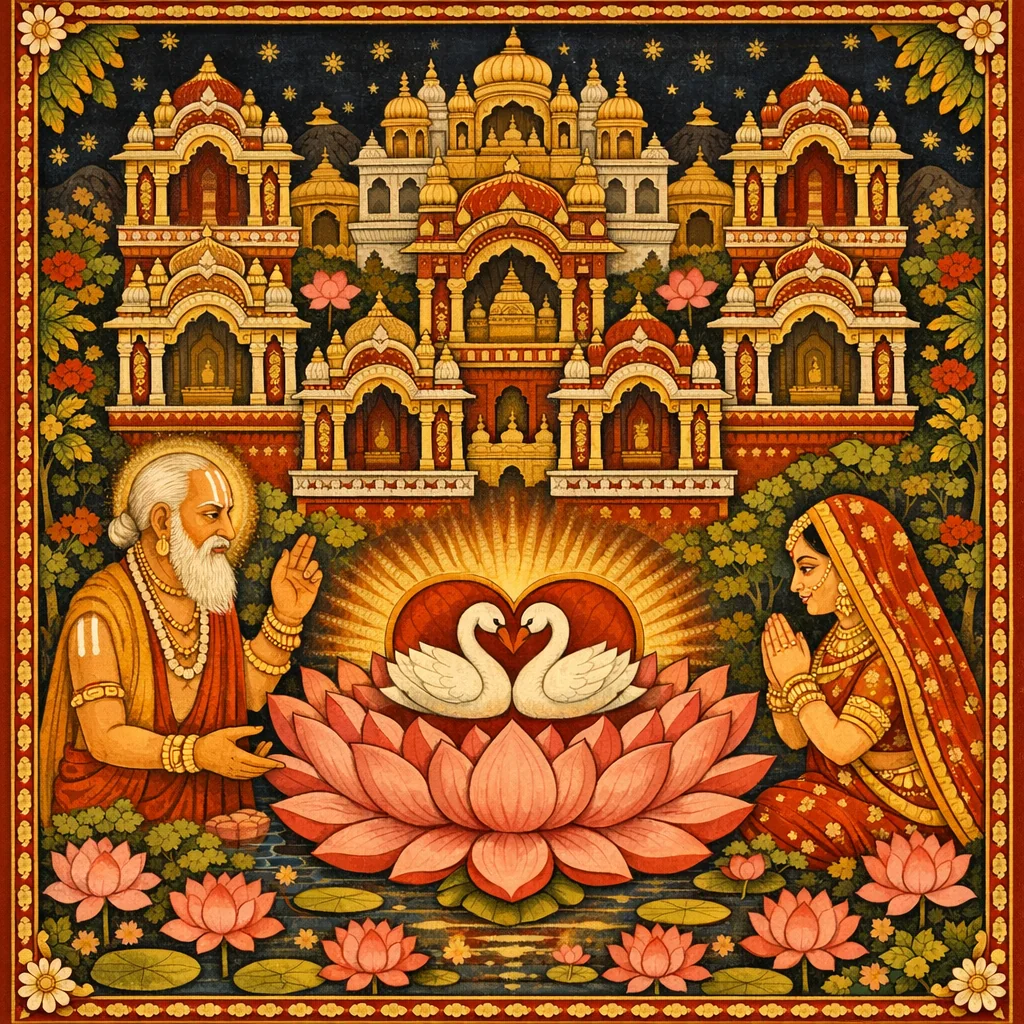
Adhyaya 28
The Fall of Purañjana and the Supersoul as the Eternal Friend (Purañjana-Upākhyāna Culmination)
Continuing Nārada’s instruction, the allegory reaches its crisis as Death and Old Age invade Purañjana’s city (the body). The guardian serpent (prāṇa) weakens, and the city is consumed by fever. Dying while attached to his wife, Purañjana is reborn as a woman (Vaidarbhī) and marries the great devotee Malayadhvaja. After her husband's departure, a brāhmaṇa (the Supersoul) instructs the grieving queen, revealing their eternal friendship and the nature of the "city of nine gates," guiding the soul from bondage to liberation.
Shlokas
Verse 1
नारद उवाच सैनिका भयनाम्नो ये बर्हिष्मन् दिष्टकारिण: । प्रज्वारकालकन्याभ्यां विचेरुरवनीमिमाम् ॥ १ ॥
Nārada said: O King Prācīnabarhiṣat, thereafter the Yavana king—whose very name is Fear—along with Prajvāra, Kālakanyā, and his soldiers, began to roam throughout this world.
Verse 2
त एकदा तु रभसा पुरञ्जनपुरीं नृप । रुरुधुर्भौमभोगाढ्यां जरत्पन्नगपालिताम् ॥ २ ॥
O King, once those perilous soldiers attacked Purañjana’s city with great force. Though the city abounded in provisions for sense enjoyment, it was guarded by an old serpent.
Verse 3
कालकन्यापि बुभुजे पुरञ्जनपुरं बलात् । ययाभिभूत: पुरुष: सद्यो नि:सारतामियात् ॥ ३ ॥
Gradually Kālakanyā, aided by those perilous soldiers, forcibly seized Purañjana’s city; and the man, overpowered by her, at once became useless for every purpose.
Verse 4
तयोपभुज्यमानां वै यवना: सर्वतोदिशम् । द्वार्भि: प्रविश्य सुभृशं प्रार्दयन् सकलां पुरीम् ॥ ४ ॥
When Kālakanyā, the daughter of Time, attacked the body, the perilous soldiers of the Yavana king entered the city through various gates and began to grievously torment all its citizens.
Verse 5
तस्यां प्रपीड्यमानायामभिमानी पुरञ्जन: । अवापोरुविधांस्तापान् कुटुम्बी ममताकुल: ॥ ५ ॥
Thus, as the city was being sorely oppressed, the proud King Purañjana—bewildered by family attachment and the sense of “mine”—fell into many kinds of distress under the assault of the Yavana king and Kālakanyā.
Verse 6
कन्योपगूढो नष्टश्री: कृपणो विषयात्मक: । नष्टप्रज्ञो हृतैश्वर्यो गन्धर्वयवनैर्बलात् ॥ ६ ॥
Embraced by Kālakanyā, King Purañjana gradually lost his beauty. Addicted to sense pleasure, his intelligence grew poor, his opulence was taken away, and the Gandharvas and Yavanas conquered him by force.
Verse 7
विशीर्णां स्वपुरीं वीक्ष्य प्रतिकूलाननादृतान् । पुत्रान् पौत्रानुगामात्याञ्जायां च गतसौहृदाम् ॥ ७ ॥
Seeing his city scattered and in ruin, King Purañjana found that his sons, grandsons, servants, and ministers were gradually turning against him and showing disrespect. He also noticed his wife growing cold and indifferent.
Verse 8
आत्मानं कन्यया ग्रस्तं पञ्चालानरिदूषितान् । दुरन्तचिन्तामापन्नो न लेभे तत्प्रतिक्रियाम् ॥ ८ ॥
When King Purañjana saw that his family, relatives, followers, servants, and secretaries had all turned against him, he became intensely anxious. Yet, being thoroughly overwhelmed by Kālakanyā, he could find no remedy.
Verse 9
कामानभिलषन्दीनो यातयामांश्च कन्यया । विगतात्मगतिस्नेह: पुत्रदारांश्च लालयन् ॥ ९ ॥
By Kālakanyā’s influence, the objects of enjoyment became stale. As his lusty desires continued, King Purañjana grew impoverished in every way and failed to understand life’s true aim. Still, he remained attached to wife and children, anxious to maintain them.
Verse 10
गन्धर्वयवनाक्रान्तां कालकन्योपमर्दिताम् । हातुं प्रचक्रमे राजा तां पुरीमनिकामत: ॥ १० ॥
King Purañjana’s city was overrun by Gandharva and Yavana soldiers and crushed by Kālakanyā. Though he had no wish to leave, circumstances forced him to abandon that city.
Verse 11
भयनाम्नोऽग्रजो भ्राता प्रज्वार: प्रत्युपस्थित: । ददाह तां पुरीं कृत्स्नां भ्रातु: प्रियचिकीर्षया ॥ ११ ॥
At that time the elder brother of Yavana-rāja, famed as Prajvāra, arrived. To please his younger brother, named Bhaya—fear itself—he set the entire city ablaze.
Verse 12
तस्यां सन्दह्यमानायां सपौर: सपरिच्छद: । कौटुम्बिक: कुटुम्बिन्या उपातप्यत सान्वय: ॥ १२ ॥
As the city burned, all the citizens and attendants, along with the whole household—sons, grandsons, wives, and other kin—were caught within the flames. King Purañjana was thus overwhelmed with sorrow.
Verse 13
यवनोपरुद्धायतनो ग्रस्तायां कालकन्यया । पुर्यां प्रज्वारसंसृष्ट: पुरपालोऽन्वतप्यत ॥ १३ ॥
The serpent, superintendent of the city’s guard, saw the citizens assailed by Kālakanyā and his own dwelling hemmed in by the Yavanas. When Prajvāra’s fire consumed his residence, he was grievously distressed.
Verse 14
न शेके सोऽवितुं तत्र पुरुकृच्छ्रोरुवेपथु: । गन्तुमैच्छत्ततो वृक्षकोटरादिव सानलात् ॥ १४ ॥
Shaking under severe distress, he could not protect anyone there. Like a serpent in a tree hollow that longs to flee when the forest burns, he wished to leave the city because of the fire’s fierce heat.
Verse 15
शिथिलावयवो यर्हि गन्धर्वैर्हृतपौरुष: । यवनैररिभी राजन्नुपरुद्धो रुरोद ह ॥ १५ ॥
O King, his limbs grew slack as the Gandharvas stole away his strength, and the Yavana foes restrained him. When he tried to depart from the body, his enemies checked him; thwarted, he cried out loudly.
Verse 16
दुहितृ: पुत्रपौत्रांश्च जामिजामातृपार्षदान् । स्वत्वावशिष्टं यत्किञ्चिद् गृहकोशपरिच्छदम् ॥ १६ ॥
King Purañjana then began to think of his daughters, sons, grandsons, daughters-in-law, sons-in-law, servants and other companions, as well as his home, household furnishings, and the small remainder of his accumulated wealth.
Verse 17
अहं ममेति स्वीकृत्य गृहेषु कुमतिर्गृही । दध्यौ प्रमदया दीनो विप्रयोग उपस्थिते ॥ १७ ॥
Embracing the notions of “I” and “mine,” King Purañjana, bound to household life, fell into misguided thinking. Overly drawn to his wife, he had already become impoverished within, and when separation approached he was overwhelmed with sorrow.
Verse 18
लोकान्तरं गतवति मय्यनाथा कुटुम्बिनी । वर्तिष्यते कथं त्वेषा बालकाननुशोचती ॥ १८ ॥
King Purañjana anxiously thought, “Alas, my wife is burdened with so many children; when I depart to another realm, she will be without shelter. When I leave this body, how will she maintain all the family? Thoughts of household support will greatly harass her.”
Verse 19
न मय्यनाशिते भुङ्क्ते नास्नाते स्नाति मत्परा । मयि रुष्टे सुसन्त्रस्ता भर्त्सिते यतवाग्भयात् ॥ १९ ॥
King Purañjana then recalled his past dealings with his wife: she would not eat until he had finished, nor bathe until he had bathed. So devoted was she to him that when he sometimes grew angry and chastised her, she would, out of fear, restrain her words, remain silent, and endure his misconduct.
Verse 20
प्रबोधयति माविज्ञं व्युषिते शोककर्शिता । वर्त्मैतद् गृहमेधीयं वीरसूरपि नेष्यति ॥ २० ॥
King Purañjana kept thinking: “When I was bewildered, she would awaken me with wise counsel; when I was away from home, she would waste away in grief. Though she is the mother of many heroic sons, I still fear she will not be able to bear the burden of household duties.”
Verse 21
कथं नु दारका दीना दारकीर्वापरायणा: । वर्तिष्यन्ते मयि गते भिन्ननाव इवोदधौ ॥ २१ ॥
King Purañjana worried: “When I depart this world, how will my sons and daughters, now wholly dependent on me, live on? Their plight will be like passengers of a ship wrecked in the midst of the ocean.”
Verse 22
एवं कृपणया बुद्ध्या शोचन्तमतदर्हणम् । ग्रहीतुं कृतधीरेनं भयनामाभ्यपद्यत ॥ २२ ॥
Thus, with miserly intelligence, he lamented what was not worthy of lamentation; meanwhile Yavana-rāja—whose very name was Fear—at once drew near to seize him.
Verse 23
पशुवद्यवनैरेष नीयमान: स्वकं क्षयम् । अन्वद्रवन्ननुपथा: शोचन्तो भृशमातुरा: ॥ २३ ॥
As the Yavanas led King Purañjana away to their abode, binding him like an animal, his followers were grievously distressed; lamenting bitterly, they were forced to go along with him.
Verse 24
पुरीं विहायोपगत उपरुद्धो भुजङ्गम: । यदा तमेवानु पुरी विशीर्णा प्रकृतिं गता ॥ २४ ॥
The serpent, already arrested by Yavana-rāja’s soldiers and brought out of the city, followed his master along with the others. As soon as they all left the city, it was at once dismantled and crushed into dust.
Verse 25
विकृष्यमाण: प्रसभं यवनेन बलीयसा । नाविन्दत्तमसाविष्ट: सखायं सुहृदं पुर: ॥ २५ ॥
Dragged away with brute force by the powerful Yavana, the king—shrouded in the darkness of ignorance—still could not remember his friend and well-wisher before him: the Paramātmā, the Supersoul.
Verse 26
तं यज्ञपशवोऽनेन संज्ञप्ता येऽदयालुना । कुठारैश्चिच्छिदु: क्रुद्धा: स्मरन्तोऽमीवमस्य तत् ॥ २६ ॥
The cruel King Purañjana had formerly slain many animals in various yajñas. Now, seizing the chance, those sacrificial beasts, enraged and remembering their suffering, pierced him with their horns, as though axes were hewing him to pieces.
Verse 27
अनन्तपारे तमसि मग्नो नष्टस्मृति: समा: । शाश्वतीरनुभूयार्तिं प्रमदासङ्गदूषित: ॥ २७ ॥
By contaminated association with women, a living being like King Purañjana sinks into boundless darkness, loses all remembrance, and for many years endures the unending pangs of material existence.
Verse 28
तामेव मनसा गृह्णन् बभूव प्रमदोत्तमा । अनन्तरं विदर्भस्य राजसिंहस्य वेश्मनि ॥ २८ ॥
Remembering his wife at death, King Purañjana gave up his body; thus in the next life he became a most beautiful and well-situated woman, born as the daughter in the house of the King of Vidarbha.
Verse 29
उपयेमे वीर्यपणां वैदर्भीं मलयध्वज: । युधि निर्जित्य राजन्यान् पाण्ड्य: परपुरञ्जय: ॥ २९ ॥
It was ordained that Vaidarbhī, the daughter of the King of Vidarbha, would wed a man of great prowess. Malayadhvaja, the Pāṇḍya prince famed as a conqueror of enemy cities, defeated other rulers in battle and then married her.
Verse 30
तस्यां स जनयां चक्र आत्मजामसितेक्षणाम् । यवीयस: सप्त सुतान् सप्त द्रविडभूभृत: ॥ ३० ॥
From her, Malayadhvaja begot one daughter with very dark eyes. He also had seven younger sons, who later became rulers of the region known as Draviḍa; thus that land came to have seven kings.
Verse 31
एकैकस्याभवत्तेषां राजन्नर्बुदमर्बुदम् । भोक्ष्यते यद्वंशधरैर्मही मन्वन्तरं परम् ॥ ३१ ॥
My dear King Prācīnabarhiṣat, each of Malayadhvaja’s sons begot countless sons—thousands upon thousands. Their descendants protected the whole earth until the end of one Manu’s lifespan, and even beyond.
Verse 32
अगस्त्य: प्राग्दुहितरमुपयेमे धृतव्रताम् । यस्यां दृढच्युतो जात इध्मवाहात्मजो मुनि: ॥ ३२ ॥
The great sage Agastya married Dhṛtavratā, Malayadhvaja’s firstborn daughter, steadfast in devotion to Śrī Kṛṣṇa. From her was born a son named Dṛḍhacyuta, and from him another son was born, named Idhmavāha.
Verse 33
विभज्य तनयेभ्य: क्ष्मां राजर्षिर्मलयध्वज: । आरिराधयिषु: कृष्णं स जगाम कुलाचलम् ॥ ३३ ॥
The saintly King Malayadhvaja divided his entire kingdom among his sons. Then, wishing to worship Śrī Kṛṣṇa with undivided attention, he went to a solitary place known as Kulācala.
Verse 34
हित्वा गृहान् सुतान् भोगान् वैदर्भी मदिरेक्षणा । अन्वधावत पाण्ड्येशं ज्योत्स्नेव रजनीकरम् ॥ ३४ ॥
Abandoning home, children, and worldly pleasures, the Vidarbhī queen with enchanting eyes followed the Pāṇḍya king—just as moonlight follows the moon at night.
Verse 35
तत्र चन्द्रवसा नाम ताम्रपर्णी वटोदका । तत्पुण्यसलिलैर्नित्यमुभयत्रात्मनो मृजन् ॥ ३५ ॥ कन्दाष्टिभिर्मूलफलै: पुष्पपर्णैस्तृणोदकै: । वर्तमान: शनैर्गात्रकर्शनं तप आस्थित: ॥ ३६ ॥
In Kulācala there were rivers named Candravasā, Tāmraparṇī, and Vaṭodakā. King Malayadhvaja regularly bathed in their sacred waters, cleansing himself outwardly and inwardly. Living on bulbs and seeds, roots and fruits, flowers and leaves, grasses and water, he undertook severe austerities until his body became very thin.
Verse 36
तत्र चन्द्रवसा नाम ताम्रपर्णी वटोदका । तत्पुण्यसलिलैर्नित्यमुभयत्रात्मनो मृजन् ॥ ३५ ॥ कन्दाष्टिभिर्मूलफलै: पुष्पपर्णैस्तृणोदकै: । वर्तमान: शनैर्गात्रकर्शनं तप आस्थित: ॥ ३६ ॥
In the land of Kulācala flowed the sacred rivers Candravasā, Tāmraparṇī, and Vaṭodakā. King Malayadhvaja would regularly bathe in those holy waters, cleansing himself outwardly and within. Living on bulbs, seeds, leaves, flowers, roots, fruits, and grasses, and drinking only water, he embraced severe austerity, and in time his body became very thin.
Verse 37
शीतोष्णवातवर्षाणि क्षुत्पिपासे प्रियाप्रिये । सुखदु:खे इति द्वन्द्वान्यजयत्समदर्शन: ॥ ३७ ॥
By austerity, King Malayadhvaja became even-minded toward the dualities—cold and heat, wind and rain, hunger and thirst, the pleasant and the unpleasant, happiness and distress. Thus he conquered all relative opposites.
Verse 38
तपसा विद्यया पक्वकषायो नियमैर्यमै: । युयुजे ब्रह्मण्यात्मानं विजिताक्षानिलाशय: ॥ ३८ ॥
By austerity, spiritual knowledge, and the disciplines of yama and niyama, King Malayadhvaja’s impurities ripened and were burned away. Conquering his senses, his life-air, and his consciousness, he fixed his whole being upon the Supreme Brahman—Śrī Kṛṣṇa.
Verse 39
आस्ते स्थाणुरिवैकत्र दिव्यं वर्षशतं स्थिर: । वासुदेवे भगवति नान्यद्वेदोद्वहन् रतिम् ॥ ३९ ॥
Thus he remained in one place, immovable like a pillar, for one hundred years by the demigods’ reckoning. After that, pure devotional attraction arose in him for Bhagavān Vāsudeva, Śrī Kṛṣṇa, and he stayed firmly fixed in that state.
Verse 40
स व्यापकतयात्मानं व्यतिरिक्ततयात्मनि । विद्वान् स्वप्न इवामर्शसाक्षिणं विरराम ह ॥ ४० ॥
King Malayadhvaja attained perfect knowledge by discerning the all-pervading Paramātmā from the individual soul, which is distinct and localized within the body. He understood that the material body is not the self; the soul is the witnessing seer of the body, and thus—like one awakening from a dream—he ceased from illusion.
Verse 41
साक्षाद्भगवतोक्तेन गुरुणा हरिणा नृप । विशुद्धज्ञानदीपेन स्फुरता विश्वतोमुखम् ॥ ४१ ॥
Thus King Malayadhvaja attained perfect knowledge, for in his purified state he was instructed directly by the Supreme Lord, Hari, as his guru. By that lamp of transcendental wisdom, he understood everything from all points of vision.
Verse 42
परे ब्रह्मणि चात्मानं परं ब्रह्म तथात्मनि । वीक्षमाणो विहायेक्षामस्मादुपरराम ह ॥ ४२ ॥
He thus perceived the Supreme Soul beside him, and himself, the individual soul, beside the Supreme Soul. Seeing both together, he abandoned separate interests and ceased such activities.
Verse 43
पतिं परमधर्मज्ञं वैदर्भी मलयध्वजम् । प्रेम्णा पर्यचरद्धित्वा भोगान् सा पतिदेवता ॥ ४३ ॥
The daughter of King Vidarbha accepted her husband Malayadhvaja, the knower of supreme dharma, as her all and as the highest. Renouncing sense enjoyment, she lovingly served him, following his principles as a devoted patidevata.
Verse 44
चीरवासा व्रतक्षामा वेणीभूतशिरोरुहा । बभावुप पतिं शान्ता शिखा शान्तमिवानलम् ॥ ४४ ॥
She wore old garments and grew lean from her vows of austerity; neglecting her hair, it became matted into locks. Though always near her husband, she remained silent and unagitated, like the steady flame of an undisturbed fire.
Verse 45
अजानती प्रियतमं यदोपरतमङ्गना । सुस्थिरासनमासाद्य यथापूर्वमुपाचरत् ॥ ४५ ॥
The daughter of King Vidarbha served her beloved husband as usual, though he sat in a steady posture, until she could ascertain that he had departed from the body.
Verse 46
यदा नोपलभेताङ्घ्रावूष्माणं पत्युरर्चती । आसीत्संविग्नहृदया यूथभ्रष्टा मृगी यथा ॥ ४६ ॥
As she served her husband by massaging his feet, she no longer felt their warmth and understood that he had departed the body. Left without his company, her heart grew greatly distressed, like a doe separated from her mate.
Verse 47
आत्मानं शोचती दीनमबन्धुं विक्लवाश्रुभि: । स्तनावासिच्य विपिने सुस्वरं प्ररुरोद सा ॥ ४७ ॥
Lamenting herself—wretched and without support—she shed helpless tears that soaked her breasts, and in that forest she cried out loudly in grief.
Verse 48
उत्तिष्ठोत्तिष्ठ राजर्षे इमामुदधिमेखलाम् । दस्युभ्य: क्षत्रबन्धुभ्यो बिभ्यतीं पातुमर्हसि ॥ ४८ ॥
Rise, rise, O royal sage! Behold this world girdled by the waters, harried by rogues and kings in name alone. The world is afraid, and it is your sacred duty to protect her.
Verse 49
एवं विलपन्ती बाला विपिनेऽनुगता पतिम् । पतिता पादयोर्भर्तू रुदत्यश्रूण्यवर्तयत् ॥ ४९ ॥
Thus lamenting, the devoted wife followed her husband into that forest, fell at the feet of her dead lord, and wept piteously as tears streamed from her eyes.
Verse 50
चितिं दारुमयीं चित्वा तस्यां पत्यु: कलेवरम् । आदीप्य चानुमरणे विलपन्ती मनो दधे ॥ ५० ॥
She then built a funeral pyre of wood and placed her husband’s body upon it. After kindling the blazing fire, she lamented bitterly and set her mind on perishing in the flames along with him.
Verse 51
तत्र पूर्वतर: कश्चित्सखा ब्राह्मण आत्मवान् । सान्त्वयन् वल्गुना साम्ना तामाह रुदतीं प्रभो ॥ ५१ ॥
My dear King, an old friend of King Purañjana—a self-possessed brāhmaṇa—came there and, with sweet and gentle words, began to console the weeping Queen.
Verse 52
ब्राह्मण उवाच का त्वं कस्यासि को वायं शयानो यस्य शोचसि । जानासि किं सखायं मां येनाग्रे विचचर्थ ह ॥ ५२ ॥
The brāhmaṇa asked: Who are you—whose wife or daughter? Who is this man lying here, for whose dead body you lament? Do you not recognize Me? I am your eternal friend; in the past you have consulted Me many times.
Verse 53
अपि स्मरसि चात्मानमविज्ञातसखं सखे । हित्वा मां पदमन्विच्छन् भौमभोगरतो गत: ॥ ५३ ॥
The brāhmaṇa continued: My dear friend, though you cannot at once recognize Me, do you not remember your most intimate companion of old? Alas, you abandoned My company and, absorbed in earthly enjoyments, became the enjoyer of this material world.
Verse 54
हंसावहं च त्वं चार्य सखायौ मानसायनौ । अभूतामन्तरा वौक: सहस्रपरिवत्सरान् ॥ ५४ ॥
My gentle friend, you and I are like two swans, dwelling together in the same lake of the heart, like Mānasa. Yet for many thousands of years we have remained far from our original home.
Verse 55
स त्वं विहाय मां बन्धो गतो ग्राम्यमतिर्महीम् । विचरन् पदमद्राक्षी: कयाचिन्निर्मितं स्त्रिया ॥ ५५ ॥
My friend, you are indeed that same companion of Mine; yet after leaving Me your mind became worldly and you descended to the earth. Not seeing Me, you have wandered in many forms through this material world, fashioned by a woman.
Verse 56
पञ्चारामं नवद्वारमेकपालं त्रिकोष्ठकम् । षट्कुलं पञ्चविपणं पञ्चप्रकृति स्त्रीधवम् ॥ ५६ ॥
In that city—the material body—there are five gardens, nine gates, one guardian, three chambers, six families, five marketplaces, the five material elements, and one woman who rules the household.
Verse 57
पञ्चेन्द्रियार्था आरामा द्वार: प्राणा नव प्रभो । तेजोऽबन्नानि कोष्ठानि कुलमिन्द्रियसङ्ग्रह: ॥ ५७ ॥
My dear friend, the five gardens are the five objects of sense enjoyment, and the guardian is prāṇa, the life air that moves through the nine gates. The three chambers are fire, water, and earth. The six families are the totality of the mind and the five senses.
Verse 58
विपणस्तु क्रियाशक्तिर्भूतप्रकृतिरव्यया । शक्त्यधीश: पुमांस्त्वत्र प्रविष्टो नावबुध्यते ॥ ५८ ॥
The five stores are the five working senses, conducting their affairs by the combined power of the five eternal elements. Behind all this activity stands the soul—truly a person and the real enjoyer—yet, hidden within the city of the body, he remains bereft of knowledge.
Verse 59
तस्मिंस्त्वं रामया स्पृष्टो रममाणोऽश्रुतस्मृति: । तत्सङ्गादीदृशीं प्राप्तो दशां पापीयसीं प्रभो ॥ ५९ ॥
My dear friend, when you enter such a body along with the woman of material desire, you become absorbed in sense enjoyment and forget śruti and smṛti—your spiritual remembrance. By that association and material conception, you are cast into many miserable conditions.
Verse 60
न त्वं विदर्भदुहिता नायं वीर: सुहृत्तव । न पतिस्त्वं पुरञ्जन्या रुद्धो नवमुखे यया ॥ ६० ॥
In truth, you are not the daughter of Vidarbha, nor is this hero your well-wishing husband. Nor were you the husband of Purañjanī. You were simply deluded and held captive within this body, the city of nine gates.
Verse 61
माया ह्येषा मया सृष्टा यत्पुमांसं स्त्रियं सतीम् । मन्यसे नोभयं यद्वै हंसौ पश्यावयोर्गतिम् ॥ ६१ ॥
This is My māyā: by bodily identification you sometimes think yourself a man, sometimes a chaste woman, and sometimes neutral. In truth, you and I are both pure spiritual identities. Understand this well; I am explaining our real position.
Verse 62
अहं भवान्न चान्यस्त्वं त्वमेवाहं विचक्ष्व भो: । न नौ पश्यन्ति कवयश्छिद्रं जातु मनागपि ॥ ६२ ॥
My dear friend, I (the Paramātmā) and you (the jīvātmā) are not different in quality, for we are both spiritual. Reflect on this: the truly learned see no qualitative distinction between you and Me.
Verse 63
यथा पुरुष आत्मानमेकमादर्शचक्षुषो: । द्विधाभूतमवेक्षेत तथैवान्तरमावयो: ॥ ६३ ॥
As a person sees his reflection in a mirror as one with himself, though others see two bodies, so in the material condition—where the jīva seems affected yet is not in essence—a difference appears between God and the living being.
Verse 64
एवं स मानसो हंसो हंसेन प्रतिबोधित: । स्वस्थस्तद्वयभिचारेण नष्टामाप पुन: स्मृतिम् ॥ ६४ ॥
Thus the two swans dwell together within the heart. When one swan instructs the other, he becomes situated in his original nature—regaining the lost, original Kṛṣṇa consciousness obscured by material attraction.
Verse 65
बर्हिष्मन्नेतदध्यात्मं पारोक्ष्येण प्रदर्शितम् । यत्परोक्षप्रियो देवो भगवान् विश्वभावन: ॥ ६५ ॥
O King Prācīnabarhi (Barhiṣman), I have shown this adhyātma truth indirectly, for Bhagavān, the sustainer of the universe, is known to be understood through indirect narration. Therefore I have spoken the tale of Purañjana as instruction for self-realization.
Frequently Asked Questions
They function allegorically: Yavana-rāja represents fear and death overtaking the embodied being, while Kālakanyā represents Time manifesting as old age that drains beauty, strength, and enjoyment. Their ‘soldiers’ symbolize the progressive breakdown of bodily systems and the pressures that force the jīva to abandon the body.
The city is the material body (deha), described as having nine gates (two eyes, two ears, two nostrils, mouth, anus, genitals). Within this city, the jīva misidentifies as the enjoyer, becomes absorbed in sense objects, and forgets the Paramātmā. The image teaches embodied psychology and the mechanics of bondage in a memorable narrative form.
The chapter applies the Bhagavatam’s principle that one’s consciousness at death shapes the next embodiment. Because Purañjana dies intensely remembering his wife and household attachment, the mind’s final fixation produces a corresponding birth—here as Vaidarbhī—illustrating how kāma and identification with relational roles redirect the jīva’s journey.
He is the Paramātmā, the Supersoul—present as the jīva’s eternal friend within the heart. He reminds the conditioned soul of their long companionship (the ‘two swans’) and reorients identity away from bodily designations toward spiritual self-knowledge and bhakti.
Malayadhvaja models the positive resolution of the allegory: disciplined living, austerity, sense control, and bhakti lead to steady realization—distinguishing the localized jīva from the all-pervading Supersoul—culminating in fixed devotional attraction to Kṛṣṇa. His life contrasts Purañjana’s downfall under attachment and forgetfulness.