Adhyaya 16
Aditi’s Lament and Kaśyapa’s Instruction of the Payo-vrata (Milk Vow) to Please Keśava
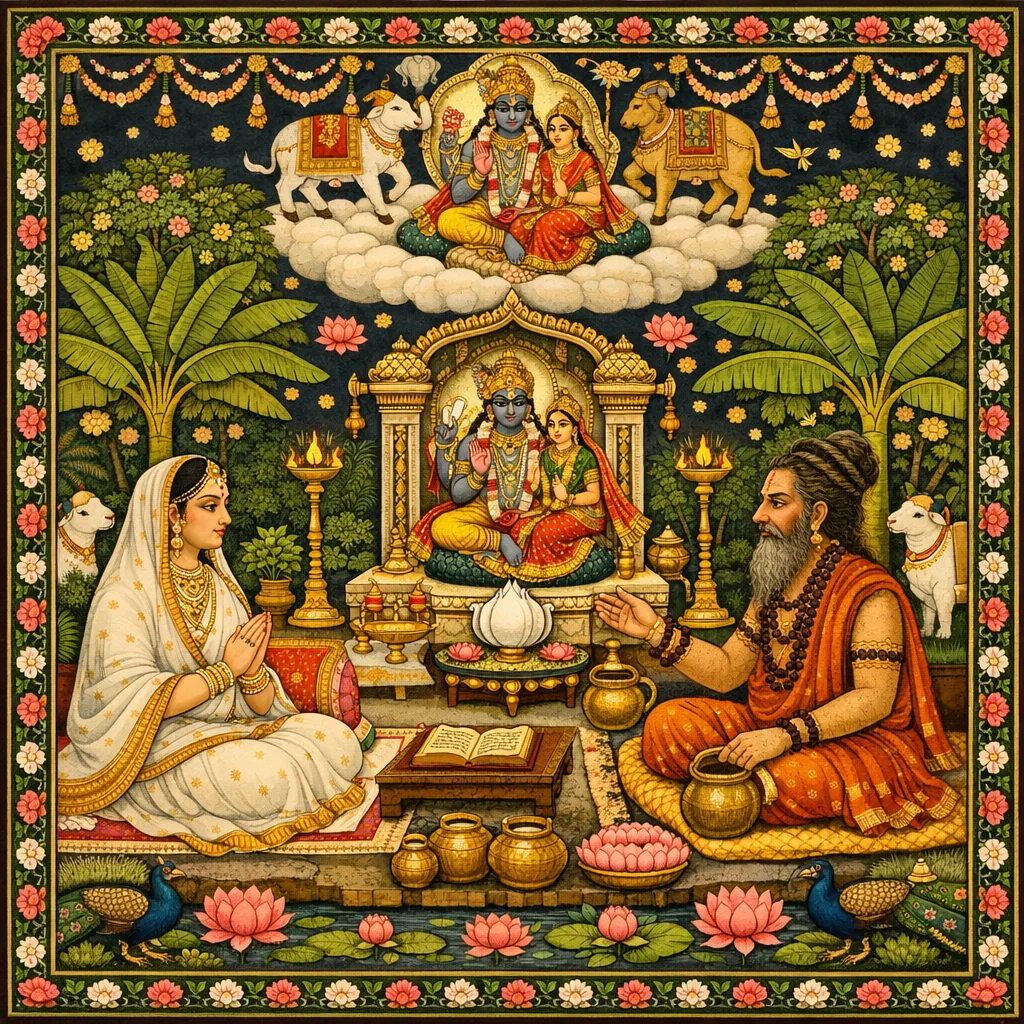
After the devas, Aditi’s sons, are driven from their heavenly station and the asuras seize Svarga, Aditi laments as one left without protection. Kaśyapa returns from meditation, sees the āśrama’s joy diminished, and first examines whether any lapse has occurred in gṛhastha-dharma—welcoming atithis, maintaining the sacrificial fire, and honoring brāhmaṇas—affirming the householder’s role as a pillar of dharma in society. Aditi replies that all duties are intact; her grief is solely the devas’ dispossession. She seeks Kaśyapa’s shelter, recalling that the Lord is impartial yet grants special grace to devotees. Kaśyapa gently turns her from bodily and familial attachment to the supreme remedy: exclusive bhakti-service to Vāsudeva/Keśava, the heart-dwelling Lord who alone bestows auspiciousness. At her request for a practical means, he conveys Brahmā’s ordinance—the twelve-day payo-vrata (milk vow) in the bright fortnight of Phālguna—marked by purification, mantra-prayers, Deity worship, offerings, feeding brāhmaṇas, celibacy, simplicity, and universal distribution of Viṣṇu-prasāda. Thus the chapter links the devas’ crisis to the coming divine response, as Aditi’s disciplined devotion prepares the ground for the Lord’s avatāra intervention.
Shlokas
Verse 1
श्रीशुक उवाच एवं पुत्रेषु नष्टेषु देवमातादितिस्तदा । हृते त्रिविष्टपे दैत्यै: पर्यतप्यदनाथवत् ॥ १ ॥
Śukadeva Gosvāmī said: O King, when Aditi’s sons, the devas, had vanished from heaven and the demons had seized Triviṣṭapa, Aditi, the mother of the gods, lamented as though she had no protector.
Verse 2
एकदा कश्यपस्तस्या आश्रमं भगवानगात् । निरुत्सवं निरानन्दं समाधेर्विरतश्चिरात् ॥ २ ॥
After many days, the powerful sage Kaśyapa Muni rose from samādhi and one day returned to the āśrama; he saw it devoid of festivity and joy.
Verse 3
स पत्नीं दीनवदनां कृतासनपरिग्रह: । सभाजितो यथान्यायमिदमाह कुरूद्वह ॥ ३ ॥
O best of the Kurus, after Kaśyapa Muni had been properly received, he took his seat and then spoke as follows to his wife Aditi, whose face was downcast.
Verse 4
अप्यभद्रं न विप्राणां भद्रे लोकेऽधुनागतम् । न धर्मस्य न लोकस्य मृत्योश्छन्दानुवर्तिन: ॥ ४ ॥
O gentle and auspicious one, has anything inauspicious now occurred regarding dharma, the brāhmaṇas, or the people in general, who follow the whims of death?
Verse 5
अपि वाकुशलं किञ्चिद् गृहेषु गृहमेधिनि । धर्मस्यार्थस्य कामस्य यत्र योगो ह्ययोगिनाम् ॥ ५ ॥
O my wife devoted to household life, when dharma, artha, and kāma are properly observed at home, even one who is not a yogi acts like a yogi; has there been any lapse in following these principles?
Verse 6
अपि वातिथयोऽभ्येत्य कुटुम्बासक्तया त्वया । गृहादपूजिता याता: प्रत्युत्थानेन वा क्वचित् ॥ ६ ॥
Have you, out of excessive attachment to the family, failed to properly receive uninvited guests, so that they departed without honor, or did you ever neglect to rise and welcome them?
Verse 7
गृहेषु येष्वतिथयो नार्चिता: सलिलैरपि । यदि निर्यान्ति ते नूनं फेरुराजगृहोपमा: ॥ ७ ॥
Homes from which guests depart without being honored even with the offering of a little water are truly like holes in the field that serve as the dwellings of jackals.
Verse 8
अप्यग्नयस्तु वेलायां न हुता हविषा सति । त्वयोद्विग्नधिया भद्रे प्रोषिते मयि कर्हिचित् ॥ ८ ॥
O chaste and auspicious woman, when I was away in other places, were you so anxious that you failed to offer ghee oblations into the sacred fire at the proper time?
Verse 9
यत्पूजया कामदुघान्याति लोकान्गृहान्वित: । ब्राह्मणोऽग्निश्च वै विष्णो: सर्वदेवात्मनो मुखम् ॥ ९ ॥
By worshiping the sacred fire and the brāhmaṇas, a householder attains the desired fruit and dwells in the higher worlds, for the sacrificial fire and the brāhmaṇas are regarded as the mouth of Lord Viṣṇu, the Supersoul of all the devas.
Verse 10
अपि सर्वे कुशलिनस्तव पुत्रा मनस्विनि । लक्षयेऽस्वस्थमात्मानं भवत्या लक्षणैरहम् ॥ १० ॥
O great-minded lady, are all your sons well? From the withered signs upon your face I perceive your mind is not at peace—how has this come about?
Verse 11
श्रीअदितिरुवाच भद्रं द्विजगवां ब्रह्मन्धर्मस्यास्य जनस्य च । त्रिवर्गस्य परं क्षेत्रं गृहमेधिन्गृहा इमे ॥ ११ ॥
Aditi said: O revered brāhmaṇa husband, the brāhmaṇas, the cows, dharma, and the welfare of the people are all auspicious. O master of the household, the three aims—dharma, artha, and kāma—find their finest field in household life; thus this home is filled with good fortune.
Verse 12
अग्नयोऽतिथयो भृत्या भिक्षवो ये च लिप्सव: । सर्वं भगवतो ब्रह्मन्ननुध्यानान्न रिष्यति ॥ १२ ॥
O beloved husband, the sacred fires, guests, servants, and beggars are all properly cared for by me. Because I constantly meditate upon you, no principle of dharma can be neglected.
Verse 13
को नु मे भगवन्कामो न सम्पद्येत मानस: । यस्या भवान्प्रजाध्यक्ष एवं धर्मान्प्रभाषते ॥ १३ ॥
O my lord, what desire of my heart could fail to be fulfilled? You are a Prajāpati, and you personally instruct me in the principles of dharma.
Verse 14
तवैव मारीच मन:शरीरजा: प्रजा इमा: सत्त्वरजस्तमोजुष: । समो भवांस्तास्वसुरादिषु प्रभो तथापि भक्तं भजते महेश्वर: ॥ १४ ॥
O son of Marīci, these beings born from your mind and body are endowed with sattva, rajas, and tamas; you are impartial toward devas and asuras alike. Yet the Supreme Lord, though equal to all, is especially gracious to His devotees.
Verse 15
तस्मादीश भजन्त्या मे श्रेयश्चिन्तय सुव्रत । हृतश्रियो हृतस्थानान्सपत्नै: पाहि न: प्रभो ॥ १५ ॥
Therefore, O gentle Lord of noble vows, please consider the welfare of Your maidservant. Our rivals, the demons, have stolen our opulence and our abode; O Prabhu, protect us.
Verse 16
परैर्विवासिता साहं मग्ना व्यसनसागरे । ऐश्वर्यं श्रीर्यश: स्थानं हृतानि प्रबलैर्मम ॥ १६ ॥
Our formidable enemies, the demons, have exiled me, and I am drowning in an ocean of distress. My opulence, beauty, fame, and even my residence have been taken away.
Verse 17
यथा तानि पुन: साधो प्रपद्येरन् ममात्मजा: । तथा विधेहि कल्याणं धिया कल्याणकृत्तम ॥ १७ ॥
O saintly sage, best of all who grant auspicious boons, please consider our plight and bestow such благословение that my sons may regain what they have lost.
Verse 18
श्रीशुक उवाच एवमभ्यर्थितोऽदित्या कस्तामाह स्मयन्निव । अहो मायाबलं विष्णो: स्नेहबद्धमिदं जगत् ॥ १८ ॥
Śukadeva Gosvāmī continued: Thus entreated by Aditi, Kaśyapa Muni smiled slightly and said, “Alas, how powerful is Lord Viṣṇu’s māyā, by which the whole world is bound by affection for children!”
Verse 19
क्व देहो भौतिकोऽनात्मा क्व चात्मा प्रकृते: पर: । कस्य के पतिपुत्राद्या मोह एव हि कारणम् ॥ १९ ॥
What is this material body, fashioned of the five elements? It is not the self. The ātman is beyond prakṛti—pure and eternal. Yet by attachment to the body one is called husband, son, and the like; such ties are mere illusion, born of delusion.
Verse 20
उपतिष्ठस्व पुरुषं भगवन्तं जनार्दनम् । सर्वभूतगुहावासं वासुदेवं जगद्गुरुम् ॥ २० ॥
O Aditi, render devotional service to Bhagavān Janārdana, the Supreme Person—master of all, subduer of enemies, dwelling in the heart-cave of every being. Only Vāsudeva, Śrī Kṛṣṇa, the guru of the universe, can bestow all auspicious blessings.
Verse 21
स विधास्यति ते कामान्हरिर्दीनानुकम्पन: । अमोघा भगवद्भक्तिर्नेतरेति मतिर्मम ॥ २१ ॥
Hari, compassionate to the destitute, will fulfill all your desires, for devotion to Bhagavān is unfailing. Any path other than bhakti is fruitless—this is my conviction.
Verse 22
श्रीअदितिरुवाच केनाहं विधिना ब्रह्मन्नुपस्थास्ये जगत्पतिम् । यथा मे सत्यसङ्कल्पो विदध्यात् स मनोरथम् ॥ २२ ॥
Śrīmatī Aditi said: O brāhmaṇa, tell me the proper rules by which I may worship the Lord of the universe, so that He will be pleased with me and fulfill my true resolve, granting the desire of my heart.
Verse 23
आदिश त्वं द्विजश्रेष्ठ विधिं तदुपधावनम् । आशु तुष्यति मे देव: सीदन्त्या: सह पुत्रकै: ॥ २३ ॥
O best of brāhmaṇas, please instruct me in the flawless method and order of worship, by which my Lord will quickly be pleased. I am afflicted, along with my sons, in a most perilous condition; by worshiping Him with bhakti, may the Lord swiftly deliver us from this dreadful plight.
Verse 24
श्रीकश्यप उवाच एतन्मे भगवान्पृष्ट: प्रजाकामस्य पद्मज: । यदाह ते प्रवक्ष्यामि व्रतं केशवतोषणम् ॥ २४ ॥
Śrī Kaśyapa Muni said: Desiring offspring, I questioned Lord Brahmā, the lotus-born. Now I shall tell you that same vow, as he instructed me, by which Keśava is fully pleased.
Verse 25
फाल्गुनस्यामले पक्षे द्वादशाहं पयोव्रतम् । अर्चयेदरविन्दाक्षं भक्त्या परमयान्वित: ॥ २५ ॥
In the bright fortnight of Phālguna, for twelve days one should observe the payo-vrata, living only on milk, and with supreme devotion worship the lotus-eyed Lord, Aravindākṣa.
Verse 26
सिनीवाल्यां मृदालिप्य स्नायात् क्रोडविदीर्णया । यदि लभ्येत वै स्रोतस्येतं मन्त्रमुदीरयेत् ॥ २६ ॥
On the new-moon day, if earth dug up by a boar is available, one should smear it on the body and bathe in a flowing river. While bathing, one should chant the following mantra.
Verse 27
त्वं देव्यादिवराहेण रसाया: स्थानमिच्छता । उद्धृतासि नमस्तुभ्यं पाप्मानं मे प्रणाशय ॥ २७ ॥
O Goddess Earth, you were lifted from Rasātala by the Supreme Lord in His form as Ādi-Varāha, for you desired a place to dwell. I bow to you; please destroy the reactions of my sins.
Verse 28
निर्वर्तितात्मनियमो देवमर्चेत् समाहित: । अर्चायां स्थण्डिले सूर्ये जले वह्नौ गुरावपि ॥ २८ ॥
Thereafter, having performed one’s daily spiritual duties, one should, with steady attention, worship the Supreme Lord—within the Deity, upon the altar, in the sun, in water, in fire, and also in the spiritual master.
Verse 29
नमस्तुभ्यं भगवते पुरुषाय महीयसे । सर्वभूतनिवासाय वासुदेवाय साक्षिणे ॥ २९ ॥
O Bhagavān Vāsudeva, greatest Purusha—dwelling in the hearts of all beings, in whom all beings abide—O witness of everything, I offer You my reverent obeisances.
Verse 30
नमोऽव्यक्ताय सूक्ष्माय प्रधानपुरुषाय च । चतुर्विंशद्गुणज्ञाय गुणसङ्ख्यानहेतवे ॥ ३० ॥
I offer my obeisances to You, the unmanifest and most subtle Pradhāna-Purusha—knower of the twenty-four elements and the very cause of the sāṅkhya enumeration of the guṇas.
Verse 31
नमो द्विशीर्ष्णे त्रिपदे चतु:शृङ्गाय तन्तवे । सप्तहस्ताय यज्ञाय त्रयीविद्यात्मने नम: ॥ ३१ ॥
I offer obeisances to You, the Supreme Lord manifest as Yajña—two-headed, three-legged, four-horned, spread as the sacred warp and woof, with seven hands—whose very soul is the threefold Vedic wisdom.
Verse 32
नम: शिवाय रुद्राय नम: शक्तिधराय च । सर्वविद्याधिपतये भूतानां पतये नम: ॥ ३२ ॥
My obeisances to You, Rudra, Śiva—bearer of all potencies, lord of all knowledge, and master of all beings.
Verse 33
नमो हिरण्यगर्भाय प्राणाय जगदात्मने । योगैश्वर्यशरीराय नमस्ते योगहेतवे ॥ ३३ ॥
I offer my obeisances to You, situated as Hiraṇyagarbha, as Prāṇa, as the Soul of the universe; Your body is the source of the splendor of all mystic yogic powers. O cause of yoga, I bow to You.
Verse 34
नमस्त आदिदेवाय साक्षिभूताय ते नम: । नारायणाय ऋषये नराय हरये नम: ॥ ३४ ॥
I offer my obeisances to You, the original Lord, the witness within every heart. O Nārāyaṇa—Nara-Nārāyaṇa Ṛṣi in human form—O Hari, I bow to You.
Verse 35
नमो मरकतश्यामवपुषेऽधिगतश्रिये । केशवाय नमस्तुभ्यं नमस्ते पीतवाससे ॥ ३५ ॥
Obeisances to You whose form is dark like the marakata gem, who fully commands Śrī, the goddess of fortune. O Keśava, clad in yellow garments, I bow to You.
Verse 36
त्वं सर्ववरद: पुंसां वरेण्य वरदर्षभ । अतस्ते श्रेयसे धीरा: पादरेणुमुपासते ॥ ३६ ॥
O most worshipable Lord, best of all who grant boons, You fulfill the desires of everyone; therefore the sober, seeking true welfare, worship the dust of Your lotus feet.
Verse 37
अन्ववर्तन्त यं देवा: श्रीश्च तत्पादपद्मयो: । स्पृहयन्त इवामोदं भगवान्मे प्रसीदताम् ॥ ३७ ॥
The demigods, and even Śrī, the goddess of fortune, serve His lotus feet, honoring as if yearning for their fragrance. May that Supreme Lord be pleased with me.
Verse 38
एतैर्मन्त्रैर्हृषीकेशमावाहनपुरस्कृतम् । अर्चयेच्छ्रद्धया युक्त: पाद्योपस्पर्शनादिभि: ॥ ३८ ॥
Kaśyapa Muni continued: By chanting these mantras, inviting Hṛṣīkeśa with faith and devotion, and offering pādya, arghya, and other worshipful items, one should worship Keśava—Kṛṣṇa, the Supreme Lord.
Verse 39
अर्चित्वा गन्धमाल्याद्यै: पयसा स्नपयेद् विभुम् । वस्त्रोपवीताभरणपाद्योपस्पर्शनैस्तत: । गन्धधूपादिभिश्चार्चेद्द्वादशाक्षरविद्यया ॥ ३९ ॥
In the beginning, the devotee should chant the twelve-syllable mantra and offer fragrance, garlands, incense, and the like. Then, having thus worshiped the Lord, one should bathe Him with milk and adorn Him with proper garments, the sacred thread, and ornaments. After offering water to wash His feet, one should again worship the Lord with fragrant flowers, incense, and other sacred paraphernalia.
Verse 40
शृतं पयसि नैवेद्यं शाल्यन्नं विभवे सति । ससर्पि: सगुडं दत्त्वा जुहुयान्मूलविद्यया ॥ ४० ॥
If one can afford it, one should offer as naivedya fine rice cooked in milk. Adding ghee and molasses, and chanting that same original mantra, one should offer it as an oblation into the sacred fire.
Verse 41
निवेदितं तद्भक्ताय दद्याद्भुञ्जीत वा स्वयम् । दत्त्वाचमनमर्चित्वा ताम्बूलं च निवेदयेत् ॥ ४१ ॥
One should give the offered prasāda to a Vaiṣṇava, or give him a portion and then partake of a portion oneself. After that, one should offer ācamana to the Deity, worship again, and also present tāmbūla (betel).
Verse 42
जपेदष्टोत्तरशतं स्तुवीत स्तुतिभि: प्रभुम् । कृत्वा प्रदक्षिणं भूमौ प्रणमेद् दण्डवन्मुदा ॥ ४२ ॥
Thereafter, one should softly repeat the mantra 108 times and glorify the Lord with prayers of praise. Then one should perform pradakṣiṇa, and finally, with heartfelt joy, offer daṇḍavat obeisances, falling fully prostrate like a rod.
Verse 43
कृत्वा शिरसि तच्छेषां देवमुद्वासयेत् तत: । द्वयवरान्भोजयेद् विप्रान्पायसेन यथोचितम् ॥ ४३ ॥
After touching to one’s head the remnants of the flowers and water offered to the Deity, one should conclude the worship with udvāsana. Then, as is proper, one should feed at least two worthy brāhmaṇas with pāyasa, sweet rice cooked in milk.
Verse 44
भुञ्जीत तैरनुज्ञात: सेष्ट: शेषं सभाजितै: । ब्रह्मचार्यथ तद्रात्र्यां श्वोभूते प्रथमेऽहनि ॥ ४४ ॥ स्नात: शुचिर्यथोक्तेन विधिना सुसमाहित: । पयसा स्नापयित्वार्चेद् यावद्व्रतसमापनम् ॥ ४५ ॥
Having duly honored the venerable brāhmaṇas who were fed, and taking their permission, one should partake of the remaining prasāda with friends and relatives. That night one must observe strict brahmacarya; and the next morning, bathing again in purity and steady attention, one should bathe Lord Viṣṇu’s Deity with milk and worship Him by the method previously described, until the vow is concluded.
Verse 45
भुञ्जीत तैरनुज्ञात: सेष्ट: शेषं सभाजितै: । ब्रह्मचार्यथ तद्रात्र्यां श्वोभूते प्रथमेऽहनि ॥ ४४ ॥ स्नात: शुचिर्यथोक्तेन विधिना सुसमाहित: । पयसा स्नापयित्वार्चेद् यावद्व्रतसमापनम् ॥ ४५ ॥
Having duly honored the venerable brāhmaṇas who were fed, and taking their permission, one should partake of the remaining prasāda with friends and relatives. That night one must observe strict brahmacarya; and the next morning, bathing again in purity and steady attention, one should bathe Lord Viṣṇu’s Deity with milk and worship Him by the method previously described, until the vow is concluded.
Verse 46
पयोभक्षो व्रतमिदं चरेद् विष्णवर्चनादृत: । पूर्ववज्जुहुयादग्निं ब्राह्मणांश्चापि भोजयेत् ॥ ४६ ॥
Living only on milk and worshiping Lord Viṣṇu with deep faith and bhakti, one should observe this vow. As before, one should offer oblations into the sacred fire and also feed the brāhmaṇas.
Verse 47
एवं त्वहरह: कुर्याद्द्वादशाहं पयोव्रतम् । हरेराराधनं होममर्हणं द्विजतर्पणम् ॥ ४७ ॥
Thus, for twelve days, one should observe this payo-vrata each day—worshiping Hari, performing homa, offering due honor, and satisfying the brāhmaṇas with food.
Verse 48
प्रतिपद्दिनमारभ्य यावच्छुक्लत्रयोदशीम् । ब्रह्मचर्यमध:स्वप्नं स्नानं त्रिषवणं चरेत् ॥ ४८ ॥
From pratipat until the bright fortnight’s trayodaśī, one should observe complete brahmacarya, sleep on the ground, and bathe three times daily, thus carrying out the vow.
Verse 49
वर्जयेदसदालापं भोगानुच्चावचांस्तथा । अहिंस्र: सर्वभूतानां वासुदेवपरायण: ॥ ४९ ॥
During this period one should avoid useless talk of worldly matters and sense enjoyment, be free from envy toward all beings, remain nonviolent, and become a pure, simple devotee wholly devoted to Lord Vāsudeva.
Verse 50
त्रयोदश्यामथो विष्णो: स्नपनं पञ्चकैर्विभो: । कारयेच्छास्त्रदृष्टेन विधिना विधिकोविदै: ॥ ५० ॥
Thereafter, on the thirteenth lunar day, with the help of brāhmaṇas learned in the śāstra, one should, according to scriptural rule, bathe Lord Viṣṇu with five substances—milk, yogurt, ghee, sugar, and honey.
Verse 51
पूजां च महतीं कुर्याद् वित्तशाठ्यविवर्जित: । चरुं निरूप्य पयसि शिपिविष्टाय विष्णवे ॥ ५१ ॥ सूक्तेन तेन पुरुषं यजेत सुसमाहित: । नैवेद्यं चातिगुणवद् दद्यात्पुरुषतुष्टिदम् ॥ ५२ ॥
Giving up miserly reluctance to spend, one should arrange splendid worship of Lord Viṣṇu, Śipiviṣṭa, who dwells in the heart of every being. With steady attention, prepare caru—grains cooked in ghee and milk—worship while chanting the Puruṣa-sūkta, and offer naivedya of many flavors, which pleases the Supreme Puruṣa.
Verse 52
पूजां च महतीं कुर्याद् वित्तशाठ्यविवर्जित: । चरुं निरूप्य पयसि शिपिविष्टाय विष्णवे ॥ ५१ ॥ सूक्तेन तेन पुरुषं यजेत सुसमाहित: । नैवेद्यं चातिगुणवद् दद्यात्पुरुषतुष्टिदम् ॥ ५२ ॥
Giving up miserly reluctance to spend, one should arrange splendid worship of Lord Viṣṇu, Śipiviṣṭa, who dwells in the heart of every being. With steady attention, prepare caru—grains cooked in ghee and milk—worship while chanting the Puruṣa-sūkta, and offer naivedya of many flavors, which pleases the Supreme Puruṣa.
Verse 53
आचार्यं ज्ञानसम्पन्नं वस्त्राभरणधेनुभि: । तोषयेदृत्विजश्चैव तद्विद्ध्याराधनं हरे: ॥ ५३ ॥
One should satisfy the ācārya, learned in Vedic wisdom, and the assisting priests (ṛtvij) by offering garments, ornaments, and cows. This is known as viṣṇu-ārādhana—the worship of Hari, Lord Viṣṇu.
Verse 54
भोजयेत् तान्गुणवता सदन्नेन शुचिस्मिते । अन्यांश्च ब्राह्मणाञ्छक्त्या ये च तत्र समागता: ॥ ५४ ॥
O most auspicious lady of pure smile, one should feed the learned ācāryas and their assisting priests with fine, sanctified food, and by distributing prasāda satisfy the brāhmaṇas and all others assembled there.
Verse 55
दक्षिणां गुरवे दद्यादृत्विग्भ्यश्च यथार्हत: । अन्नाद्येनाश्वपाकांश्च प्रीणयेत्समुपागतान् ॥ ५५ ॥
One should give suitable dakṣiṇā to the spiritual master and the assisting priests—cloth, ornaments, cows, and a monetary offering—and by distributing prasāda satisfy everyone assembled, even the caṇḍālas.
Verse 56
भुक्तवत्सु च सर्वेषु दीनान्धकृपणादिषु । विष्णोस्तत्प्रीणनं विद्वान्भुञ्जीत सह बन्धुभि: ॥ ५६ ॥
After everyone has eaten—including the poor, the blind, the miserly, and others—the performer of the yajña, knowing that Lord Viṣṇu is greatly pleased when all are fully fed with viṣṇu-prasāda, should then partake of prasāda with friends and relatives.
Verse 57
नृत्यवादित्रगीतैश्च स्तुतिभि: स्वस्तिवाचकै: । कारयेत्तत्कथाभिश्च पूजां भगवतोऽन्वहम् ॥ ५७ ॥
Each day, from pratipat to trayodaśī, one should continue the rite with dancing, music and song, with hymns, auspicious mantras, and recitation of Śrīmad-Bhāgavatam; thus one worships the Supreme Lord day after day.
Verse 58
एतत्पयोव्रतं नाम पुरुषाराधनं परम् । पितामहेनाभिहितं मया ते समुदाहृतम् ॥ ५८ ॥
This is the sacred observance called payo-vrata, the supreme worship of the Puruṣa, the Supreme Personality of Godhead. I received this teaching from Brahmā, my grandfather, and have now described it to you in full detail.
Verse 59
त्वं चानेन महाभागे सम्यक्चीर्णेन केशवम् । आत्मना शुद्धभावेन नियतात्मा भजाव्ययम् ॥ ५९ ॥
O most fortunate lady, with a purified heart and disciplined mind, properly perform this payo-vrata and worship the inexhaustible Lord Keśava with devotion.
Verse 60
अयं वै सर्वयज्ञाख्य: सर्वव्रतमिति स्मृतम् । तप:सारमिदं भद्रे दानं चेश्वरतर्पणम् ॥ ६० ॥
This payo-vrata is known as sarva-yajña and is remembered as sarva-vrata. O gentle lady, it is the essence of all austerity, the path of charity, and the means to please the Supreme Controller.
Verse 61
त एव नियमा: साक्षात्त एव च यमोत्तमा: । तपो दानं व्रतं यज्ञो येन तुष्यत्यधोक्षज: ॥ ६१ ॥
This is the supreme way to please Adhokṣaja, the transcendental Lord. It is the best of all rules and restraints, the finest austerity, the highest charity, and the most perfect sacrifice.
Verse 62
तस्मादेतद्व्रतं भद्रे प्रयता श्रद्धयाचर । भगवान्परितुष्टस्ते वरानाशु विधास्यति ॥ ६२ ॥
Therefore, O gentle lady, observe this vow with care and śraddhā, strictly following the rules. The Supreme Lord will soon be pleased with you and grant you blessings.
Frequently Asked Questions
Payo-vrata functions as a bridge from crisis to avatāra: it converts Aditi’s political loss into devotional qualification. The ritual’s elements—purity, mantra, Deity worship, feeding brāhmaṇas, celibacy, simplicity, and prasāda distribution—are framed as bhakti-aṅgas meant to please Keśava, establishing that lasting protection comes from Vāsudeva rather than from mere strategy or lineage power.
He first checks for disruptions in dharma within the āśrama—neglect of guests, sacrificial fire, and brāhmaṇa honor—because in Bhāgavata ethics, social and cosmic stability mirrors household religiosity. When Aditi confirms these duties are intact, the narrative clarifies that her grief is not domestic failure but the devas’ dispossession, which must be remedied through the Lord’s favor.
Kaśyapa states he received the method from Lord Brahmā. This establishes paramparā-authority (śāstric transmission) and signals that the vow is not a private invention but a vetted Vedic process, now repurposed in the Bhāgavata to culminate in devotion to Keśava.
Because the Bhāgavata frames Viṣṇu worship as inherently expansive and compassionate: the yajamāna’s offering becomes sanctified food meant for broad distribution. The text explicitly links the Lord’s pleasure to the community being fed, teaching that devotion expresses itself as both reverence to learned guides and mercy to all beings.