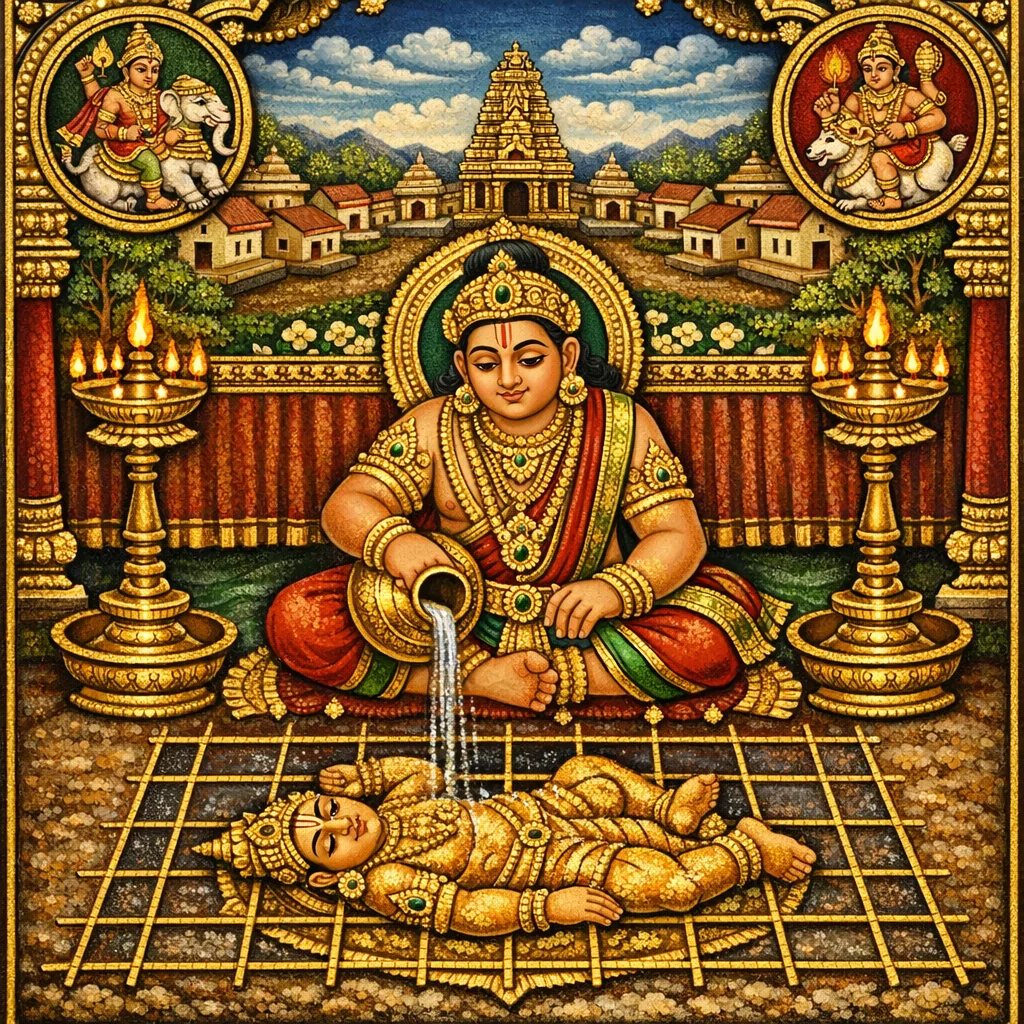
Adhyaya 39
Chapter 39 — भूपरिग्रहविधानम् (Bhū-parigraha-vidhāna: Procedure for Acquiring and Ritually Securing Land)
Hayagrīva sets forth a ritual-technical program centered on pratiṣṭhā (consecration) and its prerequisites, beginning with the lawful acquisition and purification of land. The chapter grounds authority in a Pañcarātra/Tantric lineage by listing key tantras (starting with the Hayśīrṣa Tantra), then addresses eligibility and right practice: who may perform consecration, what marks a false teacher, and how a true guru is known by tantric mastery rather than outward signs. It then gives vāstu-based planning: deities should face the settlement, and placements follow directional logic (Agni/fire, Yama, Caṇḍikā, Varuṇa, Vāyu, Nāga, Kubera/Guha, and Īśāna-sector deities). After architectural cautions on proportion and boundary limits, it prescribes bhūmi-śodhana and bhūta-bali offerings to remove obstructive beings, including scattering saktu in eight directions with the eight-syllable mantra, followed by ploughing and cow-treading to stabilize the site. The closing verses define a measurement chain (trasareṇu → hair-tip → louse → yava → aṅgula → kara → padma-hasta), linking ritual purity with precise construction science.
Shlokas
Verse 1
अवर्णनं नाम अष्टत्रिंशोध्यायः कृष्णाश्रये गता इति ख, घ, ङ, चिह्नितपुस्तकत्रयपाठः प्रतिष्ठाद्यमिति ख, ङ, चिह्नितपुस्तकद्वयपाठः अथोनचत्वारिंशो ऽध्यायः भूपरिग्रहविधानं हयग्रीव उवाच विष्ण्वादीनां प्रतिष्ठादि वक्ष्ये ब्रह्मन् शृणुष्व मे प्रोक्तानि पञ्चरातराणि सप्तरात्राणि वै मया
(Text-critical note:) “Chapter Thirty-Eight, called Avarṇana”—in the marked manuscripts (kha, gha, ṅa) the reading is “having gone to Kṛṣṇa as refuge”; in the marked manuscripts (kha, ṅa) the reading is “beginning with consecration (pratiṣṭhā)”. Now begins Chapter Thirty-Nine: “The procedure for acquiring (and ritually securing) land.” Hayagrīva said: “O Brahman, I shall explain the consecration and related rites for Viṣṇu and the other deities; listen to me. The observances of five nights and of seven nights have indeed been taught by me.”}]}{
Verse 2
व्यस्तानि मुनिभिर्लोके पञ्चविंशतिसङ्ख्यया हयशीर्षं तन्त्रमाद्यं तन्त्रं त्रैलोक्यमोहनं
In the world, the sages have set them forth as twenty-five in number. The Hayśīrṣa Tantra is the first—the Tantra that enchants the three worlds.
Verse 3
वैभवं पौष्करं तन्त्रं प्रह्रादङ्गार्ग्यगालवं नारदीयञ्च सम्प्रश्नं शाण्डिल्यं वैश्वकं तथा
Among the authoritative works are the Vaibhava treatise, the Pauṣkara Tantra, the Prahrāda, the Āṅgārgi and Gālava treatises, the Nāradiya, the Sampraśna, the Śāṇḍilya, and likewise the Vaiśvaka.
Verse 4
सत्योक्तं शौनकं तन्त्रं वासिष्ठं ज्ञानसागरं स्वायम्भुवं कपिलञ्च तार्क्षं नारायणीयकं
The Satyokta, the Śaunaka Tantra, the Vāsiṣṭha, the Jñānasāgara, the Svāyambhuva, the Kapila, the Tārkṣya, and the Nārāyaṇīyaka are to be recognized as authoritative works.
Verse 5
आत्रेयं नारसिंहाख्यमानन्दाख्यं तथारुणं बौधायनं तथार्षं तु विश्वोक्तं तस्य सारतः
The tradition (of prosody/text) is stated in its essential form as: the Ātreya; the work called Nārasiṃha; the work called Ānanda; likewise the Aruṇa; the Baudhāyana; the Ārṣa; and that which is called Viśvokta.
Verse 6
प्रतिष्ठां हि द्विजः कुर्यान्मध्यदेशादिसम्भवः नकच्छदेशसम्भूतः कावेरीकोङ्कणोद्गतः
Indeed, the consecration (pratiṣṭhā) should be performed by a twice-born (brāhmaṇa) originating from Madhyadeśa and related approved regions—not by one born in Kaccha, nor by one coming from the Kāverī region or from the Koṅkaṇa.
Verse 7
कामरूपकलिङ्गोप्त्यः काञ्चीकाश्मीरकोशलः आकाशवायुतेजोम्बु भूरेताः पञ्च रात्रयः
Kāmarūpa, Kaliṅga, Utkala (Orissa), Kāñcī, Kāśmīra, and Kośala; and likewise the five “nights” are: ether, wind, fire, water, and earth—together with retas (seed/essence).
Verse 8
अचैतन्यास्तमोद्रिक्ताः पञ्चरात्रविवर्जितं ब्रह्माहं विष्णुरमल इति विद्यात्स देशिकः
A (so-called) teacher should be recognized as one devoid of true spiritual awareness, dominated by tamas, and bereft of the Pañcarātra tradition—if he proclaims, “I am Brahmā; I am the stainless Viṣṇu.”
Verse 9
सर्वलक्षणहीणोपि स गुरुस्तन्त्रपारगः चैश्वरं तथेति ग, ङ, घ, चिह्नितपुस्तकत्रयपाठः तथाष्टाङ्गमिति ख, ङ, चिह्नितपुस्तकद्वयपाठः काश्मीरके स्थित इति ग, चिह्नितपुस्तकपाठः नगराभिमुखाः स्थाप्या देवा न च पराङ्मुखाः
Even if he lacks all (external) marks of qualification, he is to be regarded as the guru if he is fully proficient in the Tantra. The deities should be installed facing toward the city (the settlement and its people), and not facing away.
Verse 10
कुरुक्षेत्रे गयादौ च नदीनान्तु समीपतः ब्रह्मा मध्ये तु नगरे पूर्वे शक्रस्य शोभनं
At Kurukṣetra and at Gayā and other such holy places, and near the banks of rivers; in the midst of the city is (the shrine of) Brahmā, and to the east is the splendid (shrine) of Śakra (Indra).
Verse 11
अग्नावग्नेश् च मातॄणां भूतानाञ्च यमस्य च दक्षिणे चण्डिकायाश् च पितृदैत्यादिकस्य च
In the fire altar are the portions/offerings for Agni and for Agneśa; and also for the Mothers (Mātṛkās), for the Bhūtas (spirits), and for Yama. On the southern side are the portions/offerings for Caṇḍikā, for the Pitṛs (ancestors), and for the Daityas and the like.
Verse 12
वैरृते मन्दिरं कुर्यात् वरुणाददेश् च वारुणे वायोर् नागस्य वायव्ये सौम्ये यक्षगुहस्य च
In the south‑west quarter one should build a shrine/house; in the west (the Vāruṇa quarter) place Varuṇa and the other deities of that direction; in the north‑west (vāyavya) place Vāyu and the Nāga; and in the north (saumya) place the Yakṣa (Kubera) and Guha (Kārttikeya).
Verse 13
चण्डीशस्य महेशस्य ऐशे विष्णोश् च सर्वशः पूर्वदेवकुलं पीड्य प्रासादं स्वल्पकं त्वथ
For Caṇḍīśa (a fierce form of Śiva) and for Maheśa, in the Īśa (north‑east) sector, and likewise for Viṣṇu in every respect—having set aside and adjusted as needed the earlier deity‑enclosure (pūrvadeva‑kula)—one should then construct a comparatively small shrine (prāsāda).
Verse 14
समं वाप्यधिकं वापि न कर्तव्यं विजानता उभयोर्द्विगुणां सीमां त्यक्त्वा चोच्छ्रयसम्मितां
A knowledgeable builder should make the measure neither exactly equal nor excessive; having set aside the doubled boundary‑limit on both sides, he should adopt a proportion commensurate with the prescribed height.
Verse 15
प्रासादं कारयेदन्यं नोभयं पीडयेद्बुधः भूमौ तु शोधितायां तु कुर्याद्भुमिपरिग्रहं
A wise man should have another (new) building constructed and should not cause distress to either party. Only when the ground has been purified should he formally take possession of the land.
Verse 16
प्राकारसीमापर्यन्तं ततो भुतबलिं हरेत् माषं हरिद्राचूर्णन्तु सलाजं दधिसक्तुभिः
Then, up to the boundary of the enclosing wall (of the ritual area), one should perform the bhūta‑bali, the offering for bhūtas (spirits/elemental beings): offer māṣa (black gram), turmeric powder, and salāja (parched rice), together with dadhi (curds) and saktu (a flour‑mixture).
Verse 17
अष्टाक्षरेण सक्तूंश् च पातायित्वाष्टदिक्षु च राक्षसाश् च पिशाचाश् च येस्मिंस्तिष्ठन्ति भूतले
While reciting the eight-syllabled mantra and scattering saktū (parched grain) to the eight directions, the rākṣasas and piśācas—whoever dwell upon the earth’s surface in that place—are thereby driven away.
Verse 18
सर्वे ते व्यपगच्छन्तु स्थानं कुर्यामहं हरेः हलेन वाहयित्वा गां गोभिश् चैवावदारयेत्
“Let all those (obstacles/impurities) depart. I shall prepare the place of Hari. Having yoked the bull to the plough, one should plough the ground with the plough, and likewise have it trodden/cleared by cows.”
Verse 19
प्रमाण्वष्टकेनैव त्रसरेणुः प्रकीर्त्यते
A trasareṇu is declared to consist of eight pramāṇus.
Verse 20
तैर् अष्टभिस्तु बालाग्रं लिख्या तैर् अष्टभिर्मता ताभिर्यूकाष्टभिः ख्याता ताश्चाष्टौ यवमध्यमः
Eight of those (units) constitute the tip of a hair (bālāgra); eight of those are held to make a louse (yūkā). Eight such (louse-units) are known as a yava of medium size (yavamadhyama).
Verse 21
नद्यद्रिषु इति ख, ग, ङ, चिह्नितपुस्तकत्रयपाठः यवाष्टकैर् अङ्गुलं स्याच्चतुर्विंशाङ्गुलः करः चतुरङ्गुलसंयुक्तः स हस्तः पद्महस्तकः
In the three marked manuscripts (kha, ga, and ṅa) the reading is “nadyadriṣu.” An aṅgula is defined as eight yavas (barley-grains). A kara measures twenty-four aṅgulas. When increased by four aṅgulas, that measure is called a hasta, specifically the “padma-hasta.”
Frequently Asked Questions
To define how land is ritually secured and purified as a prerequisite for deity consecration (pratiṣṭhā), integrating vāstu orientation, apotropaic offerings, and construction measurements.
It couples bhūmi-śodhana and bhūta-bali (removal of obstacles) with strict directional placements and a formal metrology (yava–aṅgula–hasta), showing that sacred presence depends on both purity and precision.
Because correct consecration is treated as a technical-sacred operation; mastery of the tantra ensures orthopraxy, while mere outward signs can mask tamasic or non-Pañcarātra deviations.