Adhyaya 35
Chapter 35: पवित्राधिवासनादिविधिः (Method of Consecrating the Pavitra and Related Rites)
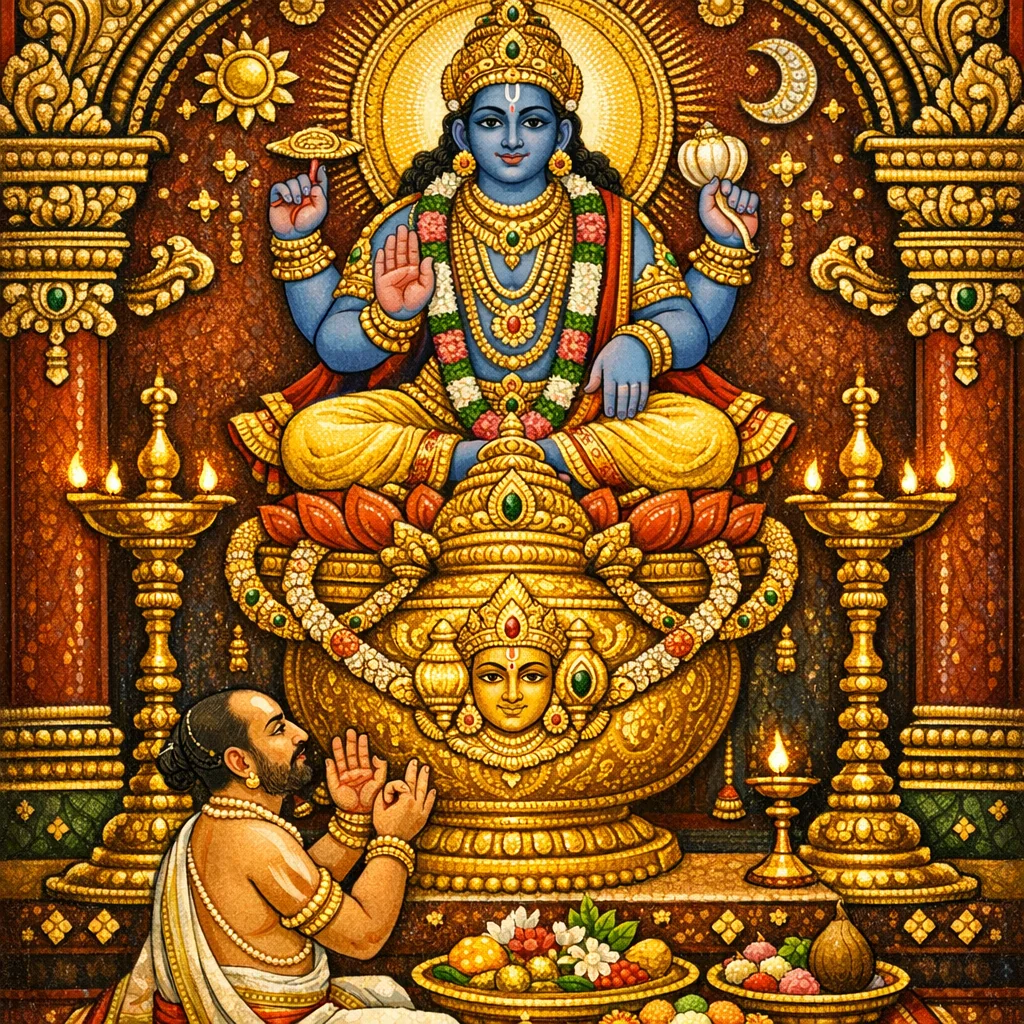
Lord Agni instructs Sage Vasiṣṭha in the adhivāsana (consecratory installation) of pavitras and the protective and preparatory rites around them. The rite begins with sampāta purification—homa oblations and sprinkling—then mantra-empowerment with the Narasiṃha mantra and concealment/protection through the Astra mantra. Ritual vessels are wrapped, set in place, sprinkled with bilva-infused water, and re-energized by mantra repetition. Spatial liturgy is stressed: protective acts are stationed beside the kumbha; implements are assigned to directions and linked to the Vyūhas (Saṅkarṣaṇa, Pradyumna, Aniruddha), with purificants such as ash with sesame, cow-dung, and clay marked by svasti-mudrā. Further placements employ hṛdaya/śiras/śikhā mantras for darbha-water, incense, and directional offerings; a puṭikā holds sandal, water, akṣata, curd, and dūrvā. The house is cordoned with a triple thread, mustard seeds are scattered, doors are propitiated, and a Viṣṇu-kumbha rite produces ‘Viṣṇu-tejas’ that destroys sins. The pavitra is offered with gandha-puṣpa-akṣata—first to the guru and parivāra, then to Hari with a root-mantra—followed by prayer, bali-offerings, kumbha preparation, maṇḍala readiness, night vigil with Purāṇa recitation, and stated allowances/limits for certain participants, never omitting the gandha-pavitraka.
Shlokas
Verse 1
इत्य् आदिमहापुराणे आग्नेये अग्निकार्यकथनं नाम चतुर्त्रिंशो ऽध्यायः अथ पञ्चत्रिंशो ऽध्यायः पवित्राधिवासनादिविधिः अग्निर् उवाच सम्पाताहुतिनासिच्य पवित्राण्यधिवासयेत् नृसिंहमन्त्रजप्तानि गुप्तान्यस्त्रेण तानि तु
Thus, in the Agni Purāṇa, the thirty-fourth chapter entitled “Account of the Fire-ritual Procedures” concludes. Now begins the thirty-fifth chapter: “The method of adhivāsana (consecration and installation) of the pavitra and related rites.” Agni said: “Having sprinkled (them) with the oblation called sampāta, one should consecrate and install the pavitras. Having recited the Narasiṃha mantra over them, one should then conceal and protect them by means of the Astra (weapon-protection) mantra.”
Verse 2
वस्त्रसंवेष्टितान्येव पात्रस्थान्यभिमन्त्रयेत् विल्वाद्यद्भिः प्रोक्षितानि मन्त्रेण चैकधा द्विधा
He should consecrate by mantra-recitation the vessels, wrapped in cloth and placed in their proper positions; and, having sprinkled them with water containing bilva and other purifying substances, he should again empower them with the mantra—once or twice.
Verse 3
कुम्भपार्श्वे तु संस्थाप्य रक्षां विज्ञाप्य देशिकः दन्तकाष्ठञ्चामरकं पूर्वे सङ्कर्षणेन तु
Having positioned the protective rite (rakṣā) beside the ritual water-pot (kumbha), the officiating preceptor (deśika) should formally announce and invoke that protection; and in the eastern direction the tooth-stick for purification (dantakāṣṭha) and the fly-whisk (cāmara) should be placed, in connection with Saṅkarṣaṇa.
Verse 4
प्रद्युम्नेन भस्मतिलान् दक्षे गोमयमृत्तिकां स्वस्तिमुद्रयेति ङ, चिह्नितपुस्तकपाठः पञ्चवक्त्रंश्चेति ङ, चिह्नितपुस्तकपाठः सङ्घाताहुतिनासिच्येति ङ, चिह्नितपुस्तकपाठः मन्त्राणां चैकधा द्विधेति ख, चिहिनितपुस्तकपाठः वारुणेन चानिरुद्धेन सौम्ये नारायणेन च
With (the mantra/form of) Pradyumna one should apply ash mixed with sesame as a purificatory unction; on the right side one should apply cow-dung and clay, sealing it with the Svasti-mudrā. With (the form of) Vāruṇa and with Aniruddha, and in the auspicious rite with Nārāyaṇa as well—thus the mantras are to be employed as a single set or divided into two, according to the ritual arrangement.
Verse 5
दर्भोदकञ्चाथ हृदा अग्नौ कुङ्कुमरोचनं ऐशान्यां शिरसा धूपं शिखया नैरृतेप्यथ
Then, with the Heart (hṛdaya) mantra/nyāsa, one should place darbha-water; into the fire one should offer saffron (kuṅkuma) and yellow rocana. In the north-east (Īśāna), with the Head (śiras) mantra, one should place incense; and likewise in the south-west (Nairṛta), with the Topknot (śikhā) mantra.
Verse 6
मूलपुष्पाणि दिव्यानि कवचेनाथ वायवे चन्दनाम्ब्वक्षतदधिदूर्वाश् च पुटिकास्थिताः
Divine root-flowers should be kept together with the kavaca (protective amulet); and likewise for the deity Vāyu—sandal paste, water, unbroken rice-grains (akṣata), curd, and dūrvā grass—arranged and kept in a small container (puṭikā).
Verse 7
गृहं त्रिसूत्रेणावेष्ट्य पुनः सिद्धार्थकान् क्षिपेत् दद्यात्पूजाक्रमेणाथ स्वैः स्वैर् गन्धपवित्रकं
Having encircled the house with a triple-thread cord (trisūtra), one should again scatter white mustard seeds (siddhārthaka); then, in the prescribed order of worship, one should offer the appropriate fragrances and consecrated purifying substances (pavitra), each according to its proper rite.
Verse 8
मन्त्रैर् वै द्वारपादिभ्यो विष्णुकुम्भे त्वनेन च विष्णुतेजोभवं रम्यं सर्वपातकनाशनं
Indeed, by mantras offered to the doorway (and its guardians) and likewise by this rite for the Viṣṇu-kumbha (Viṣṇu’s consecration-pot), there arises a lovely radiance born of Viṣṇu’s splendor, which destroys all sins.
Verse 9
सर्वकामप्रदं देवं तवाङ्गे धारयाम्यहं सम्पूज्य धूपदीपाद्यैर् व्रजेद्द्वारसमीपतः
“Upon your body I install that deity who grants all desired aims.” Having duly worshipped with incense, lamps, and the like, one should then proceed to the vicinity of the (ritual/temple) doorway.
Verse 10
गन्धपुष्पाक्षतोपेतं पवित्रञ्चाखिलेर्पयेत् पवित्रं वैष्णवं तेजो महापातकनाशनं
One should offer the pavitra (sacred thread/garland) together with fragrance, flowers, and unbroken rice (akṣata), dedicating it wholly. This Vaiṣṇava pavitra is a radiant spiritual power that destroys even the great sins (mahāpātakas).
Verse 11
धर्मकामार्थसिद्ध्यर्थं स्वकेङ्गे धारयाम्यहं आसने परिवारादौ गुरौ दद्यात् पवित्रकं
“For the attainment of dharma, kāma, and artha, I bear (this) upon my own body.” One should first offer the pavitraka (consecrated ring/cord of sanctification) to the guru, and then, at the outset, to the āsana and to the attendant deities (parivāra-devatās).
Verse 12
गन्धादिभिः समभ्यर्च्य गन्धपुष्पाक्षतादिमत् विष्णुतेजोभवेत्यादिमूलेन हरयेर्पयेत्
After duly worshipping with fragrances and the like—together with perfume, flowers, akṣata (unbroken rice-grains), and other offerings—one should present them to Lord Hari using the root-mantra beginning with “viṣṇu-tejo-bhavet…”.
Verse 13
वह्निस्थाय ततो दत्वा देवं सम्प्रार्थयेत्ततः क्षीरोदधिमहानागशय्यावस्थितविग्रहः
Then, remaining by the sacred fire and having made the offering, one should thereafter earnestly pray to the Lord, whose manifested form abides upon the great serpent couch in the Ocean of Milk.
Verse 14
प्रातस्त्वां पूजयिष्यामि सन्निधौ भव केशव इन्द्रादिभस्ततो दत्वा विष्णुपार्षदके बलिं
“In the morning I shall worship You. Be present here, O Keśava.” Then, after offering a bali-oblation to Indra and the other deities, one should give a bali-offering to the attendants of Viṣṇu (viṣṇu-pārṣadas).
Verse 15
ततो देवाग्रतः कुम्भं वासोयुगसमन्वितं रोचनाचन्द्रकाश्मीरगन्धाद्युदकसंयुतं
Then, in front of the deity, one should place a ritual jar (kumbha), furnished with a pair of cloths, and filled with water infused with rocanā, camphor, saffron, and other fragrant substances.
Verse 16
गन्धपुष्पादिनाभूष्य मूलमन्त्रेण पूजयेत् पवित्रं पार्श्वतो नयेदिति ङ, चिह्नितपुस्तकपाठः मण्डपाद्वहिरागत्य विलिप्ते मण्डलत्रये
Having adorned the worship-site/deity with perfumes, flowers, and the like, one should worship with the root-mantra (mūla-mantra). The consecrated kuśa-grass ring (pavitra) should be placed to the side—so reads the ṅa-marked variant in certain annotated manuscripts. Then, coming out from the maṇḍapa, one proceeds when the three ritual maṇḍalas have been freshly plastered/smeared and prepared.
Verse 17
पञ्चगव्यञ्चरुन्दन्तकाष्ठञ्चैव क्रमाद्भवेत् पुराणश्रवणं स्तोत्रं पठन् जागरणं निशि
In due order, one should make use of pañcagavya, the ritual caru-offering, and a tooth-stick; and during the night one should keep vigil—listening to Purāṇic recitation and chanting hymns (stotra).
Verse 18
परप्रेषकबालानां स्त्रीणां भोगभुजां तथा सद्योधिवासनं कुर्याद्विना गन्धपवित्रकं
For children sent by others, for women, and likewise for those engaged in enjoying sensual pleasures, one may prescribe immediate perfuming/odor-removal; but it should not be done without the gandha-pavitraka, the consecrated ‘fragrant purifier/amulet’.
Frequently Asked Questions
The chapter emphasizes procedural sequencing and spatial liturgy: sampāta sprinkling, Narasiṃha-mantra empowerment, Astra-mantra protection, vessel-wrapping and placement, bilva-water sprinkling, directional assignments (Īśāna/Nairṛta/Vāyu), and Vyūha-linked placements (Saṅkarṣaṇa/Pradyumna/Aniruddha/Nārāyaṇa) culminating in the Viṣṇu-kumbha and pavitra offering.
By framing meticulous consecration and protection rites as generators of Viṣṇu-tejas that destroys sins (including mahāpātakas), the chapter links correct ritual discipline to purification, dharmic ordering of space and body, and devotion to Hari—supporting both auspicious living (bhukti) and spiritual readiness for liberation (mukti).
The Viṣṇu-kumbha functions as a consecration focus that, when worshipped with mantras and offerings, is said to manifest Viṣṇu’s radiance (tejas), described as sin-destroying and spiritually beautifying.
Yes. The text allows immediate perfuming/odor-removal rites for certain categories (e.g., children sent by others, women, and those engaged in sensual enjoyment), but explicitly states it should not be performed without the gandha-pavitraka.