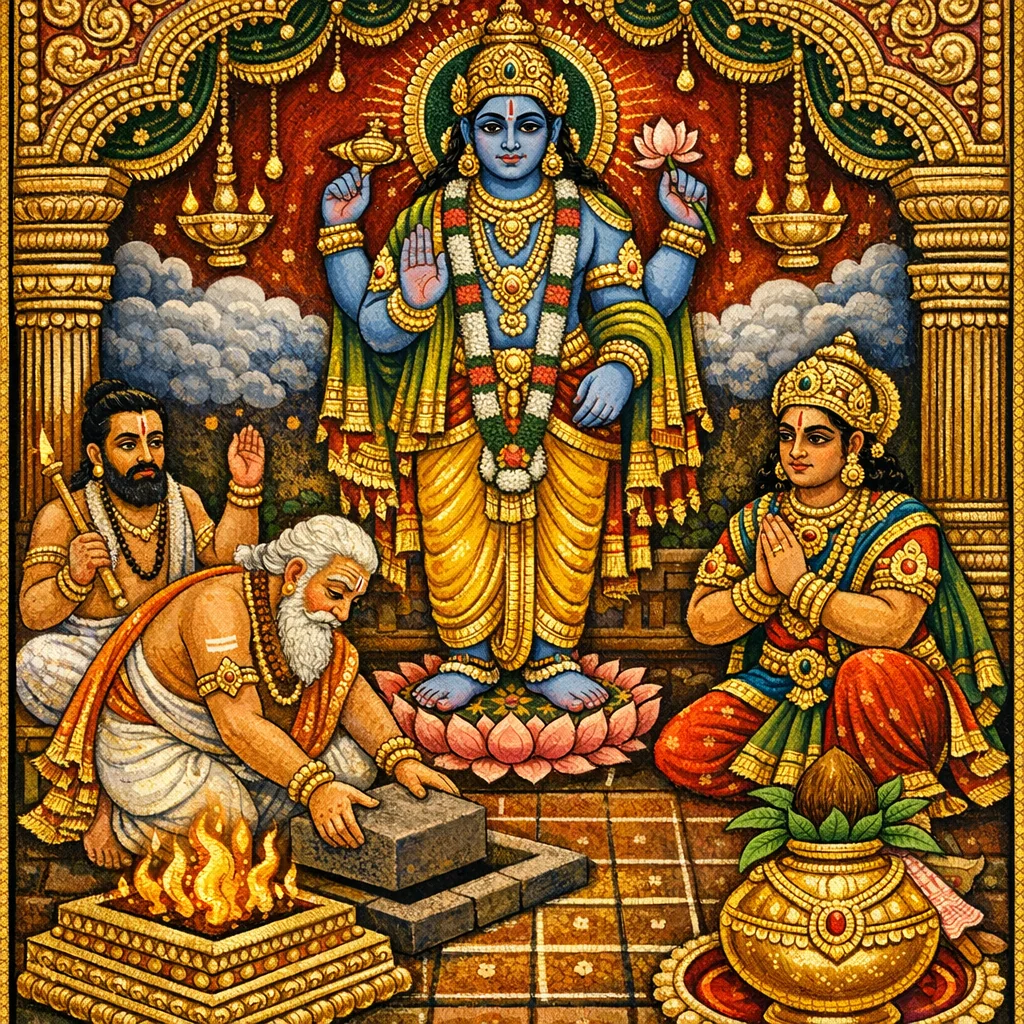
Adhyaya 41
Chapter 41 — शिलाविन्यासविधानं (The Procedure for Laying the Stones / Foundation Setting)
Agni opens the teaching on śilā-vinyāsa and pāda-pratiṣṭhā, treating temple building as a consecratory rite rather than mere engineering. The chapter lays out the sequence: prepare the maṇḍapa and ritual arrangements; perform kumbha-nyāsa and iṣṭakā-nyāsa; fix door-pillar proportions; partly refill the excavation and worship Vāstu on a leveled surface. It gives material standards (well-fired bricks measured in aṅgulas) and an alternative stone-based installation using multiple kumbhas. Purificatory waters (pañca-kaṣāya, sarvauṣadhi-jala, gandha-toya) and Vedic mantra sets (Āpo hi ṣṭhā, Śaṃ no devī, Pavamanī, Varuṇa hymns), with Śrī-sūkta, accompany the joining and stabilizing of stones. A fire-rite follows with āghāra, ājya-bhāga, vyāhṛti oblations, and prāyaścitta provisions. The officiant maps deities and śaktis onto bricks and directions, performs garbhādhāna at the center, installs womb-vessels containing metals, gems, and weapons, invokes Earth in a lotus-shaped copper vessel, and completes pit rites (sprinkling gomūtra, night-time garbhādhāna, and gifting). The chapter closes with pīṭha-bandha proportions, repeating vāstu-yajña after completion, praising the merit of temple intention and construction, and giving directional rules for village gateways.
Shlokas
Verse 1
इत्य् आदिमहापुराणे आग्नेये अर्घ्यदानकथनं नाम चत्वारिंशो ऽध्यायः अथैकचत्वारिंशो ऽध्यायः शिलाविन्यासविधानं भगवानुवाच पादप्रतिष्ठां वक्षामि शिलाविन्यासलक्षणं अग्रतो मण्डपः कार्यः कुण्डलानान्तु चतुष्टयं
Thus, in the Agni Purāṇa—within the Primordial Mahāpurāṇa—ends the fortieth chapter entitled “The Account of Offering Arghya.” Now begins the forty-first chapter: “The Procedure for Laying the Stones (Foundation Setting).” The Blessed Lord said: “I shall explain the installation of the base (pāda-pratiṣṭhā) and the defining rules for the placement of stones. In front, a maṇḍapa (ritual pavilion) should be constructed; and a set of four kuṇḍalāni (ritual rings/loops) is to be arranged.”
Verse 2
कुम्भन्यासेष्टकान्यासो द्वारस्तम्भोच्छ्रयं शुभं पादोनं पूरयेत् खातं तत्र वास्तुं यजेत् समे
After performing kumbha-nyāsa (the placement of the consecration pot) and iṣṭakā-nyāsa (the setting of the bricks), one should establish the auspicious height of the door-pillars. Having filled the excavated pit up to a level one quarter less than full (pāda-ūna), one should then worship Vāstu upon an even, level surface.
Verse 3
इष्टकाश् च सुपक्वाः स्युर्द्वादशाङ्गुलसम्मिताः सविस्तारत्रिभागेन वैपुल्येन समन्विताः
Bricks should be well-fired, measuring twelve aṅgulas in length, with a breadth equal to one-third of that length, and furnished with an appropriate thickness (depth).
Verse 4
करप्रमाणा श्रेष्ठा स्याच्छिलाप्यथ शिलामये नव कुम्भांस्ताम्रमयान् स्थापयेदिष्टकाघटान्
A measure based on the span of the hand (karapramāṇa) is considered the best. And if the structure is of stone, then in the stone-built setting one should install nine copper water-pots, as well as pots made of bricks.
Verse 5
अद्भिः पञ्चकषायेण सर्वौषधिजलेन च गन्धतोयेन च तथा कुम्भैस्तोयसुपूरितैः
With water—also with the fivefold decoction, with water infused with all medicinal herbs, and likewise with scented water; and with pitchers (kumbhas) completely filled with water.
Verse 6
हिरण्यव्रीहिसंयुक्तैर् गन्धचन्दनचर्चितैः आपो हि ष्ठेति तिसृभिः शन्नो देवीति चाप्यथ
Then, with water mixed with gold and rice-grains, and perfumed with fragrance and sandalpaste, one should perform the rite while reciting the three verses beginning “Āpo hi ṣṭhā …”, and also the mantra beginning “Śaṃ no devī …”.
Verse 7
तरत् समन्दीरिति च पावमानीभिरेव च उदुत्तमं वरुणमिति कथानश् च तथैव च
Also one should recite the hymn beginning “Tarat samandīri…”, together with the Pavamanī hymns; likewise the hymn beginning “Uduttamaṃ Varuṇam…”, and also “Kathā naḥ…”, in the same manner.
Verse 8
सुविस्तारं विभागेन नैपुण्यनेति ख, चिह्नितपुस्तकपाठः शिला स्यान्न शिलामये इति ग, चिह्नितपुस्तकपाठः भवतत्समन्दीरितीति ख, ग, ङ, चिह्नितपुस्तकद्वयपाठः वरुणस्येति मन्त्रेण हंसः शुचिषदित्यपि श्रीसूक्तेन तथा शिलाः संस्थाप्य संघटाः
With detailed division and skilled procedure (as read in certain marked manuscripts), the stones are to be installed and then firmly joined together, employing the mantra beginning “varuṇasya…”, as well as the mantras “haṃsaḥ…”, “śuciṣad…”, and also the Śrī-sūkta.
Verse 9
शय्यायां मण्डपे प्राच्यां मण्डले हरिमर्चयेत् जुहुयाज्जनयित्वाग्निं समिधो द्वादशीस्ततः
In the pavilion, on the eastern side, upon the maṇḍala (ritual diagram) and the prepared couch/altar-seat, one should worship Hari (Viṣṇu). Then, having kindled the sacred fire, one should offer oblations (homa), and thereafter present twelve (sets of) fuel-sticks (samidh).
Verse 10
आघारावाज्यभागौ तु प्रणवेनैव कारयेत् अष्टाहुतीस् तथाष्टान्तैर् आज्यं व्याहृतिभिः क्रमात्
One should perform the two āghāra libations and the two ghee-portions (ājya-bhāga) with the syllable Oṃ alone. Then, in proper sequence, one should offer eight ghee oblations with the vyāhṛtis, and likewise conclude with the final vyāhṛti formulas.
Verse 11
लोकेशानामग्नये वै सोमायावग्रहेषु च पुरुषोत्तमायेति च व्याहृतीर्जुहुयात्ततः
Then one should offer oblations into the fire, uttering the vyāhṛtis: “to Agni, indeed”; “to Soma”; “among the Avagrahas, the seizers”; and “to Puruṣottama”.
Verse 12
प्रायश्चित्तं ततः पूर्णां मूर्तिमांसघृतांस्तिलान् वेदाद्यैर् द्वादशान्तेन कुम्भेषु च पृथक् पृथक्
Thereafter, for the expiatory rite (prāyaścitta), one should prepare separate pots, each filled to the full with the prescribed offerings—an effigy or substitute form (mūrti), meat, ghee, and sesame. The rite is to be performed with Vedic recitations, beginning with the Veda and concluding with the twelvefold/“twelve” ending (dvādaśa), keeping each item distinct in its own vessel.
Verse 13
प्राङ्मुखस्तु गुरुः कुर्यादष्टदिक्षु विलिप्य च मध्ये चैकां शिलां कुम्भं न्यसेदेतान् सुरान् क्रमात्
Facing east, the teacher (officiant) should arrange the ritual ground; having smeared the prescribed markings in the eight directions, he should place in the center a single stone-slab and the kalaśa (ritual water-pot), and then install these deities in due order.
Verse 14
पद्मं चैव महापद्मं मकरं कच्छपं तथा कुमुदञ्च तथा नन्दं पद्मं शङ्खञ्च पद्मिनीं
Also, one should depict or arrange the lotus, the great lotus (mahāpadma), the makara, and likewise the tortoise (kacchapa); also the kumuda-lotus and the emblem called Nanda; again the lotus, the conch (śaṅkha), and the emblem called Padminī.
Verse 15
कुम्भान्न चालयेत्तेषु इष्टकानान्तु देवताः ईशानान्ताश् च पूर्वादाविष्टकां प्रथमं न्यसेत्
One should not move the ritual pitchers (kumbhas). In those placements, the deities are to be installed upon the altar-bricks (iṣṭakās), with Īśāna and the others in their respective quarters; and beginning from the east one should first place the brick.
Verse 16
शक्तयो विमलाद्यास्तु इष्टकानान्तु देवताः न्यसनीया यथा योगं मध्ये न्यस्या त्वनुग्रहा
The Śaktis beginning with Vimalā, and the deities of the consecrated bricks (iṣṭakās), should be installed by nyāsa in the proper sequence and arrangement; and in the middle one should install Anugrahā, the power of divine grace.
Verse 17
अव्यङ्गे चाक्षत पूर्णं मुनेरङ्गिरसः सुते इष्टके त्वं प्रयच्छेष्टं प्रतिष्ठां कारयाम्यहं
And place it upon an unblemished limb, filled with unbroken rice-grains (akṣata). O son of the sage Aṅgiras—O Iṣṭakā, consecrated brick—grant the desired boon; I shall cause your installation, the pratiṣṭhā, to be performed.
Verse 18
मन्त्रेणानेन विन्यस्य इष्टका देशक्रमोत्तमः सम्युता इति ङ, चिह्नितपुस्तकपाठः अष्टाहुतीप्लथा पूर्णैर् आज्यमिति ग, घ, ङ, इति पुस्तकत्रयपाठः सोमाय च ग्रहाय चेति ङ, चिह्नितपुस्तकपाठः द्वादशार्णेन इति ख, चिह्नितपुस्तकपाठः गर्भाधानं ततः कुर्यान्मध्यस्थाने समाहितः
Having placed the bricks (iṣṭakās) with this mantra, in the best sequence according to their proper locations, one should then—collected and attentive—perform the rite called “garbhādhāna” at the central spot of the altar/structure. (The transmitted readings also mention offering ghee in the full set of eight oblations, invocations “to Soma and to Graha,” and the use of a twelve-syllabled formula.)
Verse 19
कुम्भोपरिष्ठादेवेशं पद्मिनीं न्यस्य देवतां मृत्तिकाश् चैव पुष्पाणि धातवो रत्नमेव च
Upon the top of the ritual pot (kumbha), one should install the Lord of the gods together with the Lotus-goddess Padminī; and one should also place there clay, flowers, metals, and likewise a gemstone.
Verse 20
लौहानि दिक्पतेरस्त्रं यजेद्वै गर्भभाजने द्वादशाङ्गुलविस्तारे चतुरङ्गुलकोच्छ्रये
One should ritually consecrate the iron weapon of the Lord of the Directions, placing it in a womb-like receptacle (garbha-vessel), twelve finger-breadths wide and raised to a height of four finger-breadths.
Verse 21
पद्माकारे ताम्रमये भाजने पृथिवीं यजेत् एकान्ते सर्वभूतेशे पर्वतासनमण्डिते
In a lotus-shaped copper vessel, one should worship the Earth principle (Pṛthivī). This is to be done in a secluded place, before Sarvabhūteśa, the Lord of all beings, adorned with a mountain-seat (parvata-āsana).
Verse 22
समुद्रपरिवारे त्वं देवि गर्भं समाश्रय नन्दे नन्दय वासिष्ठे वसुभिः प्रजया सह
O Goddess, surrounded by the Ocean and its retinue, take refuge in the womb (garbha) and protect that womb. O Nandā, gladden and bless the Vāsiṣṭha lineage with the Vasus, together with progeny.
Verse 23
जये भार्गवदायादे प्रजानां विजयावहे पूर्णेङ्गिरसदायादे पूर्णकामं कुरुष्व मां
O Jayā, heir of Bhṛgu, bestower of victory upon the people; O Pūrṇā, heir of Aṅgiras—make me one whose desires are completely fulfilled.
Verse 24
भद्रे काश्यपदायादे कुरु भद्रां मतिं मम सर्ववीजसमायुक्ते सर्वरत्नौषधीवृते
O Auspicious One, descendant of Kaśyapa, make my understanding auspicious. O You who are endowed with all seed-mantras (bīja-mantras) and encompassed by all jewels and medicinal herbs.
Verse 25
जये सुरुचिरे नन्दे वासिष्ठे रम्यतामिह प्रजापतिसुते देवि चतुरस्रे महीयसि
O Victorious One; O radiant and beautiful One; O Nandā; O Vāsiṣṭhī—be gracious and delight here. O Goddess, daughter of Prajāpati; O Four-cornered One; O Great and venerable One!
Verse 26
सुभगे सुप्रभे भद्रे गृहे काश्यपि रम्यतां पूजिते परमाश् चर्ये गन्धमाल्यैर् अलङ्कृते
O fortunate One, O radiant One, O auspicious Goddess of the house—O Kāśyapī—may you delight in this home, worshipped and most wondrous, adorned with perfumes and garlands.
Verse 27
भवभूतिकरी देवि गृहे भार्गवि रम्यतां देशस्वामिपुरस्वामिगृहस्वामिपरिग्रहे
O Goddess Bhārgavī, bestower of prosperity and well-being, be graciously pleased to dwell delightfully in this house—within the holdings under the authority of the lord of the land, the lord of the city, and the lord of this house.
Verse 28
मनुष्यादिकतुष्ट्यर्थं पशुवृद्धिकरी भव एवमुक्त्वा ततः खातं गोमूत्रेण तु सेचयेत्
Saying, “Become the cause of satisfaction for people and the rest, and bring about the increase of livestock,” one should then sprinkle the dug pit with cow’s urine.
Verse 29
कृत्वा निधापयेद्गर्भं गर्भाधानं भवेन्निशि गोवस्त्रादि प्रदद्याच्च गुरवेन्येषु भोजनं
Having performed the prescribed act, one should place (the intention for) conception; the rite of Garbhādhāna is to be done at night. One should also give gifts such as a cow and garments, and provide a meal for the guru and for others as well.
Verse 30
रसमेव चेति ग घ ङ चिह्नितपुस्तकद्वयपाठः प्रिययेति ग, चिह्नितपुस्तकपाठः गर्भं न्यस्येष्टका न्यस्य ततो गर्भं प्रपूरयेत् पीठबन्धमतः कुर्यान्मितप्रासादमानतः
After placing the garbha (the sanctum’s core chamber/foundation cavity) and laying the bricks, one should completely fill the garbha. Thereafter one should construct the pīṭha-bandha (the plinth-bonding/base moulding course) in accordance with the measured proportions of the temple.
Verse 31
पीठोत्तमञ्चोच्छ्रयेण प्रासादस्यार्धविस्तरात् पदहीनं मध्यमं स्यात् कनिष्ठं चोत्तमार्धतः
Measured by the height of the pīṭha (plinth) and the uttamañca (upper platform), the prāsāda’s (temple superstructure’s) breadth is set at one half as the standard. Reduced by one pada (module), it is the ‘medium’ type; and the ‘small’ type is reckoned as half of the ‘best’.
Verse 32
पीठबन्धोपरिष्ठात्तु वास्तुयागं पुनर्यजेत् पादप्रतिष्ठाकारी तु निष्पापो दिवि मोदते
After the pīṭha-bandha (plinth-bonding) has been completed, one should perform the Vāstu-yajña again. The performer of the pāda-pratiṣṭhā (foundation/footing consecration) becomes free from sin and rejoices in heaven.
Verse 33
देवागारं करोमीति मनसा यस्तु चिन्तयेत् तस्य कायगतं पापं तदह्ना हि प्रणश्यति
Whoever, merely in the mind, forms the intention—“I shall build a temple, a devāgāra, for the Deity”—for him the sin that has accrued to the body is indeed destroyed on that very day.
Verse 34
कृते तु किं पुनस्तस्य प्रासादे विधिनैव तु अष्टेष्टकसमायुक्तं यः कुर्याद्देवतालयं
And in the Kṛta age—how much more so—if one, following the prescribed rule, constructs within that prāsāda a shrine of the Deity furnished with the ‘eight bricks’ (aṣṭeṣṭakā), the merit is exceedingly great.
Verse 35
न तस्य फलसम्पत्तिर्वक्तुं शक्येत केनचित् अनेनैवानुमेयं हि फलं प्रासादविस्तरात्
No one can fully describe the abundance of its rewards; indeed, the merit is to be inferred from this alone—namely, from the extent and scale of the prāsāda (temple).
Verse 36
ग्राममध्ये च पूर्वे च प्रत्यग्द्वारं प्रकल्पयेत् विदिशासु च सर्वासु ग्रामे प्रत्यङ्मुखो भवेत् दक्षिणे चोत्तरे चैव पश्चिमे प्राङ्मुखो भवेत्
In the middle of the village and on its eastern side, one should construct a west-facing gateway. In all the intermediate directions as well, the village’s approach should be west-facing. But on the southern and northern sides, and on the western side, it should be east-facing.
Frequently Asked Questions
Precise construction-ritual sequencing and measurements: well-fired bricks of 12 aṅgulas with proportional breadth, defined pit-filling stages (one quarter less than full before Vāstu worship), prescribed garbha-vessel dimensions (12-aṅgula breadth and 4-aṅgula height), and proportional guidelines for pīṭha-bandha and prāsāda breadth classifications (uttama/madhyama/kanīṣṭha).
It sacralizes architecture through mantra, homa, expiation, and deity/śakti installation, teaching that correct intention (“I shall build a temple”), purity rites, and Vāstu alignment transform construction into dharma-sādhana that removes sin and accrues merit supportive of higher puruṣārthas.