Adhyaya 28
Abhiṣeka-vidhāna (The Procedure for Consecratory Bathing)
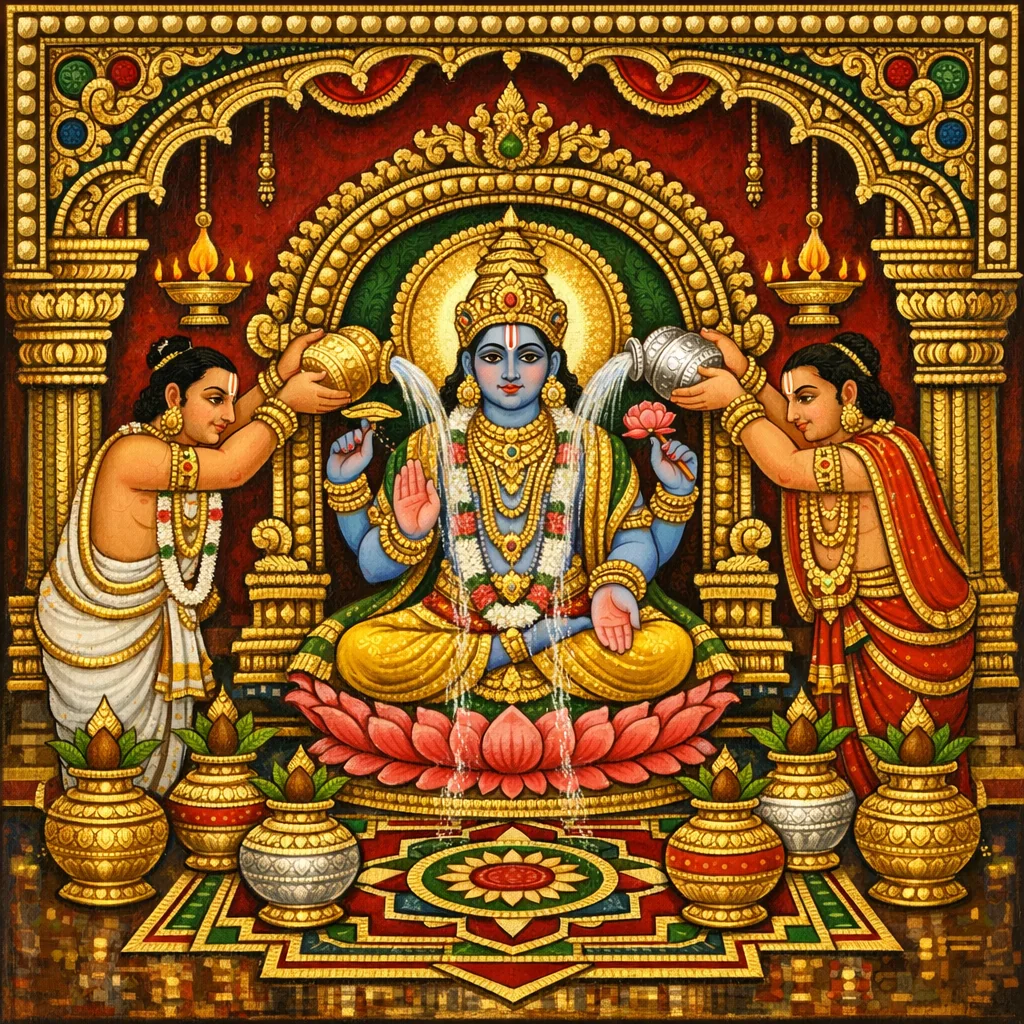
This chapter shifts from initiations to a focused teaching on abhiṣeka, the consecratory bathing rite that grants siddhi to the ācārya and the disciple-practitioner and also serves to relieve disease. Nārada outlines a carefully ordered ritual setting: jewel-adorned kumbhas bearing images are arranged in sequence from the center and then from the east, mapping the directions in a cosmological layout. The rite is strengthened by repetition—ideally a thousand times, or alternatively a hundred—indicating graded performance according to capacity. Within the maṇḍapa and maṇḍala, Viṣṇu is installed on a pedestal oriented to the east and north-east, aligning iconographic focus with vāstu spatial logic. The officiants and the putraka are prepared, worship is offered to the abhiṣeka itself, and the ceremony proceeds with auspicious sound such as gīta (songs/recitations). The chapter concludes with the transmission of yogapīṭha-related requisites and the guru’s declaration of samaya vows; secrecy and discipline qualify the disciple for the full privileges of the tradition.
Shlokas
Verse 1
ए इत्य् आदिमहापुराणे आग्नेये सर्वदीक्षाकथनं नाम सप्तविंशोध्यायः पशूनिति घ, चिह्नितपुस्तकपाठः तत् पुनरिति ख, ग, घ, ङ, चिह्नितपुस्तकचतुष्टयपाठः अथ अष्टाविंशोध्यायः अभिषेकविधानं नारद उवाच अभिषेकं प्रवक्ष्यामि यथाचार्यस्तु पुत्रकः सिद्धिभाक् साधको येन रोगी रोगाद्विमुच्यते
In the Agni Purāṇa, the twenty-seventh chapter is entitled “The Account of All Initiations (Sarva-dīkṣā-kathana).” (Variant readings are noted in marked manuscripts.) Now begins the twenty-eighth chapter, “The Procedure for Abhiṣeka (consecratory bathing).” Nārada said: “I shall teach the abhiṣeka, by which an ācārya and his disciple-practitioner become endowed with siddhi (success), and by which a sick person is released from disease.”
Verse 2
राज्यं राजा सुतं स्त्रीञ्च प्राप्नुयान्मलनाशनं मूर्तिकुम्भान् सुरत्नाढ्यान्मध्यपूर्वादितो न्यसेत्
By this impurity-destroying rite, a king obtains sovereignty; and one gains a son and a wife as well. He should place the image-bearing pots (mūrtika-kumbhas), richly adorned with fine jewels, beginning from the center and then proceeding from the eastern side onward.
Verse 3
सहस्रावर्तितान् कुर्यादथवा शतवर्तितान् मण्डपे मण्डले विष्णुं प्राच्यैशान्याञ्च पीठिके
He should prepare them as being repeated a thousand times—or else repeated a hundred times. In the pavilion (maṇḍapa) and its ritual maṇḍala, he should install Viṣṇu upon a pedestal (pīṭhikā) placed in the east and in the north-east (Īśāna).
Verse 4
निवेश्य शकलीकृत्य पुत्रकं साधकादिकं अभिषेकं समभ्यर्च्य कुर्याद्गीतादिपूर्वकं
Having arranged the ritual setting and prepared the ‘putraka’ by dividing it into pieces, and having duly worshipped the abhiṣeka together with the sādhaka and the other officiants, one should then perform it, preceded by songs and the like—auspicious recitations.
Verse 5
दद्याच्च योगपीठादींस्त्वनुग्राह्यास्त्वया नराः गुरुश् च समयान् ब्रूयाद्गुप्तः शिष्योथ सर्वभाक्
And he should bestow the yoga-seat (yoga-pīṭha) and the related requisites; those persons whom you are to favor thus receive grace. The guru should also declare the samayas, the disciplinary vows. The disciple, keeping them secret with discretion, then becomes entitled to all (teachings and privileges).
Frequently Asked Questions
It is described as impurity-destroying, granting sovereignty to a king, enabling attainment of son and wife, producing siddhi for guru and sādhaka, and releasing a sick person from disease.
The procedural details (mandala layout, repetition counts, installation, music/recitation) culminate in samaya vows and secrecy, showing that efficacy depends on disciplined conduct and controlled transmission, not merely external performance.