Adhyaya 17
Chapter 17 — सृष्टिविषयकवर्णनम् (An Account Concerning Creation)
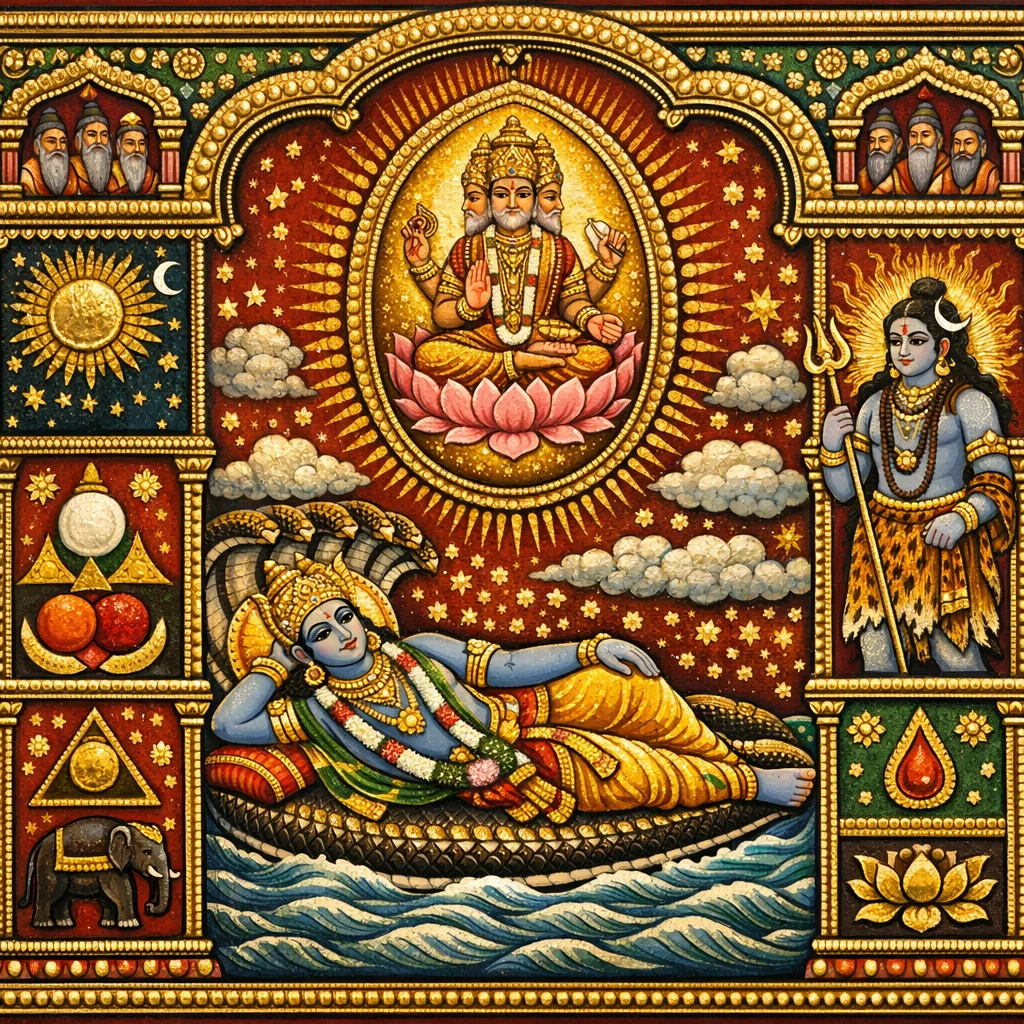
Lord Agni continues instructing Sage Vasiṣṭha, turning from avatāra tales to cosmogony and portraying creation as Viṣṇu’s līlā, both saguṇa and nirguṇa. The chapter gives a Sāṅkhya-tinged emanation order: Brahman as the unmanifest; Viṣṇu’s entry into prakṛti and puruṣa; the rise of mahat and the threefold ahaṅkāra; and the evolution of tanmātras into the mahābhūtas from ākāśa to pṛthivī. From sāttvika ahaṅkāra come the presiding deities and mind (manas); from tamasic/taijasa come the sense-faculties. It then explains the “Nārāyaṇa-waters,” the golden cosmic egg (hiraṇyāṇḍa), and Brahmā as Hiraṇyagarbha dividing the egg into heaven and earth, establishing space, directions, time, and inner forces (kāma, krodha, rati). Creation proceeds through atmospheric phenomena, birds, Parjanya, and the Vedic meters and mantras for yajña, culminating in the manifestation of Rudra, Sanatkumāra, and the seven mind-born Brahmarṣis, and in Brahmā’s androgynous division into male and female to generate beings—linking cosmology to ritual order and sacrificial efficacy.
Shlokas
Verse 1
इत्य् आदिमहापुराणे आग्नेये बुद्धकल्क्यवतारवर्णनं नाम षोडशो ऽध्यायः अथ सप्तदशो ऽध्यायः सृष्टिविषयकवर्ननम् अग्निर् उवाच जगत्सर्गादिकान् क्रीडान् विष्णोर्वक्ष्येधुना शृणु स्वर्गादिकृत् स सर्गादिः सृष्ट्यादिः सगुणोगुणः
Thus, in the Agni Purāṇa, the sixteenth chapter—“The Description of the Buddha and Kalki Avatāras”—concludes. Now begins the seventeenth chapter, “An Account Concerning Creation.” Agni said: Now listen as I describe the sacred sportive acts (līlā) of Viṣṇu, beginning with the emanation of the universe. He is the maker of heaven and the rest; He is the source of creation and what follows, the initiator of manifestation—at once with attributes (saguṇa) and beyond attributes (nirguṇa).
Verse 2
ब्रह्माव्यक्तं सदाग्रे ऽभूत् न खं रात्रिदिनादिकं प्रकृतिं पुरुषं विष्णुः प्रविश्याक्षोभयत्ततः
In the beginning Brahman existed as the unmanifest (avyakta); there was neither ether/space (kha) nor night and day and the like. Then Viṣṇu, entering into Prakṛti and Puruṣa, stirred them into agitation, thereby initiating creation.
Verse 3
स्वर्गकाले महत्तत्त्वमहङ्कारस्ततो ऽभवत् वैकारिकस्तैजसश् च भूतादिश् चैव तामसः
At the time of cosmic emanation, the principle called Mahat (Mahat-tattva) arose; from it came ahaṅkāra, the ego-sense, in three forms: sāttvika (vaikārika), rājasa (taijasa), and tāmasa (bhūtādi).
Verse 4
अहङ्काराच्छब्दमात्रमाकाशमभवत्ततः स्पर्शमात्रो ऽनिलस्तस्माद्रूपमात्रो ऽनलस्ततः
From ahaṅkāra arose ākāśa (ether), possessing only the potential of sound; from that arose anila (air), possessing only the potential of touch; and from that arose anala (fire), possessing only the potential of form/color (visibility).
Verse 5
रसमात्रा आप इतो गन्धमात्रा मही स्मृता अहङ्कारात्तामसात्तु तैजसानीन्द्रियाणि च
Water is understood here as constituted solely of the potential of taste (rasa-mātra), and earth is remembered as constituted solely of the potential of smell (gandha-mātra). From the tamasic form of ahaṅkāra also arise the taijasa indriyas, the faculties of cognition and action.
Verse 6
वैकारिका दश देवा मन एकादशेन्द्रियम् ततः स्वयंभूर्भगवान् सिसृक्षुर्विविधाः प्रजाः
From the vaikārika (sāttvika) principle arose the ten deities presiding over the senses, and the mind (manas) as the eleventh faculty. Then the Self-born Lord (Svayambhū), desiring to create, brought forth diverse kinds of beings.
Verse 7
अप एव ससर्जादौ तासु वीर्यमवासृजत् आपो नारा इति प्रोक्ता आपो वै नरसूनवः
In the beginning He created the Waters alone, and into them He released His generative potency. The Waters are called “nārā”; indeed, the waters are the offspring of Nara—therefore (He is) “Nārāyaṇa,” the Abode of the Waters.
Verse 8
अयनन्तस्य ताः पूर्वन्तेन नारायणः स्मृतः हिरण्यवर्णमभवत् तदण्डमुदकेशयम्
At the earlier end of that immeasurable course (of time/creation), He is remembered as Nārāyaṇa; the Egg became golden in hue, and that Egg lay upon the waters.
Verse 9
तस्मिन् जज्ञे स्वयं ब्रह्मा स्वयम्भूरिति नः श्रुतम् हिरण्यगर्भो भगवानुषित्वा परिवत्सरम्
In that primeval state Brahmā was born of himself—thus we have heard—(he,) the Blessed Lord Hiraṇyagarbha, having dwelt there for a full year.
Verse 10
तदण्डमकरोत् द्वैधन्दिवं भुवमथापि च तयोः शकलयोर्मध्ये आकाशमसृजत् प्रभुः
Then the Lord split that cosmic egg into two—into heaven and earth—and, between those two halves, the Sovereign created space (ākāśa).
Verse 11
अप्सु पारिप्लवां पृथिवीं दिशश् च दशधा दधे तत्र कालं मनो वाचं कामं क्रोधमथो रतिम्
Within the waters He established the earth—floating and borne upon them—and also the directions, arranged in tenfold; and there He set in due order Time, the mind, speech, desire (kāma), anger, and also sexual delight (rati).
Verse 12
आठस्तु महाभारतीयहरिवंशपर्वण उद्धृत इति अध्यवसीयते उभयत्र क्रमेण पाठसाम्यात् तासु बीजमथासृजदिति ख, चिह्नितपुस्तकपाठः हिरण्यगर्भमभवदिति ख, चिह्नितपुस्तकपाठः हिरण्यवर्ण इति ग, चिह्नित्गपुस्तकपाठः ससर्ज सृष्टिन्तद्रूपां स्रष्टुमिच्छन् प्रजापतिः विद्युतोशनिमेघांश् च रोहितेन्द्रधनूंषि च
It is determined that this reading is quoted from the Harivaṃśa section of the Mahābhārata, since in both places the sequence of the text agrees. (Variant readings are noted:) “Then he cast the seed into them”—so reads the marked manuscript; “He became Hiraṇyagarbha (the Golden Embryo)”—so reads the marked manuscript; “Golden-coloured”—so reads another marked manuscript. Desiring to create, Prajāpati produced a creation of that very form—lightnings, thunderbolts (vajra), clouds, and Indra’s red, glowing rainbows.
Verse 13
वयांसि च ससर्जादौ पर्जन्यञ्चाथ वक्त्रतः ऋचो यजूंषि सामानि निर्ममे यज्ञसिद्धये
In the beginning he created the birds, and then brought forth Parjanya, the Rain-god; and from his mouth he fashioned the Ṛc verses, the Yajus formulas, and the Sāman chants, for the successful accomplishment of sacrifice (yajña).
Verse 14
साध्यास्तैर् अयजन्देवान् भूतमुच्चावचं भुजात् सनत्कुमारं रुद्रञ्च ससर्ज क्रोधसम्भवम्
With them the Sādhyas worshipped the gods; and from Bhujāt there arose beings of varied kinds, high and low. He also brought forth Sanatkumāra and Rudra, the latter being born of wrath.
Verse 15
मरीचिमत्र्यङ्गिरसं पुलस्त्यं पुलहं क्रतुम् वसिष्ठं मानसाः सप्त ब्रह्माण इति निश्चिताः
Marīci, Atri, Aṅgiras, Pulastya, Pulaha, Kratu, and Vasiṣṭha—these seven are definitively known as the mind-born sons of Brahmā, the seven Brahmarṣis.
Verse 16
सप्तैते जनयन्ति स्म प्रजा रुद्राश् च सत्तम द्विधा कृत्वात्मनो देहमर्धेन पुरुषो ऽभवत् अर्धेन नारी तस्यां स ब्रह्मा वै चासृजत् प्रजाः
O best of the virtuous, these seven and the Rudras indeed generate progeny. Having divided his own body into two, he became male with one half and female with the other; and in her, that Brahmā truly created the creatures.
Frequently Asked Questions
It presents Brahman as unmanifest, then Viṣṇu’s activation of prakṛti–puruṣa, followed by mahat, threefold ahaṅkāra, tanmātras, and the five mahābhūtas, with mind, deities, and sense-faculties arising in parallel.
By stating that the Vedic hymns and formulas (Ṛk, Yajus, Sāman) arise for yajña-siddhi and by portraying cosmic order—time, directions, elements, and deities—as the framework within which worship and sacrifice become effective.
The chapter frames creation as līlā: the same supreme reality is beyond attributes (nirguṇa) yet functions as the qualified cause (saguṇa) that initiates and sustains manifestation.