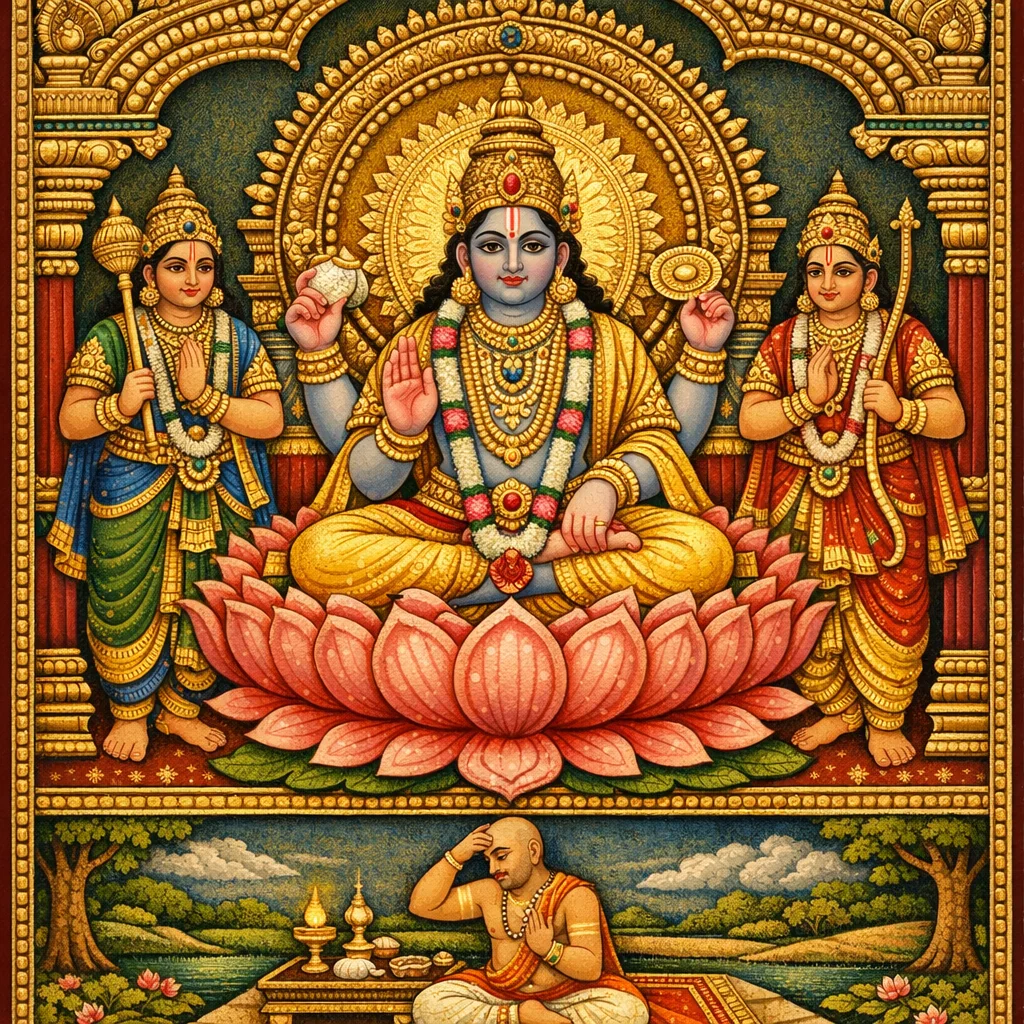
Adhyaya 25
Explanation of the Vāsudeva and Related Mantras (वासुदेवादिमन्त्रनिरूपणम्)
This chapter begins with Nārada asking for the defining marks of worship connected with the Vāsudeva-mantra system and the fourfold vyūha (Vāsudeva, Saṅkarṣaṇa, Pradyumna, Aniruddha). The text then codifies mantra formation: starting with praṇava and “namo” formulas, specifying vowel bījas (a, ā, aṃ, aḥ), and distinguishing aṅga and upāṅga by long/short vowels and placement rules. It proceeds to nyāsa practice—six-limbed bīja-nyāsa and twelve-limbed mūla-nyāsa—assigning mantra parts to heart, head, śikhā, kavaca, eyes, astra, and other bodily loci. Detailed bīja-clusters are linked to divine emblems (Garuḍa/Vainateya, the conch Pāñcajanya, Kaustubha, Sudarśana, Śrīvatsa, Vanamālā, Ananta), uniting iconographic devotion with phonemic ritual. The chapter expands into cosmological and psycho-physical correspondences: elements (bhūtas), Vedas, lokas, senses (indriyas), inner faculties (buddhi, ahaṅkāra, manas, citta), and graded vyūha enumerations up to twenty-six principles. Finally, it outlines maṇḍala worship with directional arrangements, dikpālas, central pericarp deities, and concludes with results-oriented worship (stability, royal victory), including Viśvarūpa and Viśvaksena.
Shlokas
Verse 1
इत्य् आदिमहापुराणे आग्नेये अग्निकार्यादिकथनं नाम चतुर्विंशो ऽध्यायः वासुदेवार्चनं कृत्वा इति ख, चिह्नितपुस्तकपाठः अथ पञ्चविंशो ऽध्यायः वासुदेवादिमन्त्रनिरूपणं नारद उवाच वासुदेवादिमन्त्राणां पूजानां लक्षणं वदे वासुदेवः सङ्कर्षणः प्रद्युम्नश्चानिरुद्धकः
Thus, in the Agni Purāṇa, the twenty-fourth chapter entitled “Account of fire-rites and related procedures” concludes (the marked manuscript reading adds: “having performed the worship of Vāsudeva”). Now begins the twenty-fifth chapter: “Explanation of the Vāsudeva and related mantras.” Nārada said: “Tell me the defining characteristics of the worship connected with the Vāsudeva and related mantras—Vāsudeva, Saṅkarṣaṇa, Pradyumna, and Aniruddha.”
Verse 2
नमो भगवते चादौ अ आ अं अः स्ववीजकाः ओङ्काराद्या नमोन्ताश् च नमो नारायणस्ततः
First, obeisance to the Bhagavān. (Invoke) the seed-syllables a, ā, aṃ, aḥ—each as its own bīja. Beginning with Oṃ and ending with the formula ‘namo’, thereafter offer obeisance to Nārāyaṇa.
Verse 3
ॐ तत् सत् ब्रह्मणे चैव ॐ नमो विष्णवे नमः ॐ क्षौं ॐ नमो भगवते नरसिंहाय वै नमः
Oṃ—“tat-sat”, the Real. Salutation also to Brahman; Oṃ, homage to Viṣṇu—namah. Oṃ kṣauṃ. Oṃ, homage to the Bhagavān Narasiṃha—verily, namah.
Verse 4
ॐ भूर्नमो भगवते वराहाय नराधिपाः जवारुणहरिद्राभा नीलश्यामललोहिताः
Om. Salutation to the Blessed Lord Varāha. O kings, his forms appear in hibiscus-red and turmeric-golden hues, and also in dark-blue, dusky green, and ruddy-red.
Verse 5
मेघाग्निमधुपिङ्गाभा वल्लभा नव नायकाः अङ्गानि स्वरवीजानां स्वनामान्तैर् यथाक्रमम्
Meghā, Agni, Madhu, Piṅgābhā, Vallabhā—these are the nine leading forms. The “limbs” of the vowel seed-sounds are to be stated in due order, by the final letters of their own names.
Verse 6
हृदयादीनि कल्पेत विभक्तैस्तन्त्रवेदिभिः व्यञ्जनादीनि वीजानि तेषां लक्षणमन्यथा
Those adept in Tantra, having properly classified the phonemes, should construct the “heart” (hṛdaya) and related mantric formulae. The seed-syllables begin from the consonants; their defining characteristics are distinct from the former group.
Verse 7
दीर्घस्वरैस्तु भिन्नानि नमोन्तान्तस्थितानि तु अङ्गानि ह्रस्वयुक्तानि उपाङ्गानीति वर्ण्यते
Those units distinguished by long vowels and placed at the end of the formula ending in “namo” are called aṅgas; those connected with short vowels are described as upāṅgas.
Verse 8
विभक्तनामवर्णान्तस्थितानि वीजमुत्तमं दीर्घैर् ह्रस्वैश् च संयुक्तं साङ्गोपाङ्गंस्वरैः क्रमात्
The supreme seed-syllable (bīja) is formed from the letters placed at the ends of the divided names, and is then combined step by step with long and short vowels, together with their primary and subsidiary tonal accents (svara), in due order.
Verse 9
व्यञ्जनानां क्रमो ह्य् एष हृदयादिप्रकॢप्तये स्ववीजेन स्वनामान्तैर् विभक्तान्यङ्गनामभिः
This indeed is the sequence of the consonants, prescribed for the arrangement of nyāsa beginning with the Heart and the other loci—each portion differentiated by its own bīja (seed-syllable) and by its own name-endings, together with the names of the bodily limbs (aṅgas).
Verse 10
जका इति ख, चिह्नितपुस्तकपाठः स्थितवीजार्थमुत्तममिति ख, चिह्नितपुस्तकपाठः दीर्घस्वरैश् च संयुक्तमङ्गोपाङ्गं स्वरैः क्रमादिति ख, चिह्नितपुस्तकपाठः स्वरवीजेषु नामान्तैर् विभक्तान्यङ्गनामभिरिति ङ, चिह्नितपुस्तकपाठः युक्तानि हृदयादीनि द्वादशान्तानि पञ्चतः आरभ्य कल्पयित्वा तु जपेत् सिद्ध्यनुरूपतः
Thus, having arranged the mantra-components beginning from the fivefold series, one should construct the set of nyāsas—starting with the Heart and the rest—up to the placements “ending in twelve”; and then one should perform japa in a manner suited to the intended siddhi (spiritual accomplishment). (The marked readings above describe the joining of bījas with vowels and the differentiation of aṅga- and upāṅga-names.)
Verse 11
हृदयञ्च शिरश्चूडा कवचं नेत्रमस्त्रकं षडङ्गानि तु वीजानां मूलस्य द्वादशाङ्गकं
The mantric limbs are: the Heart, the Head, the Topknot/Crown (cūḍā/śikhā), the Armor (kavaca), the Eyes, and the Missile (astra). These are the six limbs for the bīja-mantras; for the root-mantra there is a twelve-limbed arrangement.
Verse 12
हृच्छिरश् च शिखा वर्म चास्त्रनेत्रान्तयोदरं प्रष्टबाहूरुजानूंश् च जङ्घा पादौ क्रमान्न्यसेत्
One should perform nyāsa in proper sequence: upon the heart and the head; then upon the śikhā (topknot) and the kavaca (armor); then place the astra (weapon) mantra upon the eyes, the extremities, and the abdomen; thereafter upon the back, the arms, the thighs, the knees, the shanks, and the feet—step by step.
Verse 13
कं टं पं शं वैनतेयः खं ठं फं घंगदामनुः गं डं बं सं पुष्ठिमन्तो घं ढं भं हं श्रियैनमः
“kaṃ ṭaṃ paṃ śaṃ” are invoked as Vainateya (Garuḍa). “khaṃ ṭhaṃ phaṃ ghaṃ” is the mantra-formula known as “Ghaṅgada.” “gaṃ ḍaṃ baṃ saṃ” are the “Puṣṭimantaḥ,” the Nourishing Ones. “ghaṃ ḍhaṃ bhaṃ haṃ”—salutation to Śrī, the power of prosperity.
Verse 14
वं शं मं क्षं पाञ्चजन्यं छं तं पंकौस्तुभाय च जं खं वं सुदर्शनाय श्रीवत्साय सं वं दं चंलं
“(One should perform nyāsa by assigning these seed-syllables:) ‘vaṃ, śaṃ, maṃ, kṣaṃ’ to the conch Pāñcajanya; ‘chaṃ, taṃ, paṃ’ also to the Kaustubha jewel; ‘jaṃ, khaṃ, vaṃ’ to the discus Sudarśana; and ‘saṃ, vaṃ, daṃ’ to the Śrīvatsa mark—thus placing the mantra-syllables upon the divine emblems.”
Verse 15
ॐ धं वं वनमालायै महानन्ताय वै नमः निर्वीजपदमन्त्राणां पदैर् अङ्गानि कल्पयेत्
“Oṃ—salutations indeed to Vanamālā and to Mahānanta. For mantras that are without seed-syllables (nirbīja), one should arrange the nyāsa of the limbs by means of their words.”
Verse 16
जात्यन्तैर् नामसंयुक्तेर्हृदयादीनि पञ्चधा प्रणवं हृदयादीनि ततः प्रोक्तानि पञ्चधा
When the name is conjoined with case-endings (jāti-anta), the nyāsa placements beginning with the Heart and the other parts are to be done in five ways. Thereafter, the Praṇava (Oṃ) is likewise prescribed to be placed on the Heart and the other parts in five ways.
Verse 17
प्रणवं हृदयं पूर्वं परायेति शिरः शिखा नाम्नात्मना तु कवचं अस्त्रं नामान्तकं भवेत्
First, install the Praṇava (Oṃ) as the Heart-mantra. ‘Parāya’ is to be placed upon the Head and the Topknot (śikhā). By uttering one’s own name together with ‘ātman’, it becomes the Kavaca (protective armor-mantra); and the Astra (weapon-mantra) is formed by ending with ‘namaḥ’.
Verse 18
अ, चिह्नितपुस्तकपाठः श्रीवत्साय च पञ्चममिति ङ, चिह्नितपुस्त्कपाठः श्रीवत्सो वं चं दं ठं लं इति ग, चिह्नितपुस्तकपाठः नमोनन्ताय वै नम इति ङ, चिह्नितपुस्तकपाठः नाम्नामुना तु इति ख, ङ, चिह्नितपुस्त्कद्वयपाठः ॐ परास्त्रादिस्वनामात्मा चतुर्थ्यन्तो नमोन्तकः एकव्यूहादिषड्विंशव्यूहात्तस्यात्मनो मनुः
‘Oṃ’—the mantra consists of the Lord’s own name (beginning with “Parāstra” and so forth). It is to be put in the dative case (ending in -āya) and concluded with “namaḥ”. From the single Vyūha up to the twenty-six Vyūhas, the corresponding mantra-form (manu) of that very Self (ātman) of the deity is thus stated. (Marked manuscripts preserve variant readings such as “śrīvatsāya…”, “namo’nantāya…”, and syllabic sequences like “vaṃ caṃ daṃ ṭhaṃ laṃ”.)
Verse 19
कनिष्टादिकराग्रेषु प्रकृतिं देहकेर्चयेत् पराय पुरुषात्मा स्यात् प्रकृत्यात्मा द्विरूपकः
One should contemplate Prakṛti within the body, beginning at the fingertips, such as the tip of the little finger. In the transcendent state the Self is Puruṣa; in relation to Prakṛti, the self is of a twofold form.
Verse 20
ॐ परयाम्न्यात्मने चैव वाय्वर्कौ च द्विरूपकः अग्निं त्रिमूर्तौ विन्यस्य व्यापकं करदेहयोः
Uttering “Oṃ,” one should contemplate the Supreme Self; then the two-formed deity as Vāyu and Arka (the Sun). By nyāsa, placing Agni as the three-formed one, one should establish the all-pervading presence in the hands and in the body.
Verse 21
वाय्वर्कौ करशाखासु सव्येतरकरद्वये हृदि मूर्तो तनावेष त्रिव्यूहे तुर्यरूपके
Place Vāyu and Arka (the Sun) in the finger-branches, in the pair of hands—left and right. And in the heart install the embodied One, together with Tanāveṣa, within the threefold emanational array (trivyuha), in the fourth, transcendent form.
Verse 22
ऋग्वेदं व्यापकं हस्ते अङ्गुलीषु यजुर्न्यसेत् तलद्वयेथर्वरूपं शिरोहृच्चरणान्तकः
By nyāsa one should install the all-pervading Ṛgveda in the hands; the Yajurveda is to be placed upon the fingers. Then, in the form of the Atharvaveda, it is to be installed from the head and the heart down to the feet, as the concluding placement.
Verse 23
आकाशं व्यापकं न्यस्य करे देहे तु पूर्ववत् अङ्गुलीषु च वाय्वादि शिरोहृद्गुह्यपादके
Having performed nyāsa of all-pervading Ether (Ākāśa) on the hand, one should place it on the body as done previously; and on the fingers one should place Wind and the other elements, and place them at the head, heart, secret region, and at the feet.
Verse 24
वायुर्ज्योतिर्जलं पृथ्वी पञ्चव्यूहः समीरितः मनः श्रोत्रन्त्वग्दृग्जिह्वा घ्राणं षड्व्यूह ईरितः
Wind, light/fire, water, and earth are declared as the fivefold grouping (pañca-vyūha). The mind, hearing, skin (touch), sight, tongue (taste), and nose (smell) are declared as the sixfold grouping (ṣaḍ-vyūha).
Verse 25
व्यापकं मानसं न्यस्य ततोङ्गुष्टादितः क्रमात् मूर्धास्यहृद्गुह्यपत्सु कथितः करुणात्मकः
Having installed (performed nyāsa of) the all-pervading, mental (manasic) mantra, then—beginning with the thumb and proceeding in due sequence—he is declared to be placed/realized at the head, the mouth, the heart, the secret region, and the feet, as one whose very nature is compassion.
Verse 26
आदिमूर्तिस्तु सर्वत्र व्यापको जीवसञ्ज्ञितः भूर्भुवः स्वर्महर्जनस्तपः स्त्यञ्च सप्तधा
The Primordial Form indeed pervades everywhere and is known as jīva, the indwelling life-principle. It is expressed sevenfold as Bhūḥ, Bhuvaḥ, Svaḥ, Mahaḥ, Janaḥ, Tapaḥ, and Satya.
Verse 27
करे देहे न्यसेदाद्यमङ्गुष्टादिक्रमेण तु तलसंस्थः सप्तमश् च लोकेशो देहके क्रमात्
One should install (the mantras) first on the hand and then on the body, in the sequence beginning with the thumb and so on. The seventh (mantra/deity) is to be placed in the palm; and likewise the Lokanātha (Lord of the worlds) is to be installed on the body in due order.
Verse 28
ॐ परास्त्रादित्यनामात्मा इति घ, चिह्नितपुस्तकपाठः एवं व्यूहादिषड्विंशं व्यूहात्तस्यात्मनो मनुरिति ख, चिह्नितपुस्तकपाठः अग्निं द्विमूर्तौ इति ख, चिह्नितपुस्त्कपाठः तलस्थः सप्तमश् चैव इति ङ, चिह्नितपुस्तकपाठः देहे शिरोललाटास्यहृद्गुह्याङ्ग्रिषु संस्थितः अग्निष्ठोमस्तथोक्थस्तु षोडशी वाजपेयकः
Within the body, Agni as the sacrificial principle is stationed in the head, the forehead, the mouth, the heart, the secret part (genital region), and the feet—as Agniṣṭoma, Ukthya, Ṣoḍaśin, and Vājapeya. (The preceding phrases are noted as variant readings in certain manuscripts.)
Verse 29
अतिरात्राप्तोर्यामञ्च यज्ञात्मा सप्तरूपकः धीरहं मनः शब्दश् च स्पर्शरूपरसास्ततः
The sacrifice (yajña), whose essence is the Yajña-Puruṣa, is of seven forms: the Atirātra and the Āptoryāma rites; and also the steady mind, sound, and thereafter touch, form, and taste.
Verse 30
गन्धो बुद्धिर्व्यापकं तु करे देहे न्यसेत् क्रमात् न्यसेदन्त्यै च तलयोः के ललाटे मुखे हृदि
In due order, one should perform nyāsa, placing “fragrance,” “intellect (buddhi),” and the “all-pervading principle” upon the hand and then upon the body. One should also place the final syllable/mantra upon the soles, and upon the topknot, the forehead, the face, and the heart.
Verse 31
नाभौ गुह्ये च पादे च अष्टव्यूहः पुमान् स्मृतः वीजो बुद्धिरहङ्कारो मनः शब्दो गुणोनिलः
In the navel, the genital region, and the feet, the Person (Puruṣa) is taught as the “eightfold vyūha”: namely bīja (seed), buddhi (intellect), ahaṅkāra (ego-sense), manas (mind), śabda (sound), guṇa (quality/constituent), and anila (wind/breath).
Verse 32
रूपं रसो नवात्मायं जीव अङ्गुष्ठकद्वये तर्जन्यादिक्रमाच्छेषं यावद्वामप्रदेशिनीं
“Form” and “taste,” as aspects of the ninefold Self, are to be placed (by nyāsa) upon the two thumbs; the remaining aspects are to be assigned in due order, beginning with the index finger up to the left little finger.
Verse 33
देहे शिरोललाटास्यहृन्नाभिगुह्यजानुषु पादयोश् च दशात्मायं इन्द्रो व्यापी समास्थितः
Within the body—at the head, forehead, mouth, heart, navel, genital region, knees, and the feet—Indra, pervading all, abides in a tenfold form.
Verse 34
अङ्गुष्ठकद्वये वह्निस्तर्जन्यादौ परेषु च शिरोललाटवक्त्रेषु हृन्नाभिगुह्यजानुषु
Vahni (the Fire principle/mantra) is to be installed by nyāsa on both thumbs; likewise on the other fingers beginning with the index finger; and also on the head, forehead, and face, and on the heart, navel, genital region, and knees.
Verse 35
पादयोरेकदशात्मा मनः श्रोत्रं त्वगेव च चक्षुर्जिह्वा तथा घ्राणं वाक्पाण्यङ्घ्रिश् च पायुकः
In the two feet (as the basis of action), the self is said to be elevenfold: mind (manas), ear, skin, eye, tongue, and nose; and also speech, hand, foot, and the organ of excretion.
Verse 36
उपस्थं मानसो व्यापी श्रोत्रमङ्गुष्ठकद्वये तर्जन्यादिक्रमादष्टौ अतिरिक्तं तलद्वये
The generative organ (upastha) is assigned to the mind (manas); the all-pervading principle is installed (as nyāsa) at the ear; it is placed on the two thumbs; then, beginning with the index finger in sequence, on the remaining eight fingers; and the surplus placement is to be done on both palms.
Verse 37
उत्तमाङ्गुलललाटास्यहृन्नाभावथ गुह्यके उरुयुग्मे तथा जङ्घे गुल्फपादेषु च क्रमात्
Likewise, the vital points are to be understood in due order in the head, the fingers, the forehead, the mouth, the region of the heart, the navel, the genital region, the pair of thighs, the shanks, the ankles, and the feet.
Verse 38
अतिरात्राप्तयामश् च इति ख, चिह्नितपुस्त्कपाठः रसास् तथा इति ख, चिह्नितपुस्तकपाठः न्यसेदन्ते च इति ख, चिह्नितपुस्तकपाठः न्यसेदष्टौ च इति ङ, चिह्नितपुस्तकपाठः क्रमात् स्मृत इति ङ, चिह्नितपुस्तकपाट्ःअः विष्णुर्मधुहरश् चैव त्रिविक्रमकवामनौ श्रीधरोथ हृषीकेशः पद्मनाभस्तथैव च
“Atirātra-āpta-yāma”—so reads one marked manuscript; “rasāḥ tathā”—so reads one marked manuscript; “nyaset ante ca”—so reads one marked manuscript; “nyased aṣṭau ca”—so reads one marked manuscript; “kramāt smṛta”—so reads one marked manuscript. (Now,) in due order, the names are: Viṣṇu, Madhuhara, Trivikrama, Vāmana, Śrīdhara, Hṛṣīkeśa, and likewise Padmanābha.
Verse 39
दामोदरः केशवश् च नारायणस्ततः परः माधवश्चाथ गोविन्दो विष्णुं वै व्यापकं न्यसेत्
One should perform nyāsa by placing the divine names—Dāmodara, Keśava, then Nārāyaṇa; thereafter Mādhava and Govinda—thus installing Viṣṇu as the all-pervading Presence.
Verse 40
अङ्गुष्ठादौ तले द्वौ च पादे जानुनि वै कटौ शिरःशिखरकट्याञ्च जानुपादादिषु न्यसेत्
Beginning with the thumb and onward, one should place (the mantras) upon the two palms; likewise upon the feet, the knees, and the waist; and also upon the head, the śikhā (crown-lock), and the hips—thus performing nyāsa on the prescribed limbs.
Verse 41
द्वादशात्मा पञ्चविंशः षड्विंशव्यूहकस् तथा पुरुषो धीरहङ्कारो मनश्चित्तञ्च शब्दकः
He is of twelvefold nature; he is the twenty-fifth principle; and likewise he is arranged as the twenty-sixfold configuration (vyūha). He is the Puruṣa, with steadfast ahaṅkāra, with manas and citta, and he is characterized by śabda (sound).
Verse 42
तथा स्पर्शो रसो रूपं गन्धः श्रोत्रं त्वचस् तथा चक्षुर्जिह्वा नासिका च वाक्पाण्यङ्घ्रिश् च पायवः
Likewise (there are) touch, taste, form, and smell; and the corresponding faculties—the ear and the skin; likewise the eye, the tongue, and the nose; and the organs of action: speech, the hands, the feet, and the anus (pāyu).
Verse 43
उपस्थो भूर्जलन्तेजो वायुराकाशमेव च पुरुषं व्यापकं न्यस्य अङ्गुष्ठादौ दश न्यसेत्
Having installed by nyāsa earth, water, fire, wind, and ether—and then the all-pervading Puruṣa—one should place the ten nyāsas beginning with the thumb, and so on.
Verse 44
शेषान् हस्ततले न्यस्य शिरस्यथ ललाटके मुखहृन्नाभिगुह्योरुजान्वङ्घ्रौ करणोद्गतौ
Placing the remaining mantra-syllables (parts) upon the palms, and then upon the head and the forehead—placing them on the face, the heart, the navel, the secret part, the thighs, the knees, and the feet—this is the nyāsa performed by the hands as the instrument.
Verse 45
पादे जान्वोरुपस्थे च हृदये मूर्ध्नि च क्रमात् परश् च पुरुषात्मादौ षड्विंशे पूर्ववत्परं
In the feet, the knees, the region of the thighs and the generative organ, the heart, and the head—successively—one should place/meditate upon the principles. Then, beyond these, the Supreme, Para, is to be contemplated, beginning with the Self as Puruṣa; in the twenty-sixth principle, the “Higher” is to be placed in the same manner as before.
Verse 46
सञ्चिन्त्य मण्डलैके तु प्रकृतिं पूजयेद्बुधः पूर्वयाम्याप्यसौम्येषु हृदयादीनि पूजयेत्
Having mentally contemplated the single maṇḍala, the wise practitioner should worship Prakṛti; and in the eastern, southern, western, and northern quarters, he should worship the inner seats beginning with the heart and the rest.
Verse 47
अस्त्रमग्न्यादिकोणेषु वैनतेयादि पूर्ववत् दिक्पालांश् च विधिस्त्वन्यः त्रिव्यूहेग्निश् च मध्यतः
The weapon-mantras (astra) are to be arranged in the corners beginning with the Agni (southeast) corner; the sequence beginning with Vainateya is to be placed as previously stated. The installation of the guardians of the directions (dikpāla) follows a different procedure; and in the triple formation (trivyūha), Agni is to be set in the middle.
Verse 48
पूर्वादिदिग्बलावसोराज्यादिभिरलङ्कृतः कर्णिकायां नाभसश् च मानसः कर्णिकास्थितः
In the central pericarp (karṇikā) of the lotus-maṇḍala, he is adorned with the powers of the directions beginning with the East, with strength, with wealth, with sovereignty, and the like; and within that pericarp are situated the deities Nābhasa and Mānasā.
Verse 49
अस्त्रमग्न्यादिपत्रेषु इति ख, ङ, चिह्नितपुस्तकद्वयपाठः दिक्पालांश् च विधिस्तस्य इति ग, घ, चिह्नितपुस्तकपाठः दिक्पालादौ विधिस्तुल्य इति ङ, चिह्नितपुस्तकपाठः विश्वरूपं सर्वस्थित्यै यजेद्राज्यजयाय च सर्वव्यूहैः समायुक्तमङ्गैर् अपि च पञ्चभिः
“(Reading variants:) ‘on the leaves (patras) beginning with Agni and so on’—thus read the kha- and ṅa-marked manuscripts; ‘and also the guardians of the directions (Dikpālas)—this is its rule’—thus read the ga- and gha-marked manuscripts; ‘for the Dikpālas and the rest, the rite is the same’—thus reads the ṅa-marked manuscript. One should worship Viśvarūpa for the stability of all existence, and also for victory in kingship—He being endowed with all battle-formations (vyūhas) and also with the five limbs (pañcāṅga).
Verse 50
गरुडाद्यैस्तथेन्द्राद्यैः सर्वान् कामानवाप्नुयात् विश्वक्सेनं यजेन्नाम्ना वै वीजं व्योमसंस्थितं
By propitiating Garuḍa and others, and likewise Indra and others, one may obtain all desired aims. One should worship Viśvaksena by name, meditating on the true seed-mantra (bīja) established in the expanse of the sky (vyoma).
Frequently Asked Questions
The chapter emphasizes mantra-engineering: how bījas are derived and combined (vowels vs consonants), how aṅga/upāṅga units are distinguished by vowel length and placement, and how these mantra parts are installed through ṣaḍaṅga and dvādaśāṅga nyāsa across specific body loci.
By uniting sound (mantra), body (nyāsa), and space (maṇḍala) into a disciplined worship protocol, it frames devotion to the vyūha-form of Viṣṇu as an embodied yoga—supporting inner purification and concentration (mukti-oriented) while also prescribing rites for stability, protection, and success (bhukti-oriented) under dharmic intent.