Adhyaya 33
Chapter 33 — पवित्रारोहणविधानं (The Procedure for Pavitrārohaṇa / Installing the Sacred Thread or Consecratory Amulet)
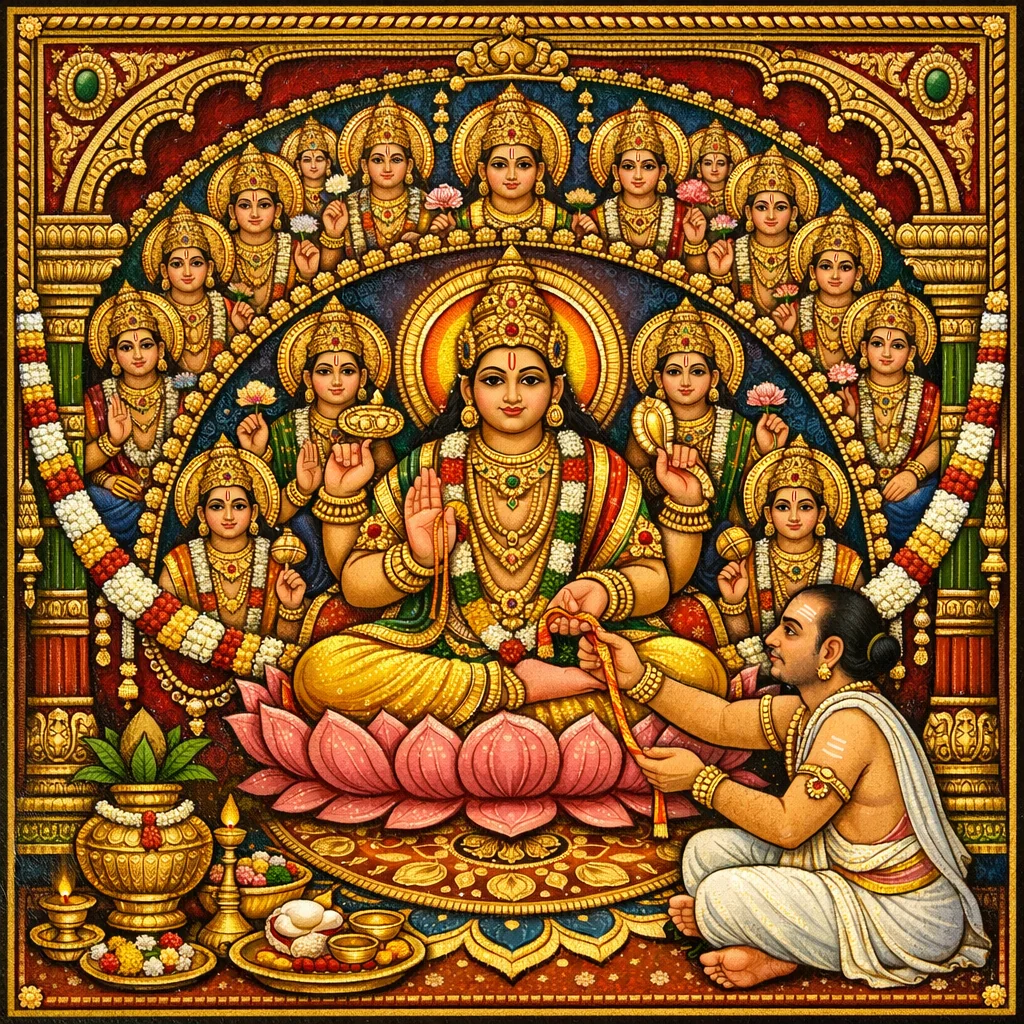
Agni opens by defining pavitrārohaṇa as Hari’s calendrically fixed annual worship-season, from Āṣāḍha through Kārtika, preferring the Pratipad tithi, while other deities follow their own tithi order (e.g., Śiva/Brahmā from Dvitīyā onward). The rite is presented as a complete worship-technology: choosing and making the pavitra thread (ideally brāhmaṇī-spun, otherwise purified), tripling and ninefolding the strands, specifying knot-counts (including 12-granthi forms), and placing it on the icon from knees/waist/navel up to higher regions, with garland and mālā standards of 108/1008 and aṅgula-based lengths. Agni then teaches protective and purificatory liturgy—vastu-apasāraṇa, kṣetrapāla and threshold worship, bali offerings—and a detailed bhūta-śuddhi that dissolves tanmātras and elements by mantra-udghātas (earth→water→fire→air→ākāśa), followed by inner-body purification, divine-body visualization, and mānasa-yāga in the heart-lotus. The chapter culminates in nyāsa, kavaca/astra protections, installation of Vaiṣṇava vyūhas and āvaraṇas, tying the rakṣā-sūtra, and observing vrata disciplines (fasting, restraint from kāma/krodha), granting worldly completeness and spiritual fruition.
Shlokas
Verse 1
इत्य् आदिमहापुराणे आग्नेये अष्टचत्वारिंशत्संस्कारकथनं नाम द्वात्रिंशो ऽध्यायः अथ त्रयस्त्रिंशो ऽध्यायः पवित्रारोहणविधानं अग्निर् उवाच पवित्रारोहणं वक्ष्ये वर्षपूजाकलं हरेः आषाढादौ कार्तिकान्ते प्रतिपद्वनदा तिथिः
Thus, in the Agni Purāṇa, the thirty-second chapter entitled “The Account of the Forty-Eight Saṁskāras (purificatory rites)” is concluded. Now begins the thirty-third chapter: “The Procedure for Pavitrārohaṇa (installing the sacred thread/amulet).” Agni said: “I shall describe the rite of pavitrārohaṇa, the proper season for the annual worship of Hari (Viṣṇu). From the beginning of Āṣāḍha to the end of Kārtika, the suitable lunar date is Pratipad, the first day of the fortnight.”
Verse 2
श्रिया गौर्या गणेशस्य सरस्वत्या गुहस्य च मार्तण्डमातृदुर्गाणां नागर्षिहरिमन्मथैः
With Śrī (Lakṣmī) and Gaurī; with Gaṇeśa; with Sarasvatī and also with Guha (Skanda); along with Mārtaṇḍa (the Sun), the Mothers (Mātṛs), and Durgā—together with the Nāgas, the Ṛṣis, Hari (Viṣṇu), and Manmatha (Kāma).
Verse 3
शिवस्य ब्रह्मणस्तद्वद्द्वितीयादितिथेः क्रमात् यस्य देवस्य यो भक्तः पवित्रा तस्य सा तिथिः
For Śiva, and likewise for Brahmā, the sequence of observances should be followed beginning with the second lunar day and onward. Whatever deity a person is devoted to, that corresponding lunar date (tithi) is purifying for him.
Verse 4
आरोहणे तुल्यविधिः पृथक् मन्त्रादिकं यदि वर्धते तिथिरिति ख, चिह्नितपुस्तकपाठः सौवर्णे राजतं ताम्रं नेत्रकार्पासिकादिकं
In the rite of ārohaṇa (mounting/installation), the procedure is the same; however, if the mantras and related items are stated separately, then—according to the reading noted in the marked manuscript—(it is) “when the lunar date increases (vardhate tithiḥ).” For an implement of gold, silver and copper may also be used, along with eye-cotton/wick and similar accessories.
Verse 5
ब्राह्मण्या कर्तितं सूत्रं तदलाभे तु संस्कृतं त्रिगुणं त्रिगुणीकृत्य तेन कुर्यात् पवित्रकं
One should use a thread spun by a Brāhmaṇī (a Brahmin woman); if that is unavailable, one should use a thread duly purified and consecrated. Folding it into three strands and then tripling it again (making it ninefold), with that one should fashion the pavitraka (purificatory ring).
Verse 6
अष्तोत्तरशतादूर्ध्वं तदर्धं चोत्तमादिकं क्रियालोपाविघातार्थं यत्त्वयाभिहितं प्रभो
O Lord, what you have stated—namely, that the count should be above one hundred and eight, and that half of that may also be taken beginning from the ‘best’ grade and so on—is for preventing omission and obstruction in ritual performance.
Verse 7
मया तत् क्रियते देव यथा यत्र पावित्रकं अविघ्नं तु भवेदत्र कुरु नाथ जयाव्यय
O God, I shall do that in the proper way and manner, so that the purificatory rite (pāvitrya) may be accomplished here without obstacles. Make it so here, O Lord—O ever-victorious, imperishable one.
Verse 8
प्रार्थ्य तन्मण्डलायादौ गायत्र्या बन्धयेन्नरः ॐ नारायणाय विद्महे वासुदेवाय धीमहि
Having first invoked and requested the presence of that maṇḍala, one should then secure it with the Gāyatrī: “Oṃ. We know Nārāyaṇa; we contemplate Vāsudeva.”
Verse 9
तन्नो विष्णुः प्रचोदयात् देवदेवानुरूपतः जानूरुनाभिनामान्तं प्रतिमासु पवित्रकं
May Viṣṇu impel and bless us—He who is in accord with the Lord of gods. In the images (pratimās), the pavitraka (sacred thread or festoon used in consecration) should extend from the knees, the thighs, and the navel, and end at the ‘name’ region, that is, up to the neck/upper part as designated in iconography.
Verse 10
पादान्ता वनमाला स्यादष्टोत्त्रसहस्रतः माला तु कल्पसाध्यं वा द्विगुणं षोडशाङ्गुलात्
A vanamālā (forest-garland), when made of one thousand and eight (1008) beads or flowers, should hang down to the feet. A japa-mālā, however, may be fashioned according to the requirements of the prescribed kalpa (ritual rule); otherwise, its length should be twice sixteen aṅgulas (finger-breadths).
Verse 11
कर्णिका केशरं पत्रं मन्त्राद्यं मण्डलान्तकं मण्डलाङ्गुलमात्रैकचक्राब्जाद्यौ पवित्रकं
Set out the karṇikā (pericarp), the keśara (stamens), and the patra (petals); place the mantra at the beginning, and complete the maṇḍala at the end. The pavitraka is to be formed as a maṇḍala of a single lotus-wheel, measuring one aṅgula, beginning with the cakrābja (lotus-wheel) design and related elements.
Verse 12
स्थण्डिले ऽङ्गुलमानेन आत्मनः सप्तविंशतिः आचार्याणां च सूत्राणि पितृमात्रादिपुस्तके
On the sthaṇḍila (ritual ground), by one’s own finger-measure, there are twenty-seven (units); and one should consult or record the sūtra-like rules of the ācāryas in the book that begins with (the accounts of) father, mother, and so forth.
Verse 13
नाभ्यन्तं द्वादशग्रन्थिं तथा गन्धपवित्रके द्व्यङ्गुलात् कल्पनादौ द्विर्माला चाष्टोत्तरं शतं
The japa-string should have twelve knots up to the level of the navel; likewise for the scented gandha-pavitraka. At the beginning of its arrangement, keep a measure of two aṅgulas; and the rosary should be double, consisting of one hundred and eight (108) counts.
Verse 14
अथवार्कचतुर्विंशषड्त्रिंशन्मालिका द्विजः अनामामध्यमाङ्गुष्ठैर् मन्दाद्यैः मालिकार्थिभिः
Now, O dvija (twice-born): the Mālikā, a metrical series, consists of (units of) twenty-four and thirty-six. Those who seek the Mālikā should understand or construct it by the finger-count measures beginning with manda and the rest, using the namā, madhyamā, and aṅguṣṭha (thumb) fingers.
Verse 15
माला स्यादष्टोत्तरसहस्रशः इति ग, चिह्नितपुस्तकपाठः गदाद्यमिति घ, चिह्नितपुस्तकपाठः चक्राङ्गदौ पवित्रके इति घ, चिह्नितपुतकपाठः मन्दादौ इति ख, ग, चिह्नितपुस्तकद्वयपाठः मन्द्राद्यैर् इति घ, चिह्नितपुस्तकपाठः कनिष्टादौ द्वादश वा ग्रन्थयः स्युः पवित्रके रवेः कुम्भहुताशादेः सम्भवे विष्णुवन्मतम्
A rosary (mālā) may be made with 1,008 (recitations/units). For the pavitraka—the sacred cord or garland used in worship—it may bear emblems beginning with the mace (gadā), and also the discus (cakra) and the armlet (aṅgada). From the smallest grade onward, the pavitraka may have twelve knots (granthayaḥ). For Ravi (the Sun), and likewise for Kumbha, Hutāśa (Fire), and others, when such a pavitraka is prepared, the procedure is held to be the same as for Viṣṇu.
Verse 16
पीठस्य पीठमानं स्यान्मेखलान्ते च कुण्डकं यथाशक्ति सूत्रग्रन्थिपरिचारेथ वैष्णवे
The pedestal’s measure should accord with the prescribed pedestal-standard; and at the end of the surrounding girdle-band (mekhalā) there should be a small fire-pit (kuṇḍaka). In the Vaiṣṇava rite, one should, as far as one is able, properly attend to the cord (sūtra) and its knots (i.e., the measuring cord and knot-markers).
Verse 17
सूत्राणि वा सप्तदश सूत्रेण त्रिविभक्तके रोचनागुरुकर्पूरहरिद्राकुङ्कुमादिभिः
Alternatively, prepare seventeen medicated threads; in a cord divided into three parts, they are to be treated with substances such as gorocanā, aguru (aloeswood), camphor, turmeric, saffron (kuṅkuma), and the like.
Verse 18
रञ्जयेच्चन्दनाद्यैर् वा स्नानसन्ध्यादिकृन्नरः एकादश्यां यागगृहे भगवन्तं हरिं जयेत्
Or else, having anointed (the deity) with sandalwood and the like, a man who performs bathing, the twilight-prayers (sandhyā), and related observances should, on Ekādaśī, worship Lord Hari in the yāga-gṛha (sacrificial hall).
Verse 19
समस्तपरिवाराय बलिं पीठे समर्चयेत् क्ष्यौं क्षेत्रपालाय द्वारान्ते द्वारोपरि तथा श्रियं
One should duly offer the bali upon the pīṭha to the deity together with all attendant powers. Reciting “kṣyauṁ”, one should worship Kṣetrapāla at the doorway; and likewise worship Śrī upon/above the door.
Verse 20
धात्रे दक्षे विधात्रे च गङ्गाञ्च यमुनां तथा शङ्खपद्मनिधी पूज्य मध्ये वास्त्वपसारणं सारङ्गायेति भूतानां भूतशुद्धिं स्थितश् चरेत्
Having worshipped Dhātṛ, Dakṣa, and Vidhātṛ, as well as the Gaṅgā and Yamunā, and also the treasure-deities Śaṅkha and Padma, one should, standing in the middle (of the site/house), perform the rite called “vāstv-apasāraṇa” (Vāstu-expulsion). Reciting “sāraṅgāya” as the mantra-formula, one should carry out bhūta-śuddhi, the purification of beings, to remove obstructive presences.
Verse 21
फट् ह्रूनिति ङ, चिह्नितपुस्तकपाठः ॐ ह्रां हः ह्रूं इति ग, चिह्नितपुस्तकपाठः ॐ ह्रां हः फट् ह्रीमिति ङ, चिह्नितपुस्तकपाठः ॐ ह्रां हः फट् इति ग, चिह्नितपुस्तकपाठः ॐ ह्रूं हः फट् ह्रूं शब्दतन्मात्रं संहरामि नमः पञ्चोद्घातैर् गन्धतन्मात्ररूपं भूमिमण्डलं चतुरस्रञ्च पीतञ्च कठिनं वज्रलाञ्छितम्
“(Variant readings:) ‘phaṭ hrūṃ’—so reads one marked manuscript; ‘oṃ hrāṃ haḥ hrūṃ’—so reads another; ‘oṃ hrāṃ haḥ phaṭ hrīṃ’—so reads one; ‘oṃ hrāṃ haḥ phaṭ’—so reads another. (The operative mantra is:) ‘oṃ hrūṃ haḥ phaṭ hrūṃ—obeisance: I withdraw (dissolve back) the subtle essence of sound, śabda-tanmātra.’ With the five ‘udghāta’ utterances, one contemplates the earth-circle (bhūmi-maṇḍala) as the form of gandha-tanmātra, the subtle essence of smell: yellow, square, hard, and marked with the vajra (diamond/thunderbolt sign).
Verse 22
इन्द्राधिदैवतं पादयुग्ममध्यगतं स्मरेत् शुद्धञ्च रसतन्मात्रं प्रविलिप्याथ संहरेत् रसमात्ररूपमात्रे क्रमेणानेन पूजकः
Let the worshipper visualize Indra as the presiding deity situated in the middle of the pair of feet. Then, having mentally installed the pure tanmātra of taste (rasa), he should withdraw it again. By this method, in due order, the worshipper proceeds from the mere tanmātra of taste to the mere tanmātra of form (rūpa).
Verse 23
ॐ ह्रीं हः फट् ह्रूं रसतन्मात्रं संहरामि नमः ॐ ह्रूं हः फट् रूपतन्मात्रं संहरामि नमः ॐ ह्रीं हः फट् ह्रूं स्पर्शतन्मात्रं संहरामि नमः ॐ ह्रीं हः फट् ह्रूं शब्दतन्मात्रं संहरामि नमः जानुनाभिमध्यगतं श्वेतं वै पद्मलाञ्छितं शुक्लवर्णं चार्धचन्द्रं ध्यायेद्वरुणदैवतं
“Om—hrīṃ, haḥ, phaṭ, hrūṃ—obeisance: I dissolve the subtle essence of taste (rasa-tanmātra).” “Om—hrūṃ, haḥ, phaṭ—obeisance: I dissolve the subtle essence of form (rūpa-tanmātra).” “Om—hrīṃ, haḥ, phaṭ, hrūṃ—obeisance: I dissolve the subtle essence of touch (sparśa-tanmātra).” “Om—hrīṃ, haḥ, phaṭ, hrūṃ—obeisance: I dissolve the subtle essence of sound (śabda-tanmātra).” Then one should meditate on the deity Varuṇa, situated between the knees and the navel—white in appearance, marked with a lotus-emblem, of radiant white complexion, and bearing the half-moon.
Verse 24
चतुर्भिश् च तदुद्घातैः शुद्धं तद्रसमात्रकं संहरेद्रूपतन्मात्रै रूपमात्रे च संहरेत्
And by its fourfold ‘udghāta’ (extractions/withdrawals), that element is purified and reduced to the mere principle of taste. One should then dissolve it into the tanmātra of form (rūpa-tanmātra), and thereafter dissolve even form into the mere principle of form.
Verse 25
ॐ ह्रूं हः फट् ह्रूं रूपतन्मात्रं संहरामि नमः ॐ ह्रूं हः फट् ह्रूं स्पर्शतन्मात्रं संहरामि नमः ॐ ह्रूं हः फट् ह्रूं शब्दतन्मात्रं संहरामि नमः इति त्रिभिस्तदुद्घातैस्त्रिकोणं वह्निमण्डलम् नाभिकण्ठमध्यगतं रक्तं स्वस्तिकलाञ्छितं
“Oṃ hrūṃ haḥ phaṭ hrūṃ— I dissolve (withdraw) the subtle essence of form (rūpa-tanmātra); homage.” “Oṃ hrūṃ haḥ phaṭ hrūṃ— I dissolve the subtle essence of touch (sparśa-tanmātra); homage.” “Oṃ hrūṃ haḥ phaṭ hrūṃ— I dissolve the subtle essence of sound (śabda-tanmātra); homage.” With these three mantra-utterances, one should visualize the triangular fire-maṇḍala, located between the navel and the throat, red in color, and marked with a svastika emblem.
Verse 26
ध्यात्वानलाधिदैवन्तच्छुद्धं स्पर्शे लयं नयत् , चिह्नितपुस्तकपाठः ॐ ह्रं हः फट् हूमिति ङ, चिह्नितपुस्तकपाठः पद्मासनमध्यगतमिति ङ, चिह्नितपुस्तकपाठः ॐ ह्रौं हः फट् ह्रूं स्पर्शतन्मात्रं संहरामि नमः ॐ ह्रौं हः फट् ह्रूं शब्दतन्मात्रं संहरामि नमः कण्ठनासामध्यगतं वृत्तं वै वायुमण्डलम्
Having meditated on the presiding divinity of Fire as purified, one should dissolve it into the principle of Touch. (Variant reading: “oṃ hraṃ haḥ phaṭ hūm”. Variant: “situated in the middle of the lotus-seat”.) (Variant:) “oṃ hrauṃ haḥ phaṭ hrūṃ— I withdraw the subtle essence of Touch; homage.” “oṃ hrauṃ haḥ phaṭ hrūṃ— I withdraw the subtle essence of Sound; homage.” The circular region located between the throat and the nose is indeed the maṇḍala of Air.
Verse 27
द्विरुद्घातैर् धूम्रवर्णं ध्यायेच्छुद्धेन्दुलाञ्छितम् स्पर्शमात्रं शब्दमात्रैः संहरेद्ध्यानयोगतः
By the twofold upward thrust (of the vital current), one should meditate on the smoke-hued inner sign marked by the pure moon; and, through the discipline of meditation-yoga, one should withdraw the mere sense of touch (sparśa-mātra) and merge it into the mere sense of sound (śabda-mātra).
Verse 28
ॐ ह्रौं हः फट् ह्रूं शब्दतन्मात्रं संहरामि नमः एकोद्घातेन चाकाशं शुद्धस्फटिकसन्निभम् नासापुटशिखान्तस्थमाकाशमुपसंहरेत्
“Oṃ hrauṃ haḥ phaṭ hrūṃ—obeisance: I withdraw (dissolve) the subtle essence of sound (śabda-tanmātra).” Then, by a single upward thrust (of breath/attention), one should withdraw space (ākāśa)—resplendent like pure crystal—situated at the tip of the nasal passage (the upper extremity within the nostril region).
Verse 29
शोषणाद्यैर् देहशुद्धिं कुर्यादेवम् क्रमात्ततः शुष्कं कलेवरं ध्यायेत् पादाद्यञ्च शिखान्तकम्
By the practices beginning with “drying up” (śoṣaṇa) and the like, one should thus effect purification of the body step by step. Then one should meditate on the body as dried up, from the feet upward to the crown of the head.
Verse 30
यं वीजेन वं वीजेन ज्वालामालासमायुतम् देहं रमित्यनेनैव ब्रह्मरन्ध्राद्विनिर्गतम्
By the seed-syllable “yaṁ” and the seed-syllable “vaṁ”, one should visualize the body as endowed with a garland of flames; and by this very mantric utterance “ram”, the prāṇa/self departs outward through the Brahmarandhra (the cranial aperture at the crown).
Verse 31
विन्दुन्ध्यात्वा चामृतस्य तेन भस्मकलेवरम् सम्प्लावयेल्लमित्यस्मात् देहं सम्पाद्य दिव्यकम्
Meditating on the nectar-like bindu, one should, by means of that amṛta, thoroughly flood (permeate and cleanse) the body that has become like ash; then, from the syllable “LAM”, one fashions a divine body.
Verse 32
न्यासं कृत्वा करे देहे मानसं यागमाचरेत् विष्णुं साङ्गं हृदि पद्मे मानसैः कुसुमादिभिः
Having performed nyāsa on the hand and on the body, one should undertake the mental sacrifice (mānasa-yāga), worshipping Viṣṇu together with His associated limbs/attendant aspects (sāṅga) within the lotus of the heart, by means of mental offerings such as flowers and the like.
Verse 33
मूलमन्त्रेण देवेशम्प्रार्चयेद्भुक्तिमुक्तिदम् स्वागतं देवदेवेश सन्निधौ भव केशव
With the root-mantra (mūla-mantra) one should duly worship the Lord of gods, the giver of both worldly enjoyment and liberation. “Welcome, O God of gods; be present here (in proximity), O Keśava.”
Verse 34
गृहाण मानसीं पूजां यथार्थं परिभाविताम् आधारशक्तिः कूर्माथ पूज्योनन्तो मही ततः
Accept this mental worship, correctly and truly contemplated. (In that visualization) the Support-Power (Ādhāra-śakti) comes first; then (is) Kūrma; then the worship-worthy Ananta; and thereafter the Earth (Mahī).
Verse 35
मध्येग्न्यादौ च धर्माद्या अधर्मादीन्द्रमुख्यगम् फट् क्रूमिति ङ, चिह्नितपुस्तकपाठः ॐ क्षौं हः फट् क्रूमिति ङ, चिह्नितपुस्तकपाठः ज्वालामालासमप्रभमिति ङ, चिह्नितपुस्तकपाठः यथास्वमिति ख, चिह्नितपुस्तकपाठः धर्मादीनिन्द्रादौ विपरीतकानिति ङ, चिह्नितपुस्तकपाठः सत्त्वादि मध्ये पद्मञ्च मायाविद्याख्यतत्त्वके
In the center, beginning with Agni, one should place/visualize Dharma and the other virtues; and in the region beginning with Indra and the principal gods, one should place Adharma and the rest in reverse order. In some manuscripts the mantra-reading is marked as “phaṭ, krūṃ,” and also as “oṃ kṣauṃ haḥ phaṭ krūṃ”; some add, “having the radiance of a garland of flames,” and “each in its own proper place.” In the midst of Sattva and the other guṇas, place the lotus within the tattva known as Māyā/Vidyā.
Verse 36
कालतत्त्वञ्च सूर्यादिमण्डलं पक्षिराजकः मध्ये ततश् च वायव्यादीशान्ता गुरुपङ्क्तिकाः
One should also place/depict the principle of Time (kāla-tattva) and the solar-and-other planetary circle (sūryādi-maṇḍala). In the middle is the ‘king of birds,’ Garuḍa; thereafter, from the north-west (vāyavya) up to the north-east (īśāna), are the rows of the gurus (gurupaṅktikāḥ).
Verse 37
गणः सरस्वती पूज्या नारदो नलकूवरः गुरुर्गुरुपादुका च परो गुरुश् च पादुका
Gaṇa (the divine attendant) is to be worshipped; Sarasvatī is to be worshipped; likewise Nārada and Nalakūvara. The Guru, the Guru’s sandals (gurupādukā), the supreme Guru, and (his) sandals are likewise to be revered.
Verse 38
पूर्वसिद्धाः परसिद्धाः केशरेषु च शक्तयः लक्ष्मीः सरस्वती प्रीतिः कीर्तिः शान्तिश् च कान्तिका
On the filaments (keśara) as well are the Śaktis: the previously accomplished (pūrva-siddhāḥ) and the subsequently accomplished (para-siddhāḥ); namely Lakṣmī, Sarasvatī, Prīti (affection), Kīrti (fame), Śānti (peace), and Kāntikā (splendour).
Verse 39
पुष्टिस्तुष्टिर्महेन्द्राद्या मध्ये वाचाहितो हरिः धृतिः श्रीरतिकान्त्याद्या मूलेन स्थापितो ऽच्युतः
Puṣṭi (prosperity), Tuṣṭi (contentment), and the group beginning with Mahendra are to be placed (invoked) in the middle; Hari is to be installed there by the power of speech/mantra. Likewise, Dhṛti (steadfastness), Śrī, Rati, Kānti and the rest are to be established at the root; thus Acyuta is installed by the root-mantra (mūla-mantra).
Verse 40
ॐ अभिमुखो भवेति प्रार्थ्य सन्निहितो भव विन्यस्यार्घ्यादिकं दत्वा गन्धाद्यैर् मूलतो यजेत्
Having entreated the deity with the mantra, “Oṁ, be facing (me),” and then, “Be present (here),” one should perform the prescribed nyāsa (ritual placements). Then, having offered arghya and the other preliminary offerings, one should worship from the root—i.e., from the beginning—with sandalpaste and the other offerings.
Verse 41
ॐ भीषय भीषय हृत् शिरस्त्रासय वै पुनः मर्दय मर्दय शिखा अग्न्यादौ शस्त्रतोस्त्रकं
Oṁ—Terrify, terrify! Cast fear into the heart; again, make the head tremble. Crush, crush! Let Agni’s śikhā (flame-crest) crush the weapon and the missile.
Verse 42
रक्ष रक्ष प्रध्वंसय प्रध्वंसय कवचाय नमस्ततः ॐ ह्रूं फट् अस्त्राय नमो मूलवीजेन चाङ्गकं
“Protect, protect; destroy, destroy!”—salutation to the kavaca, the protective armor. Then one says: “Oṁ hrūṃ phaṭ”—salutation to the astra, the weapon-mantra. And one should perform aṅga-nyāsa using the root seed-syllable (mūla-bīja).
Verse 43
पूर्वदक्षाप्यसौम्येषु मूर्त्यावरणमर्चयेत् वासुदेवः सङ्कर्षणः प्रद्युम्नश्चानिरुद्धकः
In the eastern, southern, and northern directions, one should worship the surrounding retinue of the deity’s forms: Vāsudeva, Saṅkarṣaṇa, Pradyumna, and Aniruddha.
Verse 44
अग्न्यादौ श्रीधृतिरतिकान्तयो मूर्तयो हरेः शङ्खचक्रगदापद्ममग्न्यादौ पूर्वकादिकं
Beginning with Agni, the forms (mūrti) of Hari are Śrī, Dhṛti, Rati, and Kānti. And beginning with Agni, in the prescribed order, are the emblems: conch (śaṅkha), discus (cakra), mace (gadā), and lotus (padma), in the sequence previously stated.
Verse 45
शार्ङ्गञ्च मुषलं खड्गं वनमालाञ्च तद्वहिः इन्द्राद्याश् च तयानन्तो नैरृत्यां वरुणस्ततः
And one should place/visualize the Śārṅga bow, the mace (muṣala), the sword, and the forest-garland; outside that arrangement are stationed Indra and the other directional deities. In the same directional sequence, Ananta is to be placed in the south-west (Nairṛtya), and then Varuṇa thereafter.
Verse 46
ब्रह्मेन्द्रेशानयोर्मध्ये अस्त्रावरणकं वहिः ऐरावतस्ततश्छागो महिषो वानरो झषः
Between the stations of Brahmā, Indra, and Īśāna one should establish the weapon-protective enclosure (astra-āvaraṇaka); outside it are placed Airāvata, then the goat, the buffalo, the monkey, and the fish.
Verse 47
गणश् च तासु पूज्यो ऽथ इति ङ, चिह्नितपुस्तकपाठः रक्ष रक्ष प्रध्वंसय कवचायेति ङ, चिह्नितपुस्तकपाठः ॐ ह्रीमिति ख, चिह्नितपुस्तकपाठः मृगः शशो ऽथ वृषभः कूर्मो हंसस्ततो वहिः पृश्निगर्भः कुमुदाद्या द्वारपाला द्वयं द्वयं
And among them Gaṇa (Gaṇeśa) is to be worshipped; thus reads the marked manuscript. “Protect, protect; destroy (all obstacles)—for the armour (kavaca)”: thus reads the marked manuscript. “Oṃ hrīm”: thus reads the marked manuscript. As door-guardians, stationed in pairs at the entrances, are: the Deer, the Hare, the Bull, the Tortoise, the Swan; then Vahi; and also Pṛśnigarbha, and Kumuda and the others—each set two by two.
Verse 48
पूर्वाद्युत्तरद्वारान्तं हरिं नत्वा बलिं वहिः विष्णुपार्षदेभ्यो नमो बलिपीठे बलिं ददेत्
Having bowed to Hari at the doorway—from the eastern to the northern side—one should carry the bali-offering outside; uttering, “Obeisance to Viṣṇu’s attendants,” one should place the bali upon the bali-pīṭha (offering-altar).
Verse 49
विश्वाय विश्वक्सेनात्मने ईशानके यजेत् देवस्य दक्षिणे हस्ते रक्षासूत्रञ्च बन्धयेत्
One should perform worship for Īśānaka—invoking him as “Viśva” and as the very essence of Viśvaksena—and one should tie a protective thread (rakṣā-sūtra) on the deity’s right hand.
Verse 50
संवत्सरकृताचार्याः सम्पूर्णफलदायिने पवित्रारोहणायेदं कौतुकं धारय ॐ नमः
O officiating teacher who has observed the year-long discipline, for the bestowal of complete results—wear (or bind on) this consecratory amulet for the rite of Pavitrārohaṇa, the placing of the pavitra (sacred thread/garland). Oṃ, homage.
Verse 51
उपवासादिनियमं कुर्याद्वै देवसन्निधौ उपवासादिनियतो देवं सन्तोषयाम्यहम्
In the very presence of the deity, one should undertake the discipline of fasting and related observances. Thus restrained by fasting and such vows, I please the god.
Verse 52
कामक्रोधादयः सर्वे मा मे तिष्ठन्तु सर्वथा अद्यप्रभृति देवेश यावद्वैशेषिकं दिनम्
O Lord of the gods, from this day onward, may desire, anger, and all such faults never remain in me in any way—until the appointed day.
Verse 53
यजमानो ह्य् अशक्तश्चेत् कुर्यान्नक्तादिकं व्रती हुत्वा विसर्जयेत् स्तुत्वा श्रीकरन्नित्यपूजनम् ॐ ह्रीं श्रीं श्रीधराय त्रैलोक्यमोहनाय नमः
If the yajamāna (sacrificer) is unable to perform the rite in full, the vow-observer should undertake observances such as naktā-ādi (eating only at night). Having offered the homa, he should conclude and perform the visarjana (dismissal), and after praising the deity, he should carry out the daily worship that bestows prosperity. (Mantra:) “Oṃ hrīṃ śrīṃ—obeisance to Śrīdhara, the Enchanter of the three worlds.”
Frequently Asked Questions
Precise ritual engineering: calendrical eligibility (tithi/season), measurable standards for pavitra and mālā (108/1008 counts; aṅgula lengths), knot/granthi rules, and a stepwise bhūta-śuddhi dissolution sequence supported by specific mantra-utterances and internal visualization loci.
It links external correctness (pavitra, bali, āvaraṇa, protective rites) with internal purification (bhūta-śuddhi, deha-śuddhi, divya-deha formation) and disciplined restraint (upavāsa, control of kāma/krodha), presenting ritual precision as a direct support for bhakti, mental clarity, and ultimately mukti.