Adhyaya 24
Chapter 24 — कुण्डनिर्माणादिविधिः (Procedure for Constructing the Fire-pit and Related Rites)
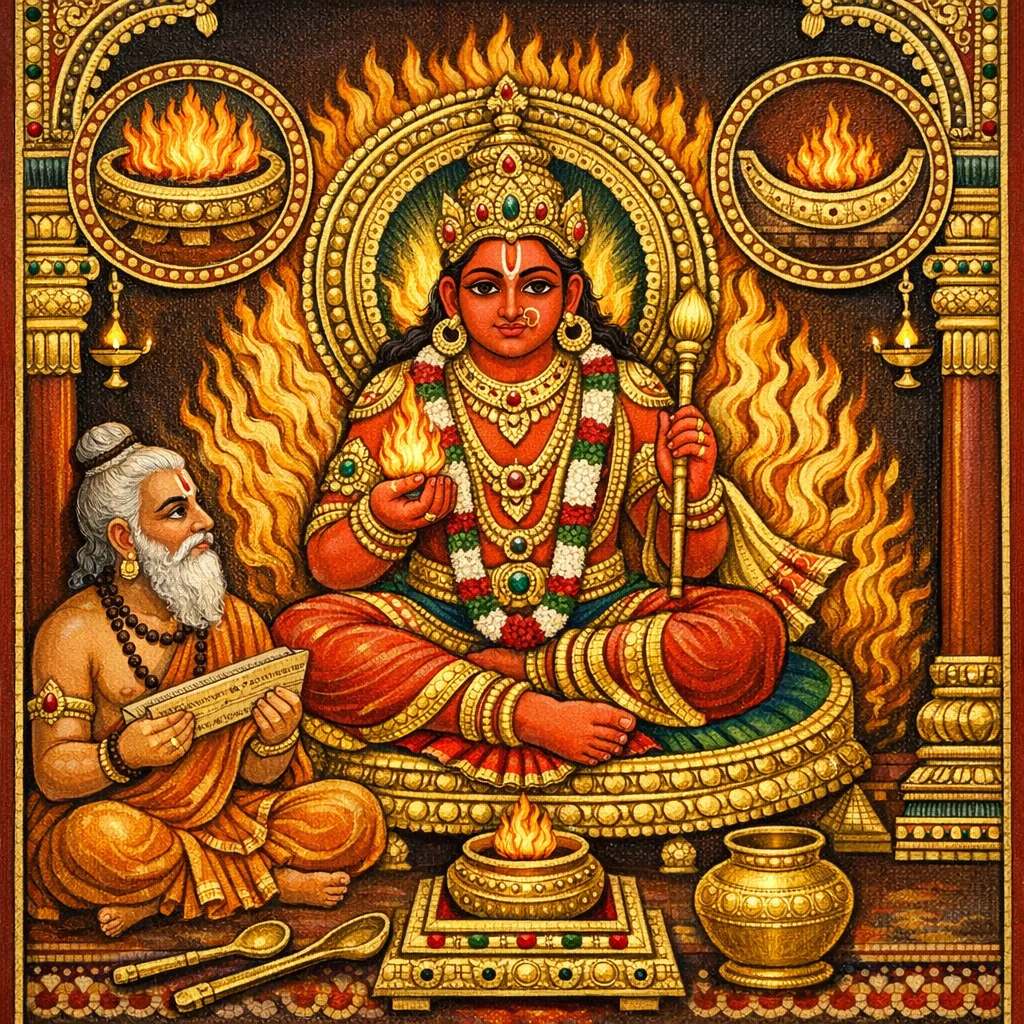
In this chapter, Nārada proclaims the agni-kārya that brings success in desired aims and begins with precise, vāstu-like specifications for constructing the homa-kuṇḍa: measuring and excavating with a cord, forming the mekhalā (raised rim), and shaping the yoni-channel with graded widths, a prescribed slope, and proper orientation. It then presents alternative kuṇḍa forms—circular, half-moon, lotus-like—and proportional rules for implements (śruk/śruva and the sruva bowl), stressing exact aṅgula-based measurements. The chapter next turns to ritual procedure: layering darbha, placing vessels, preparing praṇīta water, sprinkling and consecrating ghee (ājya-saṃskāra), and performing homa with the Praṇava (Om) as the unifying mantra-principle. The rite is linked to saṃskāras from garbhādhāna through samāvartana, integrating domestic and life-cycle ceremonies into Vaiṣṇava fire-worship. Finally, it deepens into internal cosmological meditation—bīja purification, brahmāṇḍa visualization, liṅga transformation—culminating in guru-led initiation elements, offerings to Viśvaksena, and the teaching that the bhoktā gains worldly fulfillment while the mumukṣu dissolves into Hari, thus uniting bhukti and mukti through disciplined ritual science.
Shlokas
Verse 1
इत्य् आदिमहापुराणे आग्नेये आदिमूर्त्यादिपूजाविधिर्नाम त्रयोविंशो ऽध्यायः अथ चतुर्विंशो ऽध्यायः कुण्डनिर्माणादिविधिः नारद उवाच अग्निकार्यं प्रवक्ष्यामि येन स्यात्सर्वकामभाक् चतुरभ्यधिकं विंशमङ्गुलं चतुरस्रकं
Thus ends, in the Agni Purāṇa—the primeval Mahāpurāṇa—the twenty-third chapter entitled “The procedure for worship beginning with the Primeval Form (Ādi-mūrti)”. Now begins the twenty-fourth chapter: “The procedure for constructing the fire-pit (kuṇḍa) and related rites.” Nārada said: “I shall expound the rite of the sacred fire (agni-kārya), by which one becomes a fulfiller of all desired aims. (The fire-pit should be) square, measuring twenty-four aṅgulas.”
Verse 2
सूत्रेण सूत्रयित्वा तु क्षेत्रं तावत् खनेत्समं खातस्य मेखला कार्या त्यक्त्वा चैवाङ्गुलद्वयं
After laying out the site with a measuring cord, one should then excavate the ground evenly. Around the excavated area a surrounding rim (mekhalā, a raised band) should be made, leaving a margin of two finger-breadths.
Verse 3
सत्त्वादिसञ्ज्ञा पूर्वाशा द्वादशाङ्गुलमुच्छ्रिता अष्टाङ्गुला द्व्यङुलाथ चतुरङ्गुलविस्तृता
The eastern (front) line, designated by the name beginning with “Sattva,” is to be raised to a height of twelve aṅgulas; then (in order) eight aṅgulas, then two aṅgulas, and a breadth of four aṅgulas is also prescribed.
Verse 4
योनिर्दशाङ्गुला रम्या षट्चतुर्द्व्यङ्गुलाग्रगा क्रमान्निम्ना तु कर्तव्या पश्चिमाशाव्यवस्थिता
The yoni-shaped channel should be made pleasing, measuring ten aṅgulas in length. Its mouth/forepart is to be formed with successive breadths of six, four, and two aṅgulas; it should be constructed with a gradual downward slope and positioned facing the western direction.
Verse 5
अश्वत्थपत्रसदृशी किञ्चित् कुण्डे निवेशिता तुर्याङ्गुलायता नालं पञ्चदशाङ्गुलायतं
Slightly set into a basin (kuṇḍa), it should be shaped like an aśvattha (sacred fig) leaf; its tube (nāla) should measure four aṅgulas in length, and the whole piece should be fifteen aṅgulas long.
Verse 6
मूलन्तु त्र्यङ्गुलं योन्या अग्रं तस्याः षडङ्गुलं लक्षणञ्चैकहस्तस्य द्विगुणं द्विकरादिषु
The base (mūla) within the yoni (the pedestal’s socket) is three aṅgulas; its forepart is six aṅgulas. The specification prescribed for a one-handed image is to be doubled for two-handed and other multi-armed forms.
Verse 7
एकत्रिमेखलं कुण्डं वर्तुलादि वदाम्यहं सद्मादिसञ्ज्ञा इति ख, चिह्नितपुस्तकपाठः मलन्तु द्व्यङ्गुलमिति ग,चिह्नितपुस्तकपाठः कुण्डार्धे तु स्थितं सूत्रं कोणे यदतिरिच्यते
I shall describe the circular and other forms of the single-terraced (eka-tri-mekhalā) fire-pit. The cord placed at the midpoint of the fire-pit is that which extends in excess toward the corner; (in the marked manuscript readings, variants occur such as “sadmādi-saṁjñā” and “mala—two aṅgulas”).
Verse 8
तदर्धं दिशि संस्थाप्य भ्रामितं वर्तुलं भवेत् कुण्डार्धं कोणभागार्धं दिशिश्चोत्तरतो वहिः
Placing half of that measure in the prescribed direction and rotating it yields a circular form. Thus the half-measure defines half of the kuṇḍa (fire-pit), and half of the corner-portion is set in the direction—externally—toward the north.
Verse 9
पूर्वपश्चिमतो यत्नाल्लाञ्छयित्वा तु मध्यतः संस्थाप्य भ्रामितं कुण्डमर्धचन्द्रं भवेत् शुभं
Having carefully marked it along the east–west line, then setting it at the center and turning/aligning it to the proper orientation, the kuṇḍa (fire-pit) becomes ‘half-moon’ (ardha-candra) in form—an auspicious design.
Verse 10
पद्माकारे दलानि स्युर्मेखलानान्तु वर्तुले बाहुदण्डप्रमाणन्तु होमार्थं कारयेत् स्रुचं
Its leaf-like projections should be fashioned in the form of a lotus, and its encircling bands (mekhalā) should be circular. For the homa (fire-offering), the sacred ladle (sruc) should be made to the measure of the forearm length.
Verse 11
सप्तपञ्चाङ्गुलं वापि चतुरस्रन्तु कारयेत् त्रिभागेन भवेद्गर्तं मध्ये वृत्तं सुशोभनम्
One should construct it as a square, with each side measuring seven or five aṅgulas. The pit (garta) should be made in three divisions, with a well-formed circular area at the center, pleasing in appearance.
Verse 12
तिर्यगूर्ध्वं समं खाताद्वहिरर्धन्तु शोधयेत् अङ्गुलस्य चतुर्थांशं शेषार्धार्धं तथान्ततः
From the dug-out line (trench/pit), one should finish and true-up the outside to an equal measure both horizontally and vertically, removing irregularities to the extent of one-half. Then, of an aṅgula, a quarter-part is to be taken off; and finally, the remaining portion is again to be reduced by half.
Verse 13
खातस्य मेखलां रम्यां शेषार्धेन तु कारयेत् कण्ठं त्रिभागविस्तारं अङ्गुष्ठकसमायतं
With the remaining half of the prescribed measure, one should fashion a pleasing mekhalā (girdle-band) for the cavity (khāta). The neck (kaṇṭha) is to be made three parts in width, and in height equal to one thumb-breadth (aṅguṣṭhaka).
Verse 14
सार्धमङ्गुष्ठकं वा स्यात्तदग्रे तु मुखं भवेत् चतुरङ्गुलविस्तारं पञ्चाङ्गुलमथापि वा
It may be measured as one and a half thumb-breadths (aṅguṣṭhaka), and at its front there should be the face. The breadth should be four finger-breadths, or alternatively five finger-breadths.
Verse 15
त्रिकं द्व्यङ्गुलकं तत् स्यान्मध्यन्तस्य सुशोभनम् आयामस्तत्समस्तस्य मध्यनिम्नः सुशोभनः
That triad-measure (tri-ka) should be two aṅgulas; it is pleasing for the middle and end portions. The overall length should be properly proportioned, and a gentle depression at the center is aesthetically pleasing.
Verse 16
शुषिरं कण्ठदेशे स्याद्विशेद् यावत् कनीयसी शेषकुण्डन्तु कर्तव्यं यथारुचि विचित्रितं
A hollow should be made in the neck-region (kaṇṭha-deśa), bored in up to the measure of the little finger. The remaining cavity (kuṇḍa) should then be fashioned according to one’s preference, ornamented with varied designs.
Verse 17
स्रुवन्तु हस्तमात्रं स्याद्दण्डकेन समन्वितं वटुकं द्व्यङ्गुलं वृत्तं कर्तव्यन्तु सुशोभनं
The sruva (offering-ladle) should be of hand-length and fitted with a handle. Its bowl (vaṭuka) should be made round, measuring two finger-breadths, and it should be fashioned neatly and attractively.
Verse 18
कुण्डकेन समन्वितमिति ख, चिह्नितपुस्तकपाठः कण्ठकं द्व्यङ्गुलमिति ख, चिह्नितपुस्तकपाठः चन्द्राभं द्व्यङ्गुलमिति ङ, चिह्नितपुस्तकपाठः गोपदन्तु यथा मग्नमल्पपङ्के तथा भवेत् उपलिप्य लिखेद्रेखामङ्गुलां वज्रनासिकां
([Variant readings:] “provided with a kuṇḍaka,” says one marked manuscript; “the kaṇṭhaka is two aṅgulas,” says the same; “the moon-like (candrābha) is two aṅgulas,” says another.) The ‘cow’s-footprint’ impression should be like one sunk in shallow mud. After smearing the surface, one should draw the guideline (rekhā), one aṅgula in breadth, with a ‘vajra-nose’ (vajra-nāsikā), a diamond/bolt-shaped pointed tip.
Verse 19
सौम्याग्रा प्रथमा तस्यां रेखे पूर्वमुखे तयोः मध्ये तिस्रस् तथा कुर्याद्दक्षिणादिक्रमेण तु
In that layout, the first line should have its tip toward the auspicious (northern) side, and the two lines should face east. Between them one should likewise draw three additional lines, proceeding in order beginning from the southern direction.
Verse 20
एवमुल्लिख्य चाभ्युक्ष्य प्रणवेन तु मन्त्रवित् विष्टरं कल्पयेत्तेन तस्मिन् शक्तिन्तु वैष्णवीं
Thus, having drawn the prescribed design and sprinkled it with consecrated water, the knower of mantras should, by means of the Praṇava (Oṁ), arrange the viṣṭara—the ritual seat/altar; and upon it he should install the Vaiṣṇavī Śakti, the divine power of Viṣṇu.
Verse 21
अलं कृत्वा मूर्तिमतीं क्षिपेदग्निं हरिं स्मरन् प्रादेशमात्राः समिधो दत्वा परिसमुह्य तं
Having made the setting complete and formed it into a clearly manifest rite, one should kindle/place the fire while remembering Hari (Viṣṇu). After offering fuel-sticks (samidh) about a span (prādeśa) in length, one should then carefully gather and arrange it all around.
Verse 22
दर्भैस्त्रिधा परिस्तीर्य पूर्वादौ तत्र पात्रकं आसादयेदिध्मवह्नी भूमौ च श्रुक्श्रुवद्वयं
Having spread darbha-grass in three layers—beginning from the eastern side—one should then place there the vessel (pātraka). And on the ground one should set down the kindling and the fire, as well as the pair of ladles (śruk and śruva).
Verse 23
आज्यस्थाली चरुस्थाली कुशाज्यञ्च प्रणीतया प्रोक्षयित्वा प्रोक्षणीञ्च गृहीत्वापूर्य वारिणा
Having sprinkled with the praṇītā-water the ghee-pan (ājya-sthālī), the cooked-offering pan (caru-sthālī), and the kuśa-grass anointed with ghee, one should then take up the prokṣaṇī (sprinkling vessel) and fill it with water.
Verse 24
पवित्रान्तर्हिते हस्ते परिश्राव्य च तज्जलं प्राङ्नीत्वा प्रोक्षणीपात्रण् ज्योतिरग्रे निधाय च
With the hand holding the pavitra (purifying ring/grass), one should strain that water, letting it trickle through; then, facing east, take the prokṣaṇī vessel and place it before the sacred fire (light).
Verse 25
तदद्भिस्त्रिश् च सम्प्रोक्ष्य इद्ध्मं विन्यस्य चाग्रतः प्रणीतायां सुपुष्पायां विष्णुं ध्यात्वोत्तरेण च
Having sprinkled with that water three times and placing the kindling-fuel in front, in the vessel of praṇītā-water adorned with fine flowers one should meditate on Viṣṇu and then proceed with the subsequent mantra/rite.
Verse 26
आज्यस्थालीमथाज्येन सम्पूर्याग्रे निधाय च सम्प्लवोत्पवनाभ्यान्तु कुर्यादाज्यस्य संस्कृतिं
Then, having filled the ghee-vessel (ājya-sthālī) with ghee and placing it in front (near the fire/altar), one should perform the consecration (saṃskṛti) of the ghee by means of the two acts called samplava and utpavana.
Verse 27
अखण्डिताग्रौ निर्गर्भौ कुशौ प्रादेशमात्रकौ ताभ्यामुत्तानपाणिभ्यामङ्गुष्ठानामिकेन तु
Two blades of kuśa, with unbroken tips and without nodes, each only a prādeśa (a span) in length—these are to be held with the palms turned upward, using the thumb and the ring finger.
Verse 28
आज्यं तयोस्तु सङ्गृह्य द्विर्नीत्वा त्रिरवाङ्क्षिपेत् स्रुक्स्रुवौ चापि सङ्गृह्य ताभ्यां प्रक्षिप्य वारिण
Having gathered the ghee from those (ladles), one should draw it twice and pour it downward three times. Then, having also collected the sruk and sruva ladles, one should rinse them with water.
Verse 29
रुद्रनासिकामिति ख, चिह्नितपुस्तकपाठः वक्त्रनासिकामिति ङ, चिह्नितपुस्तकपाठः आद्यं तयोस्तु सम्पूज्य त्रीन् वारानूर्ध्वमुत्क्षिपेदिति ङ, चिह्नितपुस्तकपाठः प्रतप्य दर्भैः सम्मृज्य पुनः प्रक्ष्याल्य चैव हि निष्टप्य स्थापयित्वा तु प्रणवेनैव साधकः
After heating it and wiping it with darbha-grass, he should wash it again. Then, having dried it thoroughly and set it in its proper place, the practitioner should complete (or consecrate) the act with the Pranava, the syllable Oṃ, alone. (Marked manuscripts note variant readings “rudra-nāsikā” vs. “vaktra-nāsikā,” and an instruction that, after duly worshipping the two, one should lift the first upward three times.)
Verse 30
प्रणवादिनमोन्तेन पश्चाद्धोमं समाचरेत् गर्भाधानादिकर्माणि यावदंशव्यवस्थया
After completing the salutatory formula beginning with Oṃ, one should then duly perform the homa. And the rites beginning with garbhādhāna (the conception-rite) should be carried out according to the prescribed division and sequence of their parts.
Verse 31
नामान्तं व्रतबन्धान्तं समावर्तावसानकम् अधिकारावसानं वा कर्यादङ्गानुसारतः
One should perform the concluding rite in accordance with the prescribed aṅgas (subsidiary acts): either at the completion of the naming ceremony, at the completion of vratabandha (initiation into a vow or discipline), at the completion of samāvartana (the graduation/return-from-studentship rite), or at the completion of one’s authorized period of adhikāra (eligibility).
Verse 32
प्रणवेनोपचारन्तु कुर्यात्सर्वत्र साधकः अङ्गैर् होमस्तु कर्तव्यो यथावित्तानुसारतः
In every rite, the practitioner should perform the acts of worship (upacāra) employing the Pranava, the syllable Oṃ. The homa (fire-offering) should be carried out with the prescribed aṅgas (ritual components), in accordance with one’s means.
Verse 33
गर्भादानन्तु प्रथमं ततः पुंसवनं स्मृतम् सीमन्तोन्नयनं जातकर्म नामान्नप्राशनम्
First is Garbhādhāna (the rite of conception); next is Puṃsavana as remembered; then Sīmantonnayana; thereafter Jātakarman (the birth rite), Nāmakaraṇa (name-giving), and Annaprāśana (the child’s first feeding of solid food).
Verse 34
चूडकृतिं व्रतबन्धं वेदव्रतान्यशेषतः समावर्तनं पत्न्या च योगश्चाथाधिकारकः
The tonsure-rite (cūḍākaraṇa), the initiation into vows (vrata-bandha), all the Vedic student-observances in full, the graduation-rite (samāvartana), and the discipline of yoga together with one’s wife—these are then the matters that confer eligibility for the ensuing rites and duties.
Verse 35
हृदादिक्रमतो ध्यात्वा एकैकं कर्म पूज्य च अष्टावष्टौ तु जुहुयात् प्रतिकर्माहुतीः पुनः
Meditating in due order beginning with the Heart (hṛd-nyāsa and the subsequent placements), and worshipping each rite individually, one should then offer oblations—eight and eight again—repeating once more the oblations corresponding to each rite (prati-karman).
Verse 36
पूर्णाहुतिं ततो दद्यात् श्रुचा मूलेन साधकः वौषडन्तेन मन्त्रेण प्लुतं सुस्वरमुच्चरन्
Then the practitioner should offer the full oblation (pūrṇāhuti) with the ladle (śrucā), using the root-mantra (mūla-mantra), pronouncing it in a sustained (pluta) and well-modulated tone, with the mantra ending in “vauṣaṭ.”
Verse 37
विष्णोर्वह्निन्तु संस्कृत्य श्रपयेद्वैष्णवञ्चरुम् आराध्य स्थिण्डिले विष्णुं मन्त्रान् संस्मृत्य संश्रपेत्
After duly consecrating the fire for Viṣṇu, one should cook the Vaiṣṇava caru (sacrificial rice-porridge). Having worshiped Viṣṇu on the ritual altar (sthiṇḍila), and recollecting the prescribed mantras, one should complete the cooking and offering accordingly.
Verse 38
आसनादिक्रमेणैव साङ्गावरणमुत्तमम् गन्धपुष्पैः समभ्यर्च्य ध्याता देवं सुरोत्तमम्
Following the prescribed sequence beginning with the offering of the seat (āsana) and related rites, one should perform the excellent worship of the deity together with His limbs and the surrounding attendant deities (āvaraṇa). Having duly worshipped with fragrances and flowers, the worshipper should meditate upon that God—the supreme among the gods.
Verse 39
आधायेध्ममथाघारावाज्यावग्नीशसंस्थितौ नियुज्य स्थापयित्वेति ख, चिह्नितपुस्तकपाठः देवव्रतान्यशेषत इति ख, चिह्नितपुस्तकपाठः योगश्चाथाधिकारत इति ख, चिह्नितपुस्तकपाठः मन्त्रान् सन्तर्प्य संत्रपेत् इति ख, घ, चिह्नितपुस्तकद्वयपाठः वायव्यनैरृताशादिप्रवृत्तौ तु यथाक्रमम्
Having first placed the kindling (idhma), he should then arrange the two āghāra libations of ghee in their proper positions in relation to the presiding fire, Agni. Next, he should assign the respective acts and set them in due order. He should then complete the divine observances (devavrata) in full, and undertake the prescribed yogic discipline according to his eligibility. Having satisfied the mantras by recitation and oblations, he should proceed sequentially when beginning rites connected with the Vāyavya (north-west) and Nairṛta (south-west) directions, and so on.
Verse 40
आज्यभागौ ततो हुत्वा चक्षुषी दक्षिणोत्तरे मध्येथ जुहुयात्सर्वमन्त्रानर्चाक्रमेण तु
Then, having offered the two ājya portions (ājyabhāga), one should offer in the middle the two ‘Cakṣuṣī’ oblations—right and left. Thereafter, one should make oblations of all the mantras, following the prescribed order of worship (arcā-krama).
Verse 41
आज्येन तर्पयेन्मूर्तेर्दशांशेनाङ्गहोमकम् शतं सहस्रं वाज्याद्यैः समिद्भिर्वा तिलैः सह
With clarified butter (ghee) one should perform the satiation-offering (tarpana) to the deity’s form (mūrti); and with one-tenth of the main count one should perform the ancillary limb-offering (aṅga-homa). One may offer one hundred—or one thousand—oblations, using ghee and the like, or with fuel-sticks (samidh), or together with sesame seeds.
Verse 42
समाप्यार्चान्तु होमान्तां शुचीन् शिष्यानुपोषितान् आहूयाग्रे निवेश्याथ ह्य् अस्त्रेण प्रोक्षयेत् पशून्
Having duly completed the worship up to the conclusion of the fire-offering (homa), he should summon the purified disciples whom he has maintained and trained, seat them in front, and then—using the Astra-mantra—sprinkle the animals with consecrated water for ritual purification and consecration.
Verse 43
शिष्यानात्मनि संयोज्य अविद्याकर्मबन्धनैः लिङ्गानुवृत्तश् चैतन्यं सह लिङ्गेन पाशितम्
Having yoked the disciples to the Self (Ātman) through the bonds of ignorance (avidyā) and karma, consciousness—following the liṅga (subtle body)—is fettered together with that liṅga.
Verse 44
ध्यानमार्गेन सम्प्रोक्ष्य वायुवीजेन शोधयेत् ततो दहनवीजेन सृष्टिं ब्रह्माण्डसञ्ज्ञिकाम्
By the method of meditation, having ritually sprinkled (saṃprokṣa) the body or field of practice, one should purify it with the Vāyu-bīja; then, with the Dahana (Agni)-bīja, one should generate the creation known as the “Brahmāṇḍa” (cosmic egg).
Verse 45
निर्दग्धां सकलां ध्यायेद्भस्मकूटनिभस्थिताम्
One should meditate upon (Her/that form as) wholly burnt, abiding like a heap of ash.
Verse 46
प्लावयेद्वारिणा भस्म संसारं वार्मयंस्मरेतप्_२४०४५च्द्तत्र शक्तिं न्यसेत् पश्चात् पार्थिवीं बीजसञ्ज्ञिकाम् तन्मात्राभिः समस्ताभिः संवृतं पार्थिवं शुभम्
One should moisten the ash with water and contemplate the ritual world as constituted of water. There, one should then install (nyāsa) the Power (Śakti); thereafter, install the earth-element designated by its seed-syllable. Thus the auspicious earth-principle, enveloped by all the tanmātrās (subtle elements), is established.
Verse 47
अण्डन्तदुद्भवन्ध्यायेत्तदाधारन्तदात्मकम् तन्मध्ये चिन्तयेन्मूर्तिं पौरुषीं प्रणवात्मिकाम्
One should meditate on the cosmic Egg (aṇḍa) and on That from which it arises—That which is its support and its very essence. In the midst of it, one should contemplate the Puruṣa-form, whose nature is the Praṇava (Oṃ).
Verse 48
लिङ्गं सङ्क्रामयेत् पश्चादात्मस्थं पूर्वसंस्कृतम् विभक्तेन्द्रियसंस्थानं क्रमाद् वृद्धं विचिन्तयेत्
Afterwards, one should cause the liṅga (subtle body), previously refined by discipline, to pass over and be established in the Self; and one should contemplate in due sequence the subtle body’s arrangement as constituted by the differentiated sense-faculties and its progressive development through stages.
Verse 49
ततोण्डमब्दमेकं तु स्थित्वा द्विशकलीकृतम् समिद्भिर्वा तिलैस् तथा इति घ, चिह्नितपुस्तकपाठः सह लिङ्गेन दर्शितमिति ङ, चिह्नितपुस्तकपाठः संसारञ्चाक्षयं स्मरेदिति ख, चिह्नितपुस्तकपाठः स्थण्डिले पूर्वसंस्कृतमिति ख, चिह्नितपुस्तकपाठः द्यावापृथिव्यौ शकले तयोर्मध्ये प्रजापतिम्
Then, having remained for one year within the cosmic egg, it became divided into two halves. With offerings of samidh (fuel-sticks) or likewise of tila (sesame), one should contemplate the two halves as Heaven and Earth, and, in the space between them, Prajāpati, the Lord of creatures.
Verse 50
जातं ध्यात्वा पुनः प्रोक्ष्य प्रणवेन तु संश्रितम् मन्त्रात्मकतनुं कृत्वा यथान्यासं पुरोदितम्
Having meditated upon what has been brought into being, one should again sprinkle it with consecrated water; then, taking refuge in the Praṇava (Oṁ), one should fashion it into a mantra-constituted body, according to the nyāsa previously taught.
Verse 51
विष्णुर्हस्तं ततो मूर्ध्नि दत्वा ध्यात्वा तु वैष्णवम् एवमेकं बहून् वापि जनित्वा ध्यानयोगतः
Then Viṣṇu, placing his hand upon the crown of the head and meditating upon the Vaiṣṇava (form/mantra), thus brings forth—by the discipline of meditative yoga—either a single manifestation or even many.
Verse 52
करौ सङ्गृह्य मूलेन नेत्रे बद्ध्वा तु वाससा नेत्रमन्त्रेण मन्त्री तान् सदनेनाहतेन तु
Having seized the hands at the root (i.e., by the wrists) and having bound the eyes with a cloth, the mantra-practitioner should then strike or press them with a staff (sadanāhata), while reciting the Netra-mantra.
Verse 53
कृतपूजो गुरुः सम्यक् देवदेवस्य तत्त्ववान् शिष्यान् पुष्पाञ्जलिभृतः प्राङ्मुखानुपवेशयेत्
After duly completing the worship, the guru—one who truly knows the reality of the God of gods—should seat the disciples facing east, their hands in añjali (joined palms) holding offerings of flowers.
Verse 54
अर्चयेयुश् च तेप्येवम्प्रसूता गुरुणा हरिम् क्षिप्त्वा पुष्पाञ्जलिं तत्र पुष्पादिभिरनन्तरम्
And they too, having thus been instructed by the teacher, should worship Hari; having cast there a handful-offering of flowers, they should then continue immediately with flowers and other offerings.
Verse 55
अमन्त्रमर्चनं कृत्वा गुरोः पादार्चनन्ततः विधाय दक्षिणां दद्यात् सर्वस्वं चार्धमेव वा
Having performed worship without mantras, and thereafter worshipped the Guru’s feet, one should arrange and offer a dakṣiṇā—either one’s entire wealth, or at least half of it.
Verse 56
गुरुः संशिक्षयेच्छिष्यान् तैः पूज्यो नामभिर्हरिः विश्वक्सेनं यजेदीशं शङ्खचक्रगदाधरम्
The teacher should thoroughly instruct the disciples; and by those disciples, Hari is to be worshipped through His sacred names. One should also worship Viśvaksena, the Lord, the bearer of the conch, discus, and mace.
Verse 57
तज्जपन्तञ्च तर्जन्या मण्डलस्थं विसर्जयेत्
While reciting that mantra, one should, with the index finger, dismiss (release) what has been placed within the maṇḍala.
Verse 58
विष्णुनिर्माल्यमखिलं विष्वक्सेनाय चार्पयेत् प्रणीताभिस् तथात्मानमभिषिच्य च कुण्डगं
One should offer all of Viṣṇu’s nirmālya (sacred remnants) to Viṣvaksena; likewise, with the consecrated (praṇīta) waters one should sprinkle to purify oneself and also the ritual kuṇḍa vessel/receptacle.
Verse 59
वह्निमात्मनि संयोज्य विष्वक्सेनं विसर्जयेत् बुभुक्षुः सर्वमाप्नोति मुमुक्षुर् लीयते हरौ
Having united the sacred fire (Agni) within oneself, one should ritually dismiss (visarjana) Viṣvaksena. The seeker of enjoyments attains everything, while the seeker of liberation dissolves into Hari (Viṣṇu).
Frequently Asked Questions
Exact ritual geometry and proportional measurement: the kuṇḍa is laid out by cord and excavated evenly; a mekhalā is formed with specified margins; the yoni-channel has graded widths and a directional placement; multiple kuṇḍa shapes (square, circular, half-moon, lotus-form) are derived through defined midpoints, rotations, and aṅgula-based metrics. Implements (śruk/śruva/sruva bowl) are also standardized by forearm/hand measures.
It frames technical ritual construction and homa procedure as a disciplined sādhana: the Praṇava governs worship-actions, offerings are integrated with life-cycle saṃskāras, and the rite culminates in nyāsa and cosmological meditation (bīja purification, brahmāṇḍa visualization, liṅga transformation). The closing teaching explicitly maps outcomes to intention—bhukti for the enjoyer and mukti (mergence in Hari) for the liberation-seeker.