Adhyaya 36
Pavitrāropaṇa-vidhāna (The Procedure for Installing the Pavitra)
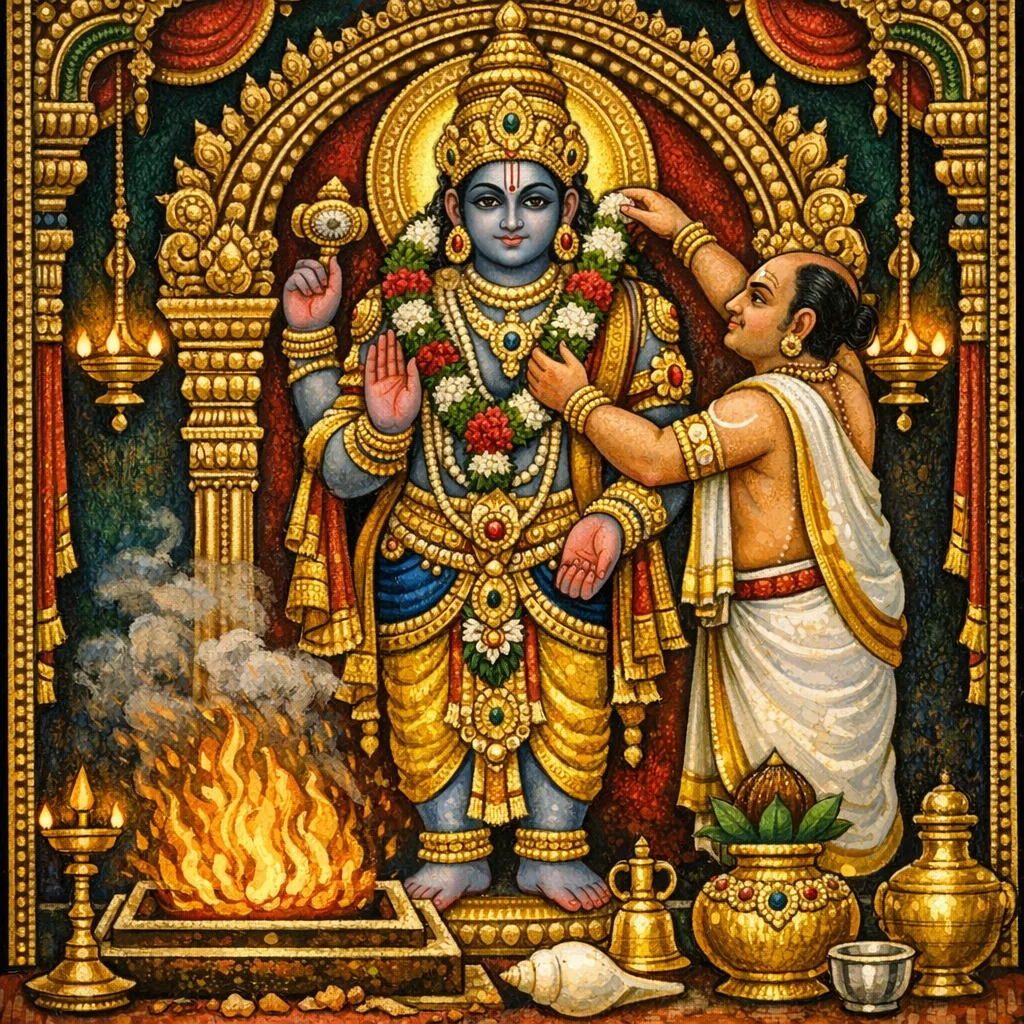
Lord Agni teaches Sage Vasiṣṭha an annual expiatory and purificatory rite centered on the pavitra (pavitraka)—a consecrated thread/cord/garland used to remedy lapses in regular worship. After morning bathing, worship of the dvārapālas, and preparation in a secluded place, old consecration materials and stale offerings are removed; the deity is re-installed and worship renewed with pañcāmṛta, kaṣāya decoctions, and fragrant water, followed by fire offerings and naimittika pūjā. The rite includes kumbha-invocation (Viṣṇu-kumbha), supplication to Hari, and mantric sanctification with hṛdādi-mantras; then the pavitra is worn/placed and offered to associated ritual agents (dvārapālas, āsana, guru, attendants). Atonement is sealed by pūrṇāhuti; optional 108 counts and abundant flower and garland offerings signify completeness. It concludes with seeking forgiveness, bali and dakṣiṇā, honoring brāhmaṇas, and finally visarjana—sending the pavitra to Viṣṇu-loka. Donating the used pavitra to a brāhmaṇa yields merit proportional to its strands, uplifting one’s lineage and leading to ultimate mokṣa.
Shlokas
Verse 1
इत्य् आदिमहापुराणे आग्नेये पवित्राधिवासनं नाम पञ्चत्रिंशो ऽध्यायः अथ षट्त्रिंशो ऽध्यायः पवित्रारोपणविधानं अग्निर् उवाच प्रातः स्नानं कृत्वा द्वारपालान् प्रपूज्य च प्रविश्य गुप्ते देशे च समाकृष्याथ धारयेत्
Thus, in the Agni Purāṇa of the primordial Mahāpurāṇa, the thirty-fifth chapter is called “Pavitra-adhivāsana (preliminary consecration of the pavitra).” Now begins the thirty-sixth chapter: “The procedure for installing the pavitra.” Agni said: “Having bathed in the morning, and having duly worshipped the gatekeepers, one should enter (the shrine); then, in a secluded place, having gathered/arranged the pavitra materials, one should thereafter wear/hold the pavitra.”
Verse 2
पूर्वाधिवासितं द्रव्यं वस्त्राभरणगन्धकं निरस्य सर्वनिर्माल्यं देवं संस्थाप्य पूजयेत्
Discard the substances previously used in the consecration-rite—such as cloth, ornaments, and fragrant materials—and remove all the withered offerings (nirmālya); then, having duly installed the deity, one should perform worship (pūjā).
Verse 3
पञ्चामृतैः कषायैश् च शुद्धगन्धोदकैस्ततः पूर्वाधिवासितं दद्याद्वस्त्रं गन्धं च पुष्पकं
Then, using the five nectars (pañcāmṛta), astringent decoctions (kaṣāya), and purified fragrant water, one should offer to the deity what has been previously consecrated—namely cloth, perfume/paste, and flowers.
Verse 4
अग्नौ हुत्वा नित्यवच्च देवं सम्प्रार्थयेन्नमेत् समर्प्य कर्म देवाय पूजां नैमित्तिकीं चरेत्
Having offered oblations into the fire and likewise performed the daily observance, one should earnestly pray to the deity and bow. Having dedicated the rite to the deity, one should then perform the occasional (naimittika) worship.
Verse 5
द्वारपालविष्णुकुम्भवर्धनीः प्रार्थयेद्धरिं अतो देवेति मन्त्रेण मूलमन्त्रेण कुम्भके
In the rite of the consecration-pot (kumbha), one should supplicate Hari—invoking the door-guardians, Viṣṇu, and the deities of the pot’s increase/prosperity (vardhanī)—by the mantra beginning “ato deva…”, and by the root (principal) mantra.
Verse 6
कृष्ण कृष्ण नमस्तुभ्यं गृह्णीष्वेदं पवित्रकं लोकपालानिति ख, चिह्नितपुस्तकपाठः प्रार्थयेन्न्यसेदिति ग, चिह्नितपुस्तकपाठः पवित्रीकरणार्थाय वर्षपूजाफलप्रदं
“O Kṛṣṇa, O Kṛṣṇa—obeisance to You. Please accept this pavitraka (a consecrated purificatory cord/amulet).” (Some marked manuscripts read: “(invoke) the Lokapālas.” Some read: “Having prayed, one should place it.”) It is done for purification and bestows the fruit of a full year’s worship.
Verse 7
पवित्रकं कुरुध्वाद्य यन्मया दुष्कृतं कृतं शुद्धो भवाम्यहं देव त्वत्प्रसादात् सुरेश्वर
Perform the pavitraka rite today, so that whatever wrongdoing has been committed by me may be purified. O God, by your grace, O Lord of the gods, may I become pure.
Verse 8
पवित्रञ्च हृदाद्यैस्तु आत्मानमभिषिच्य च विष्णुकुम्भञ्च सम्प्रोक्ष्य व्रजेद्देवसमीपतः
Then, having sanctified the pavitra with the Hṛd and related mantras, and having ritually sprinkled oneself for purification, and having also duly asperged the Viṣṇu-kumbha, one should proceed into the presence of the Deity.
Verse 9
पवित्रमात्मने दद्याद्रक्षाबन्धं विसृज्य च गृहाण ब्रह्मसूत्रञ्च यन्मया कल्पितं प्रभो
He should bestow upon himself the consecrated pavitra; and, having removed the rakṣā-bandhana, he should accept the brahma-sūtra prescribed by me, O Lord.
Verse 10
कर्मणां पूरणार्थाय यथा दोषो न मे भवेत् द्वारपालासनगुरुमुख्यानाञ्च पवित्रकम्
For the proper completion of the rites—so that no fault may arise for me—one should also provide the pavitraka for the door-keepers, the worship-seat (āsana), the guru, and the principal attendants/officiants.
Verse 11
कनिष्टादि च देवाय वनमालाञ्च मूलतः हृदादिविश्वक्सेनान्ते पवित्राणि समर्पयेत्
Beginning with the little finger and so on, one should offer the pavitra to the Deity, and place the forest-garland (vanamālā) at its base. Then, from the Hṛd mantra up to Viśvaksena, one should present the consecrated pavitra-s (sacred threads/garlands).
Verse 12
वह्नौ हुत्वाग्निवर्तिभ्यो विष्ण्वादिभ्यः पवित्रकम् प्रार्च्य पूर्णाहुतिं दद्यात् प्रायश्चित्ताय मूलतः
Having offered oblations into the fire, one should worship the deities presiding over the fire-path (Agni’s retinue) and also Viṣṇu and the others with the pavitraka; then, for fundamental expiation (prāyaścitta), one should give the final complete oblation, the pūrṇāhuti.
Verse 13
अष्टोत्तरशतं वापि पञ्चोपनिषदैस्ततः मणिविद्रुममालाभिर्मन्दारकुसुमादिभिः
Alternatively, one should perform one hundred and eight (recitations/offerings); thereafter, taking the five Upaniṣads as the basis, one should worship with garlands of jewels and coral, with mandāra flowers and similar offerings.
Verse 14
इयं सांवत्सरी पूजा तवास्तु गरुडध्वज वनमाला यथा देव कौस्तुभं सततं हृदि
May this annual worship be for You, O Lord whose banner is Garuḍa; and may the forest-garland and the Kaustubha jewel, O Deva, ever abide upon Your heart.
Verse 15
तद्वत् पवित्रतन्तूंश् च पूजां च हृदये वह कामतो ऽकामतो वापि यत्कृतं नियमार्चने
Likewise, bear in your heart the sacred pavitra-threads and the act of worship; whether the niyamārcana (observance-worship) has been performed intentionally or even unintentionally, let it be received as valid inner worship.
Verse 16
विधिना विघ्नलोपेन परिपूर्णं तदस्तु मे प्रार्थ्य नत्वा क्षमाप्याथ पवित्रं मस्तके ऽर्पयेत्
Having performed the rite according to rule and with obstacles removed, one should pray, “May this be complete for me.” Then, having bowed and asked forgiveness, one should place the pavitra (purificatory ring/cord) upon the head.
Verse 17
दत्वा बलिं दक्षिणाभिर्वैष्णवन्तोषयेद्गुरुं रक्षाबन्धं विमुच्य चेति ख, चिह्नितपुस्तकपाठः पवित्रं मूलतो दद्याद्रक्षार्थं तद्विसृज्य चेति ङ, चिह्नितपुस्तकपाठः पवित्रकं त्वञ्च पूजायां हृदये वहेति ङ, चिह्नितपुस्तकपाठः विप्रान् भोजनवस्त्राद्यैर् दिवसं पक्षमेव वा
Having offered the bali (ritual oblation) together with dakṣiṇā (monetary gifts), one should satisfy the Vaiṣṇava guru; then one should untie/remove the protective thread (rakṣā-bandha) (according to one recension). Another reading states: “One should place the pavitra (consecrated protective cord/garland) at the root (of the deity/holy plant) for protection, and then discard it.” Yet another variant says: “And during worship you should wear the pavitraka upon the heart.” One should also honor brāhmaṇas with food, clothing, and the like—either for a day or even for a fortnight.
Verse 18
पवित्रं स्नानकाले च अवतार्य समर्पयेत् अनिवारितमन्नाद्यं दद्याद्भुङ्क्तेथ च स्वयं
At the time of bathing, one should lower the pavitra (the sacred purifier-ring/grass) and offer it in due form. One should give food and the like without withholding or refusal, and then eat oneself as well.
Verse 19
विसर्जने ऽह्नि सम्पूज्य पवित्राणि विसर्जयेत् सांवत्सरीमिमां पूजां सम्पाद्य विधिवन्मम
On the day of visarjana (ritual dismissal), having duly worshipped the deity, one should ceremonially remove and consign the pavitra-threads. Thus one completes this annual worship according to rule, as taught by me.
Verse 20
व्रज पवित्रकेदानीं विष्णुलोकं विसर्जितः मध्ये सोमेशयोः प्रार्च्य विष्वक्सेनं हि तस्य च
“Go now, O Pavitraka, to Viṣṇu’s world, having been duly dismissed from the rite.” In the interval, having first worshipped Someśa, one should also worship Viṣvaksena, His (Viṣṇu’s) attendant-chief.
Verse 21
पवित्राणि समभ्यर्च्य ब्राह्मणाय समर्पयेत् यावन्तस्तन्तवस्तस्मिन् पवित्रे परिकल्पिताः
Having duly worshipped the pavitra-threads, one should present them to a Brāhmaṇa; and the merit accrues in proportion to however many strands are arranged in that pavitra.
Verse 22
तावद्युगसहस्राणि विष्णुलोके महीयते कुलानां शतमुद्धृत्य दश पूर्वान् दशापरान् विष्णुलोकं तु संस्थाप्य स्वयं मुक्तिमवाप्नुयात्
For that many thousands of yugas, one is honored in Viṣṇu’s world; having uplifted a hundred of one’s lineage—ten ancestors and ten descendants—and having established them in Viṣṇu-loka, one then attains liberation oneself.
Frequently Asked Questions
It functions as an annual prāyaścitta (expiatory purification) that corrects faults and omissions in regular worship, explicitly said to grant the fruit of a full year’s pūjā.
Bathing and dvārapāla-pūjā; removal of old adhivāsana materials and nirmālya; re-installation and worship with pañcāmṛta/kaṣāya/gandhodaka; homa and naimittika-pūjā; Viṣṇu-kumbha invocation; hṛdādi-mantra sanctification; offering pavitra to deity and ritual agents; pūrṇāhuti; bali-dakṣiṇā and brāhmaṇa-satkara; concluding visarjana and donation of pavitra.
By framing technical completion (vidhi, obstacle-removal, forgiveness, proper dismissal) as the means to purification, lineage uplift in Viṣṇu-loka, and ultimately personal liberation (mukti).