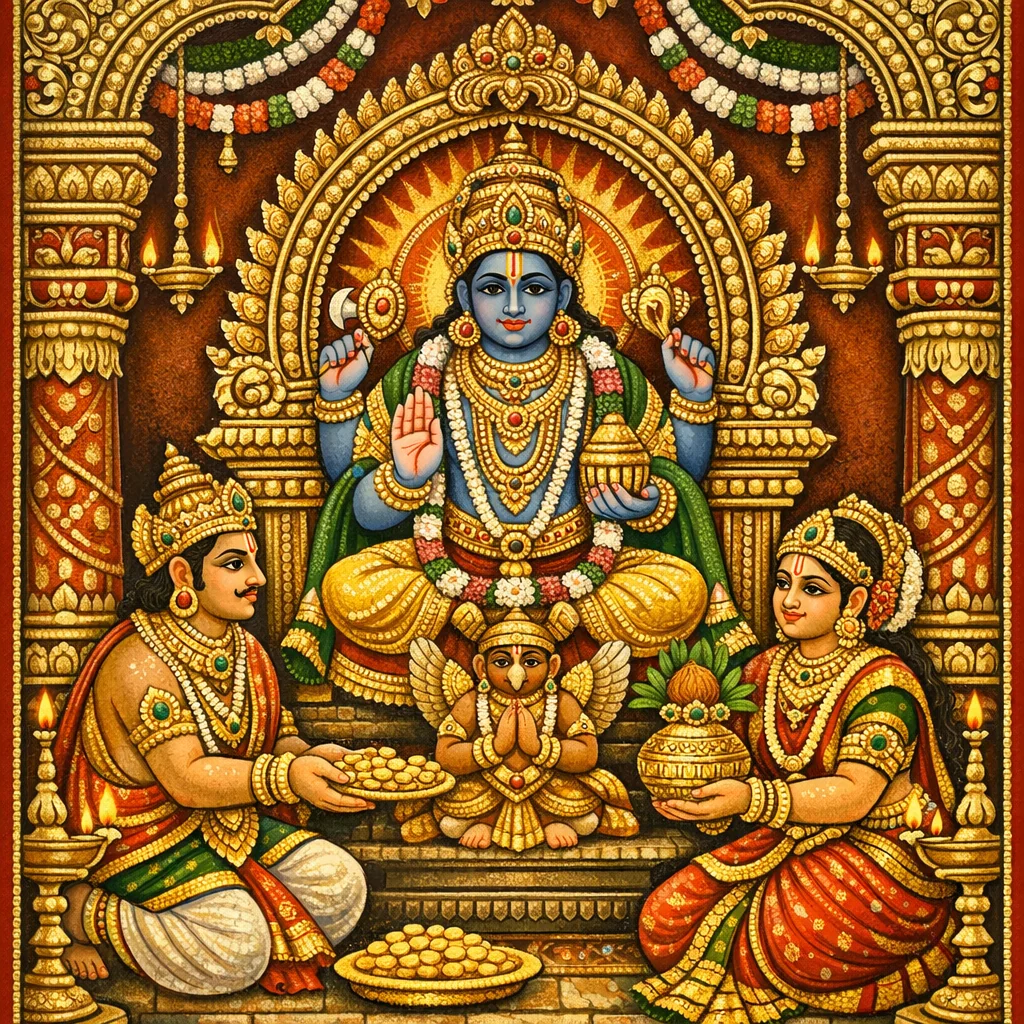
Adhyaya 38
Chapter 38 — देवालयनिर्माणफलं (The Merit of Constructing a Temple)
Agni declares that founding a divine abode—above all a shrine of Vāsudeva—wipes away sins gathered over countless births, and that the merit reaches even supporters who simply rejoice. The chapter sets out a graded doctrine of sacred construction: building, maintaining, plastering, sweeping, supplying bricks, and even a child’s play of making a sand-temple are dharmic acts leading to Viṣṇuloka and the uplift of one’s lineage, while deceitful or merely showy works yield no heavenly fruit. It then links architectural grades (single-, three-, five-, eight-, and sixteen-unit forms) to corresponding cosmic attainments, culminating in bhukti-mukti for higher temples and mokṣa through supreme Vaiṣṇava sanctuaries. Ethical counsel follows: wealth is transient but becomes meaningful when directed to temple-building, gifts to the twice-born, and kīrtana, with praise held especially potent. The discourse expands into metaphysics—Viṣṇu as the source and all-pervader—connecting temple establishment with non-return from rebirth. It compares the merits of temple-building with image-making and installation, ranks materials, and proclaims limitless fruit in pratimā-pratiṣṭhā rites. Finally, by Yama’s injunction, temple-builders and image-worshippers are exempt from hellish seizure, and the chapter turns toward formal consecration teachings attributed to Hayagrīva for Brahmā and the gods.
Shlokas
Verse 1
इत्य् आदिमहापुराणे आग्नेये सङ्क्षेपपवित्रारोहणं नाम सप्तत्रिंशो ऽध्यायः अथ अष्टत्रिंशो ऽध्यायः देवालयनिर्माणफलं अग्निर् उवाच वासुदेवाद्यालयस्य कृतौ वक्ष्ये फलादिकं चिकीर्षोर्देवधामादि सहस्रजनिपापनुत्
Thus, in the Agni Purāṇa within the Primeval Mahāpurāṇa, the thirty-seventh chapter, called “The Concise Rite of Raising the Pavitra (Sacred Banner),” concludes. Now begins the thirty-eighth chapter, “The Merit (phala) of Constructing a Temple.” Agni said: I shall declare the fruits and related results of building a shrine—beginning with that of Vāsudeva—for one who wishes to establish a divine abode; it removes the sins accumulated over a thousand births.
Verse 2
मनसा सद्मकर्तॄणां शतजन्माघनाशनं येनुमोदन्ति कृष्णस्य क्रियमाणं नरा गृहं
Even by mere mental assent, those who rejoice in the making of Kṛṣṇa’s house—approving and supporting the builders—gain the destruction of sins accumulated over a hundred births.
Verse 3
तेपि पापैर् विनिर्मुक्ताः प्रयान्त्यच्युतलोकतां समतीतं भविष्यञ्च कुलानामयुतं नरः
They too, freed from sins, go to the realm of Acyuta (Viṣṇu). A man who does this delivers ten thousand lineages—past and future alike.
Verse 4
विष्णुलोकं नयत्याशु कारयित्वा हरेर्गृहं वसन्ति पितरो दृष्ट्वा विष्णुलोके ह्य् अलङ्कृताः
Having caused a dwelling (temple) of Hari to be built, one quickly leads one’s ancestors to Viṣṇu’s world; the Pitṛs, beholding that merit, dwell in Viṣṇuloka, indeed adorned with divine splendor.
Verse 5
विमुक्ता नारकैर् दुःखैः कर्तुः कृष्णस्य मन्दिरं ब्रह्महत्यादिपापौघघातकं देवतालयं
For the patron who establishes it, Kṛṣṇa’s temple is a divine sanctuary that destroys torrents of sins beginning with brahma-hatyā, and it frees one from hellish sufferings.
Verse 6
फलं यन्नाप्यते यज्ञैर् धाम कृत्वा तदाप्यते देवागारे कृते सर्वतीर्थस्नानफलं लभेत्
That reward which is not obtained even by sacrifices (yajñas) is obtained by constructing a sacred abode for the deity. When a divine shrine (devāgāra) is built, one gains merit equal to bathing at all holy pilgrimage waters (tīrthas).
Verse 7
देवाद्यर्थे हतानाञ्च रणे यत्तत्फलादिकं शाठ्येन पांशुना वापि कृतं धाम च नाकदं
Whatever merit and related fruits are declared for those slain in battle for the sake of the gods and similar sacred causes—if it is done with deceit, or even as a mere pretence like scattering dust, then such an act does not become a heavenly abode, nor does it grant heaven.
Verse 8
गृहादिकं ग, घ, चिह्नितपुस्तकद्वयपाठः नन्दन्ति इति ख, ग, चिह्नितपुस्तकद्वयपाठः वल्गन्ति इति ङ, चिह्नितपुस्तकपाठः हृष्टा इति ख, ग, चिह्नितपुस्तकद्वयपाठः एकायतनकृत् स्वर्गी त्र्यगारी ब्रह्मलोकभाक् पञ्चागारी शम्भुलोकमष्टागाराद्धरौ स्थितिः
One who builds a single-sanctum dwelling attains heaven. The builder of a three-chambered house partakes of Brahmā’s world; the builder of a five-chambered house reaches Śambhu’s (Śiva’s) world; and from an eight-chambered house comes abiding prosperity and stability on earth.
Verse 9
षोडशालयकारी तु भुक्तिमुक्तिमवाप्नुयात् कनिष्ठं मध्यमं श्रेष्ठं कारयित्वा हरेर्गृहं
But one who constructs a sixteen-shrined (sixteen-chambered) temple attains both worldly enjoyment and liberation (mokṣa), having caused Hari’s (Viṣṇu’s) temple to be built in the inferior, middling, or excellent grade.
Verse 10
स्वर्गं च वैष्णवं लोकं मोक्षमाप्नोति च क्रमात् श्रेष्ठमायतनं विष्णोः कृत्वा यद्धनवान् लभेत्
Having constructed the supreme sanctuary of Lord Viṣṇu, a wealthy patron attains heaven, then the Vaiṣṇava world, and in due course even liberation (mokṣa).
Verse 11
कनिष्ठेनैव तत् पुण्यं प्राप्नोत्यधनवान्नरः समुत्पाद्य धनं कृत्या स्वल्पेनापि सुरालयं
Even with the smallest offering, a poor man attains that very merit. Having generated wealth through rightful effort, he should establish or support a divine shrine—even with only a little.
Verse 12
कारयित्वा हरेः पुण्यं सम्प्राप्नोत्यधिकं वरं लक्षणाथ सहस्रेण शतेनार्धेन वा हरेः
Having caused a pious rite or gift for Hari to be performed, one attains a superior boon and greater merit—Hari’s merit being reckoned as a lakh (one hundred thousand), or a thousand, or a hundred and fifty.
Verse 13
कारयन् भवनं याति यत्रास्ते गरुडध्वजः बाल्ये तु क्रीडमाणा ये पांशुभिर्भवनं हरेः
One who causes a dwelling (temple/abode) to be built reaches the realm where the Garuḍa-bannered Lord (Viṣṇu) abides. Even those who, in childhood play, build Hari’s house with sand attain that same merit.
Verse 14
वासुदेवस्य कुर्वन्ति तेपि तल्लोकगामिनः तीर्थे चायतने पुण्ये सद्धक्षेत्रे तथाष्टमे
Even those who perform worship and service to Vāsudeva become goers to His world—especially when done at a tīrtha, in a holy shrine, in a meritorious place, in a truly righteous kṣetra, and likewise in the eighth sacred category.
Verse 15
कर्तुरायतनं विष्णोर्यथोक्तात्त्रिगुणं फलं बन्धूकपुष्पविन्यासैः सुधापङ्केन वैष्णवं
For the maker or sponsor, the sanctuary of Viṣṇu—constructed as prescribed—yields a threefold reward; and the Vaiṣṇava shrine (or the installation of the image) should be adorned by arranging bandhūka flowers and by applying a coating of lime-plaster paste (sudhā).
Verse 16
ये विलिम्पन्ति भवनं ते यान्ति भगवत्पुरं पतितं पतमानन्तु तथार्धपतितं नरः
Those who plaster and thus maintain the Lord’s dwelling go to the city of the Blessed Lord (Bhagavat). Even a man who has fallen—whether falling into sin or half-fallen—attains that merit as well.
Verse 17
समुद्धृत्य हरेर्धाम प्राप्नोति द्विगुणं फलं पतितस्य तु यः कर्ता पतितस्य च रक्षिता
One who lifts up and rescues a fallen person attains the abode of Hari (Viṣṇu) and receives merit in double; indeed, whoever becomes the benefactor and protector of the fallen gains this reward.
Verse 18
विष्णोरायतनस्येह नरो विष्णुलोकभाक् इष्टकानिचयस्तिष्ठेद् यावदायतने हरेः
Here, a man becomes a sharer in Viṣṇu’s world even by setting in place a heap of bricks for Viṣṇu’s shrine; the merit endures for as long as that sanctuary of Hari remains standing.
Verse 19
सकुलस्तस्य वै कर्ता विष्णुलोके महीयते षोडशागारकारी तु इति ग, चिह्नितपुस्तकपाठः स्वल्पेनैवेति ख, चिह्नितपुस्तकपाठः स एव पुण्यवान् पूज्य इह लोके परत्र च
The benefactor who undertakes that gift is honored in Viṣṇu’s world together with his entire lineage. Indeed, the maker of sixteen houses (as read in one marked manuscript), or even by a small gift (as read in another marked manuscript)—he alone is meritorious and worthy of honor, both in this world and in the next.
Verse 20
कृष्णस्य वासुदेवस्य यः कारयति केतनं जातः स एव सुकृती कुलन्तेनैव पावितं
Whoever causes the banner (ensign, ketana) of Kṛṣṇa Vāsudeva to be made—he alone is truly meritorious from birth; by that very act his entire lineage is purified.
Verse 21
विष्णुरुद्रार्कदेव्यादेर्गृहकर्ता स कीर्तिभाक् किं तस्य वित्तनिचयैर् मूढस्य परिरक्षितः
One who establishes (builds or maintains) a sacred abode for Viṣṇu, Rudra, Sūrya, the Goddess, and the like becomes a possessor of enduring fame. What use are hoarded accumulations of wealth, guarded by a deluded man?
Verse 22
दुःखार्जितैर् यः कृष्णस्य न कारयति केतनं नोपभोग्यं धनं यस्य पितृविप्रदिवौकसां
He who, with wealth earned through hardship, does not have a dwelling or shrine (ketana) made for Kṛṣṇa, and whose wealth is not employed for the Pitṛs (Fathers), the Brahmins, and the gods, is censured as one who fails to use riches in accordance with dharma.
Verse 23
नोपभोगाय बन्धूनां व्यर्थस्तस्य धनागमः यथा ध्रुवो नृणां मृत्युर्वित्तनाशस् तथा ध्रुवः
For one who does not use wealth for the enjoyment and support of his kinsmen, the gaining of riches is futile. Just as death is certain for human beings, so too the loss of wealth is certain.
Verse 24
मूढस्तत्रानुबध्नाति जीवितेथ चले घने यदा वित्तं न दानाय नोपभोगाय देहिनां
A deluded person clings to life amid dense, fickle uncertainty, when his wealth is used neither for charity nor for the rightful enjoyment of embodied beings.
Verse 25
नापि कीर्त्यै न धर्माथं तस्य स्वाम्येथ को गुणः तस्माद्वित्तं समासाद्य दैवाद्वा पौरुषादथ
His ownership yields no benefit—neither for fame nor for the aims of dharma; what worth, then, is such mastery? Therefore one should secure wealth, whether by destiny’s favor or by personal effort.
Verse 26
दद्यात् सम्यग् द्विजाग्र्येभ्यः कीर्तनानि च कारयेत् दानेभ्यश्चाधिकं यस्मात् कीर्तनेभ्यो वरं यतः
One should duly give gifts to the foremost among the twice-born (dvijas), and also have kīrtanas—recitations of praise—performed; for kīrtana is said to be superior to gifts, and even more efficacious than acts of donation.
Verse 27
अतस्तत्कारयेद्धीमान् विष्ण्वादेर्मन्दिरादिकं विनिवेश्य हरेर्धाम भक्तिमद्भिर् नरोत्तमैः
Therefore, the wise man should have a temple and related structures made for Viṣṇu and the other deities; having duly established Hari’s sacred abode, it should be carried out by the best of men who are devoted.
Verse 28
निवेशितं भवेत् कृत्स्नं त्रैलोक्यं सचराचरं भूतं भवयम् भविष्यञ्च स्थूलं सूक्ष्मं तथेतरत्
The entire threefold world—moving and unmoving—would be pervaded by Him: what has been, what is becoming, and what will be; the gross and the subtle, and also that which lies beyond such classifications.
Verse 29
आब्राह्मस्तम्बपर्यन्तं सर्वं विष्णोः समुद्भवं तस्य देवादिदेवस्य सर्वगस्य महात्मनः
From Brahmā down to a blade of grass, everything arises from Viṣṇu—He who is the God of gods, all-pervading, and the great-souled one.
Verse 30
निवेश्य भवनं विष्णोर् न भूयो भुवि जायते यथा विष्णोर्धामकृतौ फलं तद्वद्दिवौकसां
Having established (consecrated) a dwelling of Viṣṇu, one is not born again on earth; such is the fruit of creating Viṣṇu’s sacred abode—likewise it is held for the dwellers in heaven (the gods).
Verse 31
तथैव च इति ग, चिह्नितपुस्तकपाठः सर्वेशस्य इति ख, चिह्नितपुस्तकपाठः शिवब्रह्मार्कविघ्नेशचण्डीलक्ष्म्यादिकात्मनां देवालयकृतेः पुण्यं प्रतिमाकरणेधिकं
For those whose forms are Śiva, Brahmā, the Sun, Vighneśa (Gaṇeśa), Caṇḍī, Lakṣmī, and the like, the religious merit arising from building a temple is surpassed by the merit gained from fashioning their images (icons).
Verse 32
प्रतिमास्थापने यागे फलस्यान्तो न विद्यते मृण्मयाद्दारुजे पुण्यं दारुजादिष्ट्काभवे
In the sacrificial rite performed for the installation of a sacred icon (pratimā), the fruit of merit is without limit. The merit of installing a wooden image surpasses that of an earthen one; and the merit of an image made of brick or masonry surpasses that of a wooden one.
Verse 33
इष्टकोत्थाच्छैलजे स्याद्धेमादेरधिकं फलं सप्तजन्मकृतं पापं प्रारम्भादेव नश्यति
The merit arising from works made of brick is greater than that from stone, and the merit from stone is greater than that from gold and the like. Sin accumulated over seven births is destroyed from the very commencement of such a pious undertaking.
Verse 34
देवालयस्य स्वर्गी स्यान्नरकं न स गच्छति कुलानां शतमुद्धृत्य विष्णुलोकं नयेन्नरः
One devoted to the temple is destined for heaven and does not go to hell; having uplifted a hundred generations of his lineage, that person leads them to the world of Viṣṇu (Viṣṇuloka).
Verse 35
यमो यमभटानाह देवमन्दिरकारिणः यम उवाच प्रतिमापूजादिकृतो नानेया नरकं नराः
Yama said to his attendants (the Yamabhaṭas): “Men who have built temples for the gods, and those who have performed acts such as the worship of sacred images (pratimā), are not to be taken to hell.”
Verse 36
देवालयाद्यकर्तार आनेयास्ते तु गोचरे विसारध्वं यथान्यायन्नियोगो मम पाल्यतां
Those responsible for the temple’s administration and related duties should be summoned into my presence. Examine and decide the matter according to proper law and procedure; let my directive be duly carried out.
Verse 37
नाज्ञाभङ्गं करिष्यन्ति भवतां जन्तवः क्वचित् केवलं ते जगत्तातमनन्तं समुपाश्रिताः
Your creatures will never, at any time, transgress your command; for they have taken refuge solely in Ananta—the Father of the universe.
Verse 38
भवद्भिः परिहर्तव्यास्तेषां नात्रास्ति संस्थितिः ये च भगवता लोके तच्चित्तास्तत्परायणाः
By you they should be avoided; for them there is no standing here (no place in this path/assembly). But those in the world who are devoted to the Blessed Lord—whose minds are fixed on Him and who take Him as their sole refuge—are to be accepted and honored.
Verse 39
पूजयन्ति सदा विष्णुं ते वस्त्याज्याः सुदूरतः यस्तिष्ठन् प्रस्वपन् गच्छन्नुत्तिष्ठन् स्खलिते स्थिते
They ever worship Viṣṇu; therefore their dwelling (vāstu) is to be shunned from far away. For such a one, whether standing, sleeping, walking, rising up, stumbling, or remaining still, he remains engaged in Viṣṇu.
Verse 40
सङ्कीर्तयन्ति गोविन्दं ते वस्त्याज्याः सुदूरतः नित्यनैमित्तिकैर् देवं ये यजन्ति जनार्दनम्
Those who sing the names of Govinda are to be kept far away from Vāstu-related prohibitions; whereas those who worship the Lord Janārdana through the daily and occasional rites truly worship the Divine.
Verse 41
नावलोक्या भवद्भिस्ते तद्गता यान्ति तद्गतिम् आनेयास्त्वविशेषत इति ग, चिह्नितपुस्तकपाठः नियमो मे ऽनुपाल्यतामिति ख, चिह्नितपुस्तकपाठः जन्तवः क्वचिदिति ख, चिह्नितपुस्तकपाठः ये पुष्पधूपवासोभिर्भूषणैश्चातिवल्लभैः
“They should not be looked upon with contempt by you; those who have taken refuge there attain the very destiny of that (deity/realm). Indeed, they are to be brought (accepted) without discrimination”—such is the marked variant reading. “Let my rule be duly observed”—such is another marked reading. “Living beings, at times…”—another marked reading. (These are) those who worship with flowers, incense, fragrant garments, and exceedingly dear ornaments.
Verse 42
अर्चयन्ति न ते ग्राह्या नराः कृष्णालये गताः उपलेपनकर्तारः सम्मार्जनपराश् च ये
Those men who have gone to Kṛṣṇa’s temple are not to be taken into custody while engaged in worship—namely, those who plaster/daub the shrine and those devoted to sweeping and cleaning.
Verse 43
कृष्णालये परित्यज्यास्तेषां पुत्रास् तथा कुलम् येन चायतनं विष्णोः कारितं तत्कुलोद्भवम्
In the matter of Kṛṣṇa’s (Viṣṇu’s) shrine, their sons and their lineage are to be excluded; but one who has caused a temple of Viṣṇu to be built—being born in that very family—is to be accepted as eligible.
Verse 44
पुंसां शतं नावलोक्यं भवद्भिर्दुष्टचेतसा यस्तु देवालयं विष्णोर्दारुशैलमयं तथा
Even if, with an impure mind, one does not so much as look upon a hundred men, yet whoever beholds the temple of Viṣṇu—whether fashioned of wood or of stone—obtains merit.
Verse 45
कारयेन् मृण्मयं वापि सर्वपापैः प्रमुच्यते अहन्यहनि यज्ञेन यजतो यन् महाफलम्
Even if one has (a sacred object or rite) made merely of clay, one is released from all sins. The great fruit that accrues to a sacrificer by performing the fire-sacrifice day after day is thereby obtained.
Verse 46
प्राप्नोति तत् फलं विष्णोर्यः कारयति केतनं कुलानां शतमागामि समतीतं तथा शतं
Whoever causes an abode (shrine/temple) of Viṣṇu to be built attains that very fruit; and a hundred future generations of his lineage, as well as a hundred past generations, are likewise benefited.
Verse 47
कारयन् भगवद्धाम नयत्यच्युतलोकतां सप्तलोकमयो विष्णुस्तस्य यः कुरुते गृहं
One who causes the Lord’s abode to be built leads (oneself and others) to the world of Acyuta. Viṣṇu—who pervades the seven worlds—becomes, as it were, the very dwelling of the one who makes a house for Him.
Verse 48
तारयत्यक्षयांल्लोकानक्षयान् प्रतिपद्यते इष्टकाचयविन्यासो यावन्त्यब्दानि तिष्ठति
So long as the arranged piling of the altar-bricks (iṣṭakā-caya) endures for as many years, for that same duration one delivers imperishable worlds and oneself attains imperishable realms.
Verse 49
तावद्वर्षसहस्राणि तत्कर्तुर्दिवि संस्थितिः प्रतिमाकृद्विष्णुलोकं स्थापको लीयते हरौ देवसद्मप्रतिकृतिप्रतिष्ठाकृत्तु गोचरे
For that many thousands of years, the doer of that act abides in heaven. The maker of an icon attains the world of Viṣṇu; the one who installs it is absorbed into Hari. But the one who establishes (consecrates) the replica of a divine temple attains the sphere of Go-loka/Go-gati, the auspicious heavenly realm associated with the celestial Cow.
Verse 50
अग्निर् उवाच यमोक्ता नानयंस्तेथ प्रतिष्ठादिकृतं हरेः हयशीर्षः प्रतिष्ठार्थं देवानां ब्रह्मणे ऽब्रवीत्
Agni said: Then those gods, guided by Yama’s instruction, brought forward the rite of installation (pratiṣṭhā) and related procedures for Hari (Viṣṇu). For the purpose of establishing proper consecration, Hayagrīva spoke to Brahmā on behalf of the gods.
Frequently Asked Questions
That temple-building and its allied services (support, maintenance, cleaning, supplying materials, icon-making and installation) are powerful forms of dharma that destroy accumulated sin, uplift ancestors and lineages, and lead the patron toward Viṣṇuloka and even mokṣa when performed sincerely and according to prescription.
It frames architectural acts—design grades, material choices, construction, and consecration—as sacramental disciplines. When aligned with devotion and right intention, these technical works become vehicles of purification, lineage uplift, and ultimately freedom from rebirth through the establishment of Viṣṇu’s abode.
Yes. It explicitly cautions that acts done with deceit or as mere token gestures do not yield the promised heavenly results, emphasizing intention and dharmic integrity alongside ritual correctness.
Wealth is portrayed as inherently unstable; it becomes meaningful when used for dharma—temple-building, support of kin, gifts to worthy recipients, and especially kīrtana—rather than hoarded without charitable or righteous enjoyment.