Adhyaya 34
Chapter 34 — होमादिविधिः (The Procedure for Homa and Related Rites)
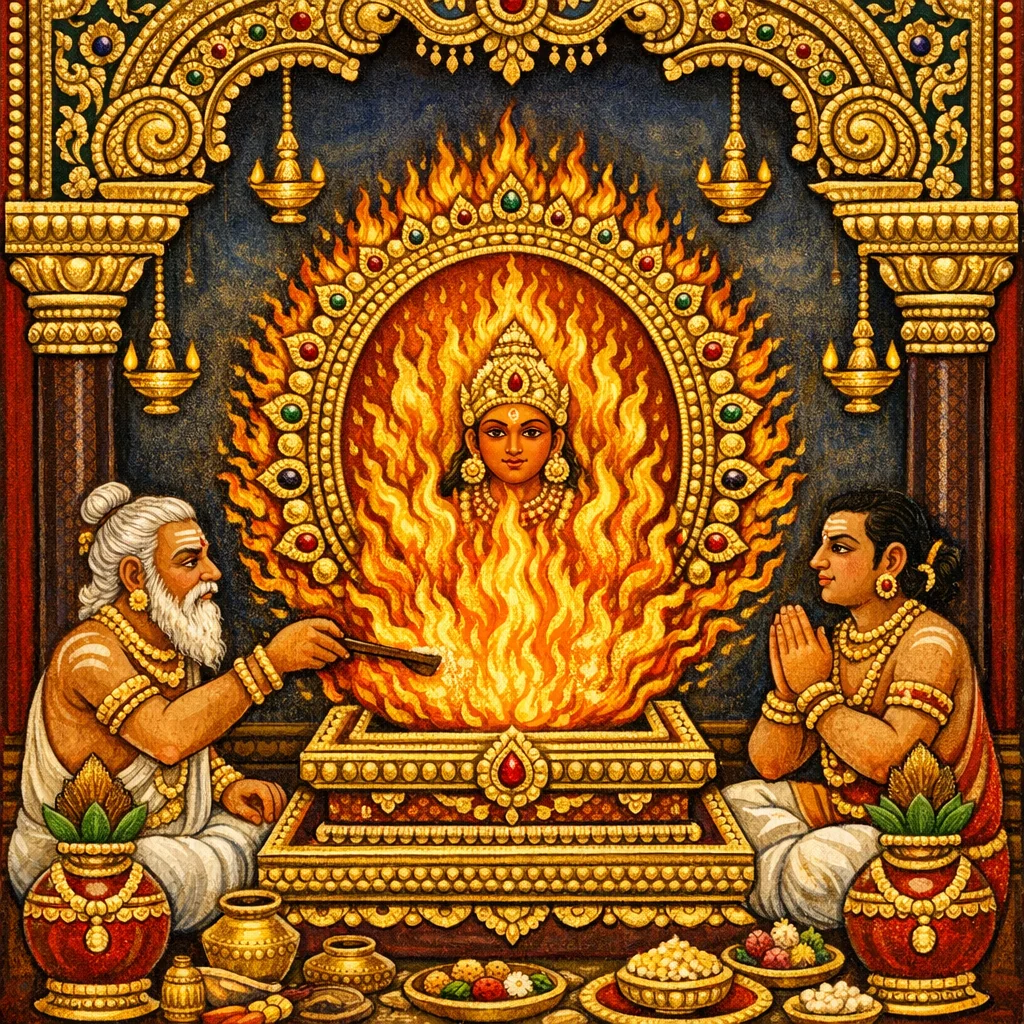
Agni sets forth a stepwise homa-vidhi, beginning with purification of space and self and culminating in fire-installation, offerings, and contemplations that link ritual skill to liberation. The practitioner sanctifies the yāga-sthāna with sprinkling mantras, draws a Veda-bodied maṇḍala, and performs threshold rites—toṛaṇa worship, directional placements, dvārapāla veneration, and obstacle-removal with Astra-mantra flowers. After bhūta-śuddhi, nyāsa, and mudrā come protections: mustard casting, pañcagavya preparation, and installing many kalaśas, including ten for the lokapālas and a northeast kumbha with vardhanī for Hari and Astra. The rite then turns to homa mechanics: arranging implements (śruk/śruva, paridhi, idhma), preparing praṇītā/prokṣaṇī waters, cooking caru, drawing ritual lines, displaying yoni-mudrā, and installing Agni in the kuṇḍa. Its inner theology is stated: Kuṇḍa-Lakṣmī (Prakṛti, trigunātmikā) is meditated at the fire’s center; Agni is proclaimed the womb of beings and mantras and the giver of mukti. Finally, prescribed counts of samidh and oblations (including 108) are offered while visualizing the seven-tongued Vaiṣṇava Fire blazing like myriad suns.
Shlokas
Verse 1
इत्य् आदिमहापुराणे आग्नेये पवित्रारोहणे श्रीधरनित्यपूजाकथनं नाम त्रयस्त्रिंशोध्यायः अथ चतुस्त्रिंशो ऽध्यायः होमादिविधिः अग्निर् उवाच विशेदनेन मन्त्रेण यागस्थानञ्च भूषयेत् नमो ब्रह्मण्यदेवाय श्रीधरायाव्ययात्मने
Thus, in the Ādi-Mahāpurāṇa, the Agni Purāṇa, in the section on Pavitrārohaṇa (the investiture/placing of the sacred thread), ends the thirty-third chapter entitled “The Account of Śrīdhara’s Daily Worship.” Now begins the thirty-fourth chapter: “The Procedure for Homa and related rites.” Agni said: “With the mantra for purification/sprinkling, one should adorn and sanctify the place of sacrifice. ‘Homage to the god who favors the brāhmaṇas, to Śrīdhara, whose essence is imperishable.’”
Verse 2
ॐ क्रीमिति ख, चिह्नितपुस्तकपाठः ऋग्यजुःसामरूपाय शब्ददेहाय विलिख्य मण्डलं सायं यागद्रव्यादि चाहरेत्
“Oṃ, krīm”—thus is the syllable. According to the marked reading of the text, one should inscribe a maṇḍala for the Word-bodied (śabda-deha) deity whose form is the Ṛg-, Yajur-, and Sāma-Vedas; and in the evening one should also bring the materials and requisites for the sacrificial rite (yāga).
Verse 3
प्रक्षालितकराङ्घ्रिः सन् विन्यस्यार्घ्यकरो नरः अर्घ्यादिभिस्तु शिरः प्रोक्ष्य द्वारदेशादिकं यथा
Having washed his hands and feet, the man should take the arghya-vessel in hand and, by sprinkling (himself) with arghya and the other sanctifying waters, should purify his head; likewise he should purify the doorway area and the other prescribed spots, in due order.
Verse 4
आरभेद् द्वारयागञ्च तोरणेशान् प्रपूजयेत् अश्वत्थोदुम्बरवटप्रक्षाः पूर्वादिगा नगाः
Beginning the rite, one should perform the worship of the doorway (dvāra-yāga) and duly venerate the presiding deities of the toraṇa (ceremonial arch). The sacred trees—Aśvattha, Udumbara, Vaṭa, and Prakṣā—are to be assigned from the eastern direction onward, according to the quarters.
Verse 5
ऋगिन्द्रशोभनं प्रास्यां युजुर्यमसुभद्रकम् सामापश् च सुधन्वाख्यं सोमाथर्वसुहोत्रकम्
In the eastern direction (prācī), the Ṛg-veda is known as Indraśobhana; the Yajur-veda as Yamasu-bhadraka; the Sāma-veda as Sudhanvan; and the Atharva-veda (together with the Soma-tradition) as Suhotraka.
Verse 6
तोरणान्तः पताकाश् च कुमुदाद्या घटद्वयम् द्वारि द्वारि स्वनाम्नार्च्याः पूर्वे पूर्णश् च पुष्करः
At the ends of the toraṇa there should be banners (patākā). At each doorway, two ritual water-pots (ghaṭas) are to be placed—beginning with the one named Kumuda and the others—each to be worshipped by its own name. On the eastern side are to be set the pots named Pūrṇa and Puṣkara.
Verse 7
आनन्दनन्दनौ दक्षे वीरसेनः सुषेणकः सम्भवप्रभवौ सौम्ये द्वारपांश् चैव पूजयेत्
On the right side of the doorway one should worship Ānanda and Nandana; on the southern side, Vīrasena and Suṣeṇaka; on the left side, Sambhava and Prabhava—thus should the door-guardians be worshipped.
Verse 8
अस्त्रजप्तपुष्पक्षेपाद्विघ्नानुत्सार्य संविशेत् भूतशुद्धिं विधायाथ विन्यस्य कृतमुद्रवः
Having driven away obstacles by casting flowers consecrated with the Astra-mantra, one should enter. Then, after performing the purification of the elements (bhūta-śuddhi), and having placed the mantras on the body by nyāsa, with the prescribed mudrās duly executed, the worshipper proceeds.
Verse 9
फट्कारान्तां शिखां जप्त्वा सर्षपान् दिक्षु निक्षिपेत् वासुदेवेन गोमूत्रं सङ्कर्षणेन गोमयम्
Having recited the Śikhā-mantra ending with the exclamation “phaṭ”, one should cast mustard seeds in the directions. With the mantra of Vāsudeva one should apply or sprinkle cow’s urine, and with the mantra of Saṅkarṣaṇa one should apply cow-dung.
Verse 10
प्रद्युम्नेन पयस्तज्जात् दधि नारायणाद् घृतम् एकद्वित्र्यादिवाराणि घृताद्वै भागतोधिकम्
From Pradyumna arises milk; from that milk curd (dadhi) is produced; and from Nārāyaṇa ghee is obtained. By repeated churning/boiling—once, twice, thrice, and so on—the yield increases by portions beyond ordinary ghee.
Verse 11
घृतपात्रे तदेकत्र पञ्चगव्यमुदाहृतम् मण्डपप्रोक्षणायैकञ्चापरम्प्राशनाय च
In a vessel of ghee, the pañcagavya is to be prepared together. One portion is for sprinkling and consecrating the maṇḍapa (ritual pavilion), and another portion is for sipping/ingesting as a purificatory intake.
Verse 12
आनीय दशकुम्भेषु इन्द्राद्यान् लोकपान् यजेत् पूज्याज्ञां श्रावयेत्तांश् च स्थातव्यं चाज्ञया हरेः
Having brought and arranged the ten ritual water-pots (kumbhas), one should worship Indra and the other Guardians of the Worlds (Lokapālas) therein. After worship, one should recite to them the venerable command (ājñā), and they are to remain stationed according to the injunction of Hari (Viṣṇu).
Verse 13
यागद्रव्यादि संरक्ष्य विकिरान् विकिरेत्ततः मूलाष्टशतसञ्जप्तान् कुशकूर्चान् हरेश् च तान्
After safeguarding the sacrificial materials and the rest, he should then scatter the strewn ritual particles; thereafter he should remove those kuśa-bunches (kuśa-kūrcas) that have been consecrated by the root-mantra recited eight hundred times.
Verse 14
ऐशान्यां दिशि तत्रस्थं स्थाप्यं कुम्भञ्च वर्धनीं कुम्भे साङ्गं हरिं प्रार्च्य वर्धन्यामस्त्रमर्चयेत्
In the Īśāna (north-east) direction, one should place there a ritual water-pot (kumbha) and the vardhanī vessel. Having duly worshipped Hari together with His attendant limbs (aṅgas) in the kumbha, one should worship the protective weapon-mantra (astra) in the vardhanī.
Verse 15
प्रदक्षिणं यागगृहं वर्धन्याच्छिन्नधारया सिञ्चन्नयेत्ततः कुम्भं पूजयेच्च स्थिरासने
Having circumambulated the sacrificial hall (yāga-gṛha) in pradakṣiṇa, one should sprinkle it with an unbroken stream of water from a vardhanī. Then, seated firmly on a steady seat, one should worship the kumbha (ritual water-pot/kalasha).
Verse 16
सपञ्चरत्नवस्त्राढ्यकुम्भे गन्धादिभिर्हरिम् वर्धन्यां हेमगर्भायां यजेदस्त्रञ्च वामतः
One should worship Hari with perfumes and related offerings in a kumbha enriched with the symbols of the five gems and cloth; and, in the auspicious vardhanī vessel—golden within—one should also worship the presiding Weapon-Mantra (astra), placing it to the left.
Verse 17
तत्समीपे वास्तुलक्ष्मीं भूविनायकमर्चयेत् स्रपनं कल्पयेद्विष्णोः सङ्क्रान्त्यादौ तथैव च
Near that place, one should worship Vāstu-Lakṣmī and Bhū-Vināyaka; and one should arrange the srapana, the ritual ablution of Lord Viṣṇu—likewise at Saṅkrānti and on other such auspicious occasions.
Verse 18
पूर्णकुम्भान् नव स्थाप्य नवकोणेषु निर्ब्रणान्
Having installed nine full water-pots (kalaśas), one should place them in the nine corners (of the ritual diagram), ensuring they are unblemished and undamaged.
Verse 19
पूर्वादिकलसेग्न्यादौ पञ्चामृतजलादिकम् दधि क्षीरं मधूष्णीदं पाद्यं स्याच्चतुरङ्गकम्
In the rite beginning with the placement of the ritual pots in the eastern direction and the kindling of the sacred fire, one should provide pañcāmṛta and water and the like. Curd, milk, honey, and warm water—this constitutes the fourfold pādya (water for washing the feet).
Verse 20
पद्मश्यामाकदूर्वाश् च विष्णुपत्नी च पाद्यकम् तथाष्टाङ्गार्घ्यमाख्यातं यवगन्धफलाक्षतम्
For the foot-water (pādya), one should include lotus (padma), śyāmāka grain, and dūrvā grass, along with viṣṇupatnī; and the eightfold arghya is declared to consist of barley, fragrance (perfume), fruit, and unbroken rice-grains (akṣata).
Verse 21
कुशाः सिद्धार्थपुष्पानि तिला द्रव्याणि चार्हणम् लवङ्गकक्कोलयुते दद्यादाचमनीयकम्
One should offer kuśa grass, siddhārtha flowers, sesame, and other substances fit for worship (ārhaṇa); and one should provide ācamanīya, the sipping-water for purification, scented with clove and kakkola.
Verse 22
स्नापयेन्मूलमन्त्रेण देवं पञ्चामृतैर् अपि शुद्धोदं मध्यकुम्भेन देवमूर्ध्नि विनिःक्षिपेत्
One should bathe the deity with the root-mantra (mūla-mantra), and also with the five nectars (pañcāmṛta). Then, using the central water-pot (kumbha), one should pour pure water upon the crown of the deity’s head.
Verse 23
कलशान्निःसृतं तोयं कूर्चाग्रं संस्पृशेन्नरः शुद्धोदकेन पाद्यञ्च अर्घ्यमाचमनन्ददेत्
A man should touch, with the tip of the kuśa-bundle (kūrca), the water that has flowed out from the ritual pot (kalaśa). With purified water he should then offer pādya (water for washing the feet), arghya (a respectful water-offering), and ācamanīya (water for sipping).
Verse 24
परिमृज्य पटेनाङ्गं सवस्त्रं मण्डलं नयेत् तत्राभ्यर्च्याचरेद्धोमं कुण्डादौ प्राणसंयमी
Having wiped the body with a cloth, and while still clothed, one should proceed to the maṇḍala (ritual ground). There, having performed worship, the self-controlled practitioner—restraining the vital breath (prāṇa)—should perform the homa in the fire-pit (kuṇḍa) and related ritual setups.
Verse 25
प्रक्षाल्य हस्तौ रेखाश् च तिस्रः पूर्वाग्रगामिनीः चार्हणा इति ख, ङ, चिह्नितपुस्तकद्वयपाठः दूर्वाग्रमिति ङ, चिह्नितपुस्तकपाठः दक्षिणादुत्तराश् च तिस्रश् चैवओत्तराग्रगाः
Having washed both hands, one should draw three lines whose tips go toward the east. (Some manuscripts read “with cārhaṇā,” while another reading is “with the tip of durvā grass.”) Likewise, one should draw three lines from the south toward the north, with their tips directed northward.
Verse 26
अर्घ्योदकेन सम्प्रोक्ष्य योनिमुद्राम्प्रदर्शयेत् ध्यात्वाग्निरूपञ्चाग्निन्तु योन्यां कुण्डे क्षिपेन्नरः
Having sprinkled (the place and implements) with arghya-water, he should display the Yoni-mudrā. Then, meditating upon Agni’s form, the practitioner should place the fire into the yoni (source/holder) and cast it into the fire-pit (kuṇḍa).
Verse 27
पात्राण्यासादयेत् पश्चाद्दर्भश्रुक्श्रुवकादिभिः बाहुमात्राः परिधय इध्मव्रश् चनमेव च
After that, one should set the vessels in their proper places, together with darbha-grass, the ladle (śruk), the offering-spoon (śruva), and the other implements; and one should also place the enclosing sticks (paridhi), each of forearm-length, as well as the fuel-sticks (idhma) and the kindling brushwood (vraśa).
Verse 28
प्रणीता प्रोक्षणीपात्रमाज्यस्थाली घृतादिकम् प्रस्थद्वयं तण्डुलानां युग्मं युग्ममधोमुखम्
The praṇītā vessel, the prokṣaṇī (sprinkling) vessel, the ājya-sthālī (ghee-pan), and ghee (ghṛta) and related offerings are to be arranged. For the rice (taṇḍula), the measure is two prasthas; and the vessels are to be kept in pairs, each pair set mouth-down.
Verse 29
प्रणीताप्रोक्षणीपात्रे न्यसेत् प्रागग्रगं कुशम् अद्भिः पूर्यप्रणीतान्तु ध्यात्वा देवं प्रपूज्य च
In the praṇītā and prokṣaṇī vessels, one should place a blade of kuśa grass with its tip oriented toward the east. Then, having filled the praṇītā with water, one should meditate upon the deity and duly worship Him.
Verse 30
प्रणीतां स्थापयेदग्रे द्रव्याणाञ्चैव मध्यतः प्रोक्षणीमद्भिः सम्पूर्य प्रार्च्य दक्षे तु विन्यसेत्
He should place the praṇītā vessel in front, and the ritual materials in the middle; then, having filled the prokṣaṇī with water and duly worshipped it, he should set it down on the right (southern) side.
Verse 31
चरुञ्च श्रपयेदग्नौ ब्रह्माणं दक्षिणे न्यसेत् कुशानास्तीर्य पूर्वादौ परिधीन् स्थापयेत्ततः
He should cook the caru (sacrificial porridge) in the fire; and he should place the Brahmā-priest on the southern side. Having spread out kuśa grass beginning from the east, he should then set the enclosing firewood-sticks (paridhis) in their places.
Verse 32
वैष्णवीकरणं कुर्याद् गर्भाधानादिना नरः गर्भाधानं पुंसवनं सीमन्तोन्नयनञ्जनिः
A man should perform the Vaiṣṇava consecration through the sacraments beginning with conception—namely garbhādhāna, puṃsavana, and sīmantonnayana.
Verse 33
नामादिसमावर्तनान्तं जुहुयादष्ट चाहुतीः पूर्णाहुतीः प्रतिकर्म श्रुचा स्रुवसुयुक्तया
Beginning with the mantras starting from “nāma” and continuing up to the concluding recitation, one should offer eight oblations into the fire; and for each rite one should also make the full concluding oblation (pūrṇāhuti), using the ladle (śruc) together with the offering-spoon (sruva).
Verse 34
कुण्डमध्ये ऋतुमतीं लक्ष्मीं सञ्चिन्त्य होमयेत् कुण्डलक्ष्मीः समाख्याता प्रकृतिस्त्रिगुणात्मका
Having meditated upon Lakṣmī—present in her seasonally potent, fertile, and auspicious form—within the center of the fire-pit, one should perform the oblations. She is known as “Kuṇḍa-Lakṣmī,” the Prakṛti (primordial Nature) whose essence consists of the three guṇas.
Verse 35
सा योनिः सर्वभूतानां विद्यामन्त्रगणस्य च विमुक्तेः कारणं वह्निः परमात्मा च मुक्तिदः
Agni is the womb and source of all beings, and also of the collections of sacred sciences and mantras; Agni is the cause of liberation, the Supreme Self (Paramātman), and the giver of release.
Verse 36
प्राच्यां शिरः समाख्यातं बाहू कोणे व्यवस्थितौ ईशानाग्नेयकोणे तु जङ्घे वायव्यनैरृते
In the eastern direction the head is said to be placed. The two arms are situated in the corners; and in the Īśāna (north-east) and Āgneya (south-east) corners the shanks (jāṅghā) are assigned, while in the Vāyavya (north-west) and Nairṛta (south-west) corners the legs/shanks are likewise assigned.
Verse 37
उदरं कुण्डमित्युक्तं योनिर्योनिर्विधीयते गुणत्रयं मेखलाः स्युर्ध्यात्वैवं समिधो दश
The belly is declared to be the kuṇḍa, the sacrificial fire-pit; the womb is to be conceived as the yoni, the source-seat. The three guṇas are to be visualized as the girdling bands (mekhalās). Having thus meditated, one should offer ten fuel-sticks (samidh).
Verse 38
पञ्चाधिकांस्तु जुहुयात् प्रणवान्मुष्टिमुद्रया पुनराघारौ जुहुयाद्वाय्वग्न्यन्तं ततः श्रपेत्
One should offer five additional oblations beyond the stated count, uttering the Praṇava (Oṁ) while forming the Muṣṭi-mudrā (fist gesture). Then one should again perform the two Āghāra oblations, reciting the formulas ending with Vāyu and Agni; thereafter one should cook the offering/food.
Verse 39
ईशान्तं मूलमन्त्रेण आज्यभागौ तु होमयेत् उत्तरे द्वादशान्तेन दक्षिणे तेन मध्यतः
With the root-mantra, ending in the Īśāna invocation, one should offer as homa the two ghee-portions (ājya-bhāga). On the northern side of the fire it is offered with the ‘dvādaśānta’ formula; on the southern side with that same formula; and likewise in the middle.
Verse 40
व्याहृत्या पद्ममध्यस्थं ध्यायेद्वह्निन्तु संस्कृतम् वैष्णवं सप्तजिह्वं च सूर्यकोटिसमप्रभम्
Having uttered the sacred vyāhṛtis, one should meditate upon the consecrated Fire as abiding in the center of a lotus—Vaishnava in nature, seven-tongued, and radiant like ten million suns.
Verse 41
चन्द्रवक्त्रञ्च सूर्याक्षं जुहुयाच्छतमष्ट च तदर्धञ्चाष्ट मूलेन अङ्गानाञ्च दशांशतः
One should offer oblations to the mantra-deities ‘Moon-faced’ and ‘Sun-eyed’—one hundred and eight in number; and then half of that, namely fifty-four. Again, with the root-mantra, the oblations for the subsidiary limbs (aṅgas) should be performed at one-tenth of the main count.
Frequently Asked Questions
It begins with purification and threshold worship (prokṣaṇa, toraṇa/dvārapāla), proceeds through bhūta-śuddhi–nyāsa–mudrā and protective rites, establishes kalaśas (including lokapālas), and then installs Agni via yoni-mudrā before arranging implements and commencing oblations.
By explicitly defining Agni as the womb of beings and mantras and as the giver of liberation, and by placing Kuṇḍa-Lakṣmī (Prakṛti, tri-guṇa) at the ritual center—making correct external procedure a support for inner metaphysical realization.