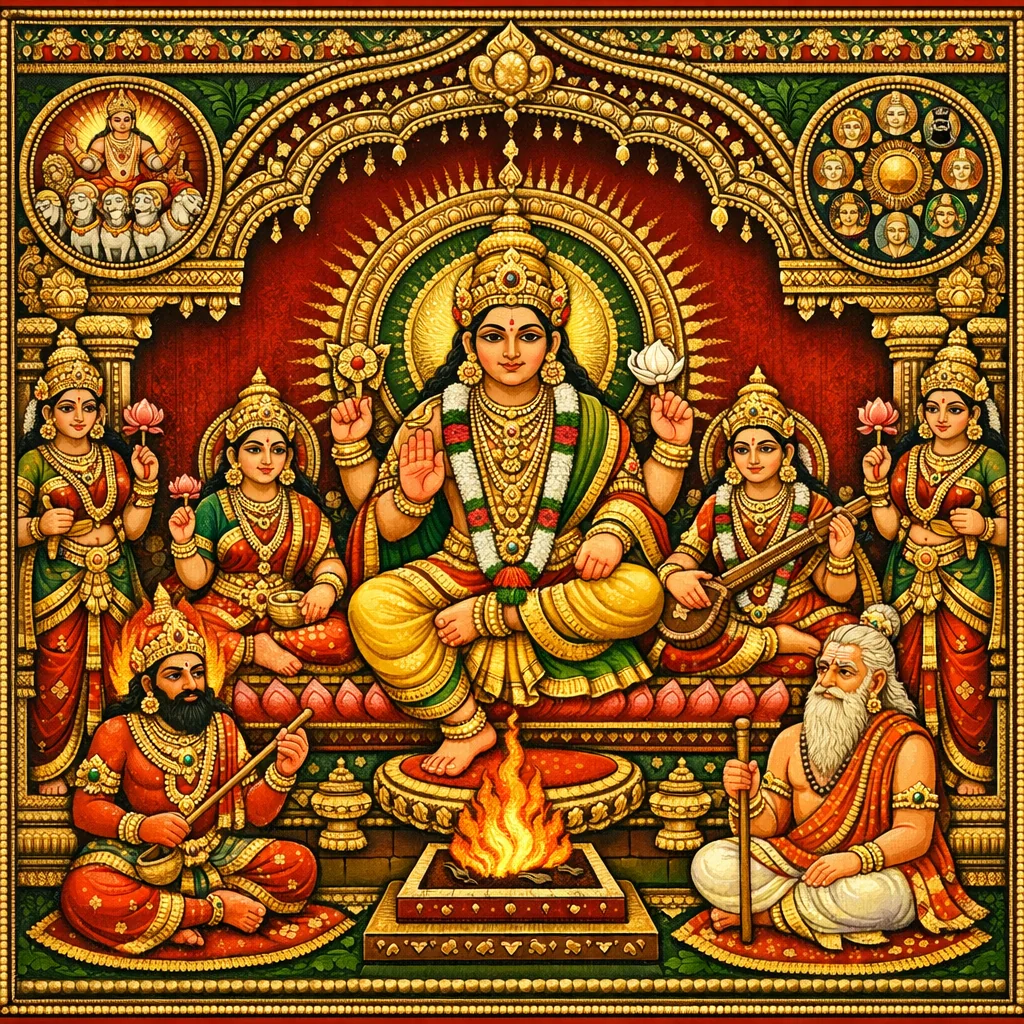
Adhyaya 21
Chapter 21 — सामान्यपूजाकथनम् (Teaching on General Worship)
This chapter codifies a “general worship” (sāmānya-pūjā) template usable for Viṣṇu and other deities as a modular ritual architecture: begin with a universal salutation to Acyuta with His full retinue, then expand through attendant divinities, mandalic placements, and protective/empowering components. It enumerates a worship-grid including threshold and site powers (Dvāra-Śrī, Vāstu), cosmic supports (Kūrma, Ananta), and abstract virtues mapped onto lotus symbolism of dharma and its opposites. Deity-specific adaptations follow: Viṣṇu’s emblems and bījas (śrīṃ, hrīṃ, klīṃ), Śiva’s general procedure (starting with Nandin and Mahākāla), and Sūrya worship with nyāsa-like assignments (heart/head/eye), kavaca elements, and planetary integrations including Rāhu–Ketu. Rules for mantra construction are given (praṇava, bindu, dative + namaḥ), culminating in homa with sesame and ghee as the puruṣārtha-yielding completion. Manuscript variants are noted, reflecting a living ritual transmission.
Shlokas
Verse 1
इत्य् आदिमहापुराणे आग्नेये जगत्सर्गवर्णनं नाम विंशतितमो ऽध्यायः अथ एकविंशो ऽध्यायः सामान्यपूजाकथनं नारद उवाच सामान्यपूजां विष्ण्वादेर्वक्ष्ये मन्त्रांश् च सर्वदान् समस्तपरिवाराय अच्युताय नमो यजेत्
Thus, in the Agni Purāṇa, the twentieth chapter entitled “Description of the Creation of the World” is concluded. Now begins the twenty-first chapter, “The Teaching on General Worship.” Nārada said: “I shall explain the general method of worship for Viṣṇu and the other deities, together with the mantras applicable at all times. One should worship, saying: ‘Homage to Acyuta, together with His entire retinue.’”
Verse 2
साग्नयो ह्य् अगादिति ख, चिह्नितपुस्तकपाठः, अग्निपाला वर्हिषदो ह्य् आज्यपाः साग्नयो ह्य् अजादिति घ, चिह्नितपुस्तकपाठः वैसारणी सुते इति ख, चिह्नितपुस्तकपाठः धात्रे विधात्रे गङ्गायै यमुनायै निधी तथा द्वारश्रियं वस्तुनवं शक्तिं कूर्ममनन्तकम्
“(Reading variants are noted in certain manuscripts:) ‘Sāgnayaḥ …’ (thus in one recension); ‘The guardians of fire; the Barhiṣads; the drinkers of ghee; Sāgnayas …’ (thus in another recension); ‘Vaisāraṇī, O Sūta’ (thus in one recension). (One should offer salutations/oblations) to Dhātṛ and Vidhātṛ, to Gaṅgā and Yamunā, and likewise to the two treasures; to Dvāra-Śrī (the prosperity of the doorway/threshold), to Vāstu (the presiding spirit of the site), to Śakti, to Kūrma, and to Ananta.”
Verse 3
पृथिवीं धर्मकं ज्ञानं वैराग्यैश्वर्यमेव च अधर्मादीन् कन्दनालपद्मकेशरकर्णिकाः
Earth (Pṛthivī) is likened to the root; righteousness (Dharma) to the stalk; knowledge (Jñāna) to the lotus; and dispassion (Vairāgya) and lordly power (Aiśvarya) to its filaments and central seed-cup—while unrighteousness (Adharma) and the rest are to be understood as the opposing, defiling counterparts.
Verse 4
ऋग्वेदाद्यं कृताद्यञ्च सत्वाद्यर्कादिमण्डलम् विमलोत्कर्षिणी ज्ञाना क्रिया योगा च ता यजेत्
One should worship the maṇḍala that begins with the Ṛgveda, and the maṇḍala that begins with the Kṛta age, and the solar maṇḍala that begins with Sattva—together with the purifying and elevating triad: Knowledge (Jñāna), Ritual Action (Kriyā), and Yoga.
Verse 5
प्रह्वीं सत्यां तथेशानानुग्रहासनमूर्तिकाम् दुर्गां गिरङ्गणं क्षेत्रं वासुदेवादिकं यजेत्
One should worship Prahvī, Satyā, and likewise Durgā—together with the form called Īśāna-Anugraha-Āsana-Mūrtikā—also (the deities of) the hill-precinct (giraṅgaṇa), the sacred field/temple-site (kṣetra), and Vāsudeva and the other (Vyūha/Viṣṇu forms).
Verse 6
हृदयञ्च शिरः शूलं वर्मनेत्रमथास्त्रकम् शङ्खं चक्रं गदां पद्मं श्रीवत्सं कौस्तुभं यजेत्
One should worship the Lord’s presiding powers in the heart and in the head; then the trident, the armor and the eye, and thereafter the sacred missile-weapon (Astra). One should also worship the conch, discus, mace, lotus, the Śrīvatsa mark, and the Kaustubha jewel.
Verse 7
वनमालां श्रियं पुष्टिं गरुडं गुरुमर्चयेत् इन्द्रमग्निं यमं रक्षो जलं वायुं धनेश्वरम्
One should worship Vanamālā, Śrī (Fortune), Puṣṭi (Nourishment), Garuḍa, and the Guru; also Indra, Agni, Yama, the protective power against the Rakṣasas, Water, Wind, and the Lord of Wealth, Kubera.
Verse 8
ईशानन्तमजं चास्त्रं वाहनं कुमुदादिकम् विष्वक्सेनं मण्डलादौ सिद्धिः पूजादिना भवेत्
In the maṇḍala arrangement, one should invoke and place Īśāna, Ananta, Aja, the presiding Astra, the Vāhana, Kumuda and the others, and Viṣvaksena; siddhi (accomplishment) arises through worship and the related observances.
Verse 9
शिवपूजाथ सामान्या पूर्वं नन्दिनमर्चयेत् महाकालं यजेद्गङ्गां यमुनाञ्च गणादिकम्
In the general procedure of Śiva-worship, one should first worship Nandin. One should then offer worship to Mahākāla, and also worship Gaṅgā, Yamunā, and the Gaṇas and other attendant deities.
Verse 10
गिरं श्रियं गुरुं वास्तुं शक्यादीन् धर्मकादिकम् वामा ज्येष्ठा तथा रौद्री काली कलविकारिणी
She is praised as Gir (Speech), as Śrī (Prosperity), as the Guru (spiritual preceptor), and as Vāstu (the indwelling order of dwelling and space). She is also Śakyā and the others, and Dharmakā and the like; she is Vāmā, Jyeṣṭhā, Raudrī, Kālī, and Kalavikāriṇī.
Verse 11
बलविकरिणी चापि बलप्रमथिनी क्रमात् घ, चिह्नितपुस्तकपाठः यजेत् दुर्गां इति ख, घ, चिह्नितपुस्तकपाठः गिरिं श्रियमिति ख, चिह्नितपुस्तकपाठः शिवं श्रियतमिति घ, चिह्नितपुस्तकपाठः गौरीं श्रियं गुरुं चास्त्रं शक्त्यादिं धर्मकादिकमिति ङ, चिह्नितपुस्तकपाठः सर्वभूतदमनी च मदनोन्मादिनी शिवासनं
Next, in proper sequence, she is to be invoked as “Balavikariṇī” and also “Balapramathinī.” (Variant readings note: some recensions read, “One should worship Durgā”; others, “Śrī—the prosperity of the mountain”; and others, “Śiva, the most auspicious / the bestower of śrī.”) Further, she is named “Gaurī,” “Śrī,” “Guru,” “Astra (weapon),” “Śakti and the rest,” and “Dharma and the rest”; also “Sarvabhūtadamanī” (Subduer of all beings), “Madanoṁmādinī” (She who drives Kāma/passion into frenzy), and “Śivāsanā” (She whose seat is Śiva / who is seated upon auspiciousness).
Verse 12
हां हुं हां शिवमूर्तये साङ्गवक्त्रं शिवं यजेत् हौं शिवाय हामित्यादि हामीशानादिवक्त्रकं
With the mantric sequence “hāṃ huṃ hāṃ,” one should worship Śiva—the embodiment of Śiva—together with His limbs (aṅga) and faces. Likewise, with “hauṃ, to Śiva,” beginning with “hām…,” one should worship Śiva whose faces are Īśāna and the others (corresponding to the directions).
Verse 13
ह्रीं गौरीं गं गणः शक्रमुखाश् चण्डीहृतादिकाः क्रमात्सूर्यार्चने मन्त्रा दण्डी पूज्यश् च पिङ्गलः
In the worship of Sūrya, the mantras are to be applied in sequence—beginning with “hrīṃ,” then “gaurīṃ,” then “gaṃ”; invoking Gaṇa (Gaṇeśa), then Śakra and the other gods; and then Caṇḍī, Hṛt/Hṛdaya and the rest. Thereafter, Daṇḍī and also Piṅgala are to be worshipped.
Verse 14
उच्चैःश्रवाश्चारुणश् च प्रभूतं विमलं यजेत् साराध्योपरमसुखं स्कन्दाद्यं मध्यतो यजेत्
One should worship Uccaiḥśravā and Cāruṇa, and also Prabhūta and Vimala. One should worship Sārādhya and Paramasukha, and likewise Skanda and the others in the middle (of the ritual arrangement).
Verse 15
दीप्ता सूक्ष्मा जया भद्रा विभूतिर्विमला तथा अमोघा विद्युता चैव पूज्याथ सर्वतोमुखी
She is “Dīptā” (Radiant), “Sūkṣmā” (Subtle), “Jayā” (Victorious), “Bhadrā” (Auspicious); she is “Vibhūti” (Manifest Power) and also “Vimalā” (Stainless). She is “Amoghā” (Unfailing), “Vidyutā” (Lightning-like), ever worthy of worship, and “Sarvatomukhī” (All-facing, present in every direction).
Verse 16
अर्कासनं हि हं खं ख सोल्कायेति च मूर्तिकाम् ह्रां ह्रीं स सूर्याय नम आं नमो हृदाय च
For the Arka (Sun) āsana, one should employ the mantric syllables “haṃ, khaṃ, kha” and the formula “solkāya” to establish the deity-form (mūrti). Then recite, “hrāṃ hrīṃ sa—obeisance to Sūrya,” and perform heart-nyāsa with “āṃ—obeisance to the heart.”
Verse 17
अर्काय शिरसे तद्वदग्नीशासुरवायुगान् भूर्भुवः स्वरे ज्वालिनि शिखा हुं कवचं स्मृतं
For the head one assigns Arka (the Sun); likewise one assigns Agni, Īśa, Asura, and Vāyu. With the utterance of “Bhūr” and “Bhuvaḥ” in the proper tone (svara), the mantra “Jvālinī, Śikhā, Huṃ” is remembered as the protective kavaca (mantric armor).
Verse 18
भां नेत्रं वस् तथार्कास्त्रं राज्ञी शक्तिश् च निष्कुभा सोमो ऽङ्गारकोथ बुधो जीवः शुक्रः शनिः क्रमात्
“Bhā” (splendour) is assigned to the eye; “Vasu,” and likewise the Sun’s weapon; the “Queen” (Rājñī), the spear (śakti), and the niṣkubhā—these are assigned in order to Soma (Moon), Aṅgāraka (Mars), then Budha (Mercury), Jīva (Bṛhaspati/Jupiter), Śukra (Venus), and Śani (Saturn), respectively.
Verse 19
राहुः केतुस्तेजश् चण्डः सङ्क्षेपादथ पूजनं आसनं मूर्तये मूलं हृदाद्यं परिचारकः
Rāhu and Ketu—also invoked as Tejas and Caṇḍa—thus is their worship stated in brief: offer the seat to the deity’s form; recite the root (mūla) mantra and perform the nyāsa beginning with the heart (hṛd-ādi); and invoke the attendant deities (paricāraka).
Verse 20
विष्ण्वासनं विष्णुर्मूर्तेरों श्रीं श्रीं श्रीधरोहरिः ह्रीं सर्वमूर्तिमन्त्रोयमिति त्रैलोक्यमोहनः
“This is the Viṣṇu-seat (āsana) for Viṣṇu’s form: ‘Oṃ, Śrīṃ, Śrīṃ—Śrīdhara Hari; Hrīṃ.’ This is the ‘Sarva-mūrti’ mantra; thus it is known as the ‘Enchanter of the three worlds’ (Trailokya-mohana).”
Verse 21
ह्रीं हृषीकेशः क्लीं विष्णुः स्वरैर् दीर्घैर्हृदादिकं समस्तैः पञ्चमी पूजा सङ्ग्रामादौ जयादिदा
“With the bīja hrīṃ one invokes Hṛṣīkeśa; with the bīja klīṃ one invokes Viṣṇu. The ‘heart (hṛd) and other’ mantras are to be recited with the complete set of long vowels. Worship performed on the fifth lunar day (pañcamī) bestows victory and similar boons, especially at the outset of battle.”
Verse 22
सावाराध्योपरं दुःखमिति ख, चिह्नितपुस्तकपाठः अग्निसाश्रयवायुगानिति ख, चिह्नितपुस्तकपाठः अर्काय शिरसे तद्वदग्निजायायुतञ्च तदिति ङ,चिह्नितपुस्तकपाठः शक्तिश् च निर्गता इति ख, चिह्नितपुस्तकपाठः चक्रं गदां क्रमाच्छङ्खं मुषलं खड्गशार्ङ्गकम् पाशाङ्कुशौ च श्रीवत्सं कौस्तुभं वनमालया
“(Some manuscripts read:) ‘Sāvārādhya…’, ‘Agnisāśraya…’, ‘for Arka as the head… likewise for Agnijāyā…’, and ‘and the spear has emerged…’.” (In the received reading, the deity is described as bearing) the discus (cakra), the mace (gadā), then the conch (śaṅkha); the pestle (muṣala), the sword, and Śārṅga (the bow); also the noose (pāśa) and the goad (aṅkuśa); together with the Śrīvatsa mark, the Kaustubha jewel, and the forest-flower garland (vanamālā).
Verse 23
श्रीं श्रीर्महालक्ष्मीतार्क्ष्यो गुरुरिन्द्रादयो ऽर्चनम् सरस्वत्यासनं मूर्तिरौं ह्रीं दधी सरस्वती
“The seed śrīṃ is Śrī (Lakṣmī), Mahālakṣmī, Tārkṣya (Garuḍa), the Guru, and Indra and the others—(all) to be worshipped by arcanā. Sarasvatī’s seat (āsana) and form (mūrti) are invoked with the seeds auṃ and hrīṃ. ‘Dadhī’ (curd) is Sarasvatī’s offering or emblem.”
Verse 24
हृदाद्या लक्ष्मीर्मेधा च कलातुष्टिश् च पुष्टिका गौरी प्रभामती दुर्गा गणो गुरुश् च क्षेत्रपः
“Hṛdādyā; Lakṣmī; Medhā and Kalā; Tuṣṭi; Puṣṭikā; Gaurī; Prabhāmatī; Durgā; Gaṇa; Guru; and Kṣetrapa—these are to be remembered/invoked as sacred divine names.”
Verse 25
तथा गं गणपतये च ह्रीं गौर्यै च श्रीं श्रियै ह्रीं त्वरितायै ह्रीं सौ त्रिपुरा चतुर्थ्यन्तनमोन्तकाः
“Likewise, one should employ the seed-syllable ‘gaṃ’ for Gaṇapati; ‘hrīṃ’ for Gaurī; ‘śrīṃ’ for Śrī (Lakṣmī); ‘hrīṃ’ for Tvaritā; and ‘hrīṃ’ together with ‘sau’ for Tripurā—these are to be formed with the dative (fourth-case) ending and concluded with the word ‘namaḥ’.”}]}
Verse 26
प्रणवाद्याश् च नामाद्यमक्षरं विन्दुसंयुतं ॐ युतं वा सर्वमन्त्रपूजनाज्जपतः स्मृताः
They should begin with the Praṇava (Oṃ); and the first syllable of the Name—joined with the bindu (ṃ), or else conjoined with Oṃ—is traditionally prescribed for japa performed for the worship of all mantras.
Verse 27
होमात्तिलघृताद्यैश् च धर्मकामार्थमोक्षदाः पूजामन्त्रान् पठेद्यस्तु भुक्तभोगो दिवं व्रजेत्
And by performing homa—oblations with sesame, ghee, and the like—the worship-mantras, bestowers of dharma, desire, prosperity, and liberation, should be recited; whoever recites them, having enjoyed lawful pleasures, goes to heaven.
Frequently Asked Questions
It outlines a repeatable template: invoke the main deity with retinue, establish āsana/mūrti, perform hṛd-ādi placements (nyāsa), add kavaca/astra protections, worship emblems and attendants in a maṇḍala order, and complete with japa and homa for puruṣārtha results.
The chapter includes site and threshold powers (Vāstu, Dvāra-Śrī), cosmic supports (Kūrma, Ananta), rivers (Gaṅgā, Yamunā), guardians and gods (Indra, Agni, Yama, Vāyu, Kubera), Viṣṇu’s retinue and emblems, Śiva’s attendants (Nandin, Mahākāla, Gaṇas), and Sūrya-linked grahas including Rāhu and Ketu.
It frames mantra-japa and homa as dharma–kāma–artha–mokṣa bestowing, showing that correct ritual order (vidhi), protective formulae, and disciplined recitation are not merely technical but vehicles aligning worldly success with ultimate liberation.
Mantras should begin with praṇava (Oṃ); use the first syllable of the deity-name joined with bindu (ṃ) or conjoined with Oṃ; and in several cases employ the dative (fourth-case) ending, concluding with “namaḥ.”