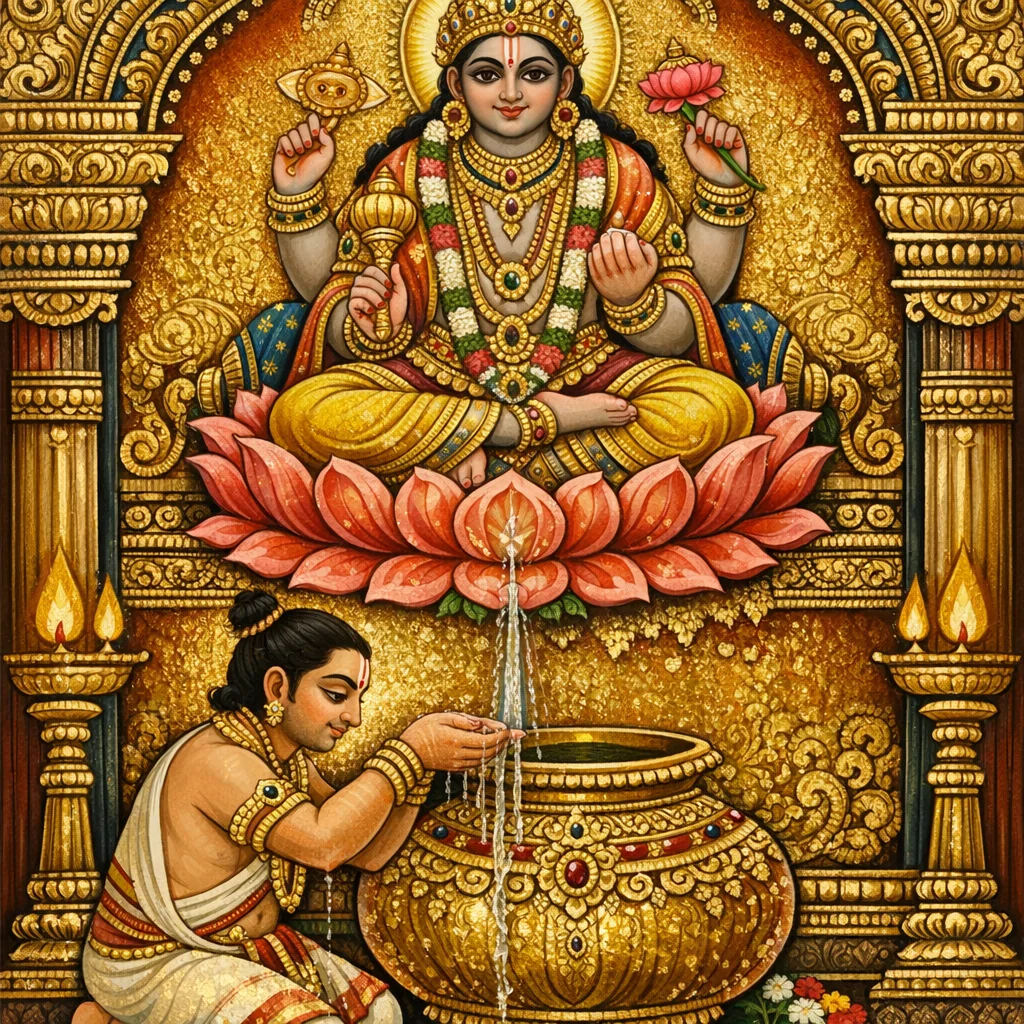
Adhyaya 22
Chapter 22 — स्नानविधिकथनं (Instruction on the Rite of Bathing)
This chapter prescribes snāna (ritual bathing) as an essential prerequisite for worship, joining bodily purification to mantra-guarded inner discipline. It begins by taking purificatory earth (mṛttikā) with the Nṛsiṃha/Siṃha mantra, dividing it, and using one portion for “mental bathing” (manaḥ-snāna), declaring purity to be first inward. After immersion and ācamana, the practitioner performs nyāsa and establishes a protective enclosure (rakṣā/digbandha) through lion-mantra recitation, with alternate protective formulas (Tvaritā or Tripurā) noted. Centering the heart in Hari-jñāna by the eight-syllabled mantra, the rite consecrates tīrtha-water with Vāsudeva-japa, cleanses the body with Vedic mantras, and worships the embodied deity (mūrti). Aghamarṣaṇa, donning clean garments, palm-water purification, prāṇāyāma under the Nārāyaṇa mantra, arghya with the twelve-syllabled mantra, and extensive japa follow, including invocations from the yogapīṭha through the dikpālas, ṛṣis, and pitṛ-gaṇas. It concludes by dismissing beings to their stations, withdrawing the ritual “limbs,” and proceeding to the worship space, establishing a reusable template for other pūjās via a root-mantra-based concluding snāna.
Shlokas
Verse 1
इत्य् आदिमहापुराणे आग्नेये वासुदेवादिपूजाकथनं नाम एकविंशतितमो ऽध्यायः अथ द्वाविंशो ऽध्यायः स्नानविधिकथनं नारद उवाच वक्ष्ये स्नानं क्रियाद्यर्थं नृसिंहेन तु मृत्तिकां गृहीत्वा तां द्विधा कृत्वा मनःस्नानमथैकया
Thus, in the Agni Purāṇa, the twenty-first chapter entitled “The narration of the worship of Vāsudeva and others” concludes. Now begins the twenty-second chapter, “The instruction on the rite of bathing.” Nārada said: “I shall explain bathing, for the sake of ritual acts and the like. Having taken purificatory earth (mṛttikā) with the Nṛsiṃha-mantra and dividing it into two portions, one should perform the ‘bath of the mind’ (manas-snāna) with one portion.”
Verse 2
निमज्याचम्य विन्यस्य सिंहेन कृतरक्षकः ह्रीं त्वरितायै, ह्रीं ऐं क्लीं सौ त्रिपुरा इति ख, चिह्नितपुस्तकपाठः कृतरक्षण इति घ, चिह्नितपुस्तकपाठः विधिस्नानं ततः कुर्यात् प्राणायामपुरःसरं
Having dipped (in water) and performed ācamana, and having carried out the prescribed nyāsa, one should establish protection by means of the mantric ‘Siṃha’ formula. (Reciting) “Hrīṃ, to Tvaritā,” or, according to another marked reading, “Hrīṃ aiṃ klīṃ sau—Tripurā,” thus having completed the rite of protection, one should then perform the ritual bath according to rule, preceded by prāṇāyāma.
Verse 3
हृदि ध्यायन् हरिज्ञानं मन्त्रेणाष्टाक्षरेण हि त्रिधा पाणितले मृत्स्नां दिग्बन्धं सिंहजप्ततः
Meditating in the heart on the saving knowledge of Hari (Viṣṇu), and using the eight-syllabled mantra, one should take purificatory earth in the palm three times; with what has been ‘lion-chanted’—that is, charged by the Siṃha-mantra—one performs digbandha, the binding of the directions as a protective enclosure.
Verse 4
वासदेवप्रजप्तेन तीर्थं सङ्कल्प्य चालभेत् गात्रं वेदादिना मन्त्रैः सम्मार्ज्याराध्य मूर्तिना
Having consecrated the holy water by the japa of the name/mantra of Vāsudeva, one should, by saṅkalpa, determine it as a tīrtha and take it up; then, cleansing the body with Vedic and related mantras, one should worship the Deity embodied in the mūrti (icon).
Verse 5
कृत्वाघमर्षणं वस्त्रं परिधाय समाचरेत् विन्यस्य मन्त्रैर् द्विर्मार्ज्य पाणिस्थं जलमेव च
Having performed the Aghamarṣaṇa rite, one should proceed after putting on a garment; then, having applied the mantras as nyāsa, one should wipe (purify) twice the water held in the palm as well.
Verse 6
नारायणेन संयम्य वायुमाघ्राय चोत्सृजेत् जलं ध्यायन् हरिं पश्चाद्दत्वार्घ्यं द्वादशाक्षरं
Having restrained the breath with the (mantra) “Nārāyaṇa,” and having inhaled the air, one should then release it. Meditating on Hari in the water, thereafter—having offered arghya—one should recite the twelve-syllabled (mantra).
Verse 7
जप्त्वान्याञ्छतशस्तस्य योगपीठादितः क्रमात् मन्त्रान् दिक्पालपर्यन्तानृषीन् पितृगणानपि
Having then recited the other mantras of that rite hundreds of times, in due order beginning with the yogapīṭha, one should invoke/recite the mantras up to the guardians of the directions (dikpāla), and also the seers (ṛṣi) and the hosts of ancestors (pitṛgaṇa).
Verse 8
मनुष्यान् सर्वभूतानि स्थावरान्तान्यथावसेत् न्यस्य चाङ्गानि संहृत्य मन्त्रान्यागगृहं व्रजेत् एवमन्यासु पूजासु मूलाद्यैः स्नानमाचरेत्
He should dismiss (visarjana) the humans and all beings—up to the immobile ones—each to their proper place. Then, having performed nyāsa and withdrawn (saṃhāra) the limbs (of the rite/deity), he should proceed to the yāgagṛha (ritual chamber) while reciting mantras. In the same manner, in other acts of worship too, he should perform the concluding bath (snāna) with the root-mantra (mūla-mantra) and the other principal mantras.
Frequently Asked Questions
The chapter emphasizes a sequenced purification protocol—mṛttikā with Siṃha/Nṛsiṃha mantra, ācamana, nyāsa, rakṣā and digbandha, tīrtha-saṅkalpa via Vāsudeva-japa, aghamarṣaṇa, prāṇāyāma with Nārāyaṇa, and arghya with the dvādaśākṣara—showing how mantra and breath discipline structure ritual purity.
By making external bathing dependent on manaḥ-snāna and Hari-jñāna meditation, it frames ritual as inner transformation: protection (digbandha), mantra-japa, and prāṇāyāma stabilize attention and purity, preparing the practitioner for deity-worship that supports dharma, bhakti, and ultimately mokṣa.
The rite is organized around protective Siṃha/Nṛsiṃha formulas, the aṣṭākṣara (Hari-centered) mantra for inward focus, Vāsudeva-japa for consecrating tīrtha-water, Nārāyaṇa for breath restraint, and the dvādaśākṣara for arghya and continuation of the worship sequence.