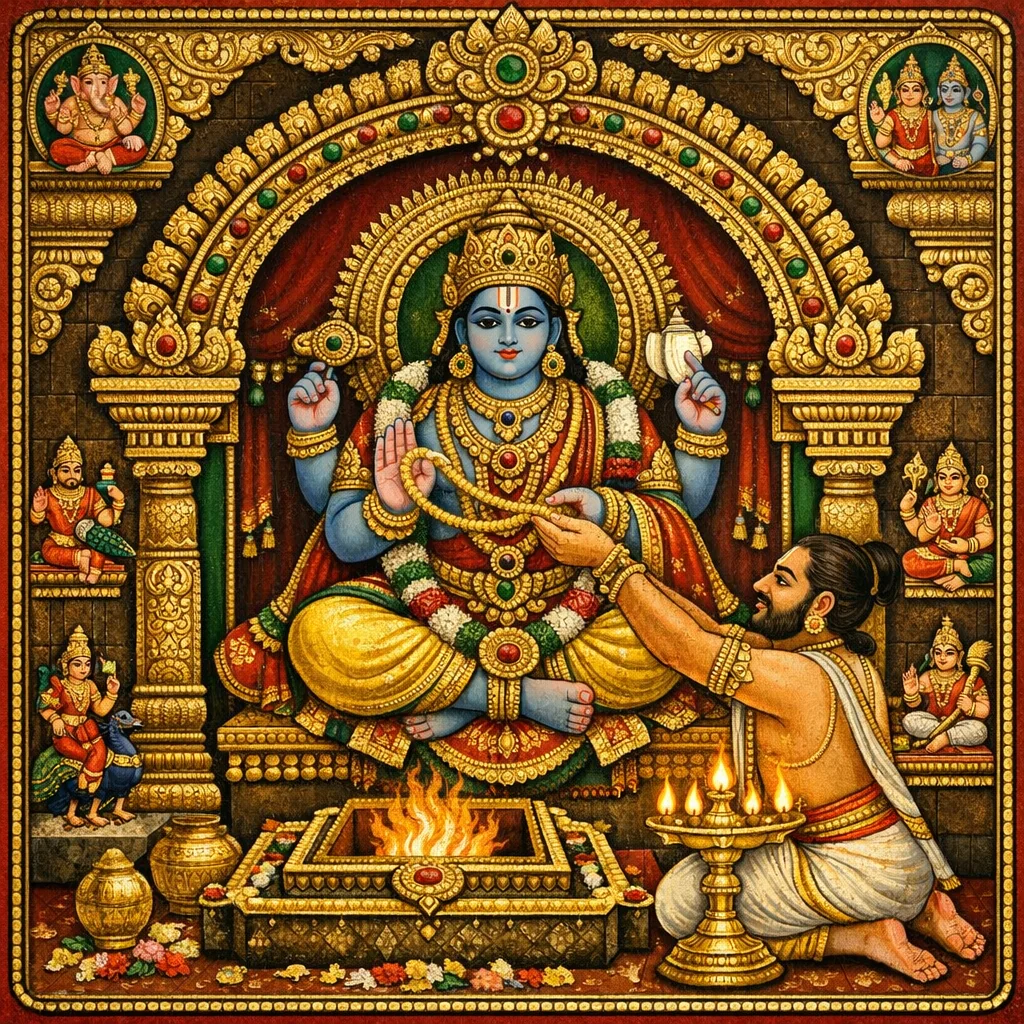
Adhyaya 37
Chapter 37 — सर्वदेवपवित्रारोहणविधिः (Procedure for Installing the Pavitra for All Deities)
Lord Agni moves from the earlier teaching on installing Viṣṇu’s pavitra to a general rite for all deities (sarvadeva-pavitrāropaṇa). He defines the pavitra as a sanctifying implement marked with auspicious signs, to be joined with correct mantra-sound and consecrated homa-fire, where material purity, sonic precision, and the power of oblation converge. The chapter supplies invocation and offering formulas: the deity, praised as the womb/source and creator of the universe, is invited with the retinue, and the pavitraka is offered in the morning. The rite is explicitly named pavitrāropaṇa and upheld as a purifier that “yields the fruit of year-long worship,” functioning as an annual audit that seals and perfects prior offerings. Agni also gives deity-specific acceptance formulas—especially for Śiva, Sūrya, Vāṇeśvara, and Śaktideva—and expands the symbolism of the sacred thread (sūtra) as pervaded by Nārāyaṇa, Aniruddha, Saṅkarṣaṇa, Kāmadeva, and Vāsudeva, linking purification to protection, prosperity, health, learning, progeny, and the four puruṣārthas. The cycle concludes with dispatching/releasing the pavitraka to the heavenly realm, while noting manuscript variant readings (pāṭhabheda) that reflect the chapter’s transmission history.
Shlokas
Verse 1
इत्य् आदिमहापुराणे आग्नेये विष्णुपवित्रारोहणं नाम षट्त्रिंशो ऽध्यायः अथ सप्तत्रिंशो ऽध्यायः सर्वदेवपवित्रारोहणविधिः अग्निर् उवाच सङ्क्षेपात् सर्वदेवानां पवित्रारोहणं शृणु पवित्र सर्वलक्ष्म स्यात् स्वरसानलगं त्वपि
Thus, in the Agni Purāṇa, the thirty-sixth chapter entitled “The Installation of the Pavitra for Viṣṇu” is concluded. Now begins the thirty-seventh chapter: “The Procedure for Installing the Pavitra for All Deities.” Agni said: “Hear, in brief, the method of installing the pavitra for all the gods. The pavitra should bear every auspicious mark, and it should also be joined with the proper mantra-sound and with the consecrated fire.”},{
Verse 2
जगद्योने समागच्छ परिवारगणैः सह निमन्त्रयाम्यहं प्रातर्दद्यान्तुभ्यं पवित्रकं
O womb and source of the universe, come here together with the hosts of your retinue. I invite you; in the morning I shall offer you the pavitraka, the consecrating and purificatory cord or ring.
Verse 3
जगत्सृजे नमस्तुभ्यं गृह्णीष्वेदं पवित्रकं पवित्रारोपणमिति ख, चिह्नितपुस्तकपाठः जगत्सूते इति ङ, चिह्नितपुस्तकपाठः पवित्रीकरणार्थाय वर्षपूजाफलप्रदं
Salutations to you, O creator of the universe. Please accept this sacred pavitraka (purificatory cord or amulet). This rite is called “pavitrāropaṇa,” the investing of the pavitra. It is performed for purification and bestows the fruit of worship offered throughout the year.
Verse 4
शिवदेव नमस्तुभ्यं गृह्णीष्वेदं पवित्रकं मणिविद्रुममालाभिर्मन्दारकुसुमादिभिः
O Lord Śiva, salutations to You. Please accept this sanctifying pavitraka, together with garlands of gems and coral, and with mandāra blossoms and other flowers.
Verse 5
इयं सांवत्सरी पूजा तवास्तु वेदवित्पते सांवत्सरीमिमां पूजां सम्पाद्य विधिमन्मम
“O lord who knows the Veda, may this be your annual worship. Having duly performed this annual pūjā according to proper rule, this is the rite prescribed for me.”
Verse 6
व्रज पवित्रकेदानीं स्वर्गलोकं विसर्जितः सूर्यदेव नमस्तुभ्यं गृह्णीष्वेदं पवित्रकं
Go now, O Pavitraka, to the heavenly world, having been duly released (by immersion/ritual dispatch). O Sun-god Sūrya, salutations to You—please accept this pavitraka.
Verse 7
पवित्रीकरणार्थाय वर्षपूजाफलप्रदं शिवदेव नमस्तुभ्यं गृह्णीष्वेदं पवित्रकं
For the sake of purification, and as the bestower of the fruit of the year-long worship—O Lord Śiva, salutations to You; please accept this pavitraka, the sacred purifier.
Verse 8
पवित्रीकरणार्थाय वर्षपूजाफलप्रदं वाणेश्वर नमस्तुभ्यं गृह्णीष्वेदं पवित्रकं
For the sake of purification—and as that which bestows the fruit of the annual worship—O Vāṇeśvara, salutations to You; please accept this sacred pavitraka (consecrating thread/garland).
Verse 9
पवित्रीकरणार्थाय वर्षपूजाफलप्रदं शक्तिदेव नमस्तुभ्यं गृह्णीष्वेदं पवित्रकं
For the sake of purification, and as that which bestows the fruit of the annual worship—O Śaktideva, salutations to You; please accept this pavitraka (consecrated purificatory thread/amulet).
Verse 10
पवित्रीकरणार्थाय वर्षपूजाफलप्रदं नारायणमयं सूत्रमनिरुद्धमयं वरं
For the sake of purification, one should adopt the sacred thread that bestows the fruit of the annual worship—an auspicious thread permeated with Nārāyaṇa, permeated with the excellent Aniruddha.
Verse 11
धनधान्यायुरारोग्यप्रदं सम्प्रददामि ते कामदेवमयं सूत्रं सङ्कर्षणमयं वरं
I bestow upon you this excellent consecrated thread, imbued with Kāmadeva and with Saṅkarṣaṇa, granting wealth, grain, longevity, and health.
Verse 12
विद्यासन्ततिसौभाग्यप्रदं सम्प्रददामि ते वासुदेवमयं सूत्रं धर्मकामार्थमोक्षदं
I now transmit to you the Vasudeva-pervaded sūtra-teaching, bestowing learning, progeny, and good fortune, and granting dharma, kāma, artha, and mokṣa.
Verse 13
संसारसागरोत्तारकारणं प्रददामि ते विश्वरूपमयं सूत्रं सर्वदं पापनाशनं
I bestow upon you the thread (sūtra), universal in form, which is the means of crossing the ocean of worldly existence; it grants all attainments and destroys sins.
Verse 14
गणेश्वर इति ग, घ, ङ, चिह्नितपुस्तकत्रयपाठः परमिति ङ, चिह्नितपुस्तकपाठः अतीतानागतकुलसमुद्धारं ददामि ते कनिष्ठादीनि चत्वारि मनुभिस्तु क्रमाद्ददे
“Gaṇeśvara” denotes the recitation of the three books marked with g, gh, and ṅ; “Parama” denotes the recitation of the book marked with ṅ. I grant you the deliverance of your lineage, past and future; and the four generations beginning with the youngest are, in due order, granted benefit (or liberation) by the Manus.
Frequently Asked Questions
It functions as a purification and completion rite for annual worship, explicitly said to bestow the fruit of the worship performed throughout the year (varṣa-pūjā-phala) while re-consecrating the deity-relationship through mantra and fire.
By framing annual ritual purification as a dharmic discipline that secures prosperity, health, learning, and lineage-welfare while orienting the worshipper toward mokṣa through sin-destruction, world-ocean crossing symbolism, and puruṣārtha integration.