Adhyaya 31
Chapter 31 — मार्जनविधानं (The Procedure of Mārjana / Purificatory Sprinkling)
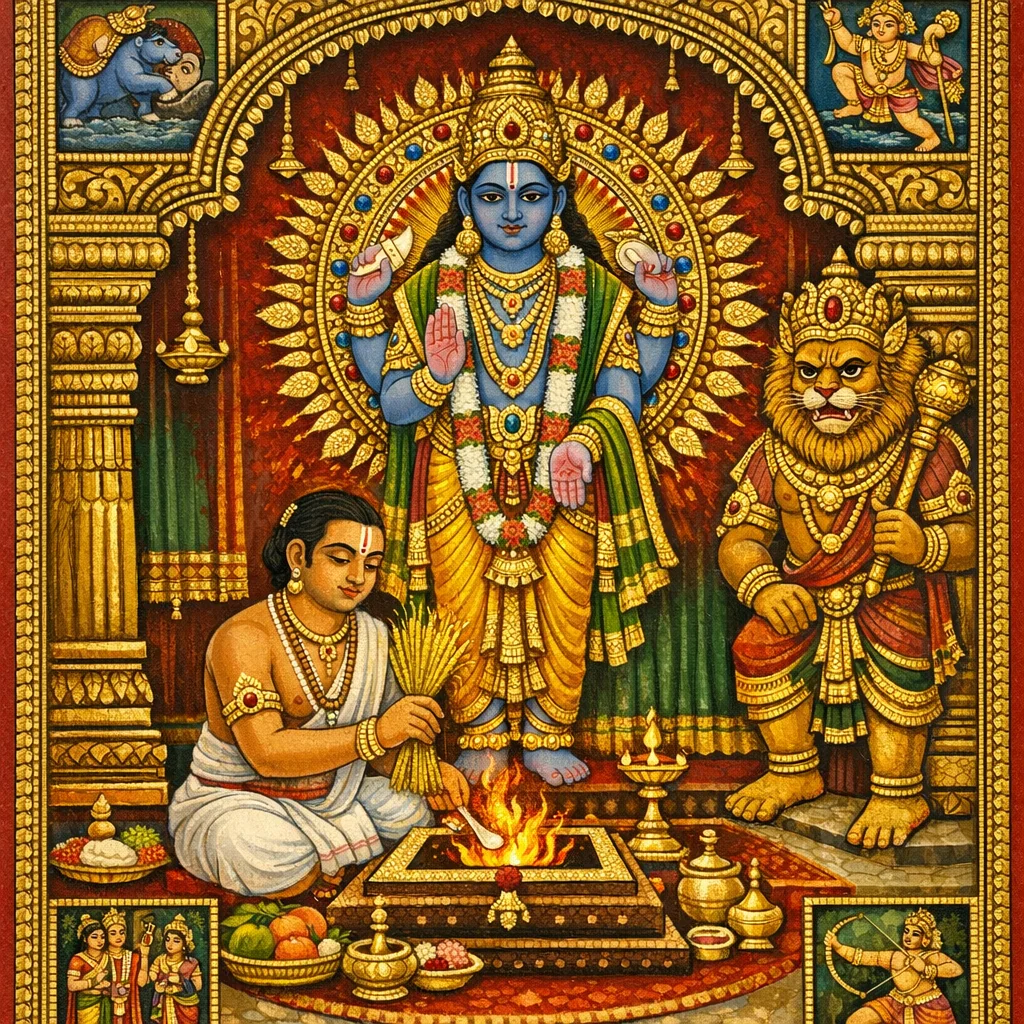
Lord Agni teaches a protective rite called mārjana—purificatory sprinkling performed for one’s own safety and for the protection of others. The chapter begins with namaskāra verses to the Supreme Self (paramātman) and to Viṣṇu’s avatāras (Varāha, Narasiṃha, Vāmana, Trivikrama, Rāma, Vaikuṇṭha, Nara), grounding the rite in the claim that protection is effected through truth (satya), remembrance (smṛti), and mantra‑power. The liturgy then unfolds as an apotropaic practice: it pacifies and destroys sorrow, sin, hostile rites (abhicāra), diseases classified in ways resembling doṣa/sannipāta categories, poisons of many origins, and spirit‑afflictions (grahas, pretas, ḍākinīs, vetālas, piśācas, yakṣas, rākṣasas). Sudarśana and Narasiṃha are invoked as guardians of the directions, and repeated “cut/cut” formulas strike at pain and pathology. The rite culminates by identifying kuśa‑grass with Viṣṇu/Hari and the apamārjanaka as a “weapon” that wards off disease, integrating ritual materials, mantra‑japa, and devotional metaphysics into a single protective technology of Agneya‑vidyā.
Shlokas
Verse 1
इत्य् आदिमहापुराणे आग्नेये मण्डलादिवर्णनं नाम त्रिंशो ऽध्यायः अथ एकत्रिंशो ऽध्यायः मार्जनविधानं अग्निर् उवाच रक्षां स्वस्य परेषाञ्च वक्ष्ये तां मार्जनाह्वयां यया विमुच्यते दुःखैः सुखञ्च प्राप्नुयान्नरः
Thus ends, in the Agni Purāṇa—the primordial Mahāpurāṇa—the thirtieth chapter entitled “Description of Maṇḍalas and Related (Ritual Diagrams).” Now begins the thirty-first chapter, “The Procedure of Mārjana (purificatory sprinkling).” Agni said: “I shall teach that protection—both for oneself and for others—called ‘Mārjana,’ by which a person is freed from sorrows and attains happiness.”
Verse 2
ॐ नमः परमार्थाय पुरुषाय महात्मने अरूपबहुरूपाय व्यापिने परमात्मने
Oṃ—salutations to the Supreme Truth (paramārtha), to the Supreme Person (Puruṣa), to the Great-Souled One; to Him who is formless yet assumes many forms, all-pervading, the Supreme Self (Paramātman).
Verse 3
निष्कल्मषाय शुद्धाय ध्यानयोगरताय च नमस्कृत्य प्रवक्ष्यामि यत् तत्सिध्यतु मे वचः
Having bowed to the One who is stainless, pure, and devoted to the yoga of meditation (dhyāna), I shall now expound; may that teaching cause my words to attain success.
Verse 4
वराहाय नृसिंहाय वामनाय महामुने नमस्कृत्य प्रवक्ष्यामि यत्तत्सिध्यतु मे वचः
Having bowed to Varāha, Narasiṃha, and Vāmana, O great sage, I shall now expound; may my words thereby attain success and accomplishment.
Verse 5
मन्त्रजं फलमश्नुते इति ख, चिह्नितपुस्तकपाठः सुखं ब्रह्माप्नुयान्नरः इति ख, चिह्नितपुस्तकपाठः त्रिविक्रमाय रामाय वैकुण्ठाय नराय च नमस्कृत्य प्रवक्ष्यामि यत्तत् सिध्यतु मे वचः
“He partakes of the fruit born of mantra”—thus reads the Kha recension (as marked in the collated manuscript). “A man may attain bliss and Brahman”—thus reads the Kha recension (as marked in the collated manuscript). Having bowed to Trivikrama, to Rāma, to Vaikuṇṭha, and to Nara, I shall now expound—may that teaching succeed, and may my words be fulfilled.
Verse 6
वराह नरसिंहेश वामनेश त्रिविक्रम हरग्रीवेश सर्वेश हृषीकेश हराशुभम्
O Lord in the forms of Varāha and Narasiṃha; O Lord Vāmana, O Trivikrama; O Lord Hayagrīva; O Lord of all; O Hṛṣīkeśa—remove and destroy inauspiciousness.
Verse 7
अपराजितचक्राद्यैश् चतुर्भिः परमायुधैः अखण्डितानुभावैस्त्वं सर्वदुष्टहरो भव
With the four supreme weapons beginning with the invincible discus—whose power is unbroken—become the remover of all evil and wicked forces.
Verse 8
हरामुकस्य दुरितं सर्वञ्च कुशलं कुरु मृत्युबन्धार्तभयदं दुरितस्य च यत् फलम्
Remove the wrongdoing of Harāmuka and bring about complete well-being. Also remove that which gives fear through death, bondage, and affliction—together with whatever result arises from sin.
Verse 9
पराभिध्यानसहितैः प्रयुक्तञ्चाभिचारकम् गदस्पर्शमहारोगप्रयोगं जरया जर
When employed together with focused hostile visualization, one may apply an abhichāra (malefic rite): paralysis or affliction by touch, the projection of a severe disease, and even the infliction of wasting old age—“ageing the one who is to be aged”.
Verse 10
ॐ नमो वासुदेवाय नमः कृष्णाय खड्गिने नमः पुष्करनेत्राय केशवायादिचक्रिणे
Oṃ—salutation to Vāsudeva; salutation to Kṛṣṇa, the sword-bearer; salutation to the Lotus-eyed One; salutation to Keśava, the primordial wielder of the discus.
Verse 11
नमः कमलकिञ्जल्कपीतनिर्मलवाससे महाहररिपुस्कन्धसृष्टचक्राय चक्रिणे
Salutations to the Discus-bearing Lord, whose spotless garment is yellow like the pollen-filaments of a lotus, and whose (Sudarśana) discus was brought forth and set in motion against the shoulder/host of the great enemy of Hara (Śiva).
Verse 12
द्ंष्ट्रोद्धृतक्षितिभृते त्रयीमूर्तिमते नमः महायज्ञवराहाय शेषभोगाङ्कशायिने
Salutations to Him who bears the earth uplifted on His tusk, whose form embodies the threefold Veda; to the Great-Sacrifice Varāha, who reclines upon the coil-lap of Śeṣa’s hoods.
Verse 13
तप्तहाटककेशाग्रज्वलत्पावकलोचन वज्राधिकनखस्पर्शं दिव्यसिंह नमोस्तु ते
Salutations to you, O celestial Lion—whose hair-tips blaze like heated gold, whose eyes are flaming fire, and whose claw-touch is harder than a thunderbolt.
Verse 14
काश्यपायातिह्रस्वाय ऋग्यजुःसामभूषित तुभ्यं वामनरूपायाक्रमते गां नमो नमः
Salutations again and again to You—the exceedingly short (dwarf) one, the son of Kaśyapa, adorned with the Ṛg-, Yajur-, and Sāma-Vedas—who, in the form of Vāmana, strides over the earth.
Verse 15
वराहाशेषदुष्टानि सर्वपापफलानि वै मर्द मर्द महादंष्ट्र मर्द मर्द च तत्फलम्
O Varāha, Boar-incarnation, crush—crush all remaining evils; indeed, crush the fruits of every sin. O Great-tusked One, crush—crush, and crush also their resultant effects.
Verse 16
अखण्डितात्मभावैस्त्वमिति ख, चिह्नितपुस्तकपाठः दंष्ट्रोद्धृतभूमिभर्त्रे इति ख, चिह्नितपुस्तकपाठः सृजते गामिति ख, चिह्नितपुस्तकपाठः नरसिंह करालाख्य दन्तप्रान्तानलोज्ज्वल भञ्ज भञ्ज निनादेन दुष्टान्यस्यार्तिनाशन
“(Variant readings are noted in some manuscripts: ‘You are of unbroken essential nature’; ‘to the bearer of the Earth lifted by the tusk’; ‘(He) creates the Earth’.) O Narasiṃha, the Terrible-Named, with the tips of Your teeth blazing like fire—crush, crush (the evil)! By Your thunderous roar, destroy the wicked; You are the remover of this devotee’s distress.”
Verse 17
ऋग्यजुःसामगर्भाभिर्वाग्भिर्वामनरूपधृक् प्रशमं सर्वदुःखानि नयत्त्वस्य जनार्दनः
May Janārdana—who bears the form of Vāmana—by words imbued with the Ṛg-, Yajur-, and Sāma-Vedas, bring all his sufferings to pacification and calm.
Verse 18
ऐकाहिकं द्व्याहिकञ्च तथा त्रिदिवसं ज्वरम् चातुर्थकन्तथात्युग्रन्तथैव सततज्वरम्
Fever is (also) classified as the one-day fever, the two-day fever, the three-day fever, the quartan (fourth-day) fever, the exceedingly severe fever, and likewise the continuous fever.
Verse 19
दोषोत्थं सन्निपातोत्थं तथैवागन्तुकं ज्वरम् शमं नयाशु गोविन्द च्छिन्धि च्छिन्ध्यस्य वेदनाम्
O Govinda, quickly pacify the fever—whether arising from the doṣas, from their combined aggravation (sannipāta), or from external causes—and cut off, cut off this suffering (pain).
Verse 20
नेत्रदुःखं शिरोदुःखं दुःखञ्चोदरसम्भवम् अन्तःश्वासमतिश्वासं परितापं सवेपथुम्
Pain in the eyes, pain in the head, and pain arising in the abdomen; laboured inward breathing, excessive breathing, burning feverish heat, and trembling—these are the stated symptoms.
Verse 21
गुदघ्राणाङ्घ्रिरोगांश् च कुष्ठरोगांस् तथा क्षयं कामलादींस् तथा रोगान् प्रमेहांश्चातिदारुणान्
And (it addresses) diseases of the anus, nose, and feet; as well as skin-diseases (kuṣṭha), consumption (kṣaya), jaundice and related disorders (kāmala-ādīni), and the extremely severe urinary-metabolic diseases (prameha).
Verse 22
भगन्दरातिसारांश् च मुखरोगांश् च वल्गुलीम् अश्मरीं मूत्रकृच्छ्रांश् च रोगानन्यांश् च दारुणान्
And (it cures) fistula-in-ano, diarrhoeal disorders, diseases of the mouth, valgulī, urinary stones, painful/difficult urination, and other severe ailments as well.
Verse 23
ये वातप्रभवा रोगा ये च पित्तसमुद्भवाः कफोद्भवाश् च ये केचित् ये चान्ये सान्निपातिकाः
Diseases that arise from vāta, those that originate from pitta, and whatever diseases arise from kapha—as well as other disorders that are sānnipātika (caused by the combined disturbance of all three doṣas).
Verse 24
आगन्तुकाश् च ये रोगा लूता विस्फोटकादयः ते सर्वे प्रशमं यान्तु वासुदेवापमार्जिताः
May all diseases that arise from external causes—such as lūtā (cutaneous eruptions/poisonous afflictions) and visphoṭaka (blistering pox-like eruptions) and the like—become pacified; may they all subside, having been wiped away by Vāsudeva.
Verse 25
विलयं यान्तु ते सर्वे विष्णोरुच्चारणेन च क्षयं गछ्हन्तु चाशेषास्ते चक्राभिहता हरेः
May all hostile forces dissolve through the very utterance of Viṣṇu’s name; and may they all, without remainder, be destroyed—struck down by Hari’s discus (Sudarśana).
Verse 26
छिन्द छिन्दास्य वेदनामिति ग, चिह्नितपुस्तकपाठः अनिश्वासमतिश्वासमिति ग, चिह्नितपुस्तकपाठः तथैव च इति ग, चिह्नितपुस्तकपाठः ये रोगाः पित्तसम्भवा इति ग, चिह्नितपुस्तकपाठः वासुदेवपराजिता इति ख, चिह्नितपुस्तकपाठः अच्युतानन्तगोविन्दनामोच्चारणभीषिताः नश्यन्ति सकला रोगाः सत्यं सत्यं वदाम्यहम्
“Cut, cut this pain!”—so reads one marked manuscript; “(for) shortness of breath and excessive breathing”—so reads one marked manuscript; “and likewise”—so reads one marked manuscript; “those diseases that arise from pitta”—so reads one marked manuscript; “vanquished by Vāsudeva”—so reads one marked manuscript. Terrified by the utterance of the names Acyuta, Ananta, and Govinda, all diseases are destroyed; this is truth—truth, I declare.
Verse 27
स्थावरं जङ्गमं वापि कृत्रिमं चापि यद्विषम् दन्तोद्भवं नखभवमाकाशप्रभवं विषम्
Poison is of these kinds: originating from stationary sources, from moving creatures, and also artificially prepared. (It is further spoken of as) poison arising from teeth, arising from nails (claws), and poison said to be “born of the sky” (airborne/atmospheric in origin).
Verse 28
लूतादिप्रभवं यच्च विषमन्यत्तु दुःखदं शमं नयतु तत् सर्वं कीर्तितोस्य जनार्दनः
May every venom arising from spiders and the like, and any other harmful poison that causes suffering, be brought to pacification—since Janārdana (Viṣṇu) has been invoked (praised) by him.
Verse 29
ग्रहान् प्रेतग्रहांश्चापि तथा वै डाकिनीग्रहान् वेतालांश् च पिशाचांश् च गन्धर्वान् यक्षराक्षसान्
([This rite/recitation wards off]) grahas (seizing afflictions), as well as preta-grahas (spirit-possessions by the departed), and indeed ḍākinī-grahas; and also vetālas, piśācas, gandharvas, yakṣas, and rākṣasas.
Verse 30
शकुनीपूतनाद्यांश् च तथा वैनायकान् ग्रहान् मुखमण्डीं तथा क्रूरां रेवतीं वृद्धरेवतीम्
And (he should pacify or ward off) Śakunī, Pūtanā, and others of their kind; likewise the Vināyaka‑type grahas; also Mukhamaṇḍī, the fierce Krūrā, Revatī, and Vṛddha‑Revatī.
Verse 31
वृद्धकाख्यान् ग्रहांश्चोग्रांस् तथा मातृग्रहानपि बालस्य विष्णोश् चरितं हन्तु बालग्रहानिमान्
May the sacred exploits (carita) of Viṣṇu, as the protector of the child, destroy these child‑seizing spirits—those called Vṛddhakā, the fierce grahas, and also the Mātṛ‑grahas.
Verse 32
वृद्धाश् च ये ग्रहाः केचिद्ये च बालग्रहाः क्वचित् नरसिंहस्य ते दृष्ट्या दग्धा ये चापि यौवने
And whatever grahas there may be—some ‘elder’ (long‑standing) ones, and at times those that seize children—by Narasiṃha’s very glance (dṛṣṭi) they are burned up; so too are those grahas that afflict one in youth.
Verse 33
सदा करालवदनो नरसिंहो महाबलः ग्रहानशेषान्निःशेषान् करोतु जगतो हितः
May Narasiṃha—ever fierce‑faced and of great strength—make all grahas, without remainder, pacified and harmless, for the welfare of the world.
Verse 34
नरसिंह महासिंह ज्वालामालोज्ज्वलानन ग्रहानशेषान् सर्वेश खाद खादाग्निलोचन
O Narasiṃha, O Great Lion—whose face blazes with a garland of flames! O Lord of all, O Fire‑eyed One—devour, devour completely all grahas (seizing afflictions) without remainder.
Verse 35
ये रोगा ये महोत्पाता यद्विषं ये महाग्रहाः यानि च क्रूरभृतानि ग्रहपीडाश् च दारुणाः
Whatever diseases there are, whatever great calamities and ominous portents, whatever poison, whatever mighty grahas, and whatever fierce malignant beings—together with the dreadful afflictions caused by the grahas—may all of these be driven away.
Verse 36
शस्त्रक्षतेषु ये दोषा ज्वालागर्दभकादयः तानि सर्वाणि सर्वात्मा परमात्मा जनार्दनः
Whatever morbid complications arise in weapon-inflicted wounds—such as those termed ‘jvālā’ and ‘gardabhaka’ and the like—Janārdana, the Supreme Self who is the Self of all, removes them all.
Verse 37
तथा वेतालिकान् ग्रहानिति घ, चिह्नितपुस्तकपाठः गन्धर्वान् राक्ससानपि इति ख, चिह्नितपुस्तकपाठः शटा इति ख, ङ, चिह्नितपुस्तकद्वयपाठः किञ्चिद्रूपं समास्याय वासुदेवास्य नाशय
Likewise, (destroy) the Vetālikas and the Grahas—so reads one marked manuscript; (destroy) the Gandharvas and also the Rākṣasas—so reads another marked manuscript; (destroy) the Śaṭā—so read two marked manuscripts. Assuming any form whatsoever, O Vāsudeva, destroy them.
Verse 38
क्षिप्त्वा सुदर्शनञ् चक्रं ज्वालामालातिभीषणम् सर्वदुष्टोपशमनं कुरु देववराच्युत
Having hurled the Sudarśana discus—terrifying with its garland of flames—O Acyuta, best of the gods, bring about the pacification (suppression) of all evil and wicked forces.
Verse 39
सुदर्शन महाज्वाल च्छिन्धि च्छिन्धि महारव सर्वदुष्टानि रक्षांसि क्षयं यान्तु विभीषण
O Sudarśana, blazing with a mighty flame—cut down, cut down! O great-roaring one, may all wicked rākṣasas go to destruction, O Terrifier.
Verse 40
प्राच्यां प्रतीच्यां च दिशि दक्षिणोत्तरतस् तथा रक्षाङ्करोतु सर्वात्मा नरसिंहः सुगर्जितः
May Narasiṃha—whose roar is auspicious and mighty, the Inner Self of all—establish protection in the eastern and western directions, and likewise from the south and from the north.
Verse 41
दिवि भुव्यन्तरीक्षे च पृष्ठतः पार्श्वतोग्रतः रक्षाङ्करोतु भगवान् बहुरूपी जनार्दनः
May the Blessed Lord Janārdana—He who assumes many forms—establish protection for me in heaven, on earth, and in the mid-region (atmosphere): from behind, from the sides, and from the front.
Verse 42
यथा विष्णुर्जगत्सर्वं सदेवासुरमानुषं तेन सत्येन दुष्टानि शममस्य व्रजन्तु वै
Just as Viṣṇu pervades the entire universe—together with gods, asuras, and human beings—by that very truth, let the wicked forces indeed come to pacification in relation to him (this person/this place).
Verse 43
यथा विष्णौ स्मृते सद्यः सङ्क्षयं यान्ति पातकाः सत्येन तेन सकलं दुष्टमस्य प्रशाम्यतु
Just as, upon remembering Viṣṇu, sins immediately go to destruction—by that very truth, may all the evil afflicting this person be completely pacified.
Verse 44
परमात्मा यथा विष्णुर्वेदान्तेषु च गीयते तेन सत्येन सकलं दुष्टमस्य प्रशाम्यतु
As Viṣṇu is sung of in the Vedāntas as the Supreme Self—by that very truth, may all that is evil/inauspicious in this person be completely pacified.
Verse 45
यथा यज्ञेश्वरो विष्णुर्देवेष्वपि हि गीयते सत्येन तेन सकलं यन्मयोक्तं तथास्तु तत्
Just as Viṣṇu is sung of—even among the gods—as the Lord of sacrifice, by that very truth may everything spoken by me come to be exactly so.
Verse 46
शान्तिरस्तु शिवञ्चास्तु दुष्टमस्य प्रशाम्यतु वासुदेवशरीरोत्थैः कुशैर् निर्मथितं मया
May there be peace; may there be auspiciousness. May the evil in this be pacified—having been rubbed (and neutralized) by me with kuśa-grass said to have arisen from the body of Vāsudeva.
Verse 47
अपमार्जतु गोविन्दो नरो नारायणस् तथा तथास्तु सर्वदुःखानां प्रशमो जपनाद्धरेः
May Govinda wipe them away; likewise may Nara and Nārāyaṇa do so. So be it: by the japa (repetition) of Hari’s name there is the pacification of all sorrows.
Verse 48
महाबल इति ख, चिह्नितपुस्तकपाठः स्वर्गर्जितैर् इति ग, ङ, चिह्नितपुस्तकद्वयपाठः प्रयान्तु वै इति ग, चिह्नितपुस्तकपाठः कुशैर् निर्णाशितमिति ख, ग, चिह्नितपुस्तकद्वयपाठः अपमार्जनकं शस्त्रं सर्वरोगादिवारणम् अयं हरिः कुशो विष्णुर्हता रोगा मया तव
“This apamārjanaka (ritual cleansing implement) is a ‘weapon’ that wards off all diseases and the like. This kuśa-grass is Hari—indeed Viṣṇu. By me, your diseases are struck down.”
Frequently Asked Questions
It is a protective and purificatory procedure performed for oneself and others, intended to remove sorrow, sin, disease, poison, and hostile influences by mantra, truth-assertion, and ritual cleansing actions.
Viṣṇu as Vāsudeva/Keśava/Hari is central, with strong emphasis on Sudarśana-cakra and Narasiṃha; the rite also salutes Varāha, Vāmana, Trivikrama, Rāma, Vaikuṇṭha, Nara, and Nārāyaṇa.
By grounding protection in remembrance of Viṣṇu, satya-vākya, and sanctified implements (kuśa identified with Hari), it frames practical healing and warding-off as dharmic purification that supports wellbeing while orienting the mind toward the Supreme Self.