Adhyaya 40
Chapter 40 — भूपरिग्रहो नाम (Bhū-parigraha) / अर्घ्यदानविधानम् (Arghya-dāna-vidhāna)
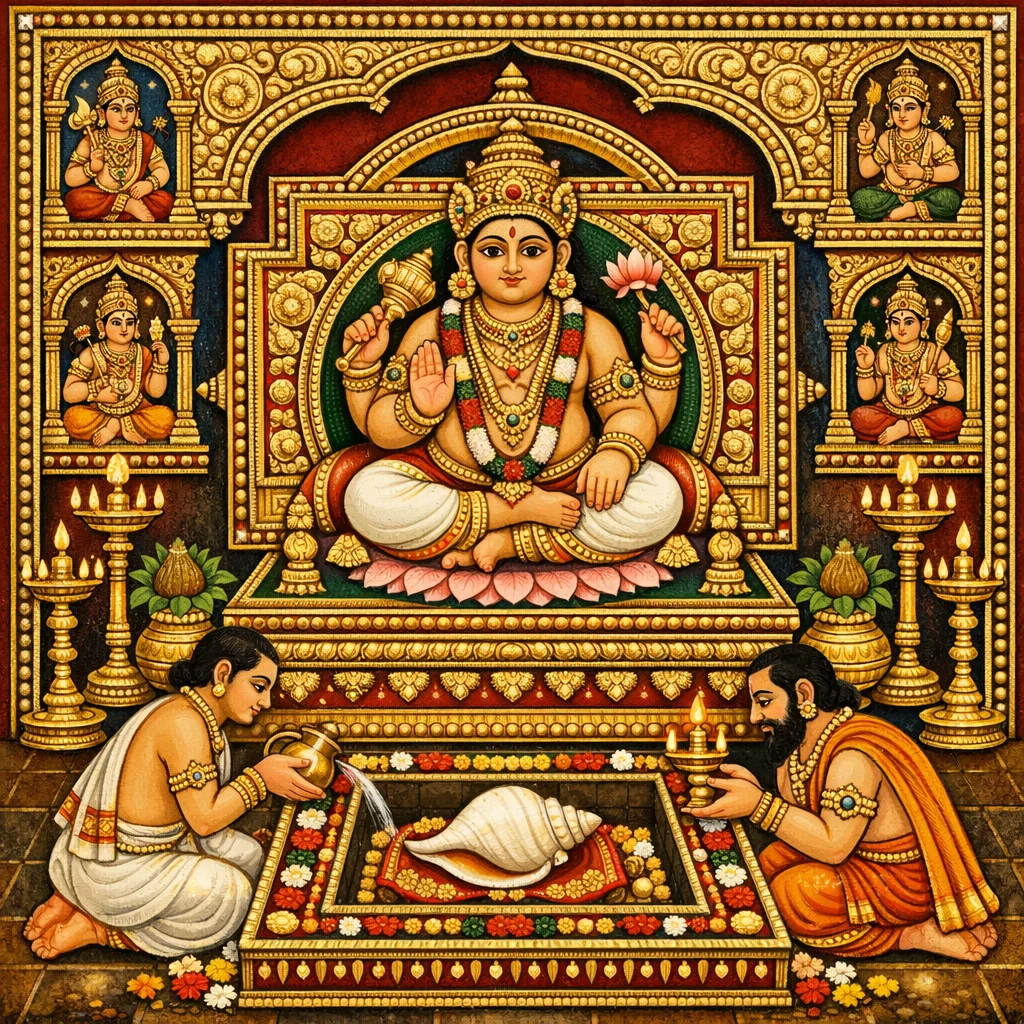
Lord Agni grounds the land-ritual in the mythic ontology of the Vāstu-Puruṣa, a formidable being subdued by the gods and laid upon the earth so that the site becomes a consecrated body. The practitioner employs a 64-pada maṇḍala grid, assigning deities and forces to padas and half-padas, and offers prescribed substances—ghee, akṣata, flowers, grains, meats, honey, milk-products, and colored materials—to nourish benefic powers and neutralize obstructive influences (asuric forces, pāpa, roga). Before construction, bali offerings are made to ancillary beings (rakṣasas, mātṛ-gaṇas, piśācas, pitṛs, kṣetrapālas), stressing ritual completeness and site-harmony. The chapter then details pratiṣṭhā procedures: kumbha installations (Mahīśvara/Vāstu-form with Vardhanī; Brahmā and the dikpālas), pūrṇāhuti, pradakṣiṇa of the maṇḍala, thread-and-water tracing, trenching, central pit preparation, arghya to four-armed Viṣṇu, and auspicious deposits (white flowers, dakṣiṇāvarta conch, seeds, earth). It concludes with a Vāstu-śāstra warning to excavate to the water-level to find and remove śalya (hidden foreign obstructions), noting omens and harms (wall disturbance, householder suffering) if neglected—uniting metaphysical purity with engineering diligence.
Shlokas
Verse 1
इत्य् आदिमहापुराणे आग्नेये प्रतिष्ठायां भूपरिग्रहो नामोनचत्वारिंशोध्यायः अथ चत्वारिंशो ऽध्यायः अर्घ्यदानविधानं भगवानुवाच पूर्वमासित् महद्भूतं सर्वभूतभयङ्करं तद्देवैर् निहितं भुमौ स वास्तुपुरुषः स्मृतः
Thus, in the Agni Purāṇa, in the section on consecration (pratiṣṭhā), is the fortieth chapter entitled “Taking possession of the land (bhū-parigraha).” Now begins the fortieth chapter: the ordinance for offering arghya. The Blessed Lord said: “In former times there was a mighty being, fearsome to all creatures. The gods laid him down upon the earth; he is remembered as the Vāstu-Puruṣa.”
Verse 2
चतुःषष्टिपदे क्षेत्रे ईशं कोणार्धसंस्थितं घृताक्षतैस्तर्पयेत्तं पर्जन्यं पदगतं ततः
In a field laid out as a sixty-four-square grid (catuḥṣaṣṭi-pada), one should propitiate Īśa (Śiva) stationed in the half-corner sector (koṇa-ardha) with ghee and unbroken rice (akṣata). Thereafter, one should worship Parjanya, the rain-god, as placed in his assigned pada (grid-position).
Verse 3
उत्पलादिभिर्जयन्तञ्च द्विपदस्थं पताकया महेन्द्रञ्चैककोष्ठस्थं सर्वरक्तैः पदे रविं
Depict Jayanta with lotuses and the like, standing on two feet and bearing a banner (patākā); depict Mahendra within a single compartment; and depict Ravi (the Sun) in his pada using wholly red colors.
Verse 4
वितानेनार्धपदगं सत्यं पदे भृशं घृतैः व्योम शाकुनमांसेन कोणार्धपदसंस्थितं
On the half-square (ardha-pada) place Vitāna; on the full square place Satya. The region called Vyoma should be abundantly anointed/filled with ghee; and the corner half-square is to be occupied by the flesh of birds.
Verse 5
स्रुचा चार्धपदे वह्निं पूषाणं लाजयैकतः स्वर्णेन वितथं द्विष्ठं मथनेन गृहाक्षतं
With the ritual ladle (sruc), on the half-pada one should place/offer Vahni (Agni). Pūṣan should be set together with lāja (parched grain). With gold (svarṇa) one counteracts what is false or defective (vitatha); with the fire-churning stick (mathana) one wards off enmity (dviṣṭa); and with household unbroken rice (gṛhākṣata) one establishes and completes the rite.
Verse 6
मांसौदनेन धर्मेशमेकैकस्मिन् स्थितं द्वयं गन्धर्वं द्विपदं गन्धैर् भृशं शाकुनजिह्वया
O Lord of Dharma, with rice cooked with meat as the offering, in each placement two portions should be set: one for the Gandharva and one for the two-footed being. They should be strongly perfumed with fragrances and offered with the “bird-tongue” (implement/arrangement).
Verse 7
एकस्थमूर्ध्वसंस्थञ्च मृगं नीलपटैस् तथा पितॄन् कृशरयार्धस्थं दन्तकाष्ठैः पदस्थितं
He should contemplate the ritual form: a deer with its head raised, fixed in a single place, draped in blue cloth; and the Pitṛs (ancestral spirits) positioned half-seated upon a dish of kṛśara (rice-and-pulse preparation), standing upon tooth-sticks (dantakāṣṭha).
Verse 8
नृहस्त इति ख, चिह्नितपुस्तकपाठः व्योम शाकुलमांसेनेति ख, चिह्नितपुस्तकपाठः दौवारिकं द्विसंस्थञ्च सुग्रीवं यावकेन तु पुष्पदन्तं कुशस्तम्बैः पद्मैर् वरुणमेकतः
“(In some marked manuscripts:) ‘Nṛhasta’ and ‘Vyoma’ are mentioned.” One should make offerings to the Dauvārika (door-guardian) and also to Dvisaṃstha; to Sugrīva with yāvaka (barley); to Puṣpadanta with stalks of kuśa-grass; and to Varuṇa separately with lotus-flowers.
Verse 9
असुरं सुरया द्विष्ठं पदे शेषं घृताम्भसा यवैः पापं पदार्धस्थं रोगमर्धे च मण्डकैः
One should ward off an asuric (malevolent) influence with surā (fermented liquor); remove the remaining residue (residual impurity) on the foot with water mixed with ghee; dispel sin when it is situated in the half-foot region with barley; and, when disease is in the mid-portion, (treat it) with maṇḍaka-cakes.
Verse 10
नागपुष्पैः पदे नागं मुख्यं भक्ष्यैर् द्विसंस्थितं मुद्गौदनेन भल्लाटं पदे सोमं पदे तथा
With nāga-flowers (nāga-puṣpa), in the designated quarter one should place the Nāga (serpent-deity). In the chief (central) position, one should place the principal offering of eatables, set in two portions. With boiled rice mixed with mudga (green gram), one should place an offering for Bhallāṭa; and likewise, in another quarter, an offering for Soma.
Verse 11
मधुना पायसेनाथ शालूकेन ऋषिं द्वये पदे दितिं लोपिकाभिरर्धे दितिमथापरं
By offering honey and rice-pudding (pāyasa), and likewise śālūka (lotus-stalk), one attains the station of a Ṛṣi; two steps higher one reaches the state of Diti. With lopikā (a grain-based preparation) one reaches Diti by half that measure, and thereafter another, higher state is obtained.
Verse 12
पूरिकाभिस्ततश्चापमीशाधः पयसा पदे ततोधश्चापवत्सन्तु दध्ना चैकपदे स्थितं
Then, with pūrikā-cakes one should place the ‘ap’ (water-offering). Below the Īśa-position, in its pāda (assigned spot), one should place milk. Below that, let there be the ‘āpa-vatsā’ (a milk–water preparation), and curd (dadhi) is to be set in a single pāda (one designated place).
Verse 13
लड्डुकैश् च मरीचिन्तु पूर्वकोष्ठचतुष्टये सवित्रे रक्तपुष्पाणि ब्रह्माधःकोणकोष्ठके
And with laddus and marīci (pepper), one should fill the four eastern compartments. For Savitṛ, one should place red flowers in the compartment at the lower corner beneath Brahmā.
Verse 14
तदधःकोष्ठके दद्यात् सावित्र्यै च कुशोदकं विवस्ते ऽरुणं दद्याच्चन्दनञ्चतुरङ्घ्रिषु
In the compartment below that, one should place kuśa-infused water for the worship of Sāvitrī. In the garment section, one should offer a red cloth, and apply/offer sandalwood paste to the four feet (of the deity or the ritual diagram).
Verse 15
रक्षोधःकोणकोष्ठे तु इन्द्रायान्नं निशान्वितं इन्द्रजयाय तस्याधो घृतान्नं कोणकोष्ठके
In the corner-compartment belonging to the Rakṣas-direction, one should place Indra’s food-offering mixed with turmeric. Beneath that, in the corner-compartment, one should place ghee-rice as an offering for Indra-jaya, the conquest of Indra.
Verse 16
चतुष्पदेषु दातव्यमिन्द्राय गुडपायसं वाय्वधःकोणदेशे तु रुद्राय पक्वमांसकं
In the four quarter-directions, one should offer to Indra a rice-pudding sweetened with jaggery; and in the north-western lower corner-region, one should offer to Rudra cooked meat.
Verse 17
तदधःकोणकोष्ठे तु यक्षायार्द्रं फलन्तथा महीधराय मांसान्नं माघञ्च चतुरङ्घ्रिषु
In the cell of the lower corner (of the plan), one should offer to the Yakṣa moist fruit; likewise, to Mahīdhara a meal with meat; and in the quadruped-quarters, one should offer Māgha as well.
Verse 18
मध्ये चतुष्पदे स्थाप्या ब्रह्मणे तिलतण्डुलाः चरकीं माषसर्पिभ्यां स्कन्दं कृशरयासृजा
In the middle, in the four-squared (quadrangular) space, one should place sesame and rice-grains as an offering for Brahmā. One should offer carakī with black gram and ghee, and offer to Skanda a preparation of kṛśara (rice cooked with pulses) together with blood/meat-juice.
Verse 19
रक्तपद्मैर् विदारीञ्च कन्दर्पञ्च पलोदनैः पूतनां पलपित्ताभ्यां मांसासृग्भ्याञ्च जम्भकं
With red lotuses, and also with vidārī and kandarpa together with palodana; with pūtanā and with palapitta; and with flesh and blood, one prepares/uses the formulation called jambhaka.
Verse 20
मध्यचतुष्टये इति ख, चिह्नितपुस्तकपाठः पित्तासृगस्थिभिः पापां पिलिपिञ्जं स्रजासृजा ईशाद्यान् रक्तमांसेन अभावादक्षतैर् यजेत्
“(According to the marked manuscript reading:) ‘In the middle set of four.’” With bile, blood, and bones one should worship Pāpā (sin personified). One should worship Pilipiñja with a garland made of sinews. The deities beginning with Īśa should be worshipped with blood and flesh; if these are unavailable, one should worship with akṣata (uncooked rice grains) as substitutes.
Verse 21
रक्षोमातृगणेभ्यश् च पिशाचादिभ्य एव च पितृभ्यः क्षेत्रपालेभ्यो बलीन् दद्यात् प्रकामतः
And one should, as desired and in due measure, offer bali-offerings to the hosts of the Rakṣas and the Mothers (Mātṛ-gaṇas), to Piśācas and the like, and also to the Pitṛs and to the guardians of the sacred ground (Kṣetrapālas).
Verse 22
आहुत्वैतानसन्तर्प्य प्रासादादीन्न कारयेत् ब्रहमस्थाने हरिं लक्ष्मीं गणं पश्चात् समर्चयेत्
Having offered the oblations (āhuti) and not leaving these (deities/attendants) unsatisfied, one should not proceed to have the temple and related structures constructed. In the Brahmā-site (the central sanctified locus), one should worship Hari (Viṣṇu), Lakṣmī, and thereafter Gaṇa (Gaṇeśa) with due reverence.
Verse 23
महीश्वरं वास्तुमयं वर्धन्या सहितं घटं ब्रह्माणं मध्यतः कुम्भे ब्रह्मादींश् च दिगीश्वरान्
One should install (invoke) Mahīśvara—the Vāstu-form, presiding deity of the site—together with Vardhanī in the consecration pot (ghaṭa/kumbha); and in the center of the kumbha one should establish Brahmā, along with Brahmā and the other deities who are the Lords of the Directions (Dikpālas).
Verse 24
दद्यात् पूर्णाहुतिं पश्चात् स्वस्ति वाच्य प्रणम्य च प्रगृह्य कर्करीं सम्यक् मण्डलन्तु प्रदक्षिणं
Afterwards, one should offer the final oblation (pūrṇāhuti). Then, having the auspicious benediction recited (svasti-vācana) and having bowed in reverence, taking up the ladle/tongs (karkarī) properly, one should circumambulate the ritual maṇḍala in the clockwise direction (pradakṣiṇa).
Verse 25
सूत्रमार्देण हे ब्रह्मंस्तोयधाराञ्च भ्रामयेत् पूर्ववत्तेन मार्गेण सप्त वीजानि वापयेत्
O Brahman, with a moistened thread one should cause a stream of water (toyadhārā) to move in a circling course; then, along that very same previously prescribed path, one should sow seven seeds.
Verse 26
प्रारम्भं तेन मार्गेण तस्य खातस्य कारयेत् ततो गर्तं खनेन्मध्ये हस्तमात्रं प्रमाणतः
One should begin by having a trench (khāta) made along the prescribed line (mārga). Then, in the middle, one should dig a pit (garta) according to the stated measure—one cubit (hasta) in extent.
Verse 27
चतुरङ्गुलकं चाधश्चोपलिप्यार्चयेत्ततः ध्यात्वा चतुर्भुजं विष्णुमर्घ्यं दद्यात्तु कुम्भतः
After smearing and preparing the lower portion to the measure of four aṅgulas, one should then perform worship. Having meditated upon four-armed Viṣṇu, one should offer the arghya—ritual water of honor—from the water-pot (kumbha).
Verse 28
कर्कर्या पूरयेत् श्वभ्रं शुक्लपुष्पाणि च न्यसेत् दक्षिणावर्तकं श्रेष्ठं बीजैर् मृद्द्भिश् च पूरयेत्
One should fill the cavity with small pebbles (karkaryā) and place white flowers there. The right-turning conch (dakṣiṇāvarta), most auspicious, should be set in place and also filled with seeds and clods of earth.
Verse 29
अर्घ्यादानं विनिष्पाद्य गोवस्त्रादीन्ददेद्गुरौ कालज्ञाय स्थपतये वैष्णवादिभ्य अर्चयेत्
Having duly completed the offering of arghya, one should give cows, garments, and the like to the guru. One should also worship and honor the knower of auspicious times (kālajñā), the sthapati (architect), and the Vaiṣṇavas and others.
Verse 30
ततस्तु खानयेद्यत्नज्जलान्तं यावदेव तु पुरुषाधःस्थितं शल्यं न गृहे दोषदं भवेत्
Then one should carefully excavate until reaching the water level, so that the foreign body or obstructing element (śalya) lying beneath a person does not remain in the house and become a source of harm or defect.
Verse 31
पिलिपिच्छमिति ङ, चिह्नितपुस्तकपाठः महीधरं वास्तुमयमिति ख, ङ, चिह्नितपुस्तकपाठः पुरुषाधिष्ठितं शल्यमिति ग, चिह्नितपुस्तकपाठः अस्थिशल्ये विद्यते वै भित्तिर्वै गृहिणो ऽसुखं यन्नामशब्दं शृणुयात्तत्र शल्यं तदुद्भवं
In the case of an “asthi-śalya” (a bone-like hidden obstruction/foreign object), there is indeed disturbance to the wall, and surely discomfort arises for the householder. Whatever name or sound is heard as an omen, there one should understand that the śalya (the concealed obstruction) has arisen from that very source indicated by the sign.
Frequently Asked Questions
The chapter emphasizes a Vāstu-śāstra workflow: 64-pada maṇḍala zoning with substance-specific offerings, followed by kumbha-sthāpana, pūrṇāhuti, traced trenching/pit creation, auspicious deposits (dakṣiṇāvarta conch, seeds), and finally śalya-doṣa detection by excavation to the water-line.
By treating land-taking and construction as dharmic worship: the site is approached as Vāstu-Puruṣa, offerings cultivate gratitude and restraint, bali reconciles visible and invisible stakeholders, and doṣa-removal becomes inner purification—aligning practical building with cosmic order and devotional discipline.