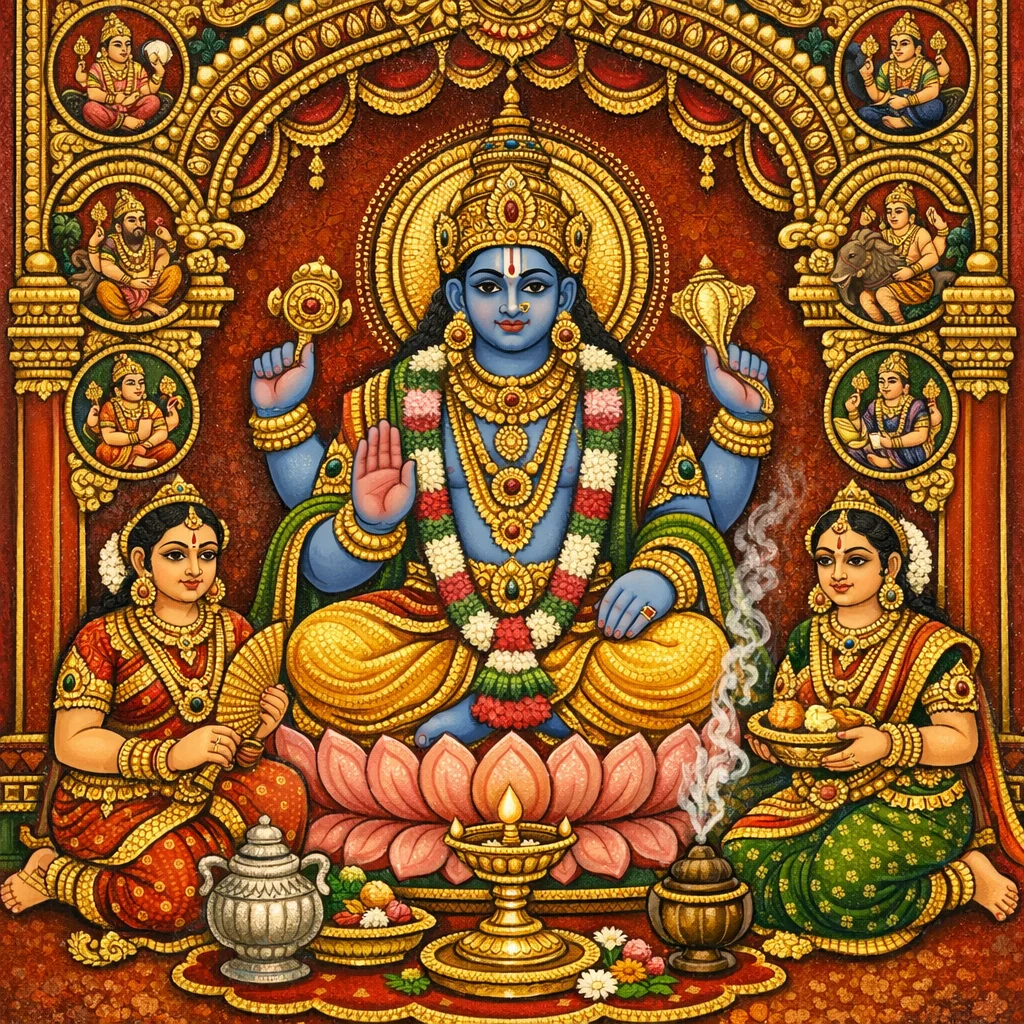
Adhyaya 23
Chapter 23 — पूजाविधिकथनम् (The Account of the Rules of Worship)
Spoken by Nārada to the brāhmaṇas, this chapter sets out a disciplined Vaiṣṇava pūjā sequence. It begins with bodily and verbal restraint—washing the feet, ācamanam, silence, and protective rites—then moves into inner yogic purification: sitting east-facing, forming mudrā, and visualizing bīja (yaṃ at the navel as fierce wind; kṣauṃ in the heart as a radiant treasury), burning impurities with flames in all directions and bathing the subtle body in nectar descending like the moon and circulating through suṣumnā and the nāḍīs. Ritual exactness follows with hand-purification, astramantra and vyāpaka placements, and full nyāsa on the limbs (heart, head, śikhā, armor, weapon, and eyes). The chapter details altar arrangement (vardhanī on the left, materials on the right), consecration by mantra-sprinkling, and construction of the yogapīṭha with directional placements of virtues and counter-qualities. A lotus-maṇḍala is contemplated, the deity is invoked from the heart into the maṇḍala, and standard upacāras are offered per Puṇḍarīkākṣa-vidyā (arghya, pādya, ācāmana, madhuparka, snāna, garments, ornaments, incense, lamp). Worship extends to attendant emblems and directional lords, concludes with japa, pradakṣiṇā, stuti, arghya, and the identity-affirmation “ahaṃ brahma; haris tvam,” and then shifts from one-form worship to the nine-vyūha scheme with finger- and body-placements, noting key manuscript variants.
Shlokas
Verse 1
इत्य् आदिमहापुराणे आग्नेये स्नानविधिकथनं नाम द्वाविंशोध्यायः अथ त्रयोविंशोध्यायः पूजाविधिकथनं नारद उवाच वक्ष्ये पूजाविधिं विप्रा यत् कृत्वा सर्वमाप्नुयात् प्रक्षालिताङ्घ्रिराचम्य वाग्यतः कृतरक्षकः
Thus, in the Agni Purāṇa of the primordial Mahāpurāṇa, the twenty-second chapter entitled “The Account of the Rules of Bathing” concludes. Now begins the twenty-third chapter, “The Account of the Rules of Worship.” Nārada said: “O brāhmaṇas, I shall teach the procedure of worship; by performing it one attains all desired results. Having washed the feet, having performed ācamanam (sipping water for purification), being restrained in speech, and having completed the protective rite (rakṣā), one should then proceed with worship.”
Verse 2
ध्यायं हरिं देवमिति घचिह्नितपुस्तकपाठः प्राङ्मुखः स्वस्तिकं बद्ध्वा पद्माद्यपरमेव च यं वीजं नाभिमध्यस्थं धूम्रं चण्डानिलात्मकं
Reciting the text-marked formula, “(I) meditate on Hari, the God,” one should face east, sit in the svastika posture, and perform the lotus and other prescribed mudrās. One should then visualize the bīja “yaṃ” stationed in the middle of the navel—smoke-hued, of the nature of a fierce wind.
Verse 3
विशेषयेदशेषन्तु ध्यायेत् कायात्तु कल्मषं क्षौं हृत्पङ्कजमध्यस्थं वीजं तेजोनिधिं स्मरन्
Then one should completely distinguish and separate all things, and meditate that the body’s impurity is being removed, while remembering the bīja “kṣauṃ” stationed in the center of the lotus of the heart—(that bīja) which is a treasury of radiance.
Verse 4
अधोर्ध्वतिर्यग्गाभिस्तु ज्वालाभिः कल्मषं दहेत् शशाङ्काकृतिवद्ध्यायेदम्बरस्थं सुधाम्बुभिः
With flames spreading downward, upward, and sideways, one should burn away impurity. Then one should meditate on a moon-shaped form stationed in the sky, showering streams of nectar-like water.
Verse 5
हृत्पद्मव्यापिभिर्देहं स्वकमाप्लावयेत्सुधीः सुसुम्नायोनिमार्गेण सर्वनाडीविसर्पिभिः
The wise practitioner should flood his own body with that (inner current/nectar), spreading from the lotus of the heart, moving through the Suṣumnā—the channel that is the womb-like path—and pervading all the nāḍīs (subtle conduits).
Verse 6
शोधयित्वा न्यसेत्तत्त्वं करशुद्धिरथास्त्रकं व्यापकं हस्तयोरादौ दक्षिणाङ्गुष्ठतोङ्गकं
Having purified the hands, one should then place (perform nyāsa of) the principle (tattva). Next comes the purification of the hands, and then the nyāsa of the ‘weapon-mantra’ (astraka). Thereafter, the all-pervading (vyāpaka) mantra-nyāsa: at the outset, upon both hands—beginning from the right thumb—one should place the mantra upon the limb-points of the hand and fingers.
Verse 7
मूलं देहे द्वादशाङ्गं न्यसेन्मन्त्रैर् द्विषट्ककैः हृदयं च शिरश् चैव शिखा वर्मास्त्रलोचने
One should install (nyāsa) the Root (mūla) upon the body, placing it on the twelve limbs by means of twelve-syllabled mantras; and then perform the placements for the Heart (hṛdaya), the Head (śiras), the Topknot (śikhā), the Armor/Protection (kavaca/varma), the Weapon (astra), and the Eyes (locana).
Verse 8
उदरं च तथा पृष्ठं बाहुरुजानुपादकं मुद्रां दत्त्वा स्मरेत् विष्णुं जप्त्वाष्टशतमर्चयेत्
Having formed the mudrā involving the belly and likewise the back, the arms, the chest, the knees, and the feet, one should meditate upon Viṣṇu; and, having performed japa, one should worship Him with eight hundred (offerings or recitations).
Verse 9
वामे तु वर्धनीं न्यस्य पूजाद्रव्यं तु दक्षिणे प्रक्षाल्यास्त्रेण चार्घ्येण गन्धपुष्पान्विते न्यसेत्
Placing the sprinkling vessel (vardhanī) on the left and the worship materials on the right, one should purify them with the weapon-mantra (astra-mantra) and then set down the arghya-offering, furnished with fragrance and flowers.
Verse 10
चैतन्यं सर्वगं ज्योतिरष्टजप्तेन वारिणा फडन्तेन तु संसिच्य हस्ते ध्यात्वा हरिं परे
Having sprinkled (the worship materials/the hand) with water over which the mantra has been recited eight times, and then with water empowered by the syllable “phaṭ,” one should meditate upon Hari in the hand as the all-pervading, conscious Light—supreme.
Verse 11
धर्मं ज्ञानं च वैराग्यमैश्वर्यं वह्निदिङ्मुखाः अधर्मादीनि गात्राणि पूर्वादौ योगपीठके
Dharma, knowledge, dispassion, and sovereign power are to be set upon the face of the fire-direction and upon the other directional faces; while adharma and the rest are assigned as the limbs, beginning from the east, upon the yogic seat (yogapīṭha).
Verse 12
कूर्मं पीठे ह्य् अनन्तञ्च यमं सूर्यादिमण्डलं पाठः स्वकामान् दाहयेत् सुधीः इति ख, चिह्नितपुस्तकपाठः स्वकमाह्लादयेत् सुधीरिति ङ, चिह्नितपुस्तकपाठः स्थलं तेन तु संसिच्य हस्ते ध्यात्वा हरिं पठेदिति ङ, चिह्नितपुस्तकपाठः पद्ममिति ख, ग, ङ, चिह्नितपुस्तकत्रयपाठः विमलाद्याः केशरस्थानुग्रहा कर्णिका स्थिता
Upon the ritual seat one should visualize Kūrma (the Tortoise) and Ananta (Śeṣa), and the solar and other maṇḍalas. According to one reading, such recitation burns up one’s desired worldly aims; according to another, it delights and fulfils the desires of the wise practitioner. Having sprinkled (consecrated) the ground with that (water/rite), and meditating upon Hari in the hand, one should recite the mantra. Then the lotus (padma) is to be contemplated: Vimalā and the others abide in the place of the filaments, and the pericarp (karṇikā) is established at the center.
Verse 13
पूर्वं स्वहृदये ध्यात्वा आवाह्यार्चैश् च मण्डले अर्घ्यं पाद्यं तथाचामं मधुपर्कं पुनश् च तत्
First, meditating upon the deity within one’s own heart, one should invoke (āvāhana) and worship in the ritual maṇḍala; then offer arghya (a respectful oblation), pādya (water for washing the feet), likewise ācāmana (purificatory sipping-water), and madhuparka (the honey-mixture offering)—and again that sequence as prescribed.
Verse 14
स्नानं वस्त्रोपवीतञ्च भूषणं गन्धपुष्पकं धूपदीपनैर् वेद्यानि पुण्डरीकाक्षविद्यया
Bathing, garments and the sacred thread (upavīta), ornaments, perfume and flowers, and also incense and lamps—these are the offerings to be presented in accordance with the Puṇḍarīkākṣa-vidyā, the ritual knowledge/mantra-system of the Lotus-eyed Lord.
Verse 15
यजेदङ्गानि पूर्वादौ द्वारि पूर्वे परेण्डजं दक्षे चक्रं गदां सौम्ये कोणे शङ्खं धनुर्न्यसेत्
He should worship (set and honor) the subsidiary limbs, beginning from the eastern quarter. At the eastern doorway he should place the Garuḍa-banner; on the right (southern side) the discus (cakra); on the gentle (northern) side the mace (gadā); in the corner the conch (śaṅkha); and he should set the bow (dhanu) as well.
Verse 16
देवस्य वामतो दक्षे चेषुधी खड्गमेव च वामे चर्म श्रियं दक्षे पुष्टिं वामेग्रतो न्यसेत्
To the deity’s left and right one should place the quiver and the sword. On the left place the shield; on the right, Śrī (Lakṣmī); on the left, Puṣṭi; and in front, arrange them all in the prescribed order.
Verse 17
वनमालाञ्च श्रीवत्सकौस्तुभौ दिक्पतीन्वहिः स्वमन्त्रैः पूजयेत् सर्वान् विष्णुरर्घोवसानतः
He should worship, with their respective mantras, the forest-garland (Vanamālā), Śrīvatsa, and Kaustubha, and also the Lords of the Directions on the outside—worshipping all of them until the offering of arghya to Viṣṇu is concluded.
Verse 18
व्यस्तेन च समस्तेन अङ्गैर् वीजेन वै यजेत् जप्त्वा प्रदक्षिणीकृत्य स्तुत्त्वार्ध्यञ्च समर्प्य च
One should indeed perform worship with the mantric “seed” (bīja), employing the limb-mantras (aṅga) both in their separate (vyasta) and collective (samasta) forms. Having performed japa, one should circumambulate, offer praise, and then present arghya as a respectful libation.
Verse 19
हृदये विन्यसेद्ध्यात्वा अहं ब्रह्म हरिस्त्विति आगच्छावाहने योज्यं क्षमस्वेति विसर्जने
Having meditated, one should place (the mantra) in the heart: “I am Brahman; you are Hari (Viṣṇu).” For the rite of invocation (āvāhana) one should use the formula “āgaccha—come”; and for dismissal (visarjana), “kṣamasva—forgive (me).”
Verse 20
एवमष्टाक्षराद्यैश् च पूजां कृत्वा विमुक्तिभाक् एकमूर्त्यर्चनं प्रोक्तं नवव्यूहार्चनं शृणु
Thus, having performed worship with the eight-syllabled mantra (aṣṭākṣara) and other mantras, one becomes a recipient of liberation. The worship of the One Form (ekamūrti) has been taught; now listen to the worship of the Nine Vyūhas.
Verse 21
अङ्गुष्ठकद्वये न्यस्य वासुदेवं बलादिकान् तर्जन्यादौ शरीरेथ शिरोललाटवक्त्रके
Having placed Vāsudeva upon the pair of thumbs, one should then place Bala and the others on the body beginning with the index finger—upon the head, the forehead, and the face (respectively).
Verse 22
हृन्नाभिगुह्यजान्वङ्घ्रौ मध्ये पूर्वादिकं यजेत् एकपीठं नवव्यूहं नवपीठञ्च पूर्ववत्
One should worship the deities stationed at the heart, navel, secret region, knees, and feet; and in the central place one should worship beginning from the eastern direction and so forth. One should worship the single Seat (eka-pīṭha), the nine Vyūhas, and the nine Seats (nava-pīṭha) in the same manner as previously described.
Verse 23
चिह्नितपुस्तकपाठः अस्मल्लब्धपुस्तकेषु विष्णुरर्घोवसानत इति विष्णावर्घौ च मानतः इति च पाठो वर्तते अयन्स्वसमीचीन इव प्रतिभाति विष्णुमर्घ्यासनादिभिरिति तु युक्तः पाठः मध्यगुल्फादितः पिस्फच इति ङ, चिह्नितपुस्तकपाठः नवाब्जे नवमूर्त्या च नवव्यूहञ्च पूर्ववत् इष्टं मध्ये ततः स्थाने वासुदेवञ्च पूजयेत्
Marked reading (variant note): In the manuscripts available to us, the reading occurs as “viṣṇur argho ’vasānataḥ” and also as “viṣṇāv arghau ca mānataḥ.” This seems not quite appropriate; the more fitting reading is “viṣṇum arghyāsanādibhiḥ”—“(one should worship) Viṣṇu with arghya, āsana, and the other offerings.” (Another noted variant: “madhya-gulphāditaḥ … pisphaca,” in ṅa.) Marked reading: “In a nine-petalled lotus, with the nine forms and the nine vyūhas as before; in the desired centre, then in that place one should worship Vāsudeva.”
Frequently Asked Questions
It begins with pādaprakṣālana (washing the feet), ācamanam, restraint of speech, and rakṣā, then proceeds to east-facing posture, dhyāna with bīja-visualizations, and only afterward to nyāsa, maṇḍala setup, and formal upacāra offerings.
They structure an inner purification: yaṃ at the navel is visualized as fierce wind to separate and mobilize impurities, while kṣauṃ in the heart-lotus is radiance; impurities are burned by flames and the subtle body is flooded with nectar (amṛta) circulating through suṣumnā and the nāḍīs, preparing the practitioner for effective nyāsa and pūjā.
Ekamūrti-arcana is worship of Viṣṇu as a single form with standard nyāsa and offerings; nava-vyūha-arcana extends the worship into a ninefold emanational arrangement, installed through finger/body placements and lotus-seat configurations, while maintaining the earlier procedural template.
The chapter preserves pāṭha-bheda (variant readings) affecting ritual sense—e.g., whether worship is described as ending with ‘Viṣṇu’s arghya’ or more coherently as ‘worship Viṣṇu with arghya, āsana, and other offerings’—illustrating how ritual manuals rely on precise wording and informed emendation.