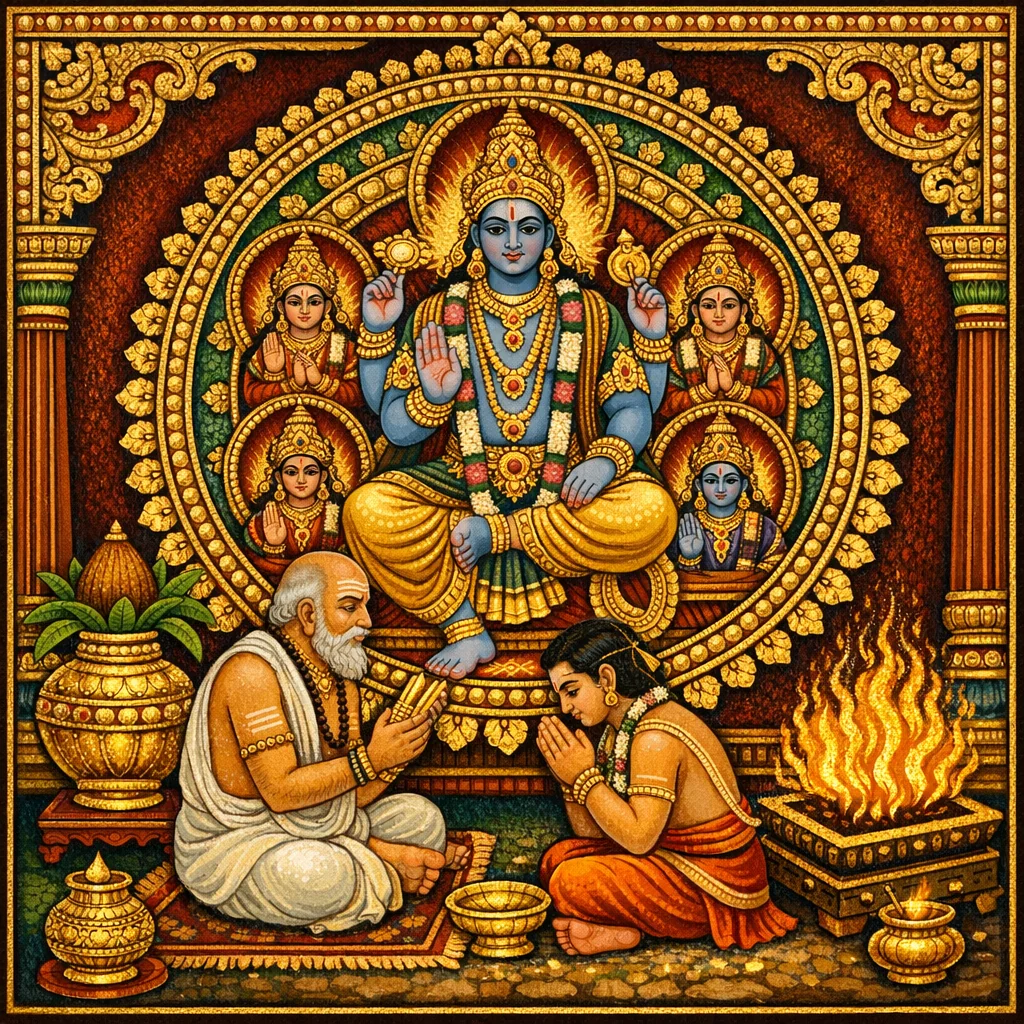
Adhyaya 27
Dīkṣāvidhi-kathana (Explanation of the Rite of Initiation)
This chapter shifts from mudrā-pradarśana to a step-by-step account of dīkṣā. Nārada outlines a Vaiṣṇava initiation centered on worship of Hari in a lotus-like maṇḍala, beginning with protections (Narasiṃha-nyāsa; scattering mantra-charged mustard seeds with phaṭ) and installing Śakti in a prāsāda-form. It proceeds through consecrations and purifications (herbs, pañcagavya, sprinklings with kuśa and “Nārāyaṇa”-ending formulas), kumbha-worship and fire-worship, and a cooked offering made under the four vyūha names (Vāsudeva, Saṅkarṣaṇa, Pradyumna, Aniruddha). A doctrinal-ritual bridge follows: the deśika contemplates and installs tattvas on the disciple by nyāsa in creation order (Prakṛti to Earth), then withdraws and purifies them by homa in saṃhāra-krama, culminating in pūrṇāhuti aimed at release from bondage. The chapter notes multiple manuscript variants for key mantras and actions, and ends with eligibility guidance (householder, sādhaka, poor/ascetics/children) and the possibility of śaktidīkṣā.
Shlokas
Verse 1
इत्य् आदिमहापुराणे आग्नेये मुद्राप्रदर्शनं नाम षड्विंशो ऽध्यायः अथ सप्तविंशो ऽध्यायः दीक्षाविधिकथनं नारद उवाच वक्ष्ये दीक्षां सर्वदाञ्च मण्डलेब्जे हरिं यजेत् दशम्यामुपसंहृत्य यागद्रव्यं समस्तकं
Thus, in the Agni Purāṇa, within the Primeval Mahāpurāṇa, ends the twenty-sixth chapter called “Demonstration of Mudrās.” Now begins the twenty-seventh chapter: “The Explanation of the Rite of Initiation (Dīkṣā).” Nārada said: “I shall describe the initiation; and one should always worship Hari (Viṣṇu) upon the lotus-like maṇḍala. On the tenth day, having concluded the rite, one should gather together the entire set of sacrificial and ritual materials.”}]}}json समाप्त
Verse 2
विन्यस्य नारसिंहेन सम्मन्त्र्य शतवारकं सर्षपांस्तु फडन्तेन रक्षोघ्नान् सर्वतः क्षिपेत्
Having performed the protective nyāsa with the Narasiṁha mantra, and having empowered mustard seeds by reciting the mantra one hundred and eight times, one should—uttering the syllable “phaṭ”—scatter those rakṣas‑destroying seeds in all directions.
Verse 3
शक्तिं सर्वात्मकां तत्र न्यसेत् प्रासादरूपिणीं सर्वौषधिं समाहृत्य विकिरानभिमन्त्रयेत्
There, one should install (perform nyāsa of) the all-pervading Śakti, taking the form of the temple. Having gathered all medicinal herbs, one should scatter them and consecrate them with mantras.
Verse 4
शतवारं शुभे पात्रे वासुदेवेन साधकः संसाध्य पण्जगव्यन्तु पञ्चभिर्मूलमूर्तिभिः
In an auspicious vessel, the practitioner should prepare the pañcagavya one hundred times while reciting the Vāsudeva mantra, performing the rite together with the five root-manifestations (mūlamūrtis).
Verse 5
नारायणान्तैः सम्प्रोक्ष्य कुशाग्रैस्तेन तांभुवं विकिरान्वासुदेवेन क्षिपेदुत्तानपाणिना
Having duly sprinkled (the area) with the tips of kuśa-grass, accompanied by the Nārāyaṇa-ending mantras, he should then scatter that consecrated water upon the ground; with the Vāsudeva mantra he should cast it with the palm held upward.
Verse 6
त्रिधा पूर्वमुखस्तिष्ठन् ध्यायेत् विष्णुं तथा हृदि वर्धन्या सहिते कुम्भे साङ्गं विष्णुं प्रपूजयेत्
Standing facing east, he should meditate upon Viṣṇu in a threefold manner, and likewise within the heart; then, in the ritual water-pot (kumbha) together with the vardhanī (consecrating ladle/sprinkler), he should duly worship Viṣṇu along with His attendant limbs (aṅga), that is, with the prescribed auxiliary rites.
Verse 7
सर्षपांस्तद्वदस्त्रेण इति ङ, चिह्नितपुस्तकपाठः कुशाग्रेणैव तां भुवमिति ङ, चिह्नितपुस्तकपाट्ःअः शतवारं मन्त्रयित्वा त्वस्त्रेणैव च वर्धनीं अच्छिन्नधारया सिञ्चन् ईशानान्तं नयेच्च तं
“Mustard-seeds likewise, with the Astra (weapon-mantra)”—so reads a marked manuscript variant; and “with the tip of kuśa-grass, that ground”—so reads another marked variant. Having empowered the rite by reciting the mantra one hundred times, he should then, using the Astra-mantra, sprinkle the vardhanī-vessel in an unbroken stream and lead it to the Īśāna end (the north-east).
Verse 8
कलसं पृष्ठतो नीत्वा स्थापयेद्विकिरोपरि संहृत्य विकिरान् दर्भैः कुम्भेशं कर्करीं यजेत्
Having carried the kalaśa (water-pot) to the rear, one should place it upon the strewn scattering (vikira). Then, gathering up the scattered offerings with darbha-grass, one should perform worship of Kumbheśa and Karkarī.
Verse 9
सवस्त्रं पञ्चरत्नाढ्यं खण्डिले पूजयेद्धरिं अग्नावपि समभ्यर्च्य मन्त्रान् सञ्जप्य पूर्ववत्
He should worship Hari upon the khaṇḍila (ritual altar), offering a cloth and an oblation enriched with the five gems; and, having likewise duly worshipped in the fire, he should repeat the mantras as before.
Verse 10
प्रक्षाल्य पुण्डरीकेन विलिप्यान्तः सुगन्धिना उखामाज्येन संपूर्य गोक्षीरेण तु साधकः
Having washed the vessel with the white lotus (puṇḍarīka), the practitioner should anoint its interior with a fragrant substance; then, filling the ukha with ghee, he should also use cow’s milk as prescribed.
Verse 11
आलोक्य वासुदेवेन ततः सङ्कर्षणेन च तण्डुलानाज्यसंसृष्टान् क्षिपेत् क्षीरे सुसंस्कृते
After consecrating with Vāsudeva and then with Saṅkarṣaṇa, one should cast rice-grains mixed with ghee into well-prepared milk.
Verse 12
प्रद्युम्नेन स्मालोड्य दर्व्या सङ्घट्टयेच्छनैः पक्वमुत्तारयेत् पश्चादनिरुद्धेन देशिकः
Having gently stirred it with (the mantra/name of) Pradyumna, one should slowly gather it together with a ladle; then, when it is cooked, the officiating teacher (deśika) should remove it afterwards with (the mantra/name of) Aniruddha.
Verse 13
प्रक्षाल्यालिप्य तत् कुर्यादूर्ध्वपुण्ड्रं तु भस्मना नारायणेन पार्श्वेषु चरुमेवं सुसंस्कृतं
Having washed and then anointed, one should make the vertical sectarian mark (ūrdhva-puṇḍra) with sacred ash; and on the two sides of the mark one should inscribe “Nārāyaṇa”. Thus the rite becomes properly sanctified.
Verse 14
भागमेकं तु देवाय कलशाय द्वितीयकं तृतीयेन तु भागेन प्रदद्यादाहुतित्रयं
One portion should be offered to the deity; the second to the ritual water-pot (kalaśa); and with the third portion one should make a set of three oblations (āhuti) into the fire.
Verse 15
शिष्यैः सह चतुर्थं तु गुरुरद्याद्विशुद्धये नारायणेन सम्मन्त्र्य सप्तधा क्षीरवृक्षजम्
Then, together with the disciples, the guru should eat the fourth share for purification, having duly invoked Nārāyaṇa with mantra, and partaking of the milky exudate obtained from a latex-bearing tree, divided into seven portions.
Verse 16
दन्तकाष्ठं भक्षयित्वा त्यक्त्वा ज्ञात्वास्वपातकं ऐन्द्राग्न्युत्तरकेशानीमुखं पतितमुत्तमं
Having chewed a tooth-stick (dantakāṣṭha) and then discarded it, one should recognize this as a minor sin (svapātaka). In the excellent prescribed manner, one should let it fall with its tip oriented toward Indra, Agni, the northern quarter, and Īśānī (the north-east direction).
Verse 17
शुभं सिंहशतं हुत्वा आचम्याथ प्रविश्य च उत्थायाज्येनेति ख, चिह्नितपुस्तकपाठः आलोड्य वासुदेवेन इति ख, चिह्नितपुस्तकपाठः विवृद्धये इति ङ, चिह्नितपुस्तकपाठः शुभं सिद्धमिति ज्ञात्वा ङ, चिह्नितपुस्तकपाठः पूजागारं न्यसेन्मन्त्री प्राच्यां विष्णुं प्रदक्षिणं
Having performed an auspicious fire-oblation of a hundred offerings, and then performing ācamana (sipping water for purification), he should enter the worship-hall. Rising, he should proceed with the mantra “utthāyājyeneti”; then “āloḍya vāsudevena”; then “vivṛddhaye” (according to certain marked manuscript readings). Knowing thereafter that “the auspicious rite is accomplished,” the knower of mantras should ritually arrange the worship-setting in the pūjāgāra and perform a clockwise circumambulation (pradakṣiṇa) of Viṣṇu, facing east.
Verse 18
संसारार्णवमग्नानां पशूनां पाशमुक्तये त्वमेव शरणं देव सदा त्वं भक्तवत्सल
For beings sunk in the ocean of saṃsāra, like animals bound fast, You alone are the refuge, O God, for release from the pāśa—the noose of bondage. Ever are You tender toward Your devotees.
Verse 19
देवदेवानुजानीहि प्राकृतैः पाशबन्धनैः पाशितान्मोचयिष्यामि त्वत्प्रसादात् पशूनिमान्
O God of gods, grant permission: by Your grace I shall release these animals, bound with ordinary bonds—noose (pāśa) and rope.
Verse 20
इति विज्ञाप्य देवेशं सम्प्रविश्य पशूंस्ततः धारणाभिस्तु संशोध्य पूर्वज्ज्वलनादिना
Having thus informed the Lord of the gods, one should then enter among the sacrificial animals; and, by means of the prescribed dhāraṇās (ritual fixations and mantric visualizations), one should purify them—beginning with the prior rite of kindling the fire and the related procedures.
Verse 21
संस्कृत्य मूर्त्या संयोज्य नेत्रे बद्ध्वा प्रदर्शयेत् पुष्पपूर्णाञ्जलींस्तत्र क्षिपेत्तन्नाम योजयेत्
Having ritually refined the materials (saṃskāra) and united them with the mūrti (sacred icon), he should keep the eyes covered and then reveal them. There he should cast handfuls of flowers filled to the brim, and assign—invoking—the deity’s name upon that image.
Verse 22
अमन्त्रमर्चनं तत्र पूर्ववत् कारयेत् क्रमात् यस्यां मूर्तौ पतेत् पुष्पं तस्य तन्नाम निर्दिशेत्
There, worship (arcana) should be performed without mantras, as before, in due sequence step by step. Upon whichever icon/form (mūrti) the flower falls, that very name should be declared as belonging to that deity/form.
Verse 23
शिखान्तसम्मितं सूत्रं पादाङ्गुष्ठादि षड्गुणं कन्यासु कर्तितं रक्तं पुनस्तत्त्रिगुणीकृतम्
The ritual thread (sūtra) should be measured up to the end of the topknot (śikhā). For young maidens it is prescribed as sixfold in measure (reckoned from the great toe and onward). The red cord prepared for maidens should again be made threefold, that is, folded into three strands.
Verse 24
यस्यां संलीयते विश्वं यतो विश्वं प्रसूयते प्रकृतिं प्रक्रियाभेदैः संस्थितां तत्र चिन्तयेत्
One should contemplate Prakṛti—into which the universe dissolves and from which the universe is born—as established through the various differentiations of its operative processes (modes of manifestation).
Verse 25
तेन प्राकृतिकान् पाशान् ग्रथित्वा तत्त्वसङ्ख्यया कृत्वा शरावे तत् सूत्रं कुण्डपार्श्वे निधाय तु
With that cord, having braided the natural nooses (pāśa) according to the number of tattvas, one should arrange that thread in a dish (śarāva) and then place it beside the sacrificial fire-pit (kuṇḍa).
Verse 26
ततस्तत्त्वानि सर्वाणि ध्यात्वा शिष्यतनौ न्यसेत् सृष्टिक्रमात् प्रकृत्यादिपृथिव्यन्तानि देशिकः
Then, having meditated upon all the tattvas, the teacher (deśika) should place them by nyāsa upon the disciple’s body, following the order of creation—from Prakṛti onward up to Earth.
Verse 27
तत्रैकधा पण्चधा स्याद्दशद्वादशधापि वा घ, चिह्नितपुस्तकत्रयपाठः निधीयते इति घ, ङ, चिह्नितपुस्तकद्वयपाठः तत्रार्चा पञ्चधा या स्यादङ्गैर् द्वादशधापि वेति ख, चिह्नितपुस्तकपाठः तत्रात्मा पञ्चधा वा स्यात् दशद्वदशधापिवेति घ, ङ, चिह्नितपुस्तकद्वयपाठः ज्ञातव्यः सर्वभेदेन ग्रथितस्तत्त्वचिन्तकैः
In this context, it is to be understood as onefold, or fivefold, and even as tenfold or twelvefold (according to the textual recensions). Likewise, the arcā (the consecrated icon/presence for worship) is said to be fivefold, or, with its limbs (aṅgas), even twelvefold. Similarly, the Self/inner principle (ātmā) is to be known as fivefold, or as tenfold or twelvefold. Thus it has been systematized in every distinction by those who contemplate the principles (tattva-cintakas).
Verse 28
अङ्गैः पञ्चभिरध्वानं निखिलं विकृतिक्रमात् तन्मात्रात्मनि संहृत्य मायासूत्रे पशोस्तनौ
With the five limbs, one should gather back the entire ‘path’ (adhvan) step by step in the order of manifested modifications (vikṛti); having dissolved it into the essence of the subtle elements (tanmātras), (one should establish it) upon the Māyā-sūtra, in the body of the bound soul (paśu).
Verse 29
प्रकृतिर्लिङ्गशक्तिश् च कर्ता बुद्धिस् तथा मनः पञ्चतन्मात्रबुद्ध्याख्यं कर्माख्यं भूतपञ्चकं
Prakṛti (primordial Nature), the subtle liṅga-power (liṅga-śakti), the agent (kartā), intellect (buddhi), and mind (manas); the five subtle elements (tanmātras), the set termed the organs of action (karmendriyas), and the group of five gross elements (bhūtas)—these are the enumerated categories.
Verse 30
ध्यायेच्च द्वादशात्मानं सूत्रे देहे तथेच्छया हुत्वा सम्पातविधिना सृष्टेः सृष्टिक्रमेण तु
One should meditate upon the twelvefold Self within the subtle ‘thread’ (sūtra) and within the body, according to one’s intention; and, having offered oblations by the sampāta method, (one should proceed) in the creation’s sequence—indeed, in the order of emanation.
Verse 31
एकैकं शतहोमेन दत्त्वा पूर्णाहुतिं ततः शरावे सम्पुटीकृत्य कुम्भेशाय निवेदयेत्
Having offered each item with a hundred oblations, and then having performed the final complete offering (pūrṇāhuti), one should enclose it in a covered dish (śarāva) and present it as an offering to Kumbheśa.
Verse 32
अधिवास्य यथा न्यायं भक्तं शिष्यं तु दीक्षयेत् करणीं कर्तरीं वापि रजांसि खटिकामपि
Having first performed, according to rule, the preliminary rite of adhivāsa, one should confer dīkṣā upon the devoted disciple; and, as the procedure requires, the officiant may also employ a small implement (karaṇī), scissors or knife (kartarī), ritual powders/dust (rajāṃsi), and even chalk (khaṭikā).
Verse 33
अन्यदप्युपयोगि स्यात् सर्वं तद्वायुगोचरे संस्थाप्य मूलमन्त्रेण परामृश्याधिवाधिवासयेत्
Any other item that may be of use should likewise be placed within the precinct assigned to Vāyu; having arranged everything there, one should touch it with the root-mantra (mūla-mantra) and then perform adhivāsa as a prior sanctification.
Verse 34
नमो भूतेभ्यश् च बलिः कुशे शेते स्मरन् हरिं मण्डपं भूषयित्वाथ वितानघटलड्डुकैः
He should also offer the bali with the salutation, “Namo bhūtebhyaḥ—homage to the beings.” Then, lying upon kuśa-grass and remembering Hari, he should adorn the maṇḍapa (ritual pavilion), thereafter arranging it with a canopy (vitāna), pots (ghaṭa), and laddūs as sweet offerings.
Verse 35
मण्डलेथ यजेद्विष्णुं ततः सन्तर्प्य पावकं आहूय दीक्षयेच्छिष्यान् बद्धपद्मासनस्थितान्
Then, within the maṇḍala, one should worship Viṣṇu; thereafter, having duly satisfied the sacred Fire, Pāvaka, with offerings (santarpya), one should invoke it and confer dīkṣā upon the disciples seated in the bound lotus posture (baddha-padma-āsana).
Verse 36
सम्मोक्ष्य विष्णुं हस्तेन मूर्धानं स्पृश्य वै क्रमात् प्रकृत्यादिविकृत्यन्तां साधिभूताधिदैवतां
Having duly invoked and established Viṣṇu, one should then, in the prescribed sequence, touch the crown of the head with the hand, contemplating the divine principle from Prakṛti up to the final evolutes (vikṛti), together with the adhibhūta and adhidaivata correspondences.
Verse 37
सृष्टिमाध्यात्मिकीं कृत्वा हृदि तां संहरेत् क्रमात् तन्मात्रभूतां सकलां जीवेन समतां गतां
Having brought forth the inner (spiritual) creation, one should withdraw it step by step into the heart, until the whole manifestation becomes nothing but the subtle elements (tanmātras) and attains identity and equipoise with the individual self (jīva).
Verse 38
ततः सम्प्रार्थ्य कम्भेशं सूत्रं संहृत्य देशिकः मायासूत्रे सुशोभने इति ङ, चिह्नितपुस्तकपाठः करालं कर्तरीञ्चापि इति ख, ग, चिह्नितपुस्तकद्वयपाठः वितानभवगन्धकैर् इति ख, चिह्नितपुस्तकपाठः वितानपटकेन्द्रियैर् इति ग, घ, चिह्नितपुस्तकद्वयपाठः अग्नेः समीपमागत्य पार्श्वे तं सन्निवेश्य तु
Then, having duly entreated Kambheśa, the officiating teacher (deśika) gathers up the ritual cord (sūtra). Coming near the sacred Fire, he places it at the side of the fire-altar and sets it down there.
Verse 39
मूलमन्त्रेण सृष्टीशमाहुतीनां शतेन तं उदासीनमथासाद्य पूर्णाहुत्या च देशिकः
Then the preceptor (deśika), having approached Sṛṣṭīśa—the Lord of Creation who remains detached—should offer a hundred oblations (āhuti) with the root-mantra (mūla-mantra), and should also conclude with the full oblation (pūrṇāhuti).
Verse 40
शुक्लं रजः समादाय मूलेन शतमन्त्रितं सन्ताड्य हृदयन्तेन हुंफट्कारान्तसंयुतैः
Taking white dust/pollen and empowering it a hundred times with the root-mantra, one should strike or cast it while reciting the Heart-mantra, joined with the concluding exclamations “huṃ” and “phaṭ”.
Verse 41
वियोगपदसंयुक्तैर् वीजैः पदादिभिः क्रमात् पृथिव्यादीनि तत्त्वानि विश्लिष्य जुहुयात्ततः
Then, in due sequence, using the seed-mantras (bīja) conjoined with the ‘separation/dissolution’ formulae—beginning with the prescribed words and syllabic units—one should ritually disjoin the principles (tattvas) starting from earth, and thereafter offer them into the fire as oblations.
Verse 42
वह्नावखिलतत्त्वानामालये व्याहृते हरौ नीयमानं क्रमात्सर्वं तत्राध्वानं स्मरेद्बुधः
The wise should contemplate, as the inner path (adhvan), how all things—led step by step—are merged into Hari, proclaimed the abode of all tattvas (principles) within the sacred Fire (vahni).
Verse 43
ताडनेन वियोज्यैवं आदायापाद्य शाम्यतां प्रकृत्याहृत्य जुहुयाद्यथोक्ते जातवेदसि
Thus, by striking it one should separate it; then, taking it up and bringing it near, one should pacify the rite. Having restored it to its proper original state, one should offer it into Jātavedas—the consecrated sacrificial Fire—exactly as prescribed.
Verse 44
गर्भाधानं जातकर्म भोगञ्चैव लयन्तथा
Here are enumerated: Garbhādhāna (the rite of conception), Jātakarma (the birth-rite), bhoga (the prescribed enjoyment/consumption of offerings), and likewise laya (dissolution or cessation).
Verse 45
शुद्धं तत्त्वं समुद्धृत्य पूर्णाहुत्या तु देशिकः सन्नयेद्द्विपरे तत्त्वे यावदव्याहृतं क्रमात्
Having raised up (withdrawn and purified) the purified tattva, the officiating teacher (deśika) should, by means of the full concluding oblation (pūrṇāhuti), lead it to settle (be reabsorbed) into the next, paired successive tattva—step by step—up to the level called “Avyāhṛta”.
Verse 46
तत् परं ज्ञानयोगेन विलाप्य परमात्मनि विमुक्तबन्धनं जीवं परस्मिन्नव्यये पदे
Then, by the supreme discipline of jñāna-yoga, dissolving the individual self (jīva) into the Supreme Self (Paramātman), one becomes a soul freed from bondage, established in that highest, imperishable state.
Verse 47
निवृत्तं परमानन्दे शुद्धे बुद्धे स्मरेद्बुधः दद्यात् पूर्णाहुतिं पश्चादेवं दीक्षा समाप्यते
The wise initiate should meditate upon Nivṛtti as the Supreme Bliss—pure and enlightened; thereafter he should offer the concluding full oblation (pūrṇāhuti). Thus the rite of initiation (dīkṣā) is completed.
Verse 48
प्रयोगमन्त्रान् वक्ष्यामि यैर् दीक्षा होमसंलयः ॐ यं भूतानि विशुद्धं हुं फट् अनेन ताडनं कुर्याद्वियोजनमिह द्वयं
“I shall declare the applied ritual mantras by which initiation is accomplished and the homa-procedure is brought to completion. With ‘oṃ yaṃ—may the beings be purified—huṃ phaṭ’, by this mantra one should perform the ritual striking (tāḍana); here it effects a twofold separation (viyojana).”
Verse 49
ॐ यं भूतान्यापातयेहं आदानं कृत्वा चानेन प्रकृत्या योजनं शृणु ताडनेन विमोक्ष्यैवमिति ख, चिह्नितपुस्तकपाठः ॐ यं भूतानि पुंश्चाहो होममन्त्रं प्रवक्ष्यामि ततः पूर्णाहुतेर्मनुं
“Oṃ yaṃ—by this I cause the bhūtas to fall away here. Having performed ādāna, the ‘taking up’, listen to the procedure of application according to the prescribed method; then by tāḍana one should release them—thus it is stated.” In a marked manuscript-reading: “Oṃ yaṃ—O bhūtas! I shall declare the homa-mantra; thereafter one should utter the mantra for the concluding full oblation (pūrṇāhuti).”
Verse 50
ॐ भूतानि संहर स्वाहा ॐ अं ॐ नमो भगवते वासुदेवाय वौषट् पूर्णाहुत्यनन्तरे तु तद्वै शिष्यन्तु साधयेत् एवं तत्त्वानि सर्वाणि क्रमात्संशोधयेद् बुधः
“Oṃ—withdraw and dissolve the beings/elements—svāhā.” “Oṃ aṃ.” “Oṃ, homage to Bhagavān Vāsudeva—vauṣaṭ.” Immediately after the concluding full oblation (pūrṇāhuti), the practitioner should accomplish that rite for the disciple. Thus the wise person should purify all the principles (tattvas) in due sequence.
Verse 51
नमोन्तेन स्ववीजेन ताडनादिपुरःसरम् ॐ वां वर्मेन्द्रियाणि ॐ दें बुद्धीन्द्रियाणि यं वीजेन समानन्तु ताडनादिप्रयोगकम्
Preceded by tāḍana and the allied acts, and employing one’s own seed-syllable (bīja) together with the ending formula “namaḥ”: one should apply “oṃ vāṃ” as the protective armor (varma) for the organs of action (karmendriya), and “oṃ deṃ” as the armor for the organs of cognition (jñānendriya); then, with the seed-syllable “yaṃ”, one should bring the tāḍana procedure and its related applications into balance.
Verse 52
ॐ सुंगन्धतन्मात्रे वियुङ्क्ष्व हुं फट् ॐ सम्पाहिं हा ॐ खं खं क्ष प्रकृत्या ॐ सुं हुं गन्धतन्मात्रे संहर स्वाहा ततः पूर्णाहुतिश् चैवमुत्तरेषु प्रयुज्यते ॐ रां रसतन्मात्रे ॐ भें रूपतन्मात्रे ॐ रं स्पर्शतन्मात्रे ॐ एं शब्दतन्मात्रे ॐ भं नमः ॐ सों अहङ्कारः ॐ नं बुद्धे ॐ ॐ प्रकृते एकमूर्तावयं प्रोक्तो दीक्षायोगः समासतः एवमेव प्रयोगस्तु नवव्यूहादिके स्मृतः
“Om—towards the tanmātra, the subtle element, of smell: ‘separate (it)!’ huṃ phaṭ. Om—‘protect/fortify!’ hā. Om khaṃ khaṃ kṣa, with reference to Prakṛti. Om suṃ huṃ: ‘withdraw/dissolve the tanmātra of smell!’ svāhā. Then one should offer the complete oblation (pūrṇāhuti); and in the same manner it is applied to the subsequent tanmātras: Om rāṃ—towards taste; Om bheṃ—towards form; Om raṃ—towards touch; Om eṃ—towards sound. Om bhaṃ—obeisance. Om soṃ—for ahaṅkāra, the ego-principle. Om naṃ—for buddhi, the intellect. Om om—for Prakṛti. Thus, in brief, this is declared to be the dīkṣā-yoga in the single-formed (ekamūrti) method; and this very procedure is remembered also in contexts such as the ‘nine formations’ (nava-vyūha) and the like.”},{
Verse 53
दग्धापरस्मिन् सन्दध्यान्निर्वाणे प्रकृतिन्नरः अविकारे समादध्यादीश्वरे प्रकृतिन्नरः
When the “other” (the external, objective field) has been burnt away, one should fix contemplation on Prakṛti in the state of nirvāṇa. In the changeless Lord (Īśvara) one should steadily place the mind upon Prakṛti.
Verse 54
शोधयित्वाथ भुतानि कर्माङ्गानि विशोधयेत् बुद्ध्याख्यान्यथ तन्मात्रमनोज्ञानमहङ्कृतिं
Having purified the gross elements (bhūtas), one should then purify the organs of action; thereafter one should purify the inner faculties—namely buddhi (intellect), the tanmātras (subtle elements), manas (mind), jñāna (cognition), and ahaṅkāra (egoity).
Verse 55
लिङ्गात्मानं विशोध्यान्ते प्रकृतिं शोधायेत् पुनः आहि हामिति ख,चिह्नितपुस्तकपाठः ॐ सं पाहि स्वाहा इति ग, ङ, चिह्नितपुस्तकद्वयपाठः अं दुं स्त्व प्रकृत्या इति ॐ खं खं स्त्व प्रकृत्या इति च ख, चिह्नितपुस्तकपाठः कर्माख्यानि च शोधयेदिति घ, ङ, चिह्नितपुस्तकद्वयपाठः पुरुषं प्राकृतं शुद्धमीश्वरे धाम्नि संस्थितं
After purifying the liṅgātman (the self of the subtle body) at the end, one should again purify Prakṛti. Some recensions read the formula “āhi hāmi”; two manuscripts read “oṃ saṃ pāhi svāhā.” Another reading gives “aṃ duṃ stva prakṛtyā,” while a marked manuscript reads “oṃ khaṃ khaṃ stva prakṛtyā.” Two manuscripts further add: “and one should also purify the karmākhyāni (karmic designations/activities).” Thus the Prākṛta Puruṣa (the embodied person constituted of nature) becomes purified and is established in the divine abode of Īśvara.
Verse 56
स्वगोचरीकृताशेषभोगमुक्तौ कृतास्पदं ध्यायन् पूर्णाहुतिं दद्याद्दीक्षेयं त्वधिकारिणी
Meditating on (the deity) in whom all enjoyments and liberation have been brought within one’s own spiritual scope, and in whom one has established an inner seat (in the heart), one should offer the final complete oblation (pūrṇāhuti). Then the qualified person is to be initiated (dīkṣā).
Verse 57
अङ्गैर् आराध्य मन्त्रस्य नीत्वा तत्त्वगणं समं क्रमादेवं विशोध्यान्ते सर्वसिद्धिसमन्वितं
Having worshipped the mantra through its ritual limbs (aṅga-practices) and having brought the aggregate of tattvas into equilibrium, one should purify them step by step; in the end one becomes endowed with all attainments (siddhis).
Verse 58
ध्यायन् पूर्णाहितिं दद्यात्दीक्षेयं साधके स्मृता द्रव्यस्य वा न सम्पत्तिरशक्तिर्वात्मनो यदि
Meditating with focused intent, one should offer a complete oblation. This is taught as the proper initiation (dīkṣā) for a sādhaka, especially when materials are unavailable or when one lacks the personal capacity to perform the rite in full.
Verse 59
इष्ट्वा देवं यथा पूर्वं सर्वोपकरणान्वितं सद्योधिवास्य द्वादश्यां दीक्षयेद्देशिकोत्तमः
Having worshipped the deity as previously prescribed, with all requisite ritual implements in place, the foremost officiating teacher should perform the immediate (same-day) adhivāsa and, on the dvādaśī (twelfth lunar day), confer initiation (dīkṣā).
Verse 60
भक्तो विनीतः शारीरैर् गुणैः सर्वैः समन्वितः शिष्यो नातिधनी यस्तु स्थण्डिलेभ्यर्च्य दीक्षयेत्
One should confer mantra-dīkṣā upon a disciple who is devoted and humble, endowed with all bodily virtues, and not excessively wealthy—after worshipping (the deity) upon the consecrated ground-altar (sthaṇḍila).
Verse 61
अध्वानं निखिलं दैवं भौतं वाध्यात्मिकी कृतं सृष्टिक्रमेण शिष्यस्य देहे ध्यात्वा तु देशिकः
The preceptor (deśika), following the order of emanation (sṛṣṭi-krama), should contemplate within the disciple’s body the entire pathway-system (adhvan) as divine, as elemental (bhūta), and as constituted within the inner self; then he proceeds with the rite.
Verse 62
अष्टाष्टाहुतिभिः पूर्वं क्रमात् सन्तर्प्य सृष्टिमान् स्वमन्त्रैर् वासुदेवादीन् जननादीन् विसर्जयेत्
First, the officiant, in due order, should satisfy the invoked powers with eight sets of eight oblations; then, by their respective mantras, he should ritually dismiss (visarjana) Vāsudeva and the rest, as well as the generative principles and what remains.
Verse 63
होमेन शोधयेत् पश्चात्संहारक्रमयोगतः योनिसूत्राणि बद्धानि मुक्त्वा कर्माणि देशिकः
Afterwards, the officiating teacher (deśika) should purify the rite and its implements by homa, following the proper sequence of withdrawal and closure (saṃhāra-krama); having released the bound ‘yoni-threads’ (yoni-sūtrāṇi), he should conclude the ritual acts.
Verse 64
शिष्यदेहात्समाहृत्य क्रमात्तत्त्वानि शोधयेत् अग्नौ प्राकृतिके विष्णौ लयं नीत्वाधिदैवके
Having gathered (withdrawn) the tattvas from the disciple’s body, one should purify those tattvas in due sequence, and bring them to dissolution (laya) in the primordial Fire and in Viṣṇu, within the presiding divine (adhidaivika) level.
Verse 65
शुद्धं तत्त्वमशुद्धेन पूर्णाहुत्या तु साधयेत् शिष्ये प्रकृतिमापन्ने दग्ध्वा प्राकृतिकान् गुणान्
One should accomplish the pure Reality even by means of what is impure—through the full concluding oblation (pūrṇāhuti). When the disciple has fallen into ordinary Nature (Prakṛti), the teacher burns up the natural guṇas (prākṛta) and restores him to purity.
Verse 66
लिखितं दैवमिति ख, चिह्नितपुस्तकपाठः पूजां कृत्वा विसर्जयेदिति घ, चिह्नितपुस्तकपाठः विमलादीन् विसर्जयेदिति ङ, चिह्नितपुस्तकपाठः पूर्णाहुत्या तु सन्नयेदिति ख, घ, चिह्नितपुस्तकद्वयपाठः मौचयेदधिकारे वा नियुञ्ज्याद्देशिकः शिशून् अथान्यान् शक्तिदीक्षां वा कुर्यात् भावे स्थितो गुरुः
“It is written: ‘this is the divine ordinance’”: thus reads one recension. “Having performed the worship, he should dismiss (visarjana)”: thus reads another. “He should dismiss Vimalā and the others”: thus reads yet another. “But he should bring it to completion by the full oblation (pūrṇāhuti)”: thus read two manuscripts. Then, when the proper qualification or occasion arises, the teacher (deśika) should either release the disciple from the observance or assign children and others to their appropriate duties; or, established in the right devotional state (bhāva), the guru may confer the Śakti-initiation (śaktidīkṣā).
Verse 67
भक्त्या सम्प्रातिपन्नानां यतीनां निर्धनस्य च सम्पूज्य स्थण्डिले विष्णुं पार्श्वस्थं स्थाप्य पुत्रकं
With devotion, having duly honored the ascetics (yatis) who have come seeking refuge, as well as the poor, one should worship Viṣṇu upon a purified earthen altar (sthaṇḍila); then, placing the child beside the deity, one should proceed with the rite.
Verse 68
देवताभिमुखः शिष्यस्तिर्यगास्यः स्वयं स्थितः अध्वानं निखिलं ध्यात्वा पर्वभिः स्वैर् विकल्पितं
The disciple should stand facing the deity, with his mouth slightly turned aside (averted), and, having fully contemplated the entire ‘path’ (adhvan), should arrange it according to his own ritual divisions into successive ‘stages’ (parvans).
Verse 69
शिष्यदेहे तथा देवमाधिदैविकयाचनं ध्यानयोगेन सञ्चिन्त्य पूर्ववत्ताडनादिना
Likewise, upon the disciple’s body, having mentally invoked the deity through the supernal (ādhidaivika) supplication by the discipline of meditative yoga, one should proceed—as stated earlier—by ritual striking (tāḍana) and the other prescribed actions.
Verse 70
क्रमात्तत्त्वानि सर्वाणि शोधयेत् स्थण्डिले हरौ ताडनेन वियोज्याथ गृहीत्वात्मनि तत्परः
Then, in due sequence, one should purify all the tattvas on the ritual ground in the worship of Hari; thereafter, by ritual striking (tāḍana) one should separate them, and—having drawn them into oneself—remain intent upon the Self (Ātman).
Verse 71
देवे संयोज्य संशोध्य गृहीत्वा तत् स्वभावतः आनीय शुद्धभावेन सन्धयित्वा क्रमेण तु
Having joined it with the deity, purified it, and taken it according to its own proper nature, one should bring it forth and, with a purified inner disposition, set it in proper union—then proceed step by step in due order.
Verse 72
शोधयेद्ध्यानयोगेन सर्वतो ज्ञानमुद्रया शुद्धेषु सर्वतत्त्वेषु प्रधाने चेश्वरे स्थिते
One should purify the inner being through the yoga of meditation, wholly by the seal (mudrā) of knowledge; when all the tattvas (principles) are purified, one abides in Pradhāna (Primordial Nature) and in Īśvara (the Lord).
Verse 73
दग्ध्वा निर्वापयेच्छिष्यान् पदे चैशे नियोजयेत् निनयेत् सिद्धिमार्गे वा साधकं देशिकोत्तमः
Having ritually “burned away” their impurities, he should then “cool/appease” the disciples and install them in the Īśa-grade. Or else, the excellent preceptor should lead the sādhaka onto the path of siddhi (spiritual attainments).
Verse 74
एवमेवाधिकारस्थो गृही कर्मण्यतन्द्रितः आत्मानं शोधयंस्तिष्ठेद् यावद्रागक्षयो भवेत्
In the same way, the householder—established in his proper adhikāra and untiring in prescribed action—should remain engaged in self-purification until the exhaustion of rāga (attachment) arises.
Verse 75
क्षीणरागमथात्मानं ज्ञात्वा संशुद्धिकिल्विषः आरोप्य पुत्रे शिष्ये वा ह्य् अधिकारन्तु संयमी
Having ascertained that he is free from rāga and that his sins have been purified, the self-controlled one should then confer the adhikāra, placing it upon his son or upon a disciple.
Verse 76
दग्ध्वा मायामयं पाशं प्रव्रज्य स्वात्मनि स्थितः शरीरपातमाकाङ्क्षन्नासीताव्यक्तलिङ्गवान्
Having burned away the noose made of māyā, and having gone forth as a renunciant (pravrajyā), established in his own Self, he remained seated—desiring the falling away of the body—bearing no outwardly manifest marks of identity.
Frequently Asked Questions
A stepwise, mantra-governed initiation workflow: protective nyāsa and scattering rites, kumbha/vardhanī consecration, vyūha-linked cooking and offerings, creation-order tattva-nyāsa on the disciple, and dissolution-order homa culminating in pūrṇāhuti—plus explicit applied mantras and manuscript variants.
It operationalizes liberation through ritual technology: by mapping cosmology onto the body (tattva-nyāsa) and then withdrawing/purifying those principles through homa and meditative absorption, the disciple is ritually led from bondage (paśu-pāśa) toward establishment in Īśvara and ultimately identity with the Supreme Self.