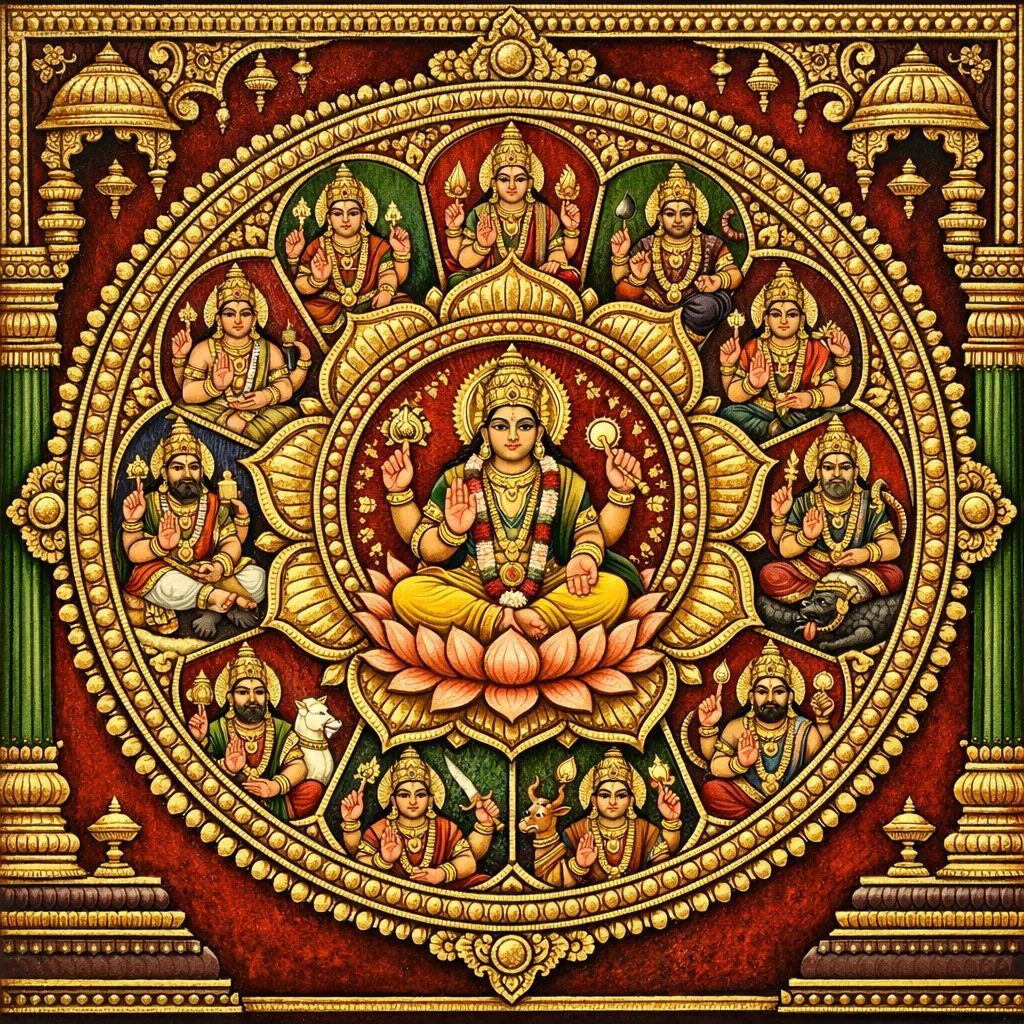
Adhyaya 29
The Description of the Sarvatobhadra Maṇḍala (सर्वतोभद्रमण्डलकथनम्)
This chapter prescribes a strict ritual‑architectural method for constructing and empowering the Sarvatobhadra Maṇḍala as a consecrated kṣetra for mantra‑sādhana. After purified ground and preliminary worship, it lays out a square grid into lotus‑based enclosures (pīṭha, vīthikā, gateways), assigns directional deities and Vedic divisions, and sets multi‑tier placements for elements, senses, and inner faculties. It then details liturgical technique—colors, pigment materials, cleaning and marking sequences, and exact measures (aṅgula, hasta, kara)—together with japa standards (bīja, mantra, vidyā) and puraścaraṇa discipline. The later portion reads the maṇḍala as inner yogic anatomy—nāḍīs, the heart‑lotus, rays of seed‑power—culminating in graded contemplations from gross sound‑formed embodiment to subtle luminous heart‑form and the supreme beyond thought. Finally it presents expanded vyūha layouts (9, 25, 26 and more), rules for door ornaments, and the auspicious martyeṣṭya maṇḍala, showing how sacred design orders both worship and realization.
Shlokas
Verse 1
इत्य् आदिमहापुराणे आग्नेये आचार्याभिषेको नाम अष्टाविंशो ऽध्यायः अथ ऊनत्रिंशो ऽध्यायः सर्वतोभद्रमण्डलकथनं नारद उवाच साधकः साधयेन्मन्त्रं देवतायतनादिके शुद्धभूमौ गृहे प्रार्च्य मण्डले हरिमीश्वरं आग्नेयेब्जे च प्रकृतिं याम्येब्जे पुरुषं यजेत्
Thus, in the Agni Purāṇa—the primordial Mahāpurāṇa—ends the twenty-eighth chapter entitled “The Consecration (Abhiṣeka) of the Ācārya.” Now begins the twenty-ninth chapter: “The Description of the Sarvatobhadra Maṇḍala.” Nārada said: A practitioner (sādhaka) should accomplish the mantra in a deity’s shrine and the like, upon purified ground within a house; having first offered worship, in the maṇḍala he should worship Hari as the Lord (Īśvara). In the lotus of the fire-direction (Āgneya) he should worship Prakṛti, and in the lotus of the southern direction (Yāmya) he should worship Puruṣa.
Verse 2
चतुरस्त्रीकृते क्षेत्रे मण्डलादीनि वै लिखेत् रसवाणाक्षिकोष्ठेषु सर्वतोभद्रमालिखेत् पुरुषाद्दक्षिणे च वह्निं नैरृते वारुणेनिलं आदित्यमैन्दवे पद्मे ऋग्यजुश् चैशपद्मके
On a square plot one should draw the maṇḍalas and the related ritual diagrams. In the compartments marked by the numerals (rasa, vāṇa, akṣi), one should draw the “Sarvatobhadra” design. To the south of the Vāstu-Puruṣa place Agni; in the south-west (Nairṛta) place Varuṇa and Vāyu. In the lotus of the Aindava/Aindra sector place Āditya (the Sun); and in the Īśa-lotus place the Ṛg- and Yajus-divisions of the Veda.
Verse 3
षट्त्रिंशत्कोष्ठकैः पद्मं पीठं पङ्क्त्यावहिर्भवेत् द्वाभ्यान्तु वीथिका तस्माद् द्वाभ्यां द्वाराणि दिक्षु च इन्द्रादींश् च द्वितीयायां पद्मे षोडशके तथा सामाथर्वाणमाकाशं वायुं तेजस् तथा जलं
The lotus-maṇḍala for the pedestal (pīṭha) is to be laid out with thirty-six compartments, with an outer boundary arranged in rows. Next, two compartments form the circumambulatory aisle (vīthikā); and from that, two compartments are allotted for the gateways in the directions. In the second lotus also—within the set of sixteen—one should place Indra and the other deities; likewise the Sāma- and Atharva-Vedas, and the elements: space (ākāśa), wind (vāyu), fire/tejas, and water (jala).
Verse 4
वर्तुलं भ्रामयित्वा तु पद्मक्षेत्रं पुरोदितम् पद्मार्धे भामयित्वा तु भागं द्वादशमं वहिः पृठिवीञ्च मनश् चैव श्रोत्रं त्वक् चक्षुरर्चयेत् रसनाञ्च तथा घ्राणं भूर्भुवश् चैव षोडशं
Having drawn (or arranged in rotation) a circular form, one should set out the lotus-field (padma-kṣetra) as previously described. Then, in the half-lotus, one should mark the twelfth division on the outside. One should worship Earth and also the mind; likewise the ear, skin, and eye; and also the tongue and the nose—together with Bhūḥ and Bhuvaḥ—placing them in the sixteenth division.
Verse 5
विभज्य भ्रामयेच्छेषं चतुःक्षेत्रन्तु वर्तुलं प्रथमं कर्णिकाक्षेत्रं केशराणां द्वितीयकम् महर्जनस्तपः सत्यं तथाग्निष्टोममेव च अत्यग्निष्टोमकं चोक्थं षोडशीं वाजपेयकं
Having divided it, one should arrange the remaining portion in a circular rotation, forming a circle of four fields. The first is the central pericarp-field (karṇikā-kṣetra), and the second is the petal-field (keśara). Therein one should place or inscribe the designations: Mahas, Jana, Tapa, Satya; likewise Agniṣṭoma; and also Atyagniṣṭoma, Ukthya, Ṣoḍaśin, and Vājapeya.
Verse 6
तृतीयं दलसन्धीनां दलाग्राणां चतुर्थकम् प्रसार्य कोणसूत्राणि कोणदिङ्मध्यमन्ततः अतिरात्रञ्च सम्पूज्य तथाप्तोर्याममर्चयेत् मनो बुद्धिमहङ्कारं शब्दं स्पर्शञ्च रूपकं
He should mark the third point at the junctions of the petals and the fourth at the tips of the petals. Having extended the diagonal lines from the corners—starting from the corner-directions, passing through the middle up to the end—he should duly worship the Atirātra rite and likewise worship the Aptoryāma. He should worship mind, intellect, ego-sense, and the subtle elements of sound, touch, and form.
Verse 7
निधाय केशराग्रे तु दलसन्धींस्तु लाञ्छयेत् पातयित्वाथ सूत्राणि तत्र पत्राष्टकं लिखेत् रसं गन्धञ्च पद्मेषु चतुर्विंशतिषु क्रमात् प्रत्यग्निष्टोमकमिति ख, चिह्नितपुस्तकपाठः ज्योतिष्टोमकमिति ङ, चिह्नितपुस्तकपाठः जीवं मनोधिपञ्चाहं प्रकृतिं शब्दमात्रकं
Placing the mark upon the tip of the pericarp, one should mark the junctions of the lotus-petals. Then, having let down the guiding threads, one should draw there an eight-petalled lotus-diagram. In due order, upon the twenty-four lotuses one should inscribe the terms ‘rasa’ and ‘gandha’. (In some marked manuscripts the reading is ‘pratyagniṣṭomakam’; in others, ‘jyotiṣṭomakam’.) Thereafter one writes: ‘jīva’, ‘manodhipa’, ‘pañcāha’, ‘prakṛti’, and ‘śabdamātraka’ as mantra-elements.
Verse 8
दलसन्ध्यन्तरालन्तु मानं मध्ये निधाय तु दलाग्रं भ्रामयेत्तेन तदग्रं तदनन्तरं वासुदेवादिमूर्तीञ्च तथा चैव दशत्मकं मनः श्रोत्रं त्वचं प्रार्च्य चक्षुश् च रसनं तथा
Placing the measuring point (māna) in the middle of the space between the junctions of the petals, one should rotate it to the tip of a petal; from that tip, immediately thereafter, one should worship the forms beginning with Vāsudeva. Likewise, one should duly worship the ‘tenfold’ set—mind, hearing, skin (touch), and also the eye and the tongue (taste).
Verse 9
तदन्तरालं तत्पार्श्वे कृत्वा वाह्यक्रमेण च केशरे तु लिखेद्द्वौ द्वौ दलमध्ये ततः पुनः घ्राणं वाक्पाणिपादञ्च द्वात्रिंशद्वारिजेष्विमान् चतुर्थावरणे पूज्याः साङ्गाः सपरिवारकाः
Having arranged the intervening spaces on its sides and proceeding in the outward sequence, one should inscribe on the filaments two by two; and then again, in the middle of the petals, place these—nose, speech, hands, and feet—upon the thirty-two lotus compartments. In the fourth enclosure they are to be worshipped, together with their limbs (aṅgas) and with their attendant retinues.
Verse 10
पद्मलक्ष्मैतत् सामान्यं द्विषट्कदलमुच्यते कर्णिकार्धेन मानेन प्राक्संस्थं भ्रामयेत् क्रमात् पायूपस्थौ च सम्पूज्य मासानां द्वादशाधिपान् पुरुषोत्तमादिषड्विंशान् वाह्यावरणके यजेत्
This is the general characteristic of the lotus-diagram (padma-lakṣmī): it is said to have twelve petals. With a measure equal to half the pericarp (karṇikā), starting from the eastern position, one should draw/rotate the placements in due sequence. Having duly worshipped (the deities) at the anus and the genital region, one should worship in the outer enclosure the twelve lords of the months, beginning with Puruṣottama—twenty-six (deities) in all.
Verse 11
तत्पार्श्वे भ्रमयोगेन कुण्डल्यः षड् भवन्ति हि एवं द्वादश मत्स्याः स्युर्द्विषट्कदलकञ्च तैः चक्राब्जे तेषु सम्पूज्या मासानां पतयः क्रमात् अष्टौ प्रकृतयः षड्वा पञ्चाथ चतुरो ऽपरे
On its side, by the method of circular arrangement, six spiral coils (kuṇḍalīs) are formed. In the same way, twelve fish-figures (matsya) arise, together with a set of twelve petals. In that wheel-lotus (cakrābja), the lords of the months (māsa-patis) are to be duly worshipped there, in order. These arrangements are described as eight fundamental constituents (prakṛtis), or as six; others as five, and still others as four.
Verse 12
पञ्चपत्राभिसिद्ध्यर्थं मत्स्यं कृत्वैवमब्जकम् व्योमरेखावहिः पीठन्तत्र कोष्टानि मार्जयेत् रजः पातं ततः कुर्याल्लिखिते मण्डले शृणु कर्णिका पीतवर्णा स्याद्रेखाः सर्वाः सिताः समाः
For the successful completion of the five-petalled lotus rite, one should first draw the fish-form (matsya) and then, in that manner, construct the lotus-diagram. On the pedestal (pīṭha) marked with the “sky-lines” (vyo-ma-rekhā), the compartments (koṣṭa) should then be wiped clean. After that, one should sprinkle the powder (rajas) upon the drawn maṇḍala—hear further: the central pericarp (karṇikā) should be yellow in colour, and all the lines should be evenly white.
Verse 13
त्रीणि कोणेषु पादार्थं द्विद्विकान्यपराणि तु चतुर्दिक्षु विलिप्तानि गात्रकाणि भवन्त्युत द्विहस्ते ऽङ्गुष्टमात्राः स्युर्हस्ते चार्धसमाः सिताः पद्मं शुक्लेन सन्धींस्तु कृष्णेन श्यामतोथवा
In the three corners, draw the marks meant for the feet; the other marks are to be made in pairs. Smeared/painted in the four directions, subsidiary limb-like parts are also produced. For a figure of two hands, they should be of thumb-measure; for a single hand, half that, and white. The lotus is to be rendered in white; its junction-lines (seams) are to be in black, or else in dark blue.
Verse 14
ततः पङ्क्तिद्वयं दिक्षु वीठ्यर्थन्तु विलोपयेत् द्वाराण्याशासु कुर्वीत चत्वारि चतसृष्वपि केशरा रक्तपीताः स्युः कोणान् रक्तेन पूरयेत् भूषयेद्योगपीठन्तु यथेष्टं सार्ववर्णिकैः
Then, in the cardinal directions, one should erase a pair of lines to form the passages (vīthi). One should make four doorways in the four directions. The filaments (keśara) should be red and yellow; the corners should be filled with red. One should adorn the yogapīṭha as desired with pigments of all colours.
Verse 15
द्वाराणां पार्श्वतः शोभा अष्टौ कुर्याद्विचक्षणः पङ्क्तिद्वयं द्वयं दिक्षु वीथ्यर्थं विनियोजयेदिति ङ, चिह्नितपुस्तकपाठः तत्पार्श्व उपशोभास्तु तावत्यः परिकीर्तिताः लतावितानपत्राद्यैर् वीथिकामुपशोभयेत् पीठद्वारे तु शुक्लेन शोभारक्तेन पीततः
A skilled architect should provide eight decorative elements on the two sides of doorways. Arranged as two rows (or sets) in each direction, they are assigned for the purpose of forming and beautifying the passageway (vīthī). These subsidiary side-ornaments are stated to be of that same number. One should adorn the corridor with creeper-work, canopy-like festoons, leaf-ornaments, and the like; and at the doorway of the pedestal/base (pīṭha-dvāra) decoration should be executed with white, with auspicious red, and with yellow.
Verse 16
समीप उपशोभानां कोणास्तु परिकीर्तिताः चतुर्दिक्षु ततो द्वे द्वे चिन्तयेन्मध्यकोष्ठकैः उपशोभाञ्च नीलेन कोणशङ्ख्यांश् च वै सितान् भद्रके पूरणं प्रोक्तमेवमन्येषु पूरणं
The corners adjoining the «upaśobhā» compartments are declared to be the corner-divisions. In the four directions, one should then conceive two such divisions in each, together with the intermediate cells. The upaśobhā compartments are to be filled in blue, and the corner-numbered divisions indeed in white. The method of filling for the «bhadraka» has been stated; in the same way, filling is to be done for the other patterns as well.
Verse 17
चत्वारि वाह्यतो मृज्यादेकैकं पार्श्वयोरपि शोभार्थं पार्श्वयोस्त्रीणि त्रीणि लुम्पद्दलस्य तु त्रिकोणं सितरक्तेन कृष्णेन च विभूषयेत् द्विकोणं रक्तपीताभ्यां नाभिं कृष्णेन चक्रके
One should mark four lines on the outer side, and one on each of the two sides as well. For ornamentation, place three and three on the two sides. In the lotus-petal design, the triangle should be decorated with white and red, and also with black; the double-triangle should be colored with red and yellow, and the hub (nābhi) of the cakra should be painted black.
Verse 18
तद्वद्विपर्यये कुर्यादुपशोभां ततः परम् कोणस्यान्तर्वहिस्त्रीणि चिन्तयेद्द्विर्विभेदतः अरकान् पीतरक्ताभिः श्यामान् नेमिन्तु रक्ततः सितश्यामारुणाः कृष्णाः पीता रेखास्तु वाह्यतः
In the reverse arrangement as well, one should then execute the secondary embellishment (upaśobhā). One should visualize three bands within and without the corner-angle, with a twofold differentiation. The «arakas» are to be painted with yellow-and-red; the dark segments likewise; but the rim (nemi) is to be red. White, dark-blue, and tawny-red—also black—are to be used, while the outermost lines are yellow.
Verse 19
एवं षोडशकोष्ठं स्यादेवमन्यत्तु मण्डलम् द्विषट्कभागे षट्त्रिंशत्पदं पद्मन्तु वीथिका शालिपिष्टादि शुक्लं स्याद्रक्तं कौसुम्भकादिकम् हरिद्रया च हारिद्रं कृष्णं स्याद्दग्धधान्यतः
Thus there is a maṇḍala of sixteen compartments; similarly there are other maṇḍalas. When divided into twice six parts, there is the thirty-six-square grid; the lotus diagram is the «vīthikā» (lane/track arrangement). White should be made from rice-flour and the like; red from safflower and similar substances; yellow from turmeric; and black from burnt grain.
Verse 20
एका पङ्क्तिः प्राभ्यां तु द्वारशोभादि पूर्ववत् द्वादशाङ्गुलिभिः पद्ममेकहस्ते तु मण्डले शमीपत्रादिकैः श्यामं वीजानां लक्षजाप्यतः चतुर्लक्षैस्तु मन्त्राणां विद्यानां लक्षसाधनम्
One row of decorative design should be made in front; and the door-ornamentation and related features are to be arranged as previously described. In the maṇḍala, a lotus measuring twelve aṅgulas should be drawn within a space of one hasta. It should be colored dark (śyāma) using śamī leaves and similar materials. The seed-syllables (bīja) are to be repeated one lakh (100,000) times; mantras are perfected by four lakhs (400,000) repetitions; and a vidyā is accomplished by one lakh repetitions.
Verse 21
द्विहस्ते हस्तमात्रं स्याद्वृद्ध्या द्वारेण वाचरेत् अपीठञ्चतुरस्रं स्याद्विकरञ्चक्रपङ्कजम् अयुतं बुद्धिविद्यानां स्तोत्राणाञ्च सहस्रकम् पूर्वमेवाथ लक्षेण मन्त्रशुद्धिस् तथात्मनः
In a rite performed with both hands, the measure should be one hasta (cubit). For enlargement, one should recite the mantra by the ‘door’ method (dvāra-nyāya). The pedestal (pīṭha) should be square, and the ‘chakra-lotus’ diagram should have the prescribed number of spokes/petals. For attainments of intellect and knowledge, perform ten thousand recitations; and for hymns, one thousand. But first of all, by completing one lakh (100,000) recitations, the mantra is purified—and likewise oneself.
Verse 22
पद्मार्धं नवभिः प्रोक्तं नाभिस्तु तिसृभिः स्मृता अष्टाभिर्द्वारकान् कुर्यान्नेमिन्तु चतुरङ्गुलैः तथापरेण लक्षेण मन्त्रः क्षेत्रीकृतो भवेत् पूर्वमेवासमो होमो वीजानां सम्प्रकीर्तितः
Half of the lotus (diagram) is prescribed as nine aṅgulas in measure; the navel (central hub) is remembered as three. With eight (measures) one should form the ‘doorways’ (dvāra), and the rim (nemi) is to be four aṅgulas. Then, by another lakṣaṇa (prescribed mark/criterion), the mantra becomes ‘kṣetrī-kṛta’—established as a consecrated ritual field. Previously, the irregular (asama) homa for the seed-syllables (bījas) has already been taught.
Verse 23
त्रिधा विभज्य च क्षेत्रमन्तर्द्वाभ्यामथाङ्कयेत् पञ्चान्तस्वरसिद्ध्यर्थं तेष्वस्फाल्य लिखेदरान् पूर्वसेवा दशांशेन मन्त्रादीनां प्रकीर्तिता परश् चर्ये तु मन्त्रे तु मासिकं व्रतमाचरेत्
Having divided the ritual ground into three parts, one should then mark it with two inner lines. For the attainment of success in the five terminal vowels (the fivefold phonemic completion used in mantra-practice), one should, without striking or damaging the surface, inscribe the spokes/lines upon those divisions. The preliminary service (pūrva-sevā) is taught as one-tenth with respect to mantras and the like; and in the rite of puraścaraṇa for a mantra, one should undertake a monthly vow (vrata).
Verse 24
इन्दीवरदलाकारानथवा मातुलाङ्गवत् पद्मपत्रायतान्वापि लिखेदिच्छानुरूपतः भुवि न्यसेद्वामपादं न गृह्णीयात् प्रतिग्रहम् एवं द्वित्रिगुणेनैव मध्यमोत्तमसिद्धयः
One should draw (the diagram/marks) in forms resembling the petals of the blue lotus (indīvara), or in the manner of a citron (mātulāṅga), or else elongated like lotus-leaves—according to one’s intention. One should place the left foot upon the ground in the prescribed manner and should not accept gifts (as payment). In this way, by doubling or tripling (the practice/measure), the middling and the highest attainments (siddhis) are obtained.
Verse 25
भ्रामयित्वा वहिर् नेमावरसन्ध्यन्तरे स्थितः भ्रामयेदरमूलन्तु सन्धिमध्ये व्यवस्थितः मन्त्रध्यानं प्रवक्ष्यामि येन स्यान्मन्त्रजं फलम् स्थूलं शब्दमयं रूपं विग्रहं वाह्यमिष्यते
Having caused it to revolve outward—while remaining stationed in the interval between the rim (nemi) and the lower junction—one should then make it revolve at the root of the spoke (ara-mūla), being positioned in the middle of the junction. I shall explain the meditation on mantra, by which the fruit born of mantra arises. The external, embodied form (vigraha) is held to be a gross form constituted of sound.
Verse 26
परिमार्जिता इति घ, चिह्नितपुस्तकपाठः द्विधा इति ख, चिह्नितपुस्तकपाठः पञ्चान्तरस्त्वसिद्ध्यर्थमिति ख, चिह्नितपुस्तकपाठः पञ्चोत्तरस्तु सिद्ध्यर्थमिति ङ, चिह्नितपुस्तकपाठः अरमध्ये स्थितो मधमरणिं भ्रामयेत् समम् एवं सिद्ध्यन्तराः सम्यक् मातुलाङ्गनिभाः समाः सुक्ष्मां ज्योतिर्मयं रूपं हार्दं चिन्तामयं भवेत् चिन्तया रहितं यत्तु तत् परं प्रकीर्तितम्
“Purified”—so reads one marked manuscript; “in two ways”—so reads another; “five intervals are for non-attainment”—so reads one; while “five beyond (the five) are for attainment”—so reads another. Stationed in the middle of the araṇi (the inner fire-churning apparatus), one should rotate the middle araṇi evenly. Thus the intermediate attainments arise properly, uniform and resembling the mātulāṅga (citron). A subtle, luminous form arises in the heart, constituted of contemplation; but that which is free from thought is proclaimed to be the Supreme.
Verse 27
विभज्य सप्तधा क्षेत्रं चतुर्दशकरं समम् द्विधा कृते शतं ह्य् अत्र षण्नवत्यधिकानि तु वराहसिंहशक्तीनां स्थूलरूपं प्रधानतः चिन्तया रहितं रूपं वासुदेवस्य कीर्तितम्
Having divided the sacred diagrammatic field into seven parts and making it an even measure of fourteen units, and then dividing it into two, there are here one hundred—and ninety-six more besides. Chiefly, this is proclaimed as the gross (outer) form of the powers of Varāha and Narasiṁha; and the form of Vāsudeva is declared to be free from conceptual construction, beyond mental fabrication.
Verse 28
कोष्टकानि चतुर्भिस्तैर् मध्ये भद्रं समालिखेत् परितो विसृजेद्वीथ्यै तथा दिक्षु समालिखेत् इतरेषां स्मृतं रूपं हार्दं चिन्तामयं सदा स्थूलं वैराजमाख्यातं सूक्ष्मं वै लिङ्गितं भवेत्
With those, one should draw four compartments (koṣṭakas); in their middle one should delineate the auspicious “bhadra” form. All around, one should leave a surrounding passage (vīthī), and likewise mark the divisions in the directions. The form of the others is remembered as “of the heart”—ever constituted of contemplation. The gross (external) form is called “Vairāja”, while the subtle one is indeed “Liṅgita” (indicated/characterized).
Verse 29
कमलानि पुनर्वीथ्यै परितः परिमृज्य तु द्वे द्वे मध्यमकोष्ठे तु ग्रीवार्थं दिक्षु लोपयेत् चिन्तया रहितं रूपमैश्वरं परिकीर्तितम् हृत्पुण्डरीकनिलयञ्चैतन्यं ज्योतिरव्ययम्
Having again traced the lotus-circles and then smoothed the diagram all around, one should, in the central compartment, erase the marks two by two in the directions to form the “neck” (of the icon/diagram). That form which is free from discursive thought is declared to be the Lord’s (aiśvara) form—abiding in the heart-lotus, pure consciousness, imperishable light.
Verse 30
चत्वारि वाह्यतः पश्चात्त्रीणि त्रीणि तु लोपयेत् ग्रीवापार्श्वे वहिस्त्वेका शोभा सा परिकीर्तिता वीजं वीजात्मकं ध्यायेत् कदम्बकुसुमाकृतिं कुम्भान्तरगतो दीपो निरुद्धप्रसवो यथा
From the outside, one should then omit four parts, and omit three and three more. At the sides of the “neck” there remains a single external mark; that is declared to be the beauty (śobhā) of the form. One should meditate on the bīja (seed-mantra) as seed-nature itself, shaped like a kadamba blossom—like a lamp set within a pot, with the flame’s emergence restrained.
Verse 31
विमृज्य वाह्यकोणेषु सप्तान्तस्त्रीणि मार्जयेत् मण्डलं नवभागं स्यान्नवव्यूहं हरिं यजेत् संहतः केवलस्तिष्ठेदेवं मन्त्रेश्वरो हृदि अनेकशुषिरे कुम्भे तावन्मात्रा गभस्तयः
Having wiped (the ground), one should cleanse the outer corners—seven marks within and three without. The maṇḍala should be divided into nine parts, and Hari should be worshipped in the ninefold array (navavyūha). Thus, remaining collected and solitary, the Lord of Mantras abides in the heart. In a kumbha (pot) with many perforations, the rays (gabhastayaḥ) manifest only according to the measure of those openings.
Verse 32
पञ्चविंशतिकव्यूहं मण्डलं विश्वरूपगं द्वात्रिंशद्धस्तकं क्षेत्रं भक्तं द्वात्रिंशता समं प्रसरन्ति वहिस्तद्वन्नाडीभिर्वीजरश्मयः अथावभासतो दैवीमात्मीकृत्य तनुं स्थिताः
The maṇḍala is arranged as a formation of twenty-five divisions and bears the universal form (viśvarūpa). The kṣetra (ritual field) is measured as thirty-two hastas, evenly divided into thirty-two parts. From it, rays of seed-power (vīja-raśmi) spread outward; likewise they extend through the nāḍīs (subtle channels). Then, shining forth, they abide, having made the divine body their own.
Verse 33
एवं कृते चतुर्विंशत्यधिकन्तु सहस्रकं कोष्ठकानां समुद्दिष्टं मध्ये शोडशकोष्ठकैः हृदयात् प्रस्थिता नाड्यो दर्शनेन्द्रियगोचराः अग्नीषोमात्मके तासां नाड्यौ नासाग्रसंस्थिते
Thus, in this arrangement, twenty-four thousand and more koṣṭhakas (bodily chambers) are described, with sixteen chambers in the middle. From the heart proceed the nāḍīs (subtle channels), which become accessible to perception through the range of the sense-organs. Of these, two nāḍīs—of the nature of Agni and Soma—are situated at the tip of the nose.
Verse 34
भद्रकं परिलिख्याथ पार्श्वे पङ्क्तिं विमृज्य तु ततः षोडशभिः कोष्टैर् दिक्षु भद्राष्टकं लिखेत् सम्यग्गुह्येन योगेन जित्वा देहसमीरणम् जपध्यानरतो मन्त्री मन्त्रलक्षणमश्नुते
Having first drawn the auspicious diagram (bhadraka), and then smoothing and cleansing the bordering line at its side, one should next inscribe the Bhadrāṣṭaka in the directions, laid out with sixteen compartments. By the proper secret discipline (yoga), having mastered the vital wind within the body, the mantra-practitioner—devoted to japa and meditation—attains the defining marks (lakṣaṇa), namely the effective potency and proper characteristics of a mantra.
Verse 35
ततोपि पङ्क्तिं सम्मृज्य तद्वत् षोडशभद्रकं लिखित्वा परितः पङ्क्तिं विमृज्याथ प्रकल्पयेत् संशुद्धभूततन्मात्रः सकामो योगमभ्यसन् अणिमादिमवाप्नोति विरक्तः प्रविलङ्घ्य च देवात्मके भूतमात्रान्मुच्यते चेन्द्रियग्रहात्
Then, having wiped the line again, one should likewise draw the sixteenfold bhadraka; having cleansed the surrounding line, one should arrange the practice accordingly. When the elements and their tanmātras (subtle essences) have been purified, a practitioner who pursues yoga with desire for results attains the siddhis beginning with aṇimā (minuteness). But one who is dispassionate, transcending even these attainments, is released from the merely elemental condition—though of divine nature—and from the grasp of the senses.
Verse 36
द्वारद्वादशकं दिक्षु त्रीणि त्रीणि यथाक्रमं षड्भिः परिलुप्यान्तर्मध्ये चत्वारि पार्श्वयोः
The twelve door-sites are to be set out in the four directions, three on each side in proper sequence; omitting six positions, four door-sites are to be placed in the inner middle, upon the flanks.
Verse 37
चत्वार्यन्तर्वहिर्द्वे तु शोभार्थं परिमृज्य तु उपद्वारसिद्ध्यर्थं त्रीण्यन्तः पञ्च वाह्यतः
For the sake of beauty, one should smooth and finish four parts on the inside and two on the outside. For the proper accomplishment of subsidiary doorways (upadvāra), prepare three on the inside and five on the outside.
Verse 38
दिक्षु तत्राष्टकं लिखेदिति ख, ग, घ, चिह्नितपुस्तकपाठः परिमृज्य तथा शोभां पूर्ववत् परिकल्पयेत् वहिः कोणेषु सप्तान्तस्त्रीणि कोष्ठानि मार्जयेत्
There, in the eight directions, one should inscribe the ‘octad’—so states the marked variant reading in the manuscripts (kha, ga, gha). Having wiped and cleansed it, one should arrange the ornamentation as before. On the outside, at the corners, one should cleanse the compartments—seven on the exterior and three on the interior.
Verse 39
पञ्चविंशतिकव्यूहे परं ब्रह्म यजेत् कजे मध्ये पूर्वादितः पद्मे वासुदेवादयः क्रमात्
In the twenty-fivefold vyūha arrangement, one should worship the Supreme Brahman; in the center of the lotus-diagram, beginning from the eastern petal, one should place and worship Vāsudeva and the others in due order.
Verse 40
वराहं पूजयित्वा च पूर्वपद्मे ततः क्रमात् व्यूहान् सम्पूजयेत्तावत् यावत् षड्विंशमो भवेत्
Having worshipped Varāha in the eastern lotus-seat, then, in due sequence, one should fully worship the divine Vyūhas, continuing until the twenty-sixth (placement/deity) is reached.
Verse 41
यथोक्तं व्यूहमखिलमेकस्मिन् पङ्कजे क्रमात् यष्टव्यमिति यत्नेन प्रचेता मन्यते ऽध्वरं
Pracetas holds that the sacrifice should be performed with diligence, arranging the entire formation (vyūha) exactly as stated, step by step, within a single lotus-diagram (pankaja).
Verse 42
सत्पन्तु मूर्तिभेदेन विभक्तं मन्यते ऽच्युतं चत्वारिंशत् करं क्षेत्रं ह्य् उत्तरं विभजेत् क्रमात्
O Acyuta (Viṣṇu), the division is understood to be made according to the differentiated forms (mūrti-bheda). Then a plot of land measuring forty karas should be divided from the northern side, in due sequence.
Verse 43
एकैकं सप्तधा भूयस्तथैवैकं द्विधा पुनः चतुःषष्ट्युत्तरं सप्तशतान्येकं सहस्रकं
Each unit is again multiplied sevenfold; likewise, one unit is again doubled. Thus, seven hundred and sixty-four are obtained; and the total is one thousand.
Verse 44
कोष्ठकानां भद्रकञ्च मध्ये षोडशकोष्ठकैः पार्श्वे वीथीं ततश्चाष्टभद्राण्यथ च वीथिका
Among the compartments (koṣṭhakas), place an auspicious bhadraka in the middle; on the sides arrange sixteen compartments; then provide a vīthī (passage/avenue), and thereafter lay out eight bhadrakas, as well as a vīthikā (a smaller passage-lane).
Verse 45
षोडशाब्जान्यथो वीथी चतुर्विंशतिपङ्कजं वीथीपद्मानि द्वात्रिंशत् पङ्क्तिवीथिकजान्यथ
Now, a vīthī (aisle/corridor) is measured as sixteen ‘lotus-units’ (abja). The caturviṃśati type has twenty‑four lotus-units. The vīthī‑padma measures thirty‑two lotus-units; and likewise the lotus-units for the paṅkti‑vīthikā type are specified.
Verse 46
चत्वारिंशत्ततो वीथी शेषपङ्क्तित्रयेण च द्वारशोभोपशोभाः स्युर्दिक्षु मध्ये विलोप्य च
Thereafter, the layout should contain forty streets (vīthīs); and with the remaining three rows of the grid, the ornaments of the principal and secondary gates should be arranged, omitting the central portion in the intermediate directions.
Verse 47
द्विचतुःषड्द्वारसिद्ध्यै चतुर्दिक्षु विलोपयेत् पञ्च त्रीण्येककं वाह्ये शोभोपद्वारसिद्धये
For the proper accomplishment of a plan with two, four, or six doorways, one should omit the prescribed portions in the four directions. For the successful placement of auxiliary doorways that enhance beauty, one should likewise omit five, three, or one units on the outer side.
Verse 48
उभे इति ङ, चिह्नितपुस्तकपाठः यष्टव्यमिति यज्ञेन इति ग, घ, चिह्नितपुस्तकद्वयपाठः यष्टव्यमिति मन्त्रेण इति ङ, चिह्नितपुस्तकपाठः प्रचेता मन्यते ध्रुवमिति ख, चिह्नितपुस्तकपाठः ह्युत्तममिति ङ, चिह्नितपुस्तकपाठः द्वाराणां पार्श्वयोरन्तः षड् वा चत्वारि मध्यतः द्वे द्वे लुम्पेदेवमेव षड् भवन्त्युपशोभिकाः
Within the two inner side-panels of a doorway, one should carve (or set) six decorative members; or, in the central portion, four, leaving two and two as recesses. Thus, in this very manner, there come to be six subsidiary ornaments (upaśobhikās) for embellishment.
Verse 49
एकस्यां दिशि सङ्ख्याः स्युः चतस्रः प्रिसङ्ख्यया
In a single direction, the numbers are to be taken as four, by systematic enumeration.
Verse 50
एकैकस्यां दिशि त्रीणि द्वाराण्यपि भवन्त्युत पञ्च पञ्च तु कोणेषु पङ्क्तौ पङ्क्तौ क्रमात् मृजेत् कोष्टकानि भवेदेवं मर्त्येष्ट्यं मण्डलं शुभं
In each direction there are also to be three door-openings. At the corners there should be five cells and five cells; row by row, in due order, one should mark and cleanse the grid-squares. Thus arises the auspicious “martyeṣṭya” maṇḍala, with its cells properly arranged.
Frequently Asked Questions
It is a consecrated ritual field for mantra-sādhana, combining precise geometric layout, deity/element placements, and disciplined japa-dhyāna to produce mantra-lakṣaṇa (effective potency) and yogic purification.
Compartment counts (16/36/24/32 and larger enumerations), lotus-zone architecture (karṇikā, keśara, vīthikā, dvāra), exact measures (aṅgula/hasta/kara), pigment sources and color codes, and procedural steps for wiping/marking/omitting cells to form passages and door-sites.
It correlates the mandala’s rays and divisions with nāḍīs arising from the heart, teaches contemplation from gross sound-formed imagery to subtle heart-luminosity, and culminates in the aiśvara form described as free from conceptual thought.
Bīja-japa is set at one lakh; mantras at four lakhs; a vidyā at one lakh; additionally, ten thousand for intellectual/knowledge attainments and one thousand for hymns—preceded by one lakh for mantra-śuddhi and self-purification.