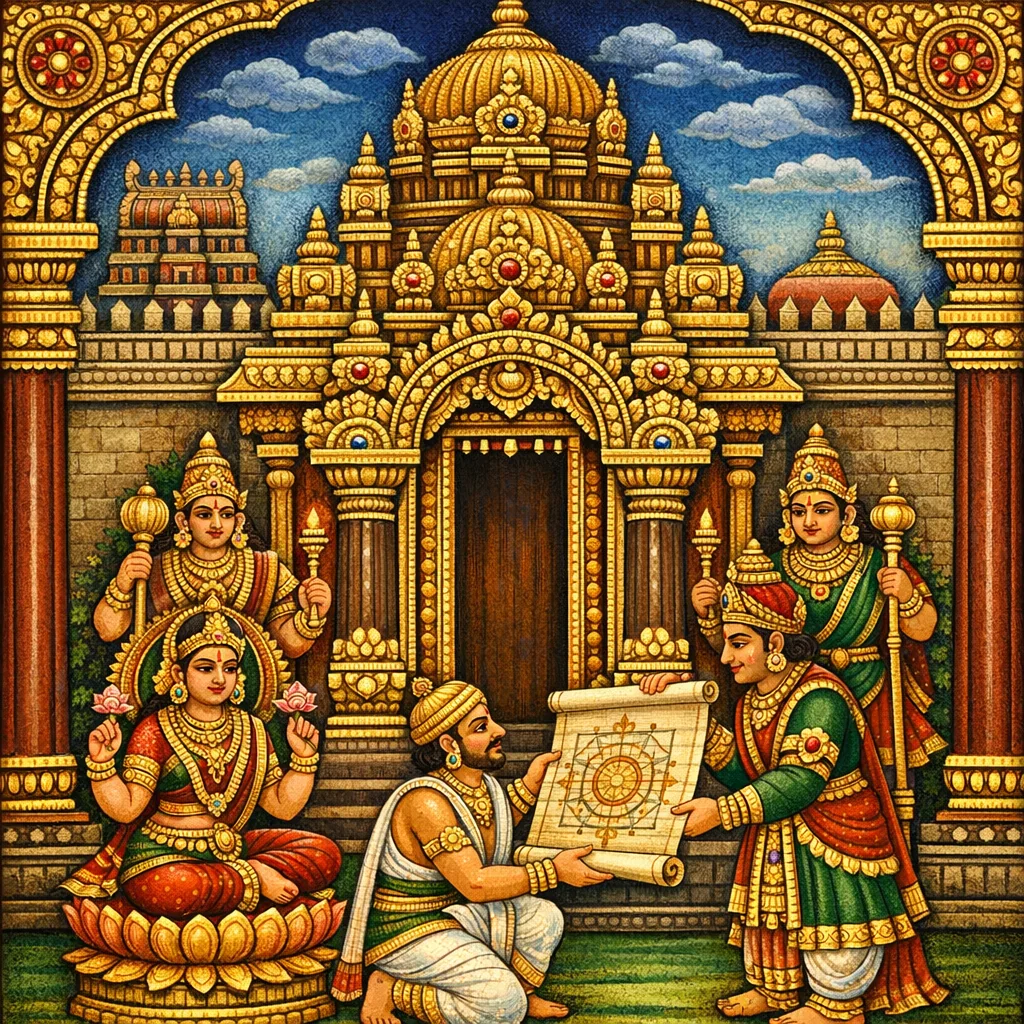
Adhyaya 42
Chapter 42 — प्रासादलक्षणकथनं (Prāsāda-lakṣaṇa-kathana: Characteristics of the Temple/Prāsāda)
Hayagrīva sets forth a generally applicable canon for prāsāda (temple) construction, starting from a square site divided into sixteen parts and moving through core (garbha) placement, wall allotments, and proportional elevation. The chapter then shifts from a “common” template to a measurement system anchored in the pratimā and its pedestal (piṇḍikā), deriving garbha and wall dimensions and prescribing a śikhara twice the wall-height. It specifies circumambulatory extents, rathaka projections, and cord-based setting-out (sūtra) for the śikhara and śukanāsa, along with iconographic and ornamental placements (siṃha motif, vedī, kalaśa). Door geometry is standardized (height twice width), with auspicious materials such as udumbara and guardian deities (Caṇḍa–Pracaṇḍa, Viśvaksena, Śrī). The surrounding complex is integrated: the prākāra is one-fourth the prāsāda’s height, the gopura slightly lower, and directional icons (Varāha, Narasiṃha, Śrīdhara, Hayagrīva, Jāmadagnya, etc.) sacralize the space. Manuscript variants are noted where fractional measures differ, underscoring śāstric precision and dharmic auspiciousness in built form.
Shlokas
Verse 1
इत्य् आदिमहापुराणे आग्नेये पातालयोगकथनं नाम एकचत्वारिंशो ऽध्यायः अथ द्वाचत्वारिंशो ऽध्यायः प्रासादलक्षणकथनं हयग्रीव उवाच प्रासादं सम्प्रवक्ष्यामि सर्वसाधारणं शृणु चतुरस्रीकृतं क्षेत्रं भजेत् षोडशधा बुधः
Thus, in the Agni Purāṇa—the primordial Mahāpurāṇa—ends the forty-first chapter called “The Account of Pātāla-yoga.” Now begins the forty-second chapter, “The Description of the Characteristics of a Prāsāda (temple/palatial structure).” Hayagrīva said: “I shall now explain the prāsāda in a manner applicable in general; listen. A wise person should take a square plot and divide it into sixteen parts.”
Verse 2
मध्ये तस्य चतुर्भिस्तु कुर्यादायसमन्वितं समप्रासादमानत इति ङ, चिह्नितपुस्तकपाठः द्वदशैव तु भागानि भित्त्यर्थं परिकल्पयेत्
In its center, using four parts, one should construct a core reinforced with iron, keeping the shrine’s measurements uniform; and for the walls, one should lay out precisely twelve divisions.
Verse 3
जङ्घोच्छ्रायन्तु कर्तव्यं चतुर्भागेण चायतं जङ्घायां द्विगुणोच्छ्रायं मञ्जर्याः कल्पयेद् बुधः
The height of the jaṅghā (the lower “shank” section) should be made with a length equal to one-fourth of the prescribed measure. Upon the jaṅghā, the wise craftsman should fashion the mañjarī (a clustered foliate ornament) with a height twice that measure.
Verse 4
तुर्यभागेन मञ्जर्याः कार्यः सम्यक् प्रदक्षिणः तन्माननिर्गमं कार्यमुभयोः पार्श्वयोः समं
Using a one‑fourth measure, one should correctly lay out the right-turning circumambulatory (pradakṣiṇa) offset around the mañjarī element; and the projection of that measure is to be executed equally on both sides.
Verse 5
शिखरेण समं कार्यमग्रे जगति विस्तरं द्विगुणेनापि कर्तव्यं यथाशोभानुरूपतः
The breadth of the front platform (jagatī) should be made equal to the measure of the śikhara; or it may even be made twice as wide, in keeping with the beauty and proportion deemed appropriate.
Verse 6
विस्तारान्मण्डपस्याग्रे गर्भसूत्रद्वयेन तु दैर्घ्यात्पादाधिकं कुर्यान्मध्यस्तम्भैर् विभूषितं
In front of the maṇḍapa, using two garbha-sūtras (central alignment cords), one should make the length exceed the breadth by one pāda, and adorn it with central pillars.
Verse 7
प्रासादगर्भमानं वा कुर्वीत मुखमण्डपं एकाशीतिपदैर् व्यास्तुं पश्चात् मण्डपमारभेत्
One should construct the mukha-maṇḍapa (front hall) in accordance with the measure prescribed for the temple’s garbha (sanctum); then, having laid out the plan by means of an eighty-one-square (81-pada) grid, one should thereafter commence the construction of the (main) maṇḍapa.
Verse 8
शुकान् प्राग्द्वारविन्यासे पादान्तःस्थान् यजेत् सुरान् तथा प्राकारविन्यासे यजेद् द्वात्रिंशदन्तगान्
In the vinyāsa (ritual placement) of the eastern gateway, one should worship the Śukas (parrot-deities) and the gods stationed at the ends of the directions; likewise, in the vinyāsa of the surrounding wall (prākāra), one should worship the thirty-two deities positioned on the inner side.
Verse 9
सर्वसाधारणं चैतत् प्रासादस्य च लक्षणं मानेन प्रतिमाया वा प्रासादमपरं शृणु
These are the common, generally applicable characteristics of a temple (prāsāda). Now hear of another kind of temple, determined by measurement—either according to the proportions of the icon (pratimā) or by a prescribed module.
Verse 10
प्रतिमायाः प्रमाणन कर्तव्या पिण्डिका शुभा गर्भस्तु पिण्डिकार्धेन गर्भमानास्तु भित्तयः
The measurements of the icon (pratimā) should be fixed in proper proportion. The auspicious pedestal-base (piṇḍikā) is to be made; the sanctum’s inner chamber (garbha) should be half the measure of the pedestal, and the walls should be measured in proportion to the garbha’s measure.
Verse 11
भित्तेरायाममानेन उत्सेधन्तु प्रकल्पयेत् भित्त्युच्छ्रायात्तु द्विगुणं शिखरं कल्पयेद् बुधः
Using the wall’s length as the measure, one should determine the elevation (height) accordingly; and from the wall’s height, a wise architect should design the superstructure (śikhara) to be twice that measure.
Verse 12
शिखरस्य तु तुर्येण भ्रमणं परिकल्पयेत् शिखरस्य चतुर्थेन व्यग्रतो मुखमण्डपं
One should prescribe the circumambulatory passage (bhramaṇa) as one-fourth of the śikhara (spire). And the front hall (mukhamaṇḍapa) should be laid out with an extent equal to one-fourth of the śikhara, projecting outward in front.
Verse 13
चत्युर्भागेण वा युतमिति ख, चिह्नितपुस्तकपाठः चतुर्भागेण संयुतमिति ग, चिह्नितपुस्तकपाठः सम्यक् कुर्यात् प्रदक्षिणमिति ख, चिह्नितपुस्तकपाठः द्वात्रिंशदन्तरे इति ख, चिह्नितपुस्तकपाठः अष्टमांसेन गर्भस्य रथकानान्तु निर्गमः परिधेर्गुणभागेन रथकांस्तत्र कल्पयेत्
“Joined with a fourth part”—so reads one marked manuscript; “conjoined with one-fourth”—so reads another; “one should make the circumambulation properly”—so reads one marked manuscript; and “at an interval of thirty-two”—so reads one marked manuscript. The projection (offset) of the rathaka elements from the central core (garbha) should be by one-eighth (measure). There, one should proportion and construct the rathaka components according to the circumference, using its proper fractional multiple.
Verse 14
तत्तृतीयेण वा कुर्याद्रथकानान्तु निर्गमं वामत्रयं स्थापनीयं रथकत्रितये सदा
Or, using the third measure/division, one should arrange the outward exit (or projection) of the rathakas; and on the left, a set of three should always be fixed in place for the triad of rathakas.
Verse 15
शिखरार्थं हि सूत्राणि चत्वारि विनिपातयेत् शुकनाशोर्ध्वतः सूत्रं तिर्यग्भूतं निपातयेत्
For laying out the śikhara (temple superstructure), one should drop four measuring cords (plumb-lines). Above the śukanāsa, one should drop a cord oriented horizontally.
Verse 16
शिखरस्यार्धभागस्थं सिंहं तत्र तु कारयेत् शुकनासां स्थिरीकृत्य मध्यसन्धौ निधापयेत्
One should have a lion (siṃha motif) made there, positioned at the midpoint of the śikhara. Having firmly fixed the śukanāsā, one should set it into the central joint (madhya-sandhi).
Verse 17
अपरे च तथा पार्श्वं तद्वत् सूत्रं निधापयेत् तदूर्ध्वन्तु भवेद्वेदी सकण्टा मनसारकं
Likewise, on the other side too, one should place the measuring cord in the same manner. Above that would be the vedī (altar-platform), with a projecting neck (kaṇṭa), arranged according to the manasāra-type layout.
Verse 18
स्कन्धभग्नं न कर्तव्यं विकरालं तथैव च ऊर्ध्वं च वेदिकामानात् कलशं परिकल्पयेत्
One should not make it with a broken skandha (shoulder/neck), nor should it be made grotesque or misshapen. The kalaśa (consecration pot) should be proportioned upward according to the measurements of the vedī.
Verse 19
विस्ताराद्द्विगुणं द्वारं कर्तव्यं तु सुशोभनं उदुम्बरौ तदूर्ध्वञ्च न्यसेच्छाखां सुमङ्गलैः
The door is to be fashioned beautifully, its height being twice its width. Using udumbara wood for the door-posts, one should set above it an auspicious branch as an emblem of supreme good fortune.
Verse 20
द्वारस्य तु चतुर्थांशे कार्यौ चण्डप्रचण्दकौ विश्वक्सेनवत्सदण्डौ शिखोर्ध्वोडुम्बरे श्रियं
In the fourth quarter of the doorway one should fashion/place the fierce guardians Caṇḍa and Pracaṇḍa, along with Viśvaksena and Vatsa-daṇḍa. Above, on the door’s crest (śikhara), upon the udumbara beam, one should install Śrī (Lakṣmī) as the presiding auspiciousness.
Verse 21
दिग्गजैः स्नाप्यमानान्तां घटेः साब्जां सुरूपिकां प्रासादस्य चतुर्थांशैः प्राकारस्योच्छ्रयो भवेत्
At the conclusion of the decorative scheme there should be a well-formed kalaśa (ritual pot) with a lotus, as though being bathed by the elephants of the directions. The height of the enclosure wall (prākāra) should be one-fourth that of the prāsāda (temple superstructure).
Verse 22
प्रासादात् पादहीनस्तु गोपुरस्योच्छ्रयो भवेत् पञ्चहस्तस्य देवस्य एकहस्ता तु पीठिका
The height of the gopura (gateway-tower) should be one pāda (a quarter) less than that of the prāsāda (temple superstructure). For a deity-image measuring five hastas (cubits), the pīṭhikā (pedestal) should be one hasta high.
Verse 23
गारुडं मण्डपञ्चाग्रे एकं भौमादिधाम च कुर्याद्धि प्रतिमायान्तु दिक्षु चाष्टमासु चोपरि
At the fore of the maṇḍapa’s fivefold front, one should make a Garuḍa emblem/icon, and also arrange the terrestrial (bhūma) and other directional stations. Indeed, the icons are to be placed in the eight directions, and above them as well.
Verse 24
पूर्वे वराहं दक्षे च नृसिंहं श्रीधरं जले उत्तरे तु हयग्रीवनाग्नेय्यां जामदग्न्यकं
In the east one should place/visualize Varāha; in the south, Narasiṃha; in the water-direction (west), Śrīdhara; in the north, Hayagrīva; and in the south-east (Agni’s quarter), Jāmadagnya (Paraśurāma).
Verse 25
तत्तुरीयेणेति ख, चिह्नितपुस्तकपाठः नैरृत्यां रामकं वायौ वामनं वासुदेवकं ईशे प्रासादरचना देया वस्वर्ककादिभिः द्वारस्य चाष्टमाद्यंशं त्यत्का बेधो न दोषभाक्
“By the fourth part”—so reads a marked manuscript variant. In the south‑west (nairṛtya) one should assign the type/plan called Rāmaka; in the north‑west (Vāyu quarter) the type called Vāmana; and also the Vāsudevaka type. In the north‑east (īśāna) the temple structure should be laid out using the measurement‑modules beginning with Vasu, Arka, and the rest. If, leaving aside the first one‑eighth portion of the doorway, a piercing/opening (bedha) is made, it is not दोषभाक्—i.e., it does not incur a ritual or structural defect.
Frequently Asked Questions
A modular proportional system: square site planning (16-part division and 81-pada grid), garbha derived from piṇḍikā, śikhara set at twice the wall-height, and standardized ratios for pradakṣiṇā/bhramaṇa, doorway geometry, prākāra, and gopura.
It frames temple-building as applied dharma: correct proportion, orientation, deity-placement, and auspicious installations convert craftsmanship into ritual order, making built space a support for pūjā, pradakṣiṇā, and disciplined devotion aligned with mokṣa.
Doorway guardians (Caṇḍa, Pracaṇḍa), Viśvaksena, Śrī above the crest, kalaśa imagery with diggajas, and directional placements including Varāha (east), Narasiṃha (south), Śrīdhara (west/water-direction), Hayagrīva (north), and Jāmadagnya (south-east), with additional quarter-specific types noted.
Yes. The text explicitly records variant readings for fractional measures (e.g., “by the fourth part,” “joined with one-fourth,” and interval notes), indicating that precise proportioning depends on vetted recension and the architect’s calibrated application.