Adhyaya 273
Indrajit’s Binding, Restoration by Viśalyā, and Counsel Restraining Rāvaṇa (Āraṇyaka Parva 273)
Upa-parva: Mārkaṇḍeya-Upākhyāna (Embedded Exemplum within Āraṇyaka Parva)
Mārkaṇḍeya describes a battlefield reversal where two heroic brothers fall and are re-bound by Indrajit (Rāvaṇi) using granted, extraordinary missiles, appearing like caged birds amid a net of arrows. Sugrīva and leading vānaras surround the scene as Vibhīṣaṇa arrives and awakens the fallen heroes through a cognition-restoring stratagem. Sugrīva then rapidly removes the embedded shafts and restores both warriors using the divine herb Viśalyā empowered by mantra, after which they regain consciousness and rise without fatigue. Vibhīṣaṇa reports the arrival of a yakṣa bearing water sent by Kubera, enabling vision of concealed beings when applied to the eyes; Rāma and Lakṣmaṇa, along with principal allies, adopt it, gaining heightened perception. Indrajit returns to report his action and re-enters combat; Lakṣmaṇa confronts him, and an intense duel follows. Lakṣmaṇa decisively disables Indrajit—severing arms and then the head—after which the chariot is brought back to Laṅkā. Rāvaṇa, shocked and grief-stricken, rushes toward Sītā with a sword, but Avindhya restrains him through counsel: a king should not kill a woman in captivity; instead, he should confront her protector, framing vengeance as properly directed. Rāvaṇa accepts the advice and orders his chariot prepared for renewed engagement.
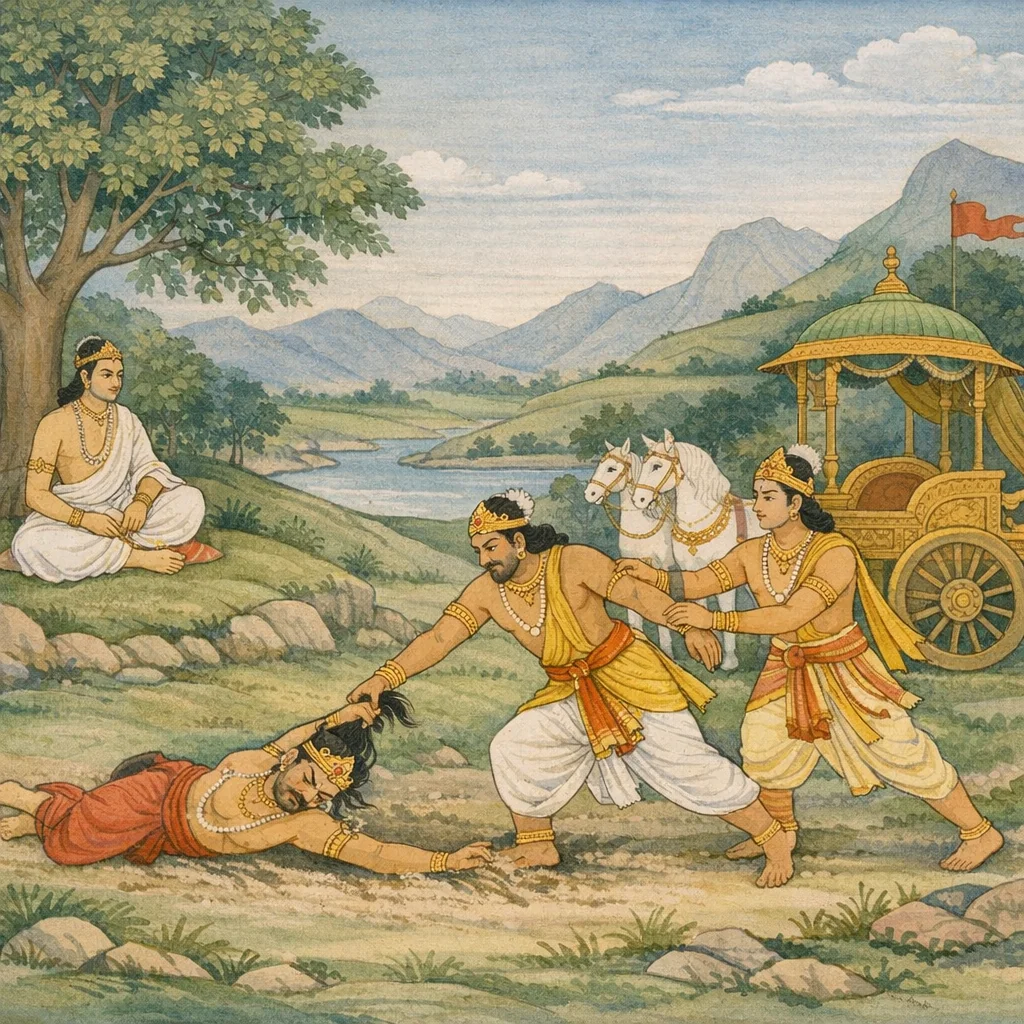
Chapter Arc: द्रौपदी-अपमान के अपराधी जयद्रथ को पकड़कर पाण्डवों के सामने लाया जाता है—भागते हुए राजा को भीम रथ से कूदकर केशपक्ष से धर दबोचता है, और वन-निर्वासन की शान्ति अचानक दण्ड-न्याय के रण में बदल जाती है। → भीम का क्रोध उफनता है: वह जयद्रथ को उठाकर भूमि पर पटकता, रौंदता और घसीटता है; अर्जुन उसे बाँधकर रथ पर चढ़ाता है—एक ओर प्रतिशोध की आग, दूसरी ओर युधिष्ठिर के धर्म-नियंत्रण की प्रतीक्षा। → युधिष्ठिर के सम्मुख जयद्रथ की दीनता और भीम की उग्रता आमने-सामने आती है; जयद्रथ भयभीत होकर शर्त स्वीकार करता है—जीवन-दान के बदले अपमान-स्वीकार और अधीनता का वचन। → युधिष्ठिर करुणा और नीति से निर्णय देता है: जयद्रथ को मृतप्राय दशा में छोड़कर ‘स्वस्ति गच्छ’ कहकर मुक्त किया जाता है—दण्ड ऐसा कि अहंकार टूटे, पर धर्म की मर्यादा में प्राण-हरण न हो। → जयद्रथ अपमानित होकर लौटता है; यह अपमान भविष्य में प्रतिशोध की चिंगारी बनेगा और पाण्डवों के लिए आगे और घोर संकट का बीज बोएगा।
Shlokas
Verse 1
हि आय ० () हि २ 7 (जयद्रथविमोक्षणपर्व) द्विसप्तत्यधिकद्धिशततमो< ध्याय: भीमद्वारा बंदी होकर जयद्रथका युधिष्ठटिरके सामने उपस्थित होना, उनकी आज्ञासे छूटकर उसका गंगाद्वारमें तप करके भगवान शिवसे वरदान पाना तथा भगवान शिवद्वारा अर्जुनके सहायक 28, श्रीकृष्णकी महिमाका व वैशम्पायन उवाच जयद्रथस्तु सम्प्रेक्ष्य भ्रातरावुद्यतावु भौ । प्राधावत् तूर्णमव्यग्रो जीवितेप्सु: सुदु:खित:,वैशम्पायनजी कहते हैं--जनमेजय! भीम और अर्जुन दोनों भाइयोंको अपने बधके लिये तुले हुए देख जयद्रथ बहुत दुःखी हुआ और घबराहट छोड़कर प्राण बचानेकी इच्छासे तुरंत तीव्र गतिसे भागने लगा
Vaiśampāyana said: Seeing both brothers—Bhīma and Arjuna—poised to kill him, Jayadratha was overwhelmed with distress. Casting off hesitation, and driven by the desire to save his life, he fled at once with great speed.
Verse 2
त॑ भीमसेनो धावन्तमवतीर्य रथाद् बली । अभिद्र॒ुत्य निजग्राह केशपक्षे हामर्षण:,उसे भागता देख अमर्षमें भरे हुए महाबली भीम भी रथसे उतर गये और बड़े वेगसे दौड़कर उन्होंने उसके केश पकड़ लिये
Vaiśampāyana said: Seeing him fleeing, the mighty Bhīmasena leapt down from his chariot. Rushing forward in wrath, he seized the fugitive by the hair—an act driven by fierce indignation and the impulse to stop an offender from escaping.
Verse 3
समुद्यम्य च तं भीमो निष्पिपेष महीतले । शिरो गृहीत्वा राजानं ताडयामास चैव ह,तत्पश्चात् भीमने उसे ऊपर उठाकर धरतीपर पटक दिया और उसे रौंदने लगे। फिर उन्होंने राजा जयद्रथका सिर पकड़कर उसे कई थप्पड़ लगाये
Vaiśampāyana said: Bhīma, lifting him up, hurled him down upon the earth and crushed him there. Then, seizing the king by the head, he struck him repeatedly—an act meant not merely to punish the offender, but to publicly humble him for his wrongdoing.
Verse 4
पुन: संजीवमानस्य तस्योत्पतितुमिच्छत: । पदा मूर्थ्नि महाबाहु: प्राहरद् विलपिष्यत:,इतनी मार खाकर भी वह अभी जीवित ही था और उठनेकी इच्छा कर रहा था। इसी समय महाबाहु भीमने उसके मस्तकपर एक लात मारी। इससे वह रोने-चिल्लाने लगा, तो भी भीमसेनने उसे गिराकर उसके शरीरपर अपने दोनों घुटने रख दिये और उसे घूँसोंसे मारने लगे। इस प्रकार बड़े जोरकी मार पड़नेसे पीड़ाके मारे राजा जयद्रथ मूर्छित हो गया
Vaiśaṃpāyana said: As he was reviving again and trying to rise, the mighty-armed Bhīma struck him on the head with his foot. When the man began to wail in pain, Bhīmasena forced him down, pinned his body with both knees, and pummeled him with his fists. Under the heavy blows, King Jayadratha, overwhelmed by agony, fell unconscious—an episode that underscores how wrath and retribution can eclipse restraint even when the offender is already subdued.
Verse 5
तस्य जानू ददौ भीमो जघ्ने चैनमरत्निना | स मोहमगमद् राजा प्रहारवरपीडित:,इतनी मार खाकर भी वह अभी जीवित ही था और उठनेकी इच्छा कर रहा था। इसी समय महाबाहु भीमने उसके मस्तकपर एक लात मारी। इससे वह रोने-चिल्लाने लगा, तो भी भीमसेनने उसे गिराकर उसके शरीरपर अपने दोनों घुटने रख दिये और उसे घूँसोंसे मारने लगे। इस प्रकार बड़े जोरकी मार पड़नेसे पीड़ाके मारे राजा जयद्रथ मूर्छित हो गया
Vaiśampāyana said: Bhīma drove his knee into him and struck him with his forearm. Sorely afflicted by the force of those blows, the king fell into a faint. The passage underscores the harsh, bodily reality of vengeance in the forest narrative: even when an enemy is subdued, anger can press beyond mere restraint, raising ethical tension between righteous punishment and excessive violence.
Verse 6
सरोषं भीमसेनं तु वारयामास फाल्गुन: । दुःशलाया: कृते राजा यत् तदाहेति कौरव,इतनेपर भी भीमसेनका क्रोध कम नहीं हुआ। यह देख अर्जुनने उन्हें रोका और कहा --“कुरुनन्दन! दुःशलाके वैधव्यका खयाल करके महाराजने जो आज्ञा दी थी, उसका भी तो विचार कीजिये”
Vaiśampāyana said: Seeing Bhīmasena still aflame with anger, Phālguna (Arjuna) restrained him and spoke: “O Kaurava prince, remember what the king commanded for Duḥśalā’s sake—out of regard for her widowhood. Consider that order as well.”
Verse 7
भीमसेन उवाच नायं पापसमाचारो मत्तो जीवितुमहति । कृष्णायास्तदनर्हाया: परिक्लेष्टा नराधम:,भीमसेनने कहा--इस नराधमने क्लेश पानेके अयोग्य द्रौपदीको कष्ट पहुँचाया है; अतः अब मेरे हाथसे इस पापाचारी जयद्रथका जीवित रहना ठीक नहीं है
Bhīmasena said: “This man of sinful conduct does not deserve to live at my hands. That vilest of men has tormented Kṛṣṇā (Draupadī), who is undeserving of such suffering; therefore it is not right that Jayadratha, this evildoer, should now be allowed to keep his life.”
Verse 8
कि नु शक््यं मया कर्तु यद् राजा सततं घृणी । त्वं च बालिशया बुद्धया सदैवास्मान् प्रबाधसे,परंतु मैं क्या कर सकता हूँ? राजा युधिष्ठिर सदा दयालु ही बने रहते हैं और तुम भी अपनी बालबुद्धिके कारण मेरे ऐसे कामोंमें सदा बाधा पहुँचाया करते हो
Bhīmasena said: “What, indeed, can I do, when the king is ever compassionate? And you too, with your childish judgment, continually obstruct us in such undertakings.”
Verse 9
एवमुक्त्वा सटास्तस्य पड्च चक्रे वृकोदर: । अर्धचन्द्रेण बाणेन किंचिदब्रुवतस्तदा,ऐसा कहकर भीमने जयद्रथके लम्बे-लम्बे बालोंको अर्द्धचन्द्राकार बाणसे मूँड़कर पाँच चोटियाँ रख दीं। उस समय वह भयके मारे कुछ भी बोल नहीं पाता था
Having spoken thus, Vṛkodara (Bhīma) sheared off Jayadratha’s long hair with a crescent-shaped arrow and left him with five tufts. At that moment Jayadratha, overwhelmed by fear, could not utter a word—his humiliation serving as a deliberate, public mark of disgrace rather than immediate execution.
Verse 10
विकत्थयित्वा राजानं ततः प्राह वृकोदर: । जीवितु चेच्छसे मूढ हेतुं मे गदत: शृणु,तदनन्तर कटुवचनोंसे सिन्धुराजका तिरस्कार करते हुए भीमने उससे कहा--“अरे मूढ़! यदि तू जीवित रहना चाहता है तो जीवनरक्षाका हेतुभूत मेरा यह वचन सुन --
After deriding the king, Vṛkodara (Bhīma) spoke: “Fool! If you wish to stay alive, then listen to the reasoned words I am about to speak.” In context, Bhīma’s harsh address functions as a warning meant to restrain arrogance and compel the opponent to heed counsel that could avert needless violence.
Verse 11
दासो5स्मीति तथा वाच्यं संसत्सु च सभासु च । एवं ते जीवितं दद्यामेष युद्धजितो विधि:,“तू राजाओंकी सभा-समितियोंमें जाकर सदा अपनेको (महाराज युधिष्ठिरका) दास बताया कर। यह शर्त स्वीकार हो, तो तुझे जीवन-दान दे सकता हूँ। युद्धमें विजयी पुरुषकी ओरसे हारे हुएके लिये ऐसा ही विधान है”
Bhīmasena said: “You must declare, ‘I am a slave,’ and you must say so in councils and in royal assemblies as well. If you accept this condition, I will grant you your life. Such is the rule imposed by a victor in war upon one who has been defeated.”
Verse 12
एवमस्त्विति तं राजा कृष्यमाणो जयद्रथ: । प्रोवाच पुरुषव्याप्रं भीममाहवशोभिनम्,उस समय सिन्धुराज जयद्रथ धरतीपर घसीटा जा रहा था। उसने उपर्युक्त शर्त स्वीकार कर ली और युद्धमें शोभा पानेवाले पुरुषसिंह भीमसेनसे अपनी स्वीकृति स्पष्ट बता दी
“So be it,” said King Jayadratha as he was being dragged along the ground. Accepting the stated condition, he clearly declared his assent to Bhīmasena—the tiger among men, resplendent in battle—thereby submitting to the demand placed upon him in the wake of his wrongdoing.
Verse 13
तत एन विचेष्टन्तं बद्ध्वा पार्थों वृकोदर: । रथमारोपयामास विसंज्ञं पांसुगुण्ठितम्
Then Vṛkodara (Bhīma), having bound that man who was still struggling, lifted him onto the chariot—unconscious and covered with dust. The act underscores Bhīma’s decisive strength used to secure a dangerous opponent, restraining him rather than killing him on the spot, and bringing the situation under control for further judgment and dharmic resolution.
Verse 14
तदनन्तर वह उठनेकी चेष्टा करने लगा। तब कुन्तीकुमार वृकोदरने उसे बाँधकर रथपर डाल दिया। वह बेचारा धूलसे लथपथ और अचेत हो रहा था ।। ततस्तं रथमास्थाय भीम: पार्थानुगस्तदा । अभ्येत्याश्रममध्यस्थमभ्यगच्छद् युधिष्ठिरम्,उसे रथपर चढ़ाकर आगे-आगे भीम चले और पीछे-पीछे अर्जुन। आश्रमपर आकर भीमसेन वहाँ मध्यभागमें बैठे हुए राजा युधिष्ठिरके पास गये
After that, the man tried to rise. Then Bhīma—Kuntī’s son, the wolf-bellied hero—bound him and placed him upon the chariot. The wretch, smeared with dust, was slipping into unconsciousness. Mounting that chariot, Bhīma went ahead with Arjuna following behind, and on reaching the hermitage he approached King Yudhiṣṭhira, who was seated in the central part of the āśrama. The scene underscores disciplined force: Bhīma restrains rather than kills, bringing the captive before the rightful authority for a dharmic decision.
Verse 15
दर्शयामास भीमस्तु तदवस्थं जयद्रथम् । त॑ राजा प्राहसद् दृष्टवा मुच्यतामिति चाब्रवीत्,भीमने उसी अवस्थामें जयद्रथको महाराजके सामने उपस्थित किया। उसे देखकर राजा युधिष्ठिर जोर-जोरसे हँसने लगे और बोले--'अब इसे छोड़ दो”
Bhīma brought Jayadratha before the king in that very condition (humbled and subdued). Seeing him, King Yudhiṣṭhira laughed aloud and said, “Release him now.” The moment underscores Yudhiṣṭhira’s restraint and adherence to dharma: even when an offender is in one’s power, vengeance is checked by ethical judgment and royal self-control.
Verse 16
राजानं चाब्रवीद् भीमो द्रौपद्या: कथ्यतामिति । दासभावगतो होष पाण्डूनां पापचेतन:,तब भीमसेनने भी राजासे कहा--“आप द्रौपदीको यह सूचित कर दीजिये कि यह पापात्मा जयद्रथ पाण्डवोंका दास हो चुका है”
Bhīma then addressed the king: “Let Draupadī be informed that this sinful-minded Jayadratha has now fallen into the condition of a slave to the Pāṇḍavas.” The statement underscores Bhīma’s insistence on public acknowledgment of justice after wrongdoing, and on restoring Draupadī’s honor through a clear declaration of the offender’s subjugation.
Verse 17
तमुवाच ततो ज्येष्ठो भ्राता सप्रणयं वच: । मुज्चैनमधमाचारं प्रमाणा यदि ते वयम्,तब बड़े भाई युधिष्िरने प्रेमपूर्वक भीमसेनसे कहा--“यदि तुम मेरी बात मानते हो तो इस पापाचारीको छोड़ दो”
Then the eldest brother addressed him with affectionate words: “Release this man of base conduct. If you accept us as your authority, then let him go.” The appeal frames restraint and deference to rightful counsel as a higher ethical choice than acting on anger.
Verse 18
22 द्रौपदी चाब्रवीद् भीममभिप्रेक्ष्य युधिष्ठिरम् । दासो<थयं मुच्यतां राज्ञस्त्ववा पडचसट: कृत:,उस समय द्रौपदीने भी युधिष्ठिकी ओर देखकर भीमसेनसे कहा--“आपने इसका सिर मूँड़कर पाँच चोटियाँ रख दी हैं तथा यह महाराजका दास हो गया है; अतः अब इसे छोड़ दीजिये'
Draupadī, glancing toward Yudhiṣṭhira, spoke to Bhīmasena: “This man has now become the king’s slave, and you have shaved his head leaving five tufts. Therefore, let him be released.”
Verse 19
स मुक्तो5भ्येत्य राजानमभिवाद्य युधिष्ठिरम् । ववन्दे विह्नलो राजंस्तांश्व॒ दृष्टवा मुनींस्तदा,राजन! तब जयद्रथ बन्धनसे मुक्त कर दिया गया। उसने विह्लल होकर राजा युधिष्ठिरके पास जा उन्हें प्रणाम करनेके पश्चात् वहाँ बैठे हुए अन्यान्य मुनियोंको भी देखकर उनके चरणोंमें मस्तक झुकाया
Released from captivity, he approached the king Yudhiṣṭhira and paid him respectful homage. Then, still shaken and humbled, O King, on seeing the sages seated there, he bowed down to them as well—an outward sign that fear and disgrace had momentarily taught him reverence and restraint.
Verse 20
तमुवाच घृणी राजा धर्मपुत्रो युधिष्ठिर: । तथा जयद्रथं दृष्टवा गृहीत॑ं सव्यसाचिना,उस समय (आदर देते हुए) अर्जुनने जयद्रथका हाथ थाम लिया। तब दयालु राजा धर्मपुत्र युधिष्ठिरने जयद्रथकी ओर देखकर कहा--
Then the compassionate king Yudhiṣṭhira, son of Dharma, spoke. Seeing Jayadratha held fast by the ambidextrous Arjuna, he addressed him—framing the moment not merely as a victory over an offender, but as a test of restraint, justice, and righteous conduct in the aftermath of wrongdoing.
Verse 21
अदासो गच्छ मुक्तो5सि मैवं कार्षी: पुनः क्वचित् | स्त्रीकामं वा धिगस्तु त्वां क्षुद्र: क्षुद्रसहायवान्
Bhīmasena said: “Go—no longer a slave; you are released. Do not ever act like this again. Whether driven by lust for a woman or otherwise—shame on you, petty man, who keeps petty company.”
Verse 22
गतसत्त्वमिव ज्ञात्वा कर्तारमशुभस्य तम्,साशथ्चः सरथपादात: स्वस्ति गच्छ जयद्रथ । वह अशुभ कर्म करनेवाला जयद्रथ मृतप्राय-सा हो गया है, यह देख और समझकर भरतश्रेष्ठ राजा युधिष्ठिरने उसपर कृपा की और कहा--तेरी बुद्धि धर्ममें उत्तरोत्तर बढ़ती रहे, तू कभी अधर्ममें मन न लगाना। जयद्रथ! अपने रथ, घोड़े और पैदल सबको साथ लिये कुशलपूर्वक चला जा'
Bhīma said: “Knowing him to be as one whose strength and spirit have departed—him, the doer of that evil deed—go in safety, O Jayadratha, together with your horses, chariot, and foot-soldiers.” The ethical force of the moment is that, even after grievous wrongdoing, the victorious side restrains vengeance and grants safe passage, upholding royal dharma and compassion over wrath.
Verse 23
सम्प्रेक्ष्य भरतश्रेष्ठ: कृपां चक्रे नराधिप: । धर्मे ते वर्धतां बुद्धिर्मा चाधर्मे मन: कृथा:
Beholding the situation, the best of the Bharatas—the king—was moved to compassion. He said, “May your understanding grow in dharma; do not set your mind upon adharma.”
Verse 24
एवमुक्तस्तु स्रीड तूष्णी किंचिदवाड्मुख:,राजन! युधिष्ठिरके ऐसा कहनेपर जयद्रथ बहुत लज्जित हुआ और नीचा मुँह किये वहाँसे चुपचाप चला गया। जनमेजय! वह पराजित होनेके महान् दुःखसे पीड़ित था; अतः वहाँसे घर न जाकर गंगाद्वार (हरिद्वार)-को चल दिया। वहाँ पहुँचकर उसने तीन नेत्रोंवाले भगवान् उमापतिकी शरण ले बड़ी भारी तपस्या की। इससे भगवान् शंकर प्रसन्न हो गये। त्रिनेत्रधारी महादेवने प्रसन्नतापूर्वक स्वयं दर्शन देकर उसकी पूजा ग्रहण की
When Yudhiṣṭhira spoke to him in this manner, Jayadratha—ashamed—fell silent, lowered his face, and quietly departed from that place. O King Janamejaya, tormented by the great sorrow of his defeat, he did not return home; instead he went to Gaṅgādvāra (Haridwar). Reaching there, he sought refuge in the three-eyed Lord, Umāpati, and undertook severe austerities. Pleased by this, Śaṅkara became gracious. The three-eyed Mahādeva appeared to him in person and accepted his worship.
Verse 25
जगाम राजन दु:खार्तो गड्जाद्वाराय भारत । स देवं शरणं गत्वा विरूपाक्षमुमापतिम्,राजन! युधिष्ठिरके ऐसा कहनेपर जयद्रथ बहुत लज्जित हुआ और नीचा मुँह किये वहाँसे चुपचाप चला गया। जनमेजय! वह पराजित होनेके महान् दुःखसे पीड़ित था; अतः वहाँसे घर न जाकर गंगाद्वार (हरिद्वार)-को चल दिया। वहाँ पहुँचकर उसने तीन नेत्रोंवाले भगवान् उमापतिकी शरण ले बड़ी भारी तपस्या की। इससे भगवान् शंकर प्रसन्न हो गये। त्रिनेत्रधारी महादेवने प्रसन्नतापूर्वक स्वयं दर्शन देकर उसकी पूजा ग्रहण की
Bhīmasena said: “O King, O Bhārata, tormented by grief, he set out for Gaṅgādvāra. Having gone there, he sought refuge in the god Virūpākṣa, the Lord of Umā.” The verse frames a moral turn: after humiliation and defeat, the character does not immediately return to worldly life but seeks divine shelter through austerity, implying that power pursued without righteousness leads to shame, while devotion is taken up as a means to recover strength and purpose.
Verse 26
तपश्चचार विपुलं तस्य प्रीतो वृषध्वज: । बलिं स्वयं प्रत्यगृह्नात् प्रीयमाणस्त्रिलोचन:,राजन! युधिष्ठिरके ऐसा कहनेपर जयद्रथ बहुत लज्जित हुआ और नीचा मुँह किये वहाँसे चुपचाप चला गया। जनमेजय! वह पराजित होनेके महान् दुःखसे पीड़ित था; अतः वहाँसे घर न जाकर गंगाद्वार (हरिद्वार)-को चल दिया। वहाँ पहुँचकर उसने तीन नेत्रोंवाले भगवान् उमापतिकी शरण ले बड़ी भारी तपस्या की। इससे भगवान् शंकर प्रसन्न हो गये। त्रिनेत्रधारी महादेवने प्रसन्नतापूर्वक स्वयं दर्शन देकर उसकी पूजा ग्रहण की
He undertook an immense austerity. Pleased with him, Vṛṣadhvaja—Śiva, the Three-eyed Lord—graciously accepted the offering (bali) with his own hands. In the narrative setting, the verse underscores that even a disgraced warrior, driven by defeat and shame, turns to severe tapas; divine favor is shown not as a reward for arrogance, but as a response to sustained discipline and devotion.
Verse 27
वरं चास्मै ददौ देव: स जग्राह च तच्छूणु । समस्तान् सरथान् पज्च जयेयं युधि पाण्डवान्,जनमेजय! भगवानने उसे वर दिया और जयद्रथने उसको ग्रहण किया। वह वर क्या था? यह बताता हूँ, सुनो--“मैं रथसहित पाँचों पाण्डवोंको युद्धमें जीत लूँ”. यही वर सिन्धुराजने महादेवजीसे माँगा। परंतु महादेवजीने उससे कहा--'ऐसा नहीं हो सकता। पाण्डव अजेय और अवध्य हैं। तुम केवल एक दिन युद्धमें महाबाहु अर्जुनको छोड़कर अन्य चार पाण्डवोंको आगे बढ़नेसे रोक सकते हो। देवेश्वर नर, जो बदरिकाश्रममें भगवान् नारायणके साथ रहकर तपस्या करते हैं, वे ही अर्जुन हैं
Bhīmasena said: “The god granted him a boon, and he accepted it—listen to what it was, O Janamejaya. ‘May I defeat the five Pāṇḍavas in battle, together with their chariots.’ Such was the boon the king of Sindhu sought from Mahādeva. Yet Mahādeva declared that this could not be fully granted, for the Pāṇḍavas are unconquerable and not to be slain. At most, for a single day, Jayadratha would be able to check the advance of the other four Pāṇḍavas, excluding the mighty Arjuna—who is none other than Nara, the divine ascetic dwelling with Nārāyaṇa at Badarikāśrama. The episode underscores the moral boundary placed even upon divine favors: power is limited when it confronts righteousness and divinely protected virtue.
Verse 28
इति राजाब्रवीद् देवं नेति देवस्तमब्रवीत् । अजय्यांक्षाप्यवध्यांश्व वारयिष्यसि तान् युधि,जनमेजय! भगवानने उसे वर दिया और जयद्रथने उसको ग्रहण किया। वह वर क्या था? यह बताता हूँ, सुनो--“मैं रथसहित पाँचों पाण्डवोंको युद्धमें जीत लूँ”. यही वर सिन्धुराजने महादेवजीसे माँगा। परंतु महादेवजीने उससे कहा--'ऐसा नहीं हो सकता। पाण्डव अजेय और अवध्य हैं। तुम केवल एक दिन युद्धमें महाबाहु अर्जुनको छोड़कर अन्य चार पाण्डवोंको आगे बढ़नेसे रोक सकते हो। देवेश्वर नर, जो बदरिकाश्रममें भगवान् नारायणके साथ रहकर तपस्या करते हैं, वे ही अर्जुन हैं
Bhima said: “Thus the king spoke to the god, but the god replied, ‘No.’ For those (Pāṇḍavas) are unconquerable and cannot be slain. Yet you will be able to check them in battle—O Janamejaya.” In context, Bhima explains that Jayadratha sought a boon to defeat the five Pāṇḍavas, but Śiva denied what violates their destined invincibility; instead, a limited power is granted—restraint rather than destruction—underscoring that divine gifts operate within the bounds of dharma and fate.
Verse 29
ऋते<र्जुनं महाबाहुं नरं नाम सुरेश्वरम् । बदर्या तप्ततपसं नारायणसहायकम्,जनमेजय! भगवानने उसे वर दिया और जयद्रथने उसको ग्रहण किया। वह वर क्या था? यह बताता हूँ, सुनो--“मैं रथसहित पाँचों पाण्डवोंको युद्धमें जीत लूँ”. यही वर सिन्धुराजने महादेवजीसे माँगा। परंतु महादेवजीने उससे कहा--'ऐसा नहीं हो सकता। पाण्डव अजेय और अवध्य हैं। तुम केवल एक दिन युद्धमें महाबाहु अर्जुनको छोड़कर अन्य चार पाण्डवोंको आगे बढ़नेसे रोक सकते हो। देवेश्वर नर, जो बदरिकाश्रममें भगवान् नारायणके साथ रहकर तपस्या करते हैं, वे ही अर्जुन हैं
Bhīmasena said: “Except for Arjuna—the mighty-armed one who is the divine being called Nara, lord among the gods—who in Badarī dwells with Nārāyaṇa as his companion and performs intense austerities, O Janamejaya.” In context, Bhīma recalls the boon Jayadratha received: he could check the advance of the four Pāṇḍavas for a single day, but not overcome Arjuna. The passage underscores a moral boundary placed even upon a granted boon: divine power does not sanction the impossible (the defeat of the invincible), and arrogance is curtailed by dharma and cosmic order.
Verse 30
|, ही | /0/00४-7-7- - (की रन प है अजित सर्वलोकानां देवैरपि दुरासदम् । मया दत्तं पाशुपतं दिव्यमप्रतिमं शरम् । अवाप लोकपालेभ्यो वज्रादीन् स महाशरान्,उन्हें तुम तो क्या, सम्पूर्ण लोक मिलकर भी जीत नहीं सकते। उनका सामना करना तो देवताओंके लिये भी कठिन है। मैंने उन्हें पाशुपत नामक दिव्य अस्त्र प्रदान किया है, जिसके जोड़का दूसरा कोई अस्त्र ही नहीं है। इसके सिवा अन्यान्य लोकपालोंसे भी उन्होंने वज्र आदि महान् अस्त्र प्राप्त किये हैं
Bhīmasena said: “He is unconquerable by all the worlds together; even the gods would find him hard to confront. I have given him the divine Pāśupata weapon—an incomparable missile with no equal. Moreover, from the other guardians of the worlds he has obtained mighty weapons as well, such as the thunderbolt and others.”
Verse 31
देवदेवो ह्ुनन्तात्मा विष्णु: सुरगुरु: प्रभु: । प्रधानपुरुषो<व्यक्तो विश्वात्मा विश्वमूर्तिमान्,[“अब मैं तुम्हें नरस्वरूप अर्जुनके सहायक भगवान् नारायणकी महिमा बताता हूँ, सूनो] भगवान् नारायण देवताओंके भी देवता, अनन्तस्वरूप, सर्वव्यापी, देवगुरु, सर्वसमर्थ, प्रकृति-पुरुषरूप, अव्यक्त, विश्वात्मा एवं विश्वरूप हैं
Bhīmasena said: “Nārāyaṇa—Viṣṇu—is the God of gods, of endless being and all-pervading. He is the preceptor of the celestials and the sovereign Lord. He is the primal ground (Pradhāna) and the conscious Person (Puruṣa), unmanifest, the Self of the universe, and the One whose form is the entire cosmos.”
Verse 32
युगान्तकाले सम्प्राप्ते कालाग्निर्दहते जगत् । सपर्वतार्णवद्वीपं सशैलवनकाननम्,'प्रलयकाल उपस्थित होनेपर वे भगवान् विष्णु ही कालाग्निरूपसे प्रकट हो पर्वत, समुद्र, द्वीप, शैल, वन और काननोंसहित सम्पूर्ण जगत्को दग्ध कर देते हैं
Bhīma says: “When the end of an age arrives, the Fire of Time consumes the world—burning it entirely, together with its mountains, oceans, and islands, with its rocky ranges, forests, and wilderness groves.” In ethical and narrative force, the verse evokes the inevitability of cosmic dissolution to underscore the insignificance of worldly supports before Time and the need to anchor oneself in enduring dharma rather than transient power or possessions.
Verse 33
निर्दहन् नागलोकांश्षव पातालतलचारिण: । अथान्तरिक्षे सुमहन्नानावर्णा: पयोधरा:,“फिर पातालतलमें विचरण करनेवाले नागलोकोंको भी वे भस्म कर डालते हैं। कालाग्निद्वारा सब कुछ भस्म हो जानेपर आकाशमें अनेक रंगके महान् मेघोंकी घोर घटा घिर आती है
Bhīmasena said: “Burning up even the serpent-worlds—those Nāgas who move about in the nether regions—(the fire consumes all). Then, when everything has been reduced to ashes by the fire of Time, a vast, terrifying mass of clouds of many colors gathers in the sky.”
Verse 34
घोरस्वरा विनदिनस्तडिन्मालावलम्बिन: । समुत्तिष्ठन् दिश: सर्वा विवर्षन्त: समन्तत:,“भयंकर स्वरसे गर्जना करते हुए वे बादल बिजलियोंकी मालाओंसे प्रकाशित हो सम्पूर्ण दिशाओंमें फैल जाते और सब ओर वर्षा करने लग जाते हैं
Bhīmasena describes the onset of a terrifying storm: the clouds, roaring with dreadful sound and flashing with garlands of lightning, rise and spread through all directions, then pour rain on every side. The scene underscores how nature’s overwhelming force can mirror the pressure of adversity—calling for steadiness and courage rather than panic.
Verse 35
ततोअग्निं नाशयामासु: संवर्ताग्निनियामका: । अक्षमात्रैश्व धाराभिस्तिष्ठन्त्यापूर्य सर्वश:,“इससे प्रलयकालीन अग्नि बुझ जाती है। संवर्तक अग्निका नियन्त्रण करनेवाले वे महामेघ लंबे सर्पोंके समान मोटी धाराओंसे जल गिराते हुए सबको डुबो देते हैं
Then those mighty clouds—controllers of the Saṁvartaka (world-ending) fire—quenched the blaze. Pouring down thick, serpent-like torrents, they stood over the scene and flooded everything on all sides, so that even the conflagration of dissolution was subdued.
Verse 36
एकार्णवे तदा तस्मिन्नुपशान्तचराचरे । नष्टचन्द्रार्कपवने ग्रहनक्षत्रवर्जिते,“उस समय सम्पूर्ण दिशाओंमें पानी भर जानेसे चारों ओर एकाकार जलमय समुद्र ही दृष्टिगोचर होता है। उस एकार्णवके जलमें समस्त चराचर जगत् नष्ट हो जाता है। चन्द्रमा, सूर्य और वायु भी विलीन हो जाते हैं। ग्रह और नक्षत्रोंका अभाव हो जाता है
Bhīmasena said: “At that time, when everything has become a single, all-engulfing ocean and all movement of the living and the non-living has fallen silent, the moon and the sun are gone, the wind has ceased, and the sky is emptied of planets and stars. In that vast flood, the entire world is dissolved.”
Verse 37
चतुर्युगसहस्रान्ते सलिलेनाप्लुता मही । ततो नारायणाख्यस्तु सहस्राक्ष: सहस्रपात्
Bhīmasena said: At the close of a thousand cycles of the four yugas, the earth was submerged by waters. Then there appeared the one known as Nārāyaṇa—described as ‘thousand-eyed’ and ‘thousand-footed’—evoking the vision of the all-pervading Lord who remains present even when the world is dissolved, and whose cosmic form grounds the moral order beyond changing times.
Verse 38
सहस्रशीर्षा पुरुष: स्वप्तुकामस्त्वतीन्द्रिय: । फटासहस्रविकटं शेषं पर्यड्कभाजनम्
Bhīmasena said: “That transcendent Person, of a thousand heads, desiring to sleep beyond the reach of the senses, has the mighty Śeṣa—terrible with his thousand hoods—as His couch and resting-bed.”
Verse 39
सहस्रमिव तिग्मांशुसंघातममितद्युतिम् । कुन्देन्दुहारगोक्षीरमृणालकुमुदप्रभम्
Bhīmasena said: “(I beheld him) blazing with immeasurable radiance, like a mass of a thousand sharp-rayed suns; yet in beauty and purity he shone with the gentle whiteness of jasmine, the moon, a pearl-garland, cow’s milk, lotus-fibre, and the white water-lily.”
Verse 40
तत्रासौ भगवान् देव: स्वपज्जलनिधौ तदा । नैशेन तमसा व्याप्तां स्वां रात्रिं कुरुते विभु:
There, that blessed divine Lord then lies upon the ocean of waters; the mighty one makes His own night—pervaded by nocturnal darkness—come to pass. The line evokes the cosmic order in which even darkness and rest are not mere accidents but part of a governed rhythm, suggesting that endurance in hardship and the alternation of light and night belong to a larger, purposeful design.
Verse 41
“एक हजार चतुर्युगी समाप्त होनेपर उपर्युक्त एकार्णवके जलमें यह पृथ्वी डूब जाती है। तत्पश्चात् नारायण नामसे प्रसिद्ध भगवान् श्रीहरि उस एकार्णवके जलमें शयन करनेके हेतु अपने लिये निशाकालोचित अन्धकार (तमोगुण)-से व्याप्त महारात्रिका निर्माण करते हैं। उन भगवानके सहसौरों नेत्र, सहस्नों चरण और सहस्रों मस्तक हैं। वे अन्तर्यामी पुरुष हैं और इन्द्रियातीत होनेपर भी शयन करनेकी इच्छासे उन शेषनागको अपना पर्यक बनाते हैं जो सहस्रों फणोंसे विकटाकार दिखायी देते हैं। वे शेषनाग एक सहस्र प्रचण्ड सूर्योंके समूहकी भाँति अनन्त एवं असीम प्रभा धारण करते हैं। उनकी कान्ति कुन्द-पुष्प, चन्द्रमा, मुक्ताहार, गोदुग्ध, कमलनाल तथा कुमुद-कुसुमके समान उज्ज्वल है। उन्हींकी शय्या बनाकर भगवान् श्रीहरि शयन करते हैं ।। सत्त्वोद्रेकात् प्रबुद्धस्तु शून्यं लोकमपश्यत । इमं चोदाहरन्त्यत्र श्लोक॑ नारायणं प्रति,“तत्पश्चात् सृष्टिकालमें सत्त्गुणके आधिक्यसे भगवान् योगनिद्रासे जाग उठे। जागनेपर उन्हें यह समस्त लोक सूना दिखायी दिया। महर्षिगण भगवान् नारायणके सम्बन्धमें यहाँ इस श्लोकका उदाहरण दिया करते हैं--
Bhīmasena said: When a thousand cycles of four yugas have come to an end, this earth sinks into the waters of the single cosmic ocean. Then the Blessed Lord Śrī Hari—known as Nārāyaṇa—creates for himself a vast ‘Great Night’, an all-enveloping darkness suited to the time of dissolution, so that he may rest upon those waters. That Lord is the inner ruler of all beings: he is described as having a thousand eyes, a thousand feet, and a thousand heads. Though beyond the senses, he chooses to lie down, making the mighty Śeṣa-serpent—terrible in form with its thousand hoods—his couch. Śeṣa shines with an immeasurable, endless radiance, like a mass of a thousand blazing suns; his brilliance is said to be as pure and bright as jasmine, the moon, a pearl necklace, cow’s milk, lotus-stalk, and the white water-lily. Upon that very bed the Lord reclines. Then, when the time of creation returns and the quality of sattva rises, the Lord awakens from yogic sleep; on waking, he beholds the worlds as empty. Therefore the sages cite here this verse concerning Nārāyaṇa.
Verse 42
आपो नारास्तत्तनव इत्यपां नाम शुश्रुम । अयन तेन चैवास्ते तेन नारायण: स्मृत:,“जल भगवान्का शरीर है, इसीलिये उनका नाम “नार' सुनते आये हैं। वह नार ही उनका अयन (गृह) है अथवा उसके साथ एक होकर वे रहते हैं, इसीलिये उन भगवान्को नारायण कहा गया है”
Bhīmasena said: “We have heard that the waters are called ‘Nārāḥ’, for they are His very body. And since He abides in them as His resting-place—indeed, dwelling in union with them—therefore that Lord is remembered as Nārāyaṇa.”
Verse 43
प्रध्यानसमकाल तु प्रजाहेतो: सनातन: । ध्यातमात्रे तु भगवन्नाभ्यां पद्म: समुत्थित:,'तत्पश्चात् प्रजाकी सृष्टिके लिये भगवानने चिन्तन किया। इस चिन्तनके साथ ही भगवान्की नाभिसे सनातन कमल प्रकट हुआ
Bhīmasena said: “Then, at the very moment of profound contemplation undertaken for the sake of bringing forth creation, the Eternal One—upon merely thinking—caused a lotus to arise from His navel.” The verse evokes the idea that ordered life and responsibility toward beings begin with inner resolve and purposeful thought, not with impulsive action.
Verse 44
ततकश्नतुर्मुखो ब्रह्मा नाभिषाद् विनि:सृत: । तत्रोपविष्ट: सहसा पद्मे लोकपितामह:,“उस नाभिकमलसे चतुर्मुख ब्रह्माजीका प्रादुर्भाव हुआ। उस कमलपर बैठे हुए लोकपितामह ब्रह्माजीने सहसा सम्पूर्ण जगत्को शून्य देखकर अपने मानसपुत्रके रूपमें अपने ही-जैसे प्रभावशाली मरीचि आदि नौ महर्षियोंको उत्पन्न किया
Then the four-faced Brahmā emerged from the lotus that sprang from the navel. Seated at once upon that lotus, the grandsire of the worlds beheld the entire expanse as void, and—taking the role of mind-born progenitor—brought forth the powerful sages beginning with Marīci (the nine great Ṛṣis), to set creation in motion.
Verse 45
शून्यं दृष्टया जगत् कृत्स्नं मानसानात्मन: समान् | ततो मरीचिप्रमुखान् महर्षीनसृजन्नव,“उस नाभिकमलसे चतुर्मुख ब्रह्माजीका प्रादुर्भाव हुआ। उस कमलपर बैठे हुए लोकपितामह ब्रह्माजीने सहसा सम्पूर्ण जगत्को शून्य देखकर अपने मानसपुत्रके रूपमें अपने ही-जैसे प्रभावशाली मरीचि आदि नौ महर्षियोंको उत्पन्न किया
Bhīmasena said: Seeing the entire world as empty, Brahmā—bringing forth mind-born sons equal to himself in power—then created nine great seers beginning with Marīci. The passage evokes the ethical idea that order and guidance arise when a responsible creator responds to emptiness and disorder by generating wise progenitors to establish the world’s continuity and dharma.
Verse 46
तेडसृजन् सर्वभूतानि त्रसानि स्थावराणि च | यक्षराक्षसभूतानि पिशाचोरगमानुषान्,“उन महर्षियोंने स्थावर-जंगमरूप सम्पूर्ण भूतोंकी तथा यक्ष, राक्षस, भूत, पिशाच, नाग और मनुष्योंकी सृष्टि की
Bhīmasena said: “Those great seers brought forth all beings—both the moving and the unmoving—and also created the classes of yakṣas, rākṣasas, bhūtas, piśācas, serpents, and humans.”
Verse 47
सृज्यते ब्रह्ममूर्तिस्तु रक्षते पौरुषी तनु: । रौद्रीभावेन शमयेत् तिसख््रो5वस्था: प्रजापते:,“ब्रह्माजीके रूपसे भगवान् सृष्टि करते हैं। परमपुरुष नारायणरूपसे इसकी रक्षा करते हैं तथा रुद्रस्वरूपसे सबका संहार करते हैं। इस प्रकार प्रजापालक भगवान्की ये तीन अवस्थाएँ हैं
Bhīmasena said: “As Brahmā in form, the Lord brings forth creation; as the Supreme Person (Nārāyaṇa) in embodied form, He protects it; and, assuming the Rudra-mode, He brings all to cessation. Thus the Lord who governs beings is understood to have these three functional states—creation, preservation, and dissolution.”
Verse 48
न श्रुतं ते सिन्धुपते विष्णोरद्भुतकर्मण: । कथ्यमानानि मुनिभिर्त्रह्यणैवेंदपारगै:,'सिन्धुराज! क्या तुमने वेदोंके पारंगत ब्रह्मर्षियोंक मुखसे अद्भुतकर्मा भगवान् विष्णुका चरित्र नहीं सुना है?
Bhīmasena said: “O lord of Sindhu, have you not heard of Viṣṇu, the doer of wondrous deeds—those sacred accounts that the sages, the Brahmarṣis who have mastered the Vedas, recount?”
Verse 49
जलेन समनुप्राप्ते सर्वतः पृथिवीतले । तदा चैकार्णवे तस्मिन्नेकाकाशे प्रभुश्चवरन्,“समस्त भूमण्डल सब ओरसे जलमें डूबा हुआ था। उस समय एकार्णवसे उपलक्षित एकमात्र आकाशमें पृथ्वीका पता लगानेके लिये भगवान् इस प्रकार विचर रहे थे, जैसे वर्षाकालकी रातमें जुगनू सब ओर उड़ता फिरता है। वे पृथ्वीको कहीं स्थिररूपसे स्थापित करनेके लिये उसकी खोज कर रहे थे
Bhīmasena said: “When the waters had spread everywhere over the surface of the earth, and all became a single boundless ocean, the Lord moved about in that lone expanse of sky, searching for the earth so that He might set it again in a stable place.”
Verse 50
निशायामिव खटद्योत: प्रावृटूकाले समन्ततः । प्रतिष्ठानाय पृथिवीं मार्गमाणस्तदाभवत्,“समस्त भूमण्डल सब ओरसे जलमें डूबा हुआ था। उस समय एकार्णवसे उपलक्षित एकमात्र आकाशमें पृथ्वीका पता लगानेके लिये भगवान् इस प्रकार विचर रहे थे, जैसे वर्षाकालकी रातमें जुगनू सब ओर उड़ता फिरता है। वे पृथ्वीको कहीं स्थिररूपसे स्थापित करनेके लिये उसकी खोज कर रहे थे
Bhīmasena said: “At that time, when the whole circle of the earth was submerged on every side in water, the Lord moved about in the lone expanse of sky marked by the single ocean, searching for the earth so that he might set it firmly in its proper place—like a firefly flitting everywhere on a rainy-season night.”
Verse 51
जले निमग्नां गां दृष्टवा चोद्धर्तु मनसेच्छति । कि नु रूपमहं कृत्वा सलिलादुद्धरे महीम्,पृथ्वीको जलमें डूबी हुई देख भगवानने मन-ही-मन उसे बाहर निकालनेकी इच्छा की। वे सोचने लगे, “कौन-सा रूप धारण करके मैं इस जलसे पृथ्वीका उद्धार करूँ
Bhīmasena said: Seeing the Earth sunk beneath the waters, the Lord resolved within his mind to raise her up. He reflected, “Assuming what form shall I lift the Earth out of this flood?” The passage evokes divine responsibility: when the world-order is overwhelmed, the protector chooses an appropriate means—power guided by purpose—to restore balance.
Verse 52
एवं संचिन्त्य मनसा दृष्ट्वा दिव्येन चक्षुषा । जलक्रीडाभिरुचितं वाराहं रूपमस्मरत्
Bhīmasena said: Having thus reflected within his mind and, with divine sight, surveyed the situation, he called to mind the form of the Boar—well-suited for sport in the waters—summoning the resolve to meet the crisis with a power that can move through and master the watery realm. The verse underscores purposeful contemplation before action and the ethical use of extraordinary strength in service of protection and duty.
Verse 53
“इस प्रकार मन-ही-मन चिन्तन करके उन्होंने दिव्य दृष्टिसे देखा कि जलमें क्रीड़ा करनेके योग्य तो वराहरूप है; अतः उन्होंने उसी रूपका स्मरण किया ।। कृत्वा वराहवपुषं वाड्मयं वेदसम्मितम् | दशयोजनविस्तीर्णमायतं शतयोजनम्,*वेदतुल्य वैदिक वाडमय वराहरूप धारण करके भगवानने जलके भीतर प्रवेश किया। उनका वह विशाल पर्वताकार शरीर सौ योजन लंबा और दस योजन चौड़ा था। उनकी दाढ़ें बड़ी तीखी थीं। उनका शरीर देदीप्यमान हो रहा था। भगवान्का कण्ठस्वर महान् मेघोंकी गर्जनजाके समान गम्भीर था। उनकी अंगकान्ति नील जलधरके समान श्याम थी
Bhimasena said: Having thus reflected within his mind, he beheld with divine sight that the boar-form was fit for sport and movement in the waters; therefore he fixed his remembrance upon that very form. Assuming a boar-body fashioned of sacred, Veda-consonant power, the Lord entered the waters. That immense, mountain-like body was a hundred yojanas in length and ten yojanas in breadth—radiant in splendor, with sharp tusks, a voice deep as thunderclouds, and a dark luster like a rain-bearing sky. The passage underscores that right action begins with inner discernment: one chooses the form and means suited to the task, aligning power with sacred order rather than mere impulse.
Verse 54
महापर्वतवर्ष्माभ॑ तीक्ष्णदंष्टं प्रदीप्तिमत् । महामेघौघनिर्घोषं नीलजीमूतसंनिभम्,*वेदतुल्य वैदिक वाडमय वराहरूप धारण करके भगवानने जलके भीतर प्रवेश किया। उनका वह विशाल पर्वताकार शरीर सौ योजन लंबा और दस योजन चौड़ा था। उनकी दाढ़ें बड़ी तीखी थीं। उनका शरीर देदीप्यमान हो रहा था। भगवान्का कण्ठस्वर महान् मेघोंकी गर्जनजाके समान गम्भीर था। उनकी अंगकान्ति नील जलधरके समान श्याम थी
Bhīmasena said: “He appeared with a body vast like a great mountain, bearing sharp tusks and blazing with radiance. His voice resounded like the deep roar of massed storm-clouds, and his hue was dark, like a blue rain-cloud.”
Verse 55
भूत्वा यज्ञवराहो वै अप: सम्प्राविशत् प्रभु: । दंष्टेणैकेन चोद्धृत्य स्वे स्थाने न्यविशन्महीम्,“इस प्रकार यज्ञवाराहरूप धारण करके भगवानने जलके भीतर प्रवेश किया और एक ही दाँतसे पृथ्वीको उठाकर उसे अपने स्थानपर स्थापित कर दिया
Assuming the form of the sacrificial Boar, the Lord entered the waters. Lifting up the Earth with a single tusk, he set her again in her own proper place—an image of divine power employed for the restoration of cosmic order and the protection of the world.
Verse 56
पुनरेव महाबाहुरपूर्वा तनुमाश्रित: । नरस्य कृत्वार्धतनुं सिंहस्यार्धतनु प्रभु:
Again, that mighty-armed, sovereign being assumed a wondrous, unprecedented form—fashioning himself as half man and half lion. The line evokes a deliberate manifestation of overwhelming power, suggesting a divinely sanctioned response to a crisis where ordinary human strength and conventional means are insufficient.
Verse 57
दैत्येन्द्रस्य सभां गत्वा पार्णिं संस्पृश्य पाणिना । दैत्यानामादिपुरुष: सुरारिरदितिनन्दन:
Bhīmasena said: “Having gone to the assembly-hall of the lord of the Daityas, and touching the bow with his hand, the primeval progenitor of the Daityas—enemy of the gods, the son who brought joy to Aditi—(stood/was present).”
Verse 58
दृष्टवा चापूर्वपुरुषं क्रोधात् संरक्तलोचन: । “तदनन्तर महाबाहु भगवान् श्रीहरिने एक अपूर्व शरीर धारण किया, जिसमें आधा अंग तो मनुष्यका था और आधा सिंहका। इस प्रकार नृसिंहरूप धारण करके हाथसे हाथका स्पर्श किये हुए दैत्यराज हिरण्यकशिपुकी सभामें गये। दैत्योंके आदिपुरुष और देवताओंके शत्रु दितिनन्दन हिरण्यकशिपुने उस अपूर्व पुरुषको देखकर क्रोधसे आँखें लाल कर लीं || ५६-५७ $ || शूलोद्यतकर: स्रग्वी हिरण्यकशिपुस्तदा,“उसने एक हाथमें शूल उठा रखा था। उसके गलेमें पुष्पोंकी माला शोभा पा रही थी। उस समय वीर हिरण्यकशिपुने, जिसकी आवाज मेघकी गर्जनाके समान थी, जो नीले मेघोंके समूह-जैसा श्याम था तथा जो दितिके गर्भसे उत्पन्न होकर देवताओंका शत्रु बना हुआ था; भगवान् नृसिंहपर धावा किया
Bhīmasena said: Seeing that unprecedented being, Hiraṇyakaśipu’s eyes reddened with rage. With a spear raised in his hand and a garland upon his neck, the Daitya-king then rushed to attack Lord Nṛsiṃha—his fury revealing the ethical blindness of arrogance that cannot endure the presence of divine justice.
Verse 59
मेघस्तनितनिर्घोषो नीलाभ्रचयसंनि भ: । देवारिदिंतिजो वीरो नृसिंहं समुपाद्रवत्,“उसने एक हाथमें शूल उठा रखा था। उसके गलेमें पुष्पोंकी माला शोभा पा रही थी। उस समय वीर हिरण्यकशिपुने, जिसकी आवाज मेघकी गर्जनाके समान थी, जो नीले मेघोंके समूह-जैसा श्याम था तथा जो दितिके गर्भसे उत्पन्न होकर देवताओंका शत्रु बना हुआ था; भगवान् नृसिंहपर धावा किया
Bhima said: “Roaring like thunder from the clouds, dark as a mass of blue rain-clouds, the valiant Hiranyakashipu—born of Diti and become an enemy of the gods—rushed to attack Narasiṃha.” The verse highlights the clash between arrogant, violent hostility toward the divine order and the divine force that arises to protect dharma.
Verse 60
समुपेत्य ततस्ती4णैर्मगेन्द्रेण बलीयसा । नारसिंहेन वपुषा दारित: करजैर्भुशम्,“इसी समय अत्यन्त बलवान मृगेन्द्रस्वरूप भगवान् नृसिंहने दैत्यके निकट जाकर उसे अपने तीखे नखोंद्वारा अत्यन्त विदीर्ण कर दिया
Then, drawing close, the supremely powerful Lord—assuming the body of Narasiṁha, the lion among beasts—tore the demon apart on the spot with His sharp claws. The episode underscores that overwhelming strength, when aligned with divine justice, becomes the swift instrument by which arrogance and oppression are ended.
Verse 61
एवं निहत्य भगवान् दैत्येन्द्रे रिपुधातिनम् भूयो<न्यः पुण्डरीकाक्ष: प्रभुलोकहिताय च,“इस प्रकार शत्रुघाती दैत्यराज हिरण्यकशिपुका वध करके भगवान् कमलनयन श्रीहरि पुनः सम्पूर्ण लोकोंके हितके लिये अन्य रूपमें प्रकट हुए
Bhīmasena said: “Thus, having slain the enemy-destroying lord of the Dānavas, Hiraṇyakaśipu, the Blessed Lord—lotus-eyed and sovereign—again manifested in yet another form, solely for the welfare of all the worlds.”
Verse 62
कश्यपस्यात्मज: श्रीमानदित्या गर्भधारित: । पूर्णे वर्षसहस्रे तु प्रसूता गर्भमुत्तमम्,“उस समय वे कश्यपजीके तेजस्वी पुत्र हुए। अदितिदेवीने उन्हें गर्भमें धारण किया था। पूरे एक हजार वर्षतक गर्भमें धारण करनेके पश्चात् अदितिने एक उत्तम बालकको जन्म दिया
Bhīmasena said: “At that time a radiant son of Kaśyapa was born—one whom the goddess Aditi had carried in her womb. After completing a full thousand years of gestation, Aditi brought forth an excellent child.”
Verse 63
दुर्दिनाम्भोदसदृशो दीप्ताक्षो वामनाकृति: । दण्डी कमण्डलुधर: श्रीवत्सोरसि भूषित:,“वह वर्षाकालके मेघके समान श्यामवर्णका था। उसके नेत्र देदीप्यमान हो रहे थे। वे वामनाकार, दण्ड और कमण्डलु धारण किये तथा वक्षःस्थलमें श्रीवत्सचिह्लसे विभूषित थे
Bhīmasena said: “He was dark like a rain-cloud on a stormy day, with eyes blazing in brilliance. Though of dwarf-like form, he bore a staff and a water-pot, and his chest was adorned with the sacred Śrīvatsa mark.”
Verse 64
जटी यज्ञोपवीती च भगवान् बालरूपधृक् । यज्ञवार्टं गत: श्रीमान् दानवेन्द्रस्य वै तदा
Bhīmasena said: “At that time, the illustrious Lord—wearing matted locks and the sacred thread, and assuming the form of a young boy—went to the sacrificial enclosure of the lord of the Dānavas.”
Verse 65
“उनके सिरपर जटा थी और गलेमें यज्ञोपवीत शोभा पाता था। उस समय वे बालरूपधारी श्रीमान् भगवान् दानवराज बलिकी यज्ञशालाके समीप गये ।। बृहस्पतिसहायो सौ प्रविष्टो बलिनो मखे । त॑ दृष्टवा वामनलनु प्रह्ृष्टो बलिरब्रवीत्,“बृहस्पतिजीकी सहायतासे उनका बलिके यज्ञ-मण्डपमें प्रवेश हुआ। वामनरूपधारी भगवान्को देखकर राजा बलि बहुत प्रसन्न हुए और बोले--
Aided by Bṛhaspati, he entered King Bali’s sacrificial arena. Seeing the Lord in the form of Vāmana, Bali was filled with joy and spoke. The scene underscores the sanctity of the yajña-space and the ethical ideal of welcoming a worthy guest—especially one who appears as a humble brahmacārin—before any request is even made.
Verse 66
प्रीतो5स्मि दर्शने विप्र ब्रूहि त्वं कि ददानि ते । एवमुक्तस्तु बलिना वामन: प्रत्युवाच ह,“ब्रह्म! आपका दर्शन पाकर मैं बहुत प्रसन्न हुआ हूँ। आज्ञा कीजिये, मैं आपकी सेवाके लिये क्या दूँ?” बलिके ऐसा कहनेपर भगवान् वामनने “(आपका) स्वस्ति (कल्याण हो)” ऐसा कहकर बलिको आशीर्वाद दिया और मुसकराते हुए कहा--“दानवराज! मुझे तीन पग पृथ्वी दे दीजिये”
Bhīmasena said: “O brāhmaṇa, I am delighted by your very sight. Tell me—what may I give you?” Thus addressed by the mighty one, Vāmana replied with a blessing for Bali’s welfare, and, smiling, said: “O lord of the Dānavas, grant me three paces of earth.” The episode highlights the ethical tension between generosity and discernment: true giving is tested when the request appears small yet carries profound consequences, and the giver’s integrity is measured by steadfastness to one’s pledged word.
Verse 67
स्वस्तीत्युक्त्वा बलिं देव: स्मयमानो5 भ्यभाषत । मेदिनीं दानवपते देहि मे विक्रमत्रयम्,“ब्रह्म! आपका दर्शन पाकर मैं बहुत प्रसन्न हुआ हूँ। आज्ञा कीजिये, मैं आपकी सेवाके लिये क्या दूँ?” बलिके ऐसा कहनेपर भगवान् वामनने “(आपका) स्वस्ति (कल्याण हो)” ऐसा कहकर बलिको आशीर्वाद दिया और मुसकराते हुए कहा--“दानवराज! मुझे तीन पग पृथ्वी दे दीजिये”
Having uttered the blessing “May it be well with you,” the Lord, smiling, addressed Bali: “O king of the Dānavas, grant me the earth measured by three strides.” In ethical terms, the scene foregrounds the tension between royal generosity and the hidden consequences of a vow: Bali’s readiness to give is praised as dāna and satya (truthfulness), even as the divine request tests the limits of discernment and attachment to power.
Verse 68
बलिरदवर॑दौ प्रसन्नात्मा विप्रायामिततेजसे । ततो दिव्यादभुततमं रूप॑ विक्रमतो हरे:,“बलिने प्रसन्नचित्त होकर उन अमिततेजस्वी ब्राह्मणदेवताको उनकी मुहमाँगी वस्तु दे दी। तब भूमिको नापते समय श्रीहरिका अत्यन्त अद्भुत दिव्य रूप प्रकट हुआ
Bhīmasena said: Bali, with a serene and willing heart, granted the radiant brāhmaṇa the boon he had asked for. Then, as Hari began to stride forth to measure the earth, the Lord revealed a supremely wondrous, divine form—showing how steadfast generosity and truthfulness become the occasion for the manifestation of the Divine and the testing of dharma.
Verse 69
विक्रमैस्त्रिभिरक्षो भ्यो जहाराशु स मेदिनीम् । ददौ शक्राय च महीं विष्णुदेव: सनातन:,“उन अक्षोभ्य सनातन विष्णुदेवने तीन पगद्वारा शीघ्र ही सारी वसुधा नाप ली और देवराज इन्द्रको समर्पित कर दी
Bhīmasena said: “That eternal Viṣṇu, unshakable in might, swiftly encompassed the whole earth in three strides and then bestowed the land upon Śakra (Indra).” The statement recalls the Vāmana–Trivikrama deed as a paradigm of rightful power: strength is exercised to restore cosmic order and then relinquished in service of dharma rather than clung to for personal possession.
Verse 70
एष ते वामनो नाम प्रादुर्भाव: प्रकीर्तित: । तेन देवा: प्रादुरासन् वैष्णवं चोच्यते जगत्,“यह मैंने तुम्हें भगवान्के वामनावतारकी बात बतायी है। उन्हींसे देवताओंकी उत्पत्ति हुई है। यह जगत् भी भगवान् विष्णुसे प्रकट होनेके कारण वैष्णव कहलाता है
“Thus I have recounted to you the manifestation known as Vāmana. From him the gods came forth; and since this whole world has issued from Viṣṇu, it is therefore called ‘Vaiṣṇava’—belonging to Viṣṇu.”
Verse 71
असतां निग्रहार्थाय धर्मसंरक्षणाय च । अवतीर्णो मनुष्याणामजायत यदुक्षये,स एवं भगवान् विष्णु: कृष्णेति परिकीर्त्यते । अनाट्यन्तमजं देवं प्रभुं लोकनमस्कृतम् ७२ ।। “राजन! वे ही भगवान् विष्णु दुष्टोंका दमन और धर्मका संरक्षण करनेके लिये मनुष्योंके बीच यदुकुलमें अवतीर्ण हुए हैं। उन्हींको श्रीकृष्ण कहते हैं। वे अनादि, अनन्त, अजन्मा, दिव्यस्वरूप, सर्वसमर्थ और विश्ववन्दित हैं
Bhima said: “For the restraint of the wicked and for the safeguarding of dharma, that very Lord Viṣṇu descended among human beings and was born in the Yadu lineage. He is celebrated as ‘Kṛṣṇa’—the beginningless and endless, unborn, divine Lord, all-powerful and revered by the worlds.”
Verse 72
स एवं भगवान् विष्णु: कृष्णेति परिकीर्त्यते । अनाट्यन्तमजं देवं प्रभुं लोकनमस्कृतम् ७२ ।। “राजन! वे ही भगवान् विष्णु दुष्टोंका दमन और धर्मका संरक्षण करनेके लिये मनुष्योंके बीच यदुकुलमें अवतीर्ण हुए हैं। उन्हींको श्रीकृष्ण कहते हैं। वे अनादि, अनन्त, अजन्मा, दिव्यस्वरूप, सर्वसमर्थ और विश्ववन्दित हैं
That very Lord Viṣṇu is celebrated by the name “Kṛṣṇa.” He is the divine one without beginning or end, unborn, the sovereign Lord, and revered by all the worlds. In this, Bhīmasena underscores that Kṛṣṇa is not merely a human ally but the cosmic protector of dharma, worthy of universal reverence and trust.
Verse 73
यं देवं विदुषो गान्ति तस्य कर्माणि सैन्धव । यमाहुरजितं कृष्णं शड्खचक्रगदाधरम्,“'सिन्धुराज! विद्वान् पुरुष उन्हीं भगवानकी महिमा गाते और उन्हींके पावन चरित्रोंका वर्णन करते हैं। उन््हींको अपराजित, शंखचक्रगदाधारी पीतपट्टाम्बर-विभूषित श्रीवत्सधारी भगवान् श्रीकृष्ण कहा गया है। अस्त्रविद्याके दिद्वानोंमें श्रेष्ठ अर्जुन उन्हीं भगवान् श्रीकृष्णके द्वारा सुरक्षित हैं
Bhīmasena said: “O Saindhava, the wise sing of that very God and recount His sacred deeds—the one whom people proclaim as the unconquered Kṛṣṇa, bearer of conch, discus, and mace.”
Verse 74
श्रीवत्सधारिणं देवं पीतकौशेयवाससम् । प्रधान: सो<स्त्रविदुषां तेन कृष्णेन रक्ष्यते,“'सिन्धुराज! विद्वान् पुरुष उन्हीं भगवानकी महिमा गाते और उन्हींके पावन चरित्रोंका वर्णन करते हैं। उन््हींको अपराजित, शंखचक्रगदाधारी पीतपट्टाम्बर-विभूषित श्रीवत्सधारी भगवान् श्रीकृष्ण कहा गया है। अस्त्रविद्याके दिद्वानोंमें श्रेष्ठ अर्जुन उन्हीं भगवान् श्रीकृष्णके द्वारा सुरक्षित हैं
Bhīmasena said: “O King of Sindhu, that very Lord—bearing the Śrīvatsa mark and clad in yellow silk—is celebrated by the wise, who sing His greatness and recount His holy deeds. He is the unconquered Śrī Kṛṣṇa, adorned with conch, discus, and mace. And Arjuna, foremost among those skilled in the science of weapons, is protected by that Kṛṣṇa.”
Verse 75
सहाय: पुण्डरीकाक्ष: श्रीमानतुलविक्रम: । समानस्यन्दने पार्थमास्थाय परवीरहा,'शत्रुवीरोंका संहार करनेवाले अतुलपराक्रमी श्रीमानू कमलनयन श्रीकृष्ण एक ही रथपर अर्जुनके समीप बैठकर उनकी सहायता करते हैं
Bhīmasena declares that Kṛṣṇa—lotus-eyed, radiant with fortune, and of incomparable prowess—stands as Arjuna’s ally. Mounted with Pārtha on the same chariot, that slayer of hostile champions supports him in the work of destroying the enemy’s warriors, underscoring that righteous strength is most effective when guided and upheld by a steadfast, divinely grounded companion.
Verse 76
न शक््यते तेन जेतुं त्रिदशैरपि दुःसह: । कः पुनर्मानुषो भावो रणे पार्थ विजेष्यति
Bhīmasena said: “That formidable one cannot be conquered by him—even by the gods. How then could any merely human power, O Pārtha, defeat him in battle?”
Verse 77
“इस कारण अर्जुनको कोई नहीं जीत सकता। उनका वेग सहन करना देवताओंके लिये भी कठिन है; फिर कौन ऐसा मनुष्य है जो युद्धमें अर्जुनपर विजय पा सके? ।। तमेकं वर्जयित्वा तु सर्व यौधिष्ठिरं बलम् | चतुर: पाण्डवान् राजन् दिनैकं जेष्यसे रिपून्,“राजन्! केवल अर्जुनको छोड़कर एक दिन ही तुम युधिष्ठिरकी सारी सेनाको और अपने शत्रु चारों पाण्डवोंको भी जीत सकोगे”
“For this reason no one can truly conquer Arjuna. His onrush is hard even for the gods to endure—so what human being could possibly win victory over Arjuna in battle? But, O King, if you set aside that one man alone, then in a single day you could defeat the entire force of Yudhiṣṭhira and even the four Pāṇḍavas—your enemies.”
Verse 78
वैशम्पायन उवाच इत्येवमुक्त्वा नृपतिं सर्वपापहरो हर: । उमापति: पशुपतिर्यज्ञहा त्रिपुरार्दन:,वैशम्पायनजी कहते हैं--जनमेजय! उमापति भगवान् हर समस्त पापोंका अपहरण करनेवाले हैं। वे पशुरूपी जीवोंके पालक, दक्षयज्ञविध्वंसक तथा त्रिपुरविनाशक हैं। उनके तीन नेत्र हैं और उन्हींके द्वारा भगदेवताके नेत्र नष्ट किये गये हैं। भगवती उमा सदा उनके साथ रहती हैं। नृपश्रेष्ठट भगवान् शिव सिन्धुराज जयद्रथसे पूर्वोक्त वचन कहकर भयंकर कानों और नेत्रोंवाले भाँति-भाँतिके अस्त्र उठाये रहनेवाले अपने भयंकर पार्षदोंके साथ, जिनमें बौने, कुबड़े और विकट आकृतिवाले प्राणी भी थे, भगवती पार्वतीसहित वहीं अन्तर्धान हो गये
Vaiśampāyana said: Having spoken thus to the king, Hara—who removes all sins—(that Lord) Umāpati, Paśupati, the destroyer of (Dakṣa’s) sacrifice and the slayer of Tripura, (with Pārvatī and his fearsome attendants) disappeared from that very place. The passage underscores Śiva’s awe-inspiring sovereignty: he is both a purifier who lifts beings from sin and a formidable power who subdues pride and sacrilegious disorder.
Verse 79
वामनैर्विकटै: कुब्जैरुग्रश्रवणदर्शनै: । वृतः पारिषदैघेरैन्नानाप्रहरणोद्यतै:,वैशम्पायनजी कहते हैं--जनमेजय! उमापति भगवान् हर समस्त पापोंका अपहरण करनेवाले हैं। वे पशुरूपी जीवोंके पालक, दक्षयज्ञविध्वंसक तथा त्रिपुरविनाशक हैं। उनके तीन नेत्र हैं और उन्हींके द्वारा भगदेवताके नेत्र नष्ट किये गये हैं। भगवती उमा सदा उनके साथ रहती हैं। नृपश्रेष्ठट भगवान् शिव सिन्धुराज जयद्रथसे पूर्वोक्त वचन कहकर भयंकर कानों और नेत्रोंवाले भाँति-भाँतिके अस्त्र उठाये रहनेवाले अपने भयंकर पार्षदोंके साथ, जिनमें बौने, कुबड़े और विकट आकृतिवाले प्राणी भी थे, भगवती पार्वतीसहित वहीं अन्तर्धान हो गये
Vaiśampāyana said: He was surrounded by dreadful attendants—some dwarfish, some grotesque, some hunchbacked—terrifying in their ears and in their very appearance, all holding aloft weapons of many kinds. The scene underscores Śiva’s awe-inspiring sovereignty: his retinue embodies the fearsome, liminal forces that serve dharma by humbling pride and enforcing the consequences of wrongdoing.
Verse 80
त्रयम्बको राजशार्दूल भगनेत्रनिपातन: । उमासहायो भगवांस्तत्रैवान्तरधीयत,वैशम्पायनजी कहते हैं--जनमेजय! उमापति भगवान् हर समस्त पापोंका अपहरण करनेवाले हैं। वे पशुरूपी जीवोंके पालक, दक्षयज्ञविध्वंसक तथा त्रिपुरविनाशक हैं। उनके तीन नेत्र हैं और उन्हींके द्वारा भगदेवताके नेत्र नष्ट किये गये हैं। भगवती उमा सदा उनके साथ रहती हैं। नृपश्रेष्ठट भगवान् शिव सिन्धुराज जयद्रथसे पूर्वोक्त वचन कहकर भयंकर कानों और नेत्रोंवाले भाँति-भाँतिके अस्त्र उठाये रहनेवाले अपने भयंकर पार्षदोंके साथ, जिनमें बौने, कुबड़े और विकट आकृतिवाले प्राणी भी थे, भगवती पार्वतीसहित वहीं अन्तर्धान हो गये
Vaiśampāyana said: “O tiger among kings, the three-eyed Lord—he who struck down Bhaga’s eyes—accompanied by Umā, vanished from that very place.” In the narrative, Śiva’s sudden disappearance underscores his sovereignty and inscrutability: he intervenes to uphold cosmic order, but does not remain bound to human expectations. Ethically, the verse reminds rulers that divine power is not a tool to be possessed; it is to be revered, and its aid—when granted—should lead to humility and restraint rather than pride.
Verse 81
जयद्रथो5पि मन्दात्मा स्वमेव भवनं ययौ । पाण्डवाश्व वने तस्मिन् न््यवसन् काम्यके तथा,तत्पश्चात् मन्दबुद्धि जयद्रथ भी अपने घर चला गया और पाण्डवगण उस काम्यकवनमें उसी प्रकार निवास करने लगे
Vaiśampāyana said: Even Jayadratha, that mean-spirited man, went back to his own residence. Thereafter the Pāṇḍavas continued to dwell in that very forest, in the Kāmyaka woods, as before—steadfast in endurance and restraint despite the wrongs done to them.
Verse 213
एवंविधं हि कः कुर्यात् त्ववन्य: पुरुषाधम: । (कर्म धर्मविरुद्धं वै लोकदुष्टं च कर्म ते ।) 'सिंधुराज! अब तू दास नहीं रहा, जा, तूझे छोड़ दिया गया है। फिर कभी ऐसा काम न करना। अरे! तू परायी स्त्रीकी इच्छा करता है, तुझे धिक्कार है! तू स्वयं तो नीच है ही तेरे सहायक भी अधम हैं। तेरे सिवा दूसरा कौन ऐसा नराधम है जो ऐसा धर्मविरुद्ध कार्य कर सके? तेरा यह कर्म सम्पूर्ण लोकमें निन्दित है”
Bhīmasena said: “Who else but you, the basest of men, would commit a deed of this kind? Your act is opposed to dharma and is condemned by the whole world.”
Verse 233
साशथ्चः सरथपादात: स्वस्ति गच्छ जयद्रथ । वह अशुभ कर्म करनेवाला जयद्रथ मृतप्राय-सा हो गया है, यह देख और समझकर भरतश्रेष्ठ राजा युधिष्ठिरने उसपर कृपा की और कहा--तेरी बुद्धि धर्ममें उत्तरोत्तर बढ़ती रहे, तू कभी अधर्ममें मन न लगाना। जयद्रथ! अपने रथ, घोड़े और पैदल सबको साथ लिये कुशलपूर्वक चला जा'
Bhima said: “Jayadratha, go in safety—together with your chariot, horses, and foot-soldiers. Seeing and understanding that Jayadratha, a doer of inauspicious deeds, had been brought to the brink of death, King Yudhiṣṭhira, best of the Bharatas, took pity on him and said: ‘May your understanding grow ever more firmly rooted in dharma; never set your mind upon adharma. Jayadratha, depart safely with all your forces.’”
Verse 271
इस प्रकार श्रीमह्या भारत वनपववके अन्तर्गत द्रौपदीहरणपर्वमें जयद्रथपलायनविषयक दो सौ इकह्तत्तरवाँ अध्याय पूरा हुआ
Thus ends the two-hundred-and-seventy-first chapter of the Mahābhārata’s Vana Parva, within the Draupadī-haraṇa section, dealing with Jayadratha’s flight. The colophon marks the close of this episode, underscoring how wrongful desire and the violation of dharma lead to fear, defeat, and disgrace, while steadfast protection of the wronged becomes a moral imperative.
Verse 272
इति श्रीमहाभारते वनपर्वणि जयद्रथविमोक्षणपर्वणि द्विसप्तत्यधिकद्धिशततमो<ध्याय:
Thus, in the Śrī Mahābhārata, within the Vana Parva, in the section concerning the release (deliverance) of Jayadratha, ends the two-hundred-and-seventy-second chapter.
Frequently Asked Questions
The chapter contrasts grief-driven retaliation with dharmic restraint: Rāvaṇa’s impulse to harm a captive woman is redirected by counsel toward a target deemed proper within kṣātra ethics—her protector—thereby framing anger within normative limits.
Effective leadership couples compassion and logistics: restore allies first using available knowledge (auṣadhi/mantra), secure informational advantage (enhanced perception), then act decisively—showing that strategy and ethics are complementary rather than opposed.
Implicitly, the episode teaches that counsel, perception, and restraint preserve legitimacy in crisis; understanding these motifs clarifies how itihāsa encodes governance ethics and the management of anger as a prerequisite for durable victory.