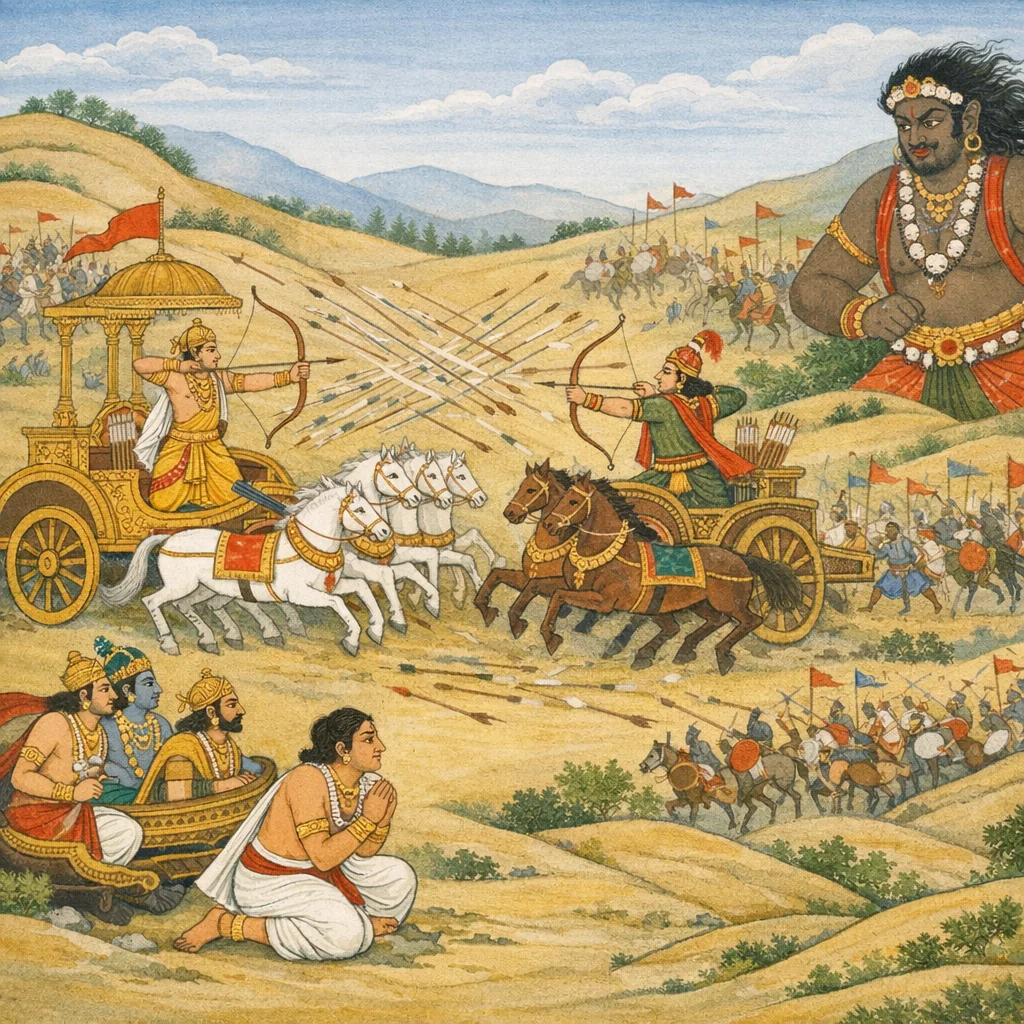
Adhyaya 175
Chapter Arc: कुरुक्षेत्र के कोलाहल में कर्ण का रथ फिर से वेग पकड़ता है—सारथि नए, शंखवर्ण तीव्र घोड़े जोत देता है, मानो युद्ध का भाग्य ही पुनः कस दिया गया हो। → धृष्टद्युम्न और कर्ण आमने-सामने होकर बाण-वृष्टि से एक-दूसरे को ढक देते हैं; कर्ण के सायकों से पांचाल-पक्ष में चीख-पुकार उठती है और रथी-समूह बिखरने लगता है। युधिष्ठिर के मन में घबराहट बढ़ती है—कर्ण निर्भय घूमता हुआ भागते रथों पर तीक्ष्ण शर बरसाता दिखता है। → युधिष्ठिर की आशंका चरम पर पहुँचती है और श्रीकृष्ण-अर्जुन के सम्मुख निर्णायक प्रस्ताव उभरता है—‘इस समय महाबली घटोत्कच ही कर्ण का सामना करे’; क्योंकि कर्ण के पास इन्द्रदत्त शक्ति है जो रौद्र रूप धारण करती है। → रणनीति का पलटाव तय होता है: कर्ण को रोकने/उसकी शक्ति को निष्फल कराने हेतु घटोत्कच को अग्रिम मोर्चे पर भेजने का निश्चय बनता है, ताकि पांचालों की टूटती पंक्ति और युधिष्ठिर की डगमगाती धीरता को सहारा मिले। → कर्ण और घटोत्कच का संग्राम आरम्भ होने को है—इन्द्र और प्रह्लाद-सदृश महायुद्ध की आहट के साथ, इन्द्रदत्त शक्ति के प्रयोग का भयावह संकेत हवा में टँगा रह जाता है।
Shlokas
Verse 1
अफ-४#-कात त्रिसप्तत्यांधिकशततमोब<् ध्याय: कर्णद्वारा धृष्टद्युम्न एवं पांचालोंकी पराजय, युधिष्ठिरकी घबराहट तथा श्रीकृष्ण और अर्जुनका घटोत्कचको प्रोत्साहन देकर कर्णके साथ युद्धके लिये भेजना संजय उवाच ततः कर्णों रणे दृष्टवा पार्षत॑ं परवीरहा । आजचघानोरसि शरैर्दशभिरम्मर्मभेदिभि:,संजय कहते हैं--राजन्! तदनन्तर शत्रुवीरोंका संहार करनेवाले कर्णने रणभूमिमें धष्टद्युम्नको उपस्थित देख उनकी छातीमें दस मर्मभेदी बाण मारे
Sañjaya said: Then Karṇa—slayer of enemy champions—seeing the son of Pṛṣata (Dhṛṣṭadyumna) on the battlefield, struck him in the chest with ten arrows that pierced the vital points. The scene underscores the ruthless precision of war, where heroic identity and personal enmity are expressed through targeted violence rather than restraint.
Verse 2
प्रतिविव्याध त॑ तूर्ण धृष्टद्युम्नोडपि मारिष | दशभि: सायकै्शष्टस्तिष्ठ तिछेति चाब्रवीत्,माननीय नरेश! तब धृष्टद्युम्नने भी हर्ष और उत्साहमें भरकर दस बाणोंद्वारा तुरंत ही कर्णको घायल करके बदला चुकाया और कहा--'खड़ा रह, खड़ा रह”
Sanjaya said: Then Dhrishtadyumna, O venerable one, swiftly struck him in return. Wounding Karna with ten arrows, he repaid the attack and cried out, “Stand firm—stand firm!” In the heat of righteous fury and warrior pride, the exchange underscores the battlefield ethic of answering force with force and meeting one’s opponent openly rather than retreating.
Verse 3
तावन्योन्यं शरै: संख्ये संछाद्य सुमहारथै: । पुनः पूर्णायतोत्सूष्टविंव्यघाते परस्परम्,वे दोनों विशाल रथपर आरूढ़ हो युद्धसस््थलमें एक-दूसरेको अपने बाणोंद्वारा आच्छादित करके पुनः धनुषको पूर्णरूपसे खींचकर छोड़े गये बाणोंद्वारा परस्पर आघात- प्रत्याघात करने लगे
Verse 4
ततः: पाज्चालमुख्यस्य धृष्टद्युम्नस्य संयुगे । सारथिं चतुरश्चाश्चान् कर्णो विव्याध सायकै:,तत्पश्चात् रणभूमिमें कर्णने अपने बाणोंद्वारा पांचाल देशके प्रमुख वीर धृष्टद्युम्नके सारथि और चारों घोड़ोंको घायल कर दिया
Sañjaya said: Then, in the thick of battle, Karṇa struck with his arrows the charioteer and the four horses of Dhṛṣṭadyumna, the foremost hero of the Pāñcālas—an act aimed at disabling the opponent’s mobility and command in war rather than meeting him only in direct personal combat.
Verse 5
कार्मुकप्रवरं चापि प्रचिच्छेद शितै: शरै: । सारथिं चास्य भल्लेन रथनीडादपातयत्,इतना ही नहीं, उसने अपने तीखे बाणोंसे धृष्टद्युम्नके श्रेष्ठ धनुषको भी काट दिया और एक भल्ल मारकर उनके सारथिको भी रथकी बैठकसे नीचे गिरा दिया
Sañjaya said: With razor-sharp arrows he also cut down Dhṛṣṭadyumna’s excellent bow; and with a broad-headed shaft he struck down his charioteer, casting him from the chariot-seat. The scene underscores how, in the brutal ethics of battlefield duty, disabling an opponent’s weapons and mobility becomes a decisive—though grim—means of turning the tide.
Verse 6
धृष्टद्युम्नस्तु विरथो हताश्वो हतसारथि: । गृहीत्वा परिघं घोरं कर्णस्याश्वानपीपिषत्,घोड़े और सारथिके मारे जानेपर रथहीन हुए धृष्टद्युम्नने एक भयंकर परिघ उठाकर उसके द्वारा कर्णके घोड़ोंको पीस डाला
Sanjaya said: Dhrishtadyumna, now deprived of his chariot—his horses slain and his charioteer killed—seized a dreadful iron club and, driven by the ruthless logic of battle, crushed Karna’s horses. In the moral haze of war, the act shows how combatants, once stripped of their own supports, turn to sheer force to disable the enemy’s means of fighting, intensifying the spiral of violence.
Verse 7
विद्धश्न बहुभिस्तेन शरैराशीविषोपमै: । ततो युधिष्ठिरानीकं पद्धयामेवान्वपद्यत,उस समय कर्णने विषधर सर्पके समान भयंकर एवं बहुसंख्यक बाणोंद्वारा उन्हें क्षत- विक्षत कर दिया। फिर वे युधिष्ठिरकी सेनामें पैदल ही चले गये
Sañjaya said: Struck and torn by his many arrows—terrible as venomous serpents—he then made his way on foot into Yudhiṣṭhira’s battle-array. Even amid the cruelty of war, the verse underscores the stark moral atmosphere of the field: injury does not end resolve, and the struggle presses onward into the very heart of the righteous king’s forces.
Verse 8
आरुरोह रथं चापि सहदेवस्य मारिष । प्रयातुकाम: कर्णाय वारितो धर्मसूनुना,आर्य! वहाँ धृष्टद्युम्न सहदेवके रथपर जा चढ़े और पुन: कर्णका सामना करनेके लिये जानेको उद्यत हुए, किंतु धर्मपुत्र युधिष्ठिरने उन्हें रोक दिया
Sañjaya said: “O venerable one, Dhṛṣṭadyumna mounted Sahadeva’s chariot and, intent on going forth again to confront Karṇa, was restrained by the son of Dharma (Yudhiṣṭhira).” The moment underscores a dharmic check on impulsive retaliation: even in war, rightful leadership curbs rash pursuit when it may endanger strategy, lives, or moral order.
Verse 9
कर्णस्तु सुमहातेजा: सिंहनादविमिश्रितम् । धनु:शब्दं महच्चक्रे दथ्मौ तारेण चाम्बुजम्,उधर महातेजस्वी कर्णने सिंहनादके साथ-साथ अपने धनुषकी महती टंकारध्वनि फैलायी और उच्चस्वरसे शंख बजाया
Sañjaya said: Karṇa, blazing with great splendor, raised a mighty bow-twang mingled with a lion-like roar, and then blew his conch—called Āmbuja—with a piercing, high note. In the moral atmosphere of the war, this is a deliberate proclamation of resolve and intimidation: a warrior publicly signals readiness to fight, seeking to strengthen his own side’s courage while shaking the enemy’s composure.
Verse 10
दृष्टवा विनिर्जित युद्धे पार्षत॑ ते महारथा: । अमर्षवशमापतन्ना: पठचाला: सहसोमका:,युद्धमें धृष्टद्यम्नको परास्त हुआ देख अमर्षमें भरे हुए वे पांचाल और सोमक महारथी सूतपुत्र कर्णके वधके लिये सब प्रकारके अस्त्र-शस्त्र लेकर मृत्युको ही युद्धसे निवृत्त होनेकी अवधि निश्चित करके उसकी ओर चल दिये
Sañjaya said: Seeing Dṛṣṭadyumna, the son of Pṛṣat, defeated in battle, those great chariot-warriors of the Pāñcālas, together with the Somakas, were seized by burning indignation. Resolving to stake their very lives and armed with every weapon, they surged forward toward Karṇa, intent on his destruction—driven by wrath and loyalty rather than restraint.
Verse 11
सूतपुत्रवधार्थाय शस्त्राण्यादाय सर्वश: । प्रययु: कर्णमुद्दिश्य मृत्युं कृत्वा निवर्तनम्,युद्धमें धृष्टद्यम्नको परास्त हुआ देख अमर्षमें भरे हुए वे पांचाल और सोमक महारथी सूतपुत्र कर्णके वधके लिये सब प्रकारके अस्त्र-शस्त्र लेकर मृत्युको ही युद्धसे निवृत्त होनेकी अवधि निश्चित करके उसकी ओर चल दिये
Sañjaya said: Enraged on seeing Dhṛṣṭadyumna routed in battle, the Pāñcāla and Somaka great chariot-warriors took up every kind of weapon with a grim resolve—counting death itself as the only limit to their withdrawal—and advanced, aiming at Karṇa, the charioteer’s son, intent on his slaying. The verse underscores the war’s hardening of intent: valor becomes inseparable from vengeance, and the fighters bind themselves to a fatalistic ethic of ‘no retreat except in death.’
Verse 12
कर्णस्यापि रथे वाहानन्यान् सूतो5भ्ययोजयत् | शड्खवर्णान् महावेगान् सैन्धवान् साधुवाहिन:,उधर कर्णके रथमें भी उसके सारथिने दूसरे घोड़े जोत दिये। वे सिंधी घोड़े अच्छी तरह सवारीका काम देते थे। उनका रंग शंखके समान सफेद था और वे बड़े वेगशाली थे
Sañjaya said: Even for Karṇa’s chariot, the charioteer yoked a fresh team of horses. They were Sindhu-bred steeds—reliable for bearing a rider—white as a conch and possessed of great speed. In the midst of war, the scene underscores the practical ethics of battle: sustaining one’s warrior through competent support and readiness, where logistics and skill become decisive instruments of fate.
Verse 13
लब्धलक्ष्यस्तु राधेय: पञ्चालानां महारथान् | अभ्यपीडयदायस्त: शरैमेंघ इवाचलम्,राधापुत्र कर्णका निशाना कभी चूकता नहीं था। जैसे मेघ किसी पर्वतपर जलकी धारा गिराता है, उसी प्रकार वह प्रयत्नपूर्वक बाणोंकी वर्षा करके पांचाल महारथियोंको पीड़ा देने लगा
Sañjaya said: Having found his mark, Rādheya (Karna) began to press hard upon the great chariot-warriors of the Pāñcālas. With tireless effort he showered them with arrows, like a rain-cloud pouring streams upon a mountain—an image of relentless martial force that, in the ethical frame of the war, highlights both the warrior’s skill and the crushing cost borne by those caught in the storm of battle.
Verse 14
सा पीड्यमाना कर्णेन पञ्चालानां महाचमू: । सम्प्राद्रवत् सुसंत्रस्ता सिंहेनेवार्दिता मृगी,कर्णके द्वारा पीड़ित होनेवाली पांचालोंकी वह विशाल वाहिनी सिंहसे सतायी गयी हरिणीकी भाँति अत्यन्त भयभीत होकर वेगपूर्वक भागने लगी
Sañjaya said: Tormented by Karṇa, the great host of the Pāñcālas, seized by extreme panic, broke and fled in haste—like a doe harried by a lion. The image underscores how fear and overwhelming force can dissolve even a vast army’s cohesion, turning valor into mere survival amid the moral chaos of war.
Verse 15
पतितास्तुरगेभ्यश्व गजेभ्यश्व महीतले | रथेभ्यश्व नरास्तूर्णमदृश्यन्त ततस्तत:,कितने ही मनुष्य वहाँ इधर-उधर घोड़ों, हाथियों और रथोंसे तुरंत ही गिरकर धराशायी हुए दिखायी देने लगे
Sañjaya said: Then, in every direction, men were seen falling swiftly to the ground—toppling from horses, from elephants, and from chariots—strewn across the battlefield. The scene underscores the relentless cost of war, where prowess and rank offer no refuge from sudden downfall.
Verse 16
धावमानस्य योधस्य क्षुरप्रै: स महामृथे । बाहू चिच्छेद वै कर्ण: शिरश्चनैव सकुण्डलम्,कर्ण उस महासमरमें अपने क्षुरप्रोंद्वारा भागते हुए योद्धाकी दोनों भुजाओं तथा कुण्डलमण्डित मस्तकको भी काट डाला था
Sañjaya said: In that great and furious battle, Karṇa, with his razor‑edged arrows, cut off the arms of the fleeing warrior, and then severed his head as well—still adorned with earrings. The verse underscores the brutal momentum of war, where prowess and wrath can eclipse restraint, and where the consequences of choosing battle unfold with irreversible finality.
Verse 17
ऊरू चिच्छेद चान्यस्य गजस्थस्य विशाम्पते । वाजिपृष्ठगतस्यापि भूमिष्ठस्थ च मारिष,माननीय प्रजानाथ! दूसरे योद्धा जो हाथियोंपर बैठे थे, घोड़ोंकी पीठपर सवार थे और पृथ्वीपर पैदल चलते थे, उनकी भी जाँघें कर्णने काट डालीं
Sañjaya said: O lord of the people, Karṇa severed the thighs of another warrior—whether he was seated upon an elephant, mounted on a horse’s back, or standing on the ground on foot. Thus, in the fury of battle, he struck down fighters of every station and mode of combat, displaying the ruthless efficiency that war unleashes when dharma is eclipsed by the drive to destroy.
Verse 18
नाज्ञासिषुर्धावमाना बहवश्न महारथा: । संछिन्नान्यात्मगात्राणि वाहनानि च संयुगे,भागते हुए बहुत-से महारथी उस युद्धस्थलमें अपने कटे हुए अंगों और वाहनोंको नहीं जान पाते थे
Sañjaya said: In the turmoil of battle, many great chariot-warriors, rushing headlong, could not even recognize their own severed limbs and their shattered vehicles. The scene reveals how war overwhelms discernment and self-awareness, reducing even the mighty to confusion amid the consequences of violence.
Verse 19
ते वध्यमाना: समरे पञ्चाला: सृञ्जयै: सह । तृणप्रस्पन्दनाच्चापि सूतपुत्र सम मेनिरे,समरांगणमें मारे जाते हुए पांचाल और सूंजय एक तिनकेके हिल जानेसे भी सूतपुत्र कर्णको ही आया हुआ मानने लगते थे
Sañjaya said: As the Pāñcālas, together with the Sṛñjayas, were being cut down in battle, they came to think that even the mere quivering of a blade of grass meant the arrival of Karṇa, the charioteer’s son. Such was the dread his presence inspired on the field—so that fear itself began to read omens into the smallest movement.
Verse 20
अपि स्वं समरे योधं धावमानं विचेतसम् । कर्णमेवाभ्यमन्यन्त ततो भीता द्रवन्ति ते,उस रणभूमिमें अचेत होकर भागते हुए अपने योद्धाको भी वे कर्ण ही समझ लेते और उसीसे डरकर भागने लगते थे
Sañjaya said: Even when they saw their own warrior on the battlefield—running in confusion and bereft of composure—they mistook him for Karṇa. Struck by that fear, they fled, their panic turning perception itself into error.
Verse 21
तान्यनीकानि भग्नानि द्रवमाणानि भारत | अभ्यद्रवद् द्रुतं कर्ण: पृष्ठठो विकिरन् शरान्,भारत! भयभीत होकर भागते हुए उन सैनिकोंके पीछे बाणोंकी वर्षा करता हुआ कर्ण बड़े वेगसे धावा करता था
Sañjaya said: “O Bhārata, as those battle-formations broke and the troops fled in panic, Karṇa swiftly charged after them, showering arrows from behind.” The verse underscores the ruthless momentum of war: fear turns ranks into flight, and a relentless pursuer exploits that collapse, intensifying the moral and human cost of the battlefield.
Verse 22
अवेक्षमाणास्त्वन्योन्यं सुसम्मूढा विचेतस: । नाशवनुवन्नवस्थातुं काल्यमाना महात्मना,महामनस्वी कर्णके द्वारा कालके गालमें भेजे जाते हुए मोहित एवं अचेत पांचाल- सैनिक एक-दूसरेकी ओर देखते हुए कहीं भी ठहर न सके
Sañjaya said: Bewildered and robbed of clear judgment, the Pāñcāla warriors kept looking at one another; driven on and pressed hard by that great-souled hero, they could not stand their ground anywhere.
Verse 23
कर्णेनाभ्याहता राजन् पञ्चाला: परमेषुभि: । द्रोणेन च दिश: सर्वा वीक्षमाणा: प्रदुद्र॒ुवु:,राजन! कर्ण और द्रोणाचार्यके चलाये हुए उत्तम बाणोंसे घायल होकर पांचाल-सैनिक सम्पूर्ण दिशाओंकी ओर देखते हुए भाग रहे थे
Sañjaya said: O King, struck down by Karṇa’s finest arrows, and also by Droṇa’s shafts, the Pāñcāla warriors—glancing in all directions in fear and confusion—broke ranks and fled.
Verse 24
ततो युधिष्छिरो राजा स्वसैन्यं प्रेक्ष्य विद्रुतम् । अपयाने मन: कृत्वा फाल्गुनं वाक्यमब्रवीत्,उस समय राजा युधिष्ठिरने अपनी सेनाको भागती देख स्वयं भी युद्धभूमिसे हट जानेका विचार करके अर्जुनसे इस प्रकार कहा--
Then King Yudhiṣṭhira, seeing his own army in flight, set his mind on withdrawing from the battlefield; and he spoke these words to Phālguna (Arjuna).
Verse 25
पश्य कर्ण महेष्वासं धनुष्पाणिमवस्थितम् । निशीथे दारुणे काले तपन्तमिव भास्करम्,'पार्थ! महाधनुर्धर कर्णको देखो; वह हाथमें धनुष लिये खड़ा है और इस भयंकर आधी रातके समय सूर्यके समान तप रहा है
Sañjaya said: “Behold Karṇa, that great archer, standing firm with bow in hand. In the dreadful hour of midnight he blazes forth, scorching like the sun.” The line heightens the moral tension of the war: Karṇa’s formidable prowess is portrayed as awe-inspiring and fearsome, suggesting how martial excellence, when yoked to a destructive cause, can become a consuming fire in the night of dharma’s eclipse.
Verse 26
कर्णसायकनुन्नानां क्रोशतामेष नि:स्वन: । अनिशं श्रूयते पार्थ त्वद्वन्धूनामनाथवत्,“अर्जुन! कर्णके बाणोंसे घायल होकर अनाथके समान चीखते-चिल्लाते हुए तुम्हारे सहायक बन्धुओंका यह आर्तनाद निरन्तर सुनायी दे रहा है
Sañjaya said: “O Pārtha, this wailing cry of your kinsmen and allies—struck and driven by Karṇa’s arrows—keeps being heard without pause, as though they were helpless and without a protector.”
Verse 27
यथा विसृजतश्चास्य संदधानस्य चाशुगान् । पश्यामि नान्तरं पार्थ क्षपयिष्यति नो ध्रुवम्,“कर्ण कब बाणोंको धनुषपर रखता है और कब उन्हें छोड़ता है, इसमें तनिक भी अन्तर मुझे नहीं दिखायी देता है। इससे जान पड़ता है यह निश्चय ही हमारी सारी सेनाका संहार कर डालेगा
Verse 28
यदत्रानन्तरं कार्य प्राप्तकालं च पश्यसि । कर्णस्य वधसंयुक्तं तत् कुरुष्व धनंजय,“धनंजय! अब यहाँ कर्णके वधके सम्बन्धमें तुम्हें जो समयोचित कर्तव्य दिखायी देता हो, उसे करो”
Sanjaya said: “O Dhananjaya (Arjuna), whatever immediate duty you discern here as timely and necessary—especially that which is bound up with the slaying of Karna—do it now.”
Verse 29
एवमुक्तो महाराज पार्थ: कृष्णमथाब्रवीत् । भीत: कुन्तीसुतो राजा राधेयस्याद्य विक्रमात्,महाराज! युधिष्ठिरके ऐसा कहनेपर अर्जुन भगवान् श्रीकृष्णसे बोले--'प्रभो! आज कुन्तीनन्दन राजा युधिष्ठिर राधापुत्र कर्णके पराक्रमसे भयभीत हो गये हैं
Sañjaya said: “Thus addressed, O great king, Pārtha (Arjuna) then spoke to Kṛṣṇa: ‘Today King Yudhiṣṭhira, the son of Kuntī, has become fearful because of the prowess displayed by Rādheya (Karna).’” The verse highlights how even a righteous ruler may be shaken amid war when confronted with overwhelming martial power, and how counsel is sought from a trusted guide at such moments.
Verse 30
एवंगते प्राप्तकालं कर्णानीके पुन: पुन: । भवान् व्यवस्यतु क्षिप्रं द्रवते हि वरूथिनी,'ऐसी अवस्थामें कर्णकी सेनाके पास हमारा जो समयोचित कर्तव्य हो, उसका आप शीघ्र निश्चय करें; क्योंकि हमारी सेना बारंबार भाग रही है
Sañjaya said: “Since matters have come to this pass and the decisive moment has arrived in Karṇa’s division, you must quickly determine what ought to be done. For our battle-array is repeatedly breaking and fleeing.”
Verse 31
द्रोणसायकनुन्नानां भग्नानां मधुसूदन । कर्णेन त्रास्यमानानामवस्थानं न विद्यते,“मधुसूदन! द्रोणाचार्यके बाणोंसे घायल और कर्णसे भयभीत होकर भागते हुए हमारे सैनिक कहीं भी ठहर नहीं पाते हैं
Sañjaya said: “O Madhusūdana, our troops—pierced and driven on by Droṇa’s arrows, shattered in spirit, and terror-stricken by Karṇa—find no place to stand their ground; they cannot hold any position.”
Verse 32
पश्यामि च तथा कर्ण विचरन्तमभीतवत् । द्रवमाणान् रथोदारान् किरन्तं निशितै: शरै:,“मैं देखता हूँ, कर्ण निर्भय-सा विचर रहा है और भागते हुए श्रेष्ठ रथियोंपर भी पीछेसे तीखे बाणोंकी वर्षा कर रहा है
Sañjaya said: “I see Karṇa moving about as though fearless, and even upon the noble chariot-warriors who are fleeing, he showers a rain of sharp arrows from behind.”
Verse 33
नैनं शक्ष्यामि संसोढुं चरन्तं रणमूर्थनि । प्रत्यक्ष वृष्णिशार्दूल पादस्पर्शमिवोरग:,“वृष्णिसिंह! जैसे सर्प किसीके चरणोंका स्पर्श नहीं सह सकता, उसी प्रकार मैं युद्धके मुहानोंपर अपनी आँखोंके सामने कर्णका इस प्रकार विचरना नहीं सह सकूँगा
Sañjaya said: “O tiger among the Vṛṣṇis, I cannot bear to see him moving about on the very forefront of the battlefield before my eyes—just as a serpent cannot endure the touch of a man’s foot.”
Verse 34
स भवांस्तत्र यात्वाशु यत्र कर्णो महारथ: । अहमेनं हनिष्यामि मां वैष मधुसूदन,“मधुसूदन! अतः आप शीघ्र वहीं चलिये, जहाँ महारथी कर्ण है। आज मैं इसे मार डालूँगा या यह मुझे (मार डालेगा)'
Sañjaya said: “O Madhusūdana, go quickly to the place where Karṇa, that great chariot-warrior, stands. Today I shall surely slay him—or he will slay me.” The utterance conveys a warrior’s grim resolve, framing the encounter as a decisive, duty-bound confrontation in which life is staked without evasion.
Verse 35
श्रीवायुदेव उवाच पश्यामि कर्ण कौन्तेय देवराजमिवाहवे । विचरन्तं नरव्याप्रमतिमानुषविक्रमम्,भगवान् श्रीकृष्णने कहा--कुन्तीनन्दन! आज युद्धस्थलमें मैं पुरुषसिंह कर्णको देवराज इन्द्रके समान अमानुषिक पराक्रम प्रकट करते और विचरते देख रहा हूँ
Verse 36
नैतस्यान्यो<स्ति संग्रामे प्रत्युद्याता धनंजय । ऋते त्वां पुरुषव्याप्र राक्षसाद् वा घटोत्कचात्,पुरुषसिंह धनंजय! संग्रामभूमिमें तुम्हें अथवा राक्षस घटोत्कचको छोड़कर दूसरा कोई ऐसा नहीं है, जो इसका सामना कर सके
Vāyu said: “O Dhanañjaya, in this battle there is no other warrior who can truly rise to confront him—except you, O tiger among men, or else the Rākṣasa Ghaṭotkaca. This is a sober appraisal of strength and duty: when a foe is beyond the reach of ordinary fighters, responsibility falls upon the few capable champions, so that the wider host is not needlessly sacrificed.”
Verse 37
न तु तावदहं मन्ये प्राप्तकालं तवानघ । समागमं महाबाहो सूतपुत्रेण संयुगे,निष्पाप महाबाहु अर्जुन! इस समय रणक्षेत्रमें सूतपुत्रके साथ तुम्हारा युद्ध करना मैं उचित नहीं मानता
Vāyu said: “Not yet do I consider the time to be right for you, O sinless one. O mighty-armed hero, I do not deem it proper that you should engage in combat with the charioteer’s son at this moment.”
Verse 38
दीप्यमाना महोल्केव तिष्ठत्यस्य हि वासवी । त्वदर्थ हि महाबाहों सूतपुत्रेण संयुगे
Vāyu said: “Vāsavī (Indra’s divine power/weapon) stands by him, blazing like a great meteor. O mighty-armed one, it is being held there for your sake, to be used in battle against the sūta’s son (Karna).”
Verse 39
घटोत्कचस्तु राधेयं प्रत्युद्यातु महाबल:,अतः मेरी रायमें इस समय महाबली घटोत्कच ही राधापुत्र कर्णका सामना करनेके लिये जाय; क्योंकि वह बलवान् भीमसेनका बेटा है, देवताओंके समान पराक्रमी है तथा उसके पास राक्षससम्बन्धी एवं असुरसम्बन्धी सभी प्रकारके दिव्य अस्त्र-शस्त्र हैं
Vāyu said: “Let the mighty Ghaṭotkaca go forth to meet Rādheya (Karna). Therefore, in my judgment, at this moment it is Ghaṭotkaca alone who should confront Karna, the son of Rādhā—because he is the son of the powerful Bhīmasena, heroic like the gods, and he possesses every kind of divine weapon connected with the Rākṣasas and the Asuras.”
Verse 40
स हि भीमेन बलिना जात: सुरपराक्रम: । तस्मिन्नस्त्राणि दिव्यानि राक्षसान्यासुराणि च,अतः मेरी रायमें इस समय महाबली घटोत्कच ही राधापुत्र कर्णका सामना करनेके लिये जाय; क्योंकि वह बलवान् भीमसेनका बेटा है, देवताओंके समान पराक्रमी है तथा उसके पास राक्षससम्बन्धी एवं असुरसम्बन्धी सभी प्रकारके दिव्य अस्त्र-शस्त्र हैं
Vāyu said: “For he was born of the mighty Bhīma and possesses valor like that of the gods. In him are divine weapons—those belonging to the Rākṣasas and the Asuras as well. Therefore, at this moment, the great Ghaṭotkaca should be sent to confront Karṇa, the son of Rādhā.”
Verse 41
सतत चानुरक्तो वो हितैषी च घटोत्कच: । विजेष्यति रणे कर्णमिति मे नात्र संशय:,घटोत्कच तुमलोगोंका हितैषी है और सदा तुम्हारे प्रति अनुराग रखता है। वह रणभूमिमें कर्णको जीत लेगा, इसमें मुझे संशय नहीं है
Ghaṭotkaca is ever devoted to you and acts as your well-wisher. He will defeat Karṇa in battle—of this I have no doubt. The statement underscores loyal protection and confidence in righteous support amid the pressures of war.
Verse 42
एवमुक्तो महाबाहु: पार्थ: पुष्करलोचन: । आजुहावाथ तद् रक्षस्तच्चासीत् प्रादुरग्रत:
Thus addressed, the mighty-armed Pārtha (Arjuna), lotus-eyed, then invoked that rākṣasa; and it immediately manifested before him. The passage underscores the grave, war-bound urgency in which a warrior, having received counsel, acts decisively—summoning formidable aid to meet an ethical and strategic necessity on the battlefield.
Verse 43
भगवान् श्रीकृष्णफेके ऐसा कहनेपर महाबाहु कमलनयन कुन्तीकुमारने राक्षस घटोत्कचका आवाहन किया और वह तत्काल उनके सामने प्रकट हो गया ।। कवची सशर: खड्गी सधन्वा च विशाम्पते । अभिवाद्य ततः कृष्णं पाण्डवं च धनंजयम् | अब्रवीच्च तदा कृष्णमयमस्म्यनुशाधि माम्
Verse 44
प्रजानाथ! उसने कवच, धनुष, बाण और खड्ग धारण कर रखे थे। वह श्रीकृष्ण और पाण्डुपुत्र धनंजयको प्रणाम करके उस समय भगवान् श्रीकृष्णसे बोला--'प्रभो! यह मैं सेवामें उपस्थित हूँ। मुझे आज्ञा दीजिये, क्या करूँ?” ।। ततस्तं मेघसंकाशं दीप्तास्यं दीप्तकुण्डलम् | अभ्यभाषत हैडिम्बिं दाशार्ह: प्रहसन्निव,तदनन्तर प्रज्वलित मुख और प्रकाशित कुण्डलोंवाले मेघके समान काले हिडिम्बाकुमार घटोत्कचसे भगवान् श्रीकृष्णने हँसते हुए-से कहा
O Lord of creatures! Armed with his cuirass, bow, arrows, and sword, he bowed to Śrī Kṛṣṇa and to Dhanañjaya (Arjuna), the son of Pāṇḍu. Then he addressed Bhagavān Śrī Kṛṣṇa: “Master, I stand ready in service. Command me—what shall I do today?” Thereupon Dāśārha (Kṛṣṇa), as though smiling, spoke to the Haiḍimba (Ghaṭotkaca), dark as a rain-cloud, with a blazing face and shining earrings—signaling the disciplined readiness of a warrior who submits his power to rightful command in the midst of war.
Verse 45
श्रीवायुदेव उवाच घटोत्कच विजानीहि यत् त्वां वक्ष्यामि पुत्रक प्राप्तो विक्रमकालो5यं तव नान्यस्य कस्यचित्,भगवान् श्रीकृष्णने कहा--बेटा घटोत्कच! मैं तुमसे जो कुछ कह रहा हूँ, उसे सुनो और समझो। यह तुम्हारे लिये ही पराक्रम दिखानेका अवसर आया है, दूसरे किसीके लिये नहीं
Vāyu-deva said: “Ghaṭotkaca, my son, understand well what I am about to tell you. This is the moment appointed for your valor—meant for you alone, and for no one else.”
Verse 46
स भवान् मज्जमानानां बन्धूनां त्वं प्लवो भव । विविधानि तवास्त्राणि सन्ति माया च राक्षसी,तुम्हारे ये बन्धु संकटके समुद्रमें डूब रहे हैं, तुम इनके जहाज बन जाओ। तुम्हारे पास नाना प्रकारके अस्त्र-शस्त्र हैं और तुममें राक्षसी मायाका भी बल है
Vāyu said: “Your kinsmen are sinking in a sea of peril—become their raft and carry them across. You possess many kinds of weapons, and you also have the power of rākṣasa-like illusion; use these strengths to rescue your own.”
Verse 47
पश्य कर्णेन हैडिम्बे पाण्डवानामनीकिनी । काल्यमाना यथा गाव: पालेन रणमूर्थनि,हिडिम्बानन्दन! देखो, जैसे चरवाहा गायोंको हाँकता है, उसी प्रकार युद्धके मुहानेपर खड़ा हुआ कर्ण पाण्डवोंकी इस विशाल सेनाको खदेड़ रहा है
Vāyu said: “Look, O Haiḍimbī—see how Karṇa is driving back the Pāṇḍavas’ great host. Just as a cowherd urges cattle onward, so does Karṇa, standing at the very forefront of battle, herd and press that army away.” The image underscores the harsh asymmetry of war: a single formidable warrior can reduce masses to a driven herd, exposing how fear and force can eclipse deliberation and restraint on the battlefield.
Verse 48
एष कर्णों महेष्वासो मतिमान् दृढविक्रम: । पाण्डवानामनीकेषु निहन्ति क्षत्रियर्षभान्
Vāyu said: “This Karṇa—an archer of mighty bow, intelligent and of unshakable valor—cuts down the bull-like heroes among the Kṣatriyas within the battle-formations of the Pāṇḍavas.” The line underscores the grim momentum of war: prowess and resolve, when yoked to hostility, become instruments of mass destruction, testing the moral endurance of all who witness it.
Verse 49
यह कर्ण महाथधनुर्धर, बुद्धिमान् और दृढ़तापूर्वक पराक्रम प्रकट करनेवाला है। यह पाण्डवोंकी सेनाओंमें जो श्रेष्ठ क्षत्रिय वीर हैं, उनका विनाश कर रहा है ।। किरन्त: शरवर्षाणि महान्ति दृढ्धन्विन: । न शवनुवन्त्यवस्थातुं पीड्यमाना: शरार्चिषा,इसके बाणोंकी आगसे संतप्त हो बाणोंकी बड़ी भारी वर्षा करनेवाले सुदृढ़ धनुर्धर वीर भी युद्धभूमिमें ठहर नहीं पाते हैं
Vāyu said: “Karna—mighty with the bow, keen in counsel, and steadfast in the display of valor—now brings destruction upon the foremost Kshatriya heroes within the Pandava host. Even powerful archers, pouring forth great showers of arrows, cannot hold their ground on the battlefield when scorched and oppressed by the fiery brilliance of his shafts.”
Verse 50
निशीथे सूतपुत्रेण शरवर्षेण पीडिता: । एते द्रवन्ति पञ्चाला: सिंहेनेवार्दिता मृगा:
In the dead of night, tormented by the charioteer’s son through a relentless shower of arrows, the Pāñcālas flee in panic—like deer harried by a lion. The verse underscores how fear and violence, when unleashed without restraint, reduce even seasoned warriors to helpless flight, revealing the moral collapse that accompanies nocturnal slaughter.
Verse 51
देखो, जैसे सिंहसे पीड़ित हुए मृग भागते हैं, उसी प्रकार इस आधी रातके समय सूतपुत्रके द्वारा की हुई बाण-वर्षासे व्यथित हो ये पांचाल सैनिक भागे जा रहे हैं ।। एतस्यैवं प्रवृद्धस्य सूतपुत्रस्य संयुगे । निषेद्धा विद्यते नान्यस्त्वामृते भीमविक्रम,भयंकर पराक्रमी वीर! इस युद्धस्थलमें तुम्हारे सिवा दूसरा कोई ऐसा योद्धा नहीं है, जो इस प्रकार आगे बढ़नेवाले सूतपुत्र कर्णको रोक सके
Vāyu said: “Look—just as deer, harried by a lion, flee in panic, so too at this midnight hour the Pāñcāla soldiers, tormented by the arrow-storm unleashed by Karṇa, the son of a charioteer, are running for their lives. In this battle, as Karṇa’s onrush swells, there is no one who can check him—except you, O Bhīma of mighty prowess, a hero of dreadful valor. On this field of war, none but you is fit to halt Karṇa as he advances in this manner.”
Verse 52
स त्वं कुरु महाबाहो कर्म युक्तमिहात्मन: । मातुलानां 4 तेजसोअस्त्रबलस्य च
Therefore, O mighty-armed one, perform here the action that is fitting for your own duty and purpose—an action worthy of the splendour and martial power of your maternal uncles as well. In this crisis, let your conduct match the honour of your lineage and the strength of your arms.
Verse 53
महाबाहो! तुम अपने पिता, मामा, तेज, अस्त्रबल तथा अपनी प्रतिष्ठके अनुरूप युद्धमें पराक्रम करो ।। एतदर्थ हि हैडिम्बे पुत्रानिच्छन्ति मानवा: | कथं नस्तारयेद् दुःखात् स त्वं तारय बान्धवान्,हिडिम्बाकुमार! मनुष्य इसीलिये पुत्रकी इच्छा करते हैं कि वह किसी प्रकार हमें दुःखसे छुड़ायेगा; अतः तुम अपने बन्धु-बान्धवोंको उबारो
O mighty-armed one, display in battle the valor that befits your lineage—your father, your maternal kin, your splendor, your mastery of weapons, and your established honor. For this very reason, O Haiḍimbī’s son, people desire sons: that they may somehow be rescued from suffering. Therefore, deliver your own kinsmen and relatives from distress, O prince of Hiḍimbā.
Verse 54
इच्छन्ति पितर: पुत्रान् स्वार्थहेतोर्घटोत्कच । इहलोकात् परे लोके तारयिष्यन्ति ये हिता:,घटोत्कच! प्रत्येक पिता अपने इसी स्वार्थके लिये पुत्रोंकी इच्छा करता है कि वे पुत्र मेरे हितैषी होकर मुझे इस लोकसे परलोकमें तार देंगे
Vāyu-deva said: “O Ghaṭotkaca, fathers desire sons for their own sake—believing that devoted, well-wishing sons will carry them from this world into the next. The bond of parent and child is thus also framed as an ethical responsibility: the son’s duty and goodwill become the father’s hoped-for support beyond death.”
Verse 55
तव हद्वात्र बल॑ भीम॑ मायाश्व तव दुस्तरा: । संग्रामे युध्यमानस्य सततं भीमनन्दन,भीमनन्दन! संग्रामभूमिमें युद्ध करते समय सदा तुम्हारा भयंकर बल बढ़ता है और तुम्हारी मायाएँ दुस्तर होती हैं
Vāyu said: “O Bhīma, your inner strength and driving force ever increase; and your powers of stratagem and illusion become hard to overcome. As you fight on the battlefield, O son of Bhīma—again I say, O Bhīma’s son—your terrible might continually grows.”
Verse 56
पाण्डवानां प्रभग्नानां कर्णेन निशि सायकै: । मज्जतां धार्तराष्ट्रेषु भव पारं परंतप,परंतप! रातके समय कर्णके बाणोंसे क्षत-विक्षत होकर पाण्डव-सैनिकोंके पाँव उखड़ गये हैं और वे कौरव-सेनारूपी समुद्रमें डूब रहे हैं। तुम उनके लिये तटभूमि बन जाओ
Vāyu said: “The Pāṇḍavas’ forces have been shattered by Karṇa’s arrows in the night. As they sink amid the Dhārtarāṣṭras, become for them the far shore—O scorcher of foes, O scorcher of foes!” In the ethical frame of the epic, the plea urges steadfast protection of the vulnerable when the tide of war turns against them, calling for courage and rescue rather than despair.
Verse 57
रात्रौ हि राक्षसा भूयो भवन्त्यमितविक्रमा: । बलवन्त: सुदुर्धर्षा: शूरा विक्रान्तचारिण:,रात्रिके समय राक्षसोंका अनन्त पराक्रम और भी बढ़ जाता है। वे बलवान, परम दुर्धर्ष, शूरवीर और पराक्रमपूर्वक विचरनेवाले होते हैं
Vāyu-deva said: “For the rākṣasas, night is the time when their might swells even further. Then they become exceedingly powerful—hard to assail, heroic, and roaming with bold, forceful prowess.”
Verse 58
जहि कर्ण महेष्वासं निशीथे मायया रणे । पार्था द्रोणं वधिष्यन्ति धृष्टद्युम्नपुरोगमा:,तुम आधी रातके समय अपनी मायाद्वारा रणभूमिमें महाधनुर्धर कर्णको मार डालो और धृष्टद्युम्न आदि पाण्डव-सैनिक द्रोणाचार्यका वध करेंगे
Vāyu said: “Slay Karṇa, that great archer, on the battlefield at midnight by means of your stratagem. Then the sons of Pṛthā, led by Dhṛṣṭadyumna, will bring about the death of Droṇa.” The utterance frames a grim wartime calculus: victory is forecast through night-attack and deception, revealing how, in the pressure of total war, even renowned heroes become targets of planned, ethically fraught tactics.
Verse 59
संजय उवाच केशवस्य वच: श्रुत्वा बीभत्सुरपि राक्षसम् | अभ्यभाषत कौरव्य घटोत्कचमरिंदमम्,संजय कहते हैं--कुरुगज! भगवान् श्रीकृष्फका यह वचन सुनकर अर्जुनने भी शत्रुओंका दमन करनेवाले राक्षस घटोत्कचसे कहा--
Sanjaya said: O descendant of Kuru, having heard Keshava’s words, even Arjuna—Bibhatsu—addressed the Rakshasa Ghatotkacha, the subduer of foes. The scene underscores disciplined obedience to wise counsel in the midst of war, as Arjuna turns to a formidable ally for the sake of the larger duty of the battle.
Verse 60
घटोत्कच भवांश्वैव दीर्घबाहुश्व सात्यकि: । मतो मे सर्वसैन्येषु भीमसेनश्न पाण्डव:,'घटोत्कच! मेरी सम्पूर्ण सेनाओंमें तीन ही वीर श्रेष्ठ माने गये हैं--तुम, महाबाहु सात्यकि तथा पाण्डुनन्दन भीमसेन
Sañjaya said: “O Ghaṭotkaca, in my judgment there are only three warriors who stand foremost among all the armies—yourself, the long-armed Sātyaki, and Bhīmasena, the son of Pāṇḍu.” In the midst of war, Sañjaya marks out exceptional strength and resolve, highlighting how individual prowess can decisively shape the moral and strategic stakes of the conflict.
Verse 61
तद्भधवान् यातु कर्णेन द्वैरथं युध्यतां निशि । सात्यकि: पृष्ठगोपस्ते भविष्यति महारथ:
Sañjaya said: “Then let that venerable one proceed with Karṇa; let them engage in a chariot-duel by night. The great chariot-warrior Sātyaki will serve as your rear-guard and protector.”
Verse 62
“अतः तुम इस निशीथकालमें कर्णके साथ द्वैरथ युद्ध करो और महारथी सात्यकि तुम्हारे पृष्ठरक्षक होंगे ।। जहि कर्ण रणे शूरं सात्वतेन सहायवान् । यथेन्द्रस्तारकं पूर्व स्कन्देन सह जध्निवान्
Sañjaya said: “Therefore, slay the heroic Karṇa in battle, supported by the Sātvata (Sātyaki) as your ally—just as Indra once slew Tāraka in former times together with Skanda. Let Sātyaki guard your rear while you engage Karṇa in this critical hour.”
Verse 63
'जैसे पूर्वकालमें स्कन्दके साथ रहकर इन्द्रने तारकासुरका वध किया था, उसी प्रकार तुम भी सात्यकिकी सहायता पाकर रणभूमिमें शूरवीर कर्णको मार डालो” ।। घटोत्कच उवाच (एवमेव महाबाहो यथा वदसि मां प्रभो । त्वया नियुक्तो गच्छामि कर्णस्य वधकाडुक्षया ।।) अलमेवास्मि कर्णाय द्रोणायालं च भारत । अन््येषां क्षत्रियाणां च कृतास्त्राणां महात्मनाम्,घटोत्कचने कहा--महाबाहो! प्रभो! आप मुझे जैसा कह रहे हैं, वैसा ही है। मैं आपका भेजा हुआ कर्णके वधकी इच्छासे जा रहा हूँ। भारत! मैं कर्णका सामना करनेमें तो समर्थ हूँ ही, द्रोणाचार्यका भी अच्छी तरह सामना कर सकता हूँ। अस्त्र-विद्याके जाननेवाले ये जो दूसरे महामनस्वी क्षत्रिय हैं, उनके साथ भी लोहा ले सकता हूँ
Ghaṭotkaca said: “So it is, mighty-armed one—exactly as you command me, my lord. Appointed by you, I go forth with the resolve to bring about Karṇa’s death. O Bhārata, I am fully capable of facing Karṇa, and I can also confront Droṇa well. And I can stand against those other great-souled kṣatriyas too, who are accomplished in the use of weapons.”
Verse 64
अद्य दास्यामि संग्रामं सूतपुत्राय तं निशि । यं जना: सम्प्रवक्ष्यन्ति यावद् भूमिर्धरिष्यति,आज मैं इस रातमें सूतपुत्र कर्णके साथ ऐसा संग्राम करूँगा, जिसकी चर्चा जबतक यह पृथ्वी रहेगी, तबतक लोग करते रहेंगे
Ghaṭotkaca declares that tonight he will engage Karṇa, the charioteer’s son, in such a battle that people will speak of it for as long as the earth endures—an announcement of a fated, fame-bearing duel in the midst of a war where renown and resolve are pursued even at the cost of life.
Verse 65
नचात्र शूरान् मोक्ष्यामि न भीतान्न कृताञज्जलीन् । सवनिव वधिष्यामि राक्षसं धर्ममास्थित:,इस युद्धमें मैं न तो शूरवीरोंको जीवित छोड़ूँगा, न डरनेवालॉंको और न हाथ जोड़नेवालोंको ही। राक्षस-धर्मका आश्रय लेकर सबका ही संहार कर डालूँगा
“Here I will spare no one—neither the brave, nor the frightened, nor even those who plead with folded hands. Standing upon the code of the rākṣasas, I will strike them down like a sacrificial offering, without exception.”
Verse 66
संजय उवाच एवमुक््त्वा महाबाहुहैंडिम्बिर्वरवीरहा । अभ्ययात् तुमुले कर्ण तव सैन्यं विभीषयन्,संजय कहते हैं--राजन! श्रेष्ठ वीरोंका संहार करनेवाला महाबाहु हिडिम्बाकुमार ऐसा कहकर उस भयंकर युद्धमें आपकी सेनाको भयभीत करता हुआ कर्णका सामना करनेके लिये गया
Verse 67
तमापतत्तं संक्रुद्धं दीप्तास्यं दीप्तमूर्थजम् । प्रहसन् पुरुषव्यात्र: प्रतिजग्राह सूतज:,क्रोधमें भरे हुए उस प्रज्वयलित मुख और चमकीले केशोंवाले राक्षसको आते हुए देख पुरुषसिंह सूतपुत्र कर्णने हँसते हुए उसे अपने प्रतिद्वन्द्दीके रूपमें ग्रहण किया
Verse 68
तयो: समभवद् युद्ध कर्णराक्षसयोर्मधे । गर्जतो राजशार्दूल शक्रप्रहादयोरिव
Sañjaya said: Then, between those two—Karna and the rākṣasa—there arose a fierce battle. Roaring like a tiger among kings, Karna clashed with him as Indra once did with Prahlāda—an encounter marked by thunderous pride and relentless resolve amid the moral darkness of war.
Verse 172
इस प्रकार श्रीमह्ाा भारत द्रोणपर्वके अन्तर्गत घटोत्कचवधपर्वमें यात्रियुद्धके अवसरपर संकुलयुद्धविषयक एक सौ बहत्तरवाँ अध्याय पूरा हुआ
Sanjaya concludes by marking the end of a chapter within the Drona Parva of the great Mahabharata: in the section describing the slaying of Ghaṭotkaca, at the time of the so-called ‘yātrā-battle,’ this chapter dealing with the confusion and crush of battle is now complete. The closing formula frames the war not as mere spectacle but as a morally charged, chaotic arena where duty, strategy, and destruction converge.
Verse 173
नृपश्रेष्ठ! संग्रामभूमिमें गर्जना करते हुए कर्ण और राक्षस दोनोंमें इन्द्र और प्रह्नलादके समान युद्ध होने लगा ।। इति श्रीमहाभारते द्रोणपर्वणि घटोत्कचवधपर्वणि रात्रियुद्धे घटोत्कचप्रोत्साहने त्रिसप्तत्यधिकशततमो<ध्याय:
Sañjaya said: O best of kings, upon the battlefield, as Karṇa and the rākṣasa roared aloud, a battle arose between them like that of Indra and Prahlāda—fierce, renowned, and charged with the moral tension of power confronting defiant might in the chaos of night-war.
Verse 386
रक्ष्यते शक्तिरेषा हि रौद्रें रूपं बिभर्ति च । क्योंकि उसके पास इन्द्रकी दी हुई शक्ति है, जो प्रज्वलित उल्काके समान प्रकाशित होती है। महाबाहो! सूतपुत्रने युद्धस्थलमें तुम्हारे ऊपर प्रयोग करनेके लिये ही इस शक्तिको सुरक्षित रखा है, यह बड़ा भयंकर रूप धारण करती है
Vāyu said: “This weapon-power has indeed been kept in reserve, and it assumes a fierce, wrathful form. It is the divine Śakti granted by Indra—blazing like a flaming meteor—and the charioteer’s son has preserved it specifically to hurl it at you on the battlefield.”