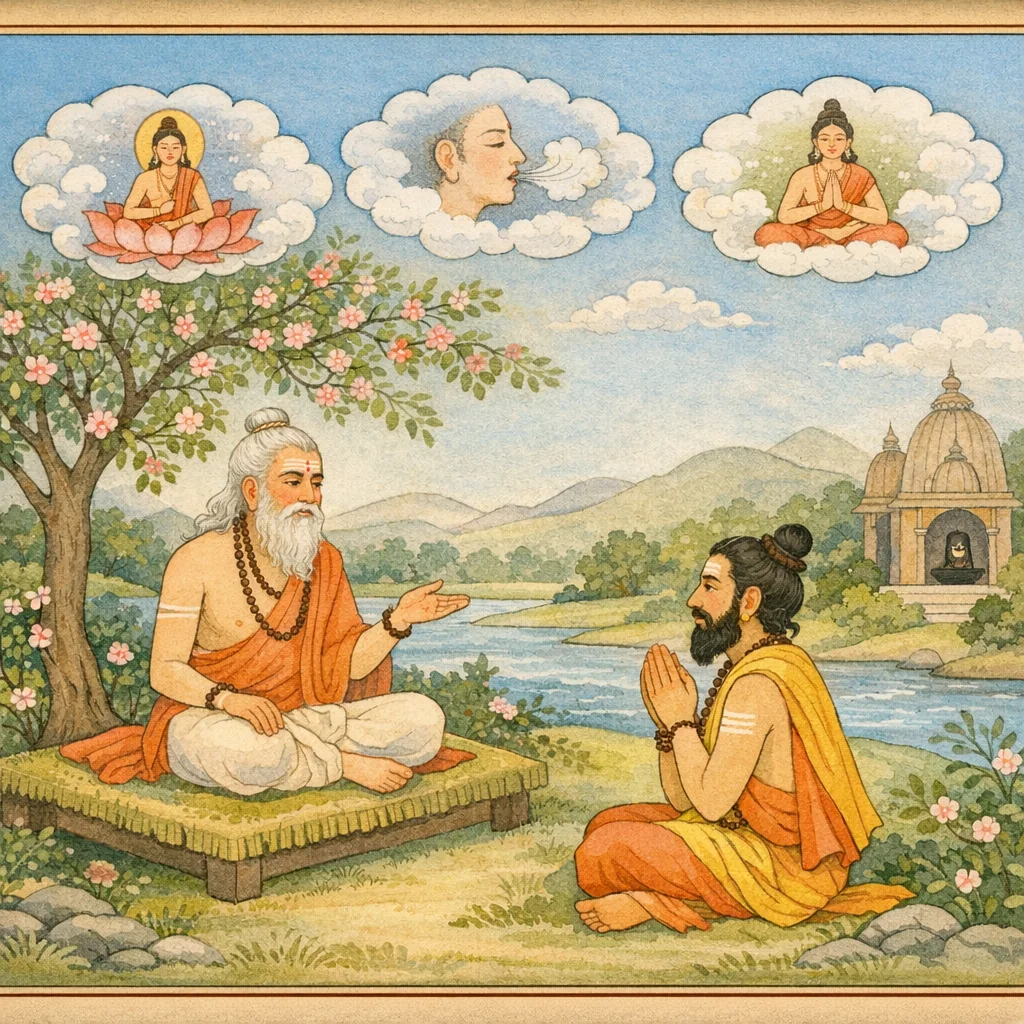
महापातकवर्णनम् (Mahāpātaka-varṇanam) — “Description of Great Sins and Their Consequences”
Adhyāya 5 unfolds as a didactic dialogue: Vyāsa asks Sanatkumāra to name the kinds of beings whose habitual sin becomes the cause (hetu) of the great hells (mahā-naraka). Sanatkumāra first classifies wrongdoing by the three instruments of action—mānasa (mind), vācika (speech), and kāyika (body)—and sets out four patterns within each, forming a compact ethical taxonomy. The chapter then turns to distinctly Shaiva offenses: hatred of Mahādeva, disparagement of teachers who impart Śiva-jñāna, and contempt for the guru and one’s ancestors. It also lists grave transgressions against sacred property and religious institutions, such as stealing deva-dravya and destroying dvija property, as harms to cosmic order and to the transmission of liberating knowledge. The inner teaching is that Shaiva liberation is not mere ritual performance, but the disciplined alignment of mind, word, and deed with reverence for Śiva, the guru, and the sanctity of dharmic resources; without this, ritual becomes spiritually inert and karmically perilous.
Shlokas
Verse 1
व्यास उवाच । ये पापनिरता जीवा महानरकहेतवः । भगवंस्तान्समाचक्ष्व ब्रह्मपुत्र नमोऽस्तु ते
Vyāsa said: “O Blessed one, describe to me those living beings who are devoted to sin and thereby become the cause of great hells. O son of Brahmā, I bow to you.”
Verse 2
सनत्कुमार उवाच । ये पापनिरता जीवा महानरकहेतवः । ते समासेन कथ्यंते सावधानतया शृणु
Sanatkumāra said: Those living beings who are devoted to sin become the cause of great hells. I shall describe them briefly—listen with attentive care.
Verse 3
परस्त्रीद्रव्यसंकल्पश्चेतसाऽनिष्टचिंतनम् । अकार्याभिनिवेशश्च चतुर्द्धा कर्म मानसम्
Mentally coveting another’s wife or another’s wealth, entertaining harmful thoughts within the mind, and being intent on what ought not be done—these four are declared to be actions of the mind.
Verse 4
अविबद्धप्रलापत्वमसत्यं चाप्रियं च यत् । परोक्षतश्च पैशुन्यं चतुर्द्धा कर्म वाचिकम्
Verbal action is fourfold: (1) incoherent and purposeless speech, (2) falsehood, (3) harsh or unpleasant words, and (4) slander spoken behind another’s back.
Verse 5
इति श्रीशिवमहापुराणे पंचम्यामुमासंहितायां महापातकवर्णनं नाम पंचमोऽध्यायः
Thus, in the Śrī Śiva Mahāpurāṇa, in the Fifth Book known as the Umāsaṃhitā, ends the Fifth Chapter, titled “The Description of the Great Sins (Mahāpātakas).”
Verse 6
इत्येतद्वा दशविधं कर्म प्रोक्तं त्रिसाधनम् । अस्य भेदान्पुनर्वक्ष्ये येषां फलमनंतकम्
Thus this tenfold religious discipline has been declared—accomplished through three means of practice. Now I shall again describe its further divisions, whose fruits are without end.
Verse 7
ये द्विषंति महादेवं संसारार्णवतारकम् । सुमहत्पातकं तेषां निरयार्णवगामिनाम्
Those who hate Mahādeva—who is the deliverer across the ocean of saṃsāra—incur a most dreadful sin; such people go to the ocean of hell (naraka).
Verse 8
ये शिवज्ञानवक्तारं निन्दंति च तपस्विनम् । गुरून्पितॄनथोन्मत्तास्ते यांति निरयार्णवम्
Those deluded people who revile the teacher who expounds the knowledge of Śiva, who also disparage an ascetic, and who insult their gurus and fathers—such persons fall into the ocean of hell.
Verse 9
शिवनिन्दा गुरोर्निन्दा शिवज्ञानस्य दूषणम् । देवद्रव्यापहरणं द्विजद्रव्यविनाशनम्
Slandering Śiva, reviling one’s guru, disparaging the knowledge of Śiva, stealing what belongs to the Devas (temple and sacred property), and destroying the property of the dvija (the twice-born)—these are grave transgressions that obstruct the Śaiva path and the rise of right devotion.
Verse 10
हरंति ये च संमूढाश्शिवज्ञानस्य पुस्तकम् । महांति पातकान्याहुरनन्तफलदानि षट्
Those deluded persons who steal away the book that imparts the knowledge of Śiva are said to incur six grievous sins—sins that yield endless consequences.
Verse 11
नाभिनन्दंति ये दृष्ट्वा शिवपूजां प्रकल्पिताम् । न नमंत्यर्चितं दृष्ट्वा शिवलिंगं स्तुवंति न
Those who, on seeing Śiva’s worship duly arranged, do not rejoice; who, on seeing the worshipped Śiva-liṅga, do not bow; and who do not offer praise—such people remain devoid of devotion and reverence toward the Lord.
Verse 12
यथेष्टचेष्टा निश्शंकास्संतिष्ठंते रमंति च । उपचारविनिर्मुक्ताश्शिवाग्रे गुरुसन्निधौ
Acting as they please and free from all fear, they remain there and rejoice—released from the formalities of worship—before Śiva, in the very presence of the Guru.
Verse 13
स्थानसंस्कारपूजां च ये न कुर्वंति पर्वसु । विधिवद्वा गुरूणां च कर्म्मयोगव्यवस्थिताः
Those who, on sacred festival days, do not perform the consecration and worship of the holy place, and who also do not duly serve the Gurus—though they claim to be established in the discipline of karma-yoga—do not follow the ordained Śaiva path of right action.
Verse 14
ये त्यजंति शिवाचारं शिवभक्तान्द्विषंति च । असंपूज्य शिवज्ञानं येऽधीयंते लिखंति च
Those who abandon Śiva’s discipline and hate Śiva’s devotees, and those who study or even copy Śiva’s sacred knowledge without first honoring it through reverent worship—such people act contrary to Śiva’s dharma.
Verse 15
अन्यायतः प्रयच्छंति शृण्वन्त्युच्चारयंति च । विक्रीडंति च लोभेन कुज्ञाननियमेन च
They dispense it (teaching or handing it out) in an unrighteous way; they listen to it and recite it too. Driven by greed, they even treat it as a plaything—bound by the disciplines of false knowledge.
Verse 16
असंस्कृतप्रदेशेषु यथेष्टं स्वापयंति च । शिवज्ञानकथाऽऽक्षेपं यः कृत्वान्यत्प्रभाषते
In uncultivated places they sleep as they please; and whoever, having interrupted the discourse on Śiva’s knowledge, goes on to speak of other matters—such a person turns away from the very path that leads the bound soul toward the Lord (Pati).
Verse 17
न ब्रवीति च यः सत्यं न प्रदानं करोति च । अशुचिर्वाऽशुचिस्थाने यः प्रवक्ति शृणोति च
One who does not speak the truth and does not practice charitable giving; who is impure, or who speaks and even listens to sacred discourse in an impure place—such a person falls away from proper Śaiva conduct and becomes unfit for higher spiritual attainment.
Verse 18
गुरुपूजामकृत्वैव यश्शास्त्रं श्रोतुमिच्छति । न करोति च शुश्रूषामाज्ञां च भक्तिभावतः
Whoever wishes to hear the sacred teaching without first worshipping the Guru—and who does not render devoted service or follow the Guru’s instructions in a spirit of bhakti—does not truly become fit for receiving the scripture’s grace.
Verse 19
नाभिनन्दंति तद्वाक्यमुत्तरं च प्रयच्छति । गुरुकर्मण्यसाध्यं यत्तदुपेक्षां करोति च
They do not approve his words, yet they still give a reply; and whatever task is hard to accomplish in the service of the Guru, that too they neglect.
Verse 20
गुरुमार्त्तमशक्तं च विदेशं प्रस्थितं तथा । वैरिभिः परिभूतं वा यस्संत्यजति पापकृत्
Whoever abandons his Guru—when the teacher is afflicted, weakened, has set out for a foreign land, or is oppressed by enemies—such a person is a doer of sin.
Verse 21
तद्भार्य्यापुत्रमित्रेषु यश्चावज्ञां करोति च । एवं सुवाचकस्यापि गुरोर्धर्मानुदर्शिनः
And whoever shows contempt toward his wife, son, and friends—likewise, whoever treats with disrespect even a well-spoken Guru who reveals the path of dharma—falls into grave fault.
Verse 22
एतानि खलु सर्वाणि कर्माणि मुनिसत्तम । सुमहत्पातकान्याहुश्शिवनिन्दासमानि च
O best of sages, all these actions are indeed declared to be exceedingly grievous sins, and they are said to be on par with reviling Lord Śiva.
Verse 23
ब्रह्मघ्नश्च सुरापश्च स्तेयी च गुरुतल्पगः । महापातकिनस्त्वेते तत्संयोगी च पंचमः
The slayer of a brāhmaṇa, the drinker of intoxicants, the thief, and the violator of the guru’s bed—these are proclaimed great sinners (mahāpātakins); and as a fifth, one who keeps company with them is also counted among them.
Verse 24
क्रोधाल्लोभाद्भयाद्द्वेषाद्ब्राह्मणस्य वधे तु यः । मर्मांतिकं महादोषमुक्त्वा स ब्रह्महा भवेत्
Whoever, driven by anger, greed, fear, or hatred, kills a brāhmaṇa—thereby committing a grievous, heart‑piercing great sin—becomes a brahmahā (a slayer of a brāhmaṇa).
Verse 25
ब्राह्मणं यः समाहूय दत्त्वा यश्चाददाति च । निर्द्दोषं दूषयेद्यस्तु स नरो ब्रह्महा भवेत्
Whoever summons a brāhmaṇa and, after giving the promised gift, takes it back; and whoever maligns a faultless brāhmaṇa—such a person becomes a brahmahā, a slayer of a brāhmaṇa.
Verse 26
यश्च विद्याभिमानेन निस्तेजयति सुद्विजम् । उदासीनं सभामध्ये ब्रह्महा स प्रकीर्तितः
He who, out of pride in his learning, humiliates a truly virtuous brāhmaṇa sitting quietly in the midst of an assembly—such a man is declared a brahmahā, guilty of the gravest sin.
Verse 27
मिथ्यागुणैर्य आत्मानं नयत्युत्कर्षतां बलात् । गुणानपि निरुद्वास्य स च वै ब्रह्महा भवेत्
Whoever, by the force of false virtues, thrusts himself into a place of superiority and even drives away the truly virtuous—he indeed becomes a brahmahā, guilty of grievous sin.
Verse 28
गवां वृषाभिभूतानां द्विजानां गुरुपूर्वकम् । यस्समाचरते विप्र तमाहुर्ब्रह्मघातकम्
O brāhmaṇa, one who violates and dishonors cows that have been mounted by a bull, and likewise violates a twice-born (dvija)—especially one’s own guru—is called a brahma-ghātaka, guilty of the gravest sin.
Verse 29
देवद्विजगवां भूमिं प्रदत्तां हरते तु यः । प्रनष्टामपि कालेन तमाहुर्ब्रह्मघातकम्
Whoever seizes land duly granted to the gods, to Brahmins, or to cows—even if, in the course of time, that grant seems lost or forgotten—is declared a perpetrator of brahmahatyā, a slayer of a Brahmin.
Verse 30
देवद्विजस्वहरणमन्यायेनार्जितं तु यत् । ब्रह्महत्यासमं ज्ञेयं पातकं नात्र संशयः
Know for certain that taking the property of the gods or of the twice-born (Brahmins) by unrighteous means is a sin equal to brahmahatyā; of this there is no doubt.
Verse 31
अधीत्य यो द्विजो वेदं ब्रह्मज्ञानं शिवात्मकम् । यदि त्यजति यो मूढः सुरापानस्य तत्समम्
If a twice-born man, having studied the Veda—whose true purport is the knowledge of Brahman and whose very essence is Śiva—then, in delusion, abandons it, that act is equal in sin to drinking liquor.
Verse 32
यत्किंचिद्धि व्रतं गृह्य नियमं यजनं तथा । संत्यागः पञ्चयज्ञानां सुरापानस्य तत्समम्
Whatever vow (vrata) one undertakes, whatever discipline (niyama) one adopts, and whatever worship or sacrificial rite (yajña) one performs—if one abandons the five daily sacrifices (pañca-yajñas), that abandonment is regarded as equivalent to drinking intoxicating liquor.
Verse 33
पितृमातृपरित्यागः कूटसाक्ष्यं द्विजानृतम् । आमिषं शिवभक्तानामभक्ष्यस्य च भक्षणम्
Abandoning one’s father and mother, bearing false witness, a Brahmin’s lying, taking meat belonging to Śiva’s devotees, and eating what is forbidden—these are grave transgressions that obstruct the path of Śiva-bhakti and bind the soul in impurity.
Verse 34
वने निरपराधानां प्राणिनां चापघातनम् । द्विजार्थं प्रक्षिपेत्साधुर्न धर्मार्थं नियोजयेत्
In the forest, a righteous person should not harm or kill blameless creatures for so-called religious merit. Even if done for the sake of a brāhmaṇa, such violence must be rejected and never appointed as a means to dharma.
Verse 35
गवां मार्गे वने ग्रामे यैश्चैवाग्निः प्रदीयते । इति पापानि घोराणि ब्रह्महत्यासमानि च
Those who set fire, or cause fire to be set, on the pathways of cattle—whether in a forest or in a village—commit dreadful sins, regarded as equal to the sin of brahmin-slaying (brahmahatyā).
Verse 36
दीनसर्वस्वहरणं नरस्त्रीगजवाजिनाम् । गोभूरजतवस्त्राणामौषधीनां रसस्य च
It is the plundering of the entire livelihood of the helpless—of men and women, elephants and horses; and likewise the seizure of cows, land, silver, garments, medicines, and even their essences.
Verse 37
चन्दनागरुकर्पूरकस्तूरीपट्टवाससाम् । विक्रयस्त्वविपत्तौ यः कृतो ज्ञानाद् द्विजातिभिः
If, in a time of no distress, the twice-born (dvija) knowingly engage in trade—selling sandalwood, agaru, camphor, musk, silk, and fine garments—such conduct is deemed improper, for it binds them further in worldly entanglement rather than turning them toward Śiva-oriented purity and liberation.
Verse 38
हस्तन्यासापहरणं रुक्मस्तेयसमं स्मृतम् । कन्यानां वरयोग्यानामदानं सदृशे वरे
To seize by force what has been placed in one’s hand as a pledged gift is declared equal to the theft of gold. Likewise, to withhold a maiden fit for marriage and not give her to a suitable, equal bridegroom is deemed a comparable wrongdoing.
Verse 39
पुत्रमित्रकलत्रेषु गमनं भगिनीषु च । कुमारीसाहसं घोरमद्यपस्त्रीनिषेवणम्
Sexual transgression—approaching the wives of one’s son or friends, or even one’s own sister—together with violating a maiden, and the dreadful habit of drinking liquor and consorting with a fallen woman: these are condemned as grave, binding sins that intensify pāśa (bondage) and obstruct the soul’s turning toward Śiva.
Verse 40
सवर्णायाश्च गमनं गुरुभार्य्यासमं स्मृतम् । महापापानि चोक्तानि शृणु त्वमुपपातकम्
Union with a woman of one’s own social order is declared to be on par with approaching the wife of one’s teacher. The great sins have been stated; now listen as I explain the subsidiary sins (upapātakas).
Frequently Asked Questions
The chapter argues that the gravest karmic failures are not only generic moral lapses but also doctrinal-relational ruptures—hatred of Mahādeva and contempt for Śiva-jñāna and the guru—because these destroy the conditions for liberation by rejecting the very source and transmission of saving knowledge.
The tri-part division encodes a Shaiva psychology of karma: intention (mānasa) seeds action, speech (vācika) externalizes and socializes intention, and bodily deed (kāyika) concretizes it in the world; purification must therefore be comprehensive, not merely ritualistic, because inner cognition can be karmically determinative even before outward action occurs.
Rather than focusing on a specific iconographic form of Umā or Śiva, the chapter foregrounds Śiva as Mahādeva—the transcendent-salvific referent of devotion and reverence—emphasizing correct orientation toward Śiva (and the teachers of Śiva-jñāna) as the decisive spiritual axis.