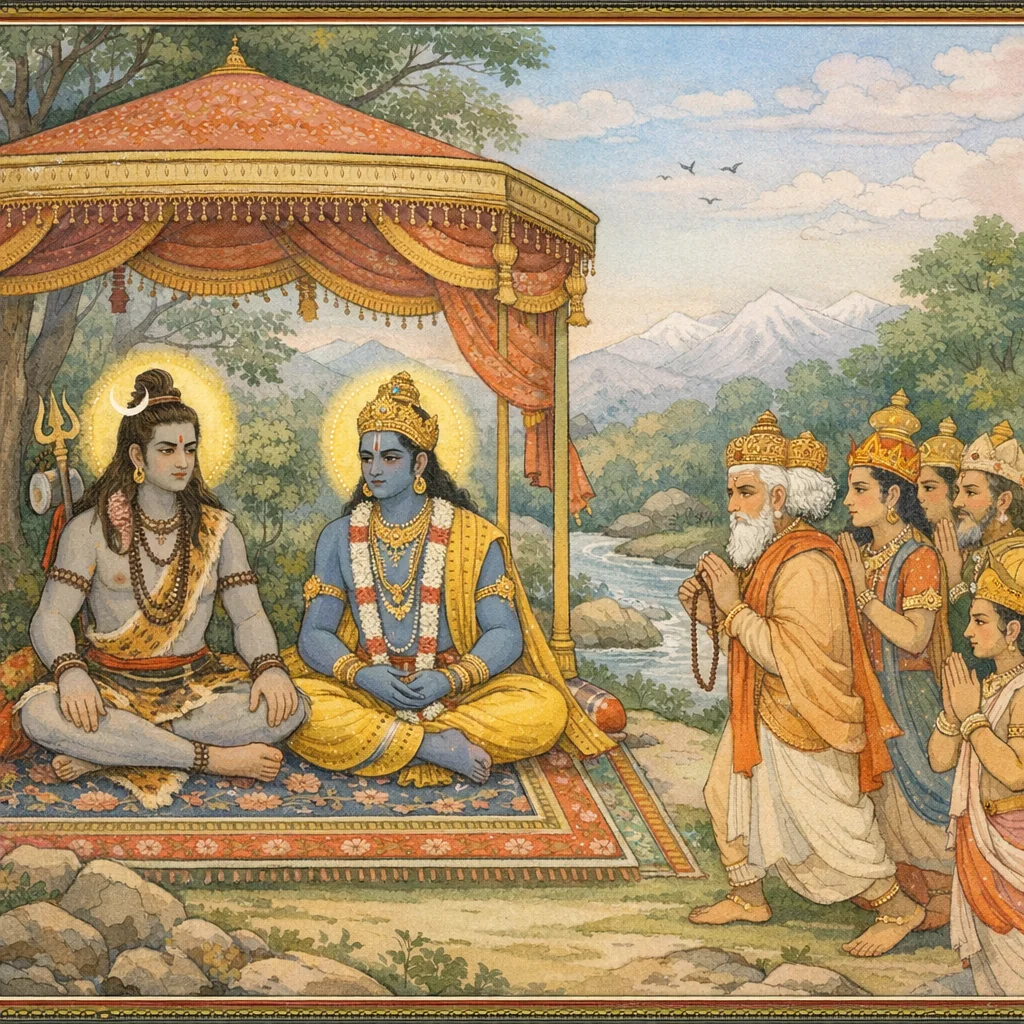
Mahiṣāsura’s Conquest of Svarga and the Devas’ Appeal to Śiva and Viṣṇu
This chapter begins with a ṛṣi recounting the daitya lineage: Raṃbhāsura begets the mighty dānava Mahiṣa. Mahiṣa defeats the devas in war, seizes sovereignty in Svarga, and takes Indra’s seat, overturning cosmic governance. Indra and many celestial functionaries, dispossessed, wander the mortal world and lament that the asura now commands and performs the duties ordained for them. Seeking the restoration of dharma, they take refuge in Brahmā, who leads them to Śaṃkara (Śiva) and Keśava (Viṣṇu). After prostrating, the devas report their defeat and beg for protection and an immediate means (vadha-upāya) to overcome Mahiṣa. Hearing their plea, Dāmodara (Viṣṇu) and Satīśvara (Śiva) blaze with intense righteous wrath, marking the turn from lament to divine counteraction. Esoterically, the chapter teaches śaraṇāgati—taking refuge and surrender—as the proper response to adharma: cosmic disorder is resolved not by force alone, but by realignment with Śiva’s supreme will, with Viṣṇu as allied cosmic power.
Shlokas
Verse 1
ऋषिरुवाच । आसीद्रंभासुरो नाम दैत्यवंशशिरोमणिः । तस्माज्जातो महातेजा महिषो नाम दानवः
The sage said: There was a demon named Rambhāsura, the crest-jewel of the Daitya race. From him was born a greatly radiant Dānava named Mahiṣa.
Verse 2
स संग्रामे सुरान्सर्वान्निर्जित्य दनुजाधिपः । चकार राज्यं स्वर्लोके महेन्द्रासनसंस्थितः
Having conquered all the gods in battle, the lord of the Dānavas established his rule in heaven itself, seated upon Indra’s royal throne.
Verse 3
पराजितास्ततो देवा ब्रह्माणं शरणं ययुः । ब्रह्मापि तान्समादाय ययौ यत्र वृषाकपी
Then, defeated, the gods sought refuge in Brahmā. Brahmā too, gathering them together, went to the place where Vṛṣa and Kapi were.
Verse 4
तत्र गत्वा सुरास्सर्वे नत्वा शंकरकेशवौ । स्ववृत्तं कथायामासुर्यथावदनुपूर्वशः
Having gone there, all the gods bowed to Śaṅkara (Śiva) and Keśava (Viṣṇu). Then, in due order and exactly as it had occurred, they narrated to them the full account of what had happened.
Verse 5
भगवन्तौ वयं सर्वे महिषेण दुरात्मना । उज्जासिताश्च स्वर्लोकान्निर्जित्य समरांगणे
O venerable Lords, all of us have been driven out from the heavenly worlds by the wicked Mahisha, who, having conquered in the battlefield, has seized dominion by force.
Verse 6
भ्रमामो मर्त्यलोकेऽस्मिन्न लभेमहि शं क्वचित् । कां कां न दुर्दशां नीता देवा इन्द्रपुरोगमाः
We wander in this mortal world and find no peace anywhere. Into what miseries have the gods—led by Indra—been driven!
Verse 7
सूर्याचन्द्रमसौ पाशी कुबेरो यम एव च । इन्द्राग्निवातगन्धर्वा विद्याधरसुचारणाः
The Sun and the Moon; Varuṇa, Lord of the noose; Kubera and Yama; Indra, Agni, and Vāyu; the Gandharvas, the Vidyādharas, and the noble Cāraṇas—all are present there, all are included.
Verse 8
एतेषामपरेषां च विधेयं कर्म सोसुरः । स्वयं करोति पापात्मा दैत्यपक्ष भयंकर
That sinful-souled Asura—terrifying to the Daitya faction—personally carries out the deeds that must be done for these and for the others as well.
Verse 9
तस्माच्छरणमापन्नान्देवान्नस्त्रातुमर्हथः । वधोपायं च तस्याशु चिन्तयेथां युवां प्रभू
Therefore, since we gods have sought refuge, you two mighty Lords should protect us. And quickly devise the means to slay him.
Verse 10
इति देववचः श्रुत्वा दामोदरसतीश्वरौ । चक्रतुः परमं कोपं रोषाघूर्णितलोचनौ
Thus hearing the words of the gods, Dāmodara and the Lord of Satī were seized by supreme wrath; their eyes rolled, whirling with anger.
Verse 11
ततोतिकोपपूर्णस्य विष्णोश्शंभोश्च वक्त्रतः । तथान्येषां च देवानां शरीरान्निर्गतं महः
Then, as Viṣṇu and Śambhu became filled with intense wrath, a great radiance burst forth from their mouths; likewise, from the bodies of the other gods as well, that blazing splendor emerged.
Verse 12
अतीव महसः पुंजं ज्वलन्तं दशदिक्षु च । अपश्यंस्त्रिदशास्सर्वे दुर्गा ध्यानपरायणाः
All the gods beheld an exceedingly radiant mass of blazing splendour spreading through the ten directions, while they remained wholly intent on meditation upon Goddess Durgā.
Verse 13
सर्वदेवशरीरोत्थं तेजस्तदतिभीषणम् । संघीभूयाभवन्नारी साक्षान्महिषमर्दिनी
That exceedingly terrifying splendor which arose from the bodies of all the gods gathered together into one mass and became a woman—the very Mahīṣamardinī in manifest form.
Verse 14
शंभुतेजस उत्पन्नं मुखमस्याः सुभास्वरम् । याम्येन बाला अभवन्वैष्णवेन च बाहवः
Her radiant, auspicious face arose from Śambhu’s divine splendor; by the southern (Yāma) power her youthful form came to be, and by the Vaiṣṇava power her arms were manifested.
Verse 15
चन्द्रमस्तेजसा तस्याः स्तनयुग्मं व्यजायत । मध्यमे न्द्रेण जंघोरू वारुणेन बभूवतुः
From the brilliance of the Moon, her pair of breasts came into being. By the power of Indra, her middle portion was formed, and by Varuṇa her shanks and thighs were produced.
Verse 16
भूतेजसा नितंबोभूद्ब्राह्मेण चरणद्वयम् । आर्केण चरणांगुल्यः करांगुल्यश्च वासवात्
By the energy of Bhūta (Śiva’s elemental power) the hips were formed; by Brahmā’s power the two feet arose; by the Sun’s power the toes were fashioned; and by the power of Vāsava (Indra) the fingers of the hands came into being.
Verse 17
कुबेरतेजसा नासा रदनाश्च प्रजापतेः । पावकीयेन नयनत्रयं सान्ध्येन भ्रूद्वयम्
Her nose was fashioned from the splendor of Kubera, and her teeth from Prajāpati. By the fiery essence of Agni she received the three eyes, and by the radiance of Sandhyā, the twilight, she received the pair of eyebrows.
Verse 18
आनिलेन श्रवोद्वन्द्वं तथान्येषां स्वरोकसाम् । तेजसां संभवः पद्मालया सा परमेश्वरी
By the agency of Ānila, the Wind, the pair of ears was formed, and likewise the other senses with their respective functions. From the principle of fire arose the Divine Śakti abiding in the lotus—she is the Supreme Goddess, Parameśvarī.
Verse 19
ततो निखिलदेवानां तेजोराशिसमुद्भवाम् । तामालोक्य सुरास्सर्वे परं हर्षं प्रपेदिरे
Then, beholding Her—arisen from the amassed radiance of all the gods—all the devas were filled with supreme joy.
Verse 20
निरायुधां च तां दृष्ट्वा ब्रह्माद्यास्त्रिदिवेश्वराः । सायुधान्तां शिवां कर्तुं मनः सन्दधिरे सुराः
Seeing that Śivā, the Divine Goddess, was without weapons, Brahmā and the other lords of the three worlds—the gods—resolved in their minds to make her armed and ready for battle.
Verse 21
ततः शूलं महेशानो महेशान्यै समर्पयत । चक्रं च कृष्णो भगवाञ्च्छंखं पाशं च पाशभृत
Then Maheshana (Lord Śiva) presented the sacred trident to Maheshānī (Pārvatī). And Bhagavān Kṛṣṇa bestowed the discus; and the bearer of the noose (Varuṇa) granted the conch (śaṅkha) and the noose (pāśa) as well.
Verse 22
शक्तिं हुताशनोऽयच्छन्मारुतश्चापमेव च । बाणपूर्णेषुधी चैव वज्रघण्टे शचीपतिः
Agni (Hutāśana) presented the śakti, the spear of power, and Vāyu (Māruta) presented the bow. Indra, lord of Śacī, gave a quiver filled with arrows, along with the vajra (thunderbolt) and a bell.
Verse 23
यमो ददौ कालदण्डमक्षमालां प्रजापतिः । ब्रह्मा कमण्डलुं प्रादाद्रोमरश्मीन्दिवाकरः
Yama bestowed the kāla-daṇḍa, the staff of Time; and Prajāpati gave the akṣa-mālā, the rosary for japa. Brahmā presented the kamaṇḍalu, the water-pot; and Divākara, the Sun, granted radiant beams like strands of hair.
Verse 24
कालः खड्गन्ददौ तस्यै फलकं च समुज्वलम् । क्षीराब्धी रुचिरं हारमजरे च तथाम्बरे
Kāla presented her with a sword and a brilliantly shining shield; and the Ocean of Milk (Kṣīrābdhi) offered a beautiful necklace, along with garments that do not decay.
Verse 25
चूडामणिं कुण्डले च कटकानि तथैव च । अर्द्धचन्द्रं च केयूरान्नूपुरौ च मनोहरो
Enchanting to behold, he was adorned with the crest-jewel (cūḍāmaṇi), earrings, and bracelets; bearing the half-moon, wearing armlets (keyūra), and also beautiful anklets (nūpura).
Verse 26
ग्रैवेयकमंगुलीषु समस्तास्वंगुलीयकम् । विश्वकर्मा च परशुं ददौ तस्यै मनोहरम्
For all her fingers he fashioned finger-rings, and he also made her a splendid necklace; and Viśvakarmā, too, bestowed upon her a beautiful axe (paraśu).
Verse 27
अस्त्राण्यनेकानि तथाभेद्यं चैव तनुच्छदम् । सुरम्यसरसां मालां पङ्कजं चाम्बुधिर्ददौ
The Ocean (the Lord of waters) bestowed many kinds of divine weapons, an impenetrable body-armour, a splendid garland of exquisite lotuses, and also a lotus-flower.
Verse 28
ददौ सिंहं च हिमवान्रत्नानि विविधानि च । सुरया पूरितं पात्रं कुबेरोऽस्यै समर्पयत्
Himavān presented a lion and many kinds of precious gems. And Kubera offered to her a vessel filled with surā (spirituous liquor).
Verse 29
शेषश्च भोगिनां नेता विचित्रर चनाञ्चितम् । ददौ तस्यै नागहारं नानास्त्रमणिगुंफितम्
Śeṣa, the foremost leader of the serpent race, presented the Goddess with a serpent-necklace, wondrously wrought and strung with gems like diverse weapons, as a reverent offering to the Divine Mother ever honored in Śiva’s sacred realm.
Verse 30
एतैश्चान्यैस्सुरैर्देवी भूषणैरायुधैस्तथा । सत्कृतोच्चैर्ननादासौ साट्टहासं पुनःपुनः
Honored by these gods and by others as well with divine ornaments and weapons, the Goddess, duly revered, roared aloud again and again, releasing a thunderous, triumphant laughter.
Verse 31
तस्या भीषणनादेन पूरिता च नभःस्थली । प्रतिशब्दो महानासीच्चुक्षुभे भुवनत्रयम्
By her terrifying roar, the whole expanse of the sky was filled; a mighty echo arose, and the three worlds were shaken.
Verse 32
चेलुः समुद्राश्चत्वारो वसुधा च चचाल ह । जयशब्दस्ततो देवैरकारि महिषार्दितैः
Then the four oceans surged, and the very earth trembled. Thereupon the gods—tormented by the Buffalo-demon—raised a mighty cry of “Victory!”
Verse 33
ततोऽम्बिकां परां शक्तिं महालक्ष्मीस्वरूपिणीम् । तुष्टुवुस्ते सुरास्सर्वे भक्तिगद्गदया गिरा
Then all the gods praised Ambikā—the Supreme Power—who manifests as Mahālakṣmī, their voices choked with devotion as they sang her glory.
Verse 34
लोकं संक्षुब्धमालोक्य देवतापरिपन्थिनः । सन्नद्धसैनिकास्ते च समुत्तस्थुरुदायुधाः
Seeing the worlds thrown into turmoil, those hostile to the gods—along with their fully armed troops—rose up at once, weapons lifted and ready for battle.
Verse 35
महिषोऽपि च तं शब्दमभ्यधावद्रुषान्वितः । स ददर्श ततो देवीं व्याप्तलोकत्रयां रुचा
Enraged, the buffalo-demon too rushed toward that sound. Then he beheld the Goddess, whose radiant splendor pervaded the three worlds.
Verse 36
एतस्मिन्नन्तरे तत्र महिषासुरपालिताः । समाजग्मुर्महावीराः कोटिशो धृतहेतयः
Meanwhile, at that very place, mighty heroes—maintained and commanded by Mahiṣāsura—arrived in crores, bearing their weapons in readiness.
Verse 37
चिक्षुरश्चामरोदग्रौ करालोद्धतबाष्कलाः । ताम्रोग्रास्योग्रवीर्याश्च बिडालोऽन्धक एव च
“(Among them were) Cikṣura, and also Āmara and Udagra; Karāla, Uddhata, and Bāṣkala; Tāmra, Ugrāsya, and Ugravīrya; as well as Biḍāla and Andhaka.”
Verse 38
दुर्धरो दुर्मुखश्चैव त्रिनेत्रश्च महाहनुः । एते चान्ये च बहवः शूरा युद्धविशा रदाः
“Durdhara, Durmukha, Trinetra, and Mahāhanu—these and many others besides—were mighty heroes, thoroughly skilled and seasoned in the arts of war.”
Verse 39
युयुधुः समरे देव्या सह शस्त्रास्त्रपारगाः । इत्थं कालो व्यतीयाय युध्यतोर्भीषणस्तयोः
Skilled in weapons and missiles, they fought on the battlefield together with the Goddess. Thus, as those two were locked in that dreadful combat, time passed on.
Verse 40
अरिवर्गकरक्षिप्ता नानाशस्त्रास्त्रराशयः । महामायाप्रभावेण विफला अभवन् क्षणात्
The heaps of diverse weapons and missiles hurled from the hands of the enemy host became futile in an instant, overwhelmed by the power of the Great Māyā.
Verse 41
ततो जघान सा देवी चिक्षुरप्रमुखानरीन् । सगणान्गदया बाणैः शूलशक्तिपरश्वधैः
Then that Goddess struck down the hostile warriors—Cikṣura and the rest—together with their troops, using her mace, arrows, trident, spear, and axe.
Verse 42
एवं स्वीयेषु सैन्येषु हतेषु महिषासुरः । देवीनिःश्वाससंभूतान्भावयामास तान्गणान्
Thus, when his own troops had been slain, Mahiṣāsura rallied and heartened those bands that had arisen from the Goddess’s very breath.
Verse 43
अताडयत्सरैः काश्चित्काश्चिच्छृङ्गद्वयेन च । लांगूलेन च तुण्डेन भिनत्ति स्म मुहुर्मुहुः
He struck some with arrows, and others with his pair of horns; and again and again he kept smashing them with his tail and with his beak (snout/mouth).
Verse 44
इत्थं देवीगणा न्हत्वाभ्यधावत्सोऽसुराधिपः । सिंहं मारयितुन्देव्यास्ततोऽसौ कुपिताऽभवत्
Thus, after slaying the bands of the Goddess, the lord of the asuras rushed forward. Intending to kill the Goddess’s lion, he then became enraged.
Verse 45
कोपात्सोपि महावीर्यः खुरकुट्टितभूतलः । शृङ्गाभ्यां शैलमुत्पाट्य चिक्षेप प्रणनाद च
Then, in anger, that mighty and exceedingly powerful one scraped and tore up the surface of the earth with his hooves; and, wrenching up a mountain with his two horns, he hurled it away and roared aloud.
Verse 46
इति श्रीशिवमहापुराणे पञ्चम्यामुमासंहितायां महिषासुरवधोपाख्याने महालक्ष्म्यवतारवर्णनं नाम षट्चत्वारिंशोऽध्यायः
Thus, in the Śrī Śiva Mahāpurāṇa—within the Fifth Book, the Umāsaṃhitā—ends the forty-sixth chapter, called “The Description of the Descent of Mahālakṣmī,” in the subsidiary narrative concerning the slaying of Mahiṣāsura.
Verse 47
शृंगभिन्नाः पयोवाहाः खण्डं खण्डमयासिषुः । लांगूलेनाहतश्चाब्धिर्विष्वगुद्वेलमस्पदत्
The streams of milk, split by the horns, were shattered into fragments. And the ocean too, struck by the tail, surged up on every side, rising beyond its bounds.
Verse 48
एवं क्रुद्धं समालोक्य महिषासुरमम्बिका । विदधे तद्वधोपायं देवानामभयंकरी
Seeing Mahishāsura thus aflame with wrath, Ambikā—the Divine Mother who grants fearlessness to the gods—devised the means for his destruction.
Verse 49
ततः पाशं समुत्थाय क्षिप्त्वा तस्योपरी श्वरी । बबन्ध महिषं सोऽपि रूपन्तत्याज माहिषम्
Then the Divine Goddess rose, lifted her noose (pāśa), and cast it over him. She bound the buffalo-demon, and he too abandoned his buffalo-form.
Verse 50
ततः सिंहो बभूवाशु मायावी तच्छिरोम्बिका । यावद्भिनत्ति तावत्स खङ्गपाणिर्बभूव ह
Then, by the power of māyā, he instantly became a lion, and Ambikā struck at its head. Yet as long as she kept shattering it, he—sword in hand—continued to manifest anew.
Verse 51
सचर्म्मासिकरं तं च देवी बाणैरताडयत् । ततो गजवपुर्भूत्वा सिंहं चिच्छेद शुण्डया
The Goddess struck that lion—fierce and hide-clad—with her arrows. Then, taking on the form of an elephant, she tore the lion apart with her trunk.
Verse 52
ततोऽस्य च करं देवी चकर्त स्वमहासिना । अधारि च पुना रूपं स्वकीयं तेन रक्षसा
Then the Goddess severed his hand with her mighty sword; and that rākṣasa thereupon resumed his own original form again.
Verse 53
तदैव क्षोभयामास त्रैलोक्यं सचराचरम् । ततः क्रुद्धा महामाया चण्डिका मानविक्रमा
At that very moment she shook the three worlds—everything moving and unmoving. Then the Great Māyā, Caṇḍikā, whose might surpasses that of mortals, became wrathful.
Verse 54
पपौ पुनःपुनः पानं जहासोद्भ्रान्तलोचना । जगर्ज चासुरः सोऽपि बलवीर्यमदो द्धतः
Again and again he drank the intoxicating draught; his eyes rolled in delusion and he burst into loud laughter. That asura too roared, swollen with the pride of strength and valor, and became violently arrogant.
Verse 55
तस्या उपरि चिक्षेप शैलानुत्पाट्य सोऽसुरः । सा च बाणावलीघातैश्चूर्णयामास सत्वरम्
Uprooting mountains, that asura hurled them down upon her. But she, striking with a swift shower of arrows, quickly crushed them to dust.
Verse 56
वारुणीमद्रसं जातमुखरागाऽऽकुलेन्द्रिया । प्रोवाच परमेशानी मेघगंभीरया गिरा
Having drunk the intoxicating liquor called Vāruṇī, her face flushed and her senses stirred, the Supreme Goddess (Pārvatī) spoke in a voice deep as thunderclouds.
Verse 57
देव्युवाच । रे मूढ रे हतप्रज्ञ व्यर्थ किं कुरुषे हठम् । न मदग्रेऽसुराः केपि स्थास्नवो जगतीत्रये
The Goddess said: “O deluded one, O one whose understanding is ruined—why do you persist in this futile obstinacy? Before me, no asura at all will be able to stand anywhere in the three worlds.”
Verse 58
ऋषि रुवाच । एकमाभाष्य कूर्दित्वा देवी सर्वकलामयी । पदाक्रम्यासुरं कण्ठे शूलेनोग्रेण साऽभिनत्
The sage said: Having addressed him with a single utterance and then leaping forth, the Goddess—who embodies all divine powers and arts—pressed the demon down beneath her foot and struck him in the throat with her fierce trident, piercing him through.
Verse 59
ततस्तच्चरणाक्रान्तस्स स्वकीयमुखात्ततः । अर्द्धनिष्क्रान्त एवासीद्देव्या वीर्येण संवृतः
Then, being pressed down by Her foot, he was forced back into his own mouth. He remained only half-emerged, held in check and enclosed by the Goddess’s power.
Verse 60
अर्द्धनिष्क्रान्त एवासौ युध्यमानो महाधमः । महासिना शिरो भित्त्वा न्यपाति धरणीतले
Even as that vile wretch was only half-emerged, still struggling in battle, his head was split with a great sword, and he fell down upon the surface of the earth.
Verse 61
हाहाशब्दं समुच्चार्य्यावाङ्मुखास्तद्गणास्ततः । पलायन्त रणाद्भीतास्त्राहित्राहीति वादिनः
Crying out “Hā! Hā!” those followers then turned their faces downward and, terrified of the battle, fled the field, repeatedly shouting, “Save us! Save us!”
Verse 62
तुष्टुवुश्च तदा देवीमिन्द्राद्याः सकलाः सुराः । गन्धर्वा गीतमुच्चेरुर्ननृतुर्नर्तकीजनाः
Then all the gods—Indra and the rest—praised the Goddess. The Gandharvas lifted up songs of celebration, and the celestial dancing maidens performed their sacred dance.
Verse 63
एवन्ते कथितो राजन्महालक्ष्म्याः समुद्भवः । सरस्वत्यास्तथोत्पत्तिं शृणु सुस्थेन चेतसा
Thus, O King, the origin of Mahālakṣmī has been told to you. Now listen as well—with a steady and composed mind—to the account of the birth of Sarasvatī.
Frequently Asked Questions
It presents Mahiṣāsura’s rise and conquest: after defeating the devas and occupying Indra’s seat in Svarga, the devas seek Brahmā’s help and collectively petition Śiva and Viṣṇu for protection and a means to slay (vadha-upāya) the asura.
Śaraṇāgati is portrayed as a metaphysical re-alignment: when delegated cosmic powers fail, the devas return to the supreme source. The narrative teaches that order is restored by re-anchoring authority in Śiva (with Viṣṇu as cooperative power), not merely by political or martial force.
The chapter foregrounds Śiva as Śaṃkara and Satīśvara (the Lord associated with Satī/Śakti) and Viṣṇu as Keśava/Dāmodara; Gaurī/Umā is not yet the narrative focus in the sampled verses, but the Śiva–Śakti frame is signaled through the epithet Satīśvara.