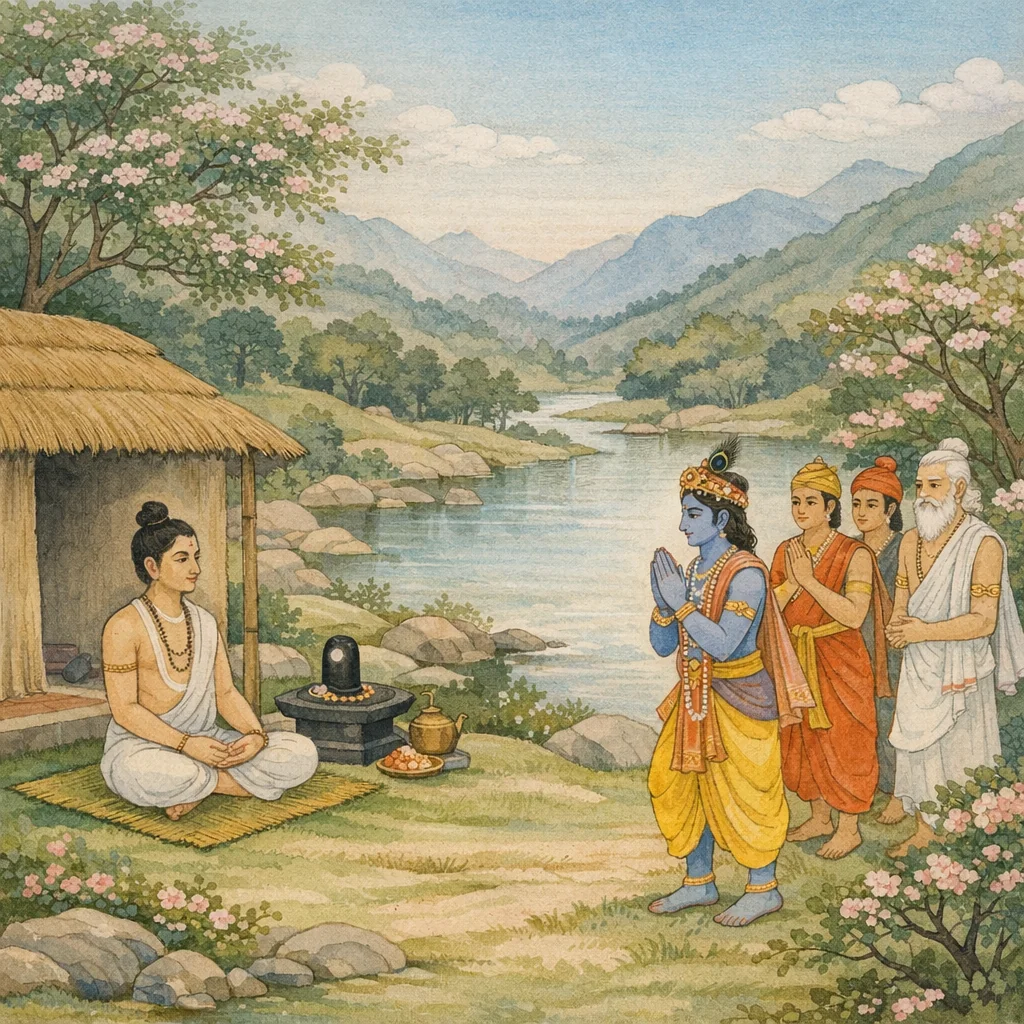
Kṛṣṇādi-Śivabhaktoddhāraṇa & Śiva-māhātmya-varṇana (Deliverance of Krishna and other devotees; Description of Shiva’s Greatness)
Adhyāya 3 unfolds as a dialogue transmitting Śiva-centered devotion and its promised fruits. Sanatkumāra describes a scene of instruction and wonder (vismaya) around the sage Upamanyu, whose tranquil mind (śānta-mānasa) shows attained steadiness. Vāsudeva (Kṛṣṇa) praises the worthy devotee, for Śiva—the devādideva—grants intimate nearness (sānnidhya) to those who strive. Upamanyu assures Vāsudeva that by Mahādeva’s grace Śiva’s darśana will come soon, and that boons will be bestowed within a stated limit, explicitly sixteen months. The central discipline is japa of the mantra-rāja “Namaḥ Śivāya,” said to be sarva-kāma-prada and to grant both bhukti and mukti. The narrative is exemplary and practical: through repeatable japa one gains darśana, blessings, and a powerful son, and in absorption in Śiva-kathā the days pass like a moment, showing the transforming power of sacred remembrance.
Shlokas
Verse 1
सनत्कुमार उवाच । एतच्छ्रुत्वा वचस्तस्य सोब्रवीत्तं महामुनिम् । विस्मयं परमं गत्वोपमन्युं शांतमानसम्
Sanatkumāra said: Hearing those words, he, overcome with the greatest wonder, spoke to that great sage Upamanyu—whose mind was serene and composed.
Verse 2
वासुदेव उवाच । धन्यस्त्वमसि विप्रेन्द्र कस्त्वां स्तोतुमलं कृती । यस्य देवादिदेवस्ते सान्निध्यं कुरुते श्रमे
Vāsudeva said: “Blessed are you, O best of brāhmaṇas. Who among the truly accomplished is fit enough to praise you—since for you the God of gods Himself grants His immediate presence, even amid toil and hardship?”
Verse 3
दर्शनं मुनिशार्दूल दद्यात्स भगवाञ्छिवः । अपि तावन्ममाप्येवं प्रसादं वा करोत्वसौ
O tiger among sages, may the Blessed Lord Śiva grant me His divine vision; at least, let Him bestow such grace upon me as well.
Verse 4
उपमन्युरुवाच । अचिरेणैव कालेन महादेवं न संशयः । तस्यैव कृपया त्वं वै द्रक्ष्यसे पुरुषोत्तम
Upamanyu said: “In a very short time you shall behold Mahādeva—of this there is no doubt. By His grace alone, O supreme person, you will surely see Him.”
Verse 5
षोडशे मासि सुवरान् प्राप्स्यसि त्वं महेश्वरात् । सपत्नीकात्कथं नो दास्यते देवो वरान्हरे
“In the sixteenth month you will obtain excellent boons from Maheśvara. O Hari, how could the Lord not grant boons to one who is devoted along with his consort?”
Verse 6
पूज्योसि दैवतैस्सर्वैः श्लाघनीयस्सदा गुणैः । जाप्यं तेऽहं प्रवक्ष्यामि श्रद्दधानाय चाच्युत
You are worthy of worship by all the Devas, and ever praiseworthy for your virtues. To you—faithful and steadfast, O Acyuta—I shall now declare the mantra to be repeated in japa.
Verse 7
तेन जपप्रभावेण सत्यं द्रक्ष्यसि शंकरम् । आत्मतुल्यबलं पुत्रं लभिष्यसि महेश्वरात्
By the power of that mantra-japa, you will truly behold Śaṅkara; and from Maheśvara you will obtain a son whose strength is equal to your own.
Verse 8
जपो नमश्शिवायेति मंत्रराजमिमं हरे । सर्वकामप्रदं दिव्यं भुक्तिमुक्तिप्रदायकम्
O Hari, repeat this king of mantras—“Namaḥ Śivāya.” It is divine, fulfills all worthy desires, and bestows both worldly enjoyment and final liberation.
Verse 9
सनत्कुमार उवाच । एवं कथयतस्तस्य महादेवाश्रिताः कथाः । दिनान्यष्टौ प्रयातानि मुहूर्तमिव तापस
Sanatkumāra said: As he spoke thus, narrating accounts centered on Mahādeva, eight days passed for that ascetic as though they were but a single moment.
Verse 10
नवमे तु दिने प्राप्ते मुनिना स च दीक्षितः । मंत्रमध्यापितं शार्वमाथर्वशिरसं महत्
When the ninth day arrived, the sage duly initiated him; and he was instructed in the sacred Śaiva mantra—the great Atharvaśiras teaching that reveals Lord Śarva (Śiva).
Verse 11
जटी मुण्डी च सद्योऽसौ बभूव सुसमाहितः । पादांगुष्ठोद्धृततनुस्तेपे चोर्द्ध्वभुजस्तथा
At once he became an ascetic with matted locks, his head shaven, and entered deep composure. Raising his body supported on the big toe, he performed austerity; likewise, with arms lifted upward, he continued his penance.
Verse 12
संप्राप्ते षोडशे मासि संतुष्टः परमेश्वरः । पार्वत्या सहितश्शंभुर्ददौ कृष्णाय दर्शनम्
When the sixteenth month arrived, the Supreme Lord Parameśvara, being pleased, Śambhu—together with Pārvatī—granted Kṛṣṇa His divine vision (darśana).
Verse 13
पार्वत्या सहितं देवं त्रिनेत्रं चन्द्रशेखरम् । ब्रह्माद्यैस्स्तूयमानं तु पूजितं सिद्धकोटिभिः
They beheld the Lord together with Pārvatī—three-eyed, the moon-crested Candraśekhara—praised by Brahmā and the other gods, and worshipped by crores of Siddhas.
Verse 14
दिव्यमाल्याम्बरधरं भक्तिनम्रैस्सुरासुरैः । प्रणतं च विशेषेण नानाभूषणभूषितम्
He was clad in divine garlands and heavenly garments, and the devas and asuras—humbled by devotion—bowed to Him. In a special manner He was reverently worshipped, adorned with many kinds of ornaments.
Verse 15
सर्वाश्चर्यमयं कांतं महेशमजमव्ययम् । नानागणान्वितं तुष्टं पुत्राभ्यां संयुतं प्रभुम्
She beheld the Beloved Lord—Mahēśa—unborn and imperishable, the very embodiment of all wonder; attended by hosts of diverse gaṇas, serene and pleased, and united with His two sons, that sovereign Master.
Verse 16
श्रीकृष्णः प्रांजलिर्दृष्ट्वा विस्मयोत्फुल्ललोचनः । ईदृशं शंकरं प्रीतः प्रणनाम महोत्सवः
Beholding Śaṅkara in such a wondrous form, Śrī Kṛṣṇa—hands joined in reverence, eyes widened with astonishment—was filled with joy and bowed down, as though a great sacred festival had arisen within his heart.
Verse 17
नानाविधैः स्तुतिपदैर्वाङ्मयेनार्चयत्तदा । सहस्रनाम्ना देवेशं तुष्टाव नतकंधरः
Then, with many kinds of hymn-verses—worship offered through sacred speech—he adored the Lord of the gods; and, bowing his head in humility, he praised Deveśa (Śiva) by reciting the Thousand Names.
Verse 18
ततो देवास्सगंधर्वा विद्याधरमहोरगाः । मुमुचुः पुष्पवृष्टिं च साधुवादान्मनोनुगान्
Then the devas—together with the Gandharvas, the Vidyādharas, and the great serpents—showered flowers and cried from the heart, “Well done! Well done!”, in joyful approval.
Verse 19
पार्वत्याश्च मुखं दृष्ट्वा भगवान्भक्तवत्सलः । उवाच केशवं तुष्टो रुद्रश्चाथ बिडौजसा
Seeing the face of Pārvatī, the Blessed Lord—ever affectionate to His devotees—was pleased; then Rudra, of mighty splendor, spoke to Keśava.
Verse 20
श्रीमहादेव उवाच । कृष्णं जानामि भक्तं त्वां मयि नित्यं दृढव्रतम् । वृणीष्व त्वं वरान्मत्तः पुण्यांस्त्रैलोक्यदुर्लभान्
Śrī Mahādeva said: “O Kṛṣṇa, I know you to be My devotee, ever steadfast in vow toward Me. Therefore choose boons from Me—holy gifts that are difficult to obtain even in the three worlds.”
Verse 21
सनत्कुमार उवाच । तस्य तद्वचनं श्रुत्वा कृष्णः प्रांजलिरादरात् । प्राह सर्वेश्वरं शम्भुं सुप्रणम्य पुनः पुनः
Sanatkumāra said: Hearing those words, Kṛṣṇa—joining his palms with reverence—addressed Śambhu, the Lord of all, after bowing down again and again.
Verse 22
कृष्ण उवाच । देवदेव महादेव याचेऽहं ह्युत्तमान्वरान् । त्वत्तोऽष्टप्रमितान्नाथ त्वयोद्दिष्टान्महेश्वर
Kṛṣṇa said: “O God of gods, O Mahādeva, I truly beg of You the most excellent boons—eight in number, O Lord—those very ones You Yourself have indicated, O Maheśvara.”
Verse 23
तव धर्म्मे मतिर्नित्यं यशश्चाप्रचलं महत् । त्वत्सामीप्यं स्थिरा भक्तिस्त्वयि नित्यं ममास्त्विति
“May my mind remain ever established in your dharma; may my great fame be unwavering. May I abide in your constant nearness, and may steadfast devotion to you ever remain in me.”
Verse 24
पुत्राणि च दशाद्यानां पुत्राणां मम संतु वै । वध्याश्च रिपवस्सर्वे संग्रामे बलदर्पिताः
“May I indeed have sons—ten and more. And may all the enemies, swollen with the pride of their strength, be slain in battle.”
Verse 25
अपमानो भवेन्नैव क्वचिन्मे शत्रुतः प्रभो । योगिनामपि सर्वेषां भवेयमतिवल्लभः
O Lord, may I never suffer dishonor anywhere because of enemies; rather, may I become exceedingly dear even to all the yogins.
Verse 26
इत्यष्टौ सुवरान्देहि देवदेव नमोऽस्तु ते । सर्वेश्वरस्त्वमेवासि मत्प्रभुश्च विशेषतः
“Thus, O God of gods, please grant me these eight excellent boons. Salutations to You. You alone are the Lord of all; and, in particular, You are my own Master.”
Verse 27
सनत्कुमार उवाच । तस्य तद्वचनं श्रुत्वा तमाह भगवान्भवः । सर्वं भविष्यतीत्येवं पुनस्स प्राह शूलधृक्
Sanatkumāra said: Hearing his words, the Blessed Lord Bhava (Śiva) addressed him. The Trident-bearer spoke again: “Thus indeed, all shall come to pass.”
Verse 28
साम्बो नाम महावीर्यः पुत्रस्ते भविता बली । घोरसंवर्तकादित्यश्शप्तो मुनिभिरेव च
“A son named Sāmba—of great valor and mighty strength—will be born to you. He will also be cursed by the sages to become like the terrible Saṃvartaka Sun, blazing with destructive intensity.”
Verse 29
मानुषो भवितासीति स ते पुत्रो भवि ष्यति । यद्यच्च प्रार्थितं किंचित्तत्सर्वं च लभस्व वै
“He shall be born as a human; he will become your son. And whatever you have prayed for—even the slightest thing—may you indeed obtain all of it.”
Verse 30
सनत्कुमार उवाच । एवं लब्ध्वा वरान्सर्वाञ्छ्रीकृष्णः परमेश्वरात् । नानाविधाभिर्बह्वीभिस्स्तुतिभिस्समतोषयत्
Sanatkumāra said: Thus, having obtained all the boons from the Supreme Lord (Parameśvara), Śrī Kṛṣṇa satisfied Him with many abundant hymns of praise, of various kinds.
Verse 31
तमाहाथ शिवा तुष्टा पार्वती भक्तवत्सला । वासुदेवं महात्मानं शंभुभक्तं तपस्विनम्
Then Śivā—Pārvatī, pleased and ever affectionate to her devotees—spoke to the great-souled Vāsudeva, a devoted worshipper of Śambhu and a steadfast ascetic.
Verse 32
पार्वत्युवाच । वासुदेव महाबुद्धे कृष्ण तुष्टास्मि तेऽनघ । गृहाण मत्तश्च वरान्मनोज्ञान्भुवि दुर्लभान्
Pārvatī said: “O Vāsudeva, O Kṛṣṇa of great intellect, O sinless one—I am pleased with you. Accept from me these boons, delightful to the heart and rarely obtained in the world.”
Verse 33
सनत्कुमार उवाच । इत्याकर्ण्य वचस्तस्याः पार्वत्यास्स यदूद्वहः । उवाच सुप्रसन्नात्मा भक्तियुक्तेन चेतसा
Sanatkumāra said: Having thus heard Pārvatī’s words, the noble scion of the Yadu line replied—his inner being serene, and his mind joined to devotion.
Verse 34
श्रीकृष्ण उवाच । देवि त्वं परितुष्टासि चेद्ददासि वरान्हि मे । तपसाऽनेन सत्येन ब्राह्मणान्प्रति मास्मभूत्
Śrī Kṛṣṇa said: “O Goddess, if you are pleased and truly grant boons to me, then by this very austerity and by this truth, let there never arise in me any disrespect or ill-will toward the brāhmaṇas.”
Verse 35
द्वेषः कदाचिद्भद्रं पूजयेयं द्विजान्सदा । तुष्टौ च मातापितरौ भवेतां मम सर्वदा
May I never harbor hatred at any time. May I always worship the noble and the twice-born (dvija). And may my mother and father ever remain pleased with me.
Verse 36
सर्वभूतेष्वानुकूल्यं भजेयं यत्र तत्रगः । कुले प्रभृति रुचिता ममास्तु तव दर्शनात्
May I cultivate friendliness toward all beings, moving freely wherever I may be. From this day onward, by the grace of beholding you, let my heart find delight in my own family and lineage.
Verse 37
तर्पयेयं सुरेन्द्रादीन्देवान् यज्ञशतेन तु । यतीनामतिथीनां च सहस्राण्यथ सर्वदा
I would gratify the gods—beginning with Indra—by a hundred sacrificial rites (yajña); and I would also continually satisfy thousands of ascetics (yati) and honored guests.
Verse 38
भोजयेयं सदा गेहे श्रद्धापूतं तु भोजनम् । बांधवैस्सह प्रीतिस्तु नित्यमस्तु सुनिर्वृतिः
May I always, in my home, offer food sanctified by faith; and may there ever be affection with my kinsfolk, with lasting contentment and deep peace.
Verse 39
देवि भार्य्यासहस्राणां भवेयं प्राणवल्लभः । अक्षीणा काम्यता तासु प्रसादात्तव शांकरि
O Goddess, may I become the life-beloved of thousands of wives; and by your grace, O Śāṅkarī, may my power of desire toward them never be diminished.
Verse 40
आसां च पितरो लोके भवेयुः सत्यावादिनः । इत्याद्याः सुवरास्संतु प्रसादात्तव पार्वति
And may the fathers (ancestors) of these women in the world be truth-speakers. By your grace, O Pārvatī, may they and the rest be endowed with a good voice and noble speech.
Verse 41
सनत्कुमार उवाच । तस्य तद्वचनं श्रुत्वा देवी तं चाह विस्मिता । एवमस्त्विति भद्रं ते शाश्वती सर्वकामदा
Sanatkumāra said: Hearing his words, the Goddess, astonished, spoke to him: “So be it. Blessings be upon you—may it be everlasting and the fulfiller of all desired aims.”
Verse 42
तस्मिंस्तांश्च वरान्दत्त्वा पार्वतीपरमेश्वरौ । तत्रैवांतश्च दधतुः कृत्वा कृष्णस्य सत्कृपाम्
Having granted him those boons there, Pārvatī and Parameśvara then remained in that very place, inwardly composed—having thus shown their true and gracious favor to Kṛṣṇa.
Verse 43
कृष्णः कृतार्थमात्मानममन्यत मुनीश्वरः । उपमन्योर्मुनराशु प्रापाश्रममनुत्तमम्
Thus Kṛṣṇa—the lord among sages—deemed himself fulfilled. Swiftly he reached the unsurpassed hermitage of the sage Upamanyu.
Verse 44
प्रणम्य शिरसा तत्र तं मुनिं केशिहा ततः । तया वृत्तं च तस्मै तत्समाचष्टोपमन्यवे
Then Keśihā bowed there with his head to that sage, and he narrated to Upamanyu the entire account of what had occurred through her.
Verse 45
स च तं प्राह कोऽन्यस्स्याच्छर्वाद्देवाज्जनार्द्दन । महादानपतिर्लोके क्रोधे वाऽतीव दुस्सहः
And he said to him: “O Janārdana, who else could there be apart from Śarva, the Divine? In this world He is the supreme lord of great gifts; and when roused to wrath, He is exceedingly unbearable (to withstand).”
Verse 46
ज्ञाने तपसि वा शौर्य्ये स्थैर्य्ये वा पद एव च । शृणु शंभोस्तु गोविन्द देवैश्वर्य्यं महायशाः
Whether in knowledge, in austerity, in valor, in steadfastness, or in the attainment of rank itself—listen, O Govinda of great renown, to the divine sovereignty of Śambhu (Lord Śiva).
Verse 47
तच्छ्रुत्वा श्रद्धया युक्तोऽभवच्छंभोस्तु भक्तिमान् । पप्रच्छ शिवमाहात्म्यं स तं प्राह मुनीश्वरः
Hearing that, he became filled with faith and became a devoted worshipper of Śambhu. He then asked about the glory of Lord Śiva; and the lordly sage spoke to him in reply.
Verse 48
उपमन्युरुवाच । भगवाञ्शंकरः पूर्वं ब्रह्मलोके महात्मना । स्तुतो नामसहस्रेण दण्डिना ब्रह्मयोगिना
Upamanyu said: Formerly, in Brahmaloka, the Blessed Lord Śaṅkara was praised by the great-souled sage Daṇḍin, knower of Brahman and yogin, through a thousand divine Names.
Verse 49
सांख्याः पठंति तद्गीतं विस्तीर्णं च निघंटवत् । दुर्ज्ञानं मानुषाणां तु स्तोत्रं तत्सर्वकामदम्
The followers of Sāṅkhya recite that teaching as a “song”, expansive like a lexicon. Yet for ordinary human beings it is hard to comprehend; still, that hymn grants the fulfillment of all aims.
Verse 50
स्मरन्नित्यं शंकरं त्वं गच्छ कृष्ण गृहं सुखी । भविष्यसि सदा तात शिवभक्तगणाग्रणीः
“Always remembering Śaṅkara, go, O Kṛṣṇa, to your home in peace. You will ever be, dear child, the foremost leader among the devotees of Śiva.”
Verse 51
इत्युक्तस्तं नमस्कृत्य वासुदेवो मुनीश्वरम् । मनसा संस्मरञ्शंभुं केशवो द्वारकां ययौ
Thus addressed, Vāsudeva bowed to that lord of sages; and Keśava, inwardly remembering Śambhu (Lord Śiva) in his mind, departed for Dvārakā.
Verse 52
सनत्कुमार उवाच । एवं कृष्णस्समाराध्य शंकरं लोकशंकरम् । कृतार्थोऽभून्मुनिश्रेष्ठ सर्वाजेयोऽभवत्तथा
Sanatkumāra said: “Thus, O best of sages, Kṛṣṇa, having duly worshipped Śaṅkara—the benefactor of the worlds—became fulfilled in his purpose; and likewise he became unconquerable by all.”
Verse 53
तथा दाशरथी रामश्शिवमाराध्य भक्तितः । कृतार्थोऽभून्मुनिश्रेष्ठ विजयी सर्वतोऽभवत्
So too, O best of sages, Rāma—the son of Daśaratha—devoutly propitiated Lord Śiva; his purpose was fulfilled, and he became victorious on every side.
Verse 54
तपस्तप्त्वाऽतिविपुलं पुरा रामो गिरौ मुने । शिवाद्धनुश्शरं चापं ज्ञानं वै परमुत्तमम्
O sage, long ago Rāma performed exceedingly great austerities upon the mountain; and from Śiva he obtained the bow and arrows, and also the supreme, unsurpassed knowledge.
Verse 55
रावणं सगणं हत्वा सेतुं बद्ध्वांभसांनिधौ । सीतां प्राप्य गृहं यातो बुभुजे निखिलां महीम्
Having slain Rāvaṇa along with his host, and having built the bridge at the edge of the ocean, he regained Sītā, returned home, and then ruled and enjoyed the entire earth in righteousness.
Verse 56
तथा च भार्गवो रामो ह्याराध्य तपसा विभुम् । निरीक्ष्य दुःखितश्शर्वात्पितरं क्षत्रियैर्हतम्
In the same way, Bhārgava Rāma (Paraśurāma), having worshipped the all-pervading Lord through austerity, beheld—grief-stricken—that his father had been slain by the Kṣatriyas, by the will and ordinance of Śarva (Lord Śiva).
Verse 57
तीक्ष्णं स परशुं लेभे निर्ददाह च तेन तान् । त्रिस्सप्तकृत्वः क्षत्रांश्च प्रसन्नात्परमेश्वरात्
From the gracious Supreme Lord (Parameśvara), he obtained a razor-sharp axe; and with it he destroyed those Kṣatriyas, repeating the deed twenty-one times, by the Lord’s favor.
Verse 58
अजेयश्चामरश्चैव सोऽद्यापि तपसांनिधिः । लिंगार्चनरतो नित्यं दृश्यते सिद्धचारणैः
Ajeya and Amara—he who, even to this day, is a treasury of austerity—ever remains devoted to the worship of the Śiva-liṅga, and is beheld by the Siddhas and the Cāraṇas.
Verse 59
महेन्द्रपर्वते रामः स्थितस्तपसि तिष्ठति । कल्पांते पुनरेवासावृषिस्थानमवाप्स्यति
Rāma remains upon Mount Mahendra, steadfastly abiding in austerity. At the end of the kalpa, he will again attain the state and station of a ṛṣi (sage).
Verse 60
असितस्यानुजः पूर्वं पीडया कृतवांस्तपः । मूलग्राहेण विश्वस्य देवलो नाम तापसः
Formerly, the younger brother of Asita—an ascetic named Devala—performed austerities, driven by affliction, seeking to grasp the very root-cause of the universe.
Verse 61
पुरन्दरेण शप्तस्तु तपस्वी यश्च सुस्थिरम् । अधर्म्यं धर्ममल मल्लिंगमारध्य कामदम्
That steadfast ascetic—though cursed by Purandara (Indra)—worshipped the wish-bestowing Liṅga. By that worship, what was unrighteous was cleansed into dharma, and the taint of wrongdoing was removed.
Verse 62
चाक्षुषस्य मनोः पुत्रो मृगोऽभूत्तु मरुस्थले । वसिष्ठशापाद्गृत्समदो दण्डकारण्य एकलः
By the curse of Vasiṣṭha, Gṛtsamāda—son of Cākṣuṣa Manu—became a deer in a desert region, dwelling alone in the Daṇḍaka forest.
Verse 63
हृदये संस्मन्भक्त्या प्रवणेन युतं शिवम् । तस्मान्मृत्युमुखाकारो गणो मृगमुखोऽभवत्
Remembering Śiva within his heart with humble, devoted surrender, that gaṇa—who had borne a terrifying visage like the very mouth of Death—became one with the face of a deer.
Verse 64
अजरामरतां नीतस्तीर्त्वा शापं पुनश्च सः । शंकरेण कृतः प्रीत्या नित्यं लम्बोदरानुगः
Having crossed beyond the curse, he was led to a state free from old age and death. Then, out of loving grace, Śaṅkara made him forever a devoted attendant of Lambodara (Gaṇeśa).
Verse 65
गार्ग्याय प्रददौ शर्वो मोक्षं च भुवि दुर्लभम् । कामचारी महाक्षेत्रं कालज्ञानं महर्द्धिमत्
To Gārgya, Śarva (Lord Śiva) granted even mokṣa—so rare to attain in this world—along with the boon of moving at will, access to a great sacred field of pilgrimage, knowledge of Time (kāla), and lofty, magnificent spiritual prosperity.
Verse 66
चतुष्पादं सरस्वत्याः पारंगत्वं च शाश्वतम् । न तुल्यं च सहस्रं तु पुत्राणां प्रददौ शिवः
Śiva bestowed upon them the fourfold perfection of Sarasvatī—everlasting mastery and consummate excellence—and, moreover, He granted a thousand sons, unequalled by any comparison.
Verse 67
वेदव्यासं तु योगीन्द्रं पुत्रं तुष्टः पिनाक धृक् । पराशराय च ददौ जरामृत्युविवर्जितम्
Pleased, the bearer of the Pināka (Lord Śiva) granted his son, the supreme yogin Vedavyāsa; and he also bestowed upon Parāśara a state free from old age and death.
Verse 68
मांडव्यश्शंकरणैव जीवं दत्त्वा विसर्जितः । वर्षाणां दश लक्षाणि शूलाग्रा दवरोपितः
Māṇḍavya, granted life by Śaṅkara Himself, was set free. Yet for ten lakh years he remained fixed upon the tip of the trident, bearing the fruit of his bond, until the Lord’s grace prevailed.
Verse 69
दरिद्रो ब्राह्मणः कश्चिन्निक्षिप्य गुरुवेश्मनि । पुत्रं तु गालवं यश्च पूर्वमासीद्गृहाश्रमी
There was a certain poor brāhmaṇa who entrusted his son to the house of his guru. Formerly he had lived the life of a householder, and that son was named Gālava.
Verse 70
गुप्तो वा मुनिशालायां भिक्षुरायाति तद्गृहम् । भार्य्यामुवाच यः कश्चिदवश्यं निर्धनो यतः
Whether he came secretly from a sage’s hermitage or arrived at that house as a mendicant—whoever he was—he said to his wife: “Surely he is poor; that is why he has come.”
Verse 71
स तु वाच्यो भवत्या च न दृश्यंत इति प्रियः । अतिथेरागतस्यापि किं दास्यामि गृहे वसन्
Beloved, you too should tell him: “He is not to be seen.” For even if a guest has arrived, if I remain in the house with nothing at hand, what can I give him?
Verse 72
कदाचिदतिथिः कश्चित्क्षुत्तृषाक्षामतर्षितः । तामुवाच स भर्ता ते क्व गतश्चेति तं च सा
Once, a certain guest arrived, worn out by hunger and thirst. Then her husband said to her, “Where have you gone?”—and she, in turn, replied to him.
Verse 73
प्राह भर्ता मदीयस्तु सांप्रतं न च दृश्यते । स ऋषिस्तामुवाचेदं ज्ञात्वा दिव्येन चक्षुषा
She said, “My husband cannot be seen at present.” Then the sage, having understood the matter with his divine sight, spoke to her thus.
Verse 74
गृहस्थितः प्रतिच्छन्नस्तत्रैव स मृतो द्विजः । विश्वामित्रस्यनुज्ञातस्तत्पुत्रो गालवस्तथा
Remaining concealed within the house, that Brahmin died there itself. With Viśvāmitra’s permission, his son—Gālava—then proceeded accordingly.
Verse 75
गृहमागत्य मातुस्स श्रुत्वा शापं सुदारुणम् । आराध्य शंकरं देवं पूजां कृत्वा तु शांभवीम्
Having returned home, he heard from his mother of that exceedingly dreadful curse. Thereupon, he propitiated Lord Śaṅkara, the Divine, and performed the Śāmbhavī worship—devoted adoration offered in reverence to Shiva’s auspicious power.
Verse 76
गृहादसौ विनिष्क्रांतस्संस्मरञ्शंकरं हृदा । अथ तं तनयं दृष्ट्वा पिता तं प्राह साञ्जलिम्
He came out of the house, remembering Śaṅkara within his heart. Then, seeing his son, the father addressed him with folded hands.
Verse 77
महादेवप्रसादाच्च कृतकृत्योऽस्मि कृत्यतः । धनवान्पुत्रवांश्चैव मृतोऽहं जीवितः पुनः
By the grace of Mahādeva, I have become fulfilled in all that ought to be done. I am endowed with wealth and sons; though I was as good as dead, I have been restored to life again.
Verse 78
इति वः कथितमशेषं नाहं शक्तः समासतो व्यासात् । वक्तुं शंभोश्च गुणाञ्शेषस्यापि न मुखानि स्युः
Thus I have told you all that can be told. Yet I am not able—whether in brief or in full—to describe completely the virtues and glory of Śambhu. Even Śeṣa himself would not have mouths enough to speak them all.
Frequently Asked Questions
The chapter advances a grace-based Shaiva argument: Vāsudeva seeks Śiva’s favor, and Upamanyu authoritatively guarantees Śiva-darśana and boons, grounding the claim in a practical means—pañcākṣarī japa—thereby converting theology into a replicable sādhanā.
“Darśana” functions as epistemic confirmation (experiential proof) of Śiva-tattva; “prasāda” encodes the doctrine that ultimate fruition is granted rather than mechanically produced; and “Namaḥ Śivāya” as mantra-rāja symbolizes a compressed total practice—renunciation (namaḥ), devotion, and identity-orientation toward Śiva.
Śiva is emphasized in functional epithets—Mahādeva/Śaṅkara/Devādideva—highlighting supremacy, beneficence, and accessibility to devotees through mantra-japa; Gaurī/Umā is not foregrounded in the sampled verses but remains the theological frame of the Umāsaṃhitā’s Śiva-with-Śakti orientation.